Wholesale Makeup Bags: Bulk Sourcing Strategy for Retailers and Distributors
Executive Summary
Wholesale makeup bags are bought through one of two routes, and the question a retailer or distributor is really asking is which route fits the volume, the calendar and the margin. The answer turns on what the buyer needs to own. A stock programme supplies an existing, proven specification at volume, with the buyer selecting design, colourway, brand elements and pack; a made-to-order programme develops the bag to a written brief, so the buyer owns pattern, materials and construction. On programmes coordinated through QUANZHOU JUNYUAN BAGS the frame is identical either way: MOQ 500 pieces per style and colourway, sampling 6-10 working days, bulk production 35-50 days after sample approval, inspection at AQL 2.5.
What separates a profitable programme from a marginal one is rarely the unit price quoted. It is how that price behaves across the 500, 1,000, 5,000 and 10,000 piece breakpoints, how much fixed development content must be amortised across run one, and how much cost arrives afterwards as tooling, freight, duty and inspection. Comparing two quotations on unit price alone means comparing the smallest line on a longer statement.
The rest of the decision is logistical and financial: how many units fit a carton, how many cartons fill a container, whether run two matches run one in shade and hand-feel, and how much cash is committed before the goods reach a shelf. This guide covers the route decision, volume tiering, landed-cost build-up, carton pack-out, colour continuity and the working-capital planning a wholesale buyer must finish before the first purchase order is raised.
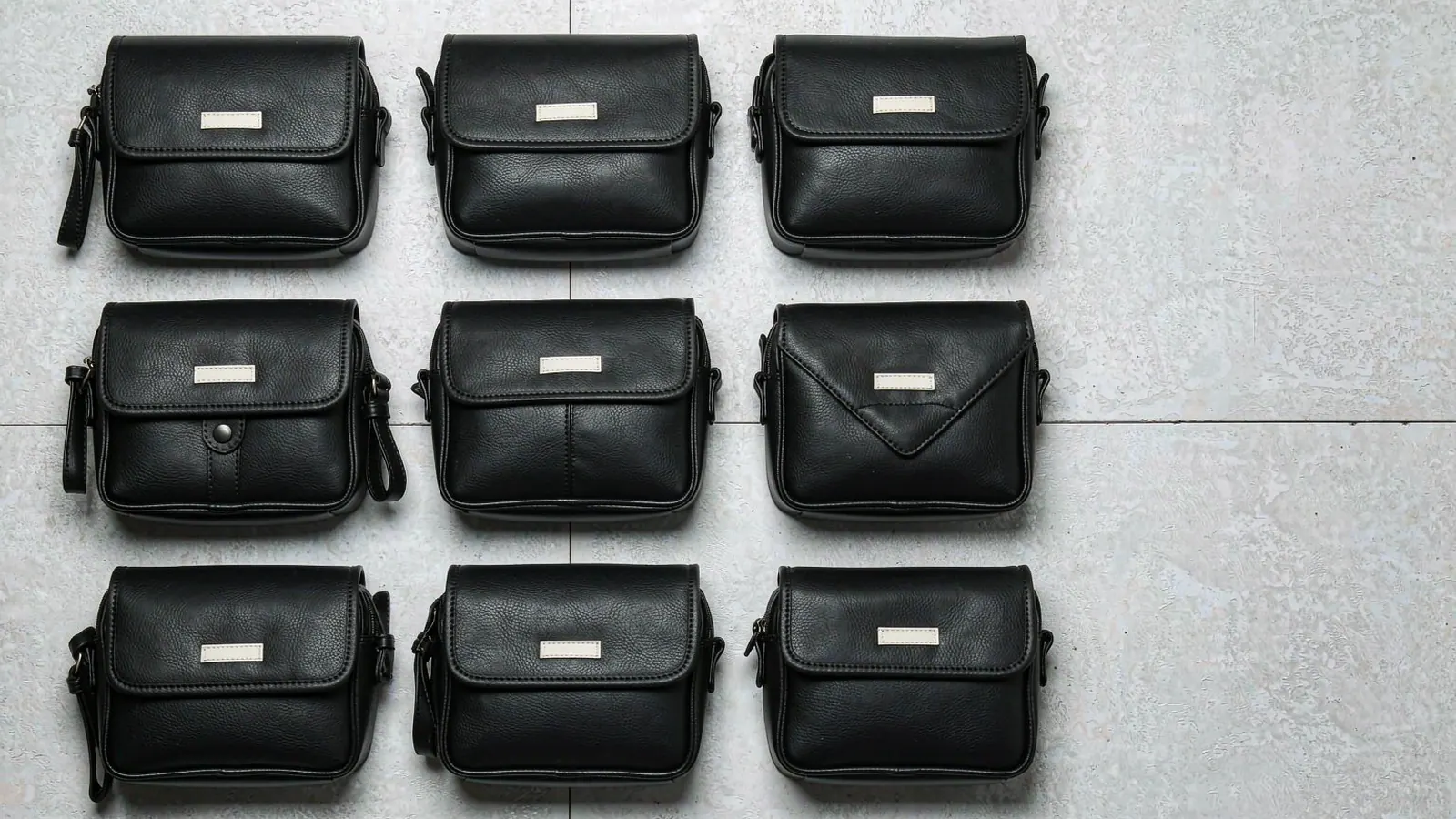
Stock Programmes vs Made-to-Order Programmes: The Routing Decision
A wholesale buyer entering the category is not choosing a product so much as choosing a route, and the route determines almost every downstream number. Under a stock programme the specification already exists: the pattern is cut and proven, the shell fabric, lining, interlining and hardware are already sourced, and the decoration method is already set up. The buyer's decisions therefore sit in a narrow band — which base design, which colourway, which brand elements, which retail pack, how many. Under a made-to-order programme the specification is developed against a written brief the buyer supplies, and pattern geometry, material selection from the mill upwards, hardware sourcing and structural proofing all become live work items. The two routes produce the same physical object; they differ entirely in who owns the decisions and who carries the fixed cost.
| Decision factor | Stock programme | Made-to-order programme | What the buyer trades away |
|---|---|---|---|
| Specification ownership | Existing pattern and materials, selected by the buyer from a defined range | Buyer's written specification; pattern, materials and hardware developed to brief | Stock gives up exclusivity; made-to-order gives up calendar and absorbs development cost |
| Minimum quantity | 500 pcs per style and colourway | 500 pcs per style and colourway | Neither route lowers the 500-piece floor, so assortment breadth is what consumes volume |
| Sampling window | 6-10 working days to confirm an existing build with the chosen brand elements | 6-10 working days, extending to 12-15 working days for complex constructions | Made-to-order absorbs more calendar before bulk can be scheduled |
| Bulk window | 35-50 days after sample approval | 35-50 days after sample approval, plus any mill or hardware lead time behind it | Made-to-order needs an earlier purchase order for the same on-shelf date |
| Fixed cost content | Low; tooling and screens are generally already amortised | Pattern development, screens or dies, hardware sourcing and proofing | Made-to-order must amortise fixed content across run one or bill it separately |
| Colour control | Shade taken from what is held; substitutions are a real risk on reorders | Shade matched to a reference lab dip, with a signed standard and tolerance | Stock accepts availability; made-to-order accepts a longer approval loop |
| Best fit | Promotional volume, retail own-brand basics, fast replenishment cycles | Exclusive assortments, structural differentiation, brand-owned design | Choosing made-to-order for a commodity item buys differentiation nobody pays for |
The table should be read as a contract rather than a catalogue. Each row is a decision the buyer makes and then has to evidence, not a service that arrives by default. A programme coordinator can propose a 600D polyester shell with a PU coating and quote it, but if the buyer never states what that coating must withstand, the quotation rests on an assumption and the sample passes by luck or fails on a criterion nobody wrote down. Where a specification cites a standard, cite it completely: coated fabric behaviour is commonly assessed under methods such as ASTM D751 for coated fabrics, and a wholesale buyer who names the method names the acceptance criterion too.
- Route follows ownership — buy stock when the buyer needs volume, price and repeatability; buy made-to-order when the buyer needs a specification nobody else can list.
- The 500-piece floor is per style and per colourway — a three-colourway launch is a 1,500-piece commitment, not a 500-piece one.
- Development content is fixed cost — pattern, screens, dies and hardware sourcing do not scale with volume and must be amortised deliberately.
- Calendar is asymmetric — stock reaches shelf sooner; made-to-order must be back-planned from material lead time, not just from the 35-50 day bulk window.
- Specification is evidence — every decision the buyer makes should exist as a written line that bulk can be measured against.
- Exclusivity has a price — if the assortment is not differentiated, made-to-order buys development cost with no margin to show for it.
Most wholesale assortments are mixed, and the mixed programme is where discipline matters. A distributor might run a stock hang of flat pouches and basic standing bags that replenishes every quarter, while carrying one or two made-to-order pieces that give the range a reason to exist on the shelf. The risk is administrative rather than technical: the two routes run on different clocks, with different approval gates and reorder rules, and a buyer managing them on one spreadsheet tends to raise the made-to-order reorder at stock-programme timing and miss the season. Separate calendars and separate reorder triggers are the cheapest control available.
Search demand supports the mixed view rather than contradicting it. Category interest is concentrated in generic, high-volume terms rather than in custom ones: ASINSIGHT data for 2026.07 records roughly 74,810 weekly Amazon searches for toiletry bag and around 110,000 monthly searches for travel bag for toiletries, while make up bags for women draws about 80,000 monthly searches and custom makeup bag only about 5,400-6,600 monthly. Those are search-demand figures, not revenue or market size, but the shape is useful: the volume sits in standard product bought at standard specification, and the custom end of the category is a narrow, deliberate slice. A wholesale buyer sizing a first programme should read that shape before committing to development content.
Before requesting any quotation, state in writing which route applies, how many colourways are in scope, and whether the pattern is owned by the buyer or selected from an existing range. Those three lines determine the sampling window, the fixed-cost content and the reorder rule, and every later price question is answerable only once they are fixed.
Volume Tiering Economics: Reading the 500 / 1,000 / 5,000 / 10,000 Breakpoints
Unit price falls as quantity rises, but it does not fall smoothly and it does not fall for one reason only. Three separate mechanisms sit behind the tiering, and a wholesale buyer who can name them can predict where the price will move and argue for it. The first is fixed-cost dilution: pattern development, screens, dies, moulds and hardware sourcing cost the same whether the run is 500 pieces or 10,000, so their per-unit contribution collapses as volume rises. The second is material buying: at small quantities fabric is bought at spot from stock, while at larger quantities it is ordered from the mill in a single lot at a better price and, critically, from a single dye lot. The third is line economics: longer runs reduce changeover, setup and the proportion of start-up waste.
| Order band | What typically moves in the quotation | Fixed cost carried per unit (illustrative) | Planning implication |
|---|---|---|---|
| 500 pcs | Base tier; fabric bought at spot, no dye-lot leverage, tooling not yet amortised | Highest of the four bands — the full fixed content is carried by the smallest denominator | Use as a specification-validation tier; do not set annual margin from it |
| 1,000 pcs | Fabric lot consolidation; screens and dies amortised across double the units | Roughly half the 500-piece figure, all else equal | First band where a promotional retail price usually clears |
| 5,000 pcs | Mill-ordered fabric, negotiated trim pricing, dedicated scheduling on the line | A small fraction of the 500-piece figure; unit price becomes mostly material-driven | Where the second decimal of unit price becomes worth negotiating |
| 10,000 pcs | Full material buy, printed packaging to order, possible split shipments | Near negligible per unit; freight, duty and handling dominate the total | Requires a demand forecast and a working-capital plan, not just an order |
The arithmetic is easier to see in a worked placeholder. Assume, purely for planning, a made-to-order programme carrying 1,200 USD of fixed content — pattern development, one logo screen or die, hardware sourcing and proofing — and a variable unit cost of 3.40 USD on a mid-weight polyester pouch at 500 pieces. These figures are illustrative placeholders for the arithmetic and are not a quotation. Fixed content adds 2.40 USD per unit across 500 pieces, 1.20 across 1,000, 0.24 across 5,000 and 0.12 across 10,000. The variable portion does not fall at the same rate, because fabric, labour and trims are consumed per unit regardless of run length, so the total per-unit curve flattens rather than collapsing. The planning lesson is that the steepest part of the curve sits below 1,000 pieces, and the expensive mistake is treating a 500-piece price as representative of the programme.
Any price arithmetic used for planning should carry its assumptions in the same sentence: material, construction, decoration method, quantity, Incoterm and whether tooling is amortised or billed separately. An unlabelled figure has a way of becoming a quotation in the next meeting, and that is how budgets get set on numbers nobody offered.
The second planning question is where to place the first order, and the answer is rarely the top band or the bottom band. A first run at 500 pieces is a specification test: it validates that the sample can be reproduced at scale, that the pack survives transit and that the retail price holds, at the worst unit cost in the programme. A first run at 10,000 pieces buys the best unit cost in the programme before any of those things is known. The usual compromise is to place run one at the 1,000-piece band where the promotional price already clears, hold the specification fixed, and let the 5,000 or 10,000 tier be earned by the reorder. That path costs a little margin on run one and removes most of the downside.
- 500 pcs — validation tier; highest fixed-cost burden per unit; use to de-risk the specification rather than to set the year's margin.
- 1,000 pcs — first commercially workable tier for most promotional programmes; fixed content roughly halves per unit.
- 5,000 pcs — unit price becomes material-driven rather than overhead-driven; worth negotiating trim and packaging separately.
- 10,000 pcs — fixed content nearly disappears per unit; freight, duty and working capital become the binding constraints.
- Never mix tiers across colourways — splitting 10,000 pieces into ten shades buys ten 1,000-piece prices, not one 10,000-piece price.
- Reorder is where the tier is earned — the discount on run two is only real if the specification has not moved.
The colourway trap deserves its own line because it is the most common error in wholesale planning: tiering applies to a style and colourway, not to an order total. A buyer ordering 5,000 pieces across five shades has placed five 1,000-piece orders, with five fabric minimums, five print setups and five inventory positions, and will be quoted accordingly. Where the assortment needs breadth, the honest comparison is a narrow deep range against a broad shallow one, judged on sell-through and working capital rather than unit price. Distributors running broad ranges accept the higher unit cost deliberately and price the breadth into the retail ticket.

Landed Cost Build-Up: Unit Price Is the First Line, Not the Total
A wholesale buyer does not buy at unit price but at landed cost: every charge required to move goods from the production floor to the distribution centre, divided by the number of sellable units that arrive. Unit price is usually the largest line and almost always the most negotiable, which is why it dominates attention and distorts decisions. The remaining lines are smaller individually and add up to a material share of the total, and several are decided by the buyer's own choices rather than by the quotation — how the carton is packed, whether the shipment consolidates, which Incoterm applies, and whether inspection is booked before production starts.
| Cost component | Quoted by | What drives it | Control lever available to the buyer |
|---|---|---|---|
| Unit price, FOB Xiamen | The programme coordinator, against a frozen written specification | Material, construction, decoration method, order quantity | Freeze the specification before quoting; any change after quote resets the price |
| Tooling, moulds, screens, dies | Billed as a one-off line or amortised into unit price | Number of print colours, moulded parts, custom hardware | Ask explicitly whether tooling is amortised or billed; it changes the reorder price |
| Sampling and courier | Billed per sample round | Number of rounds, sample quantity, destination | Consolidate all reviewers' feedback into one round rather than three |
| Freight, ocean or air | The forwarder, on chargeable volume or weight | Carton cube, gross weight, mode, season and surcharges | Carton pack-out, consolidation and mode selection; see the cube section |
| Marine insurance | Broker or forwarder | Declared value, mode, route | Decide deliberately and state the coverage in the purchase order |
| Customs duty and taxes | A licensed customs broker for the importer of record | Tariff classification of the finished bag and its country of origin | Supply a complete written product description early so classification can be confirmed before shipment |
| Pre-shipment inspection | Third-party agency or the programme's own QC function | AQL level, man-days, whether inline and final are both booked | Set AQL 2.5 under ISO 2859-1 in the purchase order, not after production finishes |
| Destination handling and drayage | The 3PL or the buyer's own distribution centre | Pallet pattern, labelling, appointment scheduling, dwell time | Specify pallet pattern, carton markings and labelling before the goods ship |
Two components in that table are routinely underestimated: tooling and inspection. Tooling can be presented in two ways, and the two produce different behaviour on reorders. Where tooling is amortised into unit price, run one looks expensive and later runs look cheap; where it is billed separately, run one looks cheap and the buyer carries a capital line to recover. Neither is wrong, but a buyer comparing two quotations must confirm which basis each uses. Inspection is underestimated differently: it is a small share of order value and a large share of downside avoided. Inspection at AQL 2.5 under ISO 2859-1 is the acceptance standard normally applied before release, and it belongs in the purchase order as a condition, not as an afterthought.
Duty payable on a shipment of cosmetic bags is set by how the finished goods are classified in the destination tariff and by the country of origin as declared and substantiated on entry. Classification turns on the complete product description — what the shell is made of, how the bag is constructed, what function it performs — and the same article can reasonably be described in more than one way. No duty percentage, tariff line number or HS code should be taken from a quotation, a marketplace listing or a sourcing article as fact. The determination belongs to the importer of record and to a licensed customs broker or the importer's own compliance function, working from the tariff in force on the date of entry. The buyer's practical action is to hand over a complete written product description early so classification is confirmed before the goods ship, and to carry duty as an open line in the budget until it is confirmed in writing.
Compliance cost belongs in the same build-up rather than in a separate file that nobody reads at budget time. A bag entering the EU market carries obligations under chemical legislation such as EU REACH, and a bag sold to children in the US market sits inside the CPSIA framework. Those obligations are met through material selection and testing, and testing is booked and paid for like any other line. Where a buyer wants a recycled-content claim on the hangtag or the listing, a chain-of-custody standard such as the Global Recycled Standard requires documented traceability, which adds material cost and administrative work. None of this is optional at the point of import, and all of it is cheaper when it is specified before the first sample than after the first shipment.
- Freeze the specification before requesting a price; a change to material, dimensions or decoration after the quote is a new quotation, not a clarification.
- Confirm the tooling basis — amortised into unit price or billed separately — before comparing two quotations.
- Book inspection in the purchase order at AQL 2.5 under ISO 2859-1, and state who pays for a re-inspection if the first one fails.
- Treat duty as an open line until a licensed broker confirms classification against the full product description.
- Budget compliance testing as a line item; late material selection is the expensive path.
- Request the freight quote on actual carton dimensions, not on an assumed pack-out.
The discipline that ties the build-up together is to express every line per sellable unit rather than per order. A 40 USD carton-level charge sounds trivial and is 0.16 USD per unit at 250 units per carton, which is a real number on a 3-4 USD item. Buyers who convert everything to a per-unit basis choose differently from those who compare unit prices, because a moulded case and a flat pouch behave very differently on freight once they share a denominator. That conversion is the whole point of landed-cost accounting.
Carton Pack-Out and Cube Efficiency: Freight Is Charged on Volume
Freight is one of the few cost lines a wholesale buyer genuinely controls, and it is controlled at the drawing board rather than at the booking. Ocean less-than-container-load freight is charged on the greater of chargeable volume and gross weight under the industry weight-or-measure convention, and the basis applying to a given lane should be confirmed with the forwarder; for lightweight textile goods, volume almost always governs. That means the cube of a packed carton, and the number of units in it, is a product-design decision with a freight consequence. A bag that ships flat costs a fraction of the freight of a bag that ships rigid, even when both weigh the same and cost the same to make.
| Pack configuration | Carton size L x W x H (cm) | Units per carton | Cartons per 20ft (illustrative) | Cube risk |
|---|---|---|---|---|
| Flat cosmetic pouch, packed flat, 25 per inner polybag | 60 x 40 x 35 | 250 | Roughly 330-350 | Low: compressible, fills the container efficiently |
| Standing pouch with a structured base, nested | 55 x 45 x 40 | 120 | Roughly 285-300 | Moderate: base inserts resist nesting and create void space |
| Hanging toiletry bag with hook, folded flat | 50 x 40 x 30 | 100 | Roughly 470-490 | Moderate: hook position dictates how tightly the bag folds |
| Moulded EVA vanity case, rigid, individually protected | 65 x 45 x 45 | 40 | Roughly 215-230 | High: the product ships air as well as material |
| Brush roll with filled interior, rolled and banded | 60 x 40 x 30 | 150 | Roughly 470-490 | Low to moderate: roll diameter sets the pack-out |
Read across the table and one number dominates: at illustrative pack-outs, a container of flat pouches carries several times the unit count of a container of moulded cases, so the freight element of landed cost per unit differs by an order of magnitude between them. The figures above are planning placeholders derived from nominal carton dimensions and typical container loading efficiency; actual carton sizes, unit counts and container utilisation must be confirmed against the production pack-out before freight is booked. The planning use of the table is comparative rather than absolute: it tells a buyer which constructions are freight-fragile before the assortment is committed. A moulded case can still be the right product, but it has to carry a retail price that absorbs shipping air.
- Flat ships cheapest — a compressible flat pouch is the most cube-efficient construction in the category.
- Rigid ships air — any moulded or framed case pays freight on volume it cannot compress, and the retail price has to absorb it.
- Nesting is design work — base inserts, hooks and handles should be positioned so units nest; a 2 cm improvement in fold height is a container-level saving.
- Confirm pack-out before booking — freight quoted on an assumed carton is a placeholder; re-quote once the production pack is confirmed.
- Consolidate where the calendar allows — one full container usually beats several part shipments on both freight and handling.
- Convert freight to per-unit — only the per-unit figure is comparable across constructions.
Carton specification is a separate document from the product specification and deserves its own line in the brief. It should state carton dimensions in centimetres, carton grade and bursting strength, units per inner polybag, units per carton, gross and net weight, carton markings and bar code placement, and whether the carton is Master-packed or inner-boxed for retail. It should also state the pallet pattern — cartons per layer, layers per pallet, pallet height — because destination handling and warehouse slotting are priced on pallets rather than cartons. A buyer who specifies the pallet pattern gets predictable DC receiving costs; a buyer who leaves it to the warehouse discovers the cost in a handling invoice weeks later.
Two carton decisions drive most downstream warehouse cost. The first is whether the carton is a shipper or a shelf-ready pack: shelf-ready cartons reduce store labour and increase cube, and the trade-off should be decided by the retail channel rather than by default. The second is drop-testing: a carton that is cost-optimised on paper and fails in transit produces damage claims that dwarf the freight saved. Where an assortment includes travel toiletry pieces sized around the TSA 3-1-1 liquids rule, the product dimensions are constrained by that rule anyway, so the pack-out should be designed around the finished folded dimension rather than the flat one. Both decisions belong in the brief before the first production run, because changing a carton after the pack-out is approved changes the freight quote, the pallet pattern and the warehouse slotting at once.

Reorder Discipline and Colour Continuity Across Repeat Runs
Wholesale programmes are reordered, and the second run is where margin is actually made. Run one carries sampling cost, amortised tooling, the learning curve and usually an air-freight premium; run two carries none of that and should be the profitable one. The reason many programmes never reach that state is continuity failure: run two arrives in a slightly different shade, with a substituted lining, a different plating on the zip puller or a marginally different hand-feel, and the retail buyer either rejects it or accepts it at a discount. Continuity is not luck. It is the result of a retained physical standard and a written specification that names materials precisely enough that a substitution cannot be made silently.
| Continuity risk | Typical cause | Control the buyer can specify | Evidence to keep for the next run |
|---|---|---|---|
| Shell fabric shade drift | Fabric re-dyed from a reference description rather than matched to the retained standard | A signed shade standard with a stated tolerance and a lab dip approval per run | Retained reference swatch, lab dip record, approval signature and date |
| Print colour shift | Ink batch, mesh count or curing condition changed between runs | Named print standard, screen mesh count and curing condition | Approved print proof plus one retained production print from run one |
| Lining substitution | Original lining discontinued and replaced with an equivalent at the same price | Named lining with weight in g/m² and finish, substitution only on written approval | Mill specification sheet and the written substitution approval |
| Hardware finish variation | Plating bath or zipper tape batch changed | Named hardware finish, zipper type and puller reference number | Approved hardware card with reference numbers and supplier lot |
| Dimension creep | Pattern re-cut or seam allowance adjusted to improve cutting yield | Dimensions in cm with a stated plus/minus tolerance | Signed dimension sheet and one retained production sample |
| Hand-feel change | Interlining or foam laminate substituted for a cheaper equivalent | Named interlining weight and lamination method | Construction sheet from the approved sample, photographed against the new run |
Colour deserves the most attention because it is the attribute a retail shopper notices and the one most sensitive to lot changes. Shade behaviour is assessed under colour-fastness test methods, and a specification that simply names a colour name is not a specification; the useful form is a physical standard plus a tolerance plus a test reference. Buyers commonly cite ISO 105 colour fastness methods alongside test methods published by AATCC, and the point of citing them is to define what an acceptable difference looks like rather than to argue about it later. Hardware deserves the second-most attention: zipper type, tape width and puller reference should be named, and zipper terminology under ASTM D2053 gives both sides the same vocabulary.
- Keep two sealed reference samples — one held by the buyer, one held by the programme; both dated and signed at approval.
- Name materials, do not describe them — fabric weight in g/m², denier, coating type, lining weight, interlining weight, hardware finish.
- Approve a lab dip per run — a shade standard alone does not control a new dye lot.
- Freeze the pattern on reorder — any change to dimensions or seam allowance must be a new sample, not a note.
- Retain one production sample per run — continuity is judged against the last shipment, not the original prototype.
- Book inspection on the reorder too — AQL 2.5 applies to run two exactly as it applied to run one.
Timing is the other half of reorder discipline. Materials are bought per order rather than held indefinitely, so a reorder raised months after a shipment lands may face a different fabric lot, a discontinued trim or a mill price move. The control is to raise the reorder while the previous purchase order is still in production, letting one material buy cover both runs and making continuity close to automatic. Where that is impossible, the buyer should ask which components are at risk and approve named alternates in advance. Both cost nothing and remove the largest cause of reorder disputes.
The reorder purchase order itself should be written as a repeat, not as a new enquiry. It should cite the original sample approval reference, restate the specification line by line, state explicitly that shade and hardware must match the retained standard, and name anything that is deliberately changing — a different quantity, a new carton marking, a revised care label. Anything not named is assumed unchanged, and that assumption is what protects the buyer. A reorder that says same as last time without a reference number gives no measurable criterion, and a rejection based on an unwritten expectation is unenforceable. Distributors who treat the reorder as a controlled document, with the sample reference in the header, resolve continuity problems in days rather than in a season.
Working Capital and Lead-Time Planning for a Wholesale Buyer
The commercial mechanics of a wholesale programme are simple and their cash consequence is not. Standard terms on these programmes are T/T 30% deposit with the balance of 70% against the bill of lading, with shipment on FOB Xiamen. That means 30% of order value leaves the buyer's account at the point the order is placed and the remaining 70% is due when the goods are ready to ship — before they have been received, before they have been inspected at destination and long before they have been sold. A buyer placing a 10,000-piece order is therefore financing the full order value for most of the lead time out of working capital, and the cost of that financing is as real as the freight charge even though it never appears on an invoice.
- Fix the route: stock or made-to-order, and how many colourways are in scope. This sets the sampling window and the fixed-cost content.
- Write the specification completely: materials with weights and denier, dimensions with tolerance, hardware references, decoration method, carton and pallet pattern.
- Request the quotation against that frozen specification, and confirm whether tooling is amortised or billed separately.
- Approve samples within the 6-10 working day sampling window, or 12-15 working days for complex constructions; every extra round is calendar, not just cost.
- Raise the purchase order with the inspection condition written in at AQL 2.5 under ISO 2859-1, and pay the 30% deposit.
- Confirm the pack-out and carton dimensions with production, then book freight on the confirmed cube rather than on the assumed cube.
- Run bulk production for 35-50 days after sample approval, with inline and final inspection booked inside that window.
- Pay the 70% balance against the bill of lading and release the shipment on FOB Xiamen terms.
- Clear customs on the classification confirmed by the broker, receive into the DC, and record the retained standard for the next run.
- Cash conversion — the interval between paying the deposit and collecting from the retail channel; plan it in days, not in seasons.
- Payment shape — 30% at order placement and 70% against the bill of lading, so the balance falls due before any unit is sold.
- Lead-time stack — sampling, approval, 35-50 days bulk, inspection, transit, customs clearance and DC receipt, summed not estimated.
- Reorder trigger — the stock level at which the next purchase order must be raised so that bulk plus transit never intersects a stockout.
- Assortment exposure — each additional colourway is a separate 500-piece minimum and a separate inventory position.
- Exit plan — the markdown cost of a colourway that does not sell, decided before the first purchase order rather than after.
Back-planning is the only reliable way to turn those windows into a date. A buyer who needs goods on shelf by a fixed date should subtract DC receiving and allocation, customs clearance, transit, inspection, the 35-50 day bulk window and the 6-10 working day sampling window, and then add a buffer for the approval loop, because approval is the step that most often slips. On a made-to-order programme the material and hardware lead time sits in front of the bulk window as well, so the same on-shelf date needs a purchase order weeks earlier than a stock programme would. Distributors who work backwards from the retail date rather than forwards from the enquiry almost never miss a season; those who work forwards discover the problem when the goods are on the water.
Inventory exposure is where tiering and working capital collide. A three-colourway launch at the 500-piece floor is a 1,500-piece commitment; the same launch at 5,000 per colourway is 15,000 pieces, and the deeper discount is real only if the inventory turns. The honest comparison is not unit price at each tier but contribution per unit of capital employed over the expected sell-through period. Programme capacity is rarely binding — coordinated programmes of this type run at around 200,000 pieces per month across seven production lines — so the constraint is the buyer's cash and shelf space.
The first is the frozen specification, complete enough that bulk can be measured against it without discussion. The second is a one-page cash plan showing the deposit date, the balance date, the expected receipt date and the expected sell-through period. Buyers who hold both make the tier decision on arithmetic; buyers who hold neither make it on the unit price, which is the least informative number in the programme. Material and chemical compliance should be settled in the same pass — standards such as OEKO-TEX Standard 100 and obligations under CPSIA are cheaper to meet by material selection than by remediation.
The B2B Customisation View
A sourcing brief for makeup bags and toiletry bags should name the test standard before it names the fabric, because the standard decides which fabrics remain on the table.
Budgeting and scheduling inputs: MOQ 500 per style and colourway; sampling 6–10 working days, extended to 12–15 for lined, moulded or hardware-heavy builds; bulk 35–50 days; pre-shipment inspection at AQL 2.5 per ISO 2859-1; FOB Xiamen; T/T 30/70.
QUANZHOU JUNYUAN BAGS sits between the brand and the production floor precisely so that the brand never has to choose between cost control and inspection discipline.
Which Brand Types This Guide Serves
This guide is written for buyers whose problem is volume rather than design: retailers, distributors and wholesale operators who need a repeatable assortment at a predictable landed cost. The questions differ by buyer type, but the underlying arithmetic does not — every one of them is choosing a route, a tier, a pack-out and a reorder rhythm, and the buyers who do well are the ones who decide all four before the first purchase order rather than discovering them one at a time.
- Retail chains and variety stores: usually best served by stock programmes on core items with a narrow colour range, because breadth at the 500-piece floor per style and colourway multiplies inventory faster than it multiplies sales. The priorities are cube-efficient constructions, a shelf-ready or clearly marked shipper carton, and a reorder trigger set well above the lead-time stack.
- Distributors and wholesalers: carry the widest assortments and therefore feel the tiering trap hardest, since splitting volume across shades buys smaller-tier pricing on every line. The priorities are a deep core range at the 1,000 or 5,000 tier, a written retained standard per style, and a buying calendar built around the 35-50 day bulk window rather than around customer enquiries.
- E-commerce sellers and marketplace brands: buy in smaller first runs and reorder fastest, so the 500 and 1,000 tiers are working tiers rather than test tiers. The priorities are carton pack-out that survives parcel handling, accurate dimensions and weights on the listing, and colour continuity tight enough that a repeat customer receives the same shade twice.
- Gift, hospitality and amenity buyers: buy against a date rather than against a season, which makes back-planning the dominant discipline. The priorities are a frozen specification early enough to protect the sampling window, one named decoration method, and a pack-out specified for the receiving site rather than for the container.
- Promotional and subscription buyers: buy volume for a defined drop, where unit cost matters less than arrival certainty. The priorities are a single colourway to protect the tier, inspection booked inside the production window, and a contingency for the markdown if the drop under-delivers.
One pattern recurs across every buyer type: the programmes that stay profitable treated specification writing and cash planning as real work in the first week, and the ones that did not are the ones that started sampling before either was finished. Sampling a bag whose dimensions, materials and carton pack-out are still in draft produces a sample that cannot be approved on time, and a reorder raised without a retained standard produces a second run that cannot be defended. Both are administrative failures rather than production failures, and both are free to prevent.
Frequently Asked Questions
What order quantity does a wholesale cosmetic bag programme start at, and does a colourway count separately?
The minimum is 500 pieces per style and per colourway, and the colourway clause is the part buyers most often miss. A single style ordered in three shades is three 500-piece commitments, so 1,500 pieces in total, with three fabric minimums, three print setups and three inventory positions. Neither the stock route nor the made-to-order route reduces that floor. The practical consequence is that assortment breadth is the most expensive decision in a first programme, and a buyer working to a fixed budget should choose between a narrow deep range at a higher tier and a broad shallow one at the base tier, rather than assuming both cost the same.
How does a stock programme differ from a made-to-order programme in what the buyer actually owns?
Under a stock programme the buyer owns the selection: a design, a colourway, brand elements and a pack, applied to a specification that already exists and is already proven. Under a made-to-order programme the buyer owns the specification itself — pattern geometry, materials, hardware and construction — developed against a written brief. Both routes carry the same commercial frame of 500 pieces minimum, 6-10 working days sampling and 35-50 days bulk after approval. The difference shows up in exclusivity, development cost and calendar: made-to-order buys differentiation and pays for it in fixed content and lead time.
At what order size does the unit price improve enough to change a promotional retail plan?
The steepest part of the curve sits below 1,000 pieces, because that is where fixed content — pattern, screens, dies and hardware sourcing — is diluted fastest. Moving from 500 to 1,000 roughly halves the fixed cost carried per unit; moving from 5,000 to 10,000 removes very little, because by then unit price is driven mainly by material rather than overhead. For most promotional plans the 1,000-piece band is the first tier where the retail ticket clears, and the 5,000 band is where negotiating trim and packaging separately starts to matter. Any figure used for planning should carry its assumptions and be labelled illustrative.
Why does the quoted unit price not equal the cost of getting goods into a distribution centre?
Unit price is one line in a landed-cost build-up that also includes tooling or amortised development, sampling and courier, freight, insurance, customs duty, inspection and destination handling. Several of those are decided by the buyer's own choices: how the carton is packed, whether shipments consolidate, which Incoterm applies and whether inspection is booked before production starts. Expressing every line per sellable unit rather than per order is what makes programmes comparable, because a bulky construction can carry several times the freight per unit of a flat one at an identical unit price.
Who determines the duty payable on a shipment of wholesale cosmetic bags?
Duty is determined by the tariff classification of the finished goods in the destination country and by the country of origin as declared and substantiated on entry. That classification is a legal determination made on the complete product description — shell material, construction and function — and it belongs to the importer of record working with a licensed customs broker or its own compliance function, using the tariff in force on the date of entry. No duty percentage, tariff line or HS code should be taken from a quotation, a marketplace listing or a sourcing article as fact. The buyer's job is to supply an accurate written product description early so classification is confirmed before shipment.
How many flat cosmetic pouches fit in a 20ft container?
On an illustrative pack-out of 250 flat pouches per carton at 60 x 40 x 35 cm, a 20ft container takes roughly 330-350 cartons, which is about 82,000 to 87,000 units. Those figures are planning placeholders derived from nominal carton dimensions and typical loading efficiency, not measured results; the production pack-out, carton grade and actual utilisation must be confirmed before freight is booked. The comparative point is the useful one: the same container holds only about 8,800 moulded EVA cases at 40 per carton, because rigid constructions ship air as well as material.
Should a wholesale buyer consolidate several styles into one shipment?
Consolidation usually wins on freight and handling when the calendar allows it, because one full container beats several part shipments on both freight rate and destination charges. It loses when the styles are needed on different dates, because the saving on freight is smaller than the cost of holding inventory or missing a promotional window. The decision should be made on the reorder rhythm rather than on the freight quote: styles that genuinely replenish together ship together, and styles on different clocks stay separate. Consolidation also concentrates risk, so inspection should be booked across all lines before release.
What does AQL 2.5 mean for a 10,000-piece wholesale order?
AQL 2.5 is the acceptance quality limit applied when sampling a shipment under ISO 2859-1, the standard that defines sampling procedures and the accept or reject rules for a given lot size and inspection level. It sets how many units are drawn at random and how many defects are tolerated before the lot is rejected; the exact sample size and accept numbers come from the tables in that standard for the lot size and inspection level agreed. It should be written into the purchase order as a release condition, along with who pays for re-inspection if the first inspection fails, so the criterion exists before production rather than after it.
How is colour continuity maintained between the first run and the second?
Continuity is maintained by a retained physical standard rather than by a description. The buyer should keep two sealed reference samples from the approved run, one held on each side, dated and signed, plus a lab dip approval for every new dye lot. The specification should name the fabric by weight in g/m², denier and coating, the lining by weight and finish, and the hardware by finish and reference number, so a substitution cannot be made silently. Colour fastness behaviour is commonly assessed against ISO 105 methods or AATCC test methods, which gives both sides a measurable definition of an acceptable difference.
What should a reorder purchase order repeat, and what should it deliberately not change?
A reorder should cite the original sample approval reference in the header, restate the specification line by line, and state explicitly that shade, hardware and hand-feel must match the retained standard. Anything the buyer wants changed — quantity, carton marking, care label copy — should be named; anything not named is assumed unchanged, and that assumption is what protects the buyer. What should not change silently is the pattern, the material weights and the hardware references. A reorder that says same as last time without a reference number creates no measurable criterion, and a rejection based on an unwritten expectation is unenforceable.
When should a reorder be raised, and why does timing affect continuity?
Ideally the reorder is raised while the previous purchase order is still in production, which allows the same material buy to cover both runs and makes shade and trim continuity close to automatic. Materials are bought per order rather than held indefinitely, so a reorder raised months later may face a different dye lot, a discontinued trim or a mill price move. Where early reordering is impossible, the buyer should ask which components are at risk and approve named alternates in advance. Timing also protects the calendar: the 35-50 day bulk window plus transit must be cleared before the stockout date, not after it.
How much working capital is committed before a wholesale order is sold?
Under standard T/T terms of 30% deposit and 70% against the bill of lading, the full order value is committed before goods are received, inspected at destination or sold — 30% at placement and the balance at shipment on FOB Xiamen terms. On a 10,000-piece order the buyer therefore finances the entire value across sampling, the 35-50 day bulk window and transit. The useful measure is contribution per unit of capital employed over the expected sell-through period, not unit price at each tier. A one-page cash plan showing deposit date, balance date, receipt date and sell-through is enough to keep the tier decision honest.
How should a buyer back-plan from a fixed on-shelf date?
Work backwards from the retail date and subtract each stage: DC receiving and allocation, customs clearance, transit, inspection, the 35-50 day bulk window and the 6-10 working day sampling window, plus a buffer for the approval loop, which is the step that slips most often. On a made-to-order programme, material and hardware lead time sits in front of the bulk window, so the same on-shelf date needs a purchase order weeks earlier than a stock programme would. Buyers who back-plan from the date rarely miss a season; those who plan forwards from the enquiry discover the problem when the goods are already on the water.
What documentation should a wholesale buyer hold for each shipment?
At minimum: the frozen written specification, the signed sample approval and dimension sheet, the retained reference sample with its date, the inspection report at the agreed AQL, the commercial invoice and packing list, the bill of lading, and the customs entry with the classification confirmed by the broker. Material and chemical compliance records should sit alongside them — test reports against the relevant destination obligations, plus any chain-of-custody documentation where a recycled-content or certified-material claim appears on the pack. Holding these per shipment rather than per programme is what makes a continuity or liability question answerable months later.
People Also Ask
What is the minimum order for wholesale makeup bags?
The minimum is 500 pieces per style and per colourway, and it applies whether the buyer selects an existing specification or has one developed to a brief. A style ordered in four shades is four separate 500-piece commitments, so 2,000 pieces in total. Buyers testing demand usually place a first run at 500 or 1,000 pieces to validate the specification and the retail price, then earn the deeper tiers on the reorder rather than committing to them before any sell-through data exists.
Is it cheaper to buy 1,000 or 5,000 cosmetic bags at once?
Per unit, yes — but the saving is not proportional and it is not free. Fixed content such as pattern, screens and dies is diluted across more units, and fabric can be ordered from the mill in one lot at a better price, so unit cost falls. Against that, 5,000 pieces ties up roughly five times the working capital, needs a demand forecast rather than an order, and adds inventory risk if the shade does not sell. The honest comparison is contribution per unit of capital employed over the expected sell-through period, not the unit price alone.
How long does a bulk cosmetic bag order take to arrive?
Sampling takes 6-10 working days, extending to 12-15 working days for complex constructions, and bulk production runs 35-50 days after sample approval. On top of that sit inspection, transit and customs clearance, so the useful figure is the whole stack rather than the production window. A buyer needing goods on shelf by a fixed date should subtract every stage backwards from that date and add a buffer for the approval loop, because approval is the step that most often slips.
What is landed cost and why does it matter for wholesale bags?
Landed cost is every charge needed to move goods from the production floor to the distribution centre, divided by the number of sellable units that arrive: unit price plus tooling, sampling, freight, insurance, duty, inspection and destination handling. It matters because unit price is the most negotiable line and the least complete one, and because freight behaviour differs sharply by construction — a flat pouch and a rigid moulded case can carry very different freight per unit at the same unit price. Converting every line to a per-unit basis is what makes programmes comparable.
How do wholesalers keep the same colour across repeat orders?
By controlling a physical standard rather than a description. Buyers keep two sealed reference samples from the approved run, approve a lab dip for every new dye lot, and name the fabric by weight in g/m², denier and coating so a substitution cannot be made silently. Colour fastness is commonly assessed against ISO 105 methods or AATCC test methods to define what an acceptable difference looks like. Raising the reorder while the previous order is still in production helps most, because the same material buy can then cover both runs.
References & Standards
- ISO 2859-1 sampling procedures for inspection by attributes
- ASTM D2053 standard terminology relating to zippers
- AATCC TM61 colour fastness to laundering
- IEC 62321 determination of certain substances in electrotechnical products
- OEKO-TEX Standard 100 testing for harmful substances
- Textile Exchange Global Recycled Standard
- US CPSC CPSIA consumer product safety improvement act
- ECHA REACH regulation on chemicals
- TSA 3-1-1 liquids rule for carry-on baggage
- ASTM D751 standard test methods for coated fabrics
- ISO 105 textiles tests for colour fastness
- Global Organic Textile Standard GOTS
In-Depth Articles in This Category
23 dedicated articles sit under this pillar guide.
Related Pillar Guides
Request a Sample or a Written Quotation
Send the silhouette, dimensions, material preference and logo artwork, and the programme team will return a written quotation with MOQ, sampling window, bulk lead time and inspection standard.
Email: service@junyuanbags.com · WhatsApp: +86 177 5002 0688