Eco-Friendly Cosmetic Bags: Sustainable Materials, Verification and Honest Tradeoffs
Executive Summary
Can an eco friendly cosmetic bag be specified so that its sustainability claim survives audit? Yes, provided material route, certificate and recycled-content arithmetic are verified as one package, because any one of the three can be genuine while the other two quietly fail. The working order is to fix the feedstock first, demand the chain-of-custody document naming that feedstock, then reconcile the declared percentage against coatings, laminates and hardware that dilute it. Programme mechanics do not change with the material choice: minimum order quantity is 500 pieces per style and colourway, sampling takes 6-10 working days (12-15 for complex constructions), bulk production runs 35-50 days after sample approval, and inspection is conducted to AQL 2.5 under ISO 2859-1.
The nine feedstock routes covered below, from post-consumer rPET through recycled cotton, jute blends, PLA and PHA bio-polymers, cork composites and mycelium-part sheets, each carry a realistic performance price. A bench that feels right in a showroom can fail abrasion, hydrolysis or wipe-clean hygiene in service, so every route is paired here with the specific artefact that substantiates it and with the problem it leaves unsolved.
No certification on this page is presented as held by any particular company. Every certificate discussed is something the brand owner commissions, requests in writing, or refuses to pay for. Cost premiums are illustrative planning ranges for budgeting and not quotations. No market growth figure and no single carbon number is asserted, because a claim offered without a stated system boundary cannot be checked by anyone reading it.
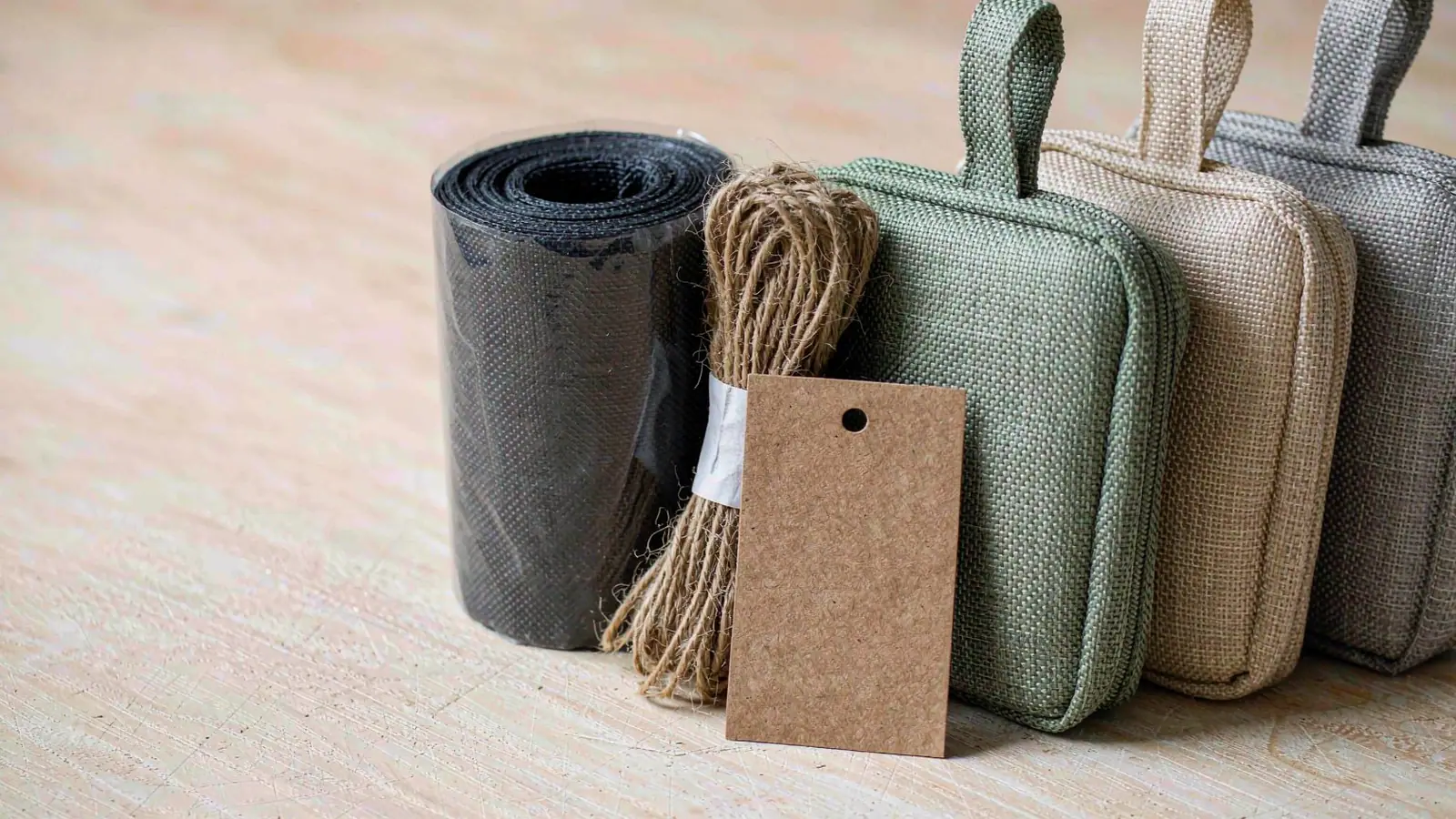
Recycled Synthetic Feedstocks: rPET, Post-Industrial Content and Recycled Nylon
Recycled content in a cosmetic bag begins as a polymer question rather than a fabric question. Three synthetic routes are realistically available: post-consumer recycled polyester, post-industrial recycled polyester, and recycled nylon where allocation exists. They differ sharply in traceability, in dye consistency and in how much documentation accompanies them.
Post-consumer rPET
Post-consumer recycled polyester is produced from collected PET, predominantly beverage bottles, which is sorted, washed, ground into flake, re-melted into chips and extruded into filament. Shell fabric here is typically 300D or 600D rPET with a PU or TPU face coating for wipe-clean behaviour, often over a 190T to 210T rPET lining. The recycled filament performs close to virgin polyester in strength. The tradeoff is variation: recovered streams differ in intrinsic viscosity and residual colour, so lot-to-lot shading is more likely, which matters most where panels must dye-match.
Post-industrial recycled content
Post-industrial recycled content comes from industrial waste such as greige offcuts, rejected rolls, yarn waste and film trim rather than consumer waste. Because input history is known, it is usually cleaner, more dye-consistent and cheaper. Its weakness is legal: several consumer-protection authorities read unqualified recycled as implying recovered consumer waste, so a safe specification writes post-industrial recycled polyester explicitly. What it does not solve: no pull on post-consumer collection, and a vendor's own production waste can count toward a claim the buyer assumed was bottle-derived.
Recycled nylon where supply exists
Recycled nylon 6 and 6,6 exist commercially but run on allocation rather than open stock, drawing on recovered fishing nets, carpet face fibre and industrial nylon waste. Where a specification needs nylon for soft hand or abrasion resistance, expect a longer booking horizon, higher unit cost and one decisive question: does the available certificate cover that specific yarn count and dtex? Nylon also shows dye variation between recycled and virgin input more readily than polyester, so a two-tone shell can read differently across panels.
All three routes share one blind spot. A recycled face fabric says nothing about the polyurethane coating that makes the bag wipeable, the foam interlining that gives it structure, or the zip tape, slider, thread, piping cord and print paste. Specifying 100 per cent recycled polyester and then approving a 0.12 mm PU face coat, TPU backing, nylon coil zip and polypropylene piping produces a composite nowhere near that figure, which is why the arithmetic later in this guide outranks the marketing line.
Recycled feedstock also carries a chemical question independent of recycledness. Recovered input can hold residues from its previous life, and processing aids added during re-polymerisation are not disclosed by a recycled-content certificate. Independent article testing such as OEKO-TEX STANDARD 100 sets limit values for specified harmful substances by article class. It is a hazard test on an article, not a proof of recycled content or organic origin.
| Feedstock route | What it actually is | Performance tradeoff in a cosmetic bag | Verification artefact | What it does not solve |
|---|---|---|---|---|
| Post-consumer rPET | Collected PET packaging sorted, washed, flaked and re-melted into filament for woven or knitted shell cloth, commonly 300D or 600D. | Strength and abrasion close to virgin polyester; higher lot-to-lot shade variation, worst on panels that must dye-match. | Scope certificate covering spinner and mill, plus a transaction certificate for the shipped fabric quantity. | Says nothing about coating, foam interlining, zip tape, thread or print paste. |
| Post-industrial recycled polyester | Greige offcuts, yarn waste and film trim reprocessed inside the same industrial chain rather than recovered post-consumer waste. | Cleaner and more dye-consistent than post-consumer input, usually lower cost; creates no pull on collection infrastructure. | Same certificate chain, but the certificate must name post-industrial input explicitly rather than generic recycled input. | Cannot be presented as bottle-derived; regulators in several markets read unqualified recycled as a consumer-waste claim. |
| Recycled nylon 6 or 6,6 | Recovered fishing nets, carpet face fibre and industrial nylon waste re-melted into filament allocated to specific programmes. | Strong abrasion resistance and softer hand; allocated supply, longer lead time, higher cost, cross-panel dye variation risk. | Certificate covering that specific yarn count and dtex, plus an allocation letter naming the programme. | Supply can lapse between sampling and bulk, so no percentage should be printed before bulk allocation is confirmed. |
| Recycled PET nonwoven or felt | Mechanically or thermally bonded sheet made from re-melted PET staple fibre, used for lining, interlining or structured inserts. | Lower tear strength than woven cloth; good dimensional stability; flexes poorly at stress points and creases permanently. | Transaction certificate for shipped roll quantities, with fibre identification testing where the route is uncertified. | Chosen for stiffness, which usually conflicts with mono-material construction and with end-of-life recovery. |
Minimum order quantity is 500 pieces per style and colourway. Because recycled filament varies more between lots than virgin yarn, splitting a programme into several small colourways multiplies both the dye-match risk and the number of transactions needing verification.
- Feedstock first — fix whether the input is post-consumer or post-industrial before discussing any percentage; the two differ in a claim.
- Dye variation — recycled filament carries higher lot-to-lot shade risk, worst on dyed-to-match panels and least visible on prints.
- Allocation strings — recycled nylon is allocated rather than stocked, so no claim should be printed before bulk allocation is confirmed.
- Composite blindness — a certificate for face fabric does not describe the coating, foam, thread or zip beside it in the finished bag.
Plant-Fibre, Bio-Polymer and Novel Routes: Cotton, Hemp, PLA, PHA, Cork and Mycelium
The second family swaps polymer provenance for plant origin or plant-part structure. These read better on shelf because texture and irregularity are legible as natural, but they bring the compromises that matter most here, since a cosmetic bag meets spilled foundation, wet toothbrushes, leaking bottles and hard wiping. Cost index numbers below are planning aids only, baseline 100 being a dyed, PU-coated 300D polyester shell.
Recycled cotton
Recycled cotton is shredded cutting waste or post-consumer garments, re-carded and re-spun. Shortened staple means lower tensile and tear strength, so recycled cotton canvas is almost always blended with virgin cotton or polyester. Blend ratio belongs on the specification: a fabric sold as recycled cotton may contain only 20 to 40 per cent recycled fibre by weight. Weave weights matter too, since 8 oz, 10 oz and 12 oz canvas differ after finishing.
Organic cotton
Organic cotton addresses agricultural practice, specifically synthetic pesticide and fertiliser use, verified through a farm-to-product chain of custody organised under the Global Organic Textile Standard. It says nothing automatic about water efficiency, fibre durability or recycled content, since organic cotton can be entirely virgin fibre. A shell can be both organically grown and recycled-derived, or a blend of the two, but each percentage must be declared separately because the schemes do not collapse into one number. Buyers should also budget for document costs charged per transaction rather than once.
Jute, linen and hemp blends
Jute gives a coarse hand and high tensile strength per unit weight but is stiff and creases brittly at folds. Linen drapes beautifully then abrades preferentially at fold lines. Hemp combines strength with reasonable softness but is expensive and supply-inconsistent outside a small number of origins. In practice these appear as blends, typically around 55/45 jute-cotton or a hemp-cotton canvas, usually over a synthetic lining, because none is naturally wipe-clean. Buyers should note that a laminated handle differs from the unlaminated swatch approved at sampling.
PLA and PHA bio-polymers
PLA (polylactic acid) is fermented from sugars derived from corn or cassava and spun into fibre, cast as film or coated onto cloth. PHA is produced by bacterial fermentation, is more flexible, and is far more expensive and tightly allocated. Both have lower heat tolerance than polyester: deformation during hot transit or in a sunlit warehouse is a recognised failure mode, and both lose strength under hydrolysis in humid storage.
Cork and plant-part composites
Cork fabric is a shaved bark veneer bonded to a textile backing. It is genuinely renewable because the bark regenerates, light, and reasonably water-resistant untreated. The catch is that the bond is an adhesive, which matters at end of life, and veneer cracks if folded tightly at a seam. Plant-part composites made from pineapple leaf, apple pomace, cactus or grain residue suspend a plant fraction in a polymer matrix, so the honest term is composite rather than plant-made.
Mycelium-part materials
Mycelium-part sheets are grown from fungal biomass on a substrate, then dried, pressed and finished. Most commercial versions still carry a textile backing or polymer finish for strength and water behaviour, supply is limited and costly, and batch-to-batch surface consistency across a 500-piece colourway is not yet routine. Treat it as a capsule or trim application rather than a default shell.
| Material | Feedstock origin | Hand and structure behaviour | Moisture and hygiene behaviour | Illustrative cost index | Claim risk |
|---|---|---|---|---|---|
| Recycled cotton canvas, 12 oz | Cutting waste or garments, re-carded, re-spun and blended with virgin fibre. | Dry, matte, firm hand; abrades faster at folds than virgin canvas. | Absorbs spills readily; needs lining or finish to wipe clean. | 130 | Blend ratio often omitted, so the stated figure can be double the real one. |
| Organic cotton canvas, 12 oz | Virgin cotton grown to organic practice, traced through a certified farm-to-product chain. | Clean, even hand; behaves like conventional cotton of the same construction. | Same as conventional cotton; no resistance to cosmetics staining or mildew. | 145 | Organic origin mistaken for recycled content or for a water-use claim. |
| Jute, linen or hemp blend | Bast fibre blended with cotton to restore the flexibility coarse bast lacks. | Stiff, slubby, strongly textured; brittle creasing at folds and bound seams. | Stable dry; poor wet behaviour, slow drying, holds odour if lined badly. | 135 to 175 | Natural look invites unqualified biodegradability claims the finish defeats. |
| PLA film or coated cloth | Plant sugar fermented to lactic acid, polymerised and extruded as fibre, film or coating. | Crisp, papery hand; printable; loses stability above moderate temperatures. | Higher moisture transmission than polyester; will not lie flat after heat. | 160 | Sold as compostable without naming the composting environment required. |
| PHA-coated fabric | Bacterial fermentation producing polyhydroxyalkanoate, applied as a flexible coating. | Softer and more flexible than PLA; closest to conventional coating in hand. | Good barrier behaviour; hydrolyses faster under sustained heat and humidity. | 320 | Heavily allocated and rarely certified, so unverifiable claims are common. |
| Cork veneer composite | Shaved bark veneer bonded to a textile backing with an adhesive layer. | Warm, tactile, slightly compressible; cracks if folded tightly at a seam. | Water-resistant face; the backing textile is the vulnerable layer. | 260 | Renewable bark is real, but adhesive and backing dominate end of life. |
| Mycelium-part sheet | Fungal biomass grown on substrate, dried, pressed and finished, usually backed or coated. | Soft, suede-like surface; lower tear strength than woven cloth; varies by batch. | Needs a finish to wipe clean; absorbs water at unfinished cut edges. | 480 | Sold as a grown leather alternative while carrying polymer finishes and backings. |
- Blend discipline — specify the recycled or plant fraction as a percentage by weight, never as an adjective before the fibre name.
- Separate numbers — organic and recycled are two attributes needing two declarations, even in one shell fabric.
- Heat reality — judge PLA-based routes against real transit and warehouse temperatures, not showroom conditions.
- Composite honesty — a plant fraction bonded into a polymer matrix is a composite and should be described that way.

Chain of Custody: Transaction Certificates, Scope Certificates and Percentage Arithmetic
A recycled-content claim is only as good as the document behind it, and most disputes arise because buyers and vendors read one certificate differently. Two documents carry nearly all the weight: the scope certificate, establishing that an entity may handle certified material, and the transaction certificate, recording that a quantity moved between certified entities.
What a scope certificate proves
A scope certificate is issued to a defined legal entity, whether spinner, mill, dyer, converter or trading entity, covering listed process and product categories, and carrying an issuing body, certificate number, validity period and audited address. What it proves is narrow: the entity was audited and may process certified material of listed kinds during that window. It holds no quantity, buyer or shipment, so it cannot substantiate a purchase on its own.
What a transaction certificate proves
A transaction certificate is issued per shipment by the seller's certification body once that seller shows it acquired at least as much certified input as it sold onward, with the claimed percentage carried through. It names seller, buyer, product, composition, quantity, standard and date. The Global Recycled Standard runs both documents in one system, and GOTS applies the same logic to organic fibre.
Why a coating dilutes the percentage
This is the arithmetic that catches most programmes. Cloth weighing 180 g/m2 taking a 35 g/m2 face coat and a 20 g/m2 back coat produces a 235 g/m2 composite, so the maximum honest recycled content is 180 divided by 235, roughly 76 per cent, even though every fibre in the base fabric is recycled. Add interlining, adhesive, print paste and binding tape and the denominator rises further. Unless upstream declares the composite number, calculate it and declare that value.
The percentage on a certificate is a weight fraction of certified input in the declared product or component, calculated over that declared item. It does not alone guarantee that every fibre was physically separated from virgin material. Where a brand needs physical identity rather than an allocated calculation, raise it at quotation stage and confirm the model the certificate was issued under, because that changes what may be printed.
Reconciling certificate quantities against purchases
Reconciliation is the cheapest anti-greenwashing test available because it needs arithmetic rather than expertise. Request every transaction certificate, sum outgoing certified quantities per stage, and compare against purchases. Warning signs are specific: a quantity larger than its inputs; a different certification body from the one on the seller's scope certificate; a transaction outside the validity window; a description too vague to tie to the goods; and a holder name not matching the invoice.
Two documents that are not recycled-content evidence
Chemical safety runs on a separate track and is regularly confused with recycledness. OEKO-TEX STANDARD 100 tests an article against limit values for specified harmful substances within an article class, while EU REACH obligations cover restricted lists for articles placed on that market. Neither substantiates recycled content or compostability.
| Document | What it certifies | Issued per | Buyer check before accepting it | Common failure mode |
|---|---|---|---|---|
| Scope certificate (GRS) | That the named entity was audited for listed process categories and may handle certified recycled input. | Site, per audit cycle, with an expiry date. | Confirm entity name, process categories and validity period cover the goods and their production dates. | Filed as proof of purchase although it carries no quantity, buyer or shipment reference. |
| Transaction certificate (GRS) | That a stated quantity with a stated recycled input moved between two certified entities. | Shipment, after the seller reconciles matching input. | Match quantity, composition, width and mass to the delivery note and commercial invoice. | Quantity exceeds the inputs feeding it, or the description is too vague to tie to the goods. |
| Scope certificate (GOTS) | That the named entity was audited to handle organically certified fibre through listed steps. | Site, per audit cycle, with an expiry date. | Check that dyeing and finishing steps appear in the listed scope of the finished cloth. | Missing finishing steps, so the completed cloth falls outside the audit rather than inside it. |
| Transaction certificate (GOTS) | That a stated quantity made with certified organic fibre moved between two certified entities. | Shipment, after input reconciliation by the certifying body. | Verify the declared organic percentage against the blend composition on the specification. | Declaring full organic content when the remaining fibre in the blend was never certified. |
| OEKO-TEX STANDARD 100 certificate | That a tested article falls within limit values for specified harmful substances for its class. | Article construction, per validity period, against a labelled article class. | Confirm the article class covers the product as sold and the tested construction matches bulk. | Treated as evidence of recycled content or organic origin, neither of which it assesses. |
| REACH restricted-substance declaration | A supply-chain statement on substances of very high concern and applicable EU restrictions. | Declaration per programme, ideally per material component. | Require it signed, dated and tied to named components rather than to a company policy. | A generic policy statement accepted instead of a component-level declaration for the bill of materials. |
A certificate held by one legal entity does not validate goods invoiced by another. Match the holder name to the entity on the commercial invoice, and where they differ, obtain written evidence of the relationship and of each entity's own scope. Payment against mismatched documents is how unverifiable claims enter a line.
- Two documents always — a scope certificate establishes entitlement, a transaction certificate evidences movement; neither substitutes.
- Recompute the composite — divide certified input weight by finished composite weight and print that number, not the supplier's headline.
- Reconcile quantities — no certified stage should be larger than the stage feeding it.
- Separate the safety track — chemical compliance documents belong alongside chain-of-custody documents, not instead of them.
End-of-Life Honesty: Biodegradable, Compostable and the Laminate Problem
Biodegradable is the most abused word in this product category. Biodegradation is not a property of a material in the abstract; it is a result observed in a defined environment, over a defined time, against defined criteria for disintegration, ultimate biodegradation and ecotoxicity. Remove the environment and the time interval and the claim has no technical content, so any unqualified biodegradability statement should be treated as unsubstantiated until a test report says otherwise.
Three environments that behave completely differently
Industrial composting is a managed process: elevated temperature sustained for a defined residence time, controlled moisture and aeration, then screening. Home composting rarely reaches those temperatures, runs on far longer cycles with lower microbial activity, and is therefore a harsher test of patience rather than a gentler version of the same process. Landfill is predominantly dry and anaerobic, so material buried there degrades slowly or barely at all, and organic matter breaking down anaerobically generates methane rather than benign residue. A material that passes one test tells a buyer nothing about the other two.
Why one bad layer defeats the whole laminate
A compostable layer bonded to a non-compostable layer produces a non-compostable laminate. There is no partial credit, because compostability is assessed against the article as presented, including print, thread, adhesive, interlining and hardware. If a PLA film is laminated to a polyester scrim with a polyurethane adhesive, disintegration fails on the polyester and the fragments fail screening. The same logic runs through the component list: a compostable shell carrying a metal slider, nylon coil tape and fusible interlining does not comply as a bag, even though the shell may pass alone.
What counts as substantiation
Substantiation means a test report naming the specific finished construction, listing the applied standard with its version, stating the pass criteria and the actual results, issued by an accredited laboratory with the sample identified by construction rather than by generic description. A letter saying compostable material was used is not a test report. A report on the film alone is not evidence about the laminate. Buyers should also confirm whether the report covers the printed, assembled bag or only an unprinted panel swatch.
Recycled content and recyclability are different axes
Recycled content describes input; recyclability describes whether the article can re-enter a recovery stream at end of life. They are independent, and an article can score well on one while failing the other. A mono-material polyester shell with polyester coil zip tape, polyester thread and no coating is both potentially high in recycled content and potentially recoverable. The same shell carrying a TPU face coat, foam insert, aluminium slider and PVC piping is neither, and multi-material laminates remain the least recoverable construction available in this category.
Wording that holds up, wording that does not
Defensible wording describes what was done and what it was measured against: shell fabric made from post-consumer recycled polyester, chain of custody verified to GRS, 76 per cent recycled content by finished composite weight, industrial compostability tested where claimed. Indefensible wording compresses all of that into eco, green, planet-friendly, zero impact or 100 per cent biodegradable. Unqualified degradable should also be refused, along with oxo-degradable and fragmentable additive claims, since fragmentation without complete biodegradation produces microplastic rather than resolving anything.
| End-of-life environment | What actually happens to the article | Defensible claim wording | Wording to refuse |
|---|---|---|---|
| Industrial composting | Managed heat, moisture and aeration over a defined residence time, so compostable constructions can disintegrate as intended. | Compostable in an industrial facility, tested to a named standard against the finished construction. | Compostable full stop, or home-compostable based on an industrial test report. |
| Home composting | Lower, fluctuating temperatures over much longer cycles, so industrial-grade materials often stay intact and recognisable. | Home-compostable only where tested and passed as a finished article against a home-composting specification. | Biodegradable anywhere, or compostable with no environment named at all. |
| Landfill | Predominantly dry and anaerobic, so degradation is slow to negligible and organic breakdown yields methane. | No positive claim; state honestly that disposal should follow household waste rules. | Breaks down in landfill, landfill-safe, or returns to the earth. |
| Mechanical recycling stream | Sorted by polymer or fibre type, then reprocessed; laminates, coatings, foams and mixed hardware contaminate the process. | Designed for polyester-stream recovery, mono-material build with hardware removable by simple tools. | Recyclable on an article bonding textile, coating, foam and metal into one laminate. |
| Leakage into soil or water | Variable ultraviolet exposure, moisture and microbial activity, with fragment routes whose fate is poorly understood. | No claim; accidental loss is not a proven end-of-life route for any practical specification. | Marine-degradable, ocean-friendly, or degrades naturally based on composition alone. |
A compostability test report that describes the film rather than the laminate is not a compostability claim. It is a description of a component that no longer exists on the shelf.
- Name the environment — industrial composting, home composting and landfill are three tests with three answers.
- Test the whole article — print, thread, interlining, adhesive, slider and coil tape all count, and one failing layer defeats the build.
- Keep the axes separate — recycled content describes what went in, recyclability what can come out; neither implies the other.
- Refuse fragments — unqualified degradable and oxo-degradable additives convert a product into microplastic rather than resolving it.

Design Levers That Reduce Impact Before Certification Does
Before any certificate is requested, the design itself determines most of what is achievable. Impact-reduction levers that survive scrutiny tend to be unglamorous: fewer materials, fewer bonding methods, longer service life, tighter pack-out. Most of them are also cheaper than certification, which matters when a first sustainable programme has to clear internal cost hurdles before it clears anything else.
Mono-material construction
A mono-material bag keeps shell, lining, binding, sewing thread, zip tape and ideally the slider body inside one polymer family, polyester throughout for example. This achieves two things at once: end-of-life recovery becomes conceivable because there is one stream rather than five, and verification becomes cheaper because one chain of custody can cover the whole bill of materials. Real limits apply. Metal sliders and aluminium pulls give the premium feel many brands want, so the usual compromise keeps every textile component in one family while making metal parts removable with simple hand tools.
Mechanical fastening instead of adhesive
Adhesive bonding is widely used to achieve clean seams on coated cloth, but every adhesive layer is another material in the end-of-life calculation and another compliance question. Alternatives include high-frequency or hot-air welding, where the coating itself becomes the bonding medium; stitched and bound construction using binding tape; and folded topstitched seams needing no glue line. Where adhesive cannot be avoided, specify the chemistry in writing, since EU REACH obligations attach to substances in articles regardless of how the seam was made.
Replaceable hardware and repairability
Most cosmetic bags are discarded because a zip fails rather than because cloth wears out, so a construction that allows the slider to be replaced, or leaves enough seam allowance for one re-stitch, keeps the article in service for years. This matters more than buyers assume, because nothing in the major recycled-content standards rewards durability: a bag lasting eight years and one lasting eight weeks can carry identical certificates. Durability therefore needs its own specification, using test-method families maintained by AATCC and coated-fabric procedures such as ASTM D751 for coating adhesion.
Writing durability into the specification
In practice that means numbers rather than adjectives: abrasion resistance to a defined rub count and endpoint for shell and lining; seam strength in newtons for load-bearing seams; coating adhesion before and after accelerated ageing; colour fastness to rubbing and water at defined grey-scale ratings; and a zip-cycle target appropriate to expected use. Specifying these removes the most common failure mode of fashion-led sustainability, which is a beautiful material with a six-week service life and no test behind it.
Cube efficiency and packing density
Freight is an impact lever that rarely appears in sustainability decks. A structured cube measuring roughly 24 x 18 x 12 cm occupies about 5.2 litres whether full or shipped empty, while a soft pouch of the same internal volume nests so several units occupy the space of one. Because freight emits per container rather than per loosely packed unit, pieces per export carton becomes an emissions-per-delivered-unit lever depending on no certificate. It also interacts with the 500-piece minimum per style and colourway.
| Design lever | Impact mechanism | How to measure it | Feasibility and cost note |
|---|---|---|---|
| Mono-material bill of materials | Keeps the article inside one recovery stream and lets one chain of custody cover shell, lining, thread and binding. | Count the polymer families in the bill of materials and require each line to name one. | Straightforward for soft pouches; harder where a rigid insert or metal puller is required. |
| Welded or stitched seams instead of adhesive | Removes an entire material class from both end-of-life and chemical compliance review. | Scan the bill of materials for adhesive lines and confirm bonding temperature records exist. | Welding needs thermoplastic faces; stitched seams add labour but no new tooling. |
| Replaceable slider and repair-friendly seam allowance | Extends service life, spreading the manufacturing impact across more years of use. | Set a zip-cycle target and check the seam allowance permits one re-stitch. | Easy to specify at sampling; very difficult to retrofit once patterns are cut. |
| Written durability specification | Prevents premature discard, the dominant failure route for this product type in ordinary use. | Abrasion rub count to a defined endpoint, seam strength in newtons, grey-scale fastness rating. | Feasible on any programme; the plan must be agreed before sampling, not after complaints. |
| Flat-pack nesting and cube efficiency | Reduces freight volume per delivered unit, whether or not anyone measures the associated emissions. | Compare pieces per export carton and cubic metres per thousand units against a structured comparator. | Only works where a soft construction suits the brand's positioning and price point. |
| Colourway and component consolidation | Fewer inputs to trace, fewer transactions to certify, fewer incomplete material lots. | Count certified transactions per season against the number they could reasonably be reduced to. | Needs merchandising discipline, since colour variety is defended for commercial reasons. |
A 76 per cent recycled, mono-material, densely packed pouch with a tested long service life is more defensible than a full-recycled coated laminate that can neither be recovered nor repaired. Design decisions are made during the sampling window, and most become expensive or impossible once bulk is released.
- One polymer family — fewer material families means one recovery story and one certificate chain rather than several competing ones.
- Bond without glue — welding and stitched seams remove an entire material class from end-of-life and compliance calculations.
- Specify durability separately — recycled-content certificates do not reward service life, so abrasion, seam strength and zip cycles need their own lines.
- Measure the carton — pieces per export carton is a real impact lever requiring no certification and usually lowering landed cost.
The Buyer's Verification Sheet: What to Demand in Writing
The difference between a verifiable programme and an unverifiable one is usually settled before sampling, by what was requested in writing. Those requests belong in the quotation documents and in the approved specification, not in an email three weeks before shipment. The groups below follow the order in which a buyer actually needs answers.
Material and composition requests
- Exact feedstock type — post-consumer or post-industrial, named explicitly, with the waste source identified rather than called recycled in general terms.
- Blend ratio by weight — every component stated as a percentage composition, including coatings and interlinings, not just the headline fibre.
- Mass per square metre per component — cloth, face coat, back coat, adhesive and print paste, so the composite percentage can be recalculated.
- Trim and hardware material — zip tape, slider, puller, thread and piping cord each named by polymer or alloy.
- Bulk equivalence statement — written confirmation that the sampled material is what will run in bulk, with no substitution without re-approval.
Document and arithmetic requests
- Full certificate chain — scope and transaction certificates for every entity that touched the material, from spinner to invoicing entity.
- Quantity reconciliation — outgoing certified quantities per stage supplied against quantities actually purchased for the programme.
- Finished-composite calculation — the percentage computed against total component weight, presented so the buyer can redo it.
- Chain-of-custody model stated in writing — physical separation or allocation, and which of the two the printed claim may use.
- Buyer named on the document where possible — harder to reuse across unrelated programmes than a certificate naming nobody.
Compliance and claim-substantiation requests
- Article-level chemical testing — restricted-substance evidence for the assembled article, not raw inputs, with the tested construction identified.
- Restricted-substance declaration — signed and dated, tied to named components, reviewed against every market's restricted lists.
- Children's product check — where a pouch sells into that channel, certificate requirements under CPSIA in the United States should be assessed before artwork is committed.
- Compostability evidence — a laboratory report naming the finished construction, standard, version, criteria and result, or no claim at all.
- Claims substantiation file — every word on a hangtag or listing mapped to its supporting document, maintained for the life of the product line.
How to spot an unverifiable claim
- A certificate supplied as an image of a logo rather than a numbered document carrying an issuing body, holder name and validity dates.
- A holder whose name does not match the entity on the commercial invoice, with no documented relationship provided.
- A transaction certificate dated outside the seller's validity window, or issued by a different certification body than the one named there.
- A product description too vague to tie to the goods, for example woven fabric with no composition, width or mass.
- A percentage quoted for base cloth and then applied to the finished bag including coating, interlining, print, thread and hardware.
- A biodegradability claim supported by a safety sheet or marketing letter rather than by a laboratory report on the finished construction.
- Sample swatches sent unlaminated or unprinted where bulk will be laminated and printed, which wins approvals bulk cannot meet.
- Recycled content offered at no premium and with no documentation, since chain of custody costs somebody money first.
Timing is the practical constraint. Documents cannot be produced retrospectively for material that was never certified, so requests belong inside the 6-10 working day sampling window (12-15 for complex constructions) and the 35-50 day bulk period rather than at inspection, when the only remedies left are acceptance or rejection. Consolidating these requests is normally handled by whoever coordinates the sourcing programme; QUANZHOU JUNYUAN BAGS is one example of the kind of sourcing and programme-management company that buyers task with collecting and checking this documentation before bulk release. Inspection to AQL 2.5 confirms that goods match the approved sample; it does not confirm any sustainability claim attached to them, because no sampling plan tests a certificate.
For every claim word that appears on a physical bag or a product page, there must be one dated document in the buyer's own file naming the construction actually shipped. If that pairing cannot be completed for a word, that word comes off the bag. Everything else in this guide is detail around that single rule.
The B2B Customisation View
Range planning for makeup bags and toiletry bags works best when the hero style and the gift-with-purchase style are engineered together, sharing linings and hardware to protect the budget.
Planning figures used across the programme: MOQ 500 pieces per style and colourway, 6–10 working days sampling (12–15 when moulding or multi-layer lamination is required), 35–50 days bulk lead time, AQL 2.5 to ISO 2859-1, FOB Xiamen, T/T 30/70.
The value of a programme-coordination model is continuity: QUANZHOU JUNYUAN BAGS keeps the approved reference sample, the shade standard and the AQL record for every repeat order.
Which Brand Types This Guide Serves
This guide is written for the buyer who has to defend a sustainability claim to someone else, whether that audience is a retailer compliance team, a marketplace reviewer, an internal legal reviewer or a customer reading a hangtag. Category demand makes that exposure real rather than theoretical: travel bag for toiletries draws roughly 110,000 monthly searches, the toiletry bag category draws around 74,810 weekly searches on Amazon according to ASINSIGHT 2026.07 readings, and custom makeup bag draws 5,400 to 6,600 monthly searches. Those are search-demand signals rather than revenue figures, and they explain why claim substantiation has become a commercial asset rather than a compliance chore.
- Independent and start-up beauty brands: usually better served by choosing one route and one certificate for the whole launch rather than three materials with three partial document sets. With a 500-piece minimum per style and colourway, one 500-piece recycled rPET pouch is a cheaper and more defensible first programme than two smaller designs nobody can fully verify.
- Established skincare and colour cosmetics brands: typically run multiple seasons and tiers, so the priority is a claims substantiation file maintained per product line, with every percentage recalculated whenever a coating, print or lining substitution changes the composite arithmetic.
- Retailers and private-label teams: carry the strictest exposure, because own-label claims are judged against retailer protocols as well as advertising law. Demanded documents include the finished-composite calculation and the quantity reconciliation, not simply the certificate in between them.
- Marketplace and e-commerce sellers: need every claim word in a listing mapped to a document, because listing copy, image text and enhanced content are all treated as advertising. Sustainability keywords without substantiation are among the easiest targets for a competitor complaint.
- Gift, hospitality and amenity buyers: field end-of-life questions from their own customers, so a clear disposal instruction printed on the item matters more than recycled content alone, since a mislabelled compostable amenity bag ends up in whichever receptacle the guest finds first.
The shared requirement across all five groups is identical: a dated document set held in the buyer's own file, naming the construction that was actually shipped. Brand owners who build that file during sampling rather than after inspection convert a sustainability claim from a liability into a durable commercial asset, at a cost that is small relative to any single season's production budget.
Frequently Asked Questions
What does recycled content actually mean when it appears on a custom cosmetic bag specification?
It is a stated percentage, by weight, of certified recycled input in the component or finished item declared by the certificate holder. That percentage applies to the declared item rather than the bag as sold, so fabric quoted at full recycled content can sit inside a finished bag whose composite figure is far lower once coating, interlining, adhesive and trim are added. Buyers need two numbers in writing: the input's certified percentage and the composite percentage from component weights. Where they differ, print the lower one.
How much does a PU or TPU coating reduce the recycled content percentage of an eco friendly cosmetic bag?
Any coating reduces the percentage, because it adds weight without adding certified input. Take cloth weighing 180 grams per square metre with a 35 gram face coat and a 20 gram back coat: the composite weighs 235 grams, so maximum honest recycled content is 180 divided by 235, roughly 76 per cent, even though every fibre in the base fabric is recycled. Add interlining and print paste and the denominator rises again. A component-weight table supplied at quotation stage lets the buyer recompute this rather than accept a headline figure.
What is the difference between a GRS scope certificate and a GRS transaction certificate?
A scope certificate is issued to a legal entity after audit and says it may process certified material of listed kinds during a validity window. It carries no quantity, buyer or shipment, so it cannot substantiate a purchase alone. A transaction certificate is issued per shipment once the seller shows it acquired at least as much certified input as it sold onward, and it names seller, buyer, product, composition, quantity and percentage. Buyers need both, checked together, with the transaction falling inside the validity window.
Can a recycled makeup bag also carry an OEKO-TEX label, and what would that actually prove?
Yes, but the two measure different things and neither satisfies the other. OEKO-TEX STANDARD 100 tests an article against limit values for specified harmful substances within a defined article class, addressing chemical safety and mattering because recovered input can carry residues from a previous life. It does not assess recycled content, organic status or compostability. A bag described as recycled and tested safe therefore needs two independent document sets from two schemes, each dated to cover the shipment.
Is organic cotton a better choice than recycled polyester for a sustainable toiletry bag?
Neither is universally better, because they address different problems and must be traded against use conditions. Organic cotton addresses agricultural practice at farm level, verified through a farm-to-product chain of custody, and can be entirely virgin fibre. Recycled polyester addresses waste feedstock and delivers the wipe-clean performance a toiletry bag usually needs. If the bag meets leaking bottles and daily wipe-downs, cotton needs a lining or finish, and that lining becomes part of the composite percentage. Fit route to use first, then verify.
Are biodegradable cosmetic bags a realistic option for a mainstream beauty brand?
Only in narrow circumstances. Biodegradation is a result observed in a defined environment over a defined time against defined criteria, so an unqualified claim has no technical content and is unsubstantiated until a test report says otherwise. Cosmetic bags are also assembled articles: print, thread, interlining, adhesive, slider and coil tape count, and one layer failing disintegration defeats the whole build. The realistic path is a small mono-material pouch, no coating, removable hardware, tested as finished, with honest disposal instructions printed on it.
What happens to a compostable fabric once it is laminated to a non-compostable film?
The finished laminate is not compostable. Compostability is assessed against the article as presented, so disintegration fails on the non-compostable layer and the remaining fragments fail screening, with no partial credit for the layer that did comply. The same logic runs down the component list: a compostable shell carrying a metal slider, nylon coil tape and fusible interlining does not comply as a bag, even if the shell passed alone. Claims must be tested on the whole construction, not its parts.
How can certified quantities be reconciled against what was actually purchased?
Request every transaction certificate in the chain, sum the outgoing certified quantities at each stage, and compare the running total against quantities actually bought. No step should exceed the certified input feeding it. Warning signs are specific and checkable: a quantity larger than its inputs; an issuing body different from the one named on the seller's scope certificate; a transaction dated outside the validity window; a holder name not matching the invoice; and a description too vague to tie to the goods.
Does a higher recycled content percentage automatically mean lower climate impact?
No, and treating it as though it does is a common sourcing error. Life cycle assessment is a method, and any figure it produces is meaningful only relative to a declared system boundary stating which stages, which functional unit and which allocation rules were applied. A single number offered without that boundary cannot be checked. The two also correlate imperfectly, because collection, sorting, transport and re-coating carry burdens, and service life multiplies the result. Ask for the boundary, not the headline.
Which packaging-format decisions reduce impact more than the material choice itself?
Volume and service life usually outweigh feedstock. A structured cube occupying roughly 5.2 litres ships at that volume whether full or empty, while a soft pouch of equal capacity nests so several units take the space of one, changing pieces per carton and therefore emissions per delivered unit without any certificate involved. Colourway consolidation works similarly, reducing both minimum exposure per colourway and the number of transactions to verify. Most of these levers also reduce landed cost.
How should a durability or long-life claim be substantiated before it reaches a hangtag?
Durability needs its own specification lines, because recycled-content certificates do not reward service life, and a bag lasting eight weeks can carry the same certificate as one lasting eight years. Write numbers into the specification: abrasion resistance to a defined rub count and endpoint, seam strength in newtons for load-bearing seams, coating adhesion before and after ageing, fastness at defined grey-scale ratings, and a zip-cycle target. Testing at sampling turns a claim into an enforceable specification.
What should be requested when a mill offers recycled nylon that is in short allocation?
Recycled nylon is allocated rather than stocked, so the first request is an allocation letter naming the programme, yarn count and dtex, because a certificate covering another count does not support the quoted fabric. The second is lead-time confirmation covering sampling and bulk, since allocation can lapse between them. The third is a written guarantee that bulk output will not switch to virgin yarn without re-approval. Never print a recycled-nylon percentage on artwork before bulk allocation is confirmed.
Which claim wording creates the greatest greenwashing exposure for a sustainable toiletry bag?
Vague absolutes carry the most risk, because they assert more than any document can show. Terms such as eco, green, planet-friendly, zero impact and 100 per cent biodegradable make assertions no certificate supports, and enforcers generally read them as environmental claims whether or not that was intended. Unqualified degradable is similarly exposed, and oxo-degradable or fragmentable claims should be refused outright, since fragmentation without complete biodegradation generates microplastic rather than resolving disposal. Defensible wording names feedstock, standard, composite percentage and composting environment, and nothing beyond what was tested.
How do recycled-content requirements interact with a 500-piece minimum per style and colourway?
Every additional style and colourway is an additional verification burden, because each ideally carries its own transaction certificates and its own dye lot risk, and recycled filament varies more between lots than virgin yarn. One 500-piece recycled rPET pouch is therefore easier to substantiate than two smaller variations nobody can document. Consolidating colourways also cuts season-end write-off. The minimum itself does not change with material, but verification cost per unit falls as lines consolidate.
People Also Ask
Are eco friendly cosmetic bags actually better for the environment?
Only where the claim is verified and the design survives service conditions. A recycled bag with heavy coating, mixed-polymer trim and a short life can perform worse across its life than a conventional bag lasting years. What decides it is evidence, not the hangtag: a named feedstock, a transaction certificate reconciled against purchases, an honest composite percentage, and durability set through abrasion and zip-cycle targets. Life cycle assessment needs a declared boundary, so any single number without one is unreliable.
What is the most verifiable sustainable material for a makeup bag?
Post-consumer recycled polyester is the most verifiable route, because its chain of custody is mature, widely issued and routinely requested by retailers. It performs near virgin polyester in strength and abrasion, though with higher dye lot variation. Its weak point is not the fibre but the composite: coating, interlining, adhesive and trim all dilute the percentage. Specifying 300D or 600D rPET with trim in the same polymer family gives both a defensible figure and an end-of-life story.
Do compostable cosmetic bags break down in a home compost bin?
Usually not, and a home heap is a harsher test than most assume. Industrial composting applies managed heat, moisture and aeration over a defined residence time, while a home heap runs cooler over longer cycles, so industrial-grade material can stay recognisable for years. Buried material in landfill degrades anaerobically rather than benignly. Home-compostable claims should only follow testing of the finished article against a home-composting specification, with a report naming that construction.
Why does a recycled makeup bag cost more per unit?
Several causes, and separating them helps a buyer negotiate. Allocation and restricted availability push input cost up, particularly for recycled nylon. Chain-of-custody administration carries per-transaction charges payable at each processing stage. Smaller recycled lots mean more lab dips and higher dye-match risk, and reaching an honest composite percentage forces recipe changes. Testing adds a fixed cost per programme too. Premiums vary widely by route and volume, so treat these as illustrative planning ranges rather than quoted figures.
How long does it take to develop a custom sustainable toiletry bag programme?
Sampling runs 6-10 working days for standard constructions and 12-15 where the build is complex, with bulk production 35-50 days after sample approval. What changes is the administrative load: documents cannot be produced for material that was never certified, so certificate requests must sit inside the sampling window. Colourway count also decides how many separate document sets are needed. Buyers waiting until inspection to request chain-of-custody evidence have no remedy beyond accepting or rejecting the shipment.
References & Standards
- ISO 2859-1 sampling procedures for inspection by attributes
- ASTM D2053 standard terminology relating to zippers
- AATCC TM61 colour fastness to laundering
- IEC 62321 determination of certain substances in electrotechnical products
- OEKO-TEX Standard 100 testing for harmful substances
- Textile Exchange Global Recycled Standard
- US CPSC CPSIA consumer product safety improvement act
- ECHA REACH regulation on chemicals
- TSA 3-1-1 liquids rule for carry-on baggage
- ASTM D751 standard test methods for coated fabrics
- ISO 105 textiles tests for colour fastness
- Global Organic Textile Standard GOTS
In-Depth Articles in This Category
9 dedicated articles sit under this pillar guide.
Related Pillar Guides
Request a Sample or a Written Quotation
Send the silhouette, dimensions, material preference and logo artwork, and the programme team will return a written quotation with MOQ, sampling window, bulk lead time and inspection standard.
Email: service@junyuanbags.com · WhatsApp: +86 177 5002 0688