Toiletry Bags for Flight Attendants: Airline Crew Use
Executive Summary
Toiletry bags for flight attendants are rotation equipment rather than holiday luggage, and that single change of frame drives the whole specification. A crew bag is packed and unpacked several times a week, lives inside a crew roller alongside uniform items, hangs from a hook in a confined space, and has to present liquids for screening quickly at a staff checkpoint. The specification that holds up uses a 420-600D coated shell, a number 5 coil zip with a metal puller, a zinc-alloy swivel hook, a wipeable lining and a removable clear liquids pouch.
Programme mechanics follow the standard made-to-order frame. Orders start at 500 pieces per style and colourway, sampling runs 6-10 working days or 12-15 working days for complex constructions, and bulk production takes 35-50 days after sample approval. Inspection is carried out to AQL 2.5 under ISO 2859-1, shipment is FOB Xiamen, and payment is T/T with 30 deposit and 70 against bill of lading. Replacement cycles should be planned around cohort dates, which cannot move.
What crew carry demands that leisure travel does not
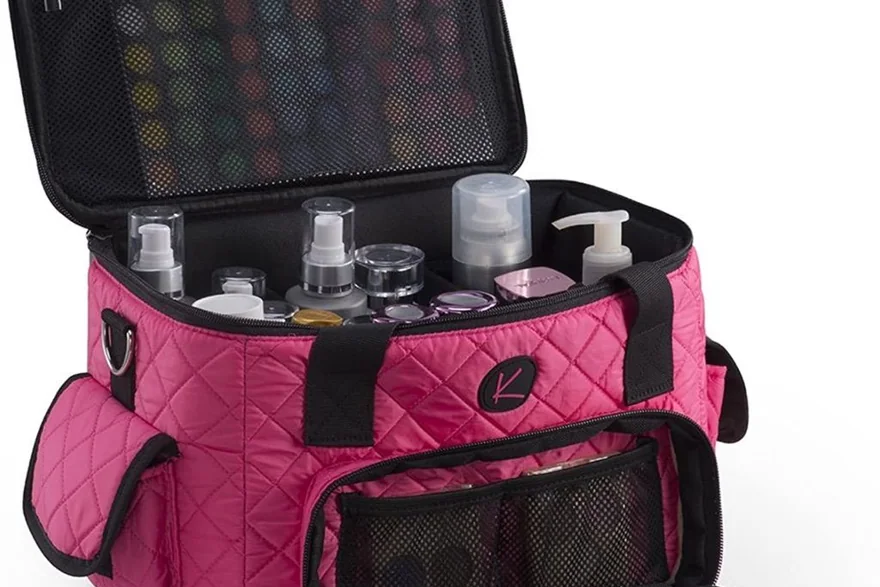
A leisure traveller uses a toiletry bag perhaps four times a year. Cabin crew use one every working week, often several times within a single duty pattern, which changes the failure profile completely. Nothing in the bag gets a recovery period: zips are cycled while the owner is tired, fabric is compressed against a uniform in an overhead locker, and the whole thing is repacked in a hotel bathroom at an early hour. Specification has to be written against that duty cycle rather than against a weekend away.
The second difference is space. A crew bag does not travel on its own; it travels inside a crew roller or alongside uniform items in a case that already holds shoes, a uniform jacket and documentation. Every centimetre given to the wash bag is taken from something else, which is why crew-specific designs are slimmer and flatter than consumer equivalents and why a bag that packs down when half empty is worth more than one with generous fixed volume.
The third difference is the checkpoint. Crew pass through staff screening repeatedly, and time lost at a security line is time lost from a rest period. A bag that forces its owner to dig for liquids at every screening is a bag that eventually gets replaced, often with something unbranded bought at an airport. The design answer is a dedicated, removable clear liquids compartment that can be presented without unpacking the rest of the bag.
- Repetition: hundreds of pack-and-unpack cycles a year, so hardware rating matters more than fabric weight.
- Compression: the bag shares a case with uniform items, so it has to tolerate being squeezed.
- Speed: screening and hotel turnarounds reward a layout that can be worked without thinking.
- Confinement: the bag has to hang and open in a small space and still give access to everything inside.
Designing around the liquids rule and the cabin reality
Screening rules are the one part of this specification that is fixed externally. Under the TSA 3-1-1 liquids rule, liquids in carry-on bags are limited to containers of 3.4 ounces or 100 millilitres, held in one quart-sized clear bag, one bag per passenger. The rule governs what the traveller carries; the bag's job is to make complying with it quick rather than to confer any compliance status of its own.
Translated into design, that means one clear, removable compartment sized to hold a quart-sized bag flat, positioned so it can be pulled out one-handed. A pouch around 20 x 18 cm in 0.30-0.40 mm TPU works, with a zip top and a loop or clip so it can hang separately if needed. Crew who fly through several jurisdictions also benefit from bottles that are clearly under 100 ml, so a bag supplied with its own decant set removes the guesswork at the line.
| Design feature | Crew-specific reason | Practical specification |
|---|---|---|
| Removable clear liquids pouch | Presented at screening without unpacking the bag | 20 x 18 cm, 0.30-0.40 mm TPU, zip top, clip loop |
| Swivel hanging hook | Limited counter space in lavatories and hotel bathrooms | Zinc-alloy hook, 30-40 mm opening, bar-tacked to a webbing anchor |
| Clamshell zip opening | Full access when the bag is hanging open | Number 5 coil, 270-degree path, two pullers |
| Wipeable lining | Spills and product residue between sectors | 210D with 0.20 mm TPU film or coated plain weave |
| Slim packed profile | Shares a crew case with uniform items | Under 7 cm deep when closed and half filled |
| Name or ID panel | Bags look identical across a crew of hundreds | Printable slip pocket or sewn label, 20 x 50 mm |
Screening practice varies between airports and jurisdictions, so the bag should not depend on one interpretation. A clear pouch that lies flat, bottles that are visibly under 100 ml, and a pouch that detaches from the body entirely all work regardless of how a particular checkpoint handles presentation. That is a more robust approach than designing to a single published rule, which can change without notice. A pouch larger than the rule allows invites a search rather than a wave-through, so the clear compartment should be sized to the rule rather than to the bag.
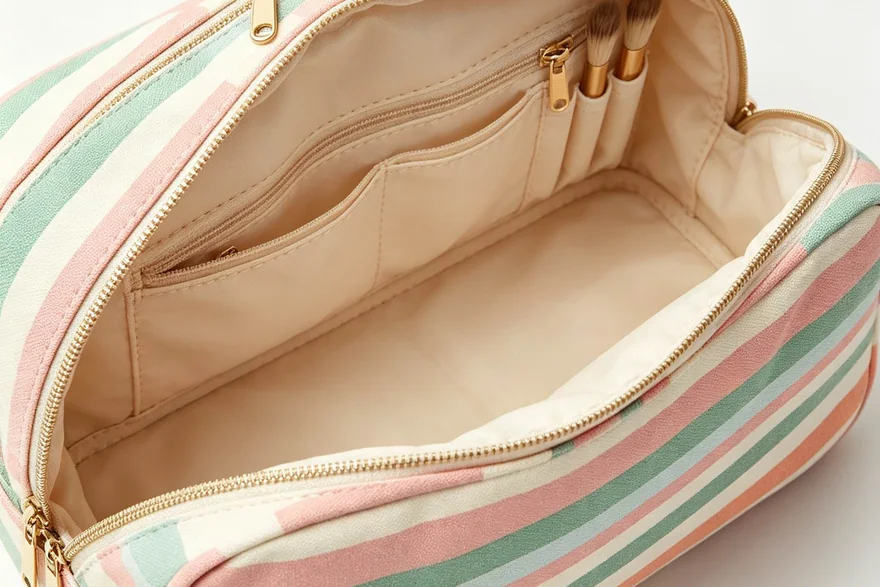
Interior layout should be shallow and obvious. Crew pack the same items every time, so a fixed arrangement beats adaptable space: three or four slip pockets at 10-12 cm depth for items used daily, two elastic loops at 20-25 mm for a toothbrush and paste, and one zip pocket for small items that otherwise migrate. Anything deeper than about 12 cm becomes a place where items disappear, which is exactly the problem at an early report time.
- Give liquids their own removable clear pouch; it is the single most valued feature in crew use.
- Keep packed depth under 7 cm so the bag shares a crew case without crowding it.
- Specify a 270-degree clamshell zip with two pullers for hanging access.
- Use fixed shallow pockets rather than deep adaptable space, because crew pack the same kit every time.
- Add a name or ID panel: crew bags are issued in batches and look identical.
Materials, hardware and the abrasion reality of rotation
A crew bag fails at its hardware long before it fails at its fabric. Zips cycle several times a day, hooks take the full weight of a filled bag from a thin door hook or a towel rail, and corners abrade against the inside of a roller case on every transfer. Specifying a heavier shell while leaving a number 3 zip and a plastic hook in place produces a bag that looks intact and stops working, which is the worst outcome for an issued item.
| Component | Light-duty option | Rotation-duty option | Why it matters for crew |
|---|---|---|---|
| Shell fabric | 210D polyester, 120-150 g/m² | 600D polyester with PU coating, 230-260 g/m² | Resists abrasion from repeated packing against uniform items |
| Alternative shell | 420D nylon, 190-220 g/m² | 420D nylon with PU backing and DWR finish | Lighter at equal abrasion resistance; packs flatter |
| Main zip | Number 3 coil, nylon puller | Number 5 coil, metal puller, 25-30 mm | Cycled several times daily; the most common failure point |
| Hanging hook | Injection-moulded plastic hook | Zinc-alloy swivel hook, 30-40 mm opening | Carries the full filled weight from a narrow fixing |
| Lining | 190T plain polyester | 210D with 0.20 mm TPU film | Residue and spills between sectors |
| Base and corners | Unlined base, no reinforcement | 2 mm EVA board, bound corners, 4-6 mm studs | Slides in and out of a roller case on every duty |
Coated fabrics are worth specifying deliberately rather than by default, and coating behaviour is described in standards such as ASTM D751, which gives buyers test methods for coated fabric rather than adjectives. Abrasion and fastness behaviour can be checked against AATCC test methods, and hardware terminology for zips is standardised in ASTM D2053, so a specification can be written in language that any production floor reads the same way.
Colour and finish also carry operational weight. Crew bags are handled by baggage systems, ground staff and crew in equal measure, so a mid-dark shell in a matte finish hides scuffing better than either black, which shows dust, or a pale shade, which shows everything. Reflective piping or a small printed identification panel helps in a dark crew room and costs under 0.30 dollars per unit.
Weight still counts, because a wash bag is carried on top of everything else. A 24 cm hanging bag in 600D coated polyester with a metal hook, board base and TPU lining weighs 300-420 g empty; the same design in 420D nylon with PU backing comes in around 240-320 g. Shaving 80-100 g sounds marginal until it is multiplied across a case that also carries uniform shoes and documentation on every rotation.
- Upgrade hardware before fabric: the zip and hook fail first in daily rotation use.
- Specify a number 5 coil zip with a metal puller and a zinc-alloy swivel hook.
- Reinforce the base and corners, which abrade against the inside of a crew case.
- Balance weight against durability; target 240-420 g empty depending on shell choice.
- Write the specification in standard test-method language so that any production floor quotes the same thing.
Programme mechanics for airline and crew-supply buyers
Crew bags are bought in three distinct patterns, and each one has a different volume shape. The first is new-intake issue, where every cadet or new hire receives a bag as part of a kit. The second is replacement and refresh, where bags are reissued on a cycle or on request. The third is recognition and gifting, where bags are given at long-service milestones, at base openings or as part of a uniform change.
| Buyer type | Typical order shape | Bag specification | Programme note |
|---|---|---|---|
| Airline crew issue | 500-5,000 pieces per intake | 24 cm hanging bag, crest print, name panel | Order against the training calendar, not the marketing calendar |
| Training academy | 100-600 pieces per cohort | Slim 22 cm pouch with academy mark | Cohort dates repeat, so reorder fidelity matters most |
| Uniform and crew supplier | 1,000-3,000 pieces per year | One body, several marks per customer | Neutral shell with a reserved print area |
| Pilot and technical crew variant | 200-800 pieces | 26 cm case, fewer pockets, darker shade | Same body family, different interior |
| Recognition and milestone gifting | 200-1,000 pieces per event | Structured 26 cm case with debossed patch | Presented in a box, so appearance outweighs packability |
Volumes sit comfortably inside the standard rule of 500 pieces per style and colourway, and most crew programmes order well above it. The practical constraint is usually colourway rather than quantity: one body in three role shades is a 1,500-piece commitment, so programmes with several crew categories commonly hold one body and one shade and differentiate by print, binding or name panel instead.
Timing follows the training calendar, which is unforgiving because a cohort date cannot move. Sampling takes 6-10 working days, or 12-15 working days where tooling for a debossed patch or a custom puller is involved, sample approval adds 10-15 days, and bulk production runs 35-50 days after approval. Inspection is carried out to AQL 2.5 under ISO 2859-1, with reports issued before shipment, which matters when goods are going straight into a kitting line. Shipments leave FOB Xiamen against T/T terms of 30 deposit and 70 against bill of lading.
Approval is the step that most often slips. An airline mark usually has to pass a brand review before artwork is released, and that review sits outside the production schedule altogether. Build 10-20 days for it into the plan and supply artwork in vector form with the Pantone reference named, because a bitmap logo redrawn at the sampling stage adds a round trip that a cohort date will not absorb.
Kitting is the last step and the easiest to underplan. Bags arriving in cartons have to be unpacked, checked, name-panelled and packed into crew kits alongside other issue items. Programmes that request cartons pre-sorted by cohort or by base remove a full handling step, and a packing list inside each carton costs nothing when it is asked for before bulk production starts.
QUANZHOU JUNYUAN BAGS coordinates crew bag programmes of this kind, holding specification, sampling and inspection together so that a replacement order for a later cohort matches the bags issued to the first. Programme enquiries go to service@junyuanbags.com.
The B2B Customisation View
Launch calendars are unforgiving, so cosmetic pouches, vanity cases and beauty organisers programmes are planned backwards from the on-shelf date rather than forwards from the first sketch.
Fixed commercial parameters: 500 pieces per style and colourway minimum, first sample in 6–10 working days (12–15 for complex or hardware-intensive constructions), bulk 35–50 days after approval, AQL 2.5 inspection under ISO 2859-1, FOB Xiamen, T/T 30/70.
A sourcing and programme-management company is answerable for the whole file, not just the sewing, which is why inspection reports and compliance documents are issued with every shipment.
Which Brand Types Benefit Most
Crew bag programmes attract a specific mix of buyers. Airlines and their uniform and crew-supply partners buy against the training calendar and care most about reorder fidelity, because a bag issued to one cohort has to match the bag issued to the next. That puts documentation above design novelty: a frozen tech pack, a retained Pantone reference and an inspection report on every shipment are worth more to this buyer than a new feature. Crew issue also carries a rolling replacement cycle, so the programme never really closes: bags are lost, damaged and retired continuously.
Other buyers use the same product family differently. Established travel and luggage brands sell a crew-inspired hanging wash bag to consumers and use the specification as a marketing position, which means the retail version can carry more finishing detail than an issued one. E-commerce sellers list the bag as a travel organiser and compete on dimensions, hook quality and review photography, so the hook and the hanging shot carry disproportionate weight. Gift and hospitality buyers, including hotel groups and conference organisers, buy hanging wash bags as in-room or delegate amenities, where the useful life may be a single stay and priority shifts to how the bag looks hanging in a bathroom. Start-up brands rarely enter here first, because the category rewards documented durability over novelty. Across every one of these buyers, the hook and the removable clear liquids pouch are the two features that generate the most comment from end users, and they are also the cheapest to specify well.
- Airlines and crew suppliers: reorder fidelity and inspection reports over design novelty.
- Uniform distributors: one neutral body with a reserved print area for several customers.
- Travel and luggage brands: crew-inspired retail versions with more finishing detail.
- E-commerce sellers: hook quality and hanging photography drive conversion.
- Hospitality buyers: appearance in a bathroom over long-term durability.
Frequently Asked Questions
What size toiletry bag works best for cabin crew?
A 24 cm hanging bag with a closed depth under 7 cm is the practical standard. It holds a full wash kit, fits inside a crew roller beside uniform items and opens fully when hung. Larger 26-28 cm cases suit pilots and technical crew or longer layover patterns, but they compete for space in an already full case.
Why does a crew toiletry bag need a removable liquids pouch?
Because liquids have to be presented separately at screening. Under the TSA 3-1-1 rule, containers are limited to 100 millilitres held in one quart-sized clear bag per passenger. A removable 20 x 18 cm TPU pouch lets crew present liquids one-handed rather than unpacking the whole bag at every checkpoint. Make the pouch removable rather than fixed, because a clear panel wastes usable space once the bag is past the checkpoint.
Which zip specification suits a bag opened several times a day?
A number 5 coil zip with a metal puller and a 270-degree opening path. Number 3 chain saves a little weight but is the most common failure item in daily rotation use. Zipper terminology is standardised in ASTM D2053, which lets a specification be written so that every quotation describes the same component. Specify two pullers on a clamshell path so the bag can be worked from either side while hanging.
What hanging hook should be specified for crew use?
A zinc-alloy swivel hook with a 30-40 mm opening, bar-tacked to a webbing anchor rather than sewn directly into the shell. Injection-moulded plastic hooks are lighter but are the second most common failure point after the zip, especially when a filled bag is hung from a narrow door hook. Ask for the hook to be bar-tacked to a webbing anchor rather than sewn straight into the shell panel.
How much should a crew wash bag weigh when empty?
Target 240-420 g. A 24 cm bag in 600D coated polyester with a metal hook, board base and TPU lining sits at 300-420 g; the same design in 420D nylon with PU backing comes in around 240-320 g. That saving matters when the bag is carried alongside uniform shoes and documentation on every rotation. Weigh the finished sample rather than estimating from the fabric specification, since hardware adds more than expected.
What minimum order applies to a crew bag programme?
The minimum is 500 pieces per style and colourway. Most crew programmes order above that, since a single intake can account for 500-5,000 pieces. The real constraint is colourway: one body in three role shades is a 1,500-piece commitment, so most programmes hold one shade and differentiate by print or name panel. Recognition gifting runs smaller and is usually ordered as a separate and less frequent block.
How long does a first crew bag order take?
Allow three to four months from locked brief to delivery. Sampling takes 6-10 working days, or 12-15 where custom pullers or debossed patches need tooling, approval adds 10-15 days, bulk runs 35-50 days, inspection takes 3-5 days and sea freight adds 25-40 days. Air freight at 5-8 days is the fallback. Cohort and training dates cannot move, so the buffer belongs before sampling rather than after bulk production.
Should crew bags be embroidered or printed with an airline mark?
Print is usually better for issued bags, because a flat surface wipes clean and takes a fine crest without added weight. Embroidery reads as premium and suits recognition gifting, but it holds residue in the stitch face. A middle route is a printed crest plus a woven label at the side seam. Where embroidery is used for recognition gifting, keep the stitch count between 8,000 and 15,000 to control cost.
How are crew bags kept identifiable across a large crew?
A name panel or a sewn label of around 20 x 50 mm is the cheapest answer, since hundreds of identical bags are issued at once. Programmes also differentiate by role using binding tape or zip pull colour rather than by ordering different bodies, which keeps the order inside a single colourway minimum. A printable slip pocket is the cheapest option and survives a wipe-down better than an exterior print.
What lining should be specified for a crew wash bag?
A 210D polyester lining with a 0.20 mm TPU film, or a coated plain weave at 190-210 g/m². An uncoated 190T lining absorbs spills and is the first visible failure point in service. The upgrade costs 0.30-0.60 dollars per unit and materially extends the usable life of an issued bag. Taped internal seams matter as much as the lining film, because a stitched seam line holds residue.
Is a hanging bag or a flat pouch better for crew?
A hanging bag suits crew who work from a hotel bathroom each night; a flat pouch suits crew who keep everything inside a roller and unpack on a counter. Many programmes issue the hanging bag at 24 cm and offer the pouch as a lighter alternative for short-haul patterns where no overnight bag is carried. Programmes covering both patterns usually issue the hanging bag and offer the pouch as an alternative.
How is abrasion resistance specified for a crew bag shell?
Reference standard test methods rather than adjectives. Coated fabric behaviour is described under ASTM D751, abrasion and fastness under AATCC test methods, and a shell at 600D with PU coating at 230-260 g/m² is the common baseline. Bar-tacked stress points at the hook and handle matter as much as the fabric choice. Ask for the test method to be named in the tech pack so that every quotation describes the same thing.
Can one bag body serve cabin crew, pilots and ground staff?
Yes, with interior variation. One shell in one shade can be built with a 24 cm hanging interior for cabin crew, a 26 cm case interior with fewer pockets for pilots, and a simpler pouch interior for ground staff gifting. That keeps the order at one colourway per 500 pieces while meeting different working patterns. Interior variation is cheaper than separate bodies and keeps the programme on a single fabric lot.
What unit price should a crew wash bag be budgeted at?
Across the category unit prices run from about 0.45 dollars for a simple pouch to around 12.00 dollars for a structured case with hardware. A 24 cm hanging crew bag with a coated shell, TPU lining, number 5 zip and metal hook typically lands in the 4.00-8.00 dollar range at volume. Custom pullers and debossed patches add tooling and push sampling toward the 12-15 working day range.
How does a replacement order match the original issue?
Keep the tech pack, Pantone reference, fabric lot and hardware references on file and reissue them with each reorder. Sampling before bulk takes 6-10 working days and confirms shade and hardware before a large commitment. Inspection to AQL 2.5 under ISO 2859-1 catches variation before goods ship. Keep a preserved reference sample from the original run and compare the new shipment against it on arrival.
Do crew bags need a clear liquids compartment on every variant?
On any variant carried through a staff checkpoint, yes. Recognition and gifting cases that never travel on duty can omit it and spend the money on a debossed patch or better lining. Where the pouch is included, make it removable, since a fixed clear panel wastes space once the bag is past security. Recognition and gifting cases that never travel on duty can omit the pouch entirely.
People Also Ask
What do flight attendants keep in their toiletry bag?
A working kit holds travel-size liquids under 100 ml, oral care, skincare, hair items and a small first-aid or medication pouch. Crew pack the same items every time, so fixed shallow pockets at 10-12 cm depth work better than deep adaptable space, with two 20-25 mm loops for a toothbrush and paste. Liquids stay in a removable clear pouch so they can be presented at screening without unpacking the bag.
How big should a flight attendant toiletry bag be?
Around 24 cm wide, with a closed depth under 7 cm so it packs flat inside a crew roller next to uniform items. Pilots and crew on longer layover patterns can use a 26 cm case. Anything deeper competes for space in a case that already carries shoes, a uniform jacket and documentation. Keep the packed depth under 7 cm so the bag shares a crew case without crowding uniform items.
Why do crew bags need a hanging hook?
Counter space in aircraft lavatories and hotel bathrooms is minimal, and a bag set on a surface gets wet or displaced. A zinc-alloy swivel hook with a 30-40 mm opening takes the full filled weight from a narrow fixing and lets the bag open fully for access. Specify a bar-tacked webbing anchor, because a hook sewn straight into the shell panel is a common failure point.
Are hanging toiletry bags worth it for frequent flyers?
For anyone packing and unpacking several times a week, yes. The value is in speed: a clamshell zip, a fixed pocket layout and a removable clear liquids pouch remove the small delays that accumulate at screening and in a hotel bathroom. Occasional travellers gain less from the hook and more from packed size. The removable liquids pouch is the second feature that pays back quickly at a staff checkpoint.
Request a Sample or a Written Quotation
Send the silhouette, dimensions, material preference and logo artwork, and the programme team will return a written quotation with MOQ, sampling window, bulk lead time and inspection standard.
Email: service@junyuanbags.com · WhatsApp: +86 177 5002 0688