Toiletry Bags for Outdoor Enthusiasts: Camping & Hiking
Executive Summary
Toiletry bags for outdoor enthusiasts should keep a compact hygiene kit organised through pack compression, damp ground, shared wash areas and limited hanging options. The best design is lightweight, easy to open with cold or wet hands, and honest about water protection. A 20 × 13 × 7 cm pouch suits a minimal hiking kit, while a 24 × 16 × 9 cm hanging organiser supports campsite or vehicle-based use. Coated fabric, raised seams and a protected base can resist splashes, but a sewn zippered bag should not be called waterproof without a defined construction and test.
Camping and hiking create different priorities. A hiker values low mass, smooth pack integration and only essential pockets; a camper may accept more structure, a mirror sleeve and a broader hanging panel. Both benefit from quick-drying lining, drainage-aware geometry, visible interior contrast and a hook that works on varied anchor points. The specification should define fabric weight, coating, seam type, zipper behaviour, loaded hanging performance and care. Toiletries still need appropriate containers, and scented contents should be stored according to local campsite or land-manager guidance rather than left hanging unattended.
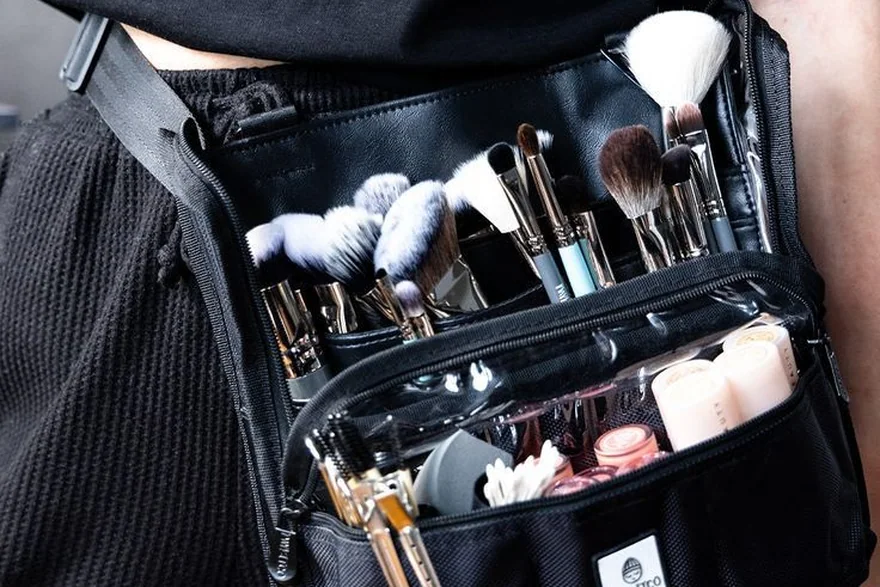
Hiking, campsite and vehicle routines create three different bags
Outdoor use is not one setting. A hiker carries every gram, packs the toiletry pouch among food, shelter and layers, and may use it briefly at a distant wash point. A campsite user can store a larger kit in a tent vestibule or communal wash area. A vehicle-based traveller may keep full-size bottles and wants rapid access during repeated stops. The product brief should select a primary route because structure, volume and hook size rise quickly when every scenario is combined.
A minimal trail pouch around 20 × 13 × 7 cm can hold toothbrush, paste, compact soap, sunscreen, small hygiene items and a lightweight cloth. A 24 × 16 × 9 cm hanging organiser adds bottle sleeves and separated wet storage for campsite use. Vehicle-based kits may reach 28 × 18 × 11 cm, but that capacity is less suitable for a backpack. The correct comparison is packed volume and mass, not external dimensions alone. Foam, mirrors, large metal hooks and duplicated pockets all consume payload.
Outdoor hygiene also requires behavioural context. A hanging bag offers access, but scented toiletries should not remain unattended where local rules require protected storage. A wipe-clean liner supports maintenance, yet the user still needs to remove damp items and dry the bag open. Product copy should distinguish water-resistant fabric from waterproof construction and should avoid claims about wildlife deterrence, sanitation or safety that the pouch itself cannot deliver. Clear limits build more trust than a long list of adventure adjectives.
Season and group size further change the object plan. Cold-weather users may operate pulls with gloves and carry thicker balm, while a warm campsite routine may include more sunscreen and a damp cloth. A shared household kit needs visible item separation and clear ownership cues but should not become so broad that it is awkward at a wash point. Define trip duration, user count, resupply pattern and expected water access before converting an outdoor label into pocket dimensions.
Coated fabric performance depends on seams, folds and closure placement
A face fabric may repel a splash while stitched seams and zipper tape admit water. That is why a coating specification cannot establish finished-bag waterproofing by itself. Common options include 210D or 420D nylon with PU backing for low mass, 300D or 600D polyester for a sturdier campsite feel, and TPU-laminated fabric for a smooth wipeable zone. State face construction, target weight in g/m², coating or film type and intended finish. Then map every seam in relation to the lowest point where water could collect.
The ASTM D751 coated-fabric methods cover several properties relevant to coated textiles, including hydrostatic resistance, adhesion and strength. Buyers can select suitable methods and acceptance criteria for the material rather than citing the standard as a blanket finished-product guarantee. Finished construction needs its own defined splash or containment procedure because needle holes, binding, zipper ends and folded corners do not appear in a flat fabric result.
Seam strategy follows the claim. Bound sewn seams are light and economical but create needle paths. Seam tape can improve selected areas if the coating, curvature and tape chemistry are compatible. Welded TPU panels remove stitching in a removable liquid pouch but add stiffness and visible fold behaviour. For a trail pouch, raising the zipper 15 to 20 mm above the base and using a coated bathtub-style lower panel often provides more practical splash resistance than adding heavy tape to every upper seam.
Closures need gloved or wet-hand operation without exaggerated bulk. A reverse-coil zipper with a 45 to 55 mm textured pull presents a clean face and sheds light splashes, but it is not watertight. A roll-top inner dry pouch can isolate particular contents, although it adds steps and should not replace approved storage for sensitive items. Drainage eyelets may help a shower caddy, yet they undermine containment. The same compartment should not be specified simultaneously to drain quickly and hold a leak.
Coating performance can change at cold folds and hot vehicle storage, so conditioning should reflect the intended trip rather than a single room-temperature review. Flex the coated sample repeatedly at corners, compress it beneath normal kit weight and inspect for whitening, tackiness or layer separation. A dark coating may also heat quickly in direct sun. The care label should discourage exposure conditions that exceed the approved use, without presenting the pouch as protective storage for temperature-sensitive contents.
| Construction decision | Mass impact | Water pathway controlled | Water pathway remaining | Best-fit trip |
|---|---|---|---|---|
| 210D PU-backed nylon body | Low | Face-fabric splash | Sewn seams and zipper | Minimal hiking |
| 600D coated polyester base | Medium | Ground splash and abrasion | Base seam perimeter | Campsite organiser |
| Raised zipper line | Minimal | Standing water at lower panel | Zipper exposure from above | Trail and camp |
| Welded TPU removable pod | Medium | Needle holes in pod body | Closure opening | Shared wash area |
| Selective compatible seam tape | Medium | Chosen stitched seams | Untaped curves and hardware | Wet-weather camping |
- Specify the finished-bag claim separately from the coated-fabric requirement.
- Raise closure paths above likely standing water before adding material weight.
- Choose drainage or containment for each compartment; demanding both creates a contradiction.
- Test coating and seam-tape compatibility after folding, not only on a flat new panel.
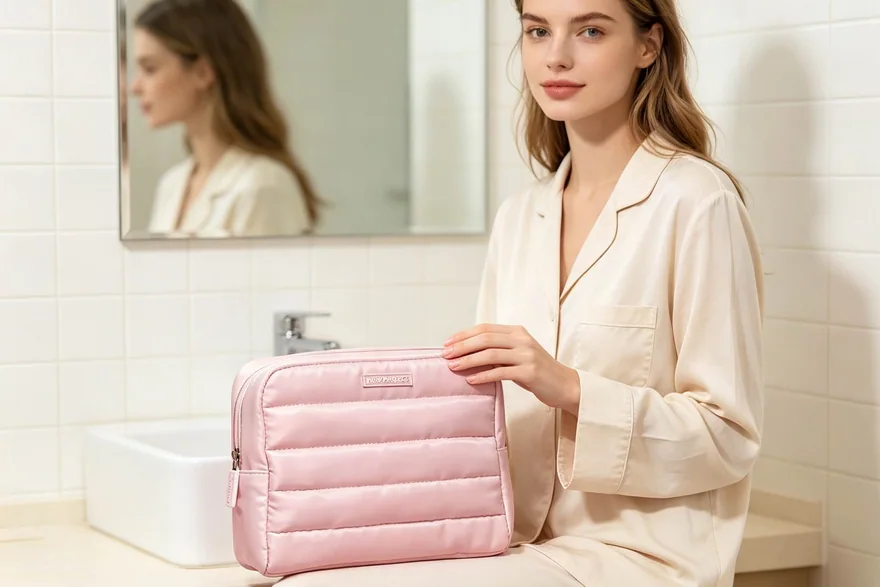
Pack geometry and hanging hardware must work beyond a bathroom door
A hiking pouch should slide into a pack gap without hard projections. Rounded corners, a recessed handle and soft webbing loops prevent snags on mesh pockets and lightweight clothing. Semi-structured foam is often unnecessary; a double-layer base and light binding can supply enough shape. Campsite organisers can accept a thin stiffener in the hanging panel so pockets do not collapse when suspended. The panel should fold without forcing the hook against a transparent pocket or mirror sleeve.
Outdoor anchor points vary: a narrow cord, branch, shower rail, cubicle hook or vehicle grab handle. A rotating hook with a broad throat covers more situations but adds weight and can press into the packed bag. A webbing loop is lighter and quieter but requires an existing hook or a separate connector. A removable gate hook offers flexibility if it has no sharp edge and remains tethered to avoid loss. Buyers should define two or three intended anchors and test those, rather than call a hook universal.
Loaded hanging geometry determines pocket function. Heavy bottles belong near the top or close to the hanging plane; placing them at the lower outer edge pulls the panel away from the anchor and makes it swing. Mesh pocket openings should face upward and include enough elastic tension to retain items when the organiser moves. A shelf-like middle pocket can hold soap temporarily, but it should drain or be removable for drying. A mirror, if included, should be a lightweight non-glass insert in a protected sleeve and described by material rather than as unbreakable.
Field access favours tactile differentiation. A large ridged main pull can be found with wet hands; a short smooth tab identifies the internal pocket. Bright lining helps reveal dark caps in dawn or evening light, while an orange or lime loop can mark the hanging point without turning the whole shell into a high-visibility product. If reflective trim is included, describe it as a visual detail unless supported by a defined performance evaluation. No cosmetic bag should be positioned as emergency signalling equipment.
Pack integration should also be tested after the pouch is partly emptied. A half-full soft bag can sag around a rigid hook, allowing the hardware to press against nearby equipment. A small padded keeper or an inward-folding hook pocket can isolate it. Compression straps should pass over flat body panels rather than bottle caps, and the pouch should retain one obvious grab point when wedged between layers. These details matter more on trail than a freestanding showroom silhouette.
| Outdoor anchor | Hardware option | Packed penalty | Stability behaviour | Design check |
|---|---|---|---|---|
| Narrow shower hook | Webbing hang loop | Very low mass | Stable if loop is centred | Loop clearance and wet grip |
| Rail or branch | Rotating broad-throat hook | Higher mass and bulk | Adapts angle but may rotate | Loaded rotation and edge finish |
| Tent internal loop | Small removable gate hook | Moderate | Good if load stays close | Gate closure and tether |
| Vehicle grab handle | Adjustable webbing strap | Moderate length bulk | Controls height well | Buckle slip under load |
| Flat ground or shelf | Reinforced standing base | Added panel mass | Independent of anchor | Tip resistance and wet surface |
A hook that fits a household towel rail may fail on a narrow campsite loop. Put the exact throat dimensions and intended anchor examples into the brief.
Trail hygiene relies on quick drying, simple cleaning and careful claims
A toiletry bag returns from outdoor use with dust, sunscreen, soap residue and moisture. Smooth coated lining and rounded internal corners make these easier to remove. Light or bright lining reveals dirt and small objects but may show permanent pigment, so a mid-tone yellow, pale grey or light blue can balance visibility and care. A removable soap or wet-item pod should turn outward for wiping and hang independently. Foam-backed walls slow drying and are best reserved for vehicle-based styles that genuinely need structure.
Care guidance should state the steps: empty the pouch, shake out dry debris, wipe or rinse only the approved component, and dry fully open away from excessive heat. A machine-wash claim needs evaluation of coating, seam tape, stiffeners, hook, zipper and decoration together. Coatings can crease or delaminate, and metal parts can damage other laundry. For many outdoor organisers, a detachable rinseable pod plus a wipe-clean shell gives a simpler, more defensible routine than immersing the complete bag.
Responsible-material claims also require traceability. If a range uses recycled polyester or nylon, GRS and RCS information from Textile Exchange describes recognised approaches to recycled-content chain of custody. Buyers should request documentation tied to the actual material and order before publishing a claim. Recycled input does not automatically establish durability, waterproofing or lower impact in every measure; those statements require separate evidence.
Field testing should combine packed handling and cleaning. Compress the pouch in the intended pack zone, remove it with wet hands, hang it from the stated anchors, operate all closures, place it on damp ground for the defined period, then clean and dry it using the label method. Inspect coating whitening, seam seepage, hook distortion, zipper grit, colour transfer and retained moisture. Final acceptance can use AQL 2.5 under ISO 2859-1, with outdoor functional defects classified before inspection.
Repairability can be considered without promising indefinite service. A removable hook, replaceable tether and simple pull cord are easier to change than hardware trapped inside several laminated layers. At the same time, detachable parts need secure storage and order records. The brief should identify which components are intended to be removable and which must remain permanent, then ensure consumer instructions do not encourage disassembly that exposes sharp ends or compromises the seam treatment.
| Field residue | Surface response | Preferred geometry | Care action | Claim caution |
|---|---|---|---|---|
| Trail dust | Smooth coated liner | Few seam ledges | Shake, then wipe | Dustproof requires evidence |
| Sunscreen and balm | TPU or compatible coated pocket | Rounded corners | Wipe with approved method | Chemical resistance is material-specific |
| Damp soap | Removable openable pod | Turnable shallow form | Rinse and hang dry | Do not promise odour prevention |
| Ground moisture | Reinforced coated base | Raised zipper and base seam | Wipe exterior, dry open | Water-resistant is not waterproof |
| Zipper grit | Reverse coil with broad access | Gentle curves | Brush according to care guidance | No jam-proof claim |
- Remove foam and stiffening from ultralight styles unless the object list demonstrates a need.
- Design wet components to open fully and dry separately.
- Tie recycled-content language to order-level documentation.
- Classify seam leakage, detached hooks and blocked closures as functional issues in the inspection plan.
The B2B Customisation View
The commercial logic behind makeup bags and toiletry bags is simple to state and hard to execute: hold the unit cost, hold the colour, hold the delivery window.
Commercial parameters stay fixed across the range: MOQ 500 pieces per style and colourway, prototype turnaround 6–10 working days (extended to 12–15 for multi-panel or moulded builds), bulk lead time 35–50 days from approved sample, AQL 2.5 inspection to ISO 2859-1, FOB Xiamen, T/T 30 deposit and 70 against bill of lading.
For makeup bags and toiletry bags, that coordination matters most in the two weeks between packing and vessel loading, when documentation errors cost more than any material decision.
Which Brand Types Benefit Most
Start-up outdoor brands can choose one clear use case—minimal trail pouch or hanging campsite organiser—and avoid a hybrid burdened by every hook and divider. Established equipment brands can repeat pack colours, webbing widths and pull shapes while stating water claims with the same discipline used elsewhere in the range. Retailers should merchandise by trip mode and packed mass; e-commerce sellers need folded and open dimensions, component weights, anchor examples and a plain explanation of water-resistant versus waterproof. Gift and hospitality buyers serving camps, lodges or vehicle tours can use a modest patch or presentation band, keeping the permanent product light and broadly useful. A simple, durable field-care card can add more practical value than ornamental hardware.
The minimum order is 500 pieces per style and colourway. Standard soft trail pouches sample in 6-10 working days, while complex hanging constructions with welded pods or custom hooks need 12-15 working days. Bulk production takes 35-50 days after sample approval. Inspection is AQL 2.5 under ISO 2859-1, shipping is FOB Xiamen, and payment is T/T 30 deposit, 70 against bill of lading. Freeze the packed object list, target dimensions, component weight budget, coating specification, seam map, hook drawing, care label and performance claim before approval. A field-style test on the approved sample should precede bulk authorisation when hanging and water exposure define the product.
After launch, reviews should identify the trip type, weather exposure, pack position and anchor used. Reports that a hook rotates on a thin cord require a different response from reports that a coating marks after vehicle storage. Keeping these contexts attached to return data supports focused revisions. It also helps retailers direct a minimal pouch to hikers and a structured hanging version to campsite users instead of presenting both as interchangeable outdoor equipment.
Frequently Asked Questions
What size toiletry bag works for lightweight hiking?
A pouch around 20 × 13 × 7 cm can carry a concise set such as toothbrush, paste, compact soap, sunscreen, small hygiene items and a light cloth. Confirm the actual object list and packed mass before fixing dimensions. Avoid deep pockets, heavy mirrors and oversized hooks in a hiking style. A soft rounded form fits pack gaps better than a rigid case and creates fewer snag points.
How is a camping toiletry bag different from a hiking pouch?
A camping organiser can accept more capacity, structure, bottle sleeves and a broad hanging panel because it may travel by vehicle or remain at a base camp. A hiking pouch prioritises low mass, compression and simple access. The two formats may share fabric and colour, but their hooks, pocket counts and stiffening should differ. Selecting a primary trip mode prevents a heavy compromise that serves neither route particularly well.
Which coated fabric suits a trail wash bag?
A 210D or 420D PU-backed nylon keeps mass low, while 300D or 600D coated polyester provides a sturdier campsite feel. TPU-laminated fabric is useful for a smooth removable wet pod. Fibre and denier do not define performance alone; specify weight, coating type, finish and relevant test criteria. Review folds and seams because flat-material water resistance does not establish waterproof finished construction.
Why is a water-resistant toiletry bag not necessarily waterproof?
Water-resistant face fabric can slow splash entry, but stitching holes, zipper tape, binding and hardware openings remain pathways. Waterproof is a finished-construction claim that needs a defined method and evidence. A raised zipper, coated lower tray and selected seam treatment can improve practical resistance. Product copy should explain the intended exposure rather than imply that a normal sewn bag protects contents during immersion.
How should a campsite organiser hang from different anchors?
Choose an attachment after listing intended anchors. A broad rotating hook fits rails and some branches but adds weight; a webbing loop is light but needs an existing hook; a tethered gate hook fits narrow loops. Publish throat or loop dimensions where useful. Test the filled organiser on representative anchors and watch rotation, panel sag and pocket spill instead of calling any hook universal.
What zipper pull works with wet or cold hands?
A textured pull about 45 to 55 mm long provides more contact area than a small metal tab. A moulded ribbed shape or cord with a semi-rigid end can stand away from the bag. Broad zipper curves and correct slider alignment remain essential; a large pull cannot correct a binding track. Evaluate the filled pouch with damp hands and gloves representative of the intended use, without promising universal operation.
Which pockets belong in a lightweight outdoor hygiene kit?
Use one main cavity, a shallow visible pocket for small items and, if required, a removable wet or soap pod. Elastic loops are worthwhile only for bottles that appear in the agreed packing list. Each divider, zipper and binding adds mass and drying time. A minimal trail pouch should not copy the multi-layer architecture of a large bathroom organiser merely to increase the advertised pocket count.
How can a toiletry bag dry faster after camp use?
Use smooth unpadded lining, a broad opening and removable wet components that can hang independently. Minimise deep corners and absorbent foam. Empty the bag promptly and follow its care instructions, drying it fully open away from excessive heat. Mesh can improve airflow for damp accessories, but it does not contain liquid. Design should make drying convenient without making unsupported odour, antimicrobial or hygiene claims.
When is a welded TPU pod useful outdoors?
A welded TPU pod is useful for soap, a damp cloth or leak-prone travel bottles when it can be removed and cleaned separately. Welding reduces needle holes in the pod body, although the closure remains a possible path. The film adds weight and can crease in cold or compressed packing. Use it selectively in campsite or shared-washroom styles rather than automatically adding it to an ultralight pouch.
What minimum applies to one camping-organiser colour?
The minimum is 500 pieces per style and colourway. A moss and a rust version of the same hanging organiser each require 500 pieces. Outdoor brands can simplify the first order by sharing lining, webbing and hardware while limiting body colours. Each colourway still needs review because dark shells, bright lining and hanging-loop contrast must work together under varied field lighting.
How long does an outdoor toiletry design take to sample?
A standard soft trail pouch samples in 6-10 working days. A complex hanging organiser with welded pods, custom hardware or taped seams needs 12-15 working days. Bulk production is 35-50 days after sample approval. Buyers should reserve review time for packed compression, wet-hand operation, loaded hanging and the approved care method, since a tabletop dimension check cannot validate field behaviour.
What should inspection cover on a hanging camping wash bag?
Inspect hook or loop attachment, upper-panel distortion, zipper function, pocket retention, seam condition, liner cleanliness and decoration alignment. Perform a loaded hang check on the approved anchor shapes and verify that heavy items do not pull pockets open. Final inspection follows AQL 2.5 under ISO 2859-1. Detached hardware, blocked closures and seam leakage against the agreed procedure should be classified as functional defects.
Why should scented toiletries not remain hanging at camp?
Storage practices depend on the location and rules set by the relevant land manager or campsite. A hanging toiletry organiser improves access but does not deter wildlife or replace protected storage where that is required. Product information can remind users to follow local guidance and return scented items to the appropriate storage location. Avoid wildlife-safety claims for a standard fabric bag unless a separate approved product and evidence support them.
How should recycled material claims be made for an outdoor pouch?
Request chain-of-custody documentation tied to the actual material and order, then use wording that matches the verified recycled-content scope. GRS or RCS frameworks can support recognised documentation routes. Recycled input does not automatically prove waterproofing, durability or an overall environmental advantage. Those are separate claims. Keep certificates, transaction evidence where applicable and approved material references with the programme records.
People Also Ask
What is the best toiletry bag for camping?
The best camping format matches the trip: a 24 × 16 × 9 cm hanging organiser for shared wash areas or a smaller soft pouch for basic sites. Look for a stable hanging panel, broad pull, visible lining, removable wet zone and clear care method. Treat coated fabric as splash resistance unless the finished construction has evidence for a stronger claim, and store scented contents according to local guidance.
Do hikers need a hanging toiletry bag?
Not always. A minimal hiker may prefer a light 20 × 13 × 7 cm pouch with a webbing loop, one shallow pocket and no stiffening. A full hanging panel adds hardware, layers and drying time. It becomes useful on longer trips with shared facilities or when several bottles need vertical organisation. Choose it only when the access benefit justifies the packed mass and volume.
Are camping toiletry bags waterproof?
Some may use highly water-resistant materials or specialised welded construction, but an ordinary sewn bag with a zipper should not be assumed waterproof. Face-fabric coating, seams, binding and closures all affect finished performance. Look for a defined test and exposure claim. A coated base, raised zipper and removable TPU pod can manage routine splash and small leaks without implying that the whole organiser is suitable for submersion.
How do you clean a hiking toiletry pouch?
Empty it, shake out dry debris, wipe the lining and shell with the approved method, rinse only removable components labelled for that treatment, and dry everything fully open away from excessive heat. Do not assume machine washing is suitable for coatings, seam tape, stiffeners or hardware. Broad openings and turnable wet pods make field residue easier to remove and reduce hidden damp areas.
Request a Sample or a Written Quotation
Send the silhouette, dimensions, material preference and logo artwork, and the programme team will return a written quotation with MOQ, sampling window, bulk lead time and inspection standard.
Email: service@junyuanbags.com · WhatsApp: +86 177 5002 0688