Hotel Branded Toiletry Bags: Amenity Program & Guest Experience
Executive Summary
How does a hotel run a branded toiletry bag amenity programme? It chooses one of three models and then specifies the bag to that model: a disposable guest pouch that leaves with the guest, a refillable in-room bag that stays and is laundered between stays, or a retail bag offered for sale at the desk. The refillable model is the one that depends on textile performance, because the bag enters an industrial laundry after every check-out.
Specification follows the laundering cycle. A shell that holds dimensional stability within an illustrative 3 per cent across repeated high-temperature washes, a closure that survives a tunnel washer and a tumble dryer, and colour fastness tested to ISO 105 and AATCC methods. Programmes start at 500 pieces per style and colourway, sample in 6-10 working days and run bulk in 35-50 days after approval, inspected to AQL 2.5 under ISO 2859-1. Par stock, reorder thresholds and written condemn criteria are what keep the programme running once it is on the property.
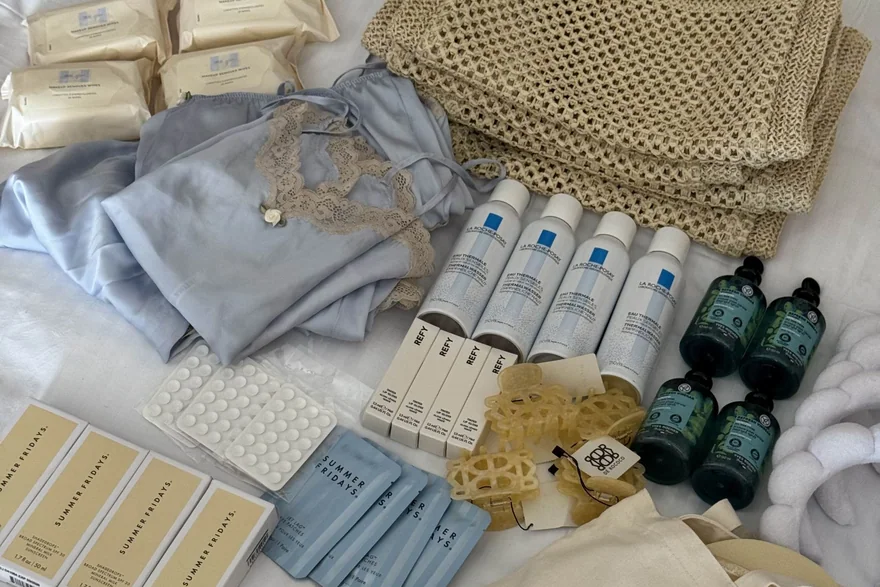
Three amenity models and what each one costs
A hotel branded toiletry bag is the one item in a guest bathroom that is touched, opened, judged and either taken home or left behind. Three programme models exist, and confusing them is the most expensive mistake a property can make, because each one implies a completely different bag. The disposable model hands the guest a sealed pouch that leaves with them. The refillable model keeps a durable bag in the room and launders it between stays. The retail model places a higher-specification bag in the room with a price tag.
Each model is measured differently at the property. A disposable programme is measured on cost per occupied room and on waste volume. A refillable programme is measured on laundering cost per stay, on bag service life measured in wash cycles, and on housekeeping minutes per room. A retail programme is measured on sell-through and margin. Only one of those three sets of numbers appears in the specification, so the model has to be chosen before the bag is written.
The format is familiar to guests already. The phrase travel bag for toiletries draws about 110,000 monthly searches, and toiletry bags draw roughly 74,810 weekly Amazon searches according to ASINSIGHT 2026.07, which means a guest does not need to be told what the object is. Typical unit price bands run $0.45 to $12.00 on Alibaba as of 2026.10, wide enough to cover a lightweight disposable pouch at one end and a structured retail case at the other.
Four decisions frame the programme. Which of the three models the property is running. How many industrial launder cycles the bag has to survive if it is refillable. What par stock the housekeeping department needs per room to keep the model running. And how the bag is presented at room turnover so that it reads as clean rather than as reused. Everything downstream follows from those four.
Properties comparing their own programme against others in the market should treat those comparisons as market observation only. Published amenity photographs, brand standards and competitor room setups are useful references for presentation and positioning; they say nothing about another operator's cost base, laundry contract or housekeeping structure, and copying a presentation without copying the operating model behind it usually produces a programme that looks right and costs too much.
Specifying for the laundering cycle
A refillable amenity bag is a textile that enters an industrial laundry after nearly every check-out. That environment is far harsher than a domestic machine: higher wash temperatures, alkaline detergents, an oxidizing bleach stage in many programmes, a tumble-dry or calender finish, and a cycle time measured in minutes rather than in an hour. A bag specified for a guest gift and a bag specified for 100 of those cycles share almost nothing.
| Shell option | Laundering tolerance | Dimensional stability | Colour behaviour across cycles | Typical position in a programme |
|---|---|---|---|---|
| 600D polyester, piece-dyed | Good to high temperature | Very stable; low shrinkage | Holds depth well; check rubbing | Refillable in-room bag |
| 420D polyester, PU-coated | Fair; coating is the limit | Stable shell, coating stiffens | Coating can dull or craze | Refillable budget tier |
| 12 oz cotton canvas, GOTS | Good if pre-shrunk | Shrinks without pre-shrinking | Fades gradually; reads as natural | Boutique refillable or retail |
| Recycled polyester, GRS | Matches virgin polyester | Very stable | Matches virgin polyester | Programmes with a recycled claim |
| TPU-laminated knit | Excellent; wipes and washes | Stable | Clear films can cloud | Wet-room and spa adjacencies |
| Nonwoven polypropylene | Single use; not laundered | Distorts when wet | Print rubs quickly | Disposable guest pouch |
Dimensional stability should be written into the specification as a number rather than a hope. An illustrative acceptance criterion is no more than 3 per cent change in any dimension after five launder cycles under the property's own conditions, with the bag measured flat and unloaded before and after. Canvas, in particular, should be specified pre-shrunk, and the sample should be washed at the property or by the property's laundry contractor before the bulk order is released rather than after.
Colour behaviour is the second specification that fails late. Chlorine and oxygen bleach attack dyes unevenly, so a deep navy or a saturated brand red will drift visibly by cycle twenty while a mid-tone or a heathered ground hides the change. The test methods for colour fastness to washing, rubbing and light are set out under ISO 105, and the laundering and perspiration methods used in North American supply chains are published by AATCC test methods.
Hardware is where a laundered bag most often dies. A metal puller scratches dryer drums, corrodes in a bleach stage and can rust-mark a pale lining, so a refillable programme should specify a moulded or cord puller on a nylon coil zipper, with the bag closed before it enters the wash. Bar-tacked webbing loops survive; rivets and eyelets should be specified as rust-proof or omitted, and any stiffener should be removable or fully encapsulated.
- Wash the sample at the property or through the property's laundry contractor before releasing the bulk order.
- Write dimensional stability as a percentage limit after five cycles, not as a general expectation.
- Specify a moulded or cord zipper puller; avoid bare metal hardware in a bleach stage.
- Choose a ground colour that hides gradual dye drift, or accept a planned replacement point.
- Ask for colour fastness results to the ISO 105 or AATCC methods on the exact fabric and print combination.
A sensible test protocol is cheap and decisive. Order samples in the 6-10 working day window, run a small batch through five, ten and twenty-five cycles at the property, and record shrinkage, colour change, coating condition, zipper action and shape retention at each checkpoint. The cycle count at which the bag stops looking acceptable is the service life, and that number is what the programme's replacement budget should be built on.
Refill versus disposable programme economics
The comparison between the two models is a whole-year calculation, not a unit-price comparison. A disposable pouch is bought per occupied room and leaves with the guest. A refillable bag is bought once, amortised over its service life in wash cycles, and then carries a laundering cost at every check-out. Which is cheaper depends almost entirely on the laundry cost per piece and on how many cycles the bag actually survives.
As an illustrative planning calculation derived from stated assumptions, and explicitly not a measured result or a quoted price. Take an illustrative 200-room property at an illustrative 68 per cent occupancy with an illustrative 1.8-night average stay. That is roughly 49,600 occupied room-nights a year, or about 27,600 stays. A disposable pouch at an illustrative $0.55 to $0.95 per stay implies roughly $15,200 to $26,200 a year. A refillable bag at an illustrative $3.80 to $5.60 amortised over an illustrative 120-cycle service life costs roughly $0.03 to $0.05 per stay in replacement, or about $830 to $1,380 a year, plus illustrative laundering of $0.35 to $0.70 per stay, or roughly $9,660 to $19,320 a year, for an illustrative total of $10,490 to $20,700.
| Programme model | Where the cost sits | Housekeeping handling | Guest perception | Best fit |
|---|---|---|---|---|
| Disposable guest pouch | Unit price times occupied rooms | Place sealed pouch; no retrieval | Expected; little brand credit | High-turnover city hotels |
| Refillable in-room bag | Amortised unit plus laundering per stay | Collect, sort, send, re-place | Reads as considered if clean | Extended-stay and serviced apartments |
| Guest gift bag, kept | Unit price per stay, higher tier | Place at turndown or on arrival | Strong recall; taken home | Boutique and resort properties |
| Retail bag for sale | Landed cost against retail margin | Stock, price, replenish, reconcile | Commercial; no giveaway signal | Spa-adjacent and design-led hotels |
The illustrative ranges overlap, which is the honest conclusion: the refillable model wins when the laundry cost per piece is low and the bag genuinely lasts, and loses when either assumption fails. Buyers should therefore test the bag with the actual laundry contractor before committing, and should write the replacement point into the annual budget rather than discovering it when the first bags look tired.
Sustainability claims need documentation behind them. A recycled-content claim should be supported by a transaction certificate under the Global Recycled Standard, whose scope is published at Textile Exchange GRS, and an organic fibre claim by certification to the Global Organic Textile Standard, set out at GOTS. Without a certificate tied to the specific lot, the claim should not appear on a hangtag, a mirror sticker or a booking page.
One hybrid is worth naming because it is common and hard to specify. Some properties place a refillable bag in the room for the stay and offer the same design for sale at the desk, which turns the amenity into a retail line with no extra design cost. For that to work the in-room version has to survive laundering while the retail version does not, so the two are usually the same shell with different linings and different hardware. The retail version then carries a hangtag, a barcode and a presentation box, none of which the in-room version needs, which is how the price gap between the two is justified at the desk.
Hygiene presentation and room turnover logistics
In a bathroom, a bag is judged as cleanliness before it is judged as design. A guest opens it within minutes of arrival and reads it as a hygiene object, so the presentation standard matters more than the branding. A bag that is damp, creased, hair-marked or faintly scented of detergent will be pushed to the back of the shelf regardless of how good the specification is.
| Turnover checkpoint | Who checks | Pass criterion | Action if it fails |
|---|---|---|---|
| Exterior visual, one metre | Room attendant | No stain, no hair, no crease line | Return to laundry; re-place from par |
| Odour check at the opening | Room attendant | Neutral; no detergent or damp smell | Air and re-check, then re-launder |
| Closure function | Room attendant | Opens and closes in one pull | Withdraw from service |
| Interior residue | Room attendant | Dry, no powder, no glass | Re-launder or withdraw |
| Lining integrity | Housekeeping supervisor, weekly | No delamination, no split seam | Withdraw; log for replacement |
| Brand legibility | Housekeeping supervisor, weekly | Logo readable at arm's length | Withdraw; log for replacement |
Par stock is the number that keeps the model running. A refillable programme needs more than one bag per room, because at any moment some are in the room, some are in the laundry and some are in the store. An illustrative planning structure is three bags per room plus an attrition allowance of roughly 10 per cent, so a 200-room property plans around 660 units. A disposable programme is planned differently: a consumption figure based on forecast occupied rooms, held as a stock of cartons rather than as a per-room count.
Reordering should be triggered by a stock threshold rather than by a calendar. For a refillable programme the trigger is the point at which the store cannot cover a full laundry round plus a week of withdrawals; for a disposable programme it is roughly the lead time multiplied by the forecast daily consumption. With sampling at 6-10 working days and bulk at 35-50 days after approval, plus ocean transit and clearance, the practical reorder point for most properties sits two to three months ahead of the stock-out date.
Storage conditions are part of the specification even though they happen at the property. Cartons should be held off the floor in a dry, ventilated store, rotated first-in first-out, and kept away from cleaning chemicals, because coated fabrics and open-cell linings absorb odour. A stated carton count on the purchase order makes the stock take quicker and makes the reorder conversation with the sourcing partner a matter of cartons rather than of pieces.
Written condemn criteria close the loop and stop the standard drifting. A bag should leave service when a stain survives laundering, when the zipper skips, when a laminated lining delaminates, when the shell loses shape, or when the logo is no longer legible. Writing those five conditions into the housekeeping manual gives room attendants a decision they can make in ten seconds, which is the only kind of standard that survives a busy turnover day. Logging the withdrawals also produces the consumption figure the next reorder needs, which turns a subjective complaint about appearance into a number a procurement team can act on.
For the disposable and gift models, the bag leaves the property with the guest, so post-stay usefulness is the design goal. A pouch sized for containers of 100 ml or less fits the TSA 3-1-1 liquids rule for carry-on screening, and a bag that solves the airport problem is one a guest keeps using, which is where the brand exposure after the stay comes from.
The B2B Customisation View
A well-run cosmetic bags programme is a documentation exercise as much as a sewing exercise, and the documents are what keep the first shipment identical to the thousandth.
Budgeting and scheduling inputs: MOQ 500 per style and colourway; sampling 6–10 working days, extended to 12–15 for lined, moulded or hardware-heavy builds; bulk 35–50 days; pre-shipment inspection at AQL 2.5 per ISO 2859-1; FOB Xiamen; T/T 30/70.
The practical outcome for the buyer is a single accountable counterpart holding cost, quality and calendar together across the life of the programme.
Which Brand Types Benefit Most
Amenity programmes suit buyers who can forecast occupancy and who control the laundering route. Five buyer types run these programmes, each with a different weighting between unit cost, laundering tolerance and presentation.
- Independent hotels and small groups. These buyers make the decision fastest and feel the brand consequence most directly, so presentation and a distinctive colourway matter more than shaving cents off the unit. A guest gift bag that leaves with the guest is often the better choice over a refillable model, because the property has no laundry contract to leverage.
- Serviced apartment and extended-stay operators. Longer stays change the economics entirely: a bag in the room for eleven nights is laundered once per stay rather than once per night, which makes the refillable model far more attractive. Dimensional stability across repeated washes and a lining that wipes clean between deep cleans are the deciding specifications, because the bag has to look right on night eleven as well as on arrival.
- Resort and spa-adjacent properties. High humidity, sunscreen and chlorinated water set the specification, so a TPU-laminated or wipe-clean lining and a rust-proof closure matter. These properties also run the retail version most successfully, because guests are already in a spending frame of mind.
- Short-term rental and aparthotel operators. Turnover is fast, the laundry route is often a third-party contractor, and nobody is on site to police the standard, so a written condemn criterion, a generous par stock and a colourway dark enough to hide sunscreen residue do more for the guest experience than a higher unit budget ever will.
- Amenity distributors and hospitality procurement companies supplying many properties at once. These buyers consolidate demand across many properties, which is how a 500-piece minimum per style and colourway becomes a routine order rather than a problem. They need consistent carton counts, stable colourways across years and documentation that survives a client audit.
Frequently Asked Questions
How many amenity bags should a hotel hold per room?
For a refillable programme, an illustrative planning structure is three bags per room plus roughly 10 per cent attrition, because at any moment bags sit in the room, in the laundry and in the store. A 200-room property therefore plans around 660 units. A property with its own on-site laundry holds a smaller store than one using an outside contractor on a two-day turn, because the float sits in the building rather than in a van. A disposable programme is planned differently, as a consumption figure derived from forecast occupied rooms plus lead time.
How many industrial launder cycles should a refillable amenity bag withstand?
Establish it by testing rather than by assumption. Run samples through five, ten and twenty-five cycles under the property's own wash conditions and record shrinkage, colour change, coating condition, zipper action and shape retention at each checkpoint. The cycle at which the bag stops looking acceptable is the service life, and that number sets the replacement budget.
Which shell fabric survives a hotel laundry best?
A piece-dyed 600D polyester shell is the most tolerant of high-temperature washing, alkaline detergent and tumble drying, and it holds dimensional stability well. A PU-coated 420D costs less but the coating, not the fabric, becomes the limit. Cotton canvas looks right in a boutique room but has to be specified pre-shrunk, and it fades gradually by design.
What shrinkage is acceptable on a laundered amenity bag?
An illustrative acceptance criterion is no more than 3 per cent change in any dimension after five launder cycles, measured flat and unloaded before and after. The limit should be written into the specification rather than left general, and the sample should be washed by the property's own laundry contractor before the bulk order is released.
Is a refillable amenity programme cheaper than a disposable one?
It depends on the laundry cost per piece and on real service life, and the illustrative ranges overlap. As an illustrative planning calculation derived from stated assumptions, a 200-room property at 68 per cent occupancy might plan roughly $15,200 to $26,200 a year for disposables against roughly $10,500 to $20,700 for a refillable programme including laundering. Test the bag with the actual contractor before committing.
How should an amenity bag be presented so it reads as clean?
Dry, crease-free, odour-neutral and closed, placed on a tray or a shelf edge rather than on the floor of a vanity unit. The guest opens it within minutes of arrival and reads it as a hygiene object, so a damp bag, a detergent smell or a hair on the lining undoes the whole specification. Presentation belongs in the room-attendant checklist.
Can an amenity bag be matched to the property's interior palette?
Yes, with a physical approved swatch rather than a screen reference, and preferably with a mid-tone ground. Deep and saturated brand colours drift visibly across repeated bleach-stage washing; mid-tones and heathered grounds hide the change. Approve one swatch for the shell, one for the lining and one for the print, and keep them as the inspection reference.
Does a guest amenity bag need to comply with the TSA liquids rule?
Only if it is meant to hold carry-on liquids. A pouch sized for containers of 100 ml or less fits the TSA 3-1-1 rule for security screening, and for the disposable and gift models that usefulness is exactly what keeps the bag in the guest's travel routine after the stay. A refillable in-room bag does not need it.
What happens to amenity bags that fail inspection at the property?
They should be withdrawn, not re-placed. A bag with a surviving stain, a skipping zipper, a delaminated lining or an illegible logo leaves service and is logged for replacement. Writing those conditions into the housekeeping manual gives room attendants a decision they can make in ten seconds, which is the only standard that survives a busy turnover day.
How often should an amenity bag programme be reordered?
Trigger on a stock threshold rather than a date. For a refillable programme, reorder when the store can no longer cover a full laundry round plus a week of withdrawals. For a disposable programme, reorder at roughly the lead time multiplied by forecast daily consumption. With 35-50 days of bulk plus transit, the practical reorder point usually sits two to three months ahead of the stock-out.
Can a hotel sell the same bag it places in the room?
Yes, and it removes the design cost from the retail line. The two versions are usually the same shell with different linings and hardware, because the in-room version must survive laundering and the retail version does not. The retail unit needs a hangtag or barcode, a better presentation box and a price point set against the property's other retail items.
What certification should a hotel ask for on amenity textiles?
A recycled-content claim needs a transaction certificate under the Global Recycled Standard, and an organic fibre claim needs certification to the Global Organic Textile Standard, both tied to the specific lot. Finished-article testing for harmful substances is covered by OEKO-TEX Standard 100. Without the certificate, the claim should not appear on a hangtag, a mirror sticker or a booking page.
How does a property stop refillable amenity bags leaving with guests?
Partly by design and partly by communication. A bag that is clearly part of the room, with a discreet mark rather than a retail-style logo, reads as a fitting rather than as a gift. A card or a mirror sticker stating that the bag is reused and can be purchased at the desk converts the impulse into a retail sale, which is the better outcome.
What closure suits a refillable amenity bag?
A nylon coil zipper with a moulded or cord puller and a boxed bottom stop. Bare metal pullers corrode in a bleach stage, scratch dryer drums and can rust-mark a pale lining. The specification should also state that bags are closed before they enter the wash, which protects the tape and the slider more than any hardware upgrade.
How should amenity cartons be stored at the property?
Off the floor, in a dry ventilated store, rotated first-in first-out and kept away from cleaning chemicals, because coated fabrics and open-cell linings absorb odour. A stated carton count on the purchase order makes stock takes quicker and turns the reorder conversation into a matter of cartons rather than pieces. A split or damaged carton should be resealed or emptied into the store on the day it arrives, because a broken carton in a corridor is where amenity stock goes missing.
People Also Ask
Do hotels give out toiletry bags?
Many do, but the model varies. Some place a sealed disposable pouch that the guest keeps; some keep a durable refillable bag in the room and launder it between stays; some offer a retail version at the desk. The format is familiar to guests, with the travel-toiletries phrase drawing about 110,000 monthly searches, so no explanation is needed in the room.
What is an amenity kit in a hotel?
The set of items a property places in the bathroom for guest use, typically a toothbrush and paste, a shaving kit, a shower cap, a sewing kit and a vanity or toiletry bag holding them. The bag is the reusable or take-home element, and its specification depends on whether the property launders it or hands it over. It is also the only item in the kit that can carry a property's mark without reading as an advertisement, which is why it gets specified rather than bought generically.
Are hotel amenity bags reusable?
In a refillable programme yes, and that is the point: the bag stays in the room and is laundered between stays, so the specification has to survive high-temperature washing, alkaline detergent and tumble drying. In a disposable programme the bag is single-use by design and is handed to the guest on arrival or at turndown. Either way the specification should follow the model: laundering tolerance and dimensional stability for the reusable version, presentation and take-home usefulness for the disposable one.
What is a par stock level in housekeeping?
The quantity of an item a property holds per room to keep an operation running while some units are in use, in laundry or in store. A refillable amenity bag programme commonly plans around three units per room plus an attrition allowance, whereas a disposable programme plans as a consumption figure against forecast occupied rooms. Getting par wrong shows up as bags missing from rooms on a full-house night, which presents to the guest as a service failure rather than as a stock problem.
Request a Sample or a Written Quotation
Send the silhouette, dimensions, material preference and logo artwork, and the programme team will return a written quotation with MOQ, sampling window, bulk lead time and inspection standard.
Email: service@junyuanbags.com · WhatsApp: +86 177 5002 0688