Toiletry Bag with Suction Cup: Shower & Bathroom Mounting
Executive Summary
A toiletry bag with a suction cup is a hanging kit whose rear panel carries two to four suction cups, or a mounting pad with cups, so the bag can be fixed to a shower wall, mirror or tile at eye level without hooks, rails or adhesive. Holding depends almost entirely on the surface: a 60 mm cup can hold a loaded 1.5 kg kit on glazed tile or glass, and will release on textured tile, grout lines or painted plasterboard. The product succeeds or fails on wall compatibility, not on cup size.
The specification has to cover cup material and durometer, cup diameter and count, the locking mechanism, the stiffness of the panel behind the cups, and a pull-test protocol with a stated dwell time and load. Coated-fabric bodies are checked under ASTM D751, and soft PVC cups raise plasticiser questions under EU REACH. Orders start at 500 pieces per style and colourway, sample in 6 to 10 working days or 12 to 15 for an overmoulded pad, and run 35 to 50 days after approval under AQL 2.5 to ISO 2859-1, FOB Xiamen, T/T 30 deposit and 70 against bill of lading.
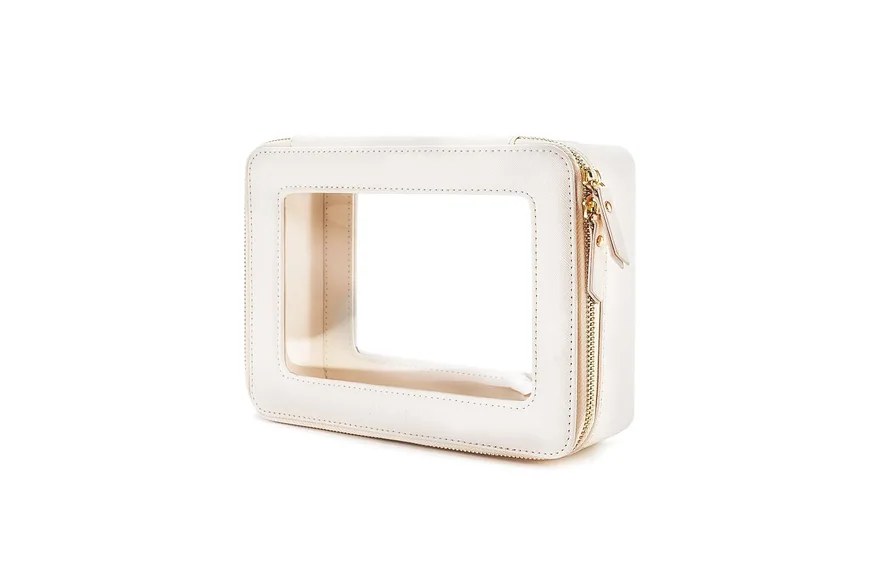
What suction mounting solves in a bathroom and what it cannot
A hanging toiletry bag normally needs a door, a towel rail or a hook, and in a shared bathroom, a hotel room or a gym shower none of those is guaranteed to be where the user wants it. Suction mounting removes the dependency. The bag goes onto the tile beside the shower, at the height the user chooses, and comes off again without leaving adhesive residue or a damaged wall. For a rental property, a cruise cabin or a student hall, where drilling and adhesive hooks are both prohibited, that is the whole argument.
The mechanism is atmospheric pressure, not adhesion. Pressing a cup against a flat surface expels the air beneath it; the pressure difference between the trapped low-pressure cavity and the outside atmosphere clamps the cup in place. The theoretical ceiling is one atmosphere, about 101 kPa, which is why cup area matters so much, and why any leak path collapses the holding force abruptly. A grout line, a hairline crack in the glaze, a textured finish or a film of soap all create that leak path.
This means the product is surface-specific, and honest copy says so. A bag that holds 2 kg on a bathroom mirror will not hold 500 g on a matt-finish porcelain tile. Brand owners who print a surface-compatibility table on the hangtag see fewer returns than those who print a single weight figure, because the common complaint is not that the cup failed but that the customer expected it to work on a wall it was never going to grip.
Demand in the wider category supports the format. Toiletry bag records about 74,810 weekly Amazon searches (ASINSIGHT 2026.07) and travel bag for toiletries roughly 110,000 monthly, while make up bags for women sits near 80,000 monthly. Hanging kits occupy the upper part of the typical $0.45 to $12.00 unit price band (Alibaba 2026.10), and a suction mounting system adds the cup tooling and a stiffener panel rather than a whole new construction.
Cup geometry, material and locking mechanism
Four variables govern holding force: cup diameter, material hardness, locking mechanism and the stiffness of whatever sits behind the cup. Diameter sets the area over which the pressure difference acts, so a 70 mm cup has roughly 2.4 times the area of a 45 mm cup. Material hardness decides whether the cup can conform to a surface that is very slightly uneven; softer compounds seal better on imperfect walls but creep more under sustained load.
| Cup specification | Material and hardness | Locking mechanism | Typical dry holding on glazed tile | Trade-off |
|---|---|---|---|---|
| 45 mm single-cup hook | PVC at 55 to 60 Shore A | Push-on, no lock | 0.8 to 1.2 kg | Small and cheap, but the weakest seal and the easiest to knock off |
| 60 mm lever-lock cup | TPE at 45 to 50 Shore A | Cam lever, five-position | 2.0 to 3.0 kg | Best grip available; lever adds thickness to the rear panel |
| 70 mm twist-lock cup | Silicone at 40 to 45 Shore A | Quarter-turn collar | 2.5 to 3.5 kg | Conforms to slight unevenness, slower to mount, highest unit cost |
| Twin 55 mm pad | TPE at 50 Shore A on a moulded PP plate | Two cam levers on one plate | 3.0 to 4.0 kg combined | Load spreads across two cups; one dirty cup still halves the grip |
| Magnetic-assist cup | Silicone with a bonded ring magnet | Push-on plus magnetic pre-load | 1.5 to 2.0 kg on steel only | Excellent on metal panels, useless on tile or glass |
The panel behind the cup is the variable most often missed. A soft bag body lets the cup flex, and flexing peels the seal. The fix is a stiffener: a 1.0 to 1.5 mm polyethylene or polypropylene board bonded or stitched into the rear panel, sized to cover the full cup footprint plus 15 mm all round, or a moulded plate where the cups are carried on a separate pad. Without it, a heavy kit slowly walks the cups off the wall even on glass.
Cup count and spacing matter for the same reason. Two cups spaced 120 to 180 mm apart resist rotation, which is how loaded hanging kits actually fail: not by dropping straight down but by twisting as weight shifts to one side. Four cups on a moulded pad suit a kit designed to carry 2 kg or more. Cups should be replaceable, because a cup that takes a permanent set in a hot suitcase will never seal again and the rest of the bag is fine.
Cleaning guidance belongs in the product rather than only in the listing. A cup picks up hard-water scale and soap residue from a shower wall, and a cup that is never cleaned loses holding force week by week. A spare set of cups in the box plus a two-line cleaning instruction costs very little and addresses the most common cause of a suction complaint, which is not a defective cup but a contaminated wall.
- State cup diameter, material and durometer in the technical pack, not just a weight rating.
- Add a stiffener panel covering the cup footprint plus a 15 mm margin on all sides.
- Space twin cups 120 to 180 mm apart so the assembly resists twisting.
- Make cups replaceable and sell spares; a deformed cup is the single most common replacement part.
- Print a surface-compatibility list on the pack rather than a single maximum weight figure.
Wall surfaces and the coated fabric that has to survive the room
Surface compatibility is the specification that decides whether the product works. Smooth, non-porous, rigid surfaces seal; anything porous, flexible or textured leaks. A bathroom mirror, a glass shower panel, a glazed ceramic tile and a polished stone panel all work. Matt porcelain, unglazed quarry tile, painted plasterboard, wallpaper, beadboard and any surface with a grout line under the cup footprint do not. Condensation between the cup and the wall is the slow leak that turns a good mount into a 4 am crash.
| Wall surface | Expected seal quality | Recommended cup | Practical guidance for the pack copy |
|---|---|---|---|
| Glazed ceramic tile | Excellent when the glaze is unbroken | 60 mm lever-lock at 45 to 50 Shore A | Clean and dry the tile before mounting; avoid grout lines |
| Glass shower panel | Excellent | 70 mm twist-lock silicone | Best surface available; state it as the reference case |
| Bathroom mirror | Excellent | 60 mm lever-lock | Confirm the mirror is rigidly fixed, not on spring clips |
| Polished natural stone | Good to excellent | 70 mm twist-lock silicone | Stone is rarely perfectly flat; use the softest compound |
| Acrylic shower liner | Poor to fair | Not recommended | The panel flexes and flexing breaks the seal |
| Matt porcelain tile | Poor | Not recommended | Micro-texture leaks; offer an adhesive hook as an alternative |
| Painted plasterboard | Failure | Not recommended | Porous and flexible; suction will not hold |
Three installation details decide whether a good cup performs, and none of them are product defects. Mounting should be onto a dry surface, because a tile carrying condensation will seal and then release as the film evaporates, which is why releases cluster in the first hour after a shower. The cup should be pressed from the centre outwards rather than at the rim, and the instruction card should say so with a diagram. The load should be applied gradually, since snatching a full kit onto a freshly mounted cup breaks a seal that a slow load would have held. All three generate returns that get logged as product failures.
The bag body has to survive the same room. A shower-adjacent kit is a wet application, so the outer fabric is normally a coated construction: PVC-coated 600D polyester at roughly 300 to 380 g/m², a TPU-laminated 420D nylon, or a PEVA film. Coated fabrics are evaluated under ASTM D751, which covers coating adhesion, hydrostatic resistance and low-temperature bend behaviour, and buyers should ask for the specific test clauses rather than a generic coated-fabric claim.
Two material risks follow from that choice. Soft PVC cups and coated bodies can contain plasticisers, which puts phthalate restrictions under EU REACH in scope for the European market and invites the same question from US retailers. The second is mildew: a bag that stays damp in a shower room will grow mould on the lining, and the relevant test methods are published by the AATCC. Specifying a mildew-resistant finish on the lining and a breathable rear panel costs little and prevents the most visible kind of return. A rear panel that cannot dry is the usual culprit, since the cups hold the back of the bag flat against a cold tile for hours at a time.
Pull testing, cycle testing and the specification pack
Suction holding is testable with a spring scale, a set of tiles and a stopwatch, and it should be tested on the surfaces the brand intends to claim rather than on one convenient sample. The protocol below separates initial grab from sustained hold, which is the distinction that predicts real-world failure. A cup that holds 3 kg for ten seconds and releases after two hours is not a 3 kg cup.
| Test | Procedure | Pass condition | Units per batch |
|---|---|---|---|
| Initial grab | Mount dry on glazed tile, pull perpendicular after 60 seconds | Holds 1.5 times the stated rated load | 5 |
| Sustained hold | Hang the rated load for 24 hours at 20 to 25 degrees Celsius | No release and no visible peel at the cup edge | 3 |
| Hot and humid hold | Hang the rated load at 35 degrees Celsius and 85 per cent relative humidity for 8 hours | No release | 3 |
| Remount cycle | Mount, remove and remount 50 times | Holding force at cycle 50 within 20 per cent of cycle 1 | 3 |
| Cup set recovery | Store compressed for 7 days at 40 degrees Celsius, then mount | Seals and holds the rated load after cleaning | 2 |
| Twist resistance | Apply the rated load 60 mm off centre | No rotation beyond 10 degrees after 30 minutes | 3 |
- Name the surfaces the product is claimed to mount on, and test on those surfaces specifically.
- Specify cup diameter, durometer, count and spacing, plus the stiffener panel material and thickness.
- Require coating adhesion and hydrostatic results under ASTM D751 for the bag body.
- Require a phthalate declaration for PVC cups and coated bodies, and a mildew-resistance method for the lining.
- Set the inspection regime at AQL 2.5 under ISO 2859-1 with the pull tests above run on a fixed sample per batch.
Field information is worth collecting even without a formal survey. The cheapest useful programme is a returns log with four fields: wall surface, load at release, time mounted and whether the wall had been cleaned. Three months of that log tells a brand more about its real failure modes than any bench test, and it usually shows that most releases come from two or three surfaces that should simply have been excluded from the pack copy. Where the log does point at a genuine product issue, the corrective action is normally a softer compound or a larger cup, and either is a cheap change at the next run.
Programme timing follows the complexity of the mounting system. Sampling takes 6 to 10 working days where standard cups are riveted or screwed to an existing rear panel, and 12 to 15 working days where an overmoulded pad, a bonded stiffener or a custom durometer compound is involved. Bulk runs 35 to 50 days after sample approval, with the cup and hardware components arriving on their own lead time. Orders start at 500 pieces per style and colourway, inspected to AQL 2.5 under ISO 2859-1, shipped FOB Xiamen with T/T terms of 30 deposit and 70 against bill of lading.
The B2B Customisation View
The brief for makeup bags and toiletry bags should state the tolerances that matter: acceptable shade drift, stitch density, and the defect threshold at final inspection.
Programme data for this category: minimum order quantity 500 pieces per style and colourway, sampling in 6–10 working days (12–15 working days for complex constructions), bulk production 35–50 days after sample approval, final random inspection at AQL 2.5 under ISO 2859-1, FOB Xiamen, T/T 30/70.
This is the model that lets a small brand launch makeup bags and toiletry bags with the same inspection discipline a large retailer would demand.
Which Brand Types Benefit Most
Suction mounting appeals to buyers whose customers cannot or will not put a hook on the wall, and the brief should follow that constraint rather than the gadget. Start-up brands find it a strong marketplace differentiator because the benefit films well and the product solves a recognised annoyance; the risk is claiming a weight figure without a surface list, which produces reviews that blame the bag for the wall. Established bath and travel brands tend to add suction to an existing hanging kit, where the work is integrating a stiffener panel without changing the silhouette the customer already recognises. Retailers evaluating private label ask about liability first, since a bag that falls and breaks a mirror or a tile is a claim, not a return; they usually require a stated surface list and a stated rated load on the pack. E-commerce sellers care about the review language, and do best with copy that names glass and glazed tile as the target surfaces. Hospitality and student-housing buyers value the no-drill, no-residue property most of all, because their walls cannot take fixings and their turnover schedule cannot take repairs. One caution applies to every group: holding force is a property of the wall as much as of the cup, so the commercial decision that protects margin is an honest surface list on the pack rather than a larger cup on the bag. A brand that excludes unsuitable surfaces in its copy will sell fewer bags and keep more of them.
- Start-up brands: film the mount on glass, and print the surface list alongside the weight rating.
- Established bath brands: integrate the stiffener without changing the recognised silhouette.
- Retailers and private label: require a rated load plus a named surface list to limit liability.
- E-commerce sellers: name glass and glazed tile in the listing copy and sell spare cups.
- Hospitality and student housing: prioritise residue-free removal and replaceable cups over maximum load.
- All buyer types: treat the surface list as a specification deliverable, not as marketing copy.
Frequently Asked Questions
What surfaces will a suction cup toiletry bag actually hold on?
Smooth, rigid, non-porous surfaces: glass shower panels, bathroom mirrors, glazed ceramic tile and polished stone. It will not hold on matt porcelain, unglazed quarry tile, painted plasterboard, wallpaper or flexible acrylic liners. The pack should name the surfaces rather than print a single weight, because a cup that holds 3 kg on glass may not hold 500 g on a matt tile. Naming the unsuitable surfaces is the cheapest available way to reduce returns.
How much weight can a suction-mounted toiletry bag carry?
A single 60 mm lever-lock cup on clean glazed tile typically holds 2.0 to 3.0 kg; a twin 55 mm pad on a moulded plate can reach 3.0 to 4.0 kg combined. Those are dry, clean-surface figures. The rated load printed on the pack should be well below the tested figure, and the test should include a 24-hour hold rather than a ten-second pull.
Why do suction cups fall off in a shower room?
Three causes cover most cases: condensation creeping under the cup edge, soap film or hard-water scale on the tile preventing a seal, and a flexible wall panel such as an acrylic liner that moves under load. A stiffener panel behind the cups addresses the first partly; the other two are solved by cleaning guidance in the pack copy and by stating which surfaces are unsuitable.
What cup material holds best on bathroom tile?
Silicone at 40 to 45 Shore A conforms best to slightly uneven glaze and is the safest choice for a 70 mm cup. TPE at 45 to 50 Shore A is the usual compromise for lever-lock cups. PVC at 55 to 60 Shore A is cheap and grips well on glass but seals poorly on anything less than perfectly flat, and it raises plasticiser questions. A silicone compound costs more per cup and is the safest default for a product sold on a holding claim.
Should suction cups be removable or bonded to the bag?
Removable. A cup that is compressed in a hot suitcase for a week can take a permanent set and will never seal again, and a bonded cup then means replacing the whole bag. Riveted or screwed cups with a spare set in the retail box turn a warranty claim into a two-dollar spare part. Specify the fixing method too, since a rivet through a thin panel needs a washer on the inside face.
How is the rear panel of a suction bag stiffened?
A 1.0 to 1.5 mm polyethylene or polypropylene board is bonded or stitched into the rear panel, covering the full cup footprint plus about 15 mm all round. Without it, a soft body lets the cup flex and the seal peels. Where cups sit on a separate moulded pad, the pad itself performs the stiffening function. A stiffener that stops short of the cup footprint leaves the cup edge unsupported, which is where the seal starts to peel.
What is the right spacing for two suction cups?
Between 120 and 180 mm, measured centre to centre. Wider spacing resists the twisting that happens when weight shifts to one side of a loaded kit, which is how hanging bags actually fail. Two cups close together behave almost like one and do nothing for rotational stability. Where a single 70 mm cup is used instead, rotation is controlled by the hook position rather than by spacing.
Which ASTM method covers the coated fabric body of a shower bag?
Coated fabrics used for wet-area bags are evaluated under ASTM D751, which covers coating adhesion, hydrostatic resistance and low-temperature bend behaviour. Buyers should name the specific clauses they want tested, because coated fabric is a generic description that covers very different performance levels. Ask for the coating adhesion and hydrostatic clauses in particular, since those are the ones that fail in a wet room.
Do PVC suction cups raise REACH or phthalate concerns?
Soft PVC can contain plasticisers that are restricted under EU REACH, and US retailers increasingly ask the same question. The practical step is a supplier declaration covering the cup compound and the coated body, requested with the first sample rather than after the first shipment. Silicone and TPE cups avoid the question entirely, which is one reason they are gaining ground.
How is mildew resistance handled on a shower-room toiletry bag?
Specify a mildew-resistant finish on the lining and a rear panel that can dry, and test to a recognised method from the AATCC range. A bag that stays damp against a tile will grow mould on the lining within weeks in a humid climate, which is a visible return that no amount of cup engineering prevents. Specify the test method by name and require the report with the first bulk shipment rather than with the first sample.
How long should a suction mount hold in testing?
Twenty-four hours at the rated load on the claimed surface, at 20 to 25 degrees Celsius, with no release and no visible peel at the cup edge. An initial grab test at 60 seconds and 1.5 times the rated load is a separate check. Ten-second pulls are marketing, not testing. Add a hot-and-humid hold at 35 degrees Celsius where the product is sold into humid climates.
What minimum applies to a toiletry bag with an overmoulded suction pad?
The minimum is 500 pieces per style and colourway. A custom cup compound or a custom pad colour carries its own tooling and component minimum, so a brand planning two colourways should confirm pad availability in both before sampling, since the moulded part is usually the constraint rather than the bag.
How long does sampling take for a suction-mounted wash bag?
Sampling runs 6 to 10 working days where standard cups are fixed to an existing rear panel, and 12 to 15 working days for an overmoulded pad, a bonded stiffener or a custom durometer compound. Bulk production then runs 35 to 50 days after approval, shipped FOB Xiamen.
How are suction cups inspected before shipment?
Appearance and construction follow AQL 2.5 under ISO 2859-1. The holding function needs a fixed-sample functional check instead, because a cup that seals badly looks identical to one that seals well: five units for initial grab, three for a 24-hour sustained hold and three for a fifty-cycle remount test.
Can a suction bag be used on a cruise ship or in rented accommodation?
Yes, and that is one of its strongest use cases. Cruise cabins, rented flats and student halls typically prohibit drilling and adhesive hooks, while their bathrooms are usually finished in glass or glazed tile, which suits suction well. Programmes aimed at those channels should emphasise residue-free removal and include spare cups. Confirm the cabin wall finish before committing, since older ships still carry laminate panels that will not hold a cup.
People Also Ask
Do suction cup toiletry bags work on textured tile?
Generally no, and the release is abrupt rather than gradual. Texture creates leak paths under the cup edge, and holding collapses abruptly rather than gradually. A softer silicone compound at 40 to 45 Shore A copes with very slight unevenness, but a genuinely textured or matt porcelain surface should be listed as unsuitable on the pack rather than left to the customer to discover.
How do you make a suction cup stick to a shower wall again?
Clean the tile and the cup with a non-oily cleaner, dry both, soften the cup in warm water at around 40 degrees Celsius for a minute, then press firmly from the centre outwards. Avoid soap film and hard-water scale. A cup that has taken a permanent set will not recover and should be replaced.
Are suction-mounted bags better than adhesive hooks for renters?
For renters, yes, because they leave no residue and no damage and can be moved as often as needed. The trade-off is lower holding force and a hard dependence on surface type, both of which belong on the pack rather than in a troubleshooting page. Where the wall is unsuitable, a removable adhesive strip is the fallback, and some programmes ship both in the box.
What size suction cup do you need for a loaded wash bag?
Two 55 to 60 mm cups on a stiffened panel, spaced 120 to 180 mm apart, suit a kit carrying up to about 2 kg. A single 45 mm cup is adequate only for a light pouch under roughly 1 kg. Cup area drives holding force, so moving from 45 mm to 70 mm roughly doubles the area rather than adding a marginal gain, and area is what holding force scales with.
Request a Sample or a Written Quotation
Send the silhouette, dimensions, material preference and logo artwork, and the programme team will return a written quotation with MOQ, sampling window, bulk lead time and inspection standard.
Email: service@junyuanbags.com · WhatsApp: +86 177 5002 0688