Makeup Bag with USB Charging Port: Smart Travel Accessory
Executive Summary
A makeup bag with a USB charging port is a travel organiser fitted with a sealed pass-through connector, an internal pocket sized for a power bank and routed cable channels, so a phone or a mirror light charges while the bag stays zipped. The port generates nothing; it is a feed-through between a battery stored inside and a device used outside. That design earns its cost on trips of more than one night and is wasted spend on a bag that only sits on a dressing table.
Adding electrics changes the risk profile rather than simply lengthening the feature list. A powered cosmetic bag needs a port cover that actually closes, a cable with strain relief at both ends, a pocket that stops a 200 to 400 g power bank from punching into glass bottles, and documentation for whichever cell is sold alongside it. Programmes start at 500 pieces per style and colourway, sample in 6 to 10 working days or 12 to 15 for a bonded port plate, then run 35 to 50 days after approval under AQL 2.5 to ISO 2859-1, FOB Xiamen, T/T 30 deposit and 70 against bill of lading.
What a charging port actually changes in a cosmetic bag
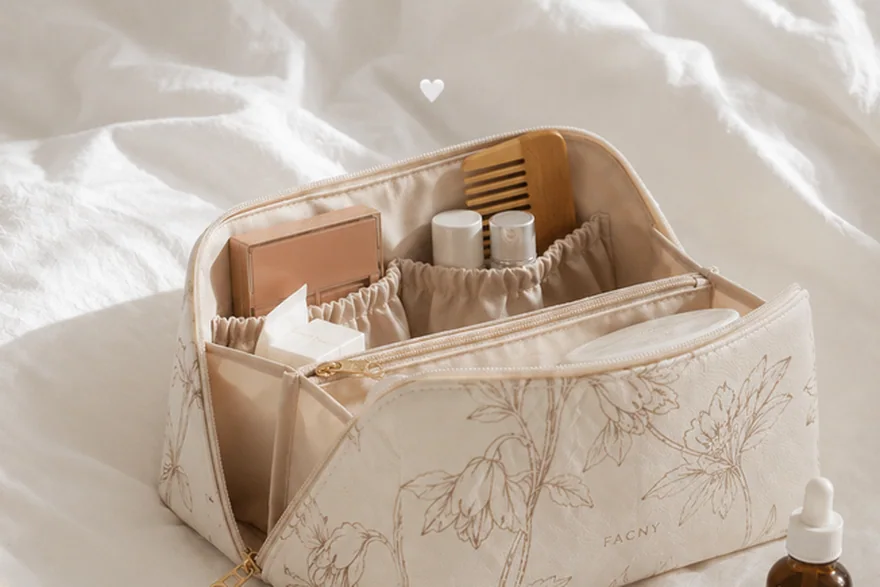
A makeup bag with a USB charging port is a cosmetic organiser with three added elements: a sealed pass-through connector set into the shell, an internal sleeve dimensioned for a power bank, and a cable channel that keeps the lead away from brushes, mascara wands and glass bottles. The port does no charging. It is a feed-through that lets a battery stored inside the bag supply a device outside it, so the bag stays closed and packed while a phone charges on a hotel nightstand or a mirror light draws current during use.
That distinction matters at brief stage because the phrase covers two very different builds. One is a moulded port plate bonded or stitched into the shell, with a captive short lead inside and a dust flap outside; the other is a rubber grommet with a loose extension cable dangling into the lining. The first looks finished and survives handling. The second is cheap, and the loose lead is the part that fails first, usually within the first month of use. The retail price gap between them is far smaller than the return-rate gap, which is why the port construction belongs in the written specification rather than in a product photo.
Demand for the surrounding category is measurable enough to plan against. Travel bag for toiletries draws roughly 110,000 monthly searches and make up bags for women roughly 80,000 monthly, while toiletry bag records about 74,810 weekly Amazon searches (ASINSIGHT 2026.07). Custom makeup bag searches run 5,400 to 6,600 monthly, which is the branded-programme end of the same demand. A powered variant sits in the travel-accessory and gift band where typical unit price lands between $0.45 and $12.00 (Alibaba 2026.10); electronics push a given build into the upper half of that band.
- Overnight and multi-night travel, where the bag is the only organiser carried and a phone charge has to happen somewhere near the mirror.
- Backstage, festival and event kits, where a mirror light or a styling tool runs off the same battery as the phone.
- Gifting programmes, where an electronic feature justifies a price step without changing the print or the silhouette.
- Hotel and hospitality amenities, where a powered vanity pouch is positioned as a premium in-room item rather than a retail SKU.
Port, cable and power bank architecture
Four decisions define the hardware: connector type, mounting method, cable route and battery retention. Connector type is settling on USB-C because the device side of the market has moved there, but USB-A still appears on bags built for older mirror lights and on price-led programmes where the panel and lead cost less. A dual port, one USB-A and one USB-C on a single plate, removes the guesswork at a small unit-cost penalty and is the safest choice for a gift SKU with an unknown end user.
| Port option | Construction | Shell change required | Unit-cost impact | Dominant failure mode |
|---|---|---|---|---|
| Moulded USB-A panel | ABS or TPE plate bonded to shell, captive 20 cm lead inside | Cut-out plus bonding flange and backing plate | Low to medium | Flange debonds after flexing at the bag corner |
| Moulded USB-C panel | Plate with reversible receptacle, captive lead to internal sleeve | Cut-out, backing plate, reinforcement patch | Medium | Receptacle wear if the plug is rocked under load |
| Dual-port plate | USB-A plus USB-C on one moulding, sealed rear | Wider cut-out, stiffer backing plate | Medium to high | One port unused and collecting lint behind the flap |
| Grommet plus extension lead | Rubber grommet, loose 30 cm lead stored in lining | Simple hole, no reinforcement | Low | Lead kinks at the grommet and the conductor breaks |
| Silicone flap over recessed port | Recessed cavity with a tethered cover | Cavity moulding or spacer ring | Medium | Flap tears at the tether after repeated opening |
Battery retention is the second specification most often left out of a brief. A 5,000 mAh power bank typically measures about 9.5 x 6.0 x 2.2 cm and weighs 130 to 150 g; a 10,000 mAh unit runs roughly 14.0 x 6.8 x 1.6 cm at 200 to 240 g; a 20,000 mAh brick can reach 16.5 x 8.0 x 2.2 cm at 380 to 450 g. The pocket has to be cut for the largest cell the brand intends to support, then closed with a strap or an elastic band so the cell cannot slide. A loose 400 g brick inside a soft bag will find the thinnest glass bottle in the kit eventually.
Cable routing completes the architecture. A captive lead of 15 to 20 cm suits a bag under 24 cm wide; 25 to 30 cm suits a hanging or train-case format where the port sits on one end and the sleeve on the other. The lead should be anchored at both ends with a moulded strain relief or a bar-tacked webbing tab, because flexing at the solder joint is what kills these products. Interior channels made from a folded binding or a mesh sleeve keep the cable out of the brush loops and stop it from coiling around a bottle neck in transit.
- Specify the port plate material and its bonding method, not just the port type.
- State the largest power bank dimensions the pocket must accept, in centimetres.
- Require a retention strap with a stated width, typically 15 to 20 mm elastic.
- Anchor the captive lead at both ends and name the strain-relief method.
- Add a dust flap with a stated open-close cycle life, usually 500 cycles minimum.
Compliance and electrical safety for a powered cosmetic bag
Two regulatory bodies matter here. The International Electrotechnical Commission publishes the cell and battery standards that any power bank sold with the bag has to meet, and the Consumer Product Safety Improvement Act governs lead, phthalates and children's-product certification in the United States. A bag with a port but no battery is, in most markets, still a textile article. The moment a cell ships inside the carton, the consignment picks up battery transport rules and the documentation burden rises sharply.
- Sell the bag empty of batteries wherever possible: the textile compliance file is far lighter than the battery file.
- If a cell is included, require the cell maker's IEC 62133 test report and a UN 38.3 transport test summary before the first bulk booking.
- Ask the port plate and cable jacket supplier for a phthalate and lead-content declaration covering the soft PVC or TPE parts.
- If the bag is marketed to children under 12, CPSIA third-party testing and a children's product certificate apply to the whole assembled item, port included.
- Confirm whether the destination market treats a powered bag as electrical equipment requiring its own conformity marking; the answer differs between the EU, UK and US.
Component sourcing is the part of a powered programme that surprises first-time buyers. The port plate, the cable harness and any cell come from electronics suppliers whose lead times do not track the fabric calendar and whose minimums are set by the moulding rather than by the bag. A brand that approves a bag sample in the first week can still be waiting on a plate colour in the fourth. The practical defence is to freeze the electrical bill of materials at the same moment the fabric is booked, and to choose a plate colour from the component supplier's standard range unless the volume justifies a tooling charge. Where a custom shade is unavoidable, the component minimum rather than the bag minimum becomes the constraint on the first order.
Water and cosmetics are the practical hazard rather than the electrical one. A bag that lives next to a sink will see splashes, and a leaking serum bottle inside will see more. The port needs a closed-cell gasket behind the plate and a flap that seats without force; the cable entry needs a boot, not a knot. Buyers should ask for an ingress check appropriate to the claim being made. If the product page says water-resistant, the powered zone has to be tested to the same level as the rest of the shell, or the claim should be dropped from the copy.
Labelling is the last piece. A permanently attached label stating the electrical rating, the cell specification if included, and the country of origin keeps the retail pack defensible. Care instructions have to say plainly that the bag is sponge-clean only and that the port must be closed before any cleaning, because a submerged powered bag will fail at the receptacle. Brand owners who print a charging diagram on the hangtag reduce returns more cheaply than any hardware upgrade at the same unit cost. Buyers shipping into the European Union should also confirm how the assembled item is classified under national implementing rules, because the answer decides whether a take-back registration obligation attaches to the brand rather than to the retailer.
Specifying and testing a powered cosmetic bag build
Because there is no published performance standard for a powered cosmetic bag, the buyer writes the acceptance criteria. That is not unusual in this category; it simply means the brief has to name the test, the load, the cycle count and the pass condition, so that a pre-shipment inspection can check it rather than argue about it. The table below is a workable starting set that a laboratory or an in-house bench can run with standard fixtures.
| Test | Method summary | Pass condition | Sample size |
|---|---|---|---|
| Port flap cycling | Open and close the dust flap on a fixed jig at 20 cycles per minute | 500 cycles with no tear at the tether and no loss of seat | 3 units |
| Cable flex | Clamp the lead, apply 500 g, flex through 90 degrees | 1,000 cycles with continuity maintained | 3 units |
| Plug insertion | Insert and withdraw a standard plug in the receptacle | 1,500 cycles with retention force still above 5 N | 3 units |
| Loaded drop | Bag loaded to 1.5 kg with a 300 g cell in the sleeve, dropped 80 cm onto concrete | 6 drops, one per face, no shell split and port still seated | 2 units |
| Pocket retention | Invert the loaded bag and shake through 20 inversions | Cell remains in the sleeve and no contact with the glass-bottle cavity | 3 units |
| Splash check | Spray the port zone at 10 litres per minute for 3 minutes | Interior lining dry and receptacle free of moisture | 2 units |
- Fix the connector type, plate material and bonding method in the technical pack before sampling starts.
- Name the largest supported power bank in centimetres and grams, and cut the sleeve to it.
- Write the electrical file requirement into the purchase order, including which IEC reports must arrive before booking.
- Set the inspection regime: AQL 2.5 under ISO 2859-1 for appearance and construction, plus the functional tests above on a fixed sample size.
- Agree a spare-parts policy for port plates and leads, because a failed lead is repairable while a failed shell is not.
Spare parts deserve a line in the purchase order. A failed lead or a lost flap is repairable in the field, and a brand that can post a replacement part keeps a customer who would otherwise return the whole bag. The usual arrangement is a spare-parts allowance of 1 to 2 per cent of the order quantity, packed loose in the shipment, together with a parts list that references the port plate and the harness to the bag style code. That costs very little, and it converts an entire class of warranty claims into a small parcel.
On programme timing, a powered cosmetic bag behaves like a complex soft build. Sampling runs 6 to 10 working days for a straightforward grommet construction and 12 to 15 working days where a bonded port plate, a moulded cavity or a custom cable harness is involved. Bulk production starts after sample approval and runs 35 to 50 days, and that window has to absorb incoming inspection of the electrical components, which arrive on a different lead time from the fabric. Orders begin at 500 pieces per style and colourway, shipped FOB Xiamen on T/T terms of 30 deposit and 70 against bill of lading, with inspection to AQL 2.5 under ISO 2859-1.
The B2B Customisation View
Cost, compliance and craft pull against each other on every cosmetic pouches, vanity cases and beauty organisers project; the specification is the record of how those three forces were balanced.
Commercial parameters stay fixed across the range: MOQ 500 pieces per style and colourway, prototype turnaround 6–10 working days (extended to 12–15 for multi-panel or moulded builds), bulk lead time 35–50 days from approved sample, AQL 2.5 inspection to ISO 2859-1, FOB Xiamen, T/T 30 deposit and 70 against bill of lading.
Buyers who use a programme coordinator keep their own supply-chain optionality; the technical pack travels, so production can be re-placed if a launch is brought forward.
Which Brand Types Benefit Most
A USB charging port is a feature that different buyer types value for different reasons, and the brief should follow the reason rather than the feature. Start-up brands tend to use it as a launch differentiator, because a powered bag gives a press release and a product page something concrete to say beyond another printed pouch; for them the risk is over-specifying the electronics before the base bag is proven. Established brands more often add a port to an existing silhouette, where the value is a price step on a known seller, and the work is in matching the port plate colour and finish to the current hardware. Retailers and private-label buyers care about the returns profile, so the questions they ask are about flap life, cable flex and what happens when a customer puts the bag in a wash. E-commerce sellers weigh shipping and compliance first, since a cell inside the carton changes the freight class and the documentation, and a bag without the cell changes the review score. Gift and hospitality buyers want a finished look and a simple story, which usually means a recessed port with a flush flap and a printed card rather than a manual. One point applies across all five: a powered bag is easier to sell than it is to keep selling. The reviews that matter are written about three months after purchase, which is roughly when a cable or a flap fails, so the specification decisions that protect the second quarter of sales are flap cycle life, strain relief and care wording on the pack rather than anything visible in the product photograph.
- Start-up brands: prove the base construction first, then add the port on the second run.
- Established brands: match the plate finish to existing hardware and keep the silhouette unchanged.
- Retailers and private label: lead with flap cycle life and wash-care wording on the pack.
- E-commerce sellers: decide early whether the cell ships inside the carton, and price the freight both ways.
- Gift and hospitality: prefer a flush recessed port with a one-line instruction card.
- All buyer types: budget a 1 to 2 per cent spare-parts allowance and print the care wording on the pack.
Frequently Asked Questions
What does the USB port on a makeup bag actually connect to?
The port on a makeup bag connects to a power bank stored inside the bag, not to mains power. A short captive lead runs from a sealed receptacle in the shell to a sleeve or pocket in the lining, and the user plugs their own device cable into the outside of the bag. Nothing charges unless a charged cell is inside, so the feature is only useful if the pocket actually holds a battery the size the brand intends.
How is a charging port sealed against cosmetic spills?
Sealing is done with a closed-cell gasket behind the port plate, a boot where the cable enters the shell, and a tethered flap over the receptacle on the outside. The flap is the part most often skipped, and it is the part that keeps serum residue and powder out of the contacts. A specification should state the gasket material, the flap attachment method and a splash test rather than relying on the word sealed in a quotation.
Which power bank capacity fits an internal pocket without distorting the bag?
For a bag up to 24 cm wide, a 5,000 mAh cell at roughly 9.5 x 6.0 x 2.2 cm and 130 to 150 g is comfortable. A 10,000 mAh unit at about 14.0 x 6.8 x 1.6 cm and 200 to 240 g needs a reinforced sleeve and a strap. A 20,000 mAh brick at 380 to 450 g belongs only in a train-case or hanging format with a stiffened base panel.
Can a makeup bag with a charging port be carried in cabin baggage?
Yes, provided any power bank inside meets airline limits and is carried in the cabin rather than the hold. The bag itself is not restricted. What trips travellers up is a loose lithium cell in a checked bag, which is why the pack copy should say the cell travels in the cabin. Brand owners should check the current airline rule at the time of listing, since it changes.
What cable length should a powered cosmetic bag specify?
Fifteen to twenty centimetres suits a bag under 24 cm wide where the port and the battery sleeve sit on the same panel. Twenty-five to thirty centimetres suits a hanging or train-case format with the port at one end. Longer than that and the lead coils into the brush loops; shorter and the plug pulls on the receptacle every time the bag is opened.
Does a USB-C port cost more than USB-A in a bag programme?
A USB-C receptacle and its moulded plate typically cost more than the USB-A equivalent, and the gap narrows as volumes rise. A dual port costs more again but removes the guesswork about which device the end user owns. The larger cost driver is usually the plate moulding and the bonding labour rather than the connector itself, so the panel design is where to negotiate.
How is a port panel attached to a soft cosmetic bag shell?
The usual methods are adhesive bonding onto a reinforcement patch, high-frequency welding where the shell is a coated or TPU laminate, or stitching through a flange with a backing plate behind. Bonded plates look the cleanest but need a stated adhesive and a peel test. Stitched flanges tolerate flexing better at the bag corner, which is where most of the stress lands when the bag is packed full.
What CPSIA documentation applies to a powered makeup bag?
Where the bag is marketed to children under 12, the Consumer Product Safety Improvement Act requires third-party testing and a children's product certificate covering lead and phthalates in every accessible component, including the port plate and cable jacket. For an adult product the general lead and phthalate limits still apply to the soft PVC parts. Buyers should request the declarations with the first sample, not with the first shipment.
Which IEC standards cover the cells used with a charging makeup bag?
The cell and battery standards published by the International Electrotechnical Commission are the reference point for any lithium cell sold with the bag, with IEC 62133 covering secondary cell safety and UN 38.3 covering transport testing. A bag shipped without a battery avoids most of this, which is the cheapest compliance decision available on a powered programme.
Can a powered cosmetic bag be washed?
No. The correct care instruction is sponge-clean only with the port flap closed, because immersion drives moisture behind the receptacle and corrodes the contacts. If a brand wants a washable product, the electronics need to be removable, which usually means a pouch that unclips from the bag. The care label and the product page have to say the same thing or returns follow.
How many charge cycles should a built-in cable survive before failure?
A captive lead in a cosmetic bag should be specified at 1,000 flex cycles under a 500 g load with continuity maintained, which is well beyond the use pattern of a travel bag but cheap to test on a bench. The plug insertion side should be specified separately at around 1,500 cycles with retention force above 5 N, because the two failure modes are unrelated.
What minimum applies to a makeup bag with a bonded USB port plate?
The minimum is 500 pieces per style and colourway, which applies to the powered variant as it does to any other build. Because the port plate and cable harness are usually bought against their own supplier minimum, a brand planning two colourways should confirm the plate colour availability before sampling, since a custom plate shade can carry a higher component minimum than the bag.
How long does sampling take for a powered cosmetic bag?
Sampling runs 6 to 10 working days for a simple grommet and lead construction, and 12 to 15 working days where a bonded port plate, a recessed cavity or a custom harness is involved. The longer window reflects component sourcing more than sewing time. Bulk production then runs 35 to 50 days after sample approval, shipped FOB Xiamen.
What inspection level applies to powered bags with cables?
Appearance and construction are inspected to AQL 2.5 under ISO 2859-1, the same level used across the category. Electrical function needs a separate fixed-sample check rather than an AQL draw, because a continuity failure is a defect class that sampling by percentage does not reliably catch. A practical regime is the standard AQL draw plus functional testing on three units per shipment.
Why do some powered makeup bags fail at the port rather than the battery?
The port is the only part that is handled, flexed and exposed to cosmetics, while the battery sits protected in a sleeve. Failures cluster at three points: the flange bond line where the shell flexes, the solder joint where the lead has no strain relief, and the flap tether where it is opened every day. All three are solved in the specification rather than by buying a better cell.
People Also Ask
Are makeup bags with charging ports allowed on planes?
The bag is not restricted, but a power bank inside it must travel in the cabin under airline lithium battery rules. Brand owners should print that instruction on the hangtag or care card, because the common failure is a customer checking a bag with a cell still in the sleeve. The rule itself should be verified against the carrier at listing time, as limits are reviewed periodically.
Do I need a power bank for a USB makeup bag to work?
Yes. The port is a pass-through, not a power source, so a charged cell has to sit in the internal sleeve for anything to happen. Some programmes ship the cell in the retail box and some ship the bag empty, with the cell sold separately. The second option keeps the compliance file and the freight class simpler, and it is the one most exporters prefer.
How do you clean a makeup bag with an electronic port?
Close the flap, wipe the shell with a damp cloth and mild detergent, and keep the port zone dry. Do not submerge the bag, do not put it in a washing machine, and do not spray cleaner directly at the receptacle. Interior spills should be blotted rather than rinsed, because water reaching the back of the plate is the usual cause of a dead port.
What size power bank fits a travel makeup bag pocket?
A 5,000 mAh cell around 9.5 x 6.0 x 2.2 cm fits a standard pouch; a 10,000 mAh cell around 14.0 x 6.8 x 1.6 cm needs a reinforced sleeve and a retention strap. The pocket should be cut to the largest cell the brand supports and closed with 15 to 20 mm elastic, so the cell cannot migrate into the bottle cavities during transit.
Request a Sample or a Written Quotation
Send the silhouette, dimensions, material preference and logo artwork, and the programme team will return a written quotation with MOQ, sampling window, bulk lead time and inspection standard.
Email: service@junyuanbags.com · WhatsApp: +86 177 5002 0688