Cosmetic Bag Features That Increase Perceived Value: 12 Upgrades
Executive Summary
Perceived value in a cosmetic bag is set by a handful of specification decisions that cost very little per unit: a branded zipper with a dyed-to-match tape, a structured base with feet, a contrast lining, elastic loops sized to a brush barrel, and a retail finish pack. Twelve upgrades cover almost the whole field, and most sit between $0.05 and $0.90 per unit against a typical category band of $0.45 to $12.00. The gain is disproportionate because buyers judge a bag by touch and by closure before they read a feature list.
The upgrades are not free of risk. Structure that makes a bag look expensive on a shelf can make it pack badly in a suitcase, and hardware weight pushes a parcel across a shipping threshold. The disciplined route is to pick four to six upgrades, prototype them and test the ones carrying a claim. Orders start at 500 pieces per style and colourway, sample in 6 to 10 working days or 12 to 15 for complex constructions, then run 35 to 50 days after approval under AQL 2.5 to ISO 2859-1, FOB Xiamen, T/T 30 deposit and 70 against bill of lading.
Why perceived value is a specification decision and not a marketing one
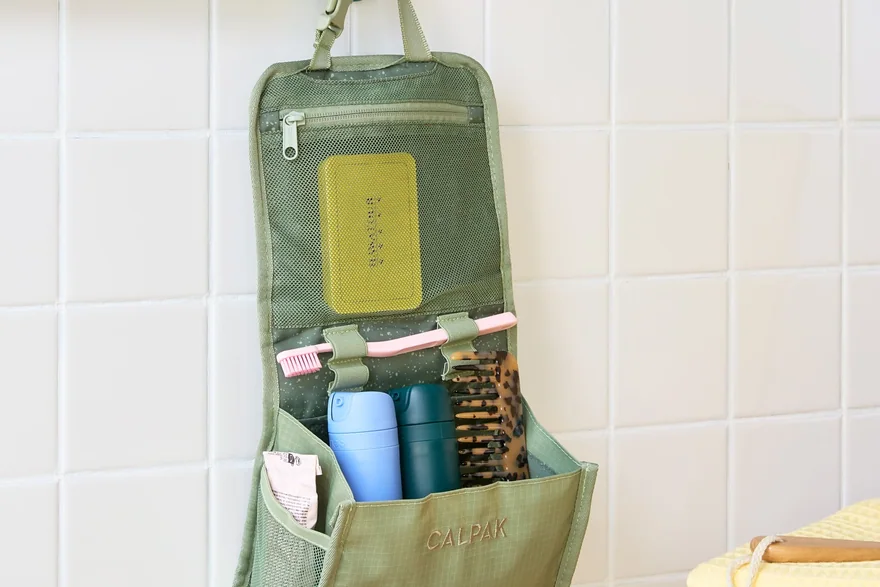
Two cosmetic bags can carry identical capacity, identical fabric and identical dimensions, and one reads as a $40 product while the other reads as a $12 product. The difference is almost never the material cost. It is a set of small, deliberate choices: how the zipper runs, whether the bag stands up on its own, whether the lining is dyed to match or deliberately contrasted, whether the seams are bound or left raw, and whether the logo is printed on a label or debossed into a patch.
That matters commercially because the judgement is made before any feature is read. A shopper picks the bag up, runs the zipper, feels the base, looks inside. Three of those four actions happen in the first five seconds and none of them involve the printed specification. A programme that spends its budget on capacity and print while leaving the closure generic is spending in the wrong place. The same judgement is made again at reorder, and a bag that disappoints on first touch rarely gets a second order even when the price was right.
Search behaviour in the category is consistent with a feature-led purchase. Toiletry bag records about 74,810 weekly Amazon searches (ASINSIGHT 2026.07), make up bags for women around 80,000 monthly and travel bag for toiletries near 110,000 monthly, while custom makeup bag runs 5,400 to 6,600 monthly. Against that demand, the typical unit price band of $0.45 to $12.00 (Alibaba 2026.10) means a modest spend on hardware and finish moves a product into a visibly different shelf position without changing the silhouette.
- Closure: the single most-touched component on the bag.
- Structure: whether the bag stands or slumps when set down empty.
- Interior contrast: what the eye sees in the first second after the zipper opens.
- Finish: bound seams, clean corners and a logo applied with intent.
- Pack-out: whether the bag still works once it is full and in a suitcase.
Twelve upgrades ranked by cost-to-perception ratio
The twelve upgrades below cover the field as it is actually specified. Cost adders are indicative unit-cost ranges at a 500-piece order and move with fabric choice and quantity. The perception column is the part to read: an upgrade is only worth its cost if the customer notices it unprompted, which rules out several popular choices.
| Upgrade | Indicative unit-cost adder | Perception effect | Risk to watch |
|---|---|---|---|
| Branded coil zipper, tape dyed to match | $0.25 to $0.45 | Highest return in the list; the closure is touched every time | Match the tape shade to the shell or the mismatch reads as cheap |
| Metal-look teeth on a #5 tape | $0.35 to $0.60 | Reads as jewellery hardware on a plain silhouette | Adds weight and can snag a fine lining at the corners |
| Structured base board with five feet | $0.30 to $0.55 | Bag stands upright on a shelf and photographs well | Feet catch on fabric; specify rounded, riveted feet |
| Contrast-colour lining | $0.05 to $0.15 | Cheapest visual upgrade available; interior looks designed | Dark linings hide spills; light linings show every mascara mark |
| Elastic loops sized to brush diameter | $0.08 to $0.18 | Interior reads organised rather than empty | Generic 20 mm loops crush a thick powder brush |
| Removable divider or T-shaped insert | $0.35 to $0.70 | Signals a system rather than a pouch | Removable parts get lost; specify a tether or a spare |
| Welded TPU wet pocket | $0.40 to $0.80 | Solves a real complaint and justifies a price step | Weld seams need a leak test, not a visual check |
| Debossed or embossed logo patch | $0.10 to $0.25 | Logo reads as a brand rather than a print | Deboss depth varies with substrate; approve a physical sample |
| Moulded metal logo puller | $0.30 to $0.75 | The most-photographed detail on a marketplace listing | Plating wears; specify a rub test and a salt-spray hour count |
| Swivel hanging hook | $0.25 to $0.50 | Converts a pouch into a travel kit | State a rated load and test the hook at that load |
| Clear window pocket | $0.12 to $0.28 | Makes contents visible without opening the bag | PVC windows cloud and crack; TPU costs more and lasts longer |
| Retail finish pack: dust bag, hangtag, bound seams | $0.35 to $0.90 | Unboxing quality, which drives review language | Pack weight and carton count rise; recalculate the freight |
Read as a budget, the arithmetic is generous. Four upgrades at the lower end of their ranges, contrast lining, elastic loops, a debossed patch and a branded zipper, add roughly $0.48 to $1.03 per unit. Against a $12 retail position that is a rounding error, and against a $6 position it is the difference between a bag that looks finished and one that looks like a sample. Six upgrades is usually the point of diminishing return; beyond that the money is better spent on the fabric.
Order of operations matters more than the list. Closure first, because it is touched most. Structure second, because it decides how the bag photographs. Interior third, because it decides what the customer sees on opening. Logo and pack last, because they are the easiest to change between runs and the cheapest to get wrong.
Where upgrades stop paying: four that backfire
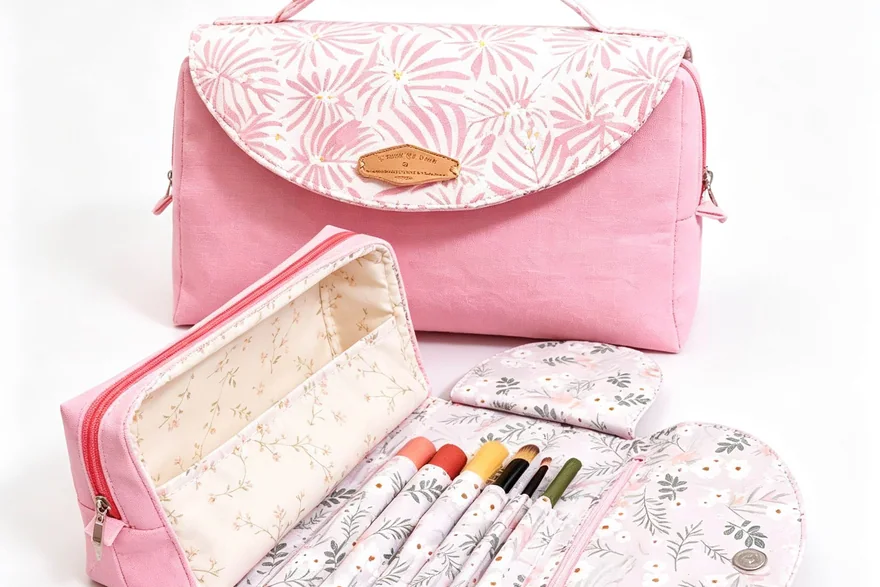
Every upgrade in the list has a failure mode, and four of them fail often enough to be called out. The pattern is the same in each case: an upgrade that improves the shelf impression degrades the use experience, and the use experience is what generates the review and the reorder.
- Rigid structure on a travel pouch: a 2.5 mm base board plus side stiffeners makes a bag stand beautifully and pack badly, since it will not compress into a suitcase corner.
- Hardware stacking: metal feet, a moulded metal puller and a logo plate together can add 80 to 140 g, which is often enough to push a parcel into the next shipping band.
- High-gloss metallic finishes: a mirror-finish PU laminate photographs superbly and scuffs in transit, so a meaningful share of units arrive with visible abrasion on the corners.
- Over-compartmentalisation: six pockets in a 22 cm bag leaves each pocket too small for a full-size product, and customers report the bag as too small rather than well organised.
- Light linings without a protective finish: a pale lining raises perceived value on the shelf and becomes the first thing the customer complains about after three weeks of use.
One interaction is easy to miss: upgrades change the packing profile. A structured base with feet and a moulded puller produces a bag that cannot be folded flat, so carton volume per unit rises and the pieces-per-carton count falls, sometimes from 50 to 30. That is a landed-cost change rather than a product-cost change, and it usually surfaces after the price has been agreed. The fix is to recalculate freight once the upgrade list is frozen and before the purchase order is signed.
Perception itself can be tested cheaply. Show five people two prototypes differing in exactly one upgrade, ask which costs more, and record the answer. It is not a laboratory method, but it reliably separates the upgrades customers notice from the ones they do not, and it takes an afternoon. Programmes that run this exercise usually find two or three items on their list are invisible to the buyer and can be dropped from the specification without any change in how the product reads.
The control for all four is a pack-out test with the actual product range, not with a stand-in. A bag should be filled with the brand's own tallest bottle, widest palette and thickest brush, closed, and then placed in the suitcase or drawer it is intended for. That single test catches the structure problem, the compartment problem and most of the lining problems before a 500-piece commitment is made.
There is also a fabric interaction worth checking. A structured base bonded to a soft shell can create a hinge line where the two meet, and that line is where the fabric eventually cracks. A piping or binding strip over the transition distributes the flex and costs a few cents. Similarly, feet riveted through a thin lining will tear out under load; a backing washer on the inside face prevents it and should be written into the pack. Both are examples of the same rule: an upgrade changes how the whole assembly flexes, not only the part it touches.
Validating upgrades before committing to a production run
Validation is cheap relative to a bulk order and should be sequenced so that the expensive checks happen only on upgrades that survive the cheap ones. A side-by-side comparison against two competitive products at the intended retail price point costs almost nothing and eliminates most bad choices. Laboratory testing then confirms the ones carrying a written claim.
| Validation step | What it resolves | Indicative cost | When to run it |
|---|---|---|---|
| Side-by-side against two competitors | Whether the upgrade is noticeable at all | Nominal | Before the first prototype |
| Physical prototype review | Hand feel, zipper run, standing stability | Sample cost only | First sampling round |
| Pack-out with the real product range | Capacity, compartment sizing, compression | Nominal | First sampling round |
| Zipper cycle test | Closure life before the teeth or slider fail | Low | Before bulk, on the chosen closure |
| Colour fastness of the lining | Whether a dark lining bleeds onto a pale shell | Low | Whenever a contrast lining is specified |
| Substance testing on the lining and shell | Retailer and marketplace acceptance | Medium | Before the first bulk shipment |
| Plating rub and salt-spray check | Whether a metal puller tarnishes in a bathroom | Low to medium | Whenever metal hardware is specified |
| Pre-production units for photography | Listing accuracy and return rate | Low | After approval, before bulk |
Sequencing the checks saves money. Run the cheap ones first and the expensive ones only on what survives: a side-by-side review and a pack-out test cost almost nothing and typically eliminate a third of the candidate upgrades. Laboratory work then confirms what remains. A brand that sends eight upgrade variants to a laboratory without pre-screening pays for eight tests to learn what one afternoon of comparison would have shown. The same logic applies across a range: validate the upgrade set once on a single format, then apply it to the remaining colourways rather than re-testing each.
Three of those steps have named methods worth referencing in the brief. Zipper terminology and construction are standardised under ASTM D2053, which gives buyers and suppliers a shared vocabulary for tape, teeth, slider and gauge. Lining and shell colour fastness is covered by the ISO 105 series, and the relevant clauses are the ones on rubbing and on washing. Substance safety on textiles is most easily evidenced through OEKO-TEX Standard 100, which most marketplaces and many retailers recognise without further argument.
Programme timing accommodates this sequence. Sampling runs 6 to 10 working days for a soft build with standard hardware and 12 to 15 working days where a moulded puller, a welded wet pocket or a structured base with feet is involved, which is most upgrade programmes. Bulk production runs 35 to 50 days after sample approval, and the window should hold a slot for the laboratory checks on the closure and the lining, which are the two items most often squeezed out when a launch date moves. Orders start at 500 pieces per style and colourway, with inspection to AQL 2.5 under ISO 2859-1, shipment FOB Xiamen and payment T/T 30 deposit and 70 against bill of lading.
The B2B Customisation View
Programmes for cosmetic pouches, vanity cases and beauty organisers move fastest when the artwork is supplied as vector files and the Pantone references are confirmed before sampling starts.
Budgeting and scheduling inputs: MOQ 500 per style and colourway; sampling 6–10 working days, extended to 12–15 for lined, moulded or hardware-heavy builds; bulk 35–50 days; pre-shipment inspection at AQL 2.5 per ISO 2859-1; FOB Xiamen; T/T 30/70.
QUANZHOU JUNYUAN BAGS is structured as a sourcing and programme-management company, which lets a buyer compare materials across several SGS-verified production lines inside one quotation.
Which Brand Types Benefit Most
Different buyer types should pick different subsets from the twelve, because the return on an upgrade depends on where the bag is sold. Start-up brands usually get the most from closure and interior contrast, since those decide whether a first-time buyer describes the product as cheap; a branded zipper and a contrast lining at under $0.60 combined is the highest-return opening move available. Established brands tend to be upgrading a bag that already sells, where the safer levers are a moulded puller, a debossed patch and a retail finish pack, all of which change the perceived tier without changing a proven silhouette. Retailers specifying private label usually work to a price point and care about consistency across a range, so their upgrades are the ones that photograph identically every time: structured base, bound seams, matched hardware finish. E-commerce sellers live and die by review language, which points toward the upgrades customers actively mention: a zipper that runs smoothly, a wet pocket, a bag that stands up. Gift and hospitality buyers value the unboxing and the finish pack most, because the recipient judges the bag before using it and a dust bag plus a printed hangtag does more work than an interior divider.
- Start-up brands: closure and contrast lining first, at under $0.60 combined.
- Established brands: hardware and finish upgrades that lift the tier without changing the silhouette.
- Retailers and private label: repeatable, photograph-consistent upgrades such as a structured base and bound seams.
- E-commerce sellers: the upgrades customers name in reviews, notably the zipper, the wet pocket and standing stability.
- Gift and hospitality: invest in the finish pack, since the judgement is made at unboxing.
- All buyer types: test each upgrade against a plain control sample before committing it.
Frequently Asked Questions
Which cosmetic bag upgrade gives the highest perceived-value return?
The closure. A branded coil zipper with a tape dyed to match the shell adds roughly $0.25 to $0.45 per unit and is the one component a customer touches every single time they open the bag. It outperforms interior upgrades of similar cost because it is registered by hand feel as well as by eye, and it is the detail most often mentioned in reviews.
How many upgrades should one cosmetic bag carry?
Four to six is the practical range. Beyond six, the marginal perception gain falls below the cost of simply improving the shell fabric, and the risk of the upgrades conflicting rises: a rigid base fights a compressible travel pouch, and stacked hardware pushes up parcel weight. Pick closure, structure and interior first, then add logo and pack finish.
Does a contrast lining really change how a bag is judged?
Yes, and it is the cheapest upgrade in the list at $0.05 to $0.15. The interior is what the customer sees immediately after opening the bag, and a deliberately contrasted lining reads as designed rather than as a cost saving. The trade-off is maintenance: pale linings show marks, so a protective finish or a mid-tone shade is usually the better call.
What makes a cosmetic bag stand up without slumping?
A 1.5 to 2.5 mm base board, usually polyethylene or polypropylene, bonded or stitched into the base panel, plus feet if the bag will sit on a hard surface. The board has to be sized to the base footprint or the corners collapse. Where the bag is meant to compress into luggage, a lighter board or a removable one is the better compromise.
Are metal feet on a cosmetic bag worth specifying?
Yes for a vanity or dressing-table bag that sits on a hard surface, because they lift the bag off spills and signal a higher tier. They are less useful on a travel pouch, where they catch on clothing. Rounded feet with a backing washer on the inside face prevent both the snagging and the tear-out that flat riveted feet cause.
How is zipper quality specified between buyer and supplier?
By using shared terminology. ASTM D2053 defines zipper terms, so a brief can state tape width, gauge, tooth type, slider type and puller finish unambiguously. A cycle test, commonly 3,000 open-close cycles, then verifies the chosen closure rather than assuming a brand name guarantees performance.
Why do dark linings need colour fastness testing?
A deep navy or black lining can crock onto a pale shell during a humid transit, producing a bag that arrives with grey transfer marks. The rubbing and washing clauses in the ISO 105 series cover exactly that risk. It is a low-cost test and a very visible failure, which makes it poor value to skip. Request the rubbing result with the first sample, because a lining that crocks is cheapest to change before the fabric is booked.
What does a welded wet pocket add over a stitched one?
A welded TPU pocket has no needle holes, so it genuinely holds liquid rather than merely slowing it. That justifies a price step and answers a real complaint about leaking bottles. The catch is that weld seams need a leak test on a sample per batch, because a weld failure is invisible to a visual inspection and only shows up in the customer's suitcase. Specify the weld width and the test pressure in the brief so the check is repeatable.
Is OEKO-TEX certification worth the cost on a cosmetic bag programme?
For most branded and marketplace programmes, yes. OEKO-TEX Standard 100 is recognised by retailers and marketplaces without further argument, which removes a recurring documentation request from every listing and every buyer conversation. It is cheaper to hold one certificate than to answer the same question per season.
Which upgrades most often trigger customer complaints?
Rigid structure on a bag bought for travel, high-gloss metallic finishes that scuff in transit, and pale linings that stain. All three improve the shelf impression and degrade the use experience. A pack-out test with the brand's actual product range catches the first and third before production, and an abrasion check catches the second.
How should a brand choose between a debossed patch and a metal plate?
A debossed patch at $0.10 to $0.25 suits a soft, fabric-forward aesthetic and adds almost no weight. A moulded metal plate or puller at $0.30 to $0.75 suits a structured vanity case and photographs strongly, but adds weight and needs a plating rub test. Approve a physical sample in both, since deboss depth varies with substrate and a shallow deboss reads as a printing fault rather than as a logo.
What minimum applies to a multi-upgrade cosmetic bag build?
The minimum is 500 pieces per style and colourway. Custom components within an upgrade list, a moulded puller, a custom deboss die or a specific hardware finish, can carry their own supplier minimums, so it is worth confirming availability of the hardware in every planned colourway before the sampling round starts.
How long does sampling take when six upgrades are specified?
Expect 12 to 15 working days where a structured base, a welded wet pocket or a moulded puller is involved, and 6 to 10 working days where the upgrades are limited to lining, loops, patches and a standard branded zipper. Bulk then runs 35 to 50 days after approval, which should include a slot for closure and lining tests.
How is an upgraded bag inspected before shipment?
To AQL 2.5 under ISO 2859-1 for appearance and construction, with the added instruction that hardware defects are treated as their own defect class rather than folded into general appearance. Functional items such as a welded pocket or a hanging hook need a fixed-sample check, since neither failure is reliably caught by percentage sampling. Hardware shade variation should also be its own defect class, because a mismatched puller finish is the complaint most often raised on a premium bag.
Should a cosmetic bag be specified with a dust bag and hangtag?
For gift, hospitality and premium retail channels, yes. A dust bag and a well-printed hangtag typically add $0.35 to $0.90 and do more for unboxing perception than any interior feature at the same cost. For a marketplace-only programme priced under about $8, the same money usually performs better in the closure and the fabric. One rule holds across all five buyer types: an upgrade only pays if the customer notices it unprompted, so the discipline is to test each candidate against a plain control sample before committing it to a 500-piece run rather than trusting the sample photograph.
People Also Ask
What makes a cheap cosmetic bag look expensive?
Closure, structure and interior contrast, in that order, all of which are noticed before any printed feature and none of which require a higher fabric spend. A branded zipper with a matched tape, a base board that lets the bag stand upright, and a lining deliberately contrasted against the shell cost well under $1.00 combined and change how the product reads. Print and capacity, which are where most budgets go, are noticed last.
How much does it cost to upgrade a cosmetic bag?
Individual upgrades run from about $0.05 for a contrast lining to $0.90 for a full retail finish pack, with most between $0.25 and $0.70. A realistic four-upgrade package lands between $0.70 and $1.60 per unit. Against a category band of $0.45 to $12.00, that is a small move with a large effect on shelf position, and it is the cheapest way to change which price tier a bag reads as belonging to.
Do more pockets make a cosmetic bag better?
Up to a point. Six pockets in a 22 cm bag usually leaves every pocket too small for a full-size product, and customers then describe the bag as too small. Three or four pockets sized to the brand's actual bottle and palette dimensions outperform more pockets sized generically, and a removable divider adds flexibility without reducing volume.
Should a travel cosmetic bag be structured or soft?
Soft, with a light base board, for anything that has to compress into luggage. Structure photographs well on a shelf and packs badly in a suitcase corner. A removable board is a workable compromise: the bag stands for display and the board comes out for travel, at a modest added unit cost. Whichever route is chosen, state the board thickness in the brief, since 1.5 mm and 2.5 mm behave very differently in a suitcase.
Request a Sample or a Written Quotation
Send the silhouette, dimensions, material preference and logo artwork, and the programme team will return a written quotation with MOQ, sampling window, bulk lead time and inspection standard.
Email: service@junyuanbags.com · WhatsApp: +86 177 5002 0688