Hanging Travel Toiletry Bags: Do You Really Need One?
Executive Summary
A hanging travel toiletry bag earns its place only when the trip includes a bathroom the traveller does not control and a kit too large to spread on a shelf. The hook turns the bag into a vertical organiser, which is genuinely useful in a hotel room, a cruise cabin or a shared hostel bathroom where the only clear surface is a washbasin rim. It is a poor choice for carry-on-only travel, where the hook and the structured tiers add weight and depth that a flat pouch does not, and for a one-night trip, where the kit fits in a washbag anyway.
For a brand deciding whether to commission one, the decision is a specification question rather than a fashion one. A loaded three-tier bag weighs 1.8 to 3.0 kg, and the hook, the webbing anchorage and the top seam have to carry that load repeatedly without tearing out. The test plan matters more than the look: static load, hook rotation cycles and seam strength on the anchor point. Programme terms: 500 pieces per style and colourway, 6-10 working day sampling, 12-15 for complex constructions, 35-50 day bulk, AQL 2.5 inspection under ISO 2859-1.
What Counts as a Hanging Toiletry Bag
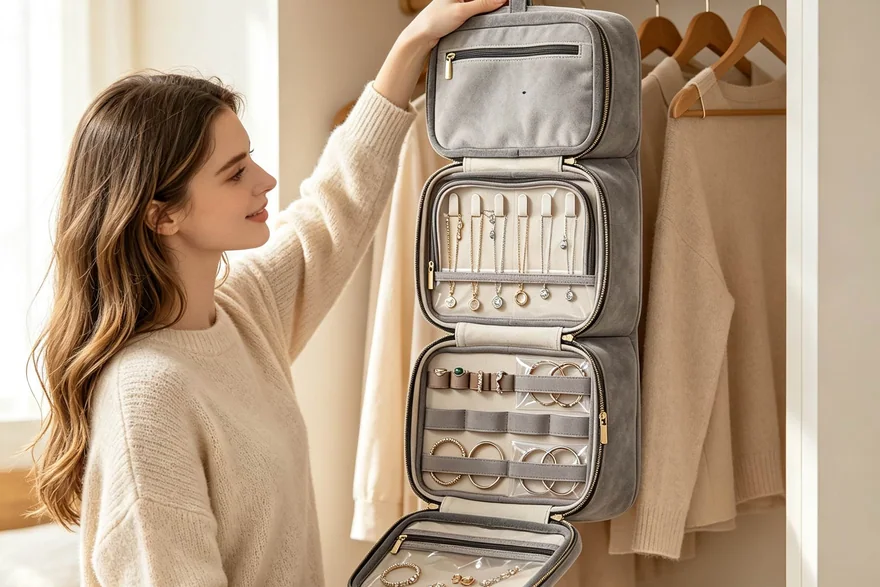
A hanging toiletry bag is defined by one component: a hook, fixed to the top of the body, that allows the bag to be suspended so its compartments hang vertically. Everything else follows from that. Because the contents are held upright rather than lying in a pile, the compartments can be shallower and more numerous, and the whole kit becomes visible at once. The format is also known as a hanging wash bag, a hanging dopp kit or a hanging organiser, and it spans a wide price band, from a lightweight pouch with a plastic hook to a structured case with a metal swivel hook and four zippered tiers.
| Component | Typical specification | Function | Common weak point |
|---|---|---|---|
| Hanging hook | Zinc alloy or steel swivel hook, or a moulded POM hook, 30 to 45 mm opening | Suspends the bag from a rail, rod or door hook | Pivot pin shears or the hook mouth opens under sustained load |
| Hook anchorage | 20 to 25 mm polyester webbing, bar-tacked through a reinforcement panel | Transfers the load into the body of the bag | Webbing tears out of the top seam rather than breaking |
| Top reinforcement panel | Second layer of shell fabric, 420D nylon or 600D polyester | Spreads the load across the top of the bag | Stitched to the lining only, so the peel starts at the lining seam |
| Tiered compartments | Two to four tiers, 8 to 12 cm deep, closed by zip or mesh | Keeps items upright and visible when hanging | Lower tiers sag when the bag is half empty |
| Base panel | Stiffened or coated fabric, sometimes with feet | Holds the bag upright when it is standing rather than hanging | Splayed base makes the bag impossible to stand in a sink recess |
| Carry handle | Webbing loop or a padded grip on the side | Carries the bag when it is not hanging | Handle stitched into a side seam that also carries the hook load |
Two construction choices separate an inexpensive hanging bag from a durable one. The first is whether the hook load path runs into a dedicated reinforcement panel or simply into the top seam of the lining. The second is whether the hook rotates: a swivel hook lets the bag turn to face the user when it is hung on a rail behind a door, while a fixed hook leaves the compartments facing the wall. Both are visible in a sample within seconds, and both are far cheaper to specify now than to fix after a production run.
The Load Case: What a Full Kit Weighs and Where It Fails
Every hanging bag is a small piece of lifting equipment, and most of the returns in this category trace back to that fact being ignored at the design stage. A hanging bag is not loaded gently and left alone; it is hung, rummaged through, bumped while a bottle is being pulled from a lower tier, and yanked off a rail in a hurry. The load a hook sees in use is therefore well above the static weight of the contents, and the anchorage has to survive both the weight and the handling.
| Kit profile | Contents | Packed weight | Recommended hook and anchorage | Observed failure mode |
|---|---|---|---|---|
| Minimal | 5 items, travel sizes only | 0.9 kg | Moulded POM hook on 20 mm webbing | Rarely fails; the lightest construction is adequate |
| Standard | 12 items, mixed travel and full sizes | 1.8 kg | Metal swivel hook on 20 mm webbing, bar-tacked | Webbing pulls from the top seam after repeated loading |
| Full | 20 items, mostly full-size bottles | 3.0 kg | Steel swivel hook on 25 mm webbing through a reinforcement panel | Hook mouth opens or the pivot pin shears |
| Professional | 30 items, glass bottles and tools | 4.2 kg | Steel hook with a riveted anchorage and an internal frame | Tiers deform and zippers burst on the lower compartment |
The numbers above describe contents only. An empty three-tier bag in 420D nylon with a metal hook, a stiffened base and four zippers typically weighs 300 to 420 g, so the load on the hook is the kit plus the bag. A useful design rule is to size the hook and the anchorage for three times the declared full-kit weight, because the dynamic load from a bumped bag or a dropped kit easily doubles the static figure, and because textile structures weaken at the stitch line where the webbing enters the seam.
The shell material carries the load between the hook and the compartments, so it deserves the same attention as the hook itself. A coated 420D nylon or a 600D polyester with a PU backing is the usual choice, and the coating is what gives the panel its resistance to tearing at the stitch holes. Coated fabrics are assessed for breaking strength, tear resistance and coating adhesion under ASTM D751, and a specification that names a method and a minimum value is far more useful than one that names a fabric weight alone. Where a bag uses an uncoated face fabric, the load path should run through a coated or laminated reinforcement panel instead.
One more load case is worth naming in the specification because it is rarely tested: the dynamic pull. A traveller who catches a sleeve on the bag, or who lifts it off a rail by one corner, imposes a short, sharp load that a static test will not reveal. A pull test on the hook with the bag loaded, applied over one second rather than ramped slowly, catches the anchorage failures that a static hang test misses.
- Size the hook and webbing for three times the declared full-kit weight, not for the weight of the empty bag
- Run the load path into a dedicated reinforcement panel rather than into the lining seam
- Bar-tack the webbing with a box stitch of at least 12 mm on each leg
- Specify the hook material by alloy or polymer grade rather than by the word metal or plastic
- Test with the bag loaded, not empty, and test the anchorage separately from the shell
Where Hanging Beats Flat Pouches, Roll-Ups and Hard Shells
The honest answer to whether a traveller needs a hanging bag is that it depends almost entirely on the bathroom at the destination and on the size of the kit. A hanging bag converts a vertical surface into a shelf, and that is valuable precisely when horizontal surfaces are wet, absent or shared. When the traveller has a clear shelf and a small kit, the hook is dead weight. The comparison below scores the four formats against the situations that actually arise.
| Situation | Hanging bag | Flat pouch | Roll-up | Hard shell case |
|---|---|---|---|---|
| Hotel bathroom with a rail | Best; the whole kit is visible and off the basin rim | Adequate; contents have to be spread out | Poor; needs a surface to lie on | Adequate; takes up shelf space |
| Hostel or shared bathroom | Best; nothing touches a wet surface | Poor; has to be held or balanced | Adequate if it has its own hanging loop | Poor; heavy and bulky to carry to a shared facility |
| Cruise cabin | Best; cabin bathrooms have very little shelf space | Adequate | Poor | Poor; the case does not fit the shelf |
| Carry-on only, low-cost fare | Poor; adds depth and 150 to 250 g over a pouch | Best; compresses into the sizer | Best; the tightest packed cylinder | Poor; rigid and heavy |
| One-night business trip | Adequate; the hook is unused | Best; smallest for a small kit | Adequate | Adequate |
| Professional kit with tools | Best in a four-tier frame version | Poor; tools are hard to find | Adequate for brushes | Best for protection of glass and pressed powders |
| Camping or festival | Best; hangs from a tent ridge or a shower rail | Adequate | Good; packs tight and dries fast | Poor; too heavy |
Read across the rows and a clear pattern emerges. The hanging format wins whenever the destination has a rail and loses whenever the constraint is the luggage. That makes it a strong proposition for hotel, cruise, hostel and camping programmes and a weak one for a brand whose customer flies with a personal-item allowance. Several brands in the category have solved the conflict with a detachable hook: the bag hangs at the destination and packs flat in transit, at the cost of one extra component and one more thing to lose.
- Hanging wins on destination convenience, flat and roll-up win on luggage space
- A detachable hook is the best compromise for a range sold to both travellers
- Four tiers suit a professional kit; two tiers suit a weekend kit and pack flatter
- A hanging bag with a stiffened base can also stand, which widens where it can be used
- Empty weight is the deciding figure once a 7 kg cabin allowance applies
There is also a retail argument that has nothing to do with travel. A hanging bag photographs well when it is displayed open, because the compartments are all visible at once, and it demonstrates capacity in a way a closed pouch cannot. For an e-commerce listing, the open-hanging photograph is one of the few ways to show a bag's capacity without resorting to a pile of props. That is a genuine commercial benefit for a brand selling online, and it should be weighed alongside the functional argument rather than instead of it.
Test Plan and Specification for a Hanging Programme
A hanging bag has more working parts than any other format in the category, and the test plan should reflect that. Zippers, a hook, a pivot, webbing, bar-tacks, a reinforcement panel and, often, a stiffened base all have to be specified and checked. The good news is that none of the tests is expensive or slow, and running them at sample stage is far cheaper than discovering a torn anchorage in a returned batch.
| Test | Method or reference | Pass criterion | Sample size |
|---|---|---|---|
| Static hook load | Loaded to three times the declared full-kit weight, hung for 60 minutes | No permanent deformation of the hook, no stitch fracture | Three samples |
| Hook rotation cycles | Rotate the loaded hook through 360 degrees, 500 cycles | Hook rotates freely; pivot shows no measurable play | Three samples |
| Anchorage pull | Tensile pull on the webbing at 90 degrees to the panel | Failure occurs in the webbing, not at the seam, above 500 N | Five samples |
| Zipper cycles | Open and close each zipper 500 times | No slider wear, no tape delamination, no tooth separation | Three samples |
| Coated fabric strength | Breaking strength, tear resistance and coating adhesion to ASTM D751 | Values at or above the figure named in the specification | Per fabric lot |
| Zipper terminology | Component naming and construction referenced to ASTM D2053 | Slider, pull, tape and stop named consistently on the tech pack | Document review |
| Loaded drop | Loaded bag dropped 50 cm onto a hard floor, five times | No seam opening, no burst zipper, no hook deformation | Two samples |
Zipper specification deserves a note, because a hanging bag typically carries three or four of them and each one is a failure point on a loaded, hanging structure. Naming the components with the terminology set out in ASTM D2053 removes the ambiguity that causes the same order to be delivered with two different slider types. On a bag that hangs, the lower compartments carry the most weight, so the lower zippers should be specified with the largest gauge in the design rather than matching the top tier for the sake of uniformity.
Most hanging bag specifications describe the empty bag. The hooks, seams and zippers fail in the loaded state. A sample approval process that includes a loaded hang test and a loaded drop test catches the majority of field failures before a bulk order of 500 pieces per style and colourway is committed.
The rest of the specification is conventional. Fabric at 420D nylon or 600D polyester with a PU coating, lining in 210D polyester with a wipe-clean finish, webbing in 20 mm or 25 mm polyester, a hook in zinc alloy or stainless steel with a documented finish, and bar-tacks at every load point. Abrasion at the base and at the hook pocket is worth checking against the AATCC test methods used by the brand's laboratory, because a bag that drags across a bathroom floor fails at the corners long before it fails at the hook. Sampling runs 6-10 working days, or 12-15 for a frame-built construction, with bulk at 35-50 days, inspection at AQL 2.5 under ISO 2859-1, shipment FOB Xiamen and payment T/T 30 deposit and 70 against bill of lading.
The B2B Customisation View
Programmes for cosmetic pouches, vanity cases and beauty organisers move fastest when the artwork is supplied as vector files and the Pantone references are confirmed before sampling starts.
Budgeting and scheduling inputs: MOQ 500 per style and colourway; sampling 6–10 working days, extended to 12–15 for lined, moulded or hardware-heavy builds; bulk 35–50 days; pre-shipment inspection at AQL 2.5 per ISO 2859-1; FOB Xiamen; T/T 30/70.
QUANZHOU JUNYUAN BAGS is structured as a sourcing and programme-management company, which lets a buyer compare materials across several SGS-verified production lines inside one quotation.
Which Brand Types Benefit Most
The hanging format suits buyers whose customer stays somewhere with a rail, and that single fact sorts the channels. A hotel group ordering amenity and retail kits can specify a hanging bag confidently, because every bathroom in the estate has a rail or a hook and the guest is stationary for several nights. A cruise line has an even stronger case, because cabin bathrooms offer almost no shelf space. A start-up brand is better advised to begin with a detachable-hook version, so the same article can be sold to a hotel guest and to a carry-on traveller without committing the range to one use case. An established brand with a travel or luggage heritage can justify a four-tier internal-frame version, because the higher ticket price absorbs the extra weight and the open-hanging photograph supports the positioning. Gift and hospitality buyers serving hotel and cruise partners should specify the hook alloy in writing, because a hook that fails in a guest bathroom generates a complaint to the hotel rather than to the brand, and contract accounts are renewed on exactly that kind of detail.
- Start-up brands: a two-tier bag with a detachable hook covers both the hotel and the carry-on customer from one article number
- Established brands: a four-tier professional version with an internal frame supports a higher price point and photographs well when displayed open
- Retailers: display the bag hanging, because the open-hanging shot demonstrates capacity more convincingly than any closed product photograph
- E-commerce sellers: state the loaded weight and the hook material in the listing, since those are the two details reviewers mention most often
- Gift and hospitality buyers: amenity kits for hotel and cruise partners should use a metal hook with a documented alloy, because a broken hook in a guest bathroom generates a complaint to the hotel rather than to the brand
Frequently Asked Questions
What load rating should the hook on a three-tier hanging bag be specified to?
A moulded plastic hook on 20 mm webbing typically handles the 0.9 to 1.8 kg of a minimal or standard kit without trouble. A full kit of around 3 kg needs a metal swivel hook on 25 mm webbing anchored into a reinforcement panel. The sensible design rule is to size the hook and the anchorage for three times the declared full-kit weight, because a bumped or dropped bag briefly loads the hook well above its static weight.
Do hotel bathroom hooks actually support a loaded hanging bag?
Most bathroom rails, towel bars and door hooks carry a 3 kg load without difficulty, so the hook on the wall is rarely the weak point. The weak point is the bag's own anchorage, followed by the fixing of the rail into a plasterboard wall. A traveller hanging a full three-tier bag from a lightweight over-door hook should check that the door hook itself is rated for the load.
What is the difference between a swivel hook and a fixed hook?
A swivel hook rotates on a pivot, so the bag can be turned to face the user after it is hung; a fixed hook cannot, which means the compartments face whichever way the bag happened to land. The swivel version is more useful in practice and adds one moving part that can wear. Specifying 500 rotation cycles in the test plan covers the wear risk adequately.
Should a hanging toiletry bag be built with two, three or four tiers?
Two tiers suit a weekend kit and pack flatter, which matters for a bag that travels in a cabin bag. Three tiers is the general-purpose answer and the most common commercial configuration. Four tiers suit a professional kit with tools or full-size bottles, but the empty weight and the packed depth both rise, which makes the format harder to justify for air travel.
Do hanging toiletry bags fit inside a carry-on allowance?
A three-tier bag closed measures roughly 24 x 20 x 10 cm, which fits a standard cabin case but is a poor fit for a low-cost personal-item sizer of 40 x 20 x 25 cm once clothing is included. The empty weight of 300 to 420 g also matters under a 7 kg cabin cap. For a carry-on-only traveller, a flat pouch or a roll-up is the better format.
Is a metal hook better than a moulded plastic hook?
Metal carries a higher load and resists creep under sustained weight, so it is the right choice for a full kit of 3 kg or more. Moulded POM is lighter, quieter against a rail and perfectly adequate below about 1.8 kg. The specification should name the alloy or polymer grade rather than the word metal, because plated zinc alloy and stainless steel perform very differently in a damp bathroom.
What causes the hook anchorage to tear out of the body panel?
Usually the load path is stitched into the lining seam rather than into a dedicated reinforcement panel, so the peel starts at the stitch line under repeated loading. The second cause is a bar-tack that is too short, concentrating the load on a few millimetres of thread. A box stitch of at least 12 mm per leg, into a second layer of shell fabric, prevents both.
Are hanging toiletry bags heavier than flat pouches of the same capacity?
Yes, typically 150 to 250 g heavier, because of the hook, the webbing, the reinforcement panel, the extra zippers and the stiffened base. Against a 7 kg cabin allowance that is 2 to 3 per cent of the total, which frequent travellers notice. The weight is the price paid for organisation at the destination, and it is the main reason to offer a detachable-hook version.
Does a hanging bag need a waterproof base?
A coated or wipe-clean base is worth specifying, because the bag is often set down on a wet basin rim before it is hung. A fully waterproof welded base adds cost and stiffness, which helps the bag stand but makes it pack less flat. For most programmes a coated 600D polyester base with a wipe-clean finish is the right balance, with welded seams reserved for the liquids compartment.
How do hanging bags behave when only half full?
Less well than a flat pouch. Empty tiers sag and collapse, and bottles in a loose mesh pocket shift towards the lowest point, which can make the bag hang crooked. Elastic loops rather than open mesh pockets hold half-full kits neatly, and a stiffened base helps the bag hang straight. This is a genuine weakness of the format and worth testing with a half-loaded sample.
Can a hanging bag be built without a zipper?
Yes. Roll-and-clip closures, hook-and-loop flaps and snap-fastened covers are all used, and removing zippers removes the most common warranty claim in the category. The trade-off is security: a snap flap will not keep a bottle inside a bag that is knocked off a rail. A hybrid, with zippers on the lower tiers and a flap on the top tier, is a practical compromise.
What fabric weight suits a three-tier hanging bag?
A 420D nylon with a PU coating is the usual starting point, giving a good strength-to-weight ratio and reasonable abrasion resistance at the corners. A 600D polyester costs less and resists abrasion well but adds weight. For the lining, 210D polyester with a wipe-clean finish keeps weight down while handling spills, since the lining is what a leaking bottle actually reaches.
How should a brand test a hanging bag before release?
Run a static load test at three times the declared full-kit weight for 60 minutes, 500 hook rotation cycles, a tensile pull on the webbing anchorage, 500 cycles on each zipper, and a loaded drop test from 50 cm. Test the loaded bag rather than the empty one. Three samples per test is enough at development stage, with a repeat on production samples before bulk ships.
Do cruise cabins and hostels suit hanging bags more than hotels do?
Yes, and more than most buyers expect. A cruise cabin bathroom typically offers a rail and very little shelf, which is exactly the condition the format is designed for. A shared hostel bathroom is wet and has almost no clear surface, so hanging is often the only practical option. In both cases the traveller is stationary for several days, which also favours a larger bag.
When is a hanging bag the wrong choice for a brand's range?
When the customer's binding constraint is luggage space rather than bathroom space. A range sold to carry-on-only travellers, to low-cost-fare flyers or to gym users is better served by a flat pouch or a roll-up, both of which pack tighter and weigh less. A brand should also avoid the format if it cannot fund the loaded-state testing, because an untested hook is a returns risk.
People Also Ask
Is a hanging toiletry bag worth the extra weight for a carry-on traveller?
They are worth it when the destination has a rail and the kit is large enough to need organising: a hotel stay, a cruise cabin, a hostel or a campsite. They are not worth it for carry-on-only travel, where the hook and the tiers add 150 to 250 g and extra packed depth. The traveller's luggage allowance, not the bag, decides the answer.
What can I use instead of a hanging toiletry bag?
A flat pouch with internal elastic loops is the closest equivalent and packs tighter. A roll-up organiser is the most space-efficient alternative for a cylindrical kit. A bag with a detachable hanging loop gives most of the benefit without the permanent hardware, and a shower caddy solves the same problem at the destination for travellers who check luggage. For a kit of fewer than about eight items, a simple standing pouch with internal loops is usually all that is needed.
How can a toiletry bag be hung when the bathroom has no hook?
Use a bag with a webbing loop slipped over a tap, a shower head or a door handle; over-the-door hooks and suction hooks are common workarounds. A carabiner clipped to a tent ridge or a shower rail works for camping. If no hanging point exists, standing the bag open on a stiffened base is the next best option, which is why a base that stands is worth specifying.
What size hanging toiletry bag should I buy?
Match the tier count to the kit. Two tiers with a closed size near 22 x 16 x 8 cm suits a weekend kit of about a dozen items. Three tiers near 24 x 20 x 10 cm is the general-purpose size. Four tiers suits a professional kit and typically exceeds 30 cm of open drop, which is worth checking against the height of the shower rail at the destination.
Request a Sample or a Written Quotation
Send the silhouette, dimensions, material preference and logo artwork, and the programme team will return a written quotation with MOQ, sampling window, bulk lead time and inspection standard.
Email: service@junyuanbags.com · WhatsApp: +86 177 5002 0688