Cruise Ship Toiletry Bags: Cruise Line Branding Opportunities
Executive Summary
Branded cruise toiletry bags earn their margin in five placements, and each placement wants a different bag: embarkation welcome gifts, stateroom retail, spa and salon retail, loyalty tier gifting and shore excursion or beach club kits. A giveaway pouch for embarkation sits at $0.80-$2.20 and is specified for cheerful print and lightweight delivery, while an onboard retail case at $4.50-$9.80 has to hold its shape under a shop light and survive the rest of the cruise in a humid cabin.
Marine exposure separates these bags from ordinary travel pouches. Tropical itineraries hold 70-95% relative humidity, balcony and deck sun pushes light fastness requirements up, and salt spray pits most metal hardware, so the working specification is solution-dyed polyester or TPU-laminated fabric with a corrosion-resistant closure rather than a brass zipper. Commercial terms do not change between placements: 500 pieces per style and colourway, 6-10 working day sampling, 35-50 days bulk, AQL 2.5 inspection and FOB Xiamen shipment.
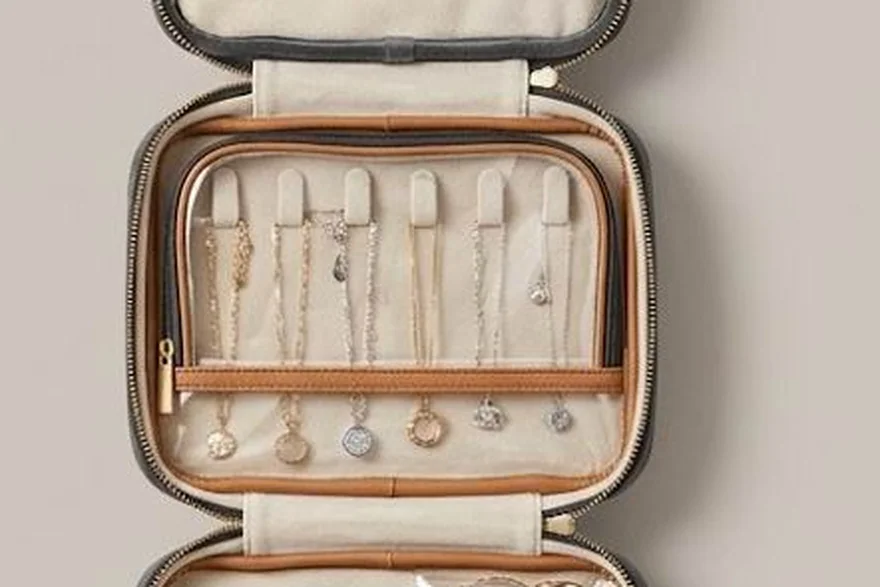
Where a Branded Toiletry Bag Appears Across a Cruise Itinerary
A cruise itinerary exposes a branded bag to more selling situations in seven nights than a retailer sees in a season, which is why cruise lines and their concession partners treat toiletry cases as a small family of products rather than one SKU. Placement drives specification, because the conditions are genuinely different: a welcome kit sits dry in a cabin for an hour before the guest unpacks, while a beach club pouch spends a day wet, sandy and folded into a backpack. Buyers who try to stretch one design across all five placements usually end up overpaying on the giveaway and under-delivering on retail.
- Embarkation welcome gift: highest unit volume, lowest unit cost, delivered palletised to a shoreside warehouse before each sailing.
- Stateroom retail: a case placed in the cabin for purchase, needing structure, a hangtag and retail-grade finishing.
- Spa and salon retail: sold after treatment alongside professional products, so it is specified against wet hands and damp counters.
- Loyalty tier gifting: small volume, high perceived value, typically embroidered and given to repeat passengers by membership level.
- Shore excursion and beach club kits: sun, salt and sand exposure, usually the shortest usable life and the boldest print.
The arithmetic differs sharply by placement. A 2,800-passenger ship on a 7-night Caribbean itinerary at about 95% occupancy issues roughly 2,660 welcome kits per sailing, which means a single weekly rotation consumes just under 140,000 pieces a year. The loyalty gift for the top membership tier might be 400-900 pieces a year from the same ship. Planning those two items in one purchase order is the classic way to over-spend: the gift wants construction and embroidery, and paying gift-level unit prices across 140,000 pouches costs far more than running two separate programmes.
Onboard stores may sail 90-120 days between replenishment points. A retail toiletry case therefore has to be forecast further ahead than its landside equivalent, with safety stock sized against the longest gap between restocking calls rather than against average weekly sales.
Five Placements Compared on Volume, Cost and Specification
The fastest way to scope a cruise programme is to place each idea against the three constraints that actually bind: how many units the placement consumes in a year, what the ship can retail it for, and how long the bag has to last. The table below sets out working figures buyers can adapt. Cost bands are unit costs for the bag alone inside the wider $0.45-$12.00 range typical of the category; landed cost adds freight to the cruise line's designated warehouse, which for steady programmes is usually a named port-side consolidation point rather than the ship itself.
| Placement | Annual units per weekly ship | Unit cost band (USD) | Typical retail or issue price | Design priority | Most common failure |
|---|---|---|---|---|---|
| Embarkation welcome gift | 95,000-140,000 | $0.80-$2.20 | Included in fare | Print impact, low cube per carton | Print rubbing against light linings |
| Stateroom retail case | 3,000-9,000 | $4.50-$9.80 | $19.95-$34.95 | Self-standing structure, retail finishing | Base collapse when filled |
| Spa and salon retail | 1,200-4,000 | $3.80-$7.60 | $22.00-$39.00 | Wipe-clean lining, wet-hand grip | Water marks on absorbent linings |
| Loyalty tier gift | 400-900 | $5.50-$11.00 | Non-retail gift | Embroidery quality, perceived weight | Puckered embroidery on thin fabric |
| Shore excursion kit | 12,000-40,000 | $1.20-$3.40 | $8.95-$16.95 or bundled | Sand shedding, fast drying | Hardware corrosion from salt |
Volume differences explain most specification decisions. At 140,000 pieces a year, halving carton cube matters more than any single material saving: a pouch that nests flat at 8 mm instead of bulging to 18 mm changes the number of units per carton from about 250 to about 500, and across a full year of weekly deliveries that difference is dozens of pallets and roughly 6-11% of freight cost. Conversely, at 600 units a year for loyalty gifting nobody cares about cube, but every gram of perceived weight and every stitch of embroidery counts.
Pricing architecture deserves attention too, because the two highest-value placements sit in the same shop. An onboard buyer usually wants a visible step between the $19.95 stateroom case and the $34.95 spa case, and that step should be legible in the product rather than only on the shelf talker. The cheapest way to create it is a construction change rather than a size change: moving from a single-layer unlined pouch to a 2 mm foam-lined case with a bound internal seam typically adds $1.10-$2.40 per unit and reads immediately under shop lighting.
Finally, minimum quantities need to be mapped to the calendar rather than argued with. The minimum is 500 pieces per style and colourway, so a programme that wants four loyalty tier colourways commits to 2,000 pieces even if the top tier only needs 400. Practical workarounds include running one shell colour with tier-specific embroidery, or consolidating a season of gifting into a single annual release so that every tier draws from the same dyed fabric lot and shade variation between tiers disappears.
Welcome gifts are usually budgeted per occupied berth per night, often at $1.20-$3.50 for a 7-night itinerary. Expressing the brief that way lets a buyer trade fabric against contents without breaching the total campaign number.
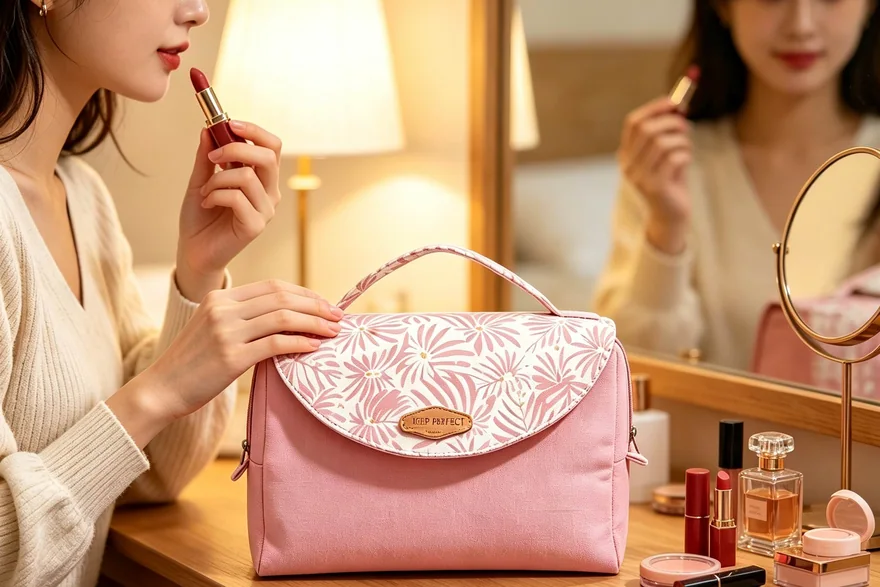
Marine Exposure: Salt, Humidity, Chlorine and Deck Sun
Marine environments attack four things at once, and a specification written for landside retail fails on all of them in sequence. Humidity in tropical itineraries runs 70-95%, so absorbent linings stay damp and develop odour. Salt spray deposits chloride on any exposed metal. Chlorinated pool water strips colour from reactive-dyed fabric. Deck and balcony sun subjects the bag to high irradiance for hours at a time, which is why light fastness, not tensile strength, is the first property to check.
- Specify colour fastness to water, sea water and chlorinated water within the ISO 105 family, with targets of grade 4 dry and grade 3-4 wet for rubbing.
- Choose solution-dyed polyester over piece-dyed fabric where the bag will sit on a balcony or deck; light fastness improves by roughly one grade.
- Use TPU laminated 420D at around 260-300 g/m² for wet placements, since it sheds water and dries in 30-60 minutes compared with hours for canvas.
- Replace brass and zinc alloy sliders with moulded plastic or POM sliders; metal hardware shows corrosion spotting within 6-12 weeks at sea.
- Ask for a mildew-resistance assessment rather than an antimicrobial finish where possible, because biocidal claims carry additional regulatory weight.
- Require nickel and lead screening on all metal components that touch skin, and keep the test report next to the specification.
- Aim units destined for Alaska and Northern Europe differently from Caribbean units: lower UV, but higher wet-cold exposure, so lining drying time dominates.
Colour behaviour is worth writing down explicitly rather than leaving to a lab to interpret. The relevant test families sit inside the ISO 105 colour fastness series, which covers colour fastness to water, sea water, chlorinated water and artificial light, and a cruise specification should name the targets and the parts being tested, including printed panels and woven labels. Buyers also lean on AATCC test methods for practical performance questions such as water repellency and dimensional change after laundering, which matter far more on a ship than they do at home.
Closure choice is where most marine complaints originate, and the fix is cheap. A number 5 coil zipper with a moulded slider costs about $0.18-$0.42 and shows no corrosion, while a brass chain with a die-cast pull costs $0.75-$1.60 and starts spotting within one season. Where a premium look is non-negotiable, an anodised aluminium pull with a coil chain splits the difference at roughly $0.55-$0.95, provided the anodising standard is written into the specification so the finish is auditable at inspection.
Damp storage between uses is the last enemy. A pouch stored closed and wet develops odour within 48 hours in tropical humidity, so designs for spa and pool placements should include either a mesh side panel or a hanging loop that lets the bag be opened and air-dried in the cabin shower area. Adding a 12 mm webbing hanging loop costs about $0.06-$0.12 and prevents the majority of the odour complaints that otherwise reach guest services, while a mesh panel of roughly 10 x 14 cm lets air circulate between slots without exposing contents. Both additions are cheaper than a returned unit, which on board typically costs several times the landed value of the bag once handling and goodwill credit are counted.
Decoration Methods, Artwork Control and Brand Governance
Cruise artwork usually arrives tightly controlled: a brand guideline specifying logo clear space, minimum logo width and permitted colour references, often with separate marks for the cruise line, the ship name and any concession. The decoration method has to reproduce those marks accurately at the size the bag allows, which is why method selection should happen at sketch stage rather than after a first sample disappoints. Minimum reproduceable stroke width, not overall logo size, is what disqualifies embroidery on a thin shell.
| Decoration method | Minimum practical detail | Typical unit cost (USD) | Wash and wear behaviour | Best placement |
|---|---|---|---|---|
| Screen print, one colour | Lines from 0.8 mm, solid shapes only | $0.09-$0.22 | Cracks after roughly 30 washes on coated fabric | Embarkation giveaway |
| Heat transfer print | Photographic detail, gradients to 6-8 tones | $0.20-$0.48 | Holds 50 washes; edges lift if applied over a seam | Shore excursion kits |
| Embroidery | Lettering above 5 mm cap height, strokes above 1.5 mm | $0.38-$1.30 | Outlasts the bag; needs backing on thin shells | Loyalty tier gifts |
| Woven label | Simple marks; no fine gradients | $0.07-$0.18 | Excellent, especially when folded | Retail cases and gifts |
| Debossed PU patch | Solid marks only, no thin serifs | $0.55-$1.40 | Very durable; reads well under warm lighting | Spa retail and premium tiers |
Colour management is the recurring budget leak. Ship name variants and seasonal themes multiply colourways fast, and since the minimum applies per style and colourway, six thematic prints of one pouch style means six lines of 500 pieces. Buyers routinely cut that by keeping the shell and hardware constant and moving all theme into artwork, so that a new theme only triggers a new print approval rather than a new pre-production sample. Where several ships share one design, a single dyed lot should cover all of them; otherwise a half-grade shade difference becomes visible when the bags are laid out together in a shop.
Documentation and timing follow standard programme terms. Sampling runs 6-10 working days for straightforward constructions and 12-15 working days when the design includes welded seams, moulded components or multi-panel embroidery. Bulk production takes 35-50 days after sample approval, inspection follows AQL 2.5 under ISO 2859-1 sampling procedures, shipment is FOB Xiamen and payment is T/T 30% deposit with 70% against bill of lading.
Component compliance travels with those shipments. Textile layers and coatings supplied into programmes carrying OEKO-TEX or restricted-substance claims generally need their OEKO-TEX Standard 100 documentation current at the time of shipment rather than at the time of quoting, since certificates run on a one-year cycle. Restricted substance obligations under EU REACH apply to inks, coatings and plastics alike, and the declaration should list component families so that a change of thread supplier mid-programme does not invalidate the file.
- Request two printed reference panels per colourway so that brand teams ashore can approve against physical rather than screen colour.
- Fix acceptable print registration tolerance at 1.5 mm on the inspection defect list, because it is not covered by the ISO sampling tables.
- Set the ship name variant count before fabric is booked; adding a seventh variant later means another 500-piece line.
- Plan delivery to the named shoreside warehouse 3-4 weeks before embarkation, not to the vessel.
- Keep the newest 2% of each lot back as replacement stock for guest service claims during the following season.
The B2B Customisation View
The route from concept to shelf for makeup bags and toiletry bags is short when the specification is tight at the start, and painfully long when it is not.
Fixed commercial parameters: 500 pieces per style and colourway minimum, first sample in 6–10 working days (12–15 for complex or hardware-intensive constructions), bulk 35–50 days after approval, AQL 2.5 inspection under ISO 2859-1, FOB Xiamen, T/T 30/70.
The role played here is programme coordinator: QUANZHOU JUNYUAN BAGS translates a retail brief into a factory-ready technical pack and then audits the output against it before goods leave the floor.
Which Brand Types Benefit Most
The five buyer types in this category each want a different first sample. A start-up brand pitching a beach club or expedition concept should lead with the shore excursion pouch, because the low unit cost band and bold print let small volumes look expensive; 500 pieces printed in one colourway is a realistic opening order and the same shell can be reissued across two seasons. An established beauty brand moving into shipboard retail already owns artwork and usually a wash-bag pattern, so the saving comes from pattern reuse: adapting an existing case to a 26 x 18 x 10 cm ship-friendly size trims development effort and knocks 8-15% off unit cost without touching materials. A retailer operating shipboard boutiques needs the structure and hangtag route, and should sample both the $4.50 and the $9.80 ends of the range in the same round so the price ladder can be compared physically. An e-commerce seller pursuing post-cruise reorders benefits most from a shell that also photographs well online, and hospitality buyers running welcome-kit programmes ashore can often consolidate with a shipboard line to improve unit pricing, since the same 35-50 day bulk schedule and 500-piece colourway minimum apply to both channels.
- Start-up brands: one printed pouch, one colourway, 500 pieces, with a second artwork reserved for the following season.
- Established brands: rescale an existing retail case to ship-friendly dimensions and keep hardware identical across channels.
- Retailers and concession operators: sample a two-step ladder in one round and ask for retail-ready packing with hangtags and barcodes.
- E-commerce sellers: use the same base shell for ship retail and post-cruise online reorders, doubling the value of one 500-piece line.
- Hospitality and gifting buyers: cruise specifications translate directly to resort welcome kits, so consolidate volumes to improve unit pricing.
Frequently Asked Questions
How many welcome kits does one weekly seven-night sailing consume in a year?
About 95,000-140,000 pieces. A 2,800-passenger vessel at 95% occupancy issues roughly 2,660 kits per sailing, multiplied by 51 or 52 turnarounds. Because a 5% occupancy swing changes the annual figure by more than 6,000 units, most buyers place a base order covering 70-75% of forecast and schedule one or two top-up releases against a mid-season restatement.
Which fabric survives Caribbean humidity and balcony sun best?
Solution-dyed polyester outperforms piece-dyed fabric on light fastness by roughly one grade, which is the difference between a print that survives a season and one that fades by month three. For wet placements a TPU-laminated 420D around 260-300 g/m² sheds water and dries in 30-60 minutes. Avoid untreated canvas linings, which stay damp and develop odour inside 48 hours.
Do metal zippers really corrode on board ship?
Yes, typically within 6-12 weeks in salt air. Brass and zinc alloy components show spotting first at the slider and bottom stop. Moulded plastic or POM sliders on a number 5 coil chain cost $0.18-$0.42 and eliminate the issue entirely; where a metallic look is required, an anodised aluminium pull with a written anodising specification costs about $0.55-$0.95 and holds up considerably longer.
What unit cost should a stateroom retail toiletry case target?
Around $4.50-$9.80 landed, retailing between $19.95 and $34.95. Those numbers assume a structured case: a 2 mm foam laminate, bound internal seams and a retail-quality closure, since an unstructured pouch will not hold shape under shop lighting. The step up to a premium tier is usually built with construction rather than size, adding $1.10-$2.40 per unit.
How far ahead of embarkation should bulk goods arrive?
Plan for pallets at the named shoreside warehouse 3-4 weeks before the first sailing. That buffer absorbs sampling at 6-10 working days, bulk production of 35-50 days after approval, freight from Xiamen, customs clearance and onward redistribution. Because ships may go 90-120 days between replenishment points, retail safety stock should be sized against the longest replenishment gap rather than average weekly sales.
How should the colour fastness targets be written into a cruise specification?
Name the test families and the target grades for each component, including printed panels, woven labels and webbing. Practical targets are grade 4 dry and 3-4 wet for rubbing, grade 4 for water and sea water, and the highest achievable grade for light on any bag destined for deck or balcony use. Naming exposes the assumption behind the fabric choice instead of leaving it to interpretation.
Can one case serve both spa retail and stateroom gifting?
Occasionally, but rarely well. Spa retail demands a wipe-clean lining and a wet-hand grip, while stateroom gifting rewards print impact and perceived volume. Sharing shell pattern and hardware while varying lining and decoration typically costs less than $0.60 per unit and preserves the visual family, so a two-variant approach is usually cheaper than either stretching one design or running unrelated programmes.
What is economical embroidery for loyalty tier gifting?
Plan for $0.38-$1.30 per unit depending on stitch count. A small mark around 6,000 stitches on a stable cotton canvas costs about $0.38-$0.55; coverage beyond 12,000 stitches requires backing stabiliser and reaches $0.90-$1.30. Keep lettering above 5 mm cap height and strokes above 1.5 mm, since thinner detail needs denser stitching and pulls at the shell.
How does the 500-piece minimum apply to a four-tier loyalty programme?
Four tiers in four colours means four lines of 500 pieces, totalling 2,000 units, even if the top tier only needs 400. Running one shell colour with tier-specific embroidery is the usual fix, since it keeps the digitising cost while collapsing four dyed lots into one. Consolidating a full season of gifting into one annual release also removes shade variation between tiers.
Which sample size applies to a 12,000-piece seasonal cruise purchase?
Under AQL 2.5 at General Inspection Level II, a lot of 3,201-10,000 pieces takes code letter L with 200 pieces inspected and an acceptance number of 10; at 10,001-35,000 pieces it moves to letter M with 315 pieces inspected and an acceptance number of 14. Buyers should attach their own zero-tolerance defect list covering print registration, loose threads and mis-set eyelets.
What stops a cruise toiletry bag developing mildew in a humid cabin?
Design rather than chemistry, in the first instance. A mesh side panel or a hanging loop lets the bag dry open; combined with a non-absorbent lining, drying completes in a few hours. A hanging loop of 12 mm webbing costs about $0.06-$0.12 and addresses most odour complaints. Biocidal finishes bring additional regulatory obligations and should be documented thoroughly before they are specified.
Should Northern Europe or Alaska itinerary units differ from Caribbean units?
Yes. Northbound itineraries trade UV exposure for cold wet conditions, so lining drying time and hand feel in low temperatures matter more than light fastness. Practical adjustments include a slightly heavier lining, a TPU face that sheds rain, and a webbing loop for drying, while the light fastness target can be relaxed by one grade for the same fabric family.
How are retail-ready cases packed for shipboard boutiques?
Usually individually polybagged with a printed hangtag and a barcode placed on two faces of the outer carton, with cartons marked by ship name, sailing date and department code. Typical counts are 60-80 cases per carton for a structured 26 x 18 x 10 cm design. Ship-specific labelling avoids repicking ashore, which costs more per unit than the labelling itself.
What happens to unused stock when an itinerary is redeployed?
Ship-specific artwork is the risk, so governance should ask for generic artwork with the ship name on a removable label or swing tag. Redeployed vessels leave printed stock ashore with weeks of sailing already committed, and a generic base with changeable detail lets it follow passenger demand to another vessel. Where artwork must be ship-specific, holding only one or two sailings of cover limits exposure, and replacement stock for guest service claims should come from the same dyed lot.
What is a realistic per-berth budget for an embarkation welcome kit?
Many programmes budget $1.20-$3.50 per occupied berth per night for a seven-night itinerary, or roughly $8.40-$24.50 per berth for the week including contents. A pouch at $0.80-$2.20 leaves the rest for content and filling labour. Expressing the brief per berth rather than per bag lets a buyer trade fabric against contents without exceeding the overall campaign number.
People Also Ask
What kind of toiletry bag is best for a cruise cabin?
A case with a hanging loop and a non-absorbent lining, because cruise bathrooms are small and stay humid. Look for wipe-clean TPU or coated polyester, a hook strong enough for a door hook rather than a towel rail, and several upright slots so bottles cannot fall. A loop costs about $0.06-$0.12 extra and solves the drying problem that causes most complaints, and a mesh panel of about 10 x 14 cm keeps contents ventilated between ports.
Why do cruise lines give away toiletry bags?
Because the bag is seen more often than almost any other branded item on board and carries the mark into the guest's home afterwards. The economics are per-berth rather than per-bag: a welcome pouch costing $0.80-$2.20 is part of a per-passenger campaign budget, and the resulting reuse keeps the brand visible long after disembarkation. Annual consumption can approach 140,000 units on one weekly sailing, which is why the specification is usually written per berth rather than per bag.
How does salt air affect cosmetic bag materials?
Salt deposits chlorides on exposed metal and drives corrosion at sliders and stops within six to twelve weeks, while salt-laden humidity keeps absorbent linings damp. A moulded plastic or POM slider avoids the first issue and a non-absorbent lining avoids the second. Conditioned fabric self-heals; surface rust does not, so hardware choice matters more than fabric strength at sea.
Are embroidered or printed logos better on cruise gift bags?
It depends on placement and volume. Embroidery at $0.38-$1.30 suits loyalty gifts where perceived value matters and generally lasts longer than the bag itself, provided lettering stays above 5 mm cap height and strokes above 1.5 mm so the shell does not pucker. Printing at $0.09-$0.48 suits embarkation volumes approaching 100,000 units a year and reproduces gradient artwork that a needle cannot realistically handle.
Request a Sample or a Written Quotation
Send the silhouette, dimensions, material preference and logo artwork, and the programme team will return a written quotation with MOQ, sampling window, bulk lead time and inspection standard.
Email: service@junyuanbags.com · WhatsApp: +86 177 5002 0688