Custom Cosmetic Bag Anatomy: 15 Components Every Designer Should Know
Executive Summary
A custom cosmetic bag is made of fifteen distinct components, and the answer to why two visually identical pouches quote differently is almost always found in that list rather than in the silhouette. Shell, lining, interlining, structure, main zip, secondary zip, puller, binding, handle webbing, thread, elastic loops, pocket panels, branding, feet and packaging each carry a specification, a failure mode and a cost lever of their own. A designer who can name all fifteen can change one at a time.
Specifying at component level produces faster sampling, fewer revisions and a cost conversation that can actually be steered. The zip alone has four separately specified parts — chain, tape, slider and puller — and its terminology is standardised under ASTM D2053, which is what makes a tech pack unambiguous. Programme minimums are 500 pieces per style and colourway, sampling runs 6-10 working days (12-15 for complex constructions), and bulk runs 35-50 days after sample approval. Inspection is carried out to AQL 2.5 under ISO 2859-1 before shipment, which is FOB Xiamen with T/T terms of 30 deposit and 70 against bill of lading.

Why Component-Level Thinking Changes the Quote
Most briefs arrive as a photograph and a size. That is enough to start a conversation and not enough to fix a price, because two pouches that look identical in a photograph can differ in every costed line of the bill of materials. A designer who knows the anatomy of the bag can change one component at a time and see exactly what it does to unit cost, lead time and field performance. A designer who does not ends up re-quoting the whole bag to solve a problem that lived in a single trim.
Reading a competitor sample component by component is the fastest way to learn the category. Turn the bag inside out, estimate the lining weight from a known area converted to g/m², count the stitches over 25 mm, measure the zip chain width across the closed teeth in millimetres, and note whether the raw edges are bound, overlocked or turned. Those five observations reproduce most of a specification and cost nothing but attention.
The category rewards this level of detail because competition runs on features rather than on silhouette. The search phrase "custom makeup bag" draws 5,400-6,600 monthly searches, and the buyers behind that traffic are comparing brush loops, wipe-clean linings and zip quality rather than overall shape. A listing that names its components converts better than one that says little more than the colour.
Every component has three attributes worth writing down: what it is made of, what dimension or gauge it is, and what it must survive. A tech pack missing any one of the three will be quoted with an assumption the designer did not intend.
The fifteen components below are grouped into the structural layer, the closure and trim layer, and the finishing layer. Not every bag has all fifteen; a flat promotional pouch may have nine, while a structured vanity case has all of them plus a moulded shell. The value of the list is that it makes the omissions deliberate rather than accidental, which is what keeps a quotation comparable from one round to the next.
The Structural Layer: Shell, Lining, Interlining and Frame
The structural layer is the first four components and it decides how the bag looks, how it stands and how long it lasts. Shell fabric is specified by fibre, weave and weight in g/m²; lining by the same three plus a stain-release or wipe-clean finish; interlining by weight and by whether it is sewn in or fused; and the frame by whether the bag is soft, board-stiffened or moulded. These four choices interact, and a change to one usually forces a change to another.
| Component | What it controls | Common options | Failure mode if underspecified |
|---|---|---|---|
| 1. Shell fabric | Drape, abrasion life, print quality | 600D polyester, 420D nylon, PU-coated knit, TPU laminate | Pilling and corner wear within one season |
| 2. Lining fabric | Stain release, wipe-clean, interior look | 190T or 210T polyester, 210D nylon, TPU film laminate | Permanent staining from foundation and oil |
| 3. Interlining | Body, shape retention, perceived quality | Non-woven 60-120 g/m², fused tricot, foam laminate | Bag collapses and looks cheap on shelf |
| 4. Frame or structure | Whether the bag stands upright | 1.5-2.0 mm board, steel wire hoop, moulded EVA shell | Lid sags, mirror or contents are crushed |
| 5. Base stiffener | Load carrying and flat sitting | Greyboard insert, PE sheet, moulded tray | Base bowls and the bag tips over |
Shell weight is the most commonly mis-specified number. A designer who asks for "a sturdy fabric" will be quoted 600D polyester because it is the safe default, when a 420D nylon at similar weight would resist abrasion better and cost more, or a 300D recycled polyester would satisfy a sustainability brief at a lower cost. The specification should name the fibre, the denier and the finished weight in g/m², plus any coating, because a PU coating can add 30-60 g/m² on its own.
Interlining weight is the second number worth controlling. A flat pouch needs no interlining at all. A case that should hold a shape on the shelf generally needs 80-120 g/m² of non-woven sewn into the panels, or a foam laminate bonded to the shell if the designer wants a softer, padded hand. Fusing rather than sewing saves labour but can delaminate on a bag that is washed, so washable programmes should specify sewn-in interlining.
The frame choice is where cost and lead time jump. A steel wire hoop sewn into the top seam costs little and adds no tooling. A moulded EVA shell gives the cleanest shape and the best protection but requires a tool, which is a one-off cost and an additional 15-25 days before the first sample can be built. A designer working to a fixed launch date should choose board or wire unless the shell shape is the whole point of the product.
- Name fibre, denier and finished weight in g/m² for both shell and lining.
- Specify interlining by weight and by method: sewn-in for washable bags, fused for dry-clean-only cases.
- Add a separate base stiffener whenever the bag has to sit flat when loaded.
- Reserve moulded EVA for programmes where the shell shape is the selling point.
- Check that the lining finish survives the product the bag will actually carry.
Closures, Hardware and Trims: The Parts Most Often Underspecified
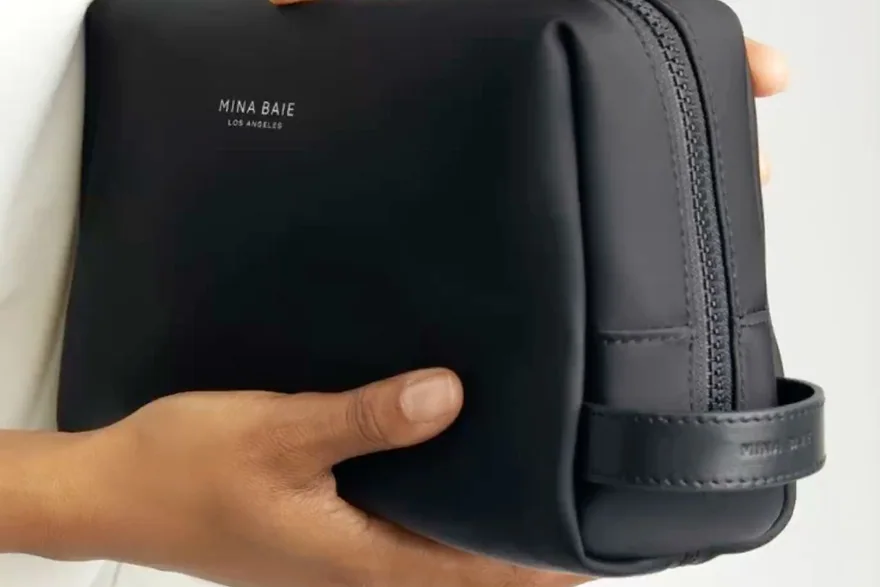
Closures and trims are where a tech pack becomes precise or becomes a negotiation. A zip is not one component but four: the chain, the tape, the slider and the puller. Each is specified separately, and the vocabulary used to describe them is standardised in ASTM D2053, which defines zipper terminology including chain width, tape, slider and top and bottom stops. Specifying in that vocabulary removes the ambiguity that produces a sample with the right size zip and the wrong puller.
| Component | What it controls | Common options | Failure mode if underspecified |
|---|---|---|---|
| 6. Main zip chain | Opening width, smoothness, strength | #3, #5 or #8 nylon coil; #5 metal; #5 reversed coil | Snagging on lining at the corners |
| 7. Zip tape | Sewing margin and colour match | Polyester tape, 12-15 mm visible width, dyed to match | Tape puckers or shows a white core |
| 8. Slider | Locking behaviour and pull effort | Non-lock, auto-lock, reversible, with or without a garage | Bag opens itself in transit |
| 9. Puller | Look, grip, noise | Metal cast, webbing loop, silicone moulded, leather wrap | Paint flakes or the puller cuts the hand |
| 10. Binding and piping | Edge finishing and shape definition | 15-20 mm bias binding, 4-6 mm corded piping | Raw edges fray inside the bag |
| 11. Handle webbing | Carry comfort and load path | 20-25 mm polyester webbing, tubular or flat | Handle tears out at the stitch line |
| 12. Thread and stitch density | Seam strength and seam appearance | Polyester or bonded nylon, 8-10 stitches per inch | Seam bursts at the base corner |
Chain size should be matched to the opening, not chosen for looks. A #3 coil is adequate for a small pouch up to about 22 cm of opening; a #5 coil suits a 25-40 cm vanity case; and a #8 is reserved for a large train case or a bag expected to carry glass bottles. Oversizing the chain adds cost and stiffness for no functional gain, while undersizing produces the single most common field complaint in the category: a zip that catches on the lining at the corner turn.
Stitch density is the cheapest quality lever available. Eight to ten stitches per inch is the working range for a bag of this type; below seven, seams open under load, and above twelve, the needle perforates the fabric so densely that the seam itself becomes the tear line. The specification should also name the thread: bonded nylon for strength on a structured case, polyester for a bag that will be washed, because nylon thread loses strength faster under repeated wetting and drying.
The remaining components finish the bag. Elastic brush loops are specified by webbing width, usually 10-20 mm, and by the relaxed length, which must be shorter than the item they hold; a loop cut to the brush diameter will not grip. Pocket panels are specified by height and by whether they are gusseted. Branding is specified by method — woven label, heat transfer, silicone badge or metal plate — and by position. Feet, where used, are specified by diameter and by whether they are riveted through a base stiffener or simply glued.
Two standards support this layer of the specification. Zipper terminology is defined under ASTM D2053, which is the reference a tech pack should cite when it names chain size, tape and slider type. Colour fastness of the tape, binding and webbing against rubbing and washing is assessed using the AATCC test methods series, and a dyed-to-match trim that fails a crocking test will stain a pale shell inside the carton.
From Component List to Costed Tech Pack
The last component is packaging, and it is the one most often left until the end. A polybag, a hangtag, a barcode sticker and an export carton are all specified items with their own costs and lead times, and a carton count fixed late in the programme can change the landed cost per unit by a visible margin. A designer who writes the packaging spec at the same time as the shell spec will not be revisiting freight quotes in the week before shipment.
| Programme stage | What is fixed | Standard timing |
|---|---|---|
| Component list agreed | All fifteen components with material, gauge and test | Before quotation |
| Sampling | Prototype built from the agreed component list | 6-10 working days, 12-15 for complex constructions |
| Sample approval | Fit, function and colour signed off | Buyer decision |
| Bulk production | Cutting, sewing, assembly and packing | 35-50 days after sample approval |
| Inspection | Visual, dimensional and functional checks | AQL 2.5 under ISO 2859-1 |
| Shipment | Cartons packed to the agreed carton count | FOB Xiamen, T/T 30 deposit, 70 against bill of lading |
- Write the material, the gauge or dimension, and the performance requirement for each of the fifteen components.
- Mark which components are stock items and which must be dyed, moulded or tooled to order.
- Confirm that every dyed-to-match trim carries a colour fastness requirement.
- Fix the carton count and the packing method before the freight quote is requested.
- Keep one approved sample sealed as the reference for inspection and any later dispute.
Component choices also set the shape of the order. The programme minimum is 500 pieces per style and colourway, and that minimum exists partly because several components — dyed zip tape, custom pullers, printed labels and moulded parts — have their own production minimums at the trim vendor. Splitting an order across three colourways therefore means three sets of trim minimums, which is why a single-colour launch is materially cheaper per unit than a three-colour launch of the same total volume.
Component availability drives reorders as much as first orders. A stock zip and a stock lining can be reordered in almost any quantity, while a custom-dyed tape, a cast puller or a printed label carries the vendor's own minimum and a longer lead time. Buyers planning a repeat programme should identify which components are stock and which are bespoke, and hold a buffer of the bespoke items against a rolling forecast rather than re-opening the whole specification each season.
Cost steering is most effective at the component level because the levers are independent. Dropping from a #5 metal zip to a #5 nylon coil removes a measurable amount from the unit cost and changes nothing the customer will notice at arm's length. Reducing interlining from 120 g/m² to 80 g/m² removes less money and changes the shelf appearance immediately. A designer who knows which levers are visible and which are not can hit a target price without damaging the product where it matters.
One further discipline pays for itself across a range: keep the component list as a versioned document. When a second colourway or a second size is added, the list is copied and only the changed lines are marked, which keeps costing comparable between seasons and prevents a quiet substitution of a cheaper trim going unnoticed. Where a component touches skin or cosmetics, screening under OEKO-TEX Standard 100 covers the assembled article including thread, elastic and printed labels.
The B2B Customisation View
For buyers building a range of cosmetic bags, the specification sheet doubles as the costing sheet, which is why it is worth getting right in week one.
Programme data for this category: minimum order quantity 500 pieces per style and colourway, sampling in 6–10 working days (12–15 working days for complex constructions), bulk production 35–50 days after sample approval, final random inspection at AQL 2.5 under ISO 2859-1, FOB Xiamen, T/T 30/70.
Because the entity is a sourcing and programme-management company, the buyer deals with one accountable counterpart for specification, sampling, inspection and consolidation.
Which Brand Types Benefit Most
Component-level specification is most valuable to buyers who iterate. A start-up brand developing its first bag will change the shell, the lining and probably the zip across two or three rounds, and each change is cheap only if the rest of the specification is written down. An established brand with a house style gains something different: a component library that lets a new seasonal colour be costed in an afternoon rather than re-engineered from a photograph. Retailers and private-label buyers benefit most from standardising the invisible components, so that a group of bags across three price tiers shares one zip, one thread and one carton specification and therefore one set of trim minimums. The same list is also the fastest route to a value-engineering conversation, because it shows exactly which line can change without the customer noticing. Buyers running several sizes at once should also fix a shared component baseline, because that is what turns a range into a repeatable programme rather than five separate developments.
- Start-up brands: a written fifteen-component list prevents the sample round that exists only because a trim was never specified.
- Established brands: a shared component library across a range compresses costing and stabilises quality between seasons.
- Retailers and private-label buyers: standardising invisible components reduces trim minimums across the whole shelf.
- E-commerce sellers: naming components in listing copy answers the questions that otherwise become returns.
- Gift and hospitality buyers: packaging and branding components carry more weight than structural ones in this channel.
- Subscription box operators: durability of elastic loops and zip drives repeat-use satisfaction more than shell appearance.
- Promotional buyers: reducing the bag to nine components is the fastest route to a defensible unit price.
- Buyers with a moulded design: tooling cost should be amortised across at least two seasons before it pencils out.
- Buyers new to the category: starting from a stock-component specification keeps the first sample round short.
Frequently Asked Questions
How many components are there in a custom cosmetic bag?
Fifteen, if the list is complete: shell, lining, interlining, frame, base stiffener, zip chain, zip tape, slider, puller, binding, handle webbing, thread and stitch, elastic loops, pocket panels and branding, plus feet and packaging where the design calls for them. A flat promotional pouch may use nine of these; a structured vanity case uses all of them. Writing the full list and striking what the design does not need keeps the spec complete.
What zip size should the main closure of a cosmetic bag use?
Match the chain to the opening length. A #3 nylon coil suits a pouch with up to about 22 cm of opening, a #5 coil suits a 25-40 cm vanity case, and a #8 suits a large train case or a bag carrying glass bottles. Oversizing adds cost and stiffness without any functional benefit to the finished bag. Chain size should also be recorded in millimetres across the closed teeth for the record.
How is zip terminology standardised so that a tech pack is unambiguous?
ASTM D2053 defines zipper terminology, including chain, tape, slider and the top and bottom stops. Citing that standard and naming the chain size, the tape width, the slider type and the puller separately removes the ambiguity that produces a sample with the right zip and the wrong puller on it. Naming each part separately is what turns a drawing into a document that can be quoted.
What does ASTM D2053 actually cover for a bag zip?
It is a terminology standard, not a performance one. It defines the vocabulary used to describe a zip's parts and types, so that a buyer, a trim vendor and a sewing floor all mean the same thing by chain width or slider type. Performance testing of the finished zip is covered by separate methods. Citing it in the tech pack costs nothing and removes a whole class of sample error.
Which interlining weight suits a structured vanity case?
Between 80 and 120 g/m² of non-woven, sewn into the panels rather than fused, gives a case that holds its shape and survives washing. Below 60 g/m² the bag collapses on the shelf. A foam laminate bonded to the shell is the alternative when a softer, padded hand is what the designer wants. Sewing the interlining in rather than fusing it keeps the shape after washing.
When is a moulded EVA shell better than a board stiffener?
When the shell shape is the selling point of the product, or when the contents need genuine crush protection. A moulded shell gives the cleanest geometry but adds a one-off tooling cost and 15-25 days before the first sample exists. Board or a wire hoop is the better choice on a fixed launch date. Board or wire is also the right answer when the launch date cannot move.
How many stitches per inch should a cosmetic bag seam use?
Eight to ten is the working range. Below seven, seams open under load, particularly at the base corners; above twelve, the needle perforates the fabric so densely that the seam becomes the tear line. The specification should also name the thread, since bonded nylon and polyester behave differently when wet. Recording the count in stitches per inch makes the seam specification inspectable.
What thread type resists damage from cosmetic oils and repeated washing?
Polyester thread is the safer choice for a bag that will be washed, because bonded nylon loses strength faster under repeated wetting and drying cycles. For a structured case that will not be washed, bonded nylon offers higher seam strength and is often preferred at the load-bearing seams of the bag. Naming the thread in the tech pack prevents a silent substitution at bulk stage.
What causes zip pullers to break on a makeup bag?
Usually either a cast metal puller whose plating flakes under abrasion, or a puller whose attachment loop is too small for the slider stem and works loose over time. Specifying the puller material, the plating thickness and the attachment method, and testing a pull-cycle count at sample stage, prevents both failures. A pull-cycle test at sample stage costs far less than a replacement programme.
Which lining fabric resists cosmetic staining best?
A TPU film laminate wipes clean and resists oil penetration, but it adds weight and cost and can crease permanently. A 210D nylon with a stain-release finish is the usual compromise, and a plain 190T polyester lining without any finish is the cheapest option and the one most likely to stain for good. The lining decision should follow what the customer actually puts in the bag.
How are elastic brush loops sized on a cosmetic bag?
By relaxed length, which must be shorter than the item being held, since a loop cut to the brush diameter will not grip. Typical loops use 10-20 mm elastic, with the relaxed length set at roughly 70-80% of the intended item's circumference and the stitching bar-tacked at both ends. Bar-tacking both ends of each loop is what keeps the elastic from tearing out.
Which branding method survives washing on a pouch?
A woven label sewn into a seam survives best, followed by a silicone or rubber badge. Heat transfers can crack after repeated washing, and a metal plate can corrode or catch on other items. The branding method should be tested on the actual shell fabric rather than assumed from a different programme. Testing on the production fabric is the only way to know how the label will behave.
When are metal feet worth adding to a cosmetic case?
On a structured case with a base stiffener, where the bag will be set down on a wet or rough surface. Feet must be riveted through the stiffener rather than glued to the lining, otherwise they push through the base. On a soft pouch they add cost and catch on other items in a suitcase. Riveting through the stiffener is what stops feet pushing into the lining.
How does component choice affect the 500-piece per style minimum?
Trim vendors set their own minimums for dyed zip tape, custom pullers and printed labels, which is part of why the programme minimum sits at 500 pieces per style and colourway. Splitting a launch across three colourways means three sets of trim minimums, so a single-colour launch is cheaper per unit at the same total volume. Grouping colourways before release is the cheapest way to protect the unit price.
What should a component list contain before sampling starts?
For each of the fifteen components: the material, the gauge or dimension, and what it must survive. It should also mark which items are stock and which must be dyed, moulded or tooled to order. A list missing any of those three attributes will be quoted with an assumption the designer did not intend. Marking stock versus bespoke components also protects the reorder timeline later.
How long does sampling take once the component list is fixed?
Six to ten working days for a standard sewn construction, extending to 12-15 working days for complex constructions such as a moulded shell or an integrated electrical module. Components that must be dyed or tooled to order run ahead of that window, so those items should be released to the vendor first. Releasing bespoke trims to the vendor first is what keeps the sample window honest.
People Also Ask
What are the parts of a makeup bag called?
The main parts are the shell, the lining, the interlining, the frame or stiffener, the closure with its chain, tape, slider and puller, the binding or piping at the edges, the handle webbing, the thread and seams, the elastic loops, the pocket panels and the branding, plus feet on structured cases. Packaging is treated as the final component. Naming each part is also what makes two quotations genuinely comparable.
What is the best material for the inside of a makeup bag?
A wipe-clean TPU laminate is the most stain resistant, and a 210D nylon with a stain-release finish is the usual compromise on cost and weight. A plain polyester lining is cheapest and stains most easily. The right answer depends on whether the bag will be washed, wiped or left uncleaned. The right lining follows the cleaning habit the customer will actually have.
How do you make a cosmetic bag stand up?
Add structure at the base and in the panels: 80-120 g/m² of sewn-in interlining in the walls, a separate base stiffener such as greyboard or a PE sheet, and optionally a steel wire hoop sewn into the top seam. A moulded EVA shell is the strongest solution and the most expensive one. A separate base stiffener is what stops a loaded bag from bowling in the middle.
What size zip do I need for a pouch?
A #3 nylon coil for an opening up to about 22 cm, a #5 for 25-40 cm, and a #8 only for a large train case. Choose the chain to match the opening and the load rather than the look, and specify the tape width and the slider type separately so the sample matches the intent. Recording the chain size in millimetres prevents the wrong sample arriving twice.
Request a Sample or a Written Quotation
Send the silhouette, dimensions, material preference and logo artwork, and the programme team will return a written quotation with MOQ, sampling window, bulk lead time and inspection standard.
Email: service@junyuanbags.com · WhatsApp: +86 177 5002 0688