Cosmetic Bag with Hanging Hook: Door, Shower & Towel Rack Use
Executive Summary
The question behind a cosmetic bag with hanging hook is whether the hook and its reinforcement can carry a loaded bag on the surfaces people actually use, and the answer is that most failures happen at the attachment rather than in the hook itself. A swivel metal hook rated for 5 kg will still tear out of a 210D polyester shell if the load path runs through a single bar-tacked tab rather than a webbing strap carried down the back panel. Hook metal, strap width and reinforcement length have to be specified as one assembly.
Fit is the second half of the decision. Door hooks need 35 mm to 45 mm of throat clearance and shower rods are 22 mm to 32 mm in diameter, so a hook with a 25 mm throat will hang on a rod and fail on a door. Programmes start at 500 pieces per style and colourway, sample in 6 to 10 working days, or 12 to 15 where a moulded hook or welded panel is involved, then 35 to 50 days in bulk after approval, inspected to AQL 2.5 under ISO 2859-1, FOB Xiamen, T/T 30 deposit and 70 against bill of lading.
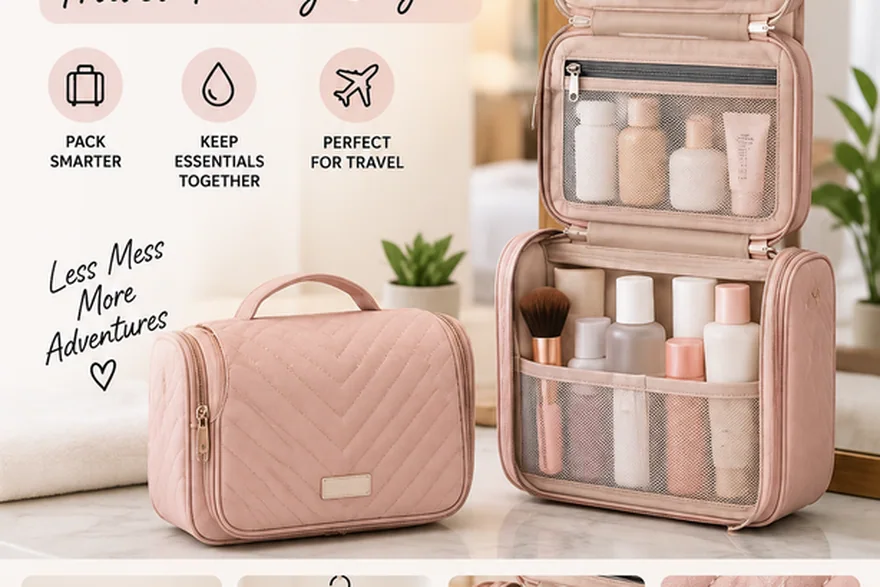
Where a hanging hook actually has to work
A hanging hook is asked to work on four surfaces, and they are not interchangeable. A bathroom door is 35 mm to 45 mm thick, sometimes more with a fire door, and its top edge is flat. A shower rod is a cylinder of 22 mm to 32 mm diameter, usually hollow and sometimes spring-tensioned. A towel rail is a cylinder or a flat bar of 15 mm to 30 mm, mounted at a height that puts the bag at eye level. A towel rack with a shelf above it is the fourth case, and it is the one most hooks fail, because there may be only 20 mm of clearance between the rail and the shelf.
This is why throat clearance is the single most useful number on a hook specification. A hook with an 18 mm to 22 mm throat fits a shower rod and most towel rails and will sit on nothing else. A hook with a 35 mm to 45 mm throat fits doors and rails. A hook with a 50 mm throat plus a swivel fits almost everything but looks oversized on a small bag and adds cost. Buyers should pick the throat to the primary use case stated on the listing, because a hook that fits nothing in the customer's bathroom generates the same return as a hook that breaks.
Hanging bags also carry a different load profile from flat bags. A hanging wash bag is loaded while it hangs, so the entire contents weight acts on the hook and its reinforcement in shear and peel rather than sitting on a base. A medium hanging bag with four 100 ml bottles, a brush set and a mirror weighs 800 g to 1.2 kg; a family bag can reach 2 kg. Add the dynamic factor of a bag being bumped or pulled down by a child, and a working design load of 3 kg to 5 kg is a reasonable specification even though the static load is far lower.
The market rewards getting this right. 'Travel bag for toiletries' draws roughly 110,000 monthly searches and 'toiletry bag' around 74,810 weekly searches on Amazon, and hanging bags are the fastest-growing slice of that demand because they solve a real problem in a small hotel bathroom. Unit pricing across the category spans 0.45 to 12.00 dollars, and the hook assembly is one of the few places where spending an extra amount produces a visible difference the customer will mention in a review.
Hook types and hardware compared
Six hook solutions cover the market, and they differ on throat clearance, whether they swivel, whether they fold for packing and how the load reaches the bag. The comparison below assumes a mid-size hanging wash bag with a working design load of 3 kg.
| Hook type | Throat clearance | Swivel | Folds flat | Typical rated load |
|---|---|---|---|---|
| Stamped steel swivel hook | 40-50 mm | Yes, 360 degrees | Yes, folds to the panel | 5-8 kg |
| Cast zinc-alloy hook | 35-45 mm | Yes, 360 degrees | No, fixed | 8-12 kg |
| Moulded POM or nylon hook | 25-35 mm | No | Yes, folds | 3-5 kg |
| Webbing loop with a side-release buckle | 30-60 mm adjustable | No | Yes, packs flat | 4-6 kg |
| Carabiner-style aluminium clip | 20-30 mm | No | Yes, detaches | 4-6 kg |
| Moulded TPE over-moulded hook | 30-40 mm | Partial | Yes, folds | 3-5 kg |
Metal hooks carry more load and look more expensive, but they bring two problems: corrosion and weight. A stamped steel hook needs a plating or coating that survives a humid bathroom, and the common failure is rust bloom at the rivet within a season. Zinc-alloy hooks are cast, heavier and more resistant, but they are brittle and will crack rather than bend if overloaded. Moulded polymer hooks will not rust and fold flat for packing, which is why they dominate the travel segment, but they creep under sustained load and should be specified with a load rating at least three times the expected contents weight.
Swivel matters more than buyers expect. A bag hung on a shower rod tends to rotate so its centre of mass sits directly below the rod, and a fixed hook transmits that rotation as a twisting load into the panel. A 360-degree swivel isolates it, which is why swivel hooks are standard on hanging bags above 250 mm in width. The swivel itself should be checked for the rivet or eyelet that retains it: a swivel retained by a single turned eyelet in a fabric tab is the most common point of failure in this whole assembly.
- Specify throat clearance in millimetres, matched to the surface named on the listing.
- Require a hook load rating at least three times the expected loaded bag weight.
- Ask whether the swivel is metal-on-metal or polymer-on-polymer; the latter wears faster.
- Confirm the corrosion protection by name: nickel plating, electrophoretic coating or a polymer over-mould.
- Check that the folded hook does not press into the contents when the bag is closed for travel.
Weight budget is the argument that usually settles the choice. A stamped steel hook with a swivel adds 25 g to 40 g, a cast zinc-alloy hook 45 g to 70 g and a moulded polymer hook 8 g to 15 g. In a carry-on bag that difference is small in absolute terms, but on a hanging bag the hook sits at the very top of the panel, where its weight adds to the moment acting on the attachment rather than simply to the total. Lighter hardware is therefore easier on the reinforcement as well as on the traveller. Buyers shipping by air should also note that metal hardware can push a lightweight bag across accessory weight thresholds on large shipments.
Load path: how the hook transfers weight into the bag
The hook is rarely what fails. What fails is the path from the hook to the bag body, and there are three ways to build it. The weakest is a fabric tab stitched into the top seam, which concentrates the whole load on a few centimetres of stitch line. The intermediate is a webbing strap stitched down the back panel for 100 mm or more, which spreads the load into the shell. The strongest is a strap carried from the hook, down the full height of the back panel and into the base seam, which turns the panel into a load-bearing member.
| Reinforcement method | Strap width | Stitch or fix | Load to first failure | Cost index |
|---|---|---|---|---|
| Fabric tab in the top seam | None | One bar tack, 500D tab | 1.5-2.5 kg, seam tears | 1.0 |
| Webbing strap, 100 mm down the panel | 20 mm | Box stitch plus bar tack | 3-5 kg, strap peels | 1.3 |
| Webbing strap, full panel height | 25 mm | Double-needle lockstitch | 6-9 kg, stitch shears | 1.6 |
| Strap into a moulded EVA back panel | 25 mm | Riveted or welded | 9-12 kg, panel cracks | 2.5 |
| Internal PE board with a strap wrap | 25 mm | Stitched through the board | 7-10 kg, board splits | 1.9 |
Stitch specification deserves its own line in the brief. A 25 mm webbing strap held by a single row of lockstitch at 8 stitches per inch will shear well before the strap itself fails; the same strap with a box-and-cross stitch pattern and a bar tack at the load point typically doubles or triples the figure. The thread matters too: a bonded polyester thread in the Tex 40 to Tex 70 range is the norm for this application, and a cotton-wrapped or low-tenacity thread will degrade in a humid bathroom far faster than the webbing it holds.
The panel behind the hook has to be stiff enough to stop the bag folding around the hook. In a soft hanging bag, the load pulls the top of the panel into a fold and the contents sag into a heap at the bottom, which is the complaint customers describe as the bag hanging crooked. A 0.8 mm to 1.2 mm PE board across the upper third of the panel, or a 2 mm EVA sheet where the bag is structured, keeps the top edge straight. Where the bag has shelves, the same board should carry down behind the top shelf so the shelf does not bow under the weight of bottles.
Fabric choice on the hanging panel follows the usual coated-fabric logic, and the properties worth specifying, tearing strength, coating adhesion and hydrostatic behaviour among them, are covered by the ASTM D751 coated-fabric methods. A 420D polyester with a 0.12 mm TPU laminate is the common specification for a mid-tier hanging bag: it resists tear propagation at the hook attachment, wipes clean, and stays flexible in a cold bathroom where a PVC laminate would stiffen.
One further attachment detail: where the strap is stitched to a hanging panel, the stitch should run with the panel rather than across it, because a cross-panel stitch line becomes a hinge that lets the top of the bag fold forward under load.
Testing the hook, fitting the surfaces and inspecting the batch
Three tests cover this assembly, and all three can be run on a sample bench without laboratory equipment. They should be written into the brief as acceptance criteria so the factory builds to a number rather than to an impression.
| Test | Method | Pass criterion | Common failure |
|---|---|---|---|
| Static load | Bag loaded to 3 kg, hung 24 hours | No stitch shear, no panel distortion | Tab seam tears within 2 hours |
| Dynamic load | Bag loaded to 2 kg, 50 pull-downs at 5 kg peak | No permanent deformation | Webbing strap peels from the panel |
| Fit check | Hang on a 40 mm door, a 25 mm rod and a 20 mm rail | Hangs level on all three | Throat too narrow for the door |
| Corrosion | 48 hours in a humidity cabinet at 40 degrees and 95 percent | No rust bloom at the rivet | Bare steel edge rusting at the swivel |
Fit checking sounds trivial and is where most programmes go wrong, because the sample is tested on a door in the office and shipped to customers who own a spring-tensioned shower rod. A fit kit of three offcuts, one 40 mm flat board, one 25 mm dowel and one 20 mm flat bar, costs almost nothing and catches the problem before 500 pieces are made. Where the listing names a specific surface, the fit check should use that surface and no other.
Hardware compliance runs alongside the mechanical tests. Any metal component in a bag sold into the US market is checked against the CPSIA limits for lead and, for coated metal, against the same screen applied to a coated fabric. Where the hook has a polymer over-mould, the polymer should be covered by the same restricted-substance documentation as the shell fabric, normally evidenced against OEKO-TEX Standard 100 in the first instance.
Inspection classifies hook defects by consequence. Under AQL 2.5 a 1,200-piece shipment draws 80 units with 5 minor and 3 major allowed. A scratch on the hook finish or slight swivel stiffness is a minor; a hook that will not open, a missing bar tack at the load point, or a strap stitched short of the specified length is a major, because each one will produce a field failure. A useful addition is a five-unit hang test on the pre-shipment sample: load to 3 kg, hang for two hours and inspect the panel for distortion.
Timing follows the hardware. A bag with a stock metal or moulded hook and a webbing reinforcement samples in 6 to 10 working days. A bag with a custom-tooled hook, a moulded back panel or a welded hanging construction falls into the complex bracket at 12 to 15 working days. Bulk runs 35 to 50 days after sample approval, FOB Xiamen, T/T 30 deposit and 70 against bill of lading, and the 500-piece minimum applies per style and colourway.
Packing is the last check and is often skipped. A bag with a fixed hook should be closed and packed exactly as it will be shipped; if the hook presses into the contents or catches the lining, it should be changed to a folding type regardless of how well it performed in the load tests.
The B2B Customisation View
A realistic cosmetic bags schedule assumes one round of sample revision; planning for a perfect first sample is the most common cause of a slipped launch.
Fixed commercial parameters: 500 pieces per style and colourway minimum, first sample in 6–10 working days (12–15 for complex or hardware-intensive constructions), bulk 35–50 days after approval, AQL 2.5 inspection under ISO 2859-1, FOB Xiamen, T/T 30/70.
A sourcing-partner structure also protects the buyer when volumes grow, because capacity for cosmetic bags can be spread across SGS-verified production lines without changing the specification.
Which Brand Types Benefit Most
Hanging bags suit buyers whose customers travel or share a bathroom, and the hook is the part that decides whether the product is kept or returned. Start-up brands should resist the temptation to save on the hook: the difference between a stamped steel swivel hook and a moulded polymer hook is small per unit and large in the review section, and a first listing cannot absorb a run of hook failures. Established brands should treat the hook and reinforcement as a platform across sizes, so a small and a large hanging bag share one hook specification and one reinforcement pattern and can be photographed together. Retailers and e-commerce sellers should ask for the static load result and the fit check, because those two documents predict the return rate better than any other item in the file. Gift and hospitality buyers have a distinct use case: a guest bathroom towel rail is usually 20 mm to 25 mm, so a hook throat of 30 mm or more is needed even though a door hook would look oversized, and a fold-flat hook is unnecessary because the bag never travels. A final point applies to every buyer type: state the throat clearance in millimetres on the listing. Two hooks that look identical in a photograph can differ by 20 mm of throat, and that single number decides whether the product works in the customer's bathroom.
- Start-up brands: one stamped steel swivel hook, one 25 mm webbing reinforcement, 500 pieces per colourway.
- Established brands: standardise the hook across three bag sizes so photography and copy stay consistent.
- Retailers: require a 24-hour static load result and a three-surface fit check before approval.
- E-commerce sellers: state the throat clearance in millimetres on the listing, not just the word door hook.
- Gift buyers: specify a 30 mm or wider throat for towel rails and skip the fold-flat requirement.
Frequently Asked Questions
What throat clearance does a hanging cosmetic bag hook need for a bathroom door?
Between 35 mm and 45 mm for a standard interior door, and up to 50 mm where fire doors are common. A hook with a 20 mm to 25 mm throat will hang on a shower rod or towel rail but will simply fall off a door. The brief should state the surface the listing names and the throat should be measured to match it.
Why do hanging bag hooks tear out rather than bend?
Because the load path usually runs through a short fabric tab stitched into the top seam, and the stitch line is weaker than the metal. A 25 mm webbing strap carried 100 mm or more down the back panel, with a box-and-cross stitch and a bar tack at the load point, typically raises first-failure load from under 2.5 kg to between 6 kg and 9 kg.
Is a metal hook or a moulded polymer hook better for a travel hanging bag?
Moulded polymer is usually better for travel: it does not rust, it is lighter and it folds flat for packing. Metal carries more load and looks more expensive but needs a corrosion-resistant finish and adds weight. Where a polymer hook is chosen, specify a load rating at least three times the expected contents weight, because polymer creeps under sustained load.
How much weight should a hanging wash bag hook be rated for?
A working design load of 3 kg to 5 kg is reasonable for a mid-size bag whose loaded weight is 800 g to 1.2 kg. The margin covers the dynamic case of a bag being pulled down or bumped. A family bag at 2 kg loaded should be specified to 6 kg or more, and the reinforcement rather than the hook is usually the limiting component.
Does the hook need to swivel on a hanging cosmetic bag?
Yes on any bag wider than about 250 mm. A bag hung on a cylindrical rod rotates until its centre of mass sits below the rod, and a fixed hook transmits that rotation into the panel as a twisting load. A 360-degree swivel isolates it. Check how the swivel is retained, since a single turned eyelet in a fabric tab is the most common failure point in the whole assembly.
What thickness of stiffener stops a hanging bag from folding at the top?
A 0.8 mm to 1.2 mm PE board across the upper third of the back panel is enough for a soft bag, rising to 2 mm of EVA where the bag is structured. Without it the load pulls the top of the panel into a fold and the contents sag, which is what customers describe as the bag hanging crooked.
How is a hanging hook load tested before bulk production?
The standard bench test loads the bag to its design weight and hangs it for 24 hours, checking for stitch shear and panel distortion. A companion dynamic test applies 50 pull-downs at roughly 1.7 times the design load to the loaded bag. Both are cheap to run and both should be written into the brief as acceptance criteria rather than requested after sampling.
What fabric suits the hanging panel of a wash bag?
A 420D polyester with a 0.12 mm TPU laminate is the common mid-tier choice: it resists tear propagation at the hook attachment, wipes clean and stays flexible in a cold bathroom. A PVC laminate at 0.10 mm is cheaper but stiffens in low temperatures. Coated-fabric properties including tearing strength and coating adhesion are covered by the ASTM D751 methods.
Will a plated steel hook rust in a bathroom?
It can, and the usual first sign is rust bloom at the rivet or swivel within a season. Specifying the protection by name, nickel plating, electrophoretic coating or a polymer over-mould, and running a 48-hour humidity check at 40 degrees and 95 percent relative humidity, catches the problem before a bulk run. A polymer over-mould removes the risk entirely at a small cost penalty.
What is the fit check for a hanging bag hook?
Hang the loaded sample on three surfaces: a 40 mm flat board standing in for a door, a 25 mm dowel for a shower rod and a 20 mm flat bar for a towel rail. The bag should hang level on all three. This costs almost nothing and catches the most common specification error, which is a throat sized for a rod and sold for a door.
How long does sampling take for a bag with a custom hook?
12 to 15 working days where the hook is custom-tooled or the back panel is moulded or welded, because tooling and parameters have to be set first. A bag using a stock hook and a webbing reinforcement samples in 6 to 10 working days. Bulk is 35 to 50 days after approval in both cases, FOB Xiamen.
How does AQL 2.5 classify hook and strap defects?
A scratched finish or slight swivel stiffness is a minor. A hook that will not open, a missing bar tack at the load point, a strap stitched short of the specified length and a swivel that separates from its eyelet are majors, because each produces a field failure. On a 1,200-piece shipment the sample is 80 units, allowing 3 major and 5 minor.
Can a hanging bag also be used as a flat packed bag?
Yes, provided the hook folds flat or detaches and the contents tolerate being laid down. A fixed cast hook prevents clean packing and is the main reason some hanging bags arrive damaged. Where dual use is the selling point, a fold-flat stamped hook or a webbing loop with a side-release buckle is the right component. A folding hook also protects the lining from being punched during shipping.
Should the hook be detachable for washing or replacement?
It helps. A detachable hook lets the bag be washed without metal in the drum and lets a broken hook be replaced rather than condemning the whole bag. The attachment point then becomes the wear item, so it should be a buckle or a heavy-duty snap rated above the hook itself rather than a light press stud.
What size hook suits a guest bathroom towel rail in a hotel?
A throat of 30 mm or more, because towel rails are commonly 20 mm to 25 mm in diameter and the hook also has to clear the wall behind the rail. A door hook at 40 mm works but looks oversized in that setting. Fold-flat capability is unnecessary for a bag that never travels, so cost can go into the finish instead.
People Also Ask
Can you hang a cosmetic bag on a shower rod?
Yes, provided the hook throat exceeds the rod diameter plus clearance for the wall behind it. Most shower rods are 22 mm to 32 mm in diameter, so a hook with a 30 mm throat or wider works. A bag hung on a cylinder will rotate, which is why a swivel hook is worth specifying for anything wider than 250 mm.
How much weight can a hanging toiletry bag hold?
A well-built mid-size bag with a webbing reinforcement carries 6 kg to 9 kg before first failure, though the loaded contents typically weigh under 1.2 kg. The limiting part is nearly always the stitch line or the panel, not the hook metal. Bags with a short fabric tab rather than a strap often fail below 2.5 kg. The hook metal itself is rarely the limiting part in that figure.
Why does my hanging bag sag when it is full?
Usually because the back panel has no stiffener, so the load folds the top edge and the contents settle into the bottom. A 0.8 mm to 1.2 mm PE board across the upper third of the panel fixes it. The second cause is a single-row stitch on the hook strap, which shears gradually and lets the bag drop. Checking the stiffener on the sample prevents the problem before bulk.
Do hanging toiletry bags work on a towel rack with a shelf above?
Only if the hook throat clears the gap between the rail and the shelf, which is often just 20 mm. A wide-throat door hook will not fit in that gap. Where this is the target surface, measure the clearance first and specify a hook with a low profile rather than a large throat. Where clearance is very tight, a webbing loop with a buckle is often the better component.
Request a Sample or a Written Quotation
Send the silhouette, dimensions, material preference and logo artwork, and the programme team will return a written quotation with MOQ, sampling window, bulk lead time and inspection standard.
Email: service@junyuanbags.com · WhatsApp: +86 177 5002 0688