Cosmetic Bag with Shoulder Strap: Crossbody & Detachable Design
Executive Summary
A cosmetic bag with a shoulder strap is worth specifying when the product has to be carried rather than packed. The decision reduces to four measurable items: webbing width and material, strap drop length, hardware load rating, and how the strap detaches. A 20 mm polyester webbing with a 48 to 58 cm drop and zinc-alloy swivel hooks suits a filled bag of roughly 0.8 to 1.5 kg on a crossbody carry. Below those figures the strap becomes the first point of failure, and the failure is almost always at the anchor rather than in the webbing.
For brand owners the strap is also a cost and compliance line. Width, hardware finish and anchor reinforcement each move unit cost, and a detachable system adds hardware sourcing, extra sewing stations and more inspection points. Programmes start at 500 pieces per style and colourway, sample in 6 to 10 working days, with 12 to 15 working days for complex constructions, and run 35 to 50 days in bulk after sample approval. Shipments are inspected to AQL 2.5 under ISO 2859-1 and ship FOB Xiamen on T/T 30 deposit, 70 against bill of lading.
Why a shoulder strap changes the whole brief
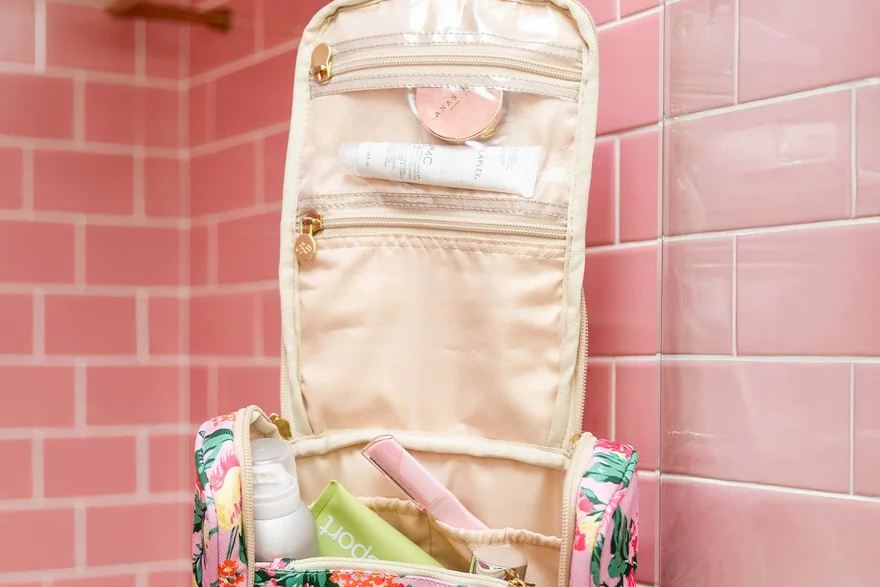
A cosmetic bag with a shoulder strap is not a cosmetic bag with a strap added to it. Adding a carry system changes what the product is for. A flat pouch is packed inside a suitcase and opened on a counter. A crossbody is carried through an airport terminal, a festival site or a hotel corridor, and it has to behave like a small bag for hours at a time. That shift moves the brief from fabric and internal layout to load path: where the weight goes, how it is anchored to the shell, and what happens when the bag swings against the body.
The commercial frame supports the shift. Search demand in this category is broad rather than specialist: 'travel bag for toiletries' draws roughly 110,000 monthly searches, and 'toiletry bag' around 74,810 weekly searches on Amazon. Within that demand, strap versions sit at the upper end of the typical $0.45 to $12.00 unit price band reported on marketplaces, because they carry more hardware, more labour operations and more inspection time. The buyer is not paying for a strap in isolation; the buyer is paying for the reinforcement that keeps the strap attached after months of use.
Three construction decisions decide whether a strap version succeeds. The first is how the webbing is anchored to the shell, which matters far more than the rated strength of the webbing itself. The second is whether the hardware can be opened and closed repeatedly without the gate loosening or the plating flaking. The third is whether the strap stores cleanly when detached, because a loose strap coiled inside a bag is a returns waiting to happen.
- Anchor reinforcement, not webbing strength, is the usual failure point on a cosmetic bag with shoulder strap.
- A detachable strap adds at least one hardware SKU and two to four reinforcement sewing stations per bag.
- Crossbody geometry, not strap length alone, decides whether the bag sits flat against the body or spins.
- Hardware finish compliance must be specified separately from shell fabric compliance.
Strap engineering: webbing, drop length and load path
Webbing is specified by width, weave and fibre. Flat polyester webbing in 20 mm is the working default for a cosmetic bag with shoulder strap; 25 mm is used when the filled weight rises above roughly 1.2 kg or when the strap is worn crossbody for long periods. Below 15 mm the webbing rolls on the shoulder and the cut edge frays against knitwear. Tubular webbing feels softer but creeps under a triglide slider, so flat weave is the safer choice whenever the strap is adjustable.
Drop length is the measurement that matters, and it is not the same as strap length. Drop runs from the top of the strap, where it crosses the shoulder, to the top of the bag body. A drop of 48 to 58 cm places a small cosmetic pouch at hip level for most adults; 55 to 70 cm suits a larger vanity-style body worn over a winter coat. Buyers should ask for an adjustable range, typically 20 to 25 cm of travel on a triglide slider, so a single stock keeping unit covers several body types and carry positions.
The load path runs from the filled contents, through the base panel and gusset, into the webbing anchor, and finally into the hardware. If the base panel is a single layer of 210D lining with no interlining, the contents sag away from the anchor and the bag swings. Specifying a 600D polyester or a 0.4 mm PE board in the base, plus a backing patch behind each anchor, spreads the load and keeps the silhouette stable when the bag is worn.
| Carry configuration | Webbing spec | Drop length | Filled-weight design target | Anchor reinforcement | Cost tier |
|---|---|---|---|---|---|
| Short hand strap | 15 mm flat polyester | 12-15 cm | Up to 0.6 kg | Single bar-tack box on side seam | Baseline |
| Shoulder carry | 20 mm flat polyester | 40-48 cm | 0.6-1.0 kg | X-box stitch, 2.5 cm leg | Low |
| Crossbody sling | 20-25 mm flat polyester | 48-58 cm | 0.8-1.5 kg | X-box plus 6 x 6 cm backing patch | Medium |
| Long crossbody | 25-32 mm flat polyester | 55-70 cm | 1.2-2.0 kg | Box stitch plus 8 x 8 cm 600D patch | Medium |
| Padded shoulder | 32-38 mm webbing with 4 mm foam pad | 45-55 cm | 1.5-2.5 kg | Full-width reinforcement panel | High |
Hardware has to be matched to the webbing size exactly. A 25 mm webbing forced through a 20 mm slider will bunch, creep under load and eventually slip, and a swivel hook with an internal gate clearance below the webbing thickness will not seat. Buyers should name the hardware size, the plating type and the plating thickness in microns in the specification, and should require the hardware supplier to be declared, because a change of hardware source mid-programme is the most common cause of finish inconsistency between the approved sample and bulk.
Adjustment hardware deserves the same scrutiny as the strap itself. A triglide slider on a smooth polyester webbing holds position well; the same slider on a soft tubular webbing slips progressively, and a bag that starts the day at hip level ends it at the knee. A cam buckle holds more reliably but adds bulk at the shoulder. Where the strap is adjustable, the free end should be finished with a heat-cut edge plus a folded end stop, because an unfinished tail frays and then looks defective even though nothing has failed.
Ask for strap and anchors to be specified to a static design load of three to five times the expected filled weight, then require a pull test on the anchor itself. The webbing rarely fails; the stitching and the backing patch do.
Detachable hardware and attachment geometry
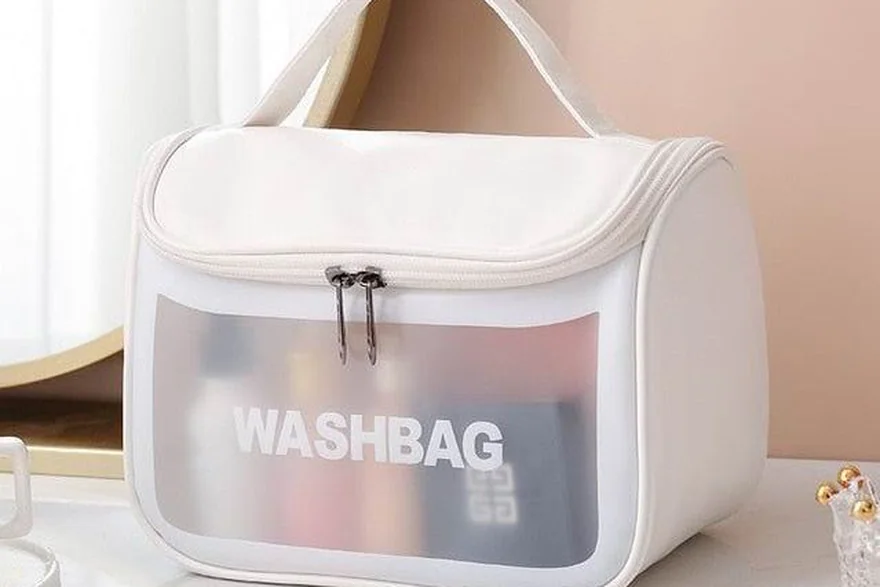
A detachable strap turns one product into two: a pouch for the suitcase and a crossbody for the day. The detach mechanism is bought-in hardware, so no mould tool is normally required. Swivel hooks suit a strap that rotates freely and resists twisting; trigger snaps and dog clips are easier to operate with one hand; split rings are cheap but can open under a side load. Carabiners read as outdoor styling and suit a canvas or nylon shell rather than a satin vanity case.
The counter-intuitive point is that the weakest part of a detachable system is not the hook. It is the anchor loop on the bag body. A webbing loop turned and bar-tacked into a side seam will pull out of a lightweight shell long before a zinc-alloy hook deforms. Specifying a loop that runs under a reinforcement patch, with the stitch box extending onto the patch, moves the failure load up substantially. Where the shell is quilted or padded, the loop should be captured in the binding rather than sewn through the face fabric alone.
Anchor position decides how the bag hangs. Anchors on the two upper side seams give the classic handbag hang and keep the zipper facing upward. Anchors on the back panel, spaced across the full width, keep a wide flat bag from folding in the middle. Anchors on the top gusset make the bag hang like a bucket, which suits a round vanity case but exposes the zipper to rain. Buyers should specify anchor position in centimetres from the nearest seam, not by description.
- Name the hook type, gate style and internal clearance in the spec; do not leave hardware to the sample room's default.
- Capture the anchor webbing under a reinforcement patch so the box stitch bites into two layers, not one.
- Set anchor position in centimetres from the nearest seam so bulk matches the approved sample.
- Choose zinc alloy for plated finish at moderate cost, stainless steel or brass for premium positioning, POM where weight matters.
- Require a corrosion test on plated hardware separately from any fabric compliance test.
Zippers deserve their own line in the specification because a strap version is opened and closed far more often than a packed pouch. Referencing ASTM D2053 zipper terminology lets a buyer name the chain type, gauge and puller precisely instead of writing 'good quality zip', which is not an enforceable requirement. A #5 coil chain with a metal-look puller is the usual pairing for a crossbody cosmetic bag; a #3 chain reads light and is more prone to tooth skip when the bag is opened while worn.
Detach hardware also interacts with retail packaging. A strap that ships coiled inside the bag can crease the lining and mark a satin face; a strap packed flat in a polybag with a silica sachet avoids both. Buyers should state how the strap is packed, whether it is attached or detached at the point of sale, and whether a printed care card explaining the detach mechanism is included. These are low-cost decisions that materially reduce the number of units returned as faulty when they are simply unfamiliar.
Testing, inspection and pack-out for strap programmes
A strap programme needs a longer test list than a flat pouch because it introduces three new risk areas: hardware, anchors and wear against clothing. The practical approach is to write a short test schedule into the purchase order, naming the method, the sample size and the acceptance criterion, and to require a third-party report before bulk shipment. Where a test house is not used, the buyer can still specify an in-house protocol and require photographs and a signed record.
| Checkpoint | What the buyer specifies | Why it matters | When it is verified |
|---|---|---|---|
| Zipper identification | Chain type, gauge and puller named per ASTM D2053 | Prevents a substitute chain appearing in bulk | Sample approval |
| Anchor pull | 500 pull cycles on each anchor, report required | The anchor is the top failure point | Pre-bulk, on 3 samples |
| Hardware corrosion | 24-hour salt spray on plated parts, report required | Plating quality varies between batches | Pre-bulk and on bulk pull |
| Colour fastness | ISO 105 rub rating for shell fabric and webbing | Webbing rubs against light clothing | Pre-bulk |
| Detach cycle | 500 open and close cycles on each hook, gate must reseat | A loose gate drops the bag in use | Pre-bulk, on 3 samples |
| Final inspection | AQL 2.5 under ISO 2859-1 | Sets the defect tolerance for hardware and stitching | Final random inspection |
| Carton declaration | Piece count, carton size and gross weight stated in the quote | Straps add volume and change freight cost | Quotation stage |
Hardware finish sits under the same chemical rules as any other component. Plated metal parts are checked against EU REACH restrictions on nickel release and other substances, and a bag marketed to children in the United States is checked against CPSIA limits for lead and phthalates in accessible components. Fabric and webbing are frequently certified to OEKO-TEX Standard 100, which covers the textile but not the metal, so the two declarations must be requested separately.
Final random inspection should be set at AQL 2.5 under ISO 2859-1, with a defect list written for this construction rather than copied from a pouch programme. Strap-specific defects include a webbing cut edge that is not heat sealed, a bar-tack box placed off the reinforcement patch, a hook that does not reseat after opening, a slider that slips at maximum drop, and left and right anchors set at different heights. Each of these should appear in the defect classification so an inspector can score it consistently.
Pack-out is the last place a strap programme loses money. A detachable strap adds volume, which reduces the piece count per carton and raises the landed cost per unit even when the ex-works price looks competitive. Buyers should ask for the carton specification, piece count and gross weight at quotation stage, and should set a maximum carton gross weight in the purchase order so a carton cannot be overfilled to hit a freight target. Programme terms run at 500 pieces per style and colourway, sampling in 6 to 10 working days, 12 to 15 for complex constructions, then 35 to 50 days bulk after sample approval, FOB Xiamen on T/T 30 deposit and 70 against bill of lading.
The B2B Customisation View
What separates a smooth cosmetic pouches, vanity cases and beauty organisers launch from a painful one is usually the quality of the technical pack rather than the price of the fabric.
Planning figures used across the programme: MOQ 500 pieces per style and colourway, 6–10 working days sampling (12–15 when moulding or multi-layer lamination is required), 35–50 days bulk lead time, AQL 2.5 to ISO 2859-1, FOB Xiamen, T/T 30/70.
QUANZHOU JUNYUAN BAGS keeps the relationship deliberately narrow: specification control, sampling, inspection and logistics coordination, all documented against the buyer's own standard.
Which Brand Types Benefit Most
The shoulder strap configuration suits different buyers for different reasons, and the reason should drive the specification. A start-up brand launching a three-piece travel set gains the most from a detachable strap, because one body can be sold as a pouch in one channel and a crossbody in another without a second tooling or fabric commitment; budgeting for 500 pieces per style and colourway keeps that flexibility affordable. An established brand with an existing vanity case line can add strap anchors to a proven body and test the variant on a single colourway before committing to a full roll-out, which is the lowest-risk way to read whether the audience wants a carry option at all.
- Retailers and catalogue buyers: a crossbody cosmetic bag photographs well on a model and answers the gift question at a higher price point than a flat pouch, provided the hardware finish survives handling in store.
- E-commerce sellers: strap versions differentiate a listing in a crowded search result, but the listing must state drop length, detachability and filled dimensions or the return rate rises sharply.
- Gift, hotel and hospitality buyers: a detachable strap lets one product serve as an amenity pouch in a suite and a retail item in the lobby shop, with a single artwork change on the hangtag.
- Subscription and influencer collabs: adjustable drop length covers a wide audience on one SKU, which matters when the buyer cannot predict the body type or carry preference of the end recipient.
- Travel and outdoor-adjacent brands: POM or stainless hardware and 25 mm webbing support a positioning that a satin pouch with a 15 mm strap cannot carry.
Across all five groups the same discipline applies: specify width, drop, hardware and anchor position before sampling rather than accepting a sample room default. A cosmetic bag with shoulder strap that is specified properly costs a little more per unit and returns materially less in warranty claims, which is the trade that matters once a programme moves past its first repeat order.
Frequently Asked Questions
What webbing width should a cosmetic bag with a shoulder strap use?
A 20 mm flat polyester webbing suits most cosmetic bags carrying up to about 1.2 kg filled, and 25 mm is the better choice above that or when the strap is worn crossbody for long periods. Below 15 mm the webbing rolls on the shoulder and the cut edge frays against knitwear. Width must be set alongside the hardware, because a swivel hook or triglide slider has to match the webbing size exactly or the strap will bunch and creep under load.
How long should the strap drop be on a crossbody cosmetic bag?
Drop is measured from the top of the strap where it crosses the shoulder to the top of the bag body, not as total strap length. A drop of 48 to 58 cm places a small cosmetic pouch at hip level for most adults, while 55 to 70 cm suits a larger vanity-style body worn over a coat. Buyers should request an adjustable range of roughly 20 to 25 cm so one stock keeping unit covers several body types.
Can the shoulder strap be detachable without paying for a new mould tool?
In most cases yes. Detachable straps use bought-in hardware such as swivel hooks, trigger snaps, dog clips or split rings, so no mould tool is needed. The added cost sits in labour: each anchor requires a turning, a bar-tack or X-box stitch and usually a reinforcement patch. Asking the sample room to quote a detachable version and a fixed version side by side makes those extra operations visible in the costing.
Which hardware metal suits a cosmetic bag with a shoulder strap best?
Zinc alloy is the common default for swivel hooks and sliders because it takes a clean plated finish at moderate cost. Brass and stainless steel cost more and suit premium positioning, while acetal or POM hardware is lighter and avoids metal-on-fabric abrasion but reads less premium on shelf. Whichever is chosen, the plating type, plating thickness in microns and a corrosion test should all be named in the specification.
How much weight should a detachable strap on a cosmetic bag be specified to carry?
Specify a design load rather than a breaking load. A sensible brief is a static design load of three to five times the expected filled weight, so a bag carrying 1.2 kg of product has strap and anchors specified for roughly 4 to 6 kg. The pull test should then be run on the anchor rather than the webbing, because the anchor usually fails first. Request the report on three samples before bulk begins.
Where should the strap anchors sit on a cosmetic bag body?
Anchors on the two upper side seams give the classic handbag hang and keep the zipper facing upward. Anchors spread across the full width of the back panel stop a wide flat bag folding in the middle. Anchors on the top gusset make the bag hang like a bucket, which suits a round vanity case but exposes the zipper to rain. Specify the position in centimetres from the nearest seam, not by description.
Does a shoulder strap cosmetic bag need a padded strap section?
A pad becomes worthwhile once the filled weight passes roughly 1.5 kg or the strap narrows below 20 mm at the shoulder. Padding is usually 4 mm foam inside a 32 to 38 mm webbing sleeve, and it adds both material and a sewing station. Below that weight the simpler fix is to widen the webbing to 25 mm, which costs less and avoids a second fabric that has to be matched for colour fastness.
How does a detachable strap affect sampling time for a cosmetic bag?
A detachable strap adds hardware sourcing to the sampling path, so a strap version tends to sit at the upper end of the 6 to 10 working day sampling window, or in the 12 to 15 working day window when the construction is complex. The delay is usually waiting for the correct hook size and plating rather than the sewing. Sending the hardware specification with the initial brief removes most of that wait.
What inspection defects are specific to shoulder strap cosmetic bags?
Strap-specific defects include a webbing cut edge that is not heat sealed, a bar-tack box placed off the reinforcement patch, a hook that does not reseat after opening, a triglide slider that slips at maximum drop, and left and right anchors set at different heights. None of these appear on a flat pouch defect list, so the classification should be rewritten for the construction and issued to the inspector before final random inspection.
Can a shoulder strap cosmetic bag use recycled webbing under GRS?
Recycled polyester webbing is available and can be claimed under the Global Recycled Standard, provided the webbing supplier holds a valid scope certificate and the transaction certificate is requested for the specific purchase. The claim covers the webbing, not the hardware or the shell, so the hangtag wording has to be precise. Buyers should ask for the certificate numbers at quotation stage rather than after bulk has shipped.
What minimum applies to a cosmetic bag with a detachable shoulder strap?
Programmes start at 500 pieces per style and colourway, which applies to the strap version as a separate style because the body carries different anchor reinforcement and a different bill of materials. A buyer wanting the same body in three colourways with straps is committing to 1,500 pieces in total. Sampling runs 6 to 10 working days, or 12 to 15 for complex constructions, and bulk runs 35 to 50 days after sample approval.
How does strap hardware affect REACH and CPSIA compliance for cosmetic bags?
Plated metal parts are assessed against EU REACH restrictions on nickel release and other substances in articles, while a bag marketed to children in the United States is assessed against CPSIA limits for lead and phthalates in accessible components. A textile certificate such as OEKO-TEX Standard 100 covers the fabric and webbing but not the metal, so the two declarations must be requested separately and both filed against the same style number.
What zipper grade pairs well with a crossbody cosmetic bag?
A #5 coil chain is the usual pairing, because a strap version is opened and closed far more often than a pouch that lives in a suitcase and the chain sees side loading while the bag is worn. A #3 chain reads light and is more prone to tooth skip when opened at an angle. The chain type, gauge and puller should be named using standard zipper terminology rather than a vague quality description.
Should the strap on a cosmetic bag be adjustable or fixed length?
Adjustable is the safer commercial choice. A triglide slider giving 20 to 25 cm of travel lets one stock keeping unit serve shoulder and crossbody carry and several body types, which matters when the end recipient is unknown. Fixed length is cheaper by one hardware component and looks cleaner on a minimal design, but it commits the buyer to a single drop measurement and increases the risk of fit complaints.
How do you stop a cosmetic bag from spinning when worn crossbody?
Spinning usually means the weight sits low and away from the body, or the two anchors are too close together relative to the bag width. The fixes are a stiffer base panel, a wider anchor spacing across the back panel rather than the side seams, and a shorter drop so the bag sits closer to the hip. Testing the filled sample on a live model catches this before tooling and bulk fabric are committed.
What does a detachable strap add to shipping volume for a cosmetic bag programme?
A detached strap packed flat adds a little thickness per unit and reduces the piece count that fits in a given carton, which raises landed cost per unit even when the ex-works price looks competitive. The strap packed coiled inside the bag can crease the lining and mark a satin face. Buyers should require carton size, piece count and gross weight in the quotation and set a maximum carton gross weight in the purchase order.
People Also Ask
Is a cosmetic bag with a shoulder strap worth the extra cost?
It is worth it when the product is carried rather than packed. The added cost is one hardware set, two to four reinforcement stations and more inspection time, and it buys a product that can be sold into two channels from one body. Where the bag will only ever sit inside a suitcase, the same money is better spent on fabric weight or on a better zipper, because a strap on a bag that never leaves the case is an unused feature.
How do you attach a shoulder strap to a makeup bag without a D-ring?
The common alternative is a turned webbing loop captured in a seam or under a reinforcement patch, with the box stitch biting into two layers rather than one. A fabric loop sewn through the face fabric alone will pull out of a lightweight shell long before the hook deforms. Specifying loop width, patch size and stitch pattern is what makes the attachment repeatable in bulk rather than dependent on one operator.
What is the best strap length for a crossbody makeup bag?
Ask for drop rather than length, since drop is measured from the shoulder to the top of the bag and is the figure that decides where the bag sits. A drop of 48 to 58 cm suits a small pouch on most adults, and 55 to 70 cm suits a larger vanity body worn over a coat. An adjustable range of 20 to 25 cm covers both cases on one stock keeping unit.
Do detachable straps on cosmetic bags break easily?
The hook rarely breaks; the anchor loop pulls out, or the gate loosens and releases. Both are specification problems rather than inherent flaws in the concept. Requiring a pull test on the anchor, a corrosion test on the plating and an open-and-close cycle test on the gate before bulk, then re-inspecting the same points at final random inspection, is the practical way to keep detach-related returns low.
Request a Sample or a Written Quotation
Send the silhouette, dimensions, material preference and logo artwork, and the programme team will return a written quotation with MOQ, sampling window, bulk lead time and inspection standard.
Email: service@junyuanbags.com · WhatsApp: +86 177 5002 0688