Toiletry Bag with Wet/Dry Compartments: Separation Technology
Executive Summary
The question behind a toiletry bag with wet and dry compartments is whether a labelled pocket actually keeps moisture away from dry items, and the answer is that most do not. A sewn-and-taped pocket made from ordinary 210D polyester will pass water through its needle holes within minutes, because the stitching perforates the fabric roughly every 2 mm. Real separation requires either a welded seam, a seam-sealed taped construction, or a laminate barrier with a water-resistant zipper on the wet side.
Buyers should therefore specify the barrier and the closure as one system, since a perfect laminate fails instantly if the zipper that closes the wet pocket is a standard coil chain. Programmes start at 500 pieces per style and colourway, sample in 6 to 10 working days, or 12 to 15 for a welded or moulded construction, and run 35 to 50 days in bulk after approval, inspected to AQL 2.5 under ISO 2859-1, FOB Xiamen, T/T 30 deposit and 70 against bill of lading.

Wet and dry separation is a barrier problem, not a pocket problem
A toiletry bag labelled as having wet and dry compartments usually has two cavities separated by a fabric wall. Whether that wall separates anything depends on three things that have nothing to do with the label: whether the fabric itself is impermeable, whether the seams joining it are impermeable, and whether the closure on the wet side is impermeable. A buyer who checks only the first receives a bag that leaks through the other two.
The category is large and competitive. 'Travel bag for toiletries' draws roughly 110,000 monthly searches and 'toiletry bag' around 74,810 weekly searches on Amazon, while unit pricing across the market spans 0.45 to 12.00 dollars. At the low end of that band the wet compartment is almost always a lining panel rather than a barrier, and the honest expectation is splash resistance rather than leak containment. At the upper end, welded TPU or TPU-laminated polyester with a water-resistant zipper gives genuine containment, and the price difference is real rather than marketing.
What travels wet is fairly consistent: a toothbrush, a razor, a bar of soap, a damp flannel, a used contact lens case and, critically, shampoo and shower gel bottles. Bottles are the hard case, because a 100 ml bottle that has been opened once will weep from the thread no matter how carefully it is packed, and the leaked volume over a flight can reach several millilitres. That is the load the barrier has to hold, and it is why the base of a wet compartment, not just its walls, needs to be impermeable.
Airport security sets a further constraint that shapes the layout. Under the TSA 3-1-1 liquids rule, liquids in carry-on bags are limited to containers of 100 ml or 3.4 ounces held in one transparent quart-sized bag, and that bag has to be reachable at the checkpoint. A wet compartment sized to hold a standard quart bag flat, roughly 180 mm by 200 mm, is therefore a functional requirement rather than a nice-to-have, and it is the single most useful dimension in the brief.
- The barrier has to include the base, not only the walls, because liquid pools at the bottom.
- The zipper on the wet side has to be water-resistant, or the barrier stops at the opening.
- The wet compartment should hold a quart-sized liquids bag flat and still close.
- The barrier should be wipeable and dry within minutes, since it will be wiped several times a week.
Barrier construction: coating, laminate, seam and closure
Five constructions appear in the market, and the difference between them is where the water stops. A coating sits on the surface of a woven fabric and slows ingress; a laminate bonds a film to the fabric and blocks it; a welded seam removes the needle holes entirely; a taped seam covers them; and a water-resistant zipper closes the opening that every barrier has to have. Only the last three deliver containment.
| Construction | Film or coating | Seam treatment | Water held | Relative cost index |
|---|---|---|---|---|
| 210D polyester, PU coated | 0.02 mm coating | Sewn, no tape | Splash only, fails in 5-10 min | 1.0 |
| 420D polyester, PVC laminate | 0.10 mm film | Sewn, taped | 30-60 min before seepage | 1.5 |
| Polyester with TPU laminate | 0.12 mm film | Sewn, taped on wet side | 2-4 hours | 1.8 |
| TPU laminate, RF welded | 0.15 mm film | Welded, no needle holes | Indefinite | 2.4 |
| Moulded EVA or TPU tray insert | 1.5-3.0 mm | One-piece, no seam | Indefinite, rigid | 2.9 |
Coated fabric performance is measurable and should be specified by the numbers rather than by the word waterproof. The coated-fabric method family maintained under ASTM D751 covers coating adhesion, tear strength, hydrostatic resistance and low-temperature flexibility, and a buyer asking for a hydrostatic figure gets a comparable answer across suppliers. As a rough working guide, a fabric that holds a 1,000 mm hydrostatic head will resist a splash and a brief spill, while containment of a leaking bottle needs the welded or moulded route rather than a higher number on a sewn seam.
The closure is where most designs fail. A standard coil zipper has gaps between the teeth and a tape that wicks, so water reaching the chain crosses it by capillary action within a minute or two. A water-resistant zipper uses a coated tape and, in the moulded-tooth variants, a close-fitting chain that slows that transfer substantially; a fully waterproof zipper with a film backing is a different component again and costs several times more. Terminology and gauge for these components are defined under ASTM D2053, which is worth citing in the brief so the factory and the buyer mean the same thing by water-resistant.
- Specify the barrier by hydrostatic head and seam treatment, not by the word waterproof.
- Put the water-resistant zipper on the wet side only; the dry side can use a standard chain and save cost.
- Weld the base panel at minimum, even if the walls are sewn and taped.
- Test the assembled bag with 20 ml of water in the wet compartment, laid flat for four hours.
- Check low-temperature flexibility if the bag will be sold in a market with cold winters, because PVC stiffens.
Taped seams need their own detail. The tape has to be applied to the side that will see water, wide enough to cover the needle line plus 5 mm on each side, and pressed rather than ironed on a laminate that softens under heat. Tape applied to the outside of a wet pocket protects nothing. Where the seam changes direction, the tape should be mitred rather than folded, because a folded corner is the first place it lifts.
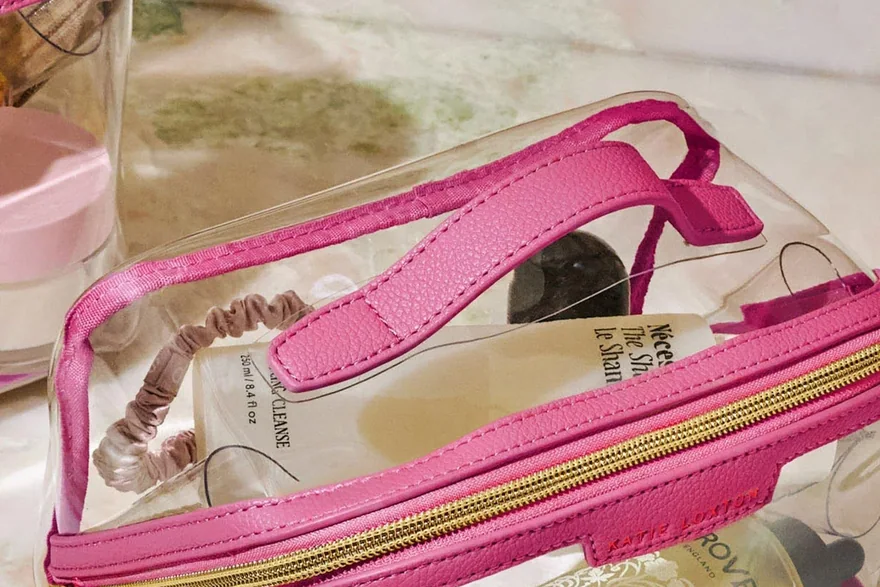
Layout, volume split and the liquids-bag dimension
Proportion decides whether the bag is usable. A wet compartment that takes half the internal volume starves the dry side, and one that takes a fifth cannot hold a liquids bag and a toothbrush together. The practical split for a travel wash bag is roughly 35 percent wet to 65 percent dry for a hanging bag and 30 to 70 for a flat pouch, with the wet compartment sized around a quart bag rather than around a fraction of total volume.
| Bag type | Overall size | Wet compartment | Dry compartment | Liquids bag fit |
|---|---|---|---|---|
| Small flat pouch | 220 x 130 x 70 mm | 190 x 120 mm, welded | 190 x 120 mm | Quart bag folded |
| Medium dopp kit | 260 x 160 x 110 mm | 240 x 140 mm, welded | 240 x 150 mm | Quart bag flat |
| Hanging wash bag, closed | 250 x 200 x 90 mm | 230 x 170 mm, welded | 230 x 180 mm | Quart bag flat |
| Hanging wash bag, open | 250 x 620 mm | Two welded pockets | Three mesh shelves | Quart bag flat, top pocket |
| Family travel case | 320 x 220 x 140 mm | 300 x 200 mm, tray | Two open bays | Two quart bags side by side |
Access geometry matters as much as volume. A wet pocket that opens only from inside the main cavity forces the user to reach past dry items to get to a wet toothbrush, which is precisely the cross-contamination the product exists to prevent. The better layouts give the wet compartment its own external opening, ideally on the end or the base of the bag, so it can be opened, emptied and wiped without disturbing the dry side. Where a hanging bag is specified, the wet pocket should sit at the bottom of the hanging panel so any residual drip falls away from the shelves below rather than onto them.
The dry side needs its own thought. Mesh shelves hold a toothbrush and a razor upright but let powder and dust travel; solid fabric shelves contain mess but hold moisture if anything damp is put away. A common and defensible arrangement is a solid shelf for items that must stay dry, mesh for items that may be slightly damp, and a zippered fabric pocket for anything small enough to disappear. Where the bag is sold for a family, two open bays separated by a fixed wall outperforms one large cavity, because children's items and adult items do not stay sorted otherwise.
Cleaning closes the specification. A welded TPU compartment wipes dry in two to five minutes and tolerates a rinse under a tap, which is the behaviour buyers should ask to see demonstrated on the sample. A taped seam on a PVC laminate can be wiped but should not be soaked, because water eventually attacks the tape adhesive. Any woven fabric on the wet side, including the zipper tape, will hold moisture and needs an air-dry period, which is why a wipeable wet side with a breathable dry side is the usual best combination rather than a wipeable bag throughout.
Zipper placement on the wet pocket should also be stated in the brief, because a horizontal opening across the top of a hanging wet pocket is far easier to reach than one running down the side.
Validating separation: ingress tests, cycle tests and inspection
Four tests are cheap enough to run on every programme and catch almost every real failure. They should be written into the brief as acceptance criteria rather than requested after the sample arrives, because a factory that knows the criteria will build to them and one that does not will build to whatever looks right.
| Test | Method | Pass criterion | Typical failure seen |
|---|---|---|---|
| Static water hold | 20 ml in the wet pocket, laid flat, 4 hours | No moisture on dry-side tissue | Seepage at the base seam within 40 min |
| Inverted hold | Wet pocket filled to 60 percent, inverted 10 min | No drip at the zipper line | Wicking along a standard coil tape |
| Zip cycle | 200 open and close cycles, then repeat the static hold | No loss of containment | Coated tape cracking at the end stop |
| Wipe and dry | Pocket wiped with a damp cloth, timed to dry | Dry in under 5 minutes | Woven tape holding moisture for 30 min |
Chemical compliance sits alongside the physical tests. A laminated fabric that holds shampoo residue is a skin-contact article in most regulatory readings, and inputs are normally evidenced against OEKO-TEX Standard 100, with the EU market additionally applying REACH substance restrictions. Where a PVC laminate is chosen, the plasticiser route deserves specific attention, because that is the part of the specification most likely to fail a restricted-substance screen. Buyers selling into the US should confirm the CPSIA position on the coated fabric and on any metal hardware.
Inspection should treat containment as a functional attribute. Under AQL 2.5, a 1,200-piece shipment draws a sample of 80 units with 5 minor and 3 major defects allowed, and the sampling plan itself is set out in ISO 2859-1. A cosmetic flaw on a weld line is a minor; a pinhole in a weld or a gap in the seam tape is a major, because the bag no longer separates. A useful addition is a five-unit water test on the pre-shipment sample: fill the wet pocket, lay the bag flat for an hour and check the dry side with tissue paper.
Timing follows the construction. A sewn and taped bag on a coated polyester samples in 6 to 10 working days. A bag with radio-frequency welded seams, a moulded tray or a waterproof zipper falls into the complex bracket at 12 to 15 working days, because tooling and welding parameters have to be set. Bulk runs 35 to 50 days after sample approval, shipped FOB Xiamen with T/T 30 deposit and 70 against bill of lading, and the 500-piece minimum per style and colourway applies to each variant, so a welded and a sewn version of the same bag are two separate programmes.
Odour deserves its own check, since a welded pocket that is never fully dried will develop a smell even though it has never leaked. A 24-hour closed-bag test after the wipe and dry test, assessed by two people, is cheap and catches the problem before bulk. Where the bag will be sold in a humid market, specify a vented dry side so the whole bag is not sealed.
The B2B Customisation View
Programmes for cosmetic pouches, vanity cases and beauty organisers move fastest when the artwork is supplied as vector files and the Pantone references are confirmed before sampling starts.
Budgeting and scheduling inputs: MOQ 500 per style and colourway; sampling 6–10 working days, extended to 12–15 for lined, moulded or hardware-heavy builds; bulk 35–50 days; pre-shipment inspection at AQL 2.5 per ISO 2859-1; FOB Xiamen; T/T 30/70.
QUANZHOU JUNYUAN BAGS is structured as a sourcing and programme-management company, which lets a buyer compare materials across several SGS-verified production lines inside one quotation.
Which Brand Types Benefit Most
Wet and dry separation sells to buyers whose customers travel, and it sells on a promise that has to be kept. Start-up brands benefit from specifying genuine separation at the outset, because a weld-line leak produces the kind of review that a new listing cannot absorb; spending the extra on a welded base and a water-resistant zipper is cheaper than rebuilding a review base. Established brands should treat the barrier as a tiering device: a sewn and taped bag for the volume tier and a welded bag for the premium tier, sold from the same pattern where possible so photography and copy stay consistent. Retailers and e-commerce sellers should ask for the static water hold result in writing, since it is the only claim in this category that can be checked in an afternoon. Gift and hospitality buyers should note that a welded wet compartment is worth the premium for a hotel amenity kit that will be refilled and reused, while a single-use guest kit is adequately served by a taped seam. One question applies to every buyer type: does the listing describe a sewn pocket or a welded compartment? A welded compartment can be described as leak resistant and demonstrated in a photograph; a sewn pocket cannot, and the gap between the two is where most bad reviews in this category are written. Buyers who intend to claim waterproof should budget for the welded or moulded route and for the longer sampling window that comes with it.
- Start-up brands: one welded wet compartment, one shell, 500 pieces per colourway.
- Established brands: tier the barrier, sewn and taped for volume, welded for premium.
- Retailers: require a four-hour static water hold result before approving the listing.
- E-commerce sellers: photograph the wet compartment holding a quart liquids bag, not empty.
- Gift buyers: choose welded for reusable amenity kits, taped for single-use guest kits.
Frequently Asked Questions
Why does a sewn wet compartment leak when the fabric is waterproof?
Because the needle perforates the fabric roughly every 2 mm, and each hole is a path for water. A 210D polyester with a perfectly good coating will still pass water through a sewn seam within minutes. The fix is either a welded seam, which removes the holes, or a taped seam, which covers them, and the tape has to be applied on the inside of the wet compartment.
What hydrostatic head should a wet compartment fabric be specified at?
Around 1,000 mm for splash and brief-spill resistance, rising to 3,000 mm or more where containment is the claim. The figure comes from the coated-fabric test family, so the brief should name the method as well as the number. Above roughly 3,000 mm the limiting factor stops being the fabric and becomes the seam, which is why welded construction beats a higher fabric number.
Does a water-resistant zipper actually keep water inside a wet pocket?
It slows transfer substantially rather than stopping it entirely. A coated tape and a close-fitting chain resist wicking for several hours under a static load, which is enough for a leaking bottle in a suitcase. A fully waterproof zipper with a film backing is a different and considerably more expensive component, and it is only worth specifying where the bag will be submerged.
How much water should a wet compartment hold in a test?
Twenty millilitres laid flat for four hours is a realistic test, because that is roughly what an opened 100 ml bottle weeps over a long flight. The pass criterion is no moisture on tissue placed in the dry compartment. A stronger version fills the pocket to 60 percent and inverts the bag for ten minutes, which exposes wicking along the zipper tape.
What size wet compartment fits a quart-sized liquids bag?
Around 180 mm by 200 mm of flat internal area, with the depth to close over it. That accommodates the standard transparent bag used under the TSA 3-1-1 rule without folding. Where the bag is a hanging wash bag, the quart bag should sit in the lowest pocket so it can be pulled out at a checkpoint without unpacking the shelves above.
Should the wet compartment have its own external opening?
Yes, wherever the bag is large enough to allow it. Reaching past dry items to retrieve a wet toothbrush is exactly the cross-contamination the product is meant to prevent. An end or base opening on the wet side also makes the compartment far easier to rinse and wipe, which is what keeps it from developing an odour over a season of use.
Is TPU or PVC better for a laminated wet compartment?
TPU at 0.12 mm or 0.15 mm is generally the better choice: it stays flexible at low temperatures, resists hydrolysis better and avoids the plasticiser route that most often trips a restricted-substance screen. PVC at 0.10 mm is cheaper and perfectly serviceable in a warm market, but it stiffens in cold weather and needs closer chemical documentation.
How is a welded seam checked for pinholes?
The shop-floor method is a visual inspection under backlight followed by a static water hold on a sample from each welding shift. A pinhole at the weld line is classified as a major defect under AQL 2.5 because the bag no longer separates. Welding parameters drift as the electrode heats, so sampling across the shift matters more than sampling across the batch.
Can a hanging wash bag have a genuinely waterproof lower pocket?
Yes, and welded hanging bags do this well. The wet pocket is welded at the base and up the sides, closed with a water-resistant zipper, and hung so any residual drip falls away from the shelves below. The one detail to check is the hanging point, since a welded pocket holding a full bottle adds real weight to the hook and its reinforcement.
How long does sampling take for a welded wet compartment?
12 to 15 working days, because welding parameters and any tooling have to be set before a clean sample can be made. A sewn and taped construction on a coated polyester samples in 6 to 10 working days. Bulk production is 35 to 50 days after sample approval in both cases, shipped FOB Xiamen. Where a waterproof zipper is specified, add a few days for component sourcing.
What cleaning claim can a buyer safely make about a wet compartment?
Wipe clean and rinse under a tap is safe for a welded TPU compartment, which dries in two to five minutes. Wipe clean only is the safe claim for a taped seam on a PVC laminate, because soaking attacks the tape adhesive. Do not claim machine washable for any bag with a welded seam, a stiffener board or a coated tape.
How should wet and dry volume be split in a travel wash bag?
Roughly 35 percent wet to 65 percent dry for a hanging bag and 30 to 70 for a flat pouch, but size the wet compartment around a quart liquids bag rather than around a percentage. A wet pocket that cannot hold the liquids bag flat fails the one job the buyer's customer will notice on the first trip.
Does the dry side need to be waterproof as well?
No, and making it so adds cost and reduces breathability. A damp toothbrush put away on a breathable fabric shelf dries; the same toothbrush in a sealed laminated pocket does not. The useful arrangement is an impermeable wet side and a breathable dry side, with a solid shelf for items that must stay dry and mesh elsewhere.
What fails first in a cheap wet and dry toiletry bag?
The seam tape, followed by the zipper tape. Adhesive tape applied over a sewn seam lifts after repeated flexing and after contact with shampoo residue, and a standard coil zipper wicks water across the opening within minutes. Both are visible in a four-hour static water test, which is why that test should be an acceptance criterion rather than a curiosity.
How does AQL 2.5 treat a leaking wet compartment?
As a major defect, because the bag no longer performs its advertised function. On a 1,200-piece shipment the sample is 80 units, allowing 3 major and 5 minor before rejection. Misaligned seam tape and cosmetic variation on the weld line are minors; pinholes, gaps in tape coverage and water-resistant zippers substituted for the specified component are majors.
People Also Ask
Are wet and dry compartments in toiletry bags actually waterproof?
Only if the seams are welded or taped and the closure is water-resistant. A compartment made from waterproof fabric but sewn with a needle will leak through the stitch holes within minutes. Buyers should ask which seam treatment was used and whether the wet-side zipper has a coated tape before accepting a waterproof claim. A four-hour static water test settles the question in an afternoon on any sample.
What should go in the wet compartment of a toiletry bag?
Anything damp or liable to leak: a toothbrush, a razor, a bar of soap, a damp flannel and shampoo or shower gel bottles. Bottles should be capped and stored upright where possible. Anything that must stay dry, including electric toothbrush chargers and spare contact lenses, belongs on the dry side. Anything electrical, including a shaver or a charging cable, belongs on the dry side as well.
How do you stop a toiletry bag from smelling damp?
Choose a wipeable welded compartment that dries in minutes, empty and wipe it after each trip, and leave the bag open to air for a few hours. A woven lining inside the wet pocket holds moisture for half an hour or more and is the usual cause of persistent odour in an otherwise sound bag. Leaving the wet pocket open to air overnight after each trip prevents most cases.
Do hanging toiletry bags need a waterproof pocket?
It helps, because gravity works in the bag's favour: a welded lower pocket catches drips and keeps them off the shelves below. The pocket should be at the bottom of the hanging panel and closed with a water-resistant zipper. Hanging bags without one tend to transfer moisture onto whatever is stored underneath them. A welded lower pocket also makes the bag easier to rinse and wipe at the end of a trip.
Request a Sample or a Written Quotation
Send the silhouette, dimensions, material preference and logo artwork, and the programme team will return a written quotation with MOQ, sampling window, bulk lead time and inspection standard.
Email: service@junyuanbags.com · WhatsApp: +86 177 5002 0688