Cosmetic Bag with Adjustable Dividers: Custom Compartment Systems
Executive Summary
The question behind a cosmetic bag with adjustable dividers is whether a moving partition genuinely beats a fixed one, and the answer depends entirely on the mechanism. A hook-and-loop panel system gives genuine reconfiguration but loses grip as the loop pile flattens, typically after 300 to 500 repositioning cycles. A snap-stud or sliding-track system holds position far longer but offers fixed stations rather than infinite adjustment. Buyers should choose on how often the end user will actually move a divider, not on how flexible the product sounds.
The rest of the decision is structural. A divider cannot hold a compartment square unless the shell or a stiffener board resists the sideways load, which is why shell stiffness, board thickness and divider height have to be specified together. Programmes start at 500 pieces per style and colourway, sample in 6 to 10 working days, or 12 to 15 for a moulded tray or welded construction, and run 35 to 50 days in bulk after approval, inspected to AQL 2.5 under ISO 2859-1, FOB Xiamen, T/T 30 deposit and 70 against bill of lading.

What adjustable actually means in a cosmetic bag
Three products are sold under the word adjustable, and they behave very differently in use. The first is the removable divider, where one or two padded panels lift out entirely and the user chooses between a large cavity and two smaller ones. The second is the repositionable divider, where panels attach by hook-and-loop tape, snap studs or a sliding track and can be moved in increments. The third is the fold-up or roll-out compartment system, where the dividers are part of an insert that comes out of the bag and reconfigures on a table. Only the second and third deserve the word in a specification.
The commercial case for adjustability is that one stock keeping unit serves several customer types. A bag sold as a makeup organiser, a skincare carrier and a travel wash bag from the same listing avoids splitting demand across three listings, and that matters because 'custom makeup bag' draws only 5,400 to 6,600 monthly searches while broader terms such as 'make up bags for women' draw roughly 80,000. Concentration of demand into one listing is a real advantage of a reconfigurable interior, and it is the reason the category has grown faster than fixed-compartment vanity cases.
The engineering case is weaker than the marketing one. Every moving interface is a place where the product wears out, and a divider that flops after a season generates the same return as a broken zipper. Hook-and-loop tape loses shear strength as the hook side loads up with lint and the loop pile flattens; snap studs crack at the socket if the panel is pulled sideways rather than straight up; sliding tracks collect powder and stiffen. The design task is therefore to pick the mechanism whose wear mode is slowest relative to how often the user will move it.
Material choice interacts with all of this. Coated fabrics are the default for a bag that will be wiped clean around a divider, and the properties that matter, coating adhesion, tear strength and hydrostatic behaviour, are characterised by the ASTM D751 coated-fabric test methods. A sourcing partner quoting a coated polyester for a divider bag should be able to name the coating type and gauge, because a 0.10 mm PVC laminate and a 0.12 mm TPU laminate behave very differently at a fold that the user flexes several times a week. The main closure deserves the same treatment: zipper gauge and the distinction between coil and moulded tooth are standardised under ASTM D2053, and a compartment bag that opens flat loads its chain differently from a pouch.
Divider attachment mechanisms compared
Four mechanisms cover nearly the whole market. They differ on three axes that a buyer can actually specify: how many positions the divider can take, how much shear load it holds before it slides, and how many repositioning cycles it survives before the holding force drops below a usable level.
| Mechanism | Position options | Typical holding force | Service life | Best use case |
|---|---|---|---|---|
| Hook-and-loop tape on base and wall | Infinite, 5 mm increments | 18-30 N shear | 300-500 cycles before noticeable loss | Makeup organisers reconfigured weekly |
| Snap studs on a fixed grid | 4-8 fixed stations | 60-90 N shear | 1,000+ cycles, socket is the wear point | Skincare carriers holding bottles upright |
| Sliding track in a moulded base | 6-12 stations | 80-120 N shear | 1,500+ cycles, powder ingress is the limit | Vanity cases with rigid trays |
| Loose padded panel, no fixing | 2-3 by friction | 5-12 N shear | Indefinite, but wanders under load | Gift sets and low-cost organisers |
Holding force is the number most often skipped in a brief and the number that decides whether the product feels solid. A divider holding a 300 ml bottle upright on a slanting hotel shelf needs to resist roughly 3 N to 6 N of sustained shear, so even the weakest mechanism clears that. The failure is dynamic rather than static: a bag dropped into a suitcase side-on generates a short impulse several times higher, and a loose panel simply tips over. Specifying a minimum shear figure, tested with a spring gauge at the top edge of the divider, gives the factory something measurable to build to.
Cycle life should be matched to the intended user. A makeup artist who reconfigures a bag every morning uses around 250 cycles a year and will exhaust cheap hook-and-loop tape inside two seasons. A consumer who sets the layout once and leaves it uses perhaps five cycles a year and will never see the wear, which is why hook-and-loop remains commercially sensible for the mass market. Where the brand intends to sell into the professional channel, a snap-stud grid or a moulded sliding track is the honest specification even at higher unit cost.
- State the mechanism by name in the brief, not by the word adjustable, which no factory can cost from.
- Ask for a repositioning cycle test result: force measured at cycle 1 and again at cycle 300.
- Specify the hook-and-loop width: 20 mm tape holds roughly half what 40 mm tape holds.
- Confirm the hook side faces away from the product cavity, because hooks abrade brushes and compacts.
- Decide whether the divider must stand unsupported, which requires a stiffener, or may lean on the shell.
Cost interacts with mechanism in a way that often surprises buyers. Hook-and-loop tape is cheap per metre but expensive in labour, because the hook side and the loop side are separate components to be cut, positioned and sewn. A snap-stud grid costs more per component and far less in labour, and it is applied faster. On a run of 500 to 2,000 pieces the difference is small; above 5,000 pieces the labour saving usually overtakes the component cost, which is why larger programmes tend to migrate from tape to studs or tracks.
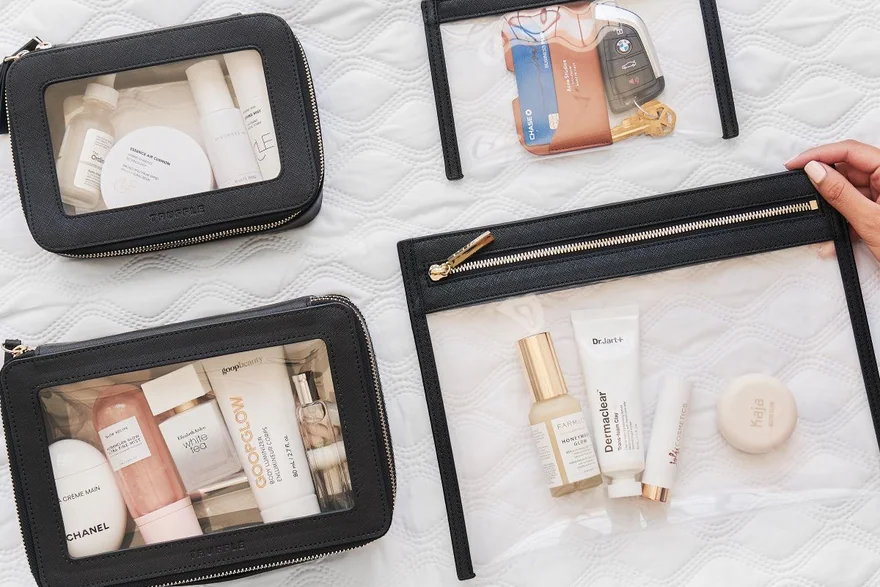
The structure behind the divider: shells, boards and trays
A divider is only as stable as what it stands on. In a soft pouch, the divider leans and the compartments collapse into each other the moment the bag is set down. In a structured case, the divider stays vertical and the compartments hold their volume. The difference is not the divider; it is the shell and whatever stiffener sits behind the lining. Buyers should specify these as one system, because a factory asked to add dividers to an unstructured pouch will produce a sample that photographs well and performs badly.
| Support type | Thickness or gauge | Shell result | Divider stability | Cost index |
|---|---|---|---|---|
| No stiffener, 420D shell only | 0 g/m2 board | Soft-sided, folds flat | Poor, dividers lean | 1.0 |
| Non-woven interlining | 80-120 g/m2 | Holds a light shape | Fair at low loads | 1.2 |
| PE board in base and walls | 0.6-1.2 mm | Semi-rigid, stands empty | Good with snap studs | 1.5 |
| EVA sheet, die-cut | 1.5-3.0 mm | Rigid, holds corners | Very good, dividers lock | 1.9 |
| Moulded EVA shell | 2.5-4.0 mm | Hard shell, crush resistant | Excellent with a sliding track | 2.8 |
Divider construction runs on the same logic. A padded divider is normally two faces of shell fabric over a 2 mm to 4 mm foam, with the foam chosen for compression set rather than softness, since a foam that takes a permanent dent leaves the compartment narrower every time it is used. A rigid divider is a PE or PP sheet at 0.8 mm to 1.5 mm, covered or left exposed. Rigid dividers hold a compartment square and are easier to wipe; padded dividers protect glass bottles and mirrors better. Where a divider must do both, a 0.8 mm PP core with a 1 mm foam face and a wipeable skin is the common compromise.
Height is the dimension buyers forget. A divider that reaches only 70 percent of the internal wall height lets tall items tip over the top, which defeats the compartment. The usual rule is internal height minus 10 mm to 15 mm of clearance, so the lining can be turned over the top edge of the divider without buckling. In a bag with an internal height of 120 mm, dividers should be 105 mm to 110 mm. Anything taller will fight the zipper line when the bag closes, and that shows up as a bulge along the top rather than as an obvious defect.
Coated fabric behaviour at the divider fold is worth testing separately. Every repositionable divider flexes at its base, and repeated flexing past 90 degrees is where a laminate separates from its scrim. The relevant properties, coating adhesion and flex resistance among them, are measured by the ASTM D751 family of coated-fabric methods, and a simple in-house version is a 500-cycle fold test at the base with a visual check for delamination. Where a divider will be moved daily, TPU at 0.12 mm outperforms PVC at 0.10 mm on both adhesion retention and low-temperature flexibility.
Edge finish matters as well. An exposed PE or PP board edge should be turned or bound, because a raw board edge abrades the lining from the inside and, over a season, works through it at the corners where the divider meets the wall.
Specifying a compartment system that survives the first season
A brief for a divider bag needs eight numbers that most buyers omit: shell fabric and denier, coating type and gauge, stiffener type and thickness, divider core and facing, divider height, mechanism type and tape width, repositioning cycle requirement, and the load each compartment must hold. With those eight, a factory can quote accurately on the first pass. Without them, the first sample is a guess, and the second sample costs another 6 to 10 working days.
| Specification line | Typical value | Effect if omitted |
|---|---|---|
| Shell fabric | 420D or 600D polyester, PU coated | Quoted on 210D, compartments slump |
| Stiffener | 0.8 mm PE board in base | Bag folds flat, dividers lean |
| Divider core | 0.8 mm PP with 2 mm foam | Divider buckles under a full bottle |
| Divider height | Internal height minus 10-15 mm | Top-edge bulge or items tipping over |
| Hook-and-loop width | 30 mm tape on base and wall | Holding force halves, panel slides |
| Cycle requirement | 300 cycles, force retention above 70 percent | Tape flattens inside one season |
| Compartment load | 500 g per station | Divider pulls away under real contents |
| Lining | TPU laminate, 0.12 mm | Pigment stains a woven lining permanently |
Inspection has to treat the divider system as a functional assembly rather than as trim. Under AQL 2.5 on a 1,200-piece shipment the sample is 80 units with 5 minor and 3 major defects allowed, and the plan itself is set out in ISO 2859-1. Divider miscount and cosmetic misalignment are minors; a divider that detaches or a hook-and-loop panel that peels at the stitch line is a major, because the product no longer performs its advertised function. Buyers should also require a pre-shipment functional check on five units: reconfigure each divider three times and confirm it still holds position.
Sampling and bulk timing follow the usual pattern for a programme of this type: 6 to 10 working days for a fabric and board construction, 12 to 15 working days where a moulded tray, a welded seam or a sliding track is involved, then 35 to 50 days for bulk after sample approval. Shipment is FOB Xiamen with T/T 30 deposit and 70 against bill of lading. The 500-piece minimum per style and colourway applies, so a brand wanting three colourways of the same compartment system is committing to 1,500 pieces.
One commercial note closes the specification. An adjustable interior is a genuine differentiator only if the listing shows it working, which means photography of the bag in at least two configurations. Buyers who commission a divider system and then photograph it in one layout have paid for a feature the customer cannot see, and the return rate for that listing tends to look like the return rate for a plain organiser.
The brief should also say what happens when a divider is lost. A consumer who misplaces one panel has a bag with two compartments instead of three, and the review will say so. Specifying one spare panel per bag, or listing a replacement panel as an accessory, protects the review score for a few cents per unit and gives the brand a low-cost add-on sale. Buyers should ask whether the panel pattern is retained on file, because a replacement run years later is only possible if the pattern still exists.
The B2B Customisation View
The brief for makeup bags and toiletry bags should state the tolerances that matter: acceptable shade drift, stitch density, and the defect threshold at final inspection.
Programme data for this category: minimum order quantity 500 pieces per style and colourway, sampling in 6–10 working days (12–15 working days for complex constructions), bulk production 35–50 days after sample approval, final random inspection at AQL 2.5 under ISO 2859-1, FOB Xiamen, T/T 30/70.
This is the model that lets a small brand launch makeup bags and toiletry bags with the same inspection discipline a large retailer would demand.
Which Brand Types Benefit Most
Adjustable compartment systems suit brands whose product mix changes, which is a different situation from a brand selling one fixed kit. Start-up brands benefit most, because a single reconfigurable unit lets them serve a makeup customer and a skincare customer from the same 500-piece run instead of splitting into two runs of 500. Established brands should consider the mechanism as a platform decision: once a snap-stud grid or a moulded track is tooled, subsequent seasons can re-skin the shell without re-engineering the interior, which is where the real cost saving sits. Retailers and e-commerce sellers should weigh the review risk, since a divider that stops holding position produces the same one-star review as a broken zipper, and the complaint is usually about the mechanism rather than the bag. Gift and hospitality buyers should note that a reconfigurable interior adds perceived value in a gift context but is wasted on a guest amenity kit that will be used once; for that application a fixed two-compartment bag at lower cost performs the same job. Across all five buyer types the same question applies: how often will the end user actually move a divider? A brand that can answer that from its own customer data can save money with a simpler mechanism, and a brand that cannot should specify the stronger one and treat the extra cost as insurance against a season of returns. The logic is unchanged at every scale: an adjustable interior only earns its cost if the customer reconfigures it at least once.
- Start-up brands: one shell, one hook-and-loop divider set, two colourways at 500 pieces each.
- Established brands: tool a snap-stud or track platform and re-skin it across three seasons.
- Retailers: require cycle-test data on the divider mechanism before listing approval.
- E-commerce sellers: photograph at least two configurations, otherwise the feature is invisible.
- Gift buyers: prefer a fixed two-compartment layout for single-use amenity kits.
Frequently Asked Questions
Which divider mechanism holds position longest in a daily-use cosmetic bag?
A moulded sliding track holds longest, typically beyond 1,500 repositioning cycles, because there is no hook-and-loop pile to flatten. Snap studs on a fixed grid come next at 1,000 or more cycles, with the socket as the wear point. Hook-and-loop tape is the weakest at 300 to 500 cycles, but it is also the cheapest and gives infinite positions rather than fixed stations.
How much shear force should a repositionable divider resist?
A minimum of 25 N measured at the top edge of the divider with a spring gauge is a reasonable specification for a consumer bag, rising to 60 N where the compartment holds bottles. Static load from a 300 ml bottle is only a few newtons, so the figure is really about surviving the impulse when a packed bag is dropped into a suitcase side-on.
What stiffener thickness turns a soft pouch into a compartment system?
A 0.8 mm PE board in the base plus 0.6 mm in the walls is usually enough for a bag up to 250 mm wide. Below that, dividers lean and compartments collapse. Moving to a 2 mm die-cut EVA sheet gives a semi-rigid case that stands empty, and a 3 mm moulded EVA shell is the choice where crush resistance is part of the selling proposition.
How tall should a divider be inside a 120 mm internal height?
Around 105 mm to 110 mm. The rule is internal height minus 10 mm to 15 mm of clearance, which leaves room for the lining to turn over the top edge of the divider without buckling. A divider that reaches only 70 percent of the wall height lets tall items tip across compartments, which is the failure customers complain about.
Why does hook-and-loop tape lose grip inside a makeup bag?
Two causes. Powder and cream residue load the hook side, and the loop pile flattens under repeated compression, so the effective engagement drops. Specifying 30 mm or 40 mm tape rather than 20 mm roughly doubles the holding force, and placing the hook side away from the product cavity keeps it out of contact with brushes and pressed powder.
Is a padded divider or a rigid divider better for glass bottles?
A padded divider protects glass better because a 2 mm to 4 mm foam face absorbs the impact, while a rigid PP sheet transmits it. The compromise most buyers land on is a 0.8 mm PP core with a 1 mm foam facing and a wipeable skin, which holds the compartment square and still cushions a bottle. Check the foam compression set, not just its thickness.
What coating should a divider bag use if it will be wiped often?
TPU at 0.12 mm is the usual answer, because it retains adhesion and stays flexible at low temperatures better than PVC at 0.10 mm. The properties that matter, coating adhesion and flex resistance, sit in the ASTM D751 coated-fabric methods, so the brief should name the coating type and gauge rather than asking only for a wipeable finish.
How many compartments should a medium cosmetic organiser have?
Three to five is the practical range. Below three the adjustable feature adds little over a fixed layout; above five the compartments become too narrow for a standard 50 mm palette or a 200 ml bottle, and the user reverts to one big cavity anyway. A bag around 260 mm by 180 mm by 110 mm supports four usable stations.
Does a moulded tray make the sampling timeline longer?
Yes. A fabric and board construction samples in 6 to 10 working days, while a moulded EVA tray, a welded seam or a sliding track falls into the complex bracket at 12 to 15 working days because tooling has to be cut. Bulk production is 35 to 50 days after sample approval regardless, shipped FOB Xiamen.
How should AQL 2.5 classify divider defects?
Treat divider miscount, panel misalignment and cosmetic variation as minor, and treat divider detachment, peeling hook-and-loop at the stitch line and a crushed stiffener board as major, because the product no longer performs as advertised. On a 1,200-piece shipment the sample is 80 units, allowing 5 minor and 3 major before the batch is rejected. The classification should be agreed in writing before inspection begins.
Can the same compartment system run in three colourways?
Yes, and the interior pattern normally stays fixed while shell and lining colour change, which avoids re-engineering. The 500-piece minimum per style and colourway means three colourways is a 1,500-piece commitment. The point to check is hook-and-loop dye lot consistency, because a dark tape against a light lining will show dye migration. Asking for tape from a single dye lot removes most of that risk.
What load should each compartment be specified to carry?
Around 500 g per station for a consumer makeup organiser and up to 1 kg where skincare bottles are the intended contents. Specifying a load figure gives the factory a target for the hook-and-loop width and the divider core stiffness. Without it, the sample is built to look right rather than to hold a realistic contents weight.
How is a divider fold tested before bulk production?
The usual in-house check is 500 flex cycles at the divider base, past 90 degrees, followed by a visual inspection for delamination or cracking at the fold. On a coated fabric this is where a laminate separates from its scrim. A TPU laminate at 0.12 mm typically passes where a PVC laminate at 0.10 mm begins to haze at the fold line.
Should the divider be removable or fixed to the bag?
Removable panels give the user the option of one large cavity, which is a genuine selling point for a bag that may carry a palette. Fixed panels hold position better and cost less. The compromise is a semi-fixed design: one panel permanently attached at the base and one or two removable, which covers the two layouts most customers actually use.
What dimensions suit a four-compartment travel cosmetic case?
Around 260 mm wide, 180 mm tall and 110 mm deep, giving internal stations of roughly 60 mm, 60 mm, 60 mm and 70 mm after divider and fabric thickness. That fits a 12-pan palette, a 200 ml bottle upright and a brush roll. Reducing depth below 90 mm stops bottles standing upright, which is the main reason customers return this product type.
How much does an adjustable interior add to unit cost?
A hook-and-loop divider set with a PE board stiffener typically adds a moderate increment over an open-lined bag, driven by the tape, the board and the extra sewing. A moulded EVA tray with a sliding track adds considerably more because of tooling. Against a typical unit band of 0.45 to 12.00 dollars, the mechanism matters most below 3 dollars.
People Also Ask
What is the point of adjustable dividers in a makeup bag?
They let one stock keeping unit serve customers with different kits: a makeup user wants narrow slots for palettes and brushes, a skincare user wants tall stations for bottles. Adjustability also protects against a change in the brand's own product range, since the interior can be reconfigured for a new bottle size without re-tooling the bag. It also lets one listing serve two audiences without a second tooling investment.
Do adjustable dividers wear out?
Yes. Hook-and-loop tape loses grip after roughly 300 to 500 repositioning cycles as the pile flattens and the hooks load with powder. Snap studs and sliding tracks last far longer. For a consumer who sets the layout once and leaves it, the wear is irrelevant; for a makeup artist reconfiguring daily, the mechanism should be upgraded. Buyers should ask for the cycle figure in writing rather than accepting a general claim.
Can you add dividers to an existing bag design?
Only if the shell can support them. Adding dividers to a soft 210D pouch produces compartments that collapse as soon as the bag is set down. A retrofit usually needs a stiffener board in the base and walls, which changes the pattern and the sewing sequence, so it is better treated as a new style than as a modification. The cost difference is usually smaller than the cost of a season of avoidable returns.
How do you stop dividers from leaning?
Give them a rigid core, at least 0.8 mm PP or PE, and a base to attach to, either hook-and-loop tape of 30 mm or wider or a snap-stud grid. Height should reach within 10 mm to 15 mm of the internal wall. A padded divider without a core will lean under any load, whatever attachment is used. A rigid core with a bound edge is the combination that holds its shape longest.
Request a Sample or a Written Quotation
Send the silhouette, dimensions, material preference and logo artwork, and the programme team will return a written quotation with MOQ, sampling window, bulk lead time and inspection standard.
Email: service@junyuanbags.com · WhatsApp: +86 177 5002 0688