Single Compartment vs Multi-Compartment Makeup Bags
Executive Summary
Single-compartment makeup bags win on cost, packing density and flexibility; multi-compartment bags win on perceived value and review scores. A single-compartment bag of 24 x 16 x 10 cm costs roughly $0.55 to $1.10 less per unit than the same shell with two dividers, a zip pocket and a brush panel, because compartment work is labour, not material. Choose single-compartment for gift-with-purchase and for ranges where the contents vary by customer.
Choose multi-compartment when the bag is sold against known contents, such as a brush set, a palette kit or a travel liquids programme, because a divider that fits the product is the feature users mention most in reviews. Minimum order is 500 pieces per style and colourway, sampling takes 6 to 10 working days and 12 to 15 for complex layouts, and bulk takes 35 to 50 days after approval. The layout also changes yield rather than only cost: at four or more compartments, alignment rejection commonly runs at 2 to 4 percent and is priced into the quote.
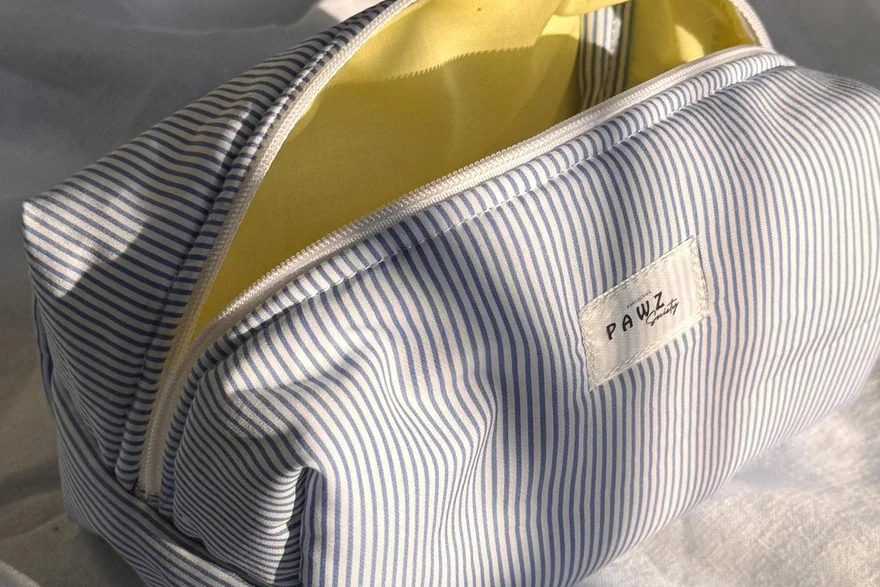
How Compartment Count Reshapes a Makeup Bag
Compartment count is the most under-estimated variable in a makeup bag brief because it looks like a design choice and behaves like a manufacturing one. Every divider is a pattern piece, a cutting operation, a binding operation and two or three sewing passes. Going from one compartment to four typically doubles sewing time on the interior, from roughly 4.5 minutes to 9 or 10 minutes per bag, and labour is the larger part of unit cost on a bag in the $0.45 to $12.00 band.
The word compartment covers three different constructions and they price very differently. A divider is a full-height or part-height panel sewn into the base, which divides the interior volume. A pocket is a flat panel applied to the lining, either open, elasticated or zipped, and it costs less because it does not have to align with the base. A brush panel is a strip of elastic loops or a folded sleeve, and it is the cheapest way to add visible organisation for the money.
- Divider: sewn into the base, divides volume, highest cost and highest perceived value
- Pocket: applied to the lining, open or zipped, lower cost, adds organisation without changing volume
- Brush panel: elastic loops or a sleeve, cheapest visible organisation, best photographic return
- Compartment work is labour: one to four compartments roughly doubles interior sewing time
Demand data supports offering both. Consumer search for "make up bags for women" runs at roughly 80,000 monthly searches, and listing imagery in that space splits between wide-open interiors that show capacity and compartmented interiors that show organisation. The terms around customisation are smaller but commercially sharper, with "custom makeup bag" at 5,400 to 6,600 monthly searches, and those enquiries almost always specify a layout because the buyer has a product to fit. Compartment count also changes what the bag can be called: an open interior reads as a pouch, while a divided interior with a brush panel reads as an organiser or a case, and that difference moves the product into a higher price bracket on the same shell.
Single-Compartment Construction: Where It Wins
A single-compartment bag is one uninterrupted volume. A typical size of 24 x 16 x 10 cm gives about 3.8 litres of usable space, which holds a full daily makeup kit or a week of toiletries. The appeal is flexibility: the same bag works for a customer carrying three items and for one carrying thirty, and it never has a divider in the wrong place for a specific product.
| Single-compartment format | Typical size | Usable volume | Interior sewing time | Typical unit band |
|---|---|---|---|---|
| Flat pouch | 20 x 14 cm | 0.6-0.9 L | 2.5-3.5 min | $0.45-$2.20 |
| Gusseted standing bag | 24 x 16 x 10 cm | 3.5-4.0 L | 4.0-5.0 min | $1.60-$6.00 |
| Deep box bag | 28 x 18 x 14 cm | 6.5-7.5 L | 5.0-6.5 min | $3.20-$9.00 |
| Wide-mouth train style | 30 x 20 x 16 cm | 9.0-10.5 L | 6.0-8.0 min | $4.50-$12.00 |
Packing is the second advantage. With no dividers the bag compresses flat, so a single-compartment gusseted bag ships at 36 to 48 pieces per export carton against 24 to 34 for the same shell fitted with two dividers and a brush panel. On a 5,000-piece order that is a freight difference in the range of 12 to 18 percent, which matters far more to a gift-with-purchase buyer working at the low end of the price band than to a retail brand at the top.
Volume efficiency is another quiet advantage. A single-compartment bag uses almost all of its internal volume, typically 85 to 92 percent, because nothing is lost to divider panels, binding tape and the clearance each compartment needs. A four-compartment bag of the same external size typically uses 62 to 72 percent of its volume, because every divider costs two fabric plies, a binding tape and 5 to 8 mm of clearance on each side. That is why a compartmented bag has to be drawn slightly larger than an open bag to hold the same kit, and why the unit cost rises twice: once for the labour and once for the extra material in the shell.
The weaknesses are real and they should be planned for. Loose items migrate and small ones end up at the bottom, which is the most frequent negative comment in reviews of open bags. Liquid leakage affects every item rather than one compartment. And an open interior photographs as a void unless it is styled, so a single-compartment bag needs either a strong printed lining or a lifestyle shot with contents to read well in a listing. A light-coloured lining also helps here, because an interior that reads bright makes the bag look larger in a photograph than the same interior in black.
Two low-cost mitigations close most of the gap. An elasticated lining pocket of about 18 x 12 cm costs $0.15 to $0.30 and gives small items a home without dividing the volume. A removable base board of 2.0 mm PP, costing $0.18 to $0.40, keeps the bag standing so the interior is visible when the mouth is opened, which addresses the void-photograph problem directly.
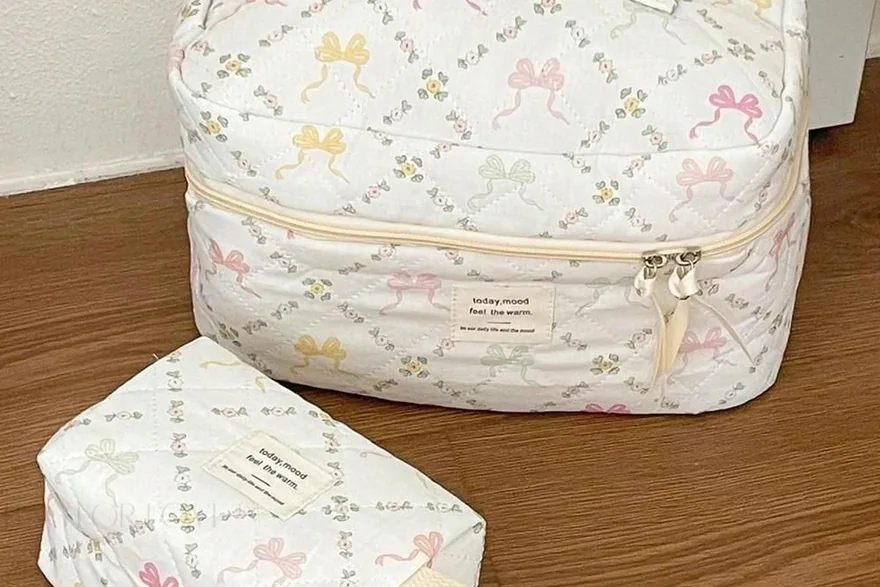
Multi-Compartment Layouts: Dividers, Pockets and Brush Panels
A multi-compartment layout should be drawn against the products it will hold, not chosen from a number. The working method is to lay the intended contents on a table, measure the largest and the smallest, and size compartments to the largest plus 5 to 8 mm of clearance. A divider sized exactly to a palette will jam after the lining and binding are added, and a divider sized with no clearance lets items rattle, which is the complaint that follows a layout designed from a photograph.
| Compartment element | Typical specification | Added unit cost | Added sewing time | Best use |
|---|---|---|---|---|
| Full-height divider | Bound panel, sewn to base | $0.22-$0.45 | 1.2-1.8 min | Separating liquids from dry items |
| Part-height divider | 60-70 percent of bag height | $0.18-$0.35 | 1.0-1.4 min | Palettes, large flat items |
| Zip pocket in lining | #3 coil, 18-20 cm | $0.22-$0.38 | 1.0-1.5 min | Small items, valuables |
| Elasticated open pocket | 18 x 12 cm, elastic top | $0.15-$0.30 | 0.8-1.2 min | Bottles, upright storage |
| Mesh pocket | Polyester mesh, bound edge | $0.18-$0.34 | 1.0-1.4 min | Visibility of contents |
| Brush panel | 8-16 loops, 12-15 mm elastic | $0.28-$0.60 | 1.5-2.5 min | Brush sets, professional kits |
Divider height is the detail that most often gets missed. A full-height divider gives true separation but prevents a long item such as a hairbrush or a mascara tube from lying across the bag, which frustrates users. A part-height divider at 60 to 70 percent of the bag height keeps separation for small items while leaving a bridge across the top, and it costs slightly less. Most four-compartment travel bags use a mix: two part-height dividers and one full-height divider for liquids.
Brush panels deserve specific numbers because elastic is the first thing to fail. Loops of 12 to 15 mm flat elastic, sewn at 18 to 22 mm centres, hold brush handles from 6 to 22 mm in diameter. Elastic relaxes with use, so specify a polyester-core elastic rather than a natural-rubber core and add a retention test: 100 insertions of a 15 mm handle followed by a check that the loop still grips a 8 mm handle.
A layout also has to be sized for the sewing sequence, not only for the contents. Dividers are set into the base before the side seams are closed, so every divider adds a handling step and every additional divider makes it harder to keep the base square. In practice three compartments is the point at which yield starts to fall: below three, interior defects run at a fraction of a percent; at four to six compartments with a brush panel, first-off rejection on interior alignment commonly rises to 2 to 4 percent, and that is charged back through the unit price. Brands planning a six-compartment layout should expect a price quote that reflects the yield rather than only the labour.
Edge wear on dividers and pockets is the main durability risk, because those edges are handled every time the bag is used. Bound edges in self-fabric bias or polyester tape outlast raw overlocked edges by a wide margin and cost $0.06 to $0.14 more per panel. Abrasion resistance of the binding tape and of any coated divider is measured under AATCC test methods, and coated fabrics used for dividers are assessed against ASTM D751 for coated fabrics, since a coating that cracks at the fold looks like a defect even when the panel is sound.
Costing, Defect Risk and Writing the Layout Line
| Decision factor | Single compartment | Two to three compartments | Four or more with brush panel |
|---|---|---|---|
| Added interior cost | $0.00 | $0.40-$1.10 | $1.20-$2.60 |
| Interior sewing time | 4.0-5.0 min | 6.5-8.0 min | 9.0-11.0 min |
| Pieces per export carton | 36-48 | 28-38 | 22-32 |
| Sampling time | 6-10 working days | 6-10 working days | 12-15 working days |
| Main defect risk | Interior photographs empty | Divider out of square | Elastic loops uneven, panel skew |
| Best retail price point | Under $15 | $15-$30 | $30 and above |
Three defects dominate multi-compartment inspection. A divider out of square is the most visible: it is caused by sewing the panel to the base before the base gusset is set, and it is prevented by a notched pattern and a first-off check. Uneven elastic loops come from marking the loop positions by eye rather than with a template, and a simple gauge jig removes it. Panel skew, where the applied pocket sits 3 mm or more off centre, is a marking issue and is normally cosmetic at inspection.
- State the compartment count explicitly and give a dimensioned sketch, not a photograph of a similar bag.
- For each compartment give internal dimensions in centimetres plus the clearance intended for the product.
- State divider height as a percentage of bag height, and whether full or part height.
- For pockets, state type, dimensions and whether the top is plain, elasticated or zipped.
- For brush panels, state loop count, elastic width, loop centres and the handle diameter range to be held.
- State the edge finish for every panel: bound bias, taped or overlocked.
Yield is the variable most buyers never see on a quotation. A single-compartment bag cuts and sews predictably, so a supplier can quote close to the material and labour cost. A compartmented bag carries alignment risk, and that risk is priced in: at four or more compartments, expect the quote to include an allowance of 2 to 4 percent for interior rework or rejection. Asking the question directly, "what rejection allowance is in this price?", is one of the more useful things a buyer can do, because a quote that looks 8 percent cheaper is often simply a quote with no allowance in it.
Programme terms follow the same structure as any custom bag: 500 pieces per style and colourway, sampling at 6 to 10 working days for layouts that use standard pattern pieces and 12 to 15 working days where a new divider or brush panel has to be patterned, and bulk at 35 to 50 days after sample approval. Shipment is FOB Xiamen with T/T 30 percent deposit and 70 percent against the bill of lading, and final random inspection runs at AQL 2.5 under ISO 2859-1, where a detached divider is functional and a slightly skewed pocket is cosmetic. Buyers should also confirm whether the interior is inspected before the lining is closed, because alignment faults are far cheaper to catch at that stage than on a finished bag.
Prototype the layout with a card mock-up before sampling. A compartment that holds the product on a drawing often fails once binding tape and seam allowances are added, and a card mock-up costs an hour rather than a sampling round.
The B2B Customisation View
Development of makeup bags and toiletry bags is a sequence of small approvals, and each approval is cheaper than the rework it prevents.
The numbers a buyer can plan around: 500 pieces minimum per style and colourway, 6–10 working days to a first sample (12–15 where tooling or moulding is involved), 35–50 days to bulk completion, AQL 2.5 under ISO 2859-1 at final inspection, FOB Xiamen terms, T/T 30/70 payment.
As the programme coordinator, QUANZHOU JUNYUAN BAGS owns the sample history, which is what makes a repeat order of makeup bags and toiletry bags look like the original rather than a near-miss.
Which Brand Types Benefit Most
Compartment strategy should follow what the buyer knows about the contents. Start-up brands usually do not know their customer's kit yet, which makes a single-compartment bag with one elasticated pocket the safer first purchase: it fits anything, packs densely and does not risk a divider sized for a product that turns out to be wrong. Brands selling a defined set, such as a twelve-piece brush kit, should commit to a layout, because the fitted panel is what makes the kit feel designed rather than assembled. A second rule helps: compartment count should track the retail price, one compartment under about $15, two to three between $15 and $30, and four or more only above $30, where the extra 5 to 6 minutes of interior sewing can be carried in the margin.
- Retailers and private-label buyers: a mixed range works best, with one single-compartment hero at the entry price and one multi-compartment bag at the top, so the price step is visible in the interior.
- E-commerce sellers: multi-compartment interiors photograph well without styling and reduce the "too small" review, but they raise the unit cost, so the layout should be justified by a price point above about $18.
- Gift-with-purchase buyers: single compartment almost always, because the insert cost has to stay low and the recipient's contents are unknown.
- Professional and salon buyers: brush panels with 12 to 16 loops and a full-height divider for liquids, since the bag is a working tool opened dozens of times a day.
- Subscription-box buyers: two-compartment with an elasticated pocket, giving some organisation at a cost that still fits a quarterly box margin.
- Travel-retail buyers: a full-height liquids compartment sized to 140 mm so a 100 ml bottle stands upright, plus part-height dividers for everything else.
- Brands planning a second season: commit to a layout only after the first season's contents data, because a divider sized for the wrong product wastes more space than it organises.
Frequently Asked Questions
How much does adding compartments add to the cost of a makeup bag?
Two to three compartments typically add $0.40 to $1.10 per unit and four or more with a brush panel add $1.20 to $2.60. Most of that is labour rather than fabric: interior sewing time rises from about 4 to 5 minutes to 9 to 11 minutes. Dividers are the most expensive element at $0.22 to $0.45 each.
What is the best number of compartments for a travel makeup bag?
Three works best for most travel kits: two part-height dividers for dry items and one full-height divider, ideally with a wipe-clean lining, for liquids at the 100 ml limit. A fourth compartment rarely earns its cost in travel use because it reduces the space available for a hairbrush or a full-size palette. A liquids compartment sized to 140 mm so a 100 ml bottle stands upright is the most useful single compartment in a travel bag, and it should be drawn first.
Should dividers be full height or part height?
Part height, at 60 to 70 percent of the bag height, is the better default. It separates small items while leaving a bridge so a long item such as a hairbrush or mascara tube can lie across the top. Full-height dividers give true separation but force everything to stand upright and cost slightly more. On a bag under 18 cm tall, go full height, because a part-height divider in a shallow bag separates almost nothing.
How should a brush panel be specified?
State the loop count, usually 8 to 16, the elastic width at 12 to 15 mm, the loop centres at 18 to 22 mm, and the handle diameter range to be held, typically 6 to 22 mm. Specify a polyester-core elastic rather than natural rubber so the loops do not relax, and add a 100-insertion retention check. Add the handle diameter range and a retention check of 100 insertions, or the loops will be sized for the display brushes rather than for the ones customers actually own.
Why do dividers end up out of square in production?
Because the panel is sewn to the base before the base gusset is set, so the two are never aligned. A notched pattern and a checked first-off piece remove most cases. It is one of the most visible interior defects and should be written into the inspection plan as a specific check rather than left to a general appearance review.
Does a multi-compartment bag pack worse than a single-compartment one?
Yes. A single-compartment gusseted bag ships at 36 to 48 pieces per export carton, two to three compartments at 28 to 38, and four or more with a brush panel at 22 to 32. On a 5,000-piece order that difference typically moves landed freight by 12 to 18 percent. The difference narrows if dividers are folded flat against the base before the carton is closed, which recovers 4 to 8 percent of volume in practice.
What is the cheapest way to add organisation to a makeup bag?
An elasticated open pocket of about 18 x 12 cm costs $0.15 to $0.30 and 0.8 to 1.2 minutes of sewing, and it does not reduce the main volume. A mesh pocket costs slightly more at $0.18 to $0.34 and lets the contents be seen, which helps in a listing image. A contrast or printed lining is the other cheap lever at $0.05 to $0.35, and it raises perceived value without adding any sewing time to the interior.
How much clearance should a compartment have around a palette?
Add 5 to 8 mm to the largest product dimension. A compartment sized exactly to the product jams once lining and binding tape are added, while one with too much clearance lets items rattle. Measure the product in its packaging, not the packaging artwork, because boxes are usually 2 to 3 mm larger than the stated size. For a tube or a pencil-shaped item, add clearance on the length only and keep the width snug, because a rattling tube scuffs the lining.
Do zip pockets inside a makeup bag fail often?
They fail less often than elastic loops but they add a second hardware item to the bill of materials, at $0.22 to $0.38 including a #3 coil. The common fault is a slider that catches the pocket lining, prevented by 3 mm clearance and a bound edge. Zip pockets suit valuables and small items. Specifying a garage at the closed end of the pocket zip removes most of the snagging risk and adds about $0.04 to $0.09.
What causes elastic brush loops to go slack?
Natural-rubber-core elastic relaxes under repeated stretching and in warm conditions, typically within a few months of daily use. A polyester-core elastic holds its recovery far longer. The loop should still grip an 8 mm handle after 100 insertions of a 15 mm handle, and that is a reasonable acceptance test at sampling. Storing the bag upright and loaded with brushes accelerates the problem, so the storage position shown in the product photography matters more than it looks.
Can a divider be removable?
Yes, usually with hook-and-loop tape on the base and the divider foot, which adds about $0.12 to $0.25 per divider. Removable dividers suit ranges sold across different kit sizes, but the hook side wears with repeated removal and should be tested over at least 200 cycles before bulk. Test the hook side over 200 cycles, and specify a woven loop tape rather than a cut one, because a cut edge frays at the anchor point.
How long does sampling take for a custom compartment layout?
Six to ten working days when the layout uses standard pattern pieces already in the range. A new divider, a brush panel or a novel pocket shape has to be patterned and tested first, which extends sampling to 12 to 15 working days. Bulk stays at 35 to 50 days after sample approval. A layout using pattern pieces already in the range stays at 6 to 10 working days, so asking for a standard divider height is the fastest way to shorten the round.
Are compartment defects functional or cosmetic at inspection?
A detached divider, a torn pocket or a zip that will not close is functional. A slightly skewed pocket, an uneven loop spacing within tolerance or minor puckering at a divider foot is cosmetic. Under AQL 2.5 in ISO 2859-1 those fall under different acceptance numbers, so the inspection plan should list them separately. Skew beyond 3 mm from the marked position is the usual trigger between the two, and it should be written into the plan as a number rather than left to judgement.
What size should a single-compartment makeup bag be?
24 x 16 x 10 cm is the volume default, giving about 3.8 litres and shipping at 36 to 48 pieces per carton. Go to 28 x 18 x 14 cm for a kit bag at 6.5 to 7.5 litres and to 30 x 20 x 16 cm for a train style. Below 20 cm on the longest edge the bag reads as a pouch, not a bag.
Does a printed lining help a single-compartment bag sell?
Yes. An open interior photographs as an empty void unless it is styled, and a printed or contrast lining gives the image something to read. A printed lining typically adds $0.10 to $0.35 depending on the method, and it is one of the cheapest ways to raise the perceived value of a single-compartment bag. A contrast lining colour is cheaper than a print at $0.05 to $0.15 and reads almost as well in a listing image.
People Also Ask
Are makeup bags with compartments better?
They are better when the contents are known and repeatable, such as a brush set or a travel liquids kit, because a fitted divider is the feature users mention in reviews. They are worse when the contents vary by customer, because a divider in the wrong place wastes space and adds $0.40 to $2.60 to the unit cost. The test is simple: if the buyer can list what goes inside, compartment it; if not, leave the interior open.
How many compartments should a makeup bag have?
One for a gift or general-purpose pouch, two to three for a daily-use bag retailing between $15 and $30, and four or more with a brush panel only above about $30, where the added interior sewing time of 9 to 11 minutes can be carried in the margin. Below $15 an open interior with one pocket is the honest answer, because the interior sewing time cannot be carried in the margin.
What is a brush holder panel in a makeup bag?
A strip of flat elastic loops, usually 8 to 16 loops at 18 to 22 mm centres, sewn to the lining or to a removable sleeve, that holds brush handles upright. It typically adds $0.28 to $0.60 per unit and is the cheapest way to make an interior look organised in a photograph. Loops at 18 to 22 mm centres suit handles from 6 to 22 mm, and a polyester-core elastic is what keeps them gripping after months of use.
Why won't my makeup bag stand up when it is empty?
Because it has no base structure. A removable base board of 2.0 mm polypropylene, costing $0.18 to $0.40, or a stiffer shell fabric with an interfacing, will make the bag stand so the interior is visible when the mouth is opened. Without it, even a compartmented interior collapses in a listing photograph. A 2.0 mm polypropylene base board costs $0.18 to $0.40 and is usually enough; extra foam in the shell helps less than buyers expect.
Request a Sample or a Written Quotation
Send the silhouette, dimensions, material preference and logo artwork, and the programme team will return a written quotation with MOQ, sampling window, bulk lead time and inspection standard.
Email: service@junyuanbags.com · WhatsApp: +86 177 5002 0688