Makeup Bag Dimensions: Small, Medium & Large Size Guide
Executive Summary
Makeup bag dimensions fall into three consumer-facing bands: small at roughly 18 x 11 x 6 cm, medium at roughly 22 x 14 x 8 cm and large at roughly 26 x 17 x 11 cm. Those three sizes carry almost all category volume, with medium typically accounting for around half of units sold. The boundaries are commercial conventions rather than published rules, so a small from one line can overlap the medium of another by a centimetre or two on every axis.
What actually separates the bands is item count rather than centimetres. A small holds roughly eight to ten everyday items, a medium around twenty to twenty-four, and a large thirty-five to forty, provided the interior has been organised rather than left as one open cavity. Category demand supports the ladder: roughly 80,000 monthly searches for make up bags for women and 5,400 to 6,600 monthly searches for custom makeup bag indicate that buyers research size before they research colour. The sections below translate each band into item counts, price positioning and channel fit.
Where the Small, Medium and Large Boundaries Actually Fall
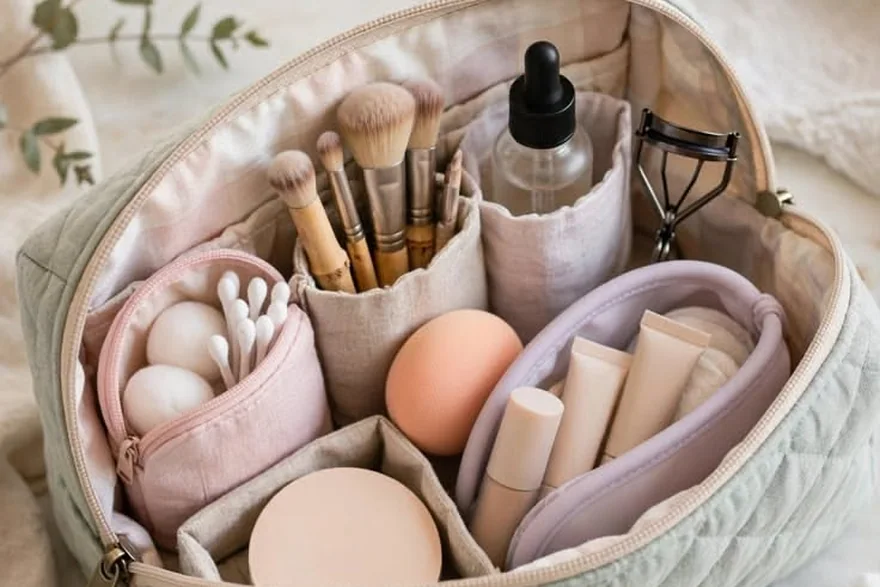
Small, medium and large are shelf positions before they are measurements. In a buying brief they name three price and use tiers that sit next to each other on a shelf or filter set, and the dimensions follow from the tier rather than defining it. Small exists to be affordable and portable, medium exists to be the everyday default, and large exists to justify a higher ticket through organisation or professional credibility. Once the three jobs are agreed, the centimetres tend to settle themselves at roughly 18 x 11 x 6, 22 x 14 x 8 and 26 x 17 x 11.
The consumer anchor is the handbag. A piece has to leave room for the wallet, phone and keys that share that space, and most everyday handbags are 28 to 35 cm wide internally. Anything longer than about 26 cm starts competing with those items, which is why the large band stops where it does and why anything bigger leaves the handbag category entirely for the travel category. That is also why demand concentrates at medium: it is the largest size that disappears into a tote.
Search behaviour confirms the ladder. Around 80,000 monthly searches for make up bags for women and 5,400 to 6,600 monthly searches for custom makeup bag indicate that most buyers arrive knowing roughly what they want and then research specifics. Because they cannot see or touch the product, the size figure on the listing becomes the deciding attribute, and listings that publish interior dimensions alongside exterior ones convert better than listings that publish photographs alone. Publishing both figures costs one line of copy.
- Small band: 18 x 11 x 6 cm, priced to be an impulse or gift item
- Medium band: 22 x 14 x 8 cm, the everyday handbag default and volume leader
- Large band: 26 x 17 x 11 cm, the step-up SKU that needs organisation features to justify itself
- Above 26 cm long, a makeup bag moves out of handbag storage and into travel
- Below 16 cm long, it can no longer hold a standard palette flat
Practically, the bands overlap - small at 20 x 13 x 6 exists, so does medium at 24 x 15 x 9. Specify the three numbers and let the label follow. The reason matters: if two SKUs land within a centimetre of each other on every axis, they cannibalise each other on the product page, and the cure is to move one, not to rename it.
Reading Makeup Bag Dimensions as Item Counts Rather Than Centimetres
Centimetres tell a customer nothing usable. A listing that says 22 x 14 x 8 requires mental arithmetic most shoppers will not perform, whereas a listing that says holds around twenty everyday items requires none. Converting dimensions to counts is a short exercise: measure the ten reference products below, calculate the usable interior volume, apply a realistic packing efficiency of about 55 percent for mixed shapes, and divide. The result is a defensible claim rather than a marketing guess.
| Reference item | Unit dimensions (cm) | Unit volume | Small 18x11x6 | Medium 22x14x8 | Large 26x17x11 |
|---|---|---|---|---|---|
| Lipstick bullet | 2.0 x 2.0 x 7.5 | 30 cm3 | 13 units | 28 units | 60 units |
| Mascara tube | 1.8 x 1.8 x 12.5 | 41 cm3 | 10 units | 20 units | 45 units |
| Compact powder, 76 mm | 7.6 x 7.6 x 1.6 | 92 cm3 | 4 units | 9 units | 20 units |
| Eyeshadow palette, 12 pan | 15 x 10 x 1.2 | 180 cm3 | 2 units | 4 units | 10 units |
| Quad palette | 7.5 x 7.5 x 1.2 | 68 cm3 | 5 units | 12 units | 26 units |
| Foundation bottle, 30 ml glass | 3.6 dia x 10.5 | 107 cm3 | 3 units | 8 units | 17 units |
| Concealer tube | 2.2 x 2.2 x 9.5 | 46 cm3 | 8 units | 18 units | 38 units |
| Setting spray, 100 ml | 4.5 x 4.5 x 15.5 | 314 cm3 | 1 unit | 2 units | 5 units |
| Full-length powder brush | 2.5 head x 19 long | 22 cm3 | 16 units | 38 units | 80 units |
| Eyeliner pencil | 0.8 x 0.8 x 14 | 9 cm3 | 40 units | 80 units | 150 units |
The columns above are dedicated-fill maxima, meaning the bag holds nothing else. Nobody packs that way, so the more useful figure is a mixed everyday kit. Fill testing produces repeatable reference kits: a small takes one palette, one foundation bottle, one mascara, two lipsticks, three pencils and one travel brush, around nine items occupying roughly 430 cubic centimetres of the 450 available after packing losses. A medium takes three palettes, foundation, concealer, two mascaras, four lipsticks, five brushes and six pencils, around twenty-two items at roughly 1,050 cubic centimetres of the 980 nominally available once items interlock rather than stack.
A large, at an effective payload near 2,090 cubic centimetres, holds four palettes, two foundations, two concealers, a 100 ml setting spray, three mascaras, eight lipsticks, ten brushes and eight pencils - thirty-eight items. Those are honest numbers, and they are lower than the figures usually printed on hangtags, because published counts almost always assume a single product category. A buyer launching a line should publish the mixed-kit figure. Reviewers then find the bag exceeds the claim rather than falling short of it, which is the cheapest review management available.
Organisation changes these numbers in both directions. Elastic brush loops, slip pockets and dividers consume interior volume, typically 8 to 14 percent, so an organised medium holds fourteen to eighteen items rather than twenty-two. What it gains is retrieval: in an unorganised bag the twentieth item is unreachable without emptying the bag, and that is the failure mode customers describe in negative reviews. The better trade is nearly always organisation, provided the published count reflects the organised interior rather than the open one.
Take the theoretical count, deduct 12 percent for interior organisation features, then round down to the nearest five. A claim of twenty items that comfortably holds twenty-two reads as good value; a claim of twenty-five that barely holds twenty generates returns.
Mapping Size Band to Channel, Price and Margin
Each band aligns with a different sales channel and a different unit economics profile. Wholesale unit prices run from about $0.45 to $12.00 across the category, and size accounts for a meaningful share of that spread simply because larger patterns consume more fabric and more labour. What matters more than the unit price is the shipped cost, and size drives that twice: through fabric consumption and through the volumetric dimensions used to price freight.
| Channel | Best-selling size | Wholesale unit | Typical retail | Hard dimension constraint |
|---|---|---|---|---|
| Amazon FBA beauty | Medium 22 x 14 x 8 | $1.60 - $4.50 | $14 - $28 | Shipper under about 25 x 18 x 10 cm to stay in the standard size tier |
| Gift with purchase | Small flat 18 x 11 x 0.8 | $0.45 - $1.20 | Not priced | Must drop inside a gift box under 20 x 13 cm |
| Subscription box insert | XS flat 12 x 8 | $0.45 - $0.90 | $3 - $6 implied | Must pack flat, under 10 mm thick |
| Specialty beauty retail | Medium and large with structure | $3.50 - $9.00 | $35 - $75 | Total depth under 12 cm to fit standard shelf trays |
| Professional artist use | Large to train case, 26 x 17 x 11 up | $5.00 - $12.00 | $70 - $160 | Rigid floor and brush protection expected |
| Travel and duty free | Medium with clear liquid pocket | $2.80 - $7.50 | $25 - $55 | Liquids compartment accessible without unpacking |
| Hotel amenity programme | Small gusseted 20 x 13 x 6 | $0.80 - $2.00 | Room amenity | Holds six to eight 50 ml minis plus a card |
The second-order effect is freight. Air freight is priced on chargeable weight, which is the greater of actual and volumetric, and volume grows cubically while retail price grows linearly. Moving from a medium to a large increases nominal volume by roughly 98 percent while typically adding perhaps 60 to 80 percent to the achievable retail price, so the large band only holds its margin when shipped by sea. That single relationship explains why a large first shipment frequently fails to hold its margin and succeeds on the second, once it moves to sea freight.
Colour and material decisions are shared across the ladder, and one test matters more than buyers expect. Colour must match across all three sizes because they ship in one carton to one retail customer, and shade variation between sizes is a common complaint. Fastness to rubbing and light is evaluated under the ISO 105 colour fastness series, and specifying the required rating on the purchase order rather than leaving it to convention removes most disputes. Where the lining sits against cosmetics and skin, an OEKO-TEX Standard 100 certificate for the fabric lot is worth requesting with the first shipment.
There is also a compliance dimension to the large band. Once a bag carries electrical items such as a lighted mirror, it attracts different rules altogether, and children-marketing lines fall under toy-safety provisions such as the Consumer Product Safety Improvement Act in the United States. A pure textile bag at any size does not trigger these, which is one argument for keeping the ladder simple.
Building a Three-Size Ladder Without Tripling Development Cost
Adding a second and third size to a line costs far less than adding an unrelated second product, provided the three share decisions deliberately. The highest-cost mistakes in ladder development are unnecessary differentiation - a different shell fabric per size, a different zip colour per size, a different lining per size - which forces separate material buys, separate testing and separate minimum quantities, and quietly triples the working capital tied up in the launch.
- Share one shell fabric, one lining colour and one zip gauge across all three sizes so a single purchase covers the whole ladder.
- Nest the patterns: derive the medium from the small by adding gusset and panel length, so only one new grade per size is required.
- Keep hardware identical - same puller, same slider finish, same end stops - to avoid three separate hardware buys.
- Vary the interior only, giving each size the organisation appropriate to its job, while the exterior construction stays common.
- Sequence sampling together: all three sizes in one sample round, 6 to 10 working days for soft constructions and 12 to 15 for structured ones.
| Decision shared across ladder | Cost effect | Decision varied per size | Cost effect |
|---|---|---|---|
| Shell fabric and colour | One material buy, one dye lot, no shade risk | Shell fabric per size | Three buys, shade mismatch risk, higher deadstock |
| Zip gauge and finish | One hardware buy, bulk pricing | Zip colour per size | Three small hardware orders, minimum charges |
| Print and branding method | One screen or plate set-up amortised across the run | Different print method per size | Multiple set-up fees, inconsistent logo appearance |
| Lining fabric | One lining roll covers all three sizes | Lining per size | Additional roll buys, more remnants |
| Carton specification | One carton size, predictable freight quote | Carton per size | Mixed pallets, higher freight per unit |
In material terms the ladder is steeper than most first-time buyers assume. Moving from small to medium adds roughly 35 percent to shell-fabric consumption, and from medium to large a further 55 percent, while labour time rises about 15 and 25 percent respectively because larger panels take longer to align and stitch. Wholesale unit cost therefore typically doubles or triples across the three bands rather than rising evenly. That is worth knowing before retail prices are fixed: a ladder priced at uniform intervals loses money on the large unless the step-up SKU carries a proportionally higher ticket and enough organisation features to justify it.
The commercial floor sits at 500 pieces per style and colourway, and it applies to each step of the ladder separately. A three-size launch in two colourways is therefore six separate style-and-colour combinations, not one order of three thousand pieces. Programmes that cannot support that should launch one size in one colourway, validate demand, and add the second size on the replenishment order. Sequencing this way also shortens the first production cycle: bulk production runs 35 to 50 days after sample approval, so every additional style starts its own clock only when approved.
Inspection should be specified once and applied to the whole ladder. Final random inspection at AQL 2.5 under ISO 2859-1 applies per style, so if three sizes ship in one container the sampling plan runs three times, once per style and colourway combination. Buyers frequently assume one inspection covers the container and discover otherwise when defects appear in the second style. Writing per-style inspection into the purchase order, along with FOB Xiamen shipment terms and the T/T 30 percent deposit and 70 percent against bill of lading structure, keeps the cost visible from the first conversation rather than the last invoice.
The B2B Customisation View
The first technical conversation about cosmetic bags normally resolves three things: dimensions, material laminate and the surface that will carry the logo.
The numbers a buyer can plan around: 500 pieces minimum per style and colourway, 6–10 working days to a first sample (12–15 where tooling or moulding is involved), 35–50 days to bulk completion, AQL 2.5 under ISO 2859-1 at final inspection, FOB Xiamen terms, T/T 30/70 payment.
QUANZHOU JUNYUAN BAGS acts as the sourcing and programme-management layer between the brand owner and the SGS-verified production floor, coordinating specification, sampling, inspection and shipment paperwork on the buyer's behalf.
Which Brand Types Benefit Most
Start-up colour brands usually benefit most from a single hero size in the medium band, at 22 x 14 x 8 cm, rather than a full ladder. One size concentrates the 500-piece minimum into one style and colourway, keeps sampling to 6 to 10 working days for a soft construction, and produces a single inventory line whose sell-through is easy to read. A second size belongs on the replenishment rather than the launch, once the first reorder curve shows whether the customer actually wanted something smaller or larger. The exception is a brand whose hero product is unusually shaped, such as a long palette format, where the bag dimension has to follow the product rather than the convention.
Established brands and private-label retailers carry the full three-size ladder because their shelf or filter set requires it, and their economies come from shared materials rather than from fewer SKUs. E-commerce sellers should size for freight first and the consumer second: keeping the shipped carton under roughly 25 x 18 x 10 cm preserves the standard size tier in most fulfilment networks, and exceeding it can cost more than the unit itself. Gift and hospitality buyers face the opposite constraint, since the bag must fit inside a predetermined box or amenity tray; for them the correct sequence is the outer packaging first, then the bag dimension derived from it with at least 5 mm of clearance per axis.
- Start-up brands: one hero size, usually medium, with the ladder deferred to the reorder
- Established brands: full small, medium and large ladder sharing one material set to control dye-lot risk
- Retailers and private label: three sizes mapped to planogram facing widths, typically 20, 25 and 30 cm
- E-commerce sellers: any size whose shipping carton stays under approximately 25 x 18 x 10 cm
- Gift and hospitality buyers: size derived backwards from the gift box, with 5 mm clearance per axis
Frequently Asked Questions
Where does the boundary between a small and a medium makeup bag fall?
Small generally ends near 18 x 11 x 6 cm and medium begins around 22 x 14 x 8 cm. The functional dividing line is whether a standard twelve-pan palette can lie flat alongside several other items. If the answer is only just, the bag is small; if the palette plus another dozen items fit comfortably, it has crossed into the medium band.
How many items does a small makeup bag realistically hold?
Around eight to ten everyday items. A typical mixed kit is one palette, one 30 ml foundation bottle, one mascara, two lipsticks, three pencils and one travel brush, which occupies roughly 430 cubic centimetres of the approximately 450 available after packing losses. Published claims above about twelve items usually assume the bag is filled with a single product type.
Why does the same nominal size hold different amounts across brands?
Interior construction varies. A bag at 22 x 14 x 8 cm with no internal features keeps its full 1.79 litres of interior, while the same nominal size fitted with elastic brush loops, slip pockets and a divider may retain only 1.55 to 1.65 litres. Seam allowances, piping width and lining thickness account for a further few percent.
Which makeup bag size sells best on Amazon FBA?
Medium, at approximately 22 x 14 x 8 cm, because it is the largest size that still ships within the standard size tier when the carton stays under roughly 25 x 18 x 10 cm. Larger products incur higher fulfilment fees per unit, which on a $14 to $28 retail price can consume the entire margin.
What size should a gift-with-purchase makeup bag be?
Usually small flat at 18 x 11 cm with under 1 cm thickness, or extra-small at 12 x 8 cm for an insert. The correct method is to start from the gift box interior, then allow at least 5 mm of clearance on each axis so the bag drops in without forcing. Thickness matters more than length in this application.
How thick can a flat makeup pouch be and still mail cheaply?
Several postal operators price by thickness thresholds, commonly around 20 mm. A flat pouch built from two fabric panels with no interfacing typically measures 6 to 10 mm, comfortably under that line. Adding even 3 mm of foam or a structured interior can push the piece above the threshold and change the postage class entirely.
Should all three sizes in a ladder share the same interior layout?
No. Sharing the exterior construction saves money, while varying the interior is what makes each size earn its place. A small needs little more than a slip pocket, a medium benefits from brush loops and a divider, and a large usually requires compartment zones. Exterior commonality should be as high as possible; interior differentiation should be deliberate.
How does a buyer convert makeup bag centimetres into litres?
Multiply interior length, width and height in centimetres and divide by one thousand. A medium with a usable interior of 20.5 x 12.5 x 7 cm gives 1.79 litres. Apply a packing efficiency of around 55 percent for mixed-shaped cosmetics, leaving roughly 0.98 litres of usable payload, and then convert that to item counts for the listing.
At what size does a makeup bag become too big for everyday handbag use?
Above about 26 cm in length. Most everyday handbags measure 28 to 35 cm internally, so anything longer competes directly with the wallet, phone and keys sharing that space. At that point the product has moved functionally into the travel category, and it should be marketed, packed and photographed as travel storage rather than as a handbag accessory.
Does bag size change the cost of logo application?
Indirectly. Screen printing is charged largely by placement and screen count, so three identical placements across three sizes add print cost but no extra set-up. Where cost rises sharply is size-based pricing for heat transfer films and large-format prints, where increasing the logo from 6 cm to 15 cm wide on a large bag can nearly double the film cost per unit.
Do small, medium and large each require separate samples?
Each style requires its own sample because each has its own pattern, but the samples can be produced in one round. Soft constructions take 6 to 10 working days and structured or moulded ones 12 to 15 working days. Requesting all three together, rather than sequentially, avoids restarting the pattern process and keeps one launch timeline intact.
What interior depth suits a brush roll inside a medium bag?
Brush loops need roughly 2.5 to 3 cm of vertical space for the ferrule and head, and the roll itself consumes about 8 to 12 percent of interior volume. In a medium with a 7 cm interior height, allocating 3 cm to loops and leaving 4 cm for bottles and palettes is workable. Below 5 cm of total height, brush storage becomes impractical.
How much clearance should a makeup bag have around its contents?
About 5 to 8 mm on each axis for a soft bag, so the contents slide in without the seams straining, and 8 to 10 mm for a rigid case where there is no give. Less clearance makes closing the zip difficult and risks seam failure; much more allows items to shift and rattle, which reads as poor construction.
When does adding a fourth size to the ladder make sense?
When cannibalisation is the alternative. If two existing sizes sit within a centimetre of each other on all three axes, they compete for the same customer and adding a genuinely distinct fourth band is cleaner than repositioning. It also makes sense when a channel with a hard limit appears, such as a subscription box that requires under 10 mm thickness.
How does size affect dimensional weight in shipping?
Chargeable weight is the greater of actual and volumetric, and volumetric weight is calculated from the carton, typically dividing volume by a factor around 5,000 or 6,000 depending on the carrier. A large whose carton measures 28 x 19 x 13 cm generates roughly 1.2 chargeable kilograms even if the bag weighs 400 grams, which is why the large band is generally uneconomic to air freight.
People Also Ask
What size makeup bag do most people actually use?
Medium, around 22 x 14 x 8 cm. It is large enough for three palettes, foundation and five brushes, small enough to disappear into a 28 to 35 cm tote alongside everyday items, and it typically accounts for somewhere near half of units sold across a three-size ladder.
Is a 20 cm makeup bag big enough?
Yes for everyday basics if it has a gusset. A bag 20 cm long with 13 cm width and around 6 cm height holds one palette, foundation, mascara, two lipsticks and a few pencils. Without a gusset the same footprint holds considerably less, because flat constructions rely entirely on the fabric belly rather than on depth.
How do you measure the capacity of a makeup bag?
Measure the interior at the base seam, not the exterior, then multiply length by width by height and divide by one thousand to get litres. Confirm the figure by a physical fill test: count real items until the zip closes without strain, subtract one, and use that count for any published claim.
What is the real difference between a small and a medium makeup bag?
Roughly 2 cm per axis, which translates into about 40 percent more nominal volume and around twelve additional everyday items. The medium can take multiple palettes and a full brush set with organisation; the small takes one palette and essentials. That step usually corresponds to a $1 to $3 increase in wholesale unit cost.
Request a Sample or a Written Quotation
Send the silhouette, dimensions, material preference and logo artwork, and the programme team will return a written quotation with MOQ, sampling window, bulk lead time and inspection standard.
Email: service@junyuanbags.com · WhatsApp: +86 177 5002 0688