Shockproof Cosmetic Cases: EVA & Foam Padding for Fragile Items
Executive Summary
Shockproof cosmetic cases protect fragile contents through three mechanisms working together: a moulded EVA shell that spreads point load, a foam layer that absorbs impact energy, and interior geometry that keeps glass bottles and pressed-powder compacts from touching one another. EVA dominates the rigid end of the category because a moulded shell holds its shape when a corner strikes a hard floor, while EPE or EVA foam liners in the 2 to 8 mm range extend the stopping distance and lower peak deceleration. Padding alone achieves little if loose items can still collide.
Shockproof is a marketing term rather than a published standard here, so the buyer defines it. The practical route is to write acceptance criteria into the brief: shell hardness and wall thickness, foam type and density, insert cavity clearance, zipper gauge, and a drop protocol with a stated height, surface, orientation and drop count. Programmes start at 500 pieces per style and colourway, sample in 6 to 10 working days for soft builds and 12 to 15 for moulded constructions, then ship 35 to 50 days after approval under AQL 2.5 to ISO 2859-1, FOB Xiamen, T/T 30 deposit and 70 against bill of lading.

What shockproof means when the contents are glass and pressed powder
A cosmetic case earns the word shockproof only in relation to what it carries. The fragile inventory in a beauty kit is specific: 30 ml and 50 ml glass perfume bottles, dropper serum bottles with a glass pipette, ceramic or glass cream jars, pressed-powder compacts with a hinge and a mirror, eyeshadow palettes with pans that crack along the corners, and glass nail polish. Each fails differently. A bottle fails at the shoulder or base, a compact fails at the pan or the hinge pin, a palette fails by shattering into loose powder that then contaminates everything else in the bag. A protection strategy that treats all of these as one problem will over-build in one place and under-build in another.
The mechanics are simple enough to specify. Impact energy rises with mass and drop height; damage occurs when the deceleration force exceeds what the container tolerates. Two levers reduce that force: spread the load over a larger area so no single point takes the hit, and extend the stopping distance so the energy is absorbed over more time. A rigid EVA shell contributes the first, a foam layer contributes the second, and a die-cut insert contributes both by preventing item-to-item contact. A soft padded pouch with no structure delivers the second but not the first, which is why a padded bag still returns broken compacts when it is dropped on a corner.
Demand supports the segment. 'make up bags for women' draws roughly 80,000 monthly searches and 'travel bag for toiletries' around 110,000 monthly searches, and the protective end of that demand is where premium gift sets, travel retail kits and fragile glass fragrance sets sit. Published marketplace pricing for cosmetic bags spans roughly $0.45 to $12.00 per unit, and a moulded EVA case with a laminated outer fabric and a die-cut insert lands in the upper half of that band. The commercial question for a brand owner is not whether protection is achievable but how much of the unit cost goes into the shell, how much into the foam, and whether the retail price supports it.
EVA shell construction: hardness, wall thickness and closure geometry
Ethylene-vinyl acetate is used for cosmetic cases in two forms that behave very differently: as a moulded shell and as a foam sheet. A moulded EVA shell is compression-moulded from EVA foam sheet into a three-dimensional clamshell, typically 3 to 6 mm thick, with hardness specified in the 45 to 70 Shore C range. Harder shells resist puncture and hold a crisp silhouette but transmit more force to the contents; softer shells absorb more but scuff and deform in a packed carton. The useful compromise for a case holding glass is a mid-hardness shell bonded to a softer inner liner, so the outside resists abrasion while the inside cushions.
Wall geometry matters as much as thickness. A corner is the most likely impact point and the most likely failure point, so a generous corner radius spreads load better than a sharp corner, and moulded ribs or a domed lid add stiffness without adding weight across the whole panel. Flat panels of the same thickness flex and then snap back, which rings the contents; a domed or ribbed lid does not. Buyers should also specify the mouth geometry: a clamshell with a zipper running around three sides opens flat for packing, while a two-shell case with a hinge and a front zipper holds its shape better under a stack load but limits how far the lid opens.
The visible surface is almost never bare EVA. Moulded EVA is laminated on the outside with a coated fabric, commonly 600D or 1680D polyester or a PU-coated nylon, and lined inside with tricot, 210D nylon or a velour for premium sets. Coated-fabric performance is the domain of ASTM D751, which covers test methods for coated fabrics including coating adhesion, hydrostatic resistance and tear strength; it is the right reference to cite in a brief when a laminated shell is specified. Bonding quality is the usual failure in cheap moulded cases: the laminate lifts at the corners long before the EVA itself fails.
Closure choice interacts with the shell. A rigid clamshell needs a zipper set into a moulded channel with enough tape width to stitch or weld cleanly; #5 coil is the common default and #8 is used where the case is larger or the buyer wants a heavier hand-feel. A moulded zip garage at the top of the run protects the slider, which is otherwise the first part to break in a drop. Water-resistant coil zippers add leak protection for a glass bottle that fails, but a coated zipper on a rigid shell is harder to set straight and should be sampled before it is committed to a mould.
| Construction | Typical build | Protection profile | Programme notes |
|---|---|---|---|
| Moulded EVA clamshell | 3-6 mm EVA, 45-70 Shore C, laminated 600D outer, tricot lining | Best corner and point-load resistance; holds shape under stack | New mould required; longest sample lead time |
| EVA panel bag | 2-4 mm EVA panels sewn into a soft shell | Moderate protection, lighter and cheaper to pack | No mould needed; corners remain weak |
| Semi-rigid padded pouch | 5-8 mm foam laminated to polyester, no shell | Good abrasion cushioning, poor corner and crush resistance | Lowest cost; suits palettes more than glass |
| Hybrid moulded base with soft lid | Moulded EVA tray, fabric lid with zipper gusset | Protects the base where bottles sit; lid flexes | Balanced cost; good for wide, low kits |
| Injected or thermoformed tray set | Rigid tray with die-cut cavities inside a fabric outer | Excellent item separation, moderate drop resistance | Tray tool plus sewing; higher unit cost |
- Specify shell hardness and wall thickness as separate line items; one does not substitute for the other.
- Corner radius and lid ribbing buy stiffness more cheaply than adding thickness across every panel.
- Laminate bonding is the most common defect in moulded cases; ask for a peel check at the corners.
- Zipper gauge and a moulded zip garage decide whether the closure survives the same drop the shell does.
Foam padding systems: EPE, EVA foam, PU and die-cut inserts
Foam is where most protection is actually bought, and the three families used in cosmetic cases behave differently. Expanded polyethylene sheet is a closed-cell foam, light, cheap and springy, used at 2 to 5 mm as a full liner or at 8 to 15 mm as a structural pad; it recovers well after repeated compression but takes a permanent set under long-term load. EVA foam is denser and finer-celled, used at 3 to 10 mm, with better tear resistance and a smoother cut edge, which matters when the foam is die-cut into a visible insert. Polyurethane foam is open-celled and soft, used where a plush hand-feel matters more than structure, and it holds water, which is a problem in a bag that may meet a leaking bottle.
Density, not thickness alone, decides how a foam behaves under impact. A low-density foam bottoms out: it compresses fully and then transmits the remaining force straight to the contents. A higher-density foam of the same thickness absorbs more energy before bottoming out but feels firmer and adds weight. The practical specification therefore names the material, the density band, the thickness and the recovery expectation together. Buyers should ask for foam density to be stated on the specification sheet in kg/m³ rather than accepted as a thickness-only description, because two 5 mm liners of different density do not protect the same way.
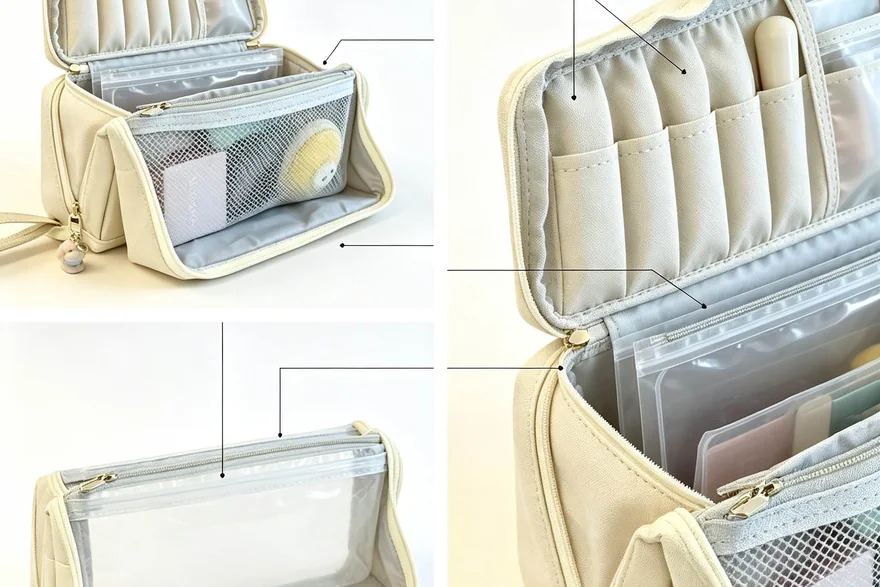
Separation is the step most briefs skip. A uniformly padded cavity still allows a glass bottle to strike a compact. A die-cut or moulded insert with cavities sized to the actual containers, holding each item with 1 to 3 mm of clearance, prevents that contact and also stops items migrating to one end of the case during transit. Clearance is a compromise: too tight and the insert crushes the foam and transmits force, too loose and the item rattles. Elastic retention straps or a lid pad hold items in place when the case is opened, and a lid pad also protects the top of tall bottles, which is otherwise the unprotected surface in most designs.
The liner fabric over the foam is a specification in its own right. Tricot is cheap and stretches over curves; 210D nylon is tougher and wipes clean; velour or suede-effect knit reads premium and protects mirrored and polished surfaces from micro-scratching, which is the dominant cosmetic defect on compacts and palettes. Stain resistance matters because makeup spills. Colour fastness of the lining should be tested alongside the outer fabric, and AATCC test methods give the buyer a common language for rubbing and laundering fastness when writing that requirement into a brief.
| Foam system | Usual thickness | Behaviour under impact | Watch-outs |
|---|---|---|---|
| EPE sheet liner | 2-5 mm | Springy, recovers quickly, light | Takes a set under long compression; coarse cell |
| EVA foam pad | 3-10 mm | Denser, higher energy absorption, clean die-cut edge | Heavier and more expensive per cubic centimetre |
| PU open-cell foam | 5-15 mm | Plush hand-feel, good surface conformity | Absorbs liquid; poor for leak-prone kits |
| Laminated foam and tricot | 3-6 mm | One-piece lining, fewer seams, fast assembly | Delamination at folds if bonding is weak |
| Die-cut cavity insert | 10-30 mm | Stops item-to-item contact, best single upgrade | Tooling per cavity layout; layout is product-specific |
Writing acceptance criteria and validating a protective case
Because shockproof has no agreed definition in this category, the buyer owns the definition. A usable acceptance clause names the load case, the conditioning, the surface, the orientation and the pass criterion. In plain terms: what is inside the case, how heavy it is, how high it is dropped, onto what, in which orientations, how many times, at what temperature, and what counts as a failure. Without those six variables a production partner can run a test, pass it, and still ship a case that breaks a customer's compact. Written this way, the criteria become comparable between quotes instead of a slogan on a hangtag.
Validation also has to cover the packed carton, not only the single unit. Corner crush and carton stacking damage more cases in transit than dropping does, because a carton compresses every case in the bottom layer for weeks. Buyers should specify carton strength, pieces per carton, internal dividers or corner protection, and a stacking height, then ask for the packed carton to be conditioned and dropped as a unit. Sampling inspection should be defined against ISO 2859-1 at AQL 2.5, with the defect list written out separately for cosmetic, functional and critical defects.
Programme timing follows the construction. Moulded EVA needs a tool, and a tool needs a drawing: cavity layout, wall thickness, corner radii, zipper channel and any moulded logo all have to be fixed before the mould is cut, which is why sampling for complex constructions runs 12 to 15 working days rather than the 6 to 10 working days typical of a soft build. Bulk production runs 35 to 50 days after sample approval. Tooling is quoted per cavity and per case size, so a buyer should decide early whether one cavity layout serves the whole set or whether each product format needs its own insert, because that choice drives tooling cost more than any other line in the brief.
Weight and volume are the costs of protection, and both are visible to the end customer. Every millimetre of shell and foam adds grams and pushes the profile outward, and a case that is heavier than the contents it protects reads as badly balanced. The discipline that keeps this in check is to weigh a finished sample rather than a design drawing, compare it against the payload it carries, and set a maximum empty weight in the brief alongside the protection clause. A case that passes a drop test but weighs more than the products inside it has solved the wrong problem.
| Spec line | What to write | Why it matters | How to verify |
|---|---|---|---|
| Shell | Material, Shore C hardness, wall thickness in mm | Sets load spreading and crush resistance | Durometer reading and calliper check on a cut sample |
| Foam | Material, density in kg/m³, thickness, recovery | Decides energy absorbed before bottoming out | Weigh a known volume; compress and measure recovery |
| Insert | Cavity drawing, clearance, retention method | Prevents item-to-item contact | Fit the actual containers and shake the closed case |
| Closure | Zipper gauge, tape width, garage, pull type | Closure fails before shell in most drops | Cycle the zipper and drop-test on the closed mouth |
| Lining | Fabric, weight, colour fastness, stain resistance | Protects polished surfaces from scuffing | AATCC rubbing fastness and a wipe test |
| Carton | Pieces per carton, board grade, dividers | Transit damage is usually stacking damage | Conditioned carton drop and a stacking check |
Put the drop height, surface, orientation, drop count, payload and pass criterion into the brief itself. A protection claim without a load case behind it cannot be compared between two quotes, and cannot be defended to a retail buyer later.
The B2B Customisation View
For buyers building a range of cosmetic bags, the specification sheet doubles as the costing sheet, which is why it is worth getting right in week one.
Programme data for this category: minimum order quantity 500 pieces per style and colourway, sampling in 6–10 working days (12–15 working days for complex constructions), bulk production 35–50 days after sample approval, final random inspection at AQL 2.5 under ISO 2859-1, FOB Xiamen, T/T 30/70.
Because the entity is a sourcing and programme-management company, the buyer deals with one accountable counterpart for specification, sampling, inspection and consolidation.
Which Brand Types Benefit Most
Protective cases suit different parts of a beauty portfolio, and the reason differs by channel. Start-up brands use a moulded EVA case as a launch-format differentiator: a glass fragrance miniature or a fragile pressed-powder palette arrives intact, which protects the review score that a young listing depends on. Established brands use protection to justify a price step, bundling a structured case into a gift set where the case itself becomes part of the perceived value. Retailers care about the reverse: a structured case reduces in-store handling damage and returns on shelf-adjacent premium sets. E-commerce sellers care most about transit, because a broken compact in a fulfilment shipment generates a return, a replacement and a negative review from a single event. Gift and hospitality buyers use protective cases for amenity and welcome kits that contain glass, where a breakage inside a guest room is a service failure rather than a product return.
- Start-up brands: one cavity layout that fits the launch product, sized for the smallest viable carton.
- Established brands: coordinated case and lining colourways across a gift set, with the case reused after the contents are finished.
- Retailers: structured cases that stand upright on a shelf and resist corner scuffing in transit.
- E-commerce sellers: insert layouts matched to the exact SKU, verified against the actual fulfilment carton.
- Gift and hospitality buyers: wipe-clean linings and neutral colourways that survive repeated housekeeping cycles.
The common planning constraint is that the insert is product-specific. A programme that covers three bottle formats needs three cavity layouts unless the brief deliberately standardises the container, and each layout is a tool. Buyers who standardise the product format before designing the case usually spend less on tooling and get a tighter fit; buyers who design the case around an existing product range should budget for more than one insert. Either way the commercial terms are the same: 500 pieces per style and colourway, sampling in 6 to 10 working days for soft builds and 12 to 15 for moulded constructions, bulk in 35 to 50 days after approval, AQL 2.5 under ISO 2859-1, FOB Xiamen, T/T 30 deposit and 70 against bill of lading.
Frequently Asked Questions
What minimum applies to a moulded EVA cosmetic case?
A moulded EVA case programme starts at 500 pieces per style and colourway, the same as any other style. The practical difference is tooling rather than quantity: a new mould has to be cut before a usable sample exists, so the drawing has to be frozen earlier. Buyers planning several sizes usually find it cheaper to share one cavity layout across sizes than to tool each one separately.
How thick should an EVA shell be for a case holding glass perfume bottles?
Most moulded cosmetic cases use 3 to 6 mm EVA, and the choice depends on bottle size and case span rather than on the word glass. A small case holding 30 ml bottles does well at 3 to 4 mm with a die-cut insert; a large case holding several 50 ml bottles needs 5 to 6 mm plus ribbing, because the unsupported panel span is longer and flexes more.
Which foam density protects pressed-powder compacts without adding bulk?
Compacts crack from point load and from contact with harder items, so separation matters more than thickness. A 3 to 5 mm EVA foam liner over a die-cut cavity that holds each compact on its own is usually more effective than doubling the liner thickness and leaving items loose. Density should be stated in kg/m³ on the spec sheet so two quotes can be compared.
Does shockproof have a recognised standard for cosmetic cases?
No single standard defines shockproof for this category. That is why the buyer has to write the load case into the brief: payload weight, drop height, surface, orientation, drop count, conditioning and a pass criterion. Once those exist, the same criteria can be applied to every quote and the claim can be substantiated to a retail buyer.
How long does sampling take for a moulded shockproof case?
Soft padded constructions sample in 6 to 10 working days. A moulded EVA case is a complex construction and samples in 12 to 15 working days, because the tool has to be cut and trialled before a finished sample can be assembled. Bulk production then runs 35 to 50 days after sample approval. Buyers should allow additional time for the first article to be checked against the protection clause before approval is given.
What zipper gauge suits a rigid clamshell cosmetic case?
#5 coil is the common default and #8 is used where the case is large or a heavier hand-feel is wanted. The gauge matters less than the setting: a zipper needs a moulded or bound channel with enough tape to stitch or weld cleanly, and a zip garage at the top of the run to protect the slider, which is usually the first part to fail in a drop.
Can a moulded EVA case be made wipe-clean inside?
Yes, by choosing the liner rather than by treating it. A 210D nylon or a PEVA wipe-clean lining handles spill better than tricot or velour, which absorb liquid and stain. The trade-off is that plush linings protect mirrored and polished surfaces better, so many programmes line the lid in velour and the base in a wipe-clean fabric.
How should a buyer verify padding performance before bulk production?
Ask for the protection clause to be written as a test protocol with named variables, then request a witnessed run or a video record of the drops on a production sample rather than a hand-made prototype. Padding behaves differently once it is bonded and assembled, and a prototype cut by hand often performs better than the first article off the line.
Will EVA foam yellow or crack over time?
EVA is stable under normal retail storage but degrades with prolonged ultraviolet exposure and with contact against certain oils and solvents, which can migrate from fragrance products into the foam. Specifying a covered lining rather than exposed foam, and asking about storage guidance for long warehouse holds, reduces both risks. Storing cases away from direct sunlight and away from strong solvents keeps both the shell and the liner stable for longer.
What lining fabric resists makeup stains best?
Smooth synthetics with a coating resist staining better than brushed fabrics because pigment sits on the surface rather than in the pile. A 210D nylon or a coated polyester wipes clean; velour and suede-effect knits feel premium but hold pigment. Many programmes use a dark lining colour in the base and a light colour in the lid for the same reason.
Can a shockproof cosmetic case be carried through airport security with liquids?
The case itself is not restricted; the liquids inside are. Under the TSA 3-1-1 liquids rule, containers in carry-on must be 100 ml or less and fit in one quart-size bag. A rigid case works well if a buyer designs a removable liquids pouch so the rest of the kit does not have to be unpacked at the checkpoint.
What inspection level applies to protective cosmetic cases?
Programmes are inspected at AQL 2.5 under ISO 2859-1, with the defect classification written separately. For a protective case the critical list usually includes laminate lifting at the corners, zipper failure and insert cavities that are out of tolerance, because those defects defeat the function rather than the appearance. Agreeing the defect list before production starts avoids arguments about classification at final inspection.
How are rigid cases packed for export to avoid corner crush?
Specify the carton, not just the case: board grade, pieces per carton, internal dividers or corner boards, and a stacking height. Corner crush in the bottom layer of a stacked carton damages more units than dropping does, because the load is applied continuously for the whole transit and storage period rather than once. A single dropped carton can damage more units than a week of normal handling, so the carton deserves the same attention as the case.
Can inserts be die-cut to fit specific bottle shapes?
Yes, and this is usually the highest-value upgrade available. The insert is drawn from the actual container, so the buyer should supply production samples rather than drawings, and should confirm the clearance in millimetres. Each distinct cavity layout is a separate tool, so standardising container formats across a range keeps tooling spend down. Confirming clearance on a production container rather than on a drawing prevents a cavity that either crushes or rattles.
Is a hard case always better than a padded bag for fragile items?
Not always. A hard shell resists point load and crushing but adds volume and weight, and if the interior is not divided the contents still strike each other. For a kit of soft tubes and palettes a well-divided padded bag can outperform an empty hard shell; for glass bottles a shell plus a divided insert is the combination that works.
People Also Ask
Are EVA cosmetic cases really shockproof?
They are shock-resistant rather than shockproof, and the difference is worth stating on the packaging. A moulded EVA shell with a foam liner and a divided insert withstands a defined drop with a defined payload; nothing in the category guarantees survival from any height. Buyers should specify a load case and use language that matches what was actually tested, which is also safer under general advertising substantiation rules.
What is the difference between EVA and EPE foam in a makeup case?
EVA foam is denser and finer-celled, die-cuts to a clean edge and absorbs more energy per unit thickness, but costs more and weighs more. EPE is lighter, springier and cheaper, recovers quickly after compression and works well as a full liner, but takes a permanent set under long-term load and has a coarser cut edge. Where the case is opened daily, EVA holds its cut edge and its shape noticeably better over a full season of use.
How do you clean the inside of a padded cosmetic case?
It depends on the lining. Coated nylon and PEVA linings wipe with a damp cloth and mild detergent; tricot and velour need spot cleaning and air drying because brushing and soaking distort the pile. Open-cell PU foam holds liquid and should never be saturated, so a wipe-clean base lining is the better choice where leaking bottles are plausible. Drying the case open, away from direct heat, prevents moisture being trapped between the liner and the foam underneath.
Do rigid cosmetic cases take up too much luggage space?
A rigid case keeps its volume whether it is full or empty, which is the real cost. Buyers should size the case to the actual contents with a small allowance rather than to a round number, keep the profile flat, and consider a moulded base with a soft lid, which gives structure where the bottles sit without fixing the whole silhouette.
Request a Sample or a Written Quotation
Send the silhouette, dimensions, material preference and logo artwork, and the programme team will return a written quotation with MOQ, sampling window, bulk lead time and inspection standard.
Email: service@junyuanbags.com · WhatsApp: +86 177 5002 0688