Scratch-Resistant Makeup Bag Exteriors: Durability Testing
Executive Summary
A scratch-resistant makeup bag exterior is an outer surface chosen and finished so that contact with keys, brush ferrules, zipper pulls and the inside of a handbag leaves no visible mark, or leaves a mark that does not break through the coating. Scratch resistance is not one property. It splits into mar resistance, which is a surface change that often disappears, and coating breach, which exposes the substrate and does not recover.
Buyers get better results by specifying the failure they care about than by asking for a scratch-proof bag. A soft PU-coated exterior marks easily and often recovers; a gloss hard shell resists light contact but shows every line and can stress-whiten at the corners. The practical tool is a named test protocol with a rub count, an adhesion grade and a hardness grade, checked on the production lot under AQL 2.5. Programmes start at 500 pieces per style and colourway, sample in 6 to 10 working days and run 35 to 50 days after sample approval.
What a scratch actually is: mar, scuff and coating breach
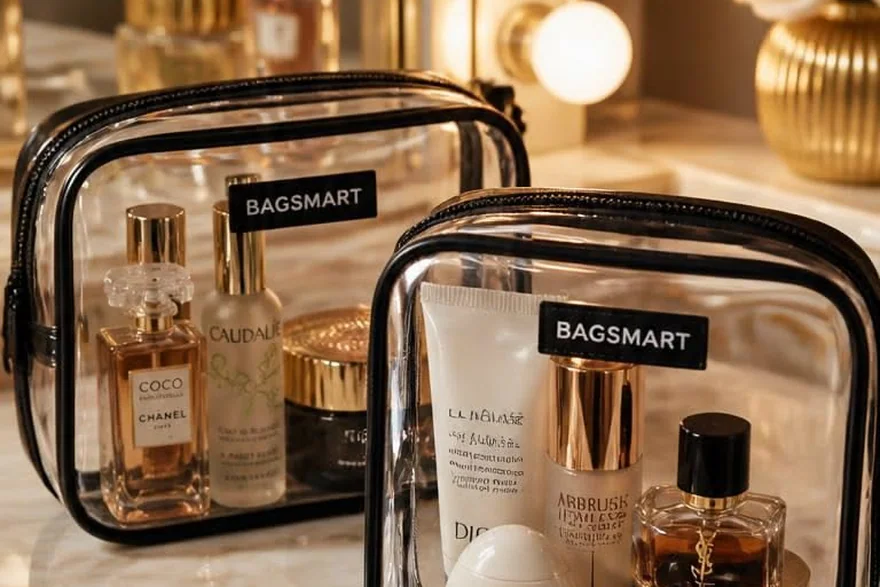
Scratch is a word buyers use for three different failures, and the distinction decides which material will survive. A mar is a surface change that does not remove material: the coating is deformed, the gloss level shifts locally, and the mark often disappears with warmth or with a thumb. A scuff removes a small amount of the surface layer and leaves a lighter or rougher patch. A breach goes through the coating to the substrate underneath, which on a laminated fabric shows as a pale line that never recovers.
A cosmetic bag meets all three in normal use. Keys and a phone share the handbag it lives in. Metal zipper pulls and brush ferrules rub the panel next to them every time the bag is opened. A structured case is set down on a tiled bathroom counter or a hotel desk, which abrades the base corners. Each of those contacts has a different geometry, and a material that survives a broad rub can still fail against a sharp corner, because point loading concentrates force in a way an abrasion test does not reproduce.
Visibility is its own variable. The same shallow mark is invisible on a matte textured weave and obvious on a gloss shell, because gloss surfaces reflect light directionally and a mar changes the direction. That is why two bags with identical measured abrasion resistance can look very different after a month. Buyers specifying a dark gloss exterior should treat surface appearance as part of the requirement and ask for a sample that has been through the rub protocol, not just a numeric result.
The durability vocabulary also overlaps with a different failure entirely: coating cracking from repeated flexing. A bag that never meets a sharp object can still fail if the coating is brittle at a fold line, and that is a flex property rather than a scratch property. Keeping the three apart, mar, breach and flex crack, is what makes a durability brief testable rather than rhetorical.
Material-by-material scratch behaviour
The exterior material sets the baseline, and the spread between materials is wider than the spread created by any finish. A coated woven fabric behaves like a coated layer sitting on a compliant textile: it can absorb a light contact by deforming, which is why many marks on PU-coated polyester disappear. A hard shell behaves like a rigid surface: it resists deformation, so light contact does nothing, but a contact that exceeds the surface strength leaves a permanent line and can crack at a stress point.
Within the soft group, the difference between a PU coating and a TPU laminate matters more than denier. Polyurethane coatings are formulated across a wide hardness range and are usually the lower-cost option, while thermoplastic polyurethane films are more elastic, recover better from a shallow scuff and cost more. Within the hard group, ABS and polycarbonate differ in the same way: one is cheaper and marks more readily, the other is tougher and carries a higher material cost and a higher tooling cost.
| Exterior material | How it marks | Typical failure mode | Relative cost tier |
|---|---|---|---|
| PU-coated polyester 600D | Fine mar along the yarn crowns; light marks often disappear with warmth | Coating cracks at a flex point after repeated creasing | Low |
| TPU-laminated fabric | Shallow scuff that partly recovers; deep gouges stay pale | Delamination at a cut edge if the film is not bound | Mid |
| Moulded EVA case | Scuffing on the skin; deep scratches expose a lighter core | Corner scuff on the base after a drop or a drag | Mid |
| ABS hard shell | Visible scratch lines, especially on a gloss finish | Stress whitening at corners and around the zip frame | Mid |
| Polycarbonate hard shell | Better resistance to light contact; still shows lines on gloss | Corner cracking after a sharp impact on a hard floor | Mid to high |
| Anodised aluminium shell | Metal contact leaves bright lines through the anodised layer | Dents rather than scratches; damage concentrates at corners | High |
| Nylon 1680D ballistic weave | Abrasion fuzzing rather than a defined scratch line | Pilling and shade change in high-contact panels | Mid |
| Silicone-coated or rubberised face | Marks readily but many marks self-heal | Dirt pick-up and edge wear at the binding | Mid |
Surface treatments shift the ranking without changing the base material. A hard coat on a polycarbonate shell improves resistance to fine marks but does not change impact behaviour, and a soft-touch coating on a moulded case reduces visible contrast at the cost of dirt pick-up. Buyers comparing two quotes should ask what surface treatment is included, because a treated mid-tier shell can outperform an untreated premium one against fine contact while still losing on corner impact. The table above describes base materials; a finish moves each row by a small amount in one direction or the other. Reading that table against a price band is the practical step. Published unit prices for cosmetic and toiletry bags run from roughly 0.45 to 12.00 dollars, and the material tiers above map onto it: coated polyester occupies the lower half, TPU-laminated and moulded EVA sit in the middle, and hard shells in polycarbonate or aluminium occupy the upper band. A buyer who wants a premium-looking exterior at a mid-band price usually lands on a matte TPU laminate, because the matte texture hides the mar that a gloss shell would show.
The durability tests a buyer can name in a brief
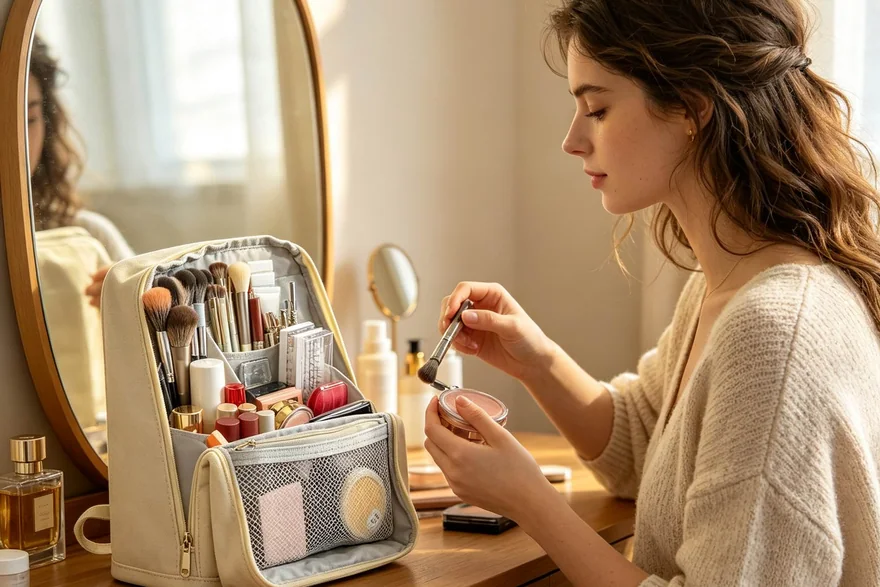
A durability requirement becomes real when it names a method, a level and a pass mark. The methods below are the ones a bag programme will meet most often; none of them is exotic, and none requires a buyer to own equipment, because all are run by third-party laboratories against published procedures. What the buyer has to do is state the level before the sample is built, since a result without a level cannot be judged.
- Abrasion resistance by a rub method: a fabric sample is rubbed against a standard abradant under a fixed load and the surface is assessed at a stated rub count. This is the headline number for a soft exterior.
- Coating adhesion by a cross-cut grid: a lattice is cut through the coating and tape is applied and removed, then the amount of coating lifted is graded. This is the test that predicts whether a scuff will spread.
- Surface hardness by a graded pencil set: pencil leads of increasing hardness are drawn across a rigid shell and the hardest grade that does not cut the surface is recorded. Used for hard shells and moulded cases.
- Colour transfer by a rubbing fastness method: a white cloth is rubbed against the surface dry and wet, and the transfer is graded. Catches a coating that is under-cured and still shedding pigment.
- Flex resistance by repeated folding: a coated sample is folded a stated number of times and inspected for cracking. Catches brittle coatings that would otherwise pass an abrasion test.
- Handling test by drop and drag: a finished bag is dropped from a stated height onto a stated surface in a stated number of orientations, and dragged a stated distance. Closer to real damage than any laboratory method.
Two of these need a published reference. Coated fabrics are assessed as a system rather than as a textile, and the standard a buyer will see quoted is ASTM D751, which covers the coated layer including adhesion and strength properties. The abrasion and rubbing procedures come from the AATCC test methods catalogue, and the report should name the specific method and the level used, because a result quoted without a rub count or an abradant type cannot be compared with a competitor quote.
Turnaround is the practical scheduling factor rather than cost. A laboratory result arrives after the sample has been built, so the level has to be stated in the brief instead of being decided later; a buyer who waits for the sample and then asks whether it is good enough has no benchmark to judge against. Stating a rub count, an adhesion grade and a hardness grade costs nothing at quotation stage and makes two quotes directly comparable, which is the whole point of writing a protocol. The handling test is worth including even though it produces no grade. Drop and drag on a finished sample reproduces the corner damage and base scuffing that generate most returns, and it is the only check that involves the assembled bag with its hardware in place. A protocol that states the height, the surface, the number of orientations and the drag distance can be repeated on a later lot, which is what makes it useful rather than theatrical.
Writing an acceptance protocol and inspecting against it
A test on a lab sample and an inspection on a shipment answer different questions. The laboratory result qualifies the material and the construction; the inspection confirms that the lot was built from that material and assembled without adding damage. Both belong in a programme file, and they should be tied together by a lot reference so that a result can be traced to the goods it describes.
The inspection side runs on a sampling plan rather than on a test method. Cosmetic bag programmes are normally inspected to AQL 2.5 under ISO 2859-1, which sets the sample size against the lot size and the number of defects that can be accepted. What the buyer has to supply is the defect dictionary: which marks count as defects, how they are classified, and which ones are unacceptable at any level. A scuff on a base corner and a scratch across a printed logo are not the same defect.
| Test or check | What it measures | How to set a pass mark | When it is run |
|---|---|---|---|
| Face fabric abrasion | Surface change after a stated number of rubs | Set the rub count and require no coating breach at that count | On the lab dip, then again on the bulk lot |
| Coating adhesion | Whether the coating stays bonded under a cross-cut grid | State the maximum permitted removal within the grid | On each coated fabric lot |
| Shell surface hardness | Resistance of a rigid shell to a graded point | State the minimum hardness grade for the shell material | On shell material before tooling |
| Colour transfer | Whether pigment rubs off or picks up | State dry and wet grades for both directions | On the production colourway |
| Flex resistance | Whether a coating cracks at a fold | State the number of folds and the permitted crack length | On the coated fabric, before cutting |
| Visual inspection at goods-in | Scuffs, cuts and coating breaks on finished bags | Define each defect and its class under the AQL plan | At final inspection before shipment |
A retained sample closes the loop. Keeping one approved bag from the bulk lot, stored away from light and handling, gives a physical reference for any later question about surface damage, and it should carry the same lot reference that appears on the inspection report. On a reorder, comparing the new lot against the retained sample is faster than reopening the laboratory file, and it catches the gradual drift in coating formulation that no single test would flag. The last piece is packaging, because a bag that survives its own material can still arrive damaged. Corner protectors, individual polybags and a carton that does not allow movement all reduce the transit damage that inspection cannot catch afterwards. Buyers should state the packing method on the brief and ask for the carton drop behaviour to be checked on the first shipment, since a programme that passes every laboratory test and arrives scuffed has failed the only test the customer sees.
Name the method and the level, for example an abrasion result at a stated rub count with no coating breach. Name the defect dictionary for inspection. Name the packing method. A brief with those three lines can be quoted, tested and inspected without argument.
The B2B Customisation View
The commercial logic behind makeup bags and toiletry bags is simple to state and hard to execute: hold the unit cost, hold the colour, hold the delivery window.
Commercial parameters stay fixed across the range: MOQ 500 pieces per style and colourway, prototype turnaround 6–10 working days (extended to 12–15 for multi-panel or moulded builds), bulk lead time 35–50 days from approved sample, AQL 2.5 inspection to ISO 2859-1, FOB Xiamen, T/T 30 deposit and 70 against bill of lading.
For makeup bags and toiletry bags, that coordination matters most in the two weeks between packing and vessel loading, when documentation errors cost more than any material decision.
Which Brand Types Benefit Most
Scratch resistance matters most to the buyer types whose product is handled before it is sold. Established brands with a premium vanity case or a brush roll care most, because a marked exterior on a high-price item reads as a quality failure and the return cost is carried by the brand. Retailers and private-label buyers specify it where product is displayed open and handled on shelf, since the display unit itself generates the marks. E-commerce sellers meet the issue from the other direction: damage in transit and a marked exterior both show up in reviews within days of delivery.
- Start-up brands: pick a matte mid-tier exterior, since texture hides the marks that a gloss shell would show at the same measured resistance.
- Established brands: invest in hard-shell tooling only where volume justifies it, and specify a hardness grade plus a corner drop protocol.
- Retailers: prioritise abrasion and colour transfer, because shelf handling and customer handling are the two dominant damage sources.
- E-commerce sellers: prioritise packing and transit testing, since much of the damage reported in reviews happens before the bag is opened.
- Gift and hospitality buyers: lower priority for scratch, higher for scuff resistance during storage and handling in bulk.
The shared mistake is specifying the material and skipping the level. A brief that says durable exterior cannot be quoted, tested or inspected, while one that states a rub count, an adhesion grade and a defect dictionary can. Standard constructions sample in 6 to 10 working days and hard-shell or moulded constructions in 12 to 15, with bulk production running 35 to 50 days after sample approval. Shipment is FOB Xiamen with payment by T/T, 30 percent deposit and 70 percent against the bill of lading, and inspection to AQL 2.5 under ISO 2859-1. Buyers repeating a programme should keep a retained sample from the approved lot, since it is the fastest way to compare a new lot against an old one.
Frequently Asked Questions
What counts as a scratch on a makeup bag exterior?
Three different failures share the word. A mar is a surface change that does not remove material and often disappears with warmth. A scuff removes part of the surface layer and leaves a lighter patch. A breach goes through the coating to the substrate and never recovers. Deciding which one matters is the first step in choosing a material and a test level.
Which exterior materials resist scratching best?
It depends on the contact. Against light contact, rigid shells in polycarbonate or aluminium resist better than coated fabric, because they do not deform. Against a sharp point or a corner impact, an elastic TPU laminate often survives better because it absorbs the load. Against broad rubbing, a dense woven nylon fuzzes gradually rather than showing a line.
Is a hard shell always more scratch-resistant than a soft bag?
No. A hard shell resists light contact well but shows every mark on a gloss finish, and it can crack or stress-whiten at a corner where a soft bag would simply absorb the load. A soft matte exterior marks more often but hides the marks it gets. Which is better depends on whether the buyer cares more about marks appearing or marks being visible.
How is scratch resistance actually measured on bag fabric?
Usually through an abrasion method: a sample is rubbed against a standard abradant under a fixed load and assessed at a stated rub count. Rigid shells are instead assessed with a graded hardness method, and coated fabrics with a cross-cut adhesion grid. A report should name the method and the level, because a result without a rub count cannot be compared.
What is the difference between abrasion resistance and scratch resistance?
Abrasion is repeated broad rubbing, which produces gradual surface change such as fuzzing, pilling or gloss loss. Scratch is a single concentrated contact, which produces a defined mark or a cut. A material can perform well against one and poorly against the other, which is why a durability protocol usually includes an abrasion method and a separate handling test.
How does a gloss finish change how scratches look?
Gloss surfaces reflect light in one direction, so a shallow mar changes the reflection and becomes highly visible even though no material was removed. Matte and textured surfaces scatter light, so the same mark is much harder to see. This is why a matte TPU laminate can look better after a month than a gloss shell with higher measured resistance.
Can a scratched PU-coated exterior be repaired?
A mar often recovers on its own with gentle warmth, because the coating deforms rather than breaks. A scuff that removed material does not recover, and a breach that reached the substrate cannot be repaired invisibly. That is the practical argument for specifying a breach criterion rather than a general appearance criterion in the durability brief.
What is cross-cut adhesion testing and why does it matter for a coated bag?
A lattice is cut through the coating to the substrate, tape is applied and pulled away, and the amount of coating removed is graded against a scale. It predicts whether a small scuff will stay small or spread along the coating, which is a common failure on a coated fabric that has been under-cured. It belongs on every coated fabric lot.
How many abrasion rubs should a cosmetic bag fabric survive?
There is no universal figure; the level should be set against how the bag will be used. A pouch that lives inside a handbag meets constant broad contact, while a vanity case that sits on a counter meets very little. The practical approach is to state a rub count with no coating breach as the pass mark, then compare quotes against the same level.
Does hardware cause most of the scratches on a bag exterior?
Hardware causes a predictable share of them. Metal zipper pulls, magnetic closures and exposed feet rub the panel next to them every time the bag is opened or set down, and a sharp corner on a pull concentrates force. Specifying a covered zip garage, a bound pull and recessed feet removes a large part of the problem at low cost.
How is scratch damage classified during final inspection?
Through a defect dictionary agreed before production: which marks are defects, how they are classified, and which are unacceptable at any level. A scuff on a base corner and a scratch across a printed logo are not the same defect even though both are scratches. Without the dictionary, an inspector has no basis for a consistent decision.
What sampling plan is used for inspecting cosmetic bag exteriors?
Programmes are normally inspected to AQL 2.5 under ISO 2859-1, which sets the sample size against the lot size and the number of acceptable defects within that sample. The buyer supplies the defect definitions and the classification. The result is a lot-level accept or reject decision, not a measurement of every bag in the shipment.
Does a scratch-resistant claim need test evidence?
Yes, if it appears on a listing or on packaging. The wording has to be substantiated in the market of sale and stay inside the tested scope: a result on one exterior material does not support a claim about another, and a laboratory abrasion result does not support a statement about everyday use. Name the method and the level in the claim file.
How does a moulded EVA case behave under durability testing?
The skin scuffs readily and a deep scratch exposes a lighter core, so the visible failure is contrast rather than damage depth. The more useful checks for EVA are a corner drop protocol and a drag test, because EVA cases usually fail at the base corners rather than on the flat panels. Sampling for that construction runs 12 to 15 working days.
What minimum applies to a hard-shell case in a custom shell colour?
The standing minimum is 500 pieces per style and colourway, and a custom shell colour can carry an additional material minimum because the shell material is compounded or masterbatched in a lot. Tooling for a new shell shape is a separate cost agreed before sampling. Complex constructions of this kind sample in 12 to 15 working days, and bulk runs 35 to 50 days.
People Also Ask
Are hard shell makeup bags more durable?
They resist light contact and crushing better than a soft bag, which is why they protect contents well, but they show marks more clearly on a gloss surface and can crack at a corner where a soft bag would absorb the impact. Soft matte exteriors mark more often and hide it better. The choice depends on whether the buyer cares about marks appearing or being visible.
How do you remove scratches from a PU bag?
Start by identifying which failure it is. A surface mar often disappears with gentle warmth from the hand or a soft cloth, because the coating was deformed rather than removed. A scuff that took material off, or a scratch that reached the substrate, will not come out. Avoid solvents, which attack the coating and make the area worse. Prevention is cheaper: a covered zip garage and a bound pull remove many of the contacts that cause marks.
What is a Martindale rub test?
A laboratory abrasion method in which a fabric sample is rubbed against a standard abradant under a fixed load in a defined path, and the surface is assessed at a stated number of rubs. It is widely used to compare coated fabrics for bags and upholstery. The result is only comparable between quotes when the rub count and the abradant are the same.
What fabric is most scratch-resistant for a bag?
Against broad rubbing, a dense woven nylon such as a ballistic construction performs well because it fuzzes gradually rather than showing a defined line. Against a sharp point, an elastic TPU laminate often survives better because it absorbs the load and recovers. Against light contact, a rigid shell wins. No single material leads on all three. Choose by the contact the bag will meet most often, then specify a rub count so quotes can be compared.
Request a Sample or a Written Quotation
Send the silhouette, dimensions, material preference and logo artwork, and the programme team will return a written quotation with MOQ, sampling window, bulk lead time and inspection standard.
Email: service@junyuanbags.com · WhatsApp: +86 177 5002 0688