Expandable Cosmetic Bags: Zipper Gusset & Capacity Flexibility
Executive Summary
Expandable cosmetic bags gain capacity from a zippered gusset: a second, usually concealed zipper run that releases a folded panel of fabric around the base or side of the bag. Closed, the panel folds inward and the bag packs like a flat pouch; opened, the same panel becomes wall and the usable volume rises substantially. The mechanism is cheap, but it has to be designed as a system, because the zipper, the panel fabric, the seam allowance and the lining all have to move together.
For a brand owner the decision is where the expansion sits and what it costs. A base gusset adds height, a side gusset adds width, and a bellows gusset adds both at the expense of a more complex panel. Each choice changes the packed silhouette, the amount of fabric in the pattern and the zipper length. Programmes start at 500 pieces per style and colourway, sample in 6 to 10 working days, or 12 to 15 for complex constructions, and ship 35 to 50 days after sample approval at AQL 2.5 under ISO 2859-1, FOB Xiamen, T/T 30 deposit and 70 against bill of lading.
Why capacity flexibility sells in the cosmetic bag category
A cosmetic bag has an awkward brief: it has to hold a small everyday set on a Tuesday and a full travel set on a Friday, and the owner does not want two bags. An expandable build answers that by letting one product occupy two volumes. The buyer-facing promise is easy to state on a product page and easy to demonstrate in a photograph, which is why the format appears across hanging toiletry kits, flat makeup pouches and weekender vanity cases at every price point.
Demand data supports the format. 'travel bag for toiletries' draws roughly 110,000 monthly searches and 'toiletry bag' around 74,810 weekly searches on Amazon, and both audiences are looking for the same thing: a bag that swallows a full wash set without becoming a rigid box in the suitcase. 'custom makeup bag' draws 5,400 to 6,600 monthly searches, which is smaller but commercially sharper because those searchers are specifying rather than browsing. A flexible-capacity construction speaks directly to that specifying audience.
Two words in the category are used loosely and are worth separating. Expandable means the bag changes volume through a zippered panel. Structured means the bag holds its shape through stiffening, interfacing or a frame. A structured bag can stay the same volume forever, and an unstructured expandable bag can grow and then slump. The most useful products combine a degree of structure with genuine expansion, which is why buyers should treat the two attributes as separate specification lines rather than as one adjective on a product page.
There is a commercial reason too. One expandable SKU can be merchandised against two use cases, which lets a range cover more shelf positions with fewer moulds and fewer patterns. On marketplaces, published cosmetic bag pricing spans roughly $0.45 to $12.00 per unit, and an expansion gusset typically moves a product one step up that band because of the added zipper, the extra panel fabric and the additional labour. The return is a higher average selling price rather than a lower unit cost, so the format suits brands that compete on features rather than on price alone.
Gusset geometry: where the extra volume actually comes from
An expansion gusset is a folded strip of fabric held closed by a zipper. When the zipper is closed the strip folds into the interior and the bag takes its compact shape; when the zipper is opened the strip unfolds and becomes a band of wall, increasing one dimension of the bag. The released dimension is decided by where the strip sits. A strip around the base increases height. A strip down each side increases width. A strip that wraps the full perimeter with corner inserts increases both, and is the most complex to cut and sew.
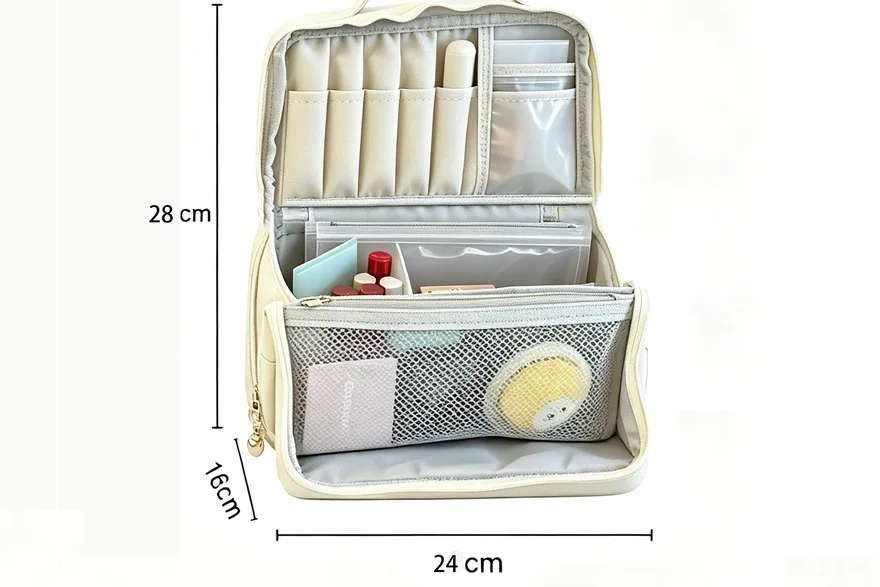
Depth of the released strip sets how much volume is gained, and it is the single number most briefs leave out. A 4 cm released band on a 24 cm by 16 cm footprint changes the packed profile meaningfully without making the bag look like a different product; an 8 cm band on the same footprint produces a bag that is visibly taller when open and noticeably slacker when closed, because the folded fabric has to sit somewhere. The folded panel occupies interior space even when the bag is compressed, which means an over-deep gusset steals usable capacity in the compact mode.
Corner treatment decides whether the open bag holds a shape or slumps. A gusset with no corner structure produces rounded, collapsing corners that look unfinished in a product photograph and let contents roll into the corners where they are hard to find. Bound corners, taped corners or a small triangular insert at each corner hold the geometry. The trade-off is labour: corner inserts add operations, and operations are the largest variable cost in a sewn bag after fabric.
Fabric choice interacts with the fold. A stiff, heavily coated fabric holds the fold line crisply but resists collapsing flat, so the compact mode is bulkier. A soft, light fabric collapses beautifully but lets the gusset wrinkle and sag when the bag is open and loaded. Most programmes land in the middle with a 300D to 600D polyester or a PU-coated fabric in a weight that folds without cracking. Coated fabric performance is covered by ASTM D751, which is the sensible reference when a brief has to state coating adhesion and tear strength for a panel that will be folded repeatedly.
The lining is the part that decides whether the mechanism feels considered. A panel that folds inward needs lining fabric with enough give to fold with it, and enough seam allowance that the lining does not pull the outer zipper out of line when the bag is expanded. A lining cut to the compact dimensions will tear at the corners the first time the bag is opened; a lining cut to the expanded dimensions will bunch and wrinkle in compact mode. The correct pattern is a lining cut to the expanded state with a controlled fold, which is one more reason the pattern has to be sampled in both configurations.
| Gusset type | Dimension released | Compact-mode penalty | Best placement |
|---|---|---|---|
| Base gusset | Height | Folded panel sits under the lining, small | Flat pouches and dopp kits |
| Side gusset pair | Width | Two folds to absorb, moderate | Tall vanity cases |
| Perimeter bellows | Height and width | Folded fabric on all four sides, larger | Weekender and hanging kits |
| Drop-bottom panel | Depth below a rigid divider | Almost none; panel zips to a base compartment | Kits with a separate brush or tool layer |
| Internal expansion pleat | Interior depth only | None externally | Bags where the silhouette must stay fixed |
Zipper specification for an expansion panel
The expansion zipper is the most heavily worked component in the bag and the most common warranty failure. It runs around a curve, it is loaded in tension by the panel fabric pulling against it, and it is operated far more often than a main closure because the owner changes configuration rather than just opening the bag. Specifying it properly means naming gauge, tape, slider, pull, direction and end treatment, and ASTM D2053 provides the standard zipper terminology that lets a buyer and a sewing floor describe the same part without ambiguity.
Gauge follows load. #3 coil is light and flexible, fine for a small pouch where the panel is short and lightly loaded, but it stretches around a tight corner and the slider can jump the track under tension. #5 coil is the dependable default for an expansion run on a mid-size bag. #8 or a moulded-tooth chain is used on large hanging kits where the panel carries the weight of a full load. The tape matters as much as the chain: a wider tape distributes the stitch line and resists tearing out of the panel fabric, which is the failure seen when a bag is overfilled and the expansion is forced open.
Two details separate a working expansion from a fragile one. The first is the slider arrangement: a single slider on a perimeter run means the owner has to walk it halfway round the bag, while two sliders meeting in the middle make the panel easy to open from either side and reduce the twisting that derails a single slider on a curve. The second is the end treatment: an open-ended expansion run needs a proper bottom stop and a box, and a closed run needs a bound end that does not create a gap where the lining can catch. A zip garage at the meeting point keeps the sliders off the floor of a suitcase.
Water resistance is the optional upgrade that most often causes problems. A coated or water-resistant zipper on a flat panel behaves well, but the same zipper running around a corner tends to crease and the coating cracks along the crease. If the bag must resist leaks, the better construction is a welded or coated lining behind a standard coil zipper rather than relying on the zipper itself. Where a brand wants a water-resistant chain, the panel should be sampled around the tightest corner in the pattern and cycled before the specification is frozen.
The pull and the chain direction are small details with outsized effect on perceived quality. A reverse coil chain, worn with the teeth facing inward and the tape on the outside, hides the metal and gives a cleaner panel, but it needs a slider rated for that chain and it is less forgiving of a tight radius. Pulls should be specified by type as well as by finish: a moulded pull with a cord, a cast metal pull, or a flat webbing tab, because a pull that swings freely against a suitcase lining abrades both. Branding on the pull is cheap and is one of the few places a logo survives repeated laundering.
- Name gauge, tape width, slider count, pull type and end treatment; zipper spec is never just a gauge number.
- #5 coil is the dependable default for a mid-size expansion run; go up a gauge on large hanging kits.
- Two sliders meeting at the centre stop the twisting that derails a single slider on a curved run.
- For leak resistance, line behind a standard coil rather than trusting a coated chain around a corner.
- Cycle-test the expansion zipper on a production sample, not on a hand-cut prototype.
Capacity maths, cost drivers and programme planning
Capacity claims should be calculated, not estimated. For a roughly rectangular bag, usable volume is the product of the three internal dimensions, expressed in litres by dividing cubic centimetres by 1,000, and then reduced by a realistic fill factor because a bag is never filled to a perfect cuboid. A pouch measuring 24 by 16 by 9 cm internally has a nominal 3.5 litres and a usable volume nearer 2.8 litres once the corners, the fold of the gusset and the zipper run are discounted. Stating both figures in a brief keeps a retail claim defensible and stops the design team arguing from different numbers.
Cost in an expandable bag is dominated by four items: the second zipper, the extra panel fabric, the corner treatment and the added labour. The zipper is usually the largest single addition because the chain is bought by length and the run is long. The panel fabric adds a modest amount. Labour is the sleeper: a perimeter bellows with corner inserts can add several operations per unit, and at the volumes typical of a launch programme those operations cost more than the fabric they attach. Buyers comparing quotes should ask for the cost split so the trade-offs are visible rather than buried in a unit price.
Programme parameters are fixed. Minimum order quantity is 500 pieces per style and colourway, which for an expandable bag applies to the whole construction rather than to each configuration. Sampling runs 6 to 10 working days for a standard expandable pouch and 12 to 15 working days for complex constructions such as a perimeter bellows with corner inserts or a drop-bottom with a rigid divider. Bulk production is 35 to 50 days after sample approval, inspected at AQL 2.5 under ISO 2859-1, shipped FOB Xiamen on T/T 30 deposit and 70 against bill of lading.
Packing efficiency is the quiet argument for the format. A bag that ships and shelves in its compact mode takes less carton volume than an equivalent rigid case, which lowers freight per unit and lets more units sit on a shelf facing. Buyers should ask for both the compact and the expanded carton quantity, because the difference is usually the difference between a profitable and a marginal landed cost on a bulky range. Carton planning should be fixed at the same time as the pattern, not after the sample is approved.
| Configuration | Nominal volume | Usable volume | Relative unit cost | Complexity |
|---|---|---|---|---|
| Flat pouch, no gusset | 1.4 L | 1.1 L | Base | Low |
| Base gusset, 4 cm release | 2.6 L | 2.1 L | Base plus zipper and panel | Low to medium |
| Base gusset, 7 cm release | 3.5 L | 2.8 L | Base plus longer zipper run | Medium |
| Perimeter bellows | 4.2 L | 3.3 L | Highest; corner inserts add labour | High |
| Drop-bottom compartment | 2.2 L plus 1.3 L | 1.8 L plus 1.0 L | Divider and second chamber | High |
A gusset that is too deep steals capacity when the bag is closed, because the folded panel occupies interior space. Set a maximum folded bulk in the brief alongside the expanded volume, or the compact mode will disappoint the customer who bought the bag for everyday use.
The B2B Customisation View
A sourcing brief for makeup bags and toiletry bags should name the test standard before it names the fabric, because the standard decides which fabrics remain on the table.
Budgeting and scheduling inputs: MOQ 500 per style and colourway; sampling 6–10 working days, extended to 12–15 for lined, moulded or hardware-heavy builds; bulk 35–50 days; pre-shipment inspection at AQL 2.5 per ISO 2859-1; FOB Xiamen; T/T 30/70.
QUANZHOU JUNYUAN BAGS sits between the brand and the production floor precisely so that the brand never has to choose between cost control and inspection discipline.
Which Brand Types Benefit Most
Expandable constructions suit different commercial positions. Start-up brands use one expandable SKU to cover two merchandising slots, which stretches a launch budget further than buying two separate patterns. Established brands use expansion to differentiate within a range: the standard pouch, the same pouch with a gusset, and the hanging kit with a bellows form a ladder that lets a customer trade up without leaving the brand. Retailers care about the photograph, because a bag that visibly changes shape demonstrates a feature in one image on a crowded shelf. E-commerce sellers value expansion for a different reason: a single listing can answer both the everyday and the travel search intent, which concentrates reviews on one ASIN instead of splitting them. Gift and hospitality buyers use expandable bags for amenity kits where the contents vary by room type, because one bag fits a standard set and an extended set.
- Start-up brands: one pattern, two volumes, two product pages.
- Established brands: a capacity ladder that gives customers a reason to trade up.
- Retailers: a demonstrable feature that reads in a single shelf photograph.
- E-commerce sellers: one listing serving everyday and travel intent, concentrating review volume.
- Gift and hospitality buyers: one bag covering variable amenity sets across room categories.
The decision that matters most is how many configurations a range needs. An expandable bag is more expensive per unit than the flat bag it replaces, so it earns its place either by replacing a second SKU or by supporting a higher retail price. Buyers who add a gusset to every bag in a range usually find that the cost increase is visible in the margin long before the benefit is visible in the sell-through. Commercial terms do not change with configuration: 500 pieces per style and colourway, 6 to 10 working days for sampling and 12 to 15 for complex constructions, 35 to 50 days to bulk, AQL 2.5 under ISO 2859-1, FOB Xiamen, T/T 30 deposit and 70 against bill of lading.
Frequently Asked Questions
What minimum order quantity applies to an expandable cosmetic bag?
The minimum is 500 pieces per style and colourway, applied to the construction as a whole rather than to each configuration. A bag that can be used closed or expanded is one style. If a buyer wants the same pattern in a second colourway, that second colourway is a separate 500-piece commitment because the fabric and zipper tape have to be dyed or sourced separately.
How much capacity does a 4 cm expansion gusset actually add?
It depends on the footprint, because the released dimension multiplies against the base area. On a 24 by 16 cm pouch a 4 cm release takes nominal volume from about 1.4 litres to about 2.6 litres, with usable volume rising from roughly 1.1 to 2.1 litres after the corners and the folded panel are discounted. Buyers should calculate both figures rather than quoting the nominal one.
Which zipper gauge should an expansion gusset use?
#5 coil is the dependable default for a mid-size bag because it handles the tension from the panel fabric without stretching around a corner. #3 coil suits a small, lightly loaded pouch, and #8 or a moulded-tooth chain suits a large hanging kit where the panel carries the weight of a full load. Tape width should be specified alongside gauge.
Does an expansion zipper make a cosmetic bag leak-resistant?
Not by itself. A standard coil zipper leaks at the teeth and the tape, and a coated chain tends to crack where it creases around a corner. If leak resistance is required, the reliable construction is a welded or coated lining behind a standard coil zipper, with the lining seams sealed independently of the closure.
Should an expansion run use one slider or two?
Two sliders meeting at the centre are usually better on a perimeter run. They let the owner open the panel from either side, they halve the travel distance, and they reduce the twisting that derails a single slider when the chain goes around a curve. A zip garage at the meeting point keeps both sliders away from the suitcase floor.
How long does sampling take for an expandable bag?
A standard expandable pouch samples in 6 to 10 working days. Constructions with corner inserts, a rigid divider or a drop-bottom compartment count as complex and sample in 12 to 15 working days. Bulk production then runs 35 to 50 days after the sample has been approved by the brand owner. Approving the sample in both the closed and the expanded state during that window avoids a second sampling round later.
Where should the expansion sit: base, side or perimeter?
A base gusset adds height and suits a flat pouch or a dopp kit. Side gussets add width and suit a tall vanity case. A perimeter bellows adds both and produces the largest volume change, at the cost of more fabric, more labour and a bulkier compact mode. The choice is really about which dimension the packed bag can afford to grow.
What stops an expanded bag from slumping at the corners?
Corner structure. A gusset with no corner treatment collapses into rounded corners that look unfinished and let contents roll out of reach. Bound corners, taped corners or small triangular inserts hold the geometry, and the cost is labour rather than material, which is why the cheapest expandable bags are also the ones that sag. A structured corner also keeps the expanded silhouette square, which matters more in a product photograph than on a bench.
Can an expandable bag still be carried as cabin luggage with liquids?
Yes, the bag is not restricted, but the liquids inside are. Containers in carry-on must be 100 ml or less and fit in one quart-size bag under the TSA 3-1-1 liquids rule. A removable liquids pouch inside an expandable kit saves the owner from unpacking the whole bag at the checkpoint. Designing that pouch as a removable module keeps the rest of the kit closed and organised through the checkpoint.
How is capacity verified before a claim goes on the packaging?
By measuring the internal dimensions of a finished sample and applying a stated fill factor, not by filling the bag with a graduated jug of water, which overstates what a customer can pack. The brief should fix the internal dimensions, the fill factor and the resulting litre figure so the retail claim and the spec sheet agree.
What inspection standard covers expandable bags?
Inspection runs at AQL 2.5 under ISO 2859-1, with a written defect classification. For an expandable build the critical list normally includes zipper derailment, tape tearing out of the panel, corner inserts that are mis-set, and an expansion that does not close flat, because those defeat the feature the customer paid for. Agreeing the classification in writing before bulk starts prevents disputes about whether a fault is cosmetic or functional.
Does a deeper gusset always mean a better bag?
No. A deeper gusset produces a taller open bag but also a bulkier closed bag, because the folded panel has to sit inside the shell. Beyond roughly 6 to 7 cm of release on a mid-size pouch, the compact mode starts to feel slack and the extra fabric wrinkles. Depth should be matched to the contents, not maximised.
Can a hanging toiletry kit have an expansion gusset?
Yes, and it works well because the hook carries the load while the gusset adds depth. The check is whether the expanded bag still hangs flat against a door: if the released panel pushes the centre of gravity away from the wall, the kit tips forward and the contents slide. A base gusset usually behaves better than a perimeter bellows on a hanging kit.
What fabric weight suits a panel that folds repeatedly?
A mid-weight coated polyester in the 300D to 600D range is the usual answer. Heavy coated fabric holds a crisp fold line but resists collapsing flat, and very light fabric collapses well but sags when loaded. Whatever is chosen, coating durability on a folding panel should be referenced to a coated-fabric test method rather than assumed.
How much does an expansion gusset add to unit cost?
The increase comes from four items: the second zipper, the extra panel fabric, the corner treatment and the added labour. The zipper is usually the largest single addition because the run is long and chain is bought by length. Buyers should ask for the split so the trade-offs are visible rather than hidden inside a single unit price.
People Also Ask
What is an expandable cosmetic bag?
It is a bag with a second, usually concealed zipper that releases a folded fabric panel around the base or side. Closed, the panel folds inward and the bag behaves like a flat pouch; opened, the panel becomes wall and the usable volume rises. The feature lets one product serve an everyday set and a travel set without the owner buying two bags.
How do you measure the capacity of a cosmetic bag?
Multiply the three internal dimensions to get cubic centimetres, divide by 1,000 for litres, then apply a fill factor for corners, seams and the folded gusset. A pouch with 24 by 16 by 9 cm internals is nominally 3.5 litres and realistically about 2.8 litres usable. Measuring a finished sample is more reliable than measuring a pattern. Repeating the measurement on three finished samples gives a figure that survives contact with a retail buyer.
Is a zippered gusset durable enough for daily use?
It is, if the zipper is specified properly. The expansion run is worked harder than a main closure because it goes around a curve and carries panel tension, so gauge, tape width, slider count and end treatment all matter. #5 coil with two sliders and a bound end is a durable default for a mid-size bag. Cycling the expansion on a production sample before approval is the cheapest way to confirm that durability.
Can an expandable makeup bag replace two different sizes?
Often yes for the owner, and that is the main argument for the format. Commercially the calculation is different: the expandable unit costs more than the flat bag it replaces, so it pays for itself either by removing a second SKU from the range or by supporting a higher retail price on one listing. Ranges that already sell two sizes well may find that one expandable unit dilutes rather than concentrates demand.
Request a Sample or a Written Quotation
Send the silhouette, dimensions, material preference and logo artwork, and the programme team will return a written quotation with MOQ, sampling window, bulk lead time and inspection standard.
Email: service@junyuanbags.com · WhatsApp: +86 177 5002 0688