Makeup Bags for Mothers: Baby Bag Integration & Family Travel
Executive Summary
Makeup bags for mothers work best as removable personal-care modules that fit inside a shared baby bag or family travel bag without mixing adult cosmetics with feeding, changing or children's items. The most useful format has an obvious identity, one-handed retrieval, a wipe-clean interior and enough structure to protect pumps and compacts. A slim 22 × 14 × 7 cm module fits everyday baby-bag organisation, while a 26 × 17 × 9 cm version supports longer outings or family travel. The design should acknowledge that care is shared: attachment points, labels and opening logic need to work for any parent or caregiver.
Integration is more important than decorative pocket count. A short tether or colour-coded handle helps the module surface quickly; a top opening avoids emptying the whole bag; and a contained liquid pocket keeps personal-care spills away from nappies, snacks, documents and clothing. Closures should resist accidental opening but not demand high force or two-handed alignment. Product copy should not imply that a cosmetic pouch is childproof. Instead, the brief can specify secure zipper storage, small-part controls and adult placement within the larger bag, while keeping cosmetics and toiletries out of children's reach.
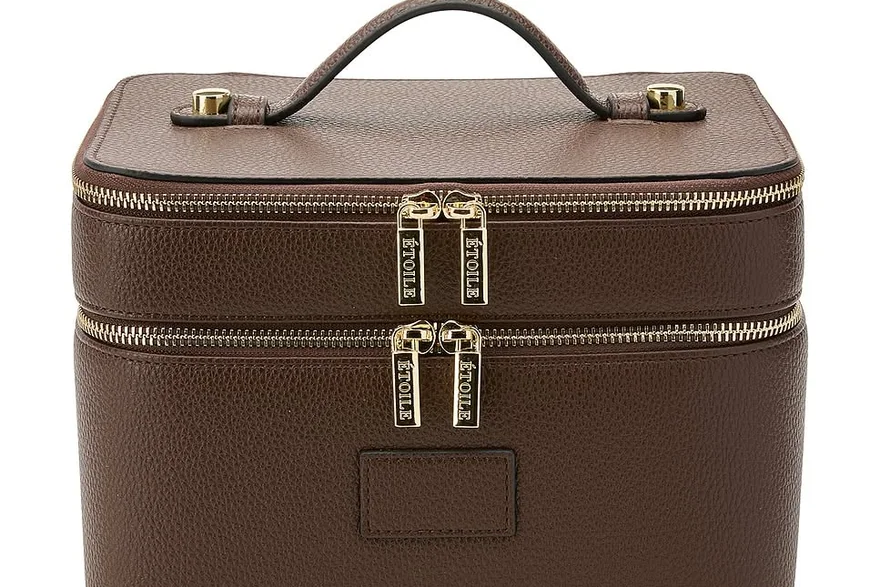
A personal-care module protects clarity inside a shared family bag
A baby bag or family carryall combines unrelated categories: changing supplies, spare clothing, snacks, documents, comfort items, charging cables and adult personal care. A makeup bag adds value when it acts as a clearly bounded module, not another anonymous pouch. Its first task is recognition. A distinct handle texture, a colour-blocked edge or a simple icon patch lets any caregiver identify it without opening several compartments. This is especially useful during transfers, when the person who packed the bag may not be the person retrieving an item.
Everyday and travel modules need different volume. An everyday insert around 22 × 14 × 7 cm can hold sunscreen, lip care, hand cream, a compact, small hygiene products and personal essentials. A family-travel version around 26 × 17 × 9 cm may add skincare, travel bottles and a brush. Going larger encourages unrelated items to migrate into the pouch, making it difficult to inventory. Two shallow layers or one cavity with a visible divider usually perform better than many narrow slots, because contents change with the child's age, trip length and caregiver.
Language and imagery should centre the organising task rather than claim that personal care belongs to one gender or one family role. The title addresses mothers, but the product can remain usable by partners, grandparents and other caregivers. Neutral exterior options, legible cues and adjustable internal organisation broaden use without erasing the intended merchandising context. The bag should also be photographed inside the parent bag and beside the actual object set; an isolated beauty image does not demonstrate integration, tether length or the space left for family essentials.
Placement should reflect access frequency. Sunscreen or lip care needed during an outing can sit in the upper shallow pocket, while less frequent cosmetics remain in the lower dry zone. The organisation should not place adult items in an external child-accessible pocket simply to speed retrieval. A secure main module near the host-bag opening, identifiable by handle and edge cue, gives a caregiver fast access while maintaining deliberate adult storage.
Baby-bag fit depends on tether length, opening direction and hand clearance
Integration starts with the host bag. Measure its internal base, opening width, pocket height and attachment points before setting the makeup module. A wide parent bag can accept a horizontal pouch; a backpack-style baby bag often works better with a vertical module that can be lifted by its top handle. The pouch should not block insulated bottle zones or changing-mat storage. A flexible depth of 7 to 9 cm lets the module compress slightly as supplies change, while a reinforced lower panel prevents pumps and compacts from being crushed at the bottom.
A tether is useful only when the anchor point and retrieval path are defined. A 15 to 20 cm webbing tether attached near the module's top edge can connect to an internal D-ring and still allow the pouch to reach the bag opening. If it is too short, the user has to disconnect it before opening; if too long, it tangles around bottles and clothing. A low-profile gate hook offers fast release, while a loop-and-snap tether has fewer hard edges. The connector should be tested under the filled pouch load and checked for accessible gaps where fabric can catch.
One-handed access does not mean an unrestrained opening. Twin zipper sliders can meet at a high point, allowing the user to grasp either pull and open only the necessary width. A U-shaped top lid gives a clear view, but side gussets should limit it to prevent contents dropping when the host bag stands upright. Pulls around 40 mm with a soft or textured end are easier to locate among straps. The pull shape should remain too substantial to detach easily, and attachment construction should be part of the inspection plan.
Zipper language should be precise. ASTM D2053 zipper terminology provides common definitions for zipper components, helping a brief distinguish slider, pull, chain, tape, stops and separable elements. This matters when a buyer requests a low-force closure or reports a failure: the correction is clearer when the affected component is named. It does not assign a universal child-resistant or accessibility rating, so those claims should not be inferred.
| Host-bag condition | Module position | Retrieval feature | Dimension to verify | Likely failure |
|---|---|---|---|---|
| Wide tote opening | Horizontal near top | Side grab tab | Host opening versus 22 cm module width | Pouch sinks beneath clothing |
| Backpack baby bag | Vertical against back panel | Top handle and short tether | Pocket height versus 14-17 cm module height | Handle trapped under flap |
| Under-seat travel bag | Flat above changing kit | High-contrast edge | Loaded depth of 7-9 cm | Module overfilled by shared items |
| Pushchair storage basket | Contained inside zipped parent bag | Internal D-ring tether | Reach from bag opening | External dust and accidental loss |
| Shared handover bag | Consistent marked zone | Tactile pull and icon patch | Clearance for one-handed opening | Wrong pouch retrieved |
- Measure the parent bag before fixing module orientation or tether length.
- Place tether anchoring near the top so the filled pouch rises rather than rolls.
- Use gussets to control a U-shaped opening when the host bag remains vertical.
- Describe the zipper by component and function; do not imply childproof performance.
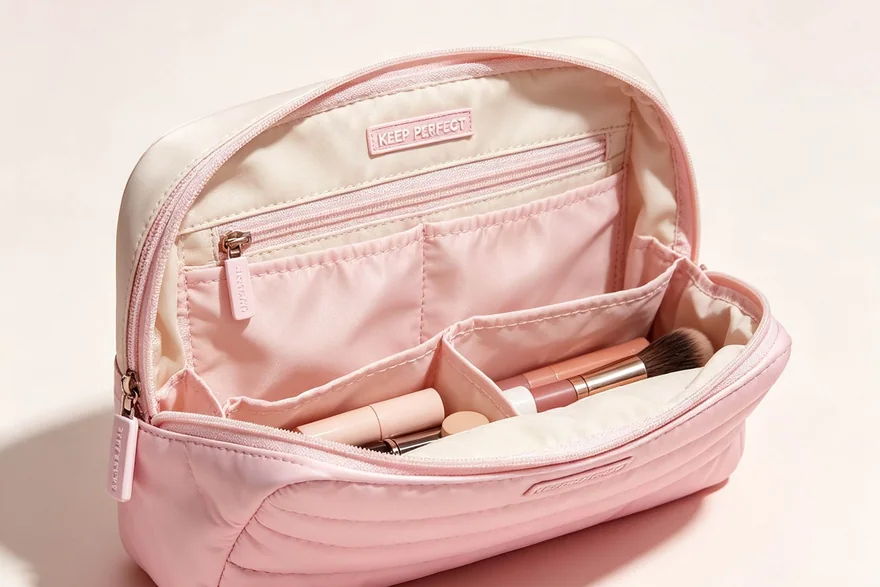
Spill zoning keeps personal-care products away from shared essentials
Family bags expose a cosmetic module to higher consequences from a leak. A loose pump can wet spare clothing, labels can transfer to wipes, and pigment can mark travel documents. The first control is container restraint: short elastic loops around pump bodies, a cap-height divider and enough top clearance that the lid does not press the dispenser. The second is a contained interior tray with seams above the base where possible. The third is module placement inside the host bag, separated from food and feeding supplies even when the cosmetic pouch has its own lining.
A two-zone layout is usually sufficient. The liquid side can use a removable coated pouch or welded TPU envelope, while the dry side holds compacts, brushes and hygiene essentials behind mesh or in elastic loops. The transparent component should not be densely printed because visibility helps inventory and cleaning. Rounded lower corners reduce places where product accumulates. If a brush sleeve is included, its flap should keep bristles from contacting the lining and stop residual powder migrating into the main cavity.
Material compliance has to follow the destination market and the actual component set. A bag used near children is not automatically a children's product, yet small detachable parts, coatings and accessible trims deserve disciplined review. The Consumer Product Safety Improvement Act information gives buyers a starting point for understanding United States children's-product obligations where a product is designed or primarily intended for children. Legal classification and testing scope should be confirmed for the intended market rather than assumed from family-oriented marketing.
Cleaning claims should remain component-specific. A removable TPU envelope can be wiped or rinsed according to its approved method; a structured outer case with foam, board and decoration may be wipe-clean only. Light grey or sand lining exposes pigment and leaked lotion, while a darker removable brush flap can conceal normal makeup staining without hiding the main compartment. Care instructions should tell the user to remove contents, wipe the affected zone and dry the module open before returning it to the shared bag.
The host bag also needs protection from exterior residue. A cosmetic module lifted from a bathroom counter can carry moisture on its base even when nothing leaked inside. A distinct coated base panel with rounded corners is easier to wipe before repacking, and a small standing rim can keep the main body off a damp surface. The design should avoid absorbent feet or deep piping channels that retain moisture where the user cannot see it.
| Potential contaminant | First barrier | Secondary separation | Cleaning access | Briefing note |
|---|---|---|---|---|
| Loose lotion pump | Elastic body loop and cap clearance | Contained lower tray | Wide top opening | Test with full retail container |
| Pigment from compact | Closed dry pocket | Brush flap or internal sleeve | Light-coloured main lining | Inspect hinge and closure pressure |
| Damp cleansing cloth | Removable coated envelope | Keep outside dry cosmetic zone | Turnable rounded pouch | Label for prompt removal |
| Sunscreen residue | Smooth coated lining | Separate from documents and clothing | Low seam ledges | Test approved wipe method |
| Small personal items | Zipped internal pocket | Adult placement in parent bag | Shallow visible pocket | Avoid detachable decorative parts |
A lined pouch does not justify storing toiletries with food or feeding supplies. Container control, an internal liquid zone and thoughtful placement inside the parent bag all contribute.
Family travel rewards handover cues and predictable closure details
A shared travel day includes handovers between caregivers, hotel unpacking, transport checks and repeated repacking. The cosmetic module should communicate its role without requiring memory of an exact pocket map. A distinctive but restrained colour edge, a tactile zipper pull and an icon such as a simple drop or mirror can identify personal care. Labels should not use personal names by default, since the same pouch may serve different adults on different trips. A writable or removable card window can support temporary assignment without making the product single-use.
Closure force needs balance. A very loose slider can move when the packed parent bag flexes; an excessively tight coated zipper can require two hands and sideways force. A smooth #5 coil zipper is a practical starting point for a mid-sized module, with a curved path generous enough to avoid binding. Twin sliders allow a small access opening, but their meeting point should sit near the top rather than at the base. Pulls should be easy to grip yet securely attached, with no decorative bead or small charm that can separate during use.
For air travel, the module can contain a removable transparent liquids envelope while dry cosmetics remain packed. Family documents, children's supplies and personal care can then be checked independently. On road trips, the same envelope can move to a hotel bathroom while the dry case stays in a day bag. The system should not become an elaborate set of indistinguishable mini-pouches. Two internal zones and one host-bag tether normally offer sufficient modularity, with colour and texture doing the identification work.
Approval should involve realistic handover tasks. Fill the parent bag, connect the tether, place the makeup module in its intended zone and ask a person who did not pack it to locate, open and replace it using the provided cues. Record snagging, visibility and whether the tether twists. Then check the zipper with one hand while the module remains partly inside the host bag. This is a usability review rather than a medical or safety certification, but it reveals practical failures that flat tabletop inspection misses.
Travel transitions also test label durability. A printed icon rubbed against bottles and clothing may fade faster than a woven or moulded cue, while a card window can cloud or crack at a fold. Place permanent identifiers away from the base and high-abrasion corners. Any temporary name or itinerary card should face inward when the host bag opens, protecting personal details from casual view while still helping the caregiver identify the module.
| Handover cue | Perception channel | Best placement | Why it helps | Control needed |
|---|---|---|---|---|
| Contrasting edge binding | Visual | Top perimeter | Visible before full removal | Approve colour under indoor light |
| Ribbed zipper pull | Tactile | Primary opening | Distinguishes from wet-zone pull | Pull attachment check |
| Simple personal-care icon | Visual and language-light | Top handle patch | Supports shared caregiving | Avoid tiny detachable badges |
| Short internal tether | Positional | Host-bag D-ring | Returns module to known zone | Loaded connection test |
| Writable card window | Changeable identification | Interior-facing side panel | Supports temporary trip assignment | No exposed sharp window edge |
- Design cues for any caregiver who may receive the bag, not only the person who packed it.
- Keep zipper meeting points high and pull components secure.
- Limit modularity to pieces that genuinely travel or clean separately.
- Test retrieval while the module is inside a fully packed host bag.
The B2B Customisation View
Most delays on cosmetic pouches, vanity cases and beauty organisers trace back to one unanswered question in the brief, so the first working session is spent removing ambiguity rather than choosing colours.
The numbers a buyer can plan around: 500 pieces minimum per style and colourway, 6–10 working days to a first sample (12–15 where tooling or moulding is involved), 35–50 days to bulk completion, AQL 2.5 under ISO 2859-1 at final inspection, FOB Xiamen terms, T/T 30/70 payment.
QUANZHOU JUNYUAN BAGS operates as the custom bag specialist on the file, managing the parts of the process that brands rarely resource in-house: shade matching, component sourcing and pre-shipment inspection.
Which Brand Types Benefit Most
Start-up parenting brands can begin with one clearly marked personal-care module that matches an existing baby bag rather than creating a large family of near-identical pouches. Established brands can use shared lining, pull shapes and tether hardware to make the module feel native to their luggage system. Retailers should show it inside common tote and backpack formats, explaining external dimensions and whether the tether is included. E-commerce sellers need overhead images of both zones, a packed-object list, pull close-ups and a direct statement that the item is not childproof. Gift and hospitality buyers serving family travel can add a removable message sleeve or luggage card while keeping permanent branding subtle and the product useful after the trip.
Ordering starts at 500 pieces per style and colourway. Standard soft modules sample in 6-10 working days; more complex builds with welded inserts, custom pulls or several attachment parts take 12-15 working days. Bulk production is 35-50 days after sample approval. Final inspection follows AQL 2.5 under ISO 2859-1, shipping is FOB Xiamen, and payment is T/T 30 deposit, 70 against bill of lading. Before approval, freeze host-bag compatibility, tether length, pull attachment, internal seam map, care wording and artwork. The product should then be inspected with the agreed object set and, where integration is central, inside the representative parent bag rather than only as an empty standalone pouch.
Range maintenance should keep the integration dimensions visible in every sales and development record. If a later host bag changes opening width, anchor position or internal pocket height, the matching makeup module needs a compatibility review even when its own pattern is unchanged. Retail returns should identify the parent-bag format and load condition. That evidence helps distinguish a true module defect from a mismatch created by pairing it with an untested host layout.
Frequently Asked Questions
What size makeup module fits an everyday baby bag?
A slim module around 22 × 14 × 7 cm fits many everyday parent bags without consuming the changing or bottle zones. It can hold a compact, sunscreen, lip care, hand cream, small hygiene items and personal essentials. Measure the host bag first, especially its opening and internal pocket height. A vertical backpack may need a different orientation from a wide tote even when total volume is similar.
How should personal cosmetics be separated from baby supplies?
Keep them in a closed, clearly identified module with a contained liquid zone, then place that module away from food, feeding items and children's immediate-access pockets. Elastic loops should control pumps and bottles, while a separate dry pocket protects compacts and brushes. A wipe-clean lining adds a barrier but does not replace sensible placement. Empty and clean any leak before returning the pouch to the shared bag.
Which tether works for baby-bag integration?
A detachable 15 to 20 cm webbing tether connected near the pouch top works for many internal D-rings. It should be long enough to lift the module to the opening but short enough to avoid tangling around clothing and bottles. Choose a low-profile connector without sharp edges, and test it with the pouch filled. The host-bag anchor and pouch connector need to be specified as one system.
Why does a shared family pouch need tactile identification?
A ribbed pull, smooth-versus-textured pair of tabs or distinctive handle helps a caregiver identify the right module without opening several similar pouches. The cue supports handovers and low-light retrieval without depending on colour alone. It should remain simple, securely attached and easy to explain in product imagery. Tactile distinction is an inclusive usability feature, not a medical claim.
How can a makeup bag open with one hand without spilling?
Use twin sliders on a smooth curved top path and add gussets that limit the lid to roughly 100 to 120 degrees. The user can open only the required width while the gussets retain contents. A stable base and a top handle help steady the pouch inside the host bag. One-handed operation should be tested with realistic packing; an overfilled sample will force the lid and cancel the intended benefit.
What zipper details reduce accidental opening in a parent bag?
Position the twin-slider meeting point at the top, use a smooth #5 coil appropriate to the pouch size and avoid an excessively loose slider. The opening path should not end at the lowest point where pressure from packed items can work directly against it. Secure, substantial pulls are preferable to decorative charms. Product language should describe secure closure and adult storage, not claim childproof performance.
Which lining colour is practical for family travel cosmetics?
A light-to-mid neutral such as stone, warm grey or muted blue makes lotion, pigment and small items visible without showing every minor handling mark like pure white. A darker removable brush flap can manage normal powder staining while the main cavity remains easy to inspect. Test wet and dry colour transfer from the lining and binding, especially when the pouch may touch pale clothing.
When should a family-travel makeup bag include a clear pouch?
A removable clear pouch is useful when liquids need separate airport screening, hotel-bathroom carry or independent cleaning. Keep it modest in size and avoid dense decoration across the viewing panel. Dry cosmetics can stay in the main module. The clear pouch should support organisation but should not be advertised as universally approved; travellers remain responsible for the requirements that apply to their route.
How should buyers assess small detachable components?
List every pull, hook, snap, patch and decoration, then review whether it can detach during expected use and where the adult user will store the bag. Avoid unnecessary beads, charms and loosely fixed badges. Inspect attachment strength and exposed edges on the approved construction. Market classification and compliance scope depend on intended use and destination, so family-oriented positioning should not be treated as a substitute for a proper review.
What minimum applies to a matching baby-bag makeup insert?
The minimum is 500 pieces per style and colourway. A matching cosmetic module in two parent-bag colours therefore requires 500 pieces of each colour. Brands can reduce complexity by sharing zipper gauge, lining and tether hardware across the colour options. Even so, each colourway needs approval because the visual contrast between body, edge cue and lining is part of the handover and identification function.
How long does sampling take for a tethered family module?
A standard soft module normally samples in 6-10 working days. A complex version with a welded clear insert, custom tactile pulls or multiple connectors takes 12-15 working days. Bulk production is 35-50 days after sample approval. Build time into the review for loaded integration with the host bag, not just standalone measurements, because tether reach and opening clearance are central to the concept.
What should inspection cover on a caregiver handover pouch?
Inspect tether attachment, zipper operation, pull security, pocket dimensions, lining cleanliness, seam containment and identification-cue placement. A loaded retrieval check should confirm that the module reaches the host-bag opening and returns without twisting. Final inspection follows AQL 2.5 under ISO 2859-1. The defect list should rank detached hardware, blocked access or exposed sharp edges above small appearance variations.
Why should product copy avoid calling this pouch childproof?
A normal zipper pouch is an organising product, not a child-resistant closure. Calling it childproof may create an expectation the design and evidence do not support. Clearer copy describes a secure adult-access module, recommends storage out of children's reach and explains any internal tether or contained liquid zone. Safety and compliance statements should match the exact intended use, destination market and evaluated construction.
How can family-travel merchandising remain inclusive?
Show the module being located, handed over and repacked by varied caregivers, and describe the function rather than assigning tasks by gender. Neutral and accent colour options can sit in one coherent range. Product copy may address mothers while recognising partners, relatives and other caregivers. Adjustable loops and flexible zones also accommodate different personal-care routines without assuming that every user carries the same cosmetics.
People Also Ask
Can a makeup bag fit inside a diaper bag?
Yes. A slim makeup module around 22 × 14 × 7 cm can fit many diaper or baby bags, provided the host opening, internal pocket height and bottle zones are measured first. Place the closed module away from food and feeding supplies, and use a short internal tether if the host bag provides an anchor. A contrasting edge or tactile pull makes it easier for any caregiver to identify.
What should a mother keep in a travel makeup pouch?
The contents depend on the individual routine and trip, but a practical list may include sunscreen, lip care, hand cream, a compact, small skincare products and personal essentials. Use travel-size liquid containers, control pumps with loops and keep dry cosmetics separate. The bag should remain a personal-care module rather than absorb unrelated family items, because a clear inventory makes handovers and repacking easier.
How do you organise cosmetics in a family travel bag?
Use one recognisable closed module with two zones: contained liquids and dry cosmetics. Connect it to a known internal point if the host bag supports a tether, and place it away from children's supplies, food and documents. Keep the object list concise, return the module to the same position after use and clean any spill before repacking. Visible and tactile cues help when caregivers hand the bag between them.
Are cosmetic pouches in baby bags safe around children?
They should remain under adult control and out of children's reach, especially when they contain cosmetics, toiletries or small components. A standard pouch is not childproof. Buyers should minimise unnecessary detachable decoration, inspect pulls and connectors, and review market requirements for the product's intended use. Design supports organised adult storage, but it does not replace supervision or appropriate handling of the contents.
Request a Sample or a Written Quotation
Send the silhouette, dimensions, material preference and logo artwork, and the programme team will return a written quotation with MOQ, sampling window, bulk lead time and inspection standard.
Email: service@junyuanbags.com · WhatsApp: +86 177 5002 0688