Makeup Bags for Makeup Artists: Professional Kit Requirements
Executive Summary
The professional kit requirements for makeup bags come down to duty cycle rather than appearance. A retail cosmetic pouch is opened a few times a week and carried in a handbag; a working kit is opened continuously through a shift, loaded with several kilograms of product, set down on floors and location surfaces, wiped with solvent between clients and closed again under time pressure. That duty cycle changes every decision: shell abrasion resistance, zipper gauge, seam construction, handle load path, lining chemistry and how quickly a spill can be contained before it reaches a client's carpet or a costume.
The commercial shape follows the specification. Professional kits sit at the top of the $0.45 to $12.00 unit band recorded on marketplaces in Alibaba's 2026.10 data because they use heavier shells, wipe-clean linings, reinforced handles and compartment inserts. Programmes start at 500 pieces per style and colourway, sample in 6 to 10 working days for soft builds and 12 to 15 for moulded or framed constructions, then run 35 to 50 days of bulk after approval, inspected to AQL 2.5 under ISO 2859-1, FOB Xiamen, T/T 30 deposit and 70 against bill of lading.
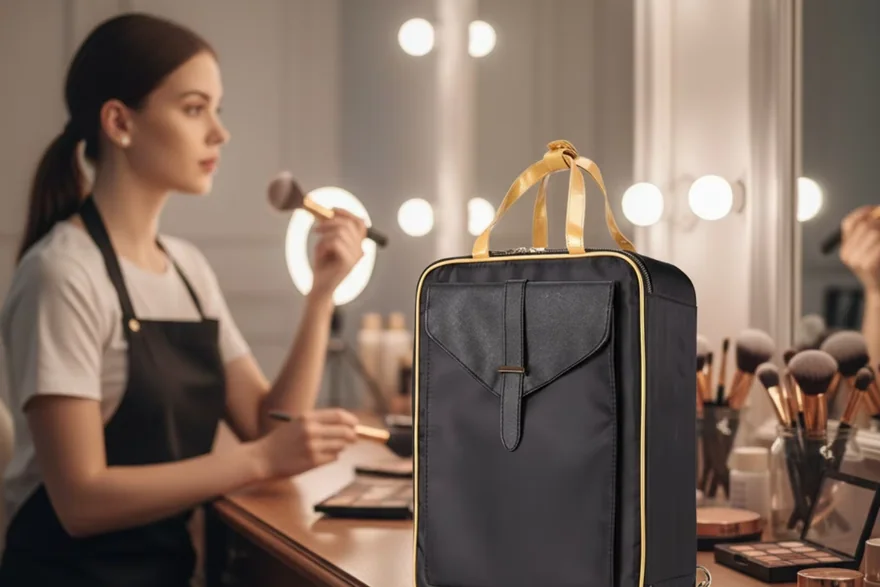
What professional duty demands that a retail pouch never sees
A makeup artist's bag is a tool holder, and the brief is written by the working day rather than by the shelf. It is opened and closed continuously from first client to last, carried loaded rather than empty, placed on surfaces that range from a clean counter to a location floor, and wiped down with alcohol or brush cleaner between faces. It is also judged in front of the client: a kit that looks tired reads as a kit that is not clean, which is a commercial problem for the artist regardless of how well the bag performs.
Three failure modes dominate. The first is structural: a loaded kit of 8 to 15 kg puts sustained tension on the handle attachment and the zipper line, and a bag specified for a 1 kg retail load will tear out at the handle within weeks. The second is chemical: foundation, cream pigments, isopropyl alcohol and brush cleaner attack printed surfaces, uncoated linings and adhesive-bonded logos. The third is organisational: a kit that cannot be re-packed in a fixed order costs the artist time on every job, and time is the thing a professional actually sells.
The category also has a discoverability quirk worth noting. Custom makeup bag records 5,400 to 6,600 monthly searches while make up bags for women sits around 80,000 monthly, so the generic terms still carry the volume even though the professional requirement is a distinct product. A buyer building a pro line should expect to merchandise on the broad term and differentiate on the specification, rather than expecting a professional-specific search term to deliver the traffic on its own.
That distinction shapes everything downstream. The same factory floor can produce a satin retail pouch and a coated-nylon artist case, but they share almost nothing in material, trim or test protocol. Treating them as one product with two price points produces a kit that fails in professional hands and generates returns, warranty claims and, worse for a brand, public photographs of a broken bag on a working job.
Load-out architecture: how a working kit is actually organised
Professional kit is not one bag; it is a system of nested holders, each sized to a category of tool. Brushes travel in a roll or a upright cup section, pigments travel flat in a palette case, liquids travel upright in a sealed pouch, and disposables travel in a separate compartment so that used wipes and spoolies never touch clean stock. The table below sets out the common formats, what each holds, and the structural specification that makes each one survive professional use.
| Format | Typical load | Structural specification | Best-fit professional use |
|---|---|---|---|
| Brush roll, 20-30 slots | 20-30 brushes, 45 cm rolled | 600D shell, elastic or mesh slots, tie or snap closure | Bridal and freelance artist working from a table |
| Brush cup section, 12-18 cm deep | 12-20 brushes upright | Framed base, divider panel, reinforced rim | On-set artist who needs one-handed grab |
| Clear PVC product pouch | Foundations, creams, liquids | 0.3-0.5 mm PVC or TPU, welded seams, #5 zipper | Any artist who must identify contents without opening |
| Palette case, flat | 6-12 pressed pans, refillable | Rigid EVA shell, magnetic or snap-in pan wells | Artists carrying custom-mixed or depot palettes |
| Train case, framed | Full kit, 8-15 kg loaded | ABS or PP frame, aluminium or PP edge trim, lockable latch | Salon-based and counter artist with a fixed station |
| Rolling trolley case | Full kit plus hair tools | Telescopic handle, 60-80 mm wheels, internal frame | Film, TV and theatre artist moving between locations |
| Backstage belt pouch | 10-20 core items only | Webbing belt, quick-release buckle, wipe-clean shell | Fashion show and backstage touch-up work |
Two specification points separate a working format from a costume version. The first is seam construction: welded or high-frequency welded seams on a clear pouch hold liquid where a sewn seam wicks it, and a buyer should state the seam method in the brief rather than accepting whatever the sample happens to show. The second is the load path for anything carried by a handle. On a framed train case the handle load must transfer into the frame, not into the shell fabric; on a soft case the handle webbing must run under the body panel and be bartacked, not simply stitched to the top seam.
Clear pouches also raise a chemistry question. PVC plasticised for flexibility can stiffen, craze or turn tacky after repeated contact with alcohol-based cleaners and certain foundation oils, and TPU behaves differently again. Rather than choosing on feel, a buyer should require a compatibility soak on the approval sample: a swab of the cleaner the end user actually uses, applied repeatedly to the lining and shell for a stated number of cycles, then inspected for haze, tackiness and colour change. That is a test a buyer defines, and it costs almost nothing to run before bulk.
Access speed is the third architectural decision and the one most often left to chance. A top-opening case forces the artist to unstack to reach what is at the bottom; a clamshell opening exposes the whole load at once but needs a frame to hold shape when open; a front-loading case with drop-down tiers suits a counter artist working from a fixed station. The right answer depends on where the kit is used, so a buyer should state the working context in the brief rather than letting the sample decide by default.
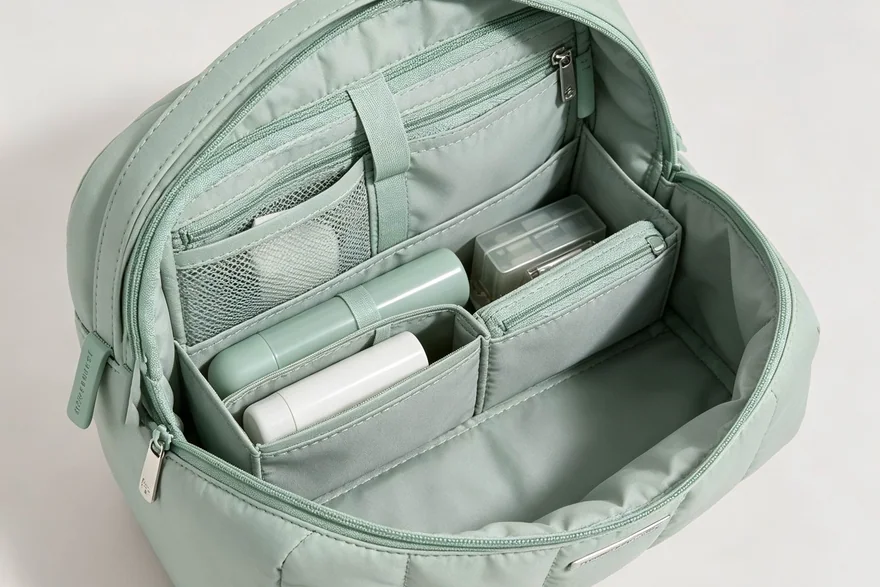
Sanitation, cleanability and product-contact surfaces
Cleanability is the requirement most often discovered after launch. A professional kit is wiped down between clients, and the agent used is usually an alcohol-based brush cleaner or a 70 percent isopropyl spray, applied dozens of times a week. An uncoated polyester lining absorbs pigment, a printed logo lifts, and a foam insert becomes a reservoir. The specification answer is to treat every interior surface as a product-contact surface and write the acceptance criteria accordingly.
- Interior lining: PU-coated or TPU-laminated 190T to 210D polyester, wipe-clean, no printed artwork on any surface the client or the cleaner touches.
- Coated fabric test method: reference ASTM D751 for coating adhesion and blocking resistance so a supplier quotation and a lab report use the same language.
- Shell: 600D to 900D polyester or nylon with a PU or PVC backing; abrasion resistance specified by Martindale or Wyzenbeek cycle count in the brief.
- Seams: welded or taped on liquid compartments; sewn-and-bound seams only on dry compartments such as brush slots.
- Colour: charcoal, black or deep navy interior hides pigment; a pale interior photographs well and stains permanently within one season.
- Inserts: closed-cell EVA or PE board rather than open-cell foam, which absorbs product and cannot be disinfected.
- Hardware: corrosion-resistant pulls and latches, since cleaner overspray reaches every metal part on the bag.
Restricted substances belong in the same conversation. Shell fabric, coating, zipper tape, thread, elastic, PVC film and printed labels are all assessed under OEKO-TEX Standard 100, and a certificate tied to the fabric roll is the cheapest evidence a buyer can hold. Cleaning agents also interact with colour: repeated solvent wiping strips dye from some shell finishes, and the rubbing and solvent fastness methods published by AATCC give a buyer a defined test to cite rather than a subjective opinion about whether the sample looks durable.
There is also a hygiene boundary worth designing for: clean stock and used items must not share a compartment. A dedicated zip pocket for used spoolies, wipes and disposable applicators costs one panel and one zipper, and it removes the most common professional complaint about kit design, which is that everything ends up in the same space by the third job of the day. Buyers who add this pocket and say so in the product copy usually find it becomes the line quoted in reviews.
Removable and washable interiors are the logical extension of the same requirement. A case with a lift-out lining tray can be fully cleaned rather than spot-wiped, and a tray that fits a standard sink changes the cleaning routine from a chore into a step the artist will actually perform. The cost is one extra panel, four hook-and-loop tabs and a slightly longer sampling round. The alternative is a fixed lining that accumulates product until the artist replaces the whole bag, which is a replacement sale for the brand and a complaint for everyone else.
Specifying a professional kit programme: tiers, tolerances and timing
Professional ranges usually work as a ladder rather than a single product, because one artist buys a brush roll in year one and a rolling case in year three. The ladder below is a practical way to structure a programme so that all three tiers share fabric, trim and branding, which is what keeps the range looking coherent and keeps the colourway minimums manageable.
| Tier | Shell and lining | Hardware and closure | Branding | Programme note |
|---|---|---|---|---|
| Entry: brush roll and pouch set | 600D polyester, PU-coated 190T lining | #5 coil zipper, snap or tie closure | Woven label, tonal print | Lowest unit cost; fastest 6-10 day sampling route |
| Core: soft kit bag with dividers | 900D polyester, TPU-laminated lining | #8 zipper, removable divider set, bartacked handle | Debossed PU patch | Mid-band cost; divider tooling shared across sizes |
| Pro: framed train case | ABS or PP frame, 1680D ballistic shell | Lockable latch, aluminium edge trim, structured base | Metal badge or laser-etched plate | Top of the band; 12-15 day sampling plus frame tooling |
| Mobile: rolling trolley case | Frame plus 1680D shell, internal divider system | Telescopic handle, 60-80 mm wheels, replaceable | Badge plus woven side label | Highest freight per unit; specify carton and pallet count |
| Consumable: clear pouches, sold in multipacks | 0.3-0.5 mm PVC or TPU, welded seams | #5 zipper with metal-look pull | Single-colour print on hangtag only | Sold in 2- and 3-packs; drives repeat orders |
Timing is the part that catches buyers out. Sampling runs 6 to 10 working days for soft builds and 12 to 15 working days for complex constructions, and a framed train case sits in the longer window because the frame, latch and edge trim are separate components with their own lead times. Bulk then runs 35 to 50 days after sample approval. A buyer who needs a range on a counter for a specific season should build the calendar backwards from the launch date, including courier transit, internal sign-off and freight clearance, and should treat 50 days as the planning figure rather than 35.
Minimums, inspection and terms complete the brief. Each style and colourway starts at 500 pieces, so a three-tier ladder in two colourways commits 3,000 units, and a buyer should decide at the outset which tier carries the depth. Shipments are inspected to AQL 2.5 under ISO 2859-1, with professional kit defects normally classified so that handle attachment, zipper function and weld integrity are major rather than minor. Standard terms are FOB Xiamen with T/T 30 deposit and 70 against bill of lading, and the brief should also state pieces per carton because a framed case ships far fewer units per carton than a pouch.
Warranty and spare parts are worth settling before the first order rather than after the first complaint. A professional range generates requests for replacement wheels, telescopic handles, dividers and zipper pulls, and a buyer who can ship a spare part keeps a customer who would otherwise replace the whole case. That means specifying those components as catalogued items with their own part numbers at the briefing stage, and ordering a spare-parts quantity alongside the first bulk run so the parts exist before they are needed.
The B2B Customisation View
What separates a smooth cosmetic pouches, vanity cases and beauty organisers launch from a painful one is usually the quality of the technical pack rather than the price of the fabric.
Planning figures used across the programme: MOQ 500 pieces per style and colourway, 6–10 working days sampling (12–15 when moulding or multi-layer lamination is required), 35–50 days bulk lead time, AQL 2.5 to ISO 2859-1, FOB Xiamen, T/T 30/70.
QUANZHOU JUNYUAN BAGS keeps the relationship deliberately narrow: specification control, sampling, inspection and logistics coordination, all documented against the buyer's own standard.
Which Brand Types Benefit Most
Professional kit programmes suit buyers who can sell a specification rather than a colour, and each brand type enters the category from a different angle. Start-up brands do best at the entry and consumable tiers: a brush roll, a pouch set and a clear multipack share one fabric buy and one trim package, and the 500-piece minimum per colourway stays affordable when the range is built from small items. Established beauty brands with a professional division should anchor on the core tier, because a soft kit bag with removable dividers is the product that gets replaced and therefore the product that generates repeat orders. Retailers serving the trade, including professional beauty supply and salon distributors, need the framed and rolling tiers in the assortment even at low depth, since those are the items an artist expects to see on the shelf before trusting a range.
- Start-up brands: entry and consumable tiers, 500 pieces per colourway, differentiated by slot count and cleaning performance rather than by print.
- Established brands: core soft kit bag with a shared divider system across two or three sizes, so replacement and upsell both stay inside the range.
- Retailers and distributors: one framed train case and one rolling case held at minimum depth for credibility, with depth carried in pouches and rolls.
- E-commerce sellers: the clear pouch multipack, sold in 2- and 3-packs, which is the format most likely to generate repeat purchase and review volume.
- Gift, hospitality and education buyers: brush roll plus pouch sets in a single neutral colourway, packed as a course or amenity kit for training academies, spas and hotel beauty suites, where the specification should follow the contents list supplied by the academy rather than a catalogue pattern, and where a lift-out washable lining is worth the extra panel because the kits are cleaned between cohorts rather than by one owner.
Frequently Asked Questions
What distinguishes a professional makeup bag from a retail cosmetic bag?
Duty cycle. A retail pouch carries a light load and is opened occasionally; a professional kit carries 8 to 15 kg, is opened continuously through a shift, is set down on unknown surfaces and is wiped with solvent between clients. That changes the shell to 600D or heavier, the lining to a coated or laminated wipe-clean fabric, the handle to a load-path construction, and the closure to a heavier zipper gauge.
How much weight should a loaded train case handle?
A buyer should set the figure rather than inherit it. Write a loaded weight into the brief, typically 10 to 15 kg for a framed case, and require a static hold test on the approval sample with the handle and latch inspected afterwards for deformation. The failure point is almost never the fabric; it is the handle attachment or the rivets holding the latch plate.
Which lining survives repeated alcohol wiping?
A PU-coated or TPU-laminated 190T to 210D polyester, welded or taped at the seams, is the standard answer. Uncoated polyester absorbs pigment and cleaner and will stain permanently. The acceptance test is a repeated-wipe soak using the agent the end user actually applies, followed by inspection for haze, tackiness and colour change, not a visual judgement on a fresh sample.
How many brush slots should a professional brush roll carry?
Twenty to thirty slots covers most working kits, with a mix of narrow slots for lip and liner brushes and wide slots for powder and foundation brushes. Slot depth matters as much as count: a 12 cm slot protects a long handle, while a 25 cm slot lets short brushes disappear. Specify slot widths in the brief rather than accepting a single uniform pitch.
Is PVC or TPU better for a clear product pouch?
Each has a trade-off. PVC at 0.3 to 0.5 mm welds cleanly and costs less, but some plasticised grades stiffen or craze after repeated alcohol contact. TPU resists solvents and stays flexible in cold conditions but costs more and welds at different settings. The decision should be made after a solvent compatibility soak on the actual film, not on price alone.
What zipper gauge suits a professional kit bag?
#8 for the main opening of a kit bag carrying several kilograms, and #5 for internal pockets and pouch closures. The slider takes the load, so specify slider type, pull and end stops as well as gauge, and use consistent terminology from ASTM D2053 so the brief and the sample can be compared without argument. Bartacks at both ends are not optional.
How should a professional kit be sized for airline cabin carriage?
Size to the liquids rule first: 100 ml containers in one quart-sized transparent bag, per the TSA 3-1-1 rule. A kit bag of roughly 30 x 20 x 18 cm fits under a cabin seat and still holds a brush roll and a palette case. Larger trolley cases are check-in items, which is why the nested system matters more than any single bag dimension.
What minimum applies to a makeup artist kit programme?
500 pieces per style and colourway. A three-tier ladder in two colourways therefore commits 3,000 units, which is why most buyers carry depth in the entry and consumable tiers and hold the framed case at minimum depth. Marketplace listings advertising 100 to 1,000 pieces usually describe stock designs rather than a specified professional build.
How long does sampling take for a framed train case?
12 to 15 working days, because the frame, latch, edge trim and handle are separate components with their own lead times, and soft builds sample in 6 to 10 working days. Buyers should also allow time for a second sample round after corrections, then count 35 to 50 days of bulk production plus freight before the range can be merchandised.
Should dividers in a professional kit be removable?
Yes. Removable dividers let one case serve a bridal artist carrying cream products and an on-set artist carrying palettes, which widens the addressable market without a second tooling set. Specify hook-and-loop attachment on both the divider and the case floor, and require a pull test, because dividers that detach in transit are the most common complaint after zipper failure.
How should a brand mark a professional kit so the logo does not peel?
Use a debossed PU patch, a woven label or a metal badge rather than a surface heat transfer, which lifts under solvent wiping. Placement matters: a patch on the front panel above the handle stays visible when the case is stacked or hung. Avoid printed artwork on any interior surface, since that is the surface the cleaner reaches first.
Which interior colour hides pigment staining best?
Charcoal, black or deep navy. A pale interior photographs well on a product page and looks stained after one season of foundation and lipstick contact, which produces returns and poor reviews that cost more than the photography gained. If a pale interior is required for brand reasons, pair it with a fully welded, non-absorbent coating and accept that it is a replaceable consumable.
What inspection level applies to professional kit shipments?
AQL 2.5 under ISO 2859-1, which sets sample size and accept and reject numbers for the lot. For professional kit, the defect classification matters more than the level: handle attachment, zipper function and weld integrity should be written into the brief as major defects so that a lot with those failures is rejected rather than accepted with a minor-defect allowance.
How is a professional kit cleaned between clients?
Linings are wiped with an alcohol-based brush cleaner or 70 percent isopropyl spray, and brushes are cleaned separately and returned dry. The bag design supports this by keeping a dedicated pocket for used disposables so that soiled wipes and spoolies never touch clean stock. Buyers should confirm that the specified lining tolerates the agent the end user actually applies before bulk.
Should professional kits be sold empty or filled with product?
Empty, in most programmes. Filled kits add regulatory complexity, shorten shelf life and tie up capital in product that may not match the buyer's market. The exception is an education or starter kit, where contents are chosen by the academy and the bag is specified around the contents list. In both cases the bag brief should be written from the contents list forwards.
People Also Ask
What bag do professional makeup artists use?
Most use a system rather than one bag: a brush roll or upright brush section, a clear pouch for liquids and creams, a palette case for pressed product, and a framed train case or rolling trolley for the full load. The format chosen depends on whether the artist works from a fixed station or moves between locations during a shift.
How do you organise a makeup artist kit?
Organise by category and by frequency of use. Brushes upright or rolled, liquids in a sealed clear pouch, palettes flat, and a separate pocket for used disposables. The test of a good layout is whether the kit can be re-packed in the same order every time, because an artist working under time pressure cannot search for a product. Nested pouches and a labelled slot order make that repeatable across jobs.
What is a train case used for?
A train case is a framed, structured case that holds a full professional kit and protects pressed palettes and glass product from crushing. The frame carries the handle load rather than the fabric, which is why a loaded case can be carried by one hand. It suits salon and counter artists with a fixed station more than artists moving between locations.
Do makeup bags for artists need to be wipe-clean?
Yes, because the bag is cleaned between clients with alcohol-based agents. That rules out uncoated polyester linings, printed interior artwork and open-cell foam inserts. A PU-coated or TPU-laminated lining with welded seams at liquid compartments is the specification that survives daily wiping, and it should be verified by a repeated solvent soak on the approval sample before bulk is released, since a sample that looks clean on day one tells a buyer nothing about month three.
Request a Sample or a Written Quotation
Send the silhouette, dimensions, material preference and logo artwork, and the programme team will return a written quotation with MOQ, sampling window, bulk lead time and inspection standard.
Email: service@junyuanbags.com · WhatsApp: +86 177 5002 0688