Makeup Bags for Performers: Theater & Stage Kit Design
Executive Summary
Makeup bags for performers are work kits built around sequence and lighting, not travel wash bags built around packing flat. A stage kit is opened dozens of times in one evening, often in low light, so the priorities are a light lining that makes dark pencils readable, a wide mouth that lays contents out flat, compartments that return every brush to the same slot, and a finish that wipes clean after greasepaint. Volume runs 4 to 6 litres for an ensemble kit and 8 to 15 litres for a principal kit.
The specification is therefore a list of mechanisms rather than pockets: zipper gauge and slider count, lining colour and weight, wet-item separation, mirror size and material, and hanging method, all fixed before artwork is discussed. Colour transfer needs particular attention, since red and black pigment stains aggressively. Programmes begin at 500 pieces per style and colourway, sampling takes 6 to 10 working days and 12 to 15 for moulded builds, and bulk ships 35 to 50 days after approval under AQL 2.5 to ISO 2859-1, FOB Xiamen, T/T 30 deposit and 70 against bill of lading.
What a stage kit carries, and why it is not a travel wash bag
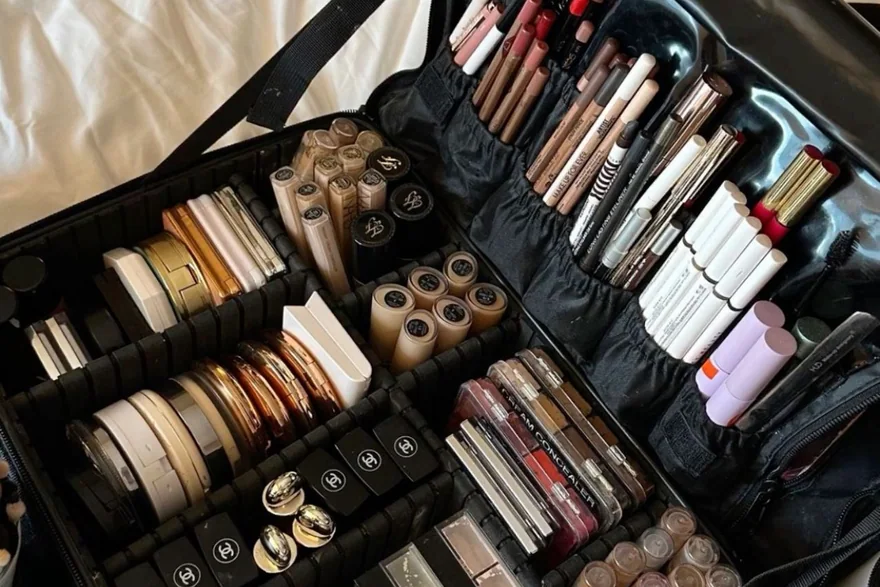
A stage makeup kit is a work kit, not a travel kit, and the distinction should be settled before any material is chosen because the two formats optimise for opposite outcomes. A travel wash bag is built to pack flat, hold a week of personal product and survive the inside of a suitcase. A performer's kit is built to be opened dozens of times in a single evening, in low light, by someone whose hands are already busy, and to return every item to the same place every time. The contents are also different: cream-based greasepaint in 20 g and 40 g pots, cake liners, loose setting powder, spirit gum and its remover, liquid latex, theatrical blood, a dozen brushes in several gauges, false lashes and lash adhesive, hair pins, and a mirror. Several of those are semi-liquid, several stain permanently, and all of them are needed quickly.
The failure modes follow directly from that list. A travel bag fails when a bottle leaks. A stage kit fails when a brush cannot be found in a few seconds, when a black interior swallows a black eyeliner pencil, when a pot of greasepaint contaminates a clean brush roll, or when the bag slides off a dressing-room table that is also holding a costume and a wig. Buyers who brief a stage kit as a makeup bag with more pockets end up solving the first kind of failure and leaving the second kind untouched. The brief should start from the working sequence instead: what is touched first, what is touched most often, what must stay clean, and what must never come into contact with anything else.
Volume expectations diverge from travel as well. A working kit for a principal performer commonly runs 8 to 15 litres and is laid out flat rather than stacked, because stacking forces the performer to dig. An ensemble kit is smaller, often 4 to 6 litres, because it moves between shared dressing spaces and has to fit a shelf or a rail hook. Sizing should be written both in litres and in centimetres for the base panel, since a bag that holds the volume but not the footprint will not stay put on a crowded surface. That gives the order of work for the rest of the specification: sequence first, volume second, materials third.
Designing for quick changes: access speed, low light and one-handed use
A quick change is measured against the length of a scene change, which can be a handful of seconds to a couple of minutes. In that window the bag is a workstation rather than a container, so every design decision should be tested against one question: can this be done with one hand, in dim light, without looking? That single test eliminates a surprising number of otherwise attractive features. A flap that has to be folded and clipped fails it. A zip that runs the full length of one side and stops fails it. A compartment that only opens when the bag is upright fails it. What passes is a mouth that opens wide and stays open, contents that are visible from above, and closures that operate by touch.
Light is the variable most often ignored. Backstage working light is deliberately dim, and a bag with a black interior and black elastic loops makes every retrieval a search. A light grey or light tan lining at 90 to 110 g/m² in 210D polyester turns the interior into a readable ground, and colour-coded elastic in two or three assigned shades lets a performer find a brush family by colour rather than by shape. Contrast binding on the pocket edges helps the eye find the opening. Exterior colour works the other way: a dark shell hides scuffing from being dragged across a stage floor, so a dark outer with a light inner is the standard combination rather than a stylistic preference.
Zipper specification deserves more attention in a stage kit than in almost any other cosmetic format. The relevant vocabulary of gauge, tape, slider and puller is set out in ASTM D2053 zipper terminology, and using it stops a brief from degenerating into a request for a strong zip. A #5 coil is adequate for a 4 to 6 litre ensemble pouch; a kit of 8 litres and above with a wide mouth should move to #8, because the tape carries more of the load when the bag is opened hard and often. Two sliders on a single tape allow opening from either end, which matters when the bag is hung on a rail and only one side is reachable.
| Access feature | Working specification | Where it helps | Trade-off |
|---|---|---|---|
| Two-way zipper | #5 or #8 coil tape, two sliders, 60-80 cm run | Opens from either end on a table or a rail | Two sliders double the alignment checks at inspection |
| Light-coloured lining | 210D polyester, light grey, 90-110 g/m² | Dark pencils and caps read against a light ground | Shows pigment marks sooner than a black lining |
| Magnetic closure tab | Two 18-20 mm magnets inside a folded PU tab | One-handed closure in the middle of a change | Adds 4-6 mm of build at the mouth |
| Hanging swivel hook | Zinc-alloy hook on 25 mm webbing, bar-tacked | Keeps the kit off a wet or crowded surface | Needs a reinforcement patch on the back panel |
| Colour-coded elastic | 20 mm elastic in three assigned shades | Brush families found by colour, not shape | Shade must be repeatable across reorders |
| Lid-mounted mirror | 20 x 15 cm acrylic, 2 mm, in a padded sleeve | No separate mirror to lose in the dark | Acrylic scratches; needs a protective sleeve |
Two further details repay attention. A grab handle of 25 mm webbing, box-stitched rather than single-stitched, lets a kit be moved between dressing room and wings without being clutched by the mouth, which is how zip tapes get torn. And the mirror should be specified by material rather than by description: 2 mm acrylic at roughly 20 by 15 cm survives being dropped on a hard floor, whereas glass of the same size does not, and a shattered mirror in a kit is both a safety problem and a lost performance.
Materials, linings and finishes that survive a rehearsal room
A rehearsal room is harder on a bag than a bedroom. Bags are stacked, dragged, sat on, left on radiators and wiped down with solvent. The outer shell should therefore be chosen for abrasion and cleanability rather than for hand feel. A 600D polyester with a PU backing at 280 to 320 g/m² is the workhorse specification and takes a screen print or a heat transfer cleanly. A 900D polyester or a PVC-backed variant suits a rolling case that will be wheeled over a stage edge. A 420D nylon ripstop at around 180 to 210 g/m² is worth considering for a kit that has to be carried up and down stairs between floors, since it saves 150 to 250 g on a 10 litre build. Unlined cotton canvas looks appropriate in a period production and is the wrong choice for anything that will meet greasepaint, because it absorbs rather than releases.
The lining is where stage kits succeed or fail. It has to resist pigment, release it on wiping, and tolerate repeated cleaning. A TPU or PU lamination of 0.15 to 0.25 mm bonded to a 210D or 420D base gives a surface that can be wiped with a standard cosmetic solvent without the solvent reaching the foam or the interlining underneath. Seams inside a wet or pigment-prone compartment should be welded or bound rather than merely turned and stitched, because a needle hole is a wicking path. Where branding or lining fabric is dyed a dark shade, the colour fastness question is not abstract: a lining that crocks will mark costume fabric, and the relevant family of tests is described under ISO 105 colour fastness.
Skin contact is a third consideration, and it is easy to overlook because most of the bag does not touch skin. Brush handles, sponges and applicators do, and so does the interior of any pouch used to carry them. Linings and any dyed trim that will sit against the face or hands should be checked against a restricted-substance framework such as OEKO-TEX Standard 100, particularly for programmes aimed at youth theatre or school productions where the buyer's own compliance team will ask. Where an illuminated mirror is specified, the lighting component falls outside textile testing altogether and should be checked against IEC standards for the destination market before the bag is costed.
- Shell: 600D polyester with PU backing at 280-320 g/m² for general kits; 900D for wheeled or floor-dragged formats.
- Lining: TPU or PU lamination of 0.15-0.25 mm on a 210D or 420D base, in a light shade for interior readability.
- Seams: welded or bound inside any compartment that will carry cream pigment, spirit gum or remover.
- Zipper: #5 coil below 6 litres, #8 with two sliders above it, with metal sliders avoided where silence on stage matters.
- Mirror: 2 mm acrylic at 20 x 15 cm in a padded sleeve; glass only for a case that never travels.
- Structure: 3 mm EVA base board for a kit that must stand open on a table; 5 mm where the bag carries glass bottles.
Buyers sometimes ask for a flame-retardant finish because the bag will be used near stage lighting and drapes. The correct response is to name the standard and the test rather than to request FR generically, because flame-retardant treatments vary in chemistry, hand feel and durability, and a coating applied to meet one market's requirement may not satisfy another's. The same discipline applies to antimicrobial claims, which should be tied to a named test method rather than to a marketing adjective.
Standardising a kit across a cast without losing individual labelling
Costume and makeup departments usually run two tiers of kit at once. A station kit serves a shared dressing room and holds the consumables that everyone draws from: greasepaint palettes, setting powder, remover, tissues and spare applicators. A personal kit belongs to one performer and holds the items that should not be shared: mascara, lip products, lash adhesive and any product used near the eyes. The two tiers have different replacement cycles and different hygiene expectations, so they should be specified as separate styles with separate colourways rather than as one style in two sizes. A station kit is replaced when the consumables run out; a personal kit is replaced with the performer.
Individual labelling is where the commercial constraint appears. A programme has a minimum of 500 pieces per style and colourway, which is straightforward when the whole cast shares one design. Name personalisation applied during production turns every performer into a separate colourway in effect, so the usual approach is to run the base bag in one colourway and add the name downstream, or to specify a removable name tag that can be swapped between productions. Where a production genuinely needs per-performer embroidery, the buyer should plan the name list as a data file delivered with the order and confirm the digitising charge per name separately.
| Format | Typical size | Holds | Best use |
|---|---|---|---|
| Belt pouch | 20 x 12 x 8 cm, 1.5-2 L | Lip, liner, a few pins, a small mirror | Quick changes at the side of the stage |
| Shoulder kit bag | 35 x 25 x 20 cm, 10-14 L | Full personal kit with a brush roll | Principal performers with a dedicated table |
| Hanging roll | 60 x 40 cm open, 6-8 L | Brush roll plus palettes in sleeves | Shared dressing rooms with a rail |
| Rolling case | 45 x 32 x 28 cm, 28-34 L | Station consumables and refill stock | Touring productions moved between venues |
| Station caddy | 30 x 20 x 15 cm, 6-8 L | Open-top storage for shared product | Makeup stations and rehearsal rooms |
Reorder logic should be settled at the first order rather than discovered at the second. Stage kits are consumable in a way that retail bags are not: a production reopens, a tour extends, a school replaces a year's worth of kit. That means the shade of the lining, the shade of the elastic and the gauge of the zip have to be repeatable, and the buyer should retain a physical reference sample from the approved run rather than relying on a photograph. Where a design uses a custom-dyed trim, keeping a dye-lot reference avoids the situation in which the replacement bag does not match the bags already in service. Consumable parts should be planned the same way: a brush roll, a mirror sleeve and a wet pouch are the three items most often replaced inside an otherwise sound bag, and specifying them as separate spare articles costs nothing at the first order and saves a full bag replacement later.
State the working sequence before the pocket count. A layout derived from the order in which products are used outperforms a layout derived from how many pockets can be fitted, and it is cheaper to make because it removes pockets that nobody opens.
The B2B Customisation View
Range planning for makeup bags and toiletry bags works best when the hero style and the gift-with-purchase style are engineered together, sharing linings and hardware to protect the budget.
Planning figures used across the programme: MOQ 500 pieces per style and colourway, 6–10 working days sampling (12–15 when moulding or multi-layer lamination is required), 35–50 days bulk lead time, AQL 2.5 to ISO 2859-1, FOB Xiamen, T/T 30/70.
The value of a programme-coordination model is continuity: QUANZHOU JUNYUAN BAGS keeps the approved reference sample, the shade standard and the AQL record for every repeat order.
Which Brand Types Benefit Most
Performer kit formats suit different parts of a buyer's portfolio for different reasons. Start-up brands use a stage kit as a credibility product: a bag that survives a fortnight of performances generates word of mouth in a community that talks to itself, and makeup artists who work in theatre are influential with the retail customer who buys the same brand on a Saturday. Established brands use the format to extend a colour cosmetic line into a tools and storage range, where the bag carries the same artwork language as the palette and the margin per unit is higher than on the cosmetic itself. Retailers treat the category as a seasonal one, building assortment around the autumn production calendar and around exam and recital periods, which means the buying decision is made months before the shelves change. E-commerce sellers benefit from the specificity of the search language: a listing that names the use case competes against far fewer pages than a listing that says only makeup bag, and the review content from performers tends to be detailed enough to answer the next buyer's question. Gift and hospitality buyers use smaller versions as programme gifts for cast and crew, where a personalised pouch is a credible closing-night item that costs less than a garment and does not need a size run. Volume here is also less seasonal than it first appears: retail demand peaks around the autumn production calendar, but touring and school business arrives whenever a schedule is confirmed, so a buyer holding one approved base design can serve both. The commercial caution is artwork lifetime, because a bag carrying a production's name and dates cannot be reused the following season.
- Start-up brands: a durable stage kit earns reviews in a tight-knit professional community.
- Established brands: extends a colour line into tools and storage with higher unit margin.
- Retailers: seasonal assortment tied to the production, recital and exam calendar.
- E-commerce sellers: specific use-case language reduces the number of competing listings.
- Gift and hospitality buyers: personalised pouches work as cast gifts with no size run to manage.
Frequently Asked Questions
What size makeup bag works for a quick change at the side of the stage?
A side-of-stage kit should be small enough to be worn or grabbed without thinking, which puts it at roughly 20 by 12 by 8 cm and 1.5 to 2 litres. That is enough for lip colour, a liner, a few pins, a small mirror and a sponge. Anything larger becomes a second bag to manage during a change, which is exactly when it will be set down and lost.
Why should a stage makeup bag have a light-coloured lining?
Backstage working light is deliberately dim, and a black interior hides black and dark brown product. A light grey or light tan lining at 90 to 110 g/m² turns the interior into a readable ground so pencils, caps and small pots can be identified without being picked up. The cost is cosmetic: light linings show pigment marks sooner, so the lining must be a wipe-clean laminated fabric rather than a plain woven one.
Which zipper gauge should a performer's kit bag specify?
A #5 coil tape is adequate for pouches and kits up to about 6 litres. Above 8 litres, and for any bag with a wide mouth that will be opened hard and often, #8 is the safer choice because the tape carries more load. Terminology for gauge, tape, slider and puller is set out in ASTM D2053, which is useful for writing a brief that a supplier cannot interpret loosely.
How does a brush roll differ from elastic loops in a stage kit?
A brush roll holds brushes in individual sleeves and rolls closed, which protects the bristles and lets a performer see every brush at once. Elastic loops sewn into the lid or a panel hold brushes in place but leave the heads exposed to neighbouring product. Working kits usually need both: a roll for the brushes that matter and loops for the tools that are grabbed constantly.
Can a stage makeup bag include an illuminated mirror?
Yes, but it changes the nature of the product. An illuminated mirror introduces an electrical component, so the lighting element needs to meet the standards applicable in the destination market, and the battery or power supply has to be accessible for replacement. Buyers should confirm the certification route before costing, since it adds both lead time and documentation to what is otherwise a textile programme.
What lining material wipes clean after cream-based greasepaint?
A TPU or PU lamination of 0.15 to 0.25 mm bonded to a 210D or 420D base fabric releases cream and wax on wiping and stops solvent reaching the interlining. Unlined cotton canvas absorbs pigment and should be avoided in any compartment carrying greasepaint. Seams inside those compartments should be welded or bound, because needle holes wick solvent and pigment into the structure of the bag.
How many compartments does a working theatre kit need?
Fewer than most briefs request. A working kit typically needs a brush zone, a pigment zone, a clean-tools zone and one sealed compartment for anything wet or solvent-based. Beyond four or five zones, compartments stop being found and start being ignored. The better question is which zones must never touch each other, and the layout should be derived from that answer.
What colourway works for a bag used in a dark backstage corridor?
A dark shell with a light interior is the standard answer. The dark outer hides scuffing from floors, rails and stacked transport, and the light inner solves the retrieval problem. Where visibility of the bag itself matters, a reflective piping or a light-coloured puller is more effective than a bright shell, which will show dirt within a week.
Does a hanging kit bag need a swivel hook or a fixed hook?
A swivel hook, because a hung kit gets rotated to reach the back panel. The hook should be on 25 mm webbing with a bar-tacked reinforcement patch, since the hook takes the full weight of a loaded kit and a pulled patch is a common return reason. Metal hooks hold better than moulded plastic but add weight and can mark a painted rail.
How can a cast standardise kits across multiple performers?
Specify one base bag in one colourway and separate the personal element from it. Names are best added downstream or as a removable tag, because per-performer embroidery effectively creates a separate colourway for each person. Shared station kits and personal kits should also be separate styles, since they have different replacement cycles and different hygiene expectations.
What minimum applies to a custom stage makeup kit bag?
A stage kit programme starts at 500 pieces per style and colourway, the same as any other style. The practical constraint is the number of distinct styles rather than the total quantity: a production that wants three formats in one colourway is placing three programmes, so consolidating formats early is the cheapest decision available to the buyer.
How long does sampling take for a kit bag with a moulded brush caddy?
Soft-built kits sample in 6 to 10 working days. A construction with a moulded caddy, a framed mouth or a welded wet compartment is classed as complex and takes 12 to 15 working days, because tooling or fixture work has to happen before a usable sample exists. Bulk then runs 35 to 50 days after sample approval.
What inspection level applies to a 500-piece run of performer kit bags?
Programmes are inspected at AQL 2.5 under ISO 2859-1, which defines the sample size and the accept and reject numbers for a given lot size. A stage kit benefits from a buyer-defined defect list on top of the standard, since cosmetic defects on the visible lining and functional defects on the zip matter more here than on a bag that is used once a week.
How should a kit bag handle liquid foundation and setting spray in transit?
Liquids belong in a sealed compartment with a welded or bound seam and a laminated lining, separated from brushes and powder. Bottles should sit in a divided sleeve so they cannot knock together, and the compartment should be sized to the bottle rather than generously, since movement is what causes caps to loosen. A removable wet pouch is easier to clean than a fixed one.
What lining weight resists pigment staining from red and black greasepaint?
Weight matters less than surface. A 210D base with a 0.15 to 0.25 mm lamination outperforms a heavy uncoated fabric of 420D, because pigment sits on the film instead of entering the weave. Where a heavier hand is wanted, move to a 420D base with the same lamination rather than to an uncoated fabric. Colour fastness of dark linings should be checked against the ISO 105 family of tests.
Can a stage kit bag be personalised per cast member without breaking the minimum?
Yes, by separating the base run from the name. The base bag runs as one style in one colourway at 500 pieces, and names are applied as a downstream embroidery step, as a printed label, or as a removable tag that transfers between productions. This keeps the minimum intact and lets unsold base stock be reused for the next production.
People Also Ask
What is the difference between a stage makeup kit and a travel makeup bag?
A travel bag is built to pack flat and protect contents in transit; a stage kit is built to be opened repeatedly, in low light, at speed. That difference drives a wide mouth that stays open, a light lining for readability, compartments fixed by sequence rather than by count, and a wipe-clean surface for cream pigment. A travel bag reused on stage usually fails on retrieval speed rather than on protection.
Do performers really need wipe-clean linings?
Yes, because the products used in theatre are more aggressive than retail cosmetics. Cream greasepaint, spirit gum, liquid latex and theatrical blood are formulated to adhere, and an uncoated fabric will hold them permanently. A laminated lining turns a stained interior into a wiped interior, which matters for shared kits where hygiene expectations apply as well as appearance, and it also extends the usable life of the bag.
How do you organise a makeup kit for quick changes?
Organise by sequence and by isolation rather than by category. Put what is touched first nearest the opening, group the products that are used together in one zone, and separate anything wet or solvent-based into a sealed compartment. Then fix the layout with elastic and dividers so every item has one home, and colour-code the zones so they can be found by sight in dim light.
What size hanging toiletry bag works backstage?
A hanging kit of roughly 60 by 40 cm open and 6 to 8 litres suits a shared dressing room rail without crowding neighbouring bags. It should hang from a swivel hook on reinforced webbing and close to about 30 by 22 by 12 cm for transport. Anything larger tends to be left at the venue rather than carried, which defeats the purpose of a personal kit.
Request a Sample or a Written Quotation
Send the silhouette, dimensions, material preference and logo artwork, and the programme team will return a written quotation with MOQ, sampling window, bulk lead time and inspection standard.
Email: service@junyuanbags.com · WhatsApp: +86 177 5002 0688