Waterproof Travel Toiletry Bags: Leak-Proof Design Guide
Executive Summary
What makes a waterproof travel toiletry bag leak-proof is not the coating alone but whether shell, seams and closure hold water under the same load; a 420-denier shell rated at 1,500 mm still wets a suitcase if every seam is needle-perforated. The spec that survives transit pairs a coated or laminated face fabric at 210-600 denier and 180-420 g/m² with welded or seam-taped joins, then closes on a water-resistant zipper or roll-top rather than a plain coil chain, over a pale liner that shows a 30 ml spill at once.
Buyers can verify every one of those decisions before approving a sample. Coated-fabric behaviour is standardised under the ASTM D751 methods, wet-fastness and abrasion under AATCC methods, and the practical bench protocol is a 24-hour inverted fill with 200 ml, a 1.2 m drop at half capacity and a 500-cycle zipper run. Programme terms do not move with the waterproof spec: 500 pieces per style and colourway, 6-10 working days sampling, 35-50 days bulk, AQL 2.5 under ISO 2859-1, FOB Xiamen, T/T 30/70.
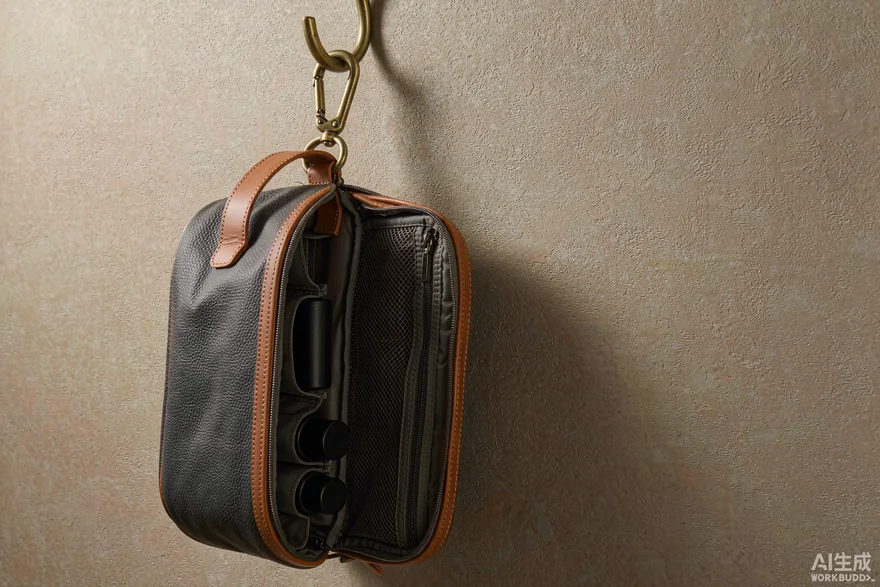
What "Waterproof" Means on a Travel Toiletry Bag
A travel toiletry bag described as waterproof is usually only water-resistant. Water-resistant means the face fabric sheds a splash or five minutes of light rain; waterproof means the assembled bag holds liquid under a stated hydrostatic head with no penetration at the seams or the closure for a stated period. The distinction matters because a toiletry bag spends its working life carrying shampoo, conditioner and serum bottles at 30-100 ml whose caps seal imperfectly, tip over in transit and press against the lining under the weight of a packed suitcase. Fabric is the easy half of the problem; the needle holes that join panels and the two ends of the zipper tape are the hard half.
- Water-resistant shell: sprays and light rain bead off for 5-10 minutes, then wet through, typically rated below 600 mm hydrostatic head.
- Water-resistant construction: the shell fabric may be 3,000 mm while the seam line leaks at effectively zero because every stitch perforates it.
- Waterproof closure: a laminated shell with a standard coil zipper leaks along the chain within 60-90 seconds of direct contact.
- Leak-proof interior: welded floor seams hold 200-400 ml of pooled liquid long enough for the traveller to reach a bathroom counter.
- Buyer shorthand: request hydrostatic head, seam method and closure type as three separate line items on the tech pack, never as one adjective.
The vocabulary buyers should insist on is millimetres of water column, grams per square metre and denier. Hydrostatic head is the height of a water column a fabric supports before the third drop penetrates; 1,500 mm is the practical floor for a toiletry bag that will sit in a hold bag under compression, 3,000-5,000 mm is comfortable for a bag that doubles as a shower or beach pouch, and above 5,000 mm adds weight and cost without protecting against anything a toiletry bag actually meets. Coated-fabric behaviour is measured under the ASTM D751 coated-fabric test methods, which cover hydrostatic resistance, coating adhesion to the base cloth and blocking; wet and dry crocking, together with abrasion resistance, sit under the AATCC test methods.
Write "hydrostatic head 3,000 mm minimum after five home launderings at 30 °C" on the tech pack, not "waterproof fabric". Post-wash values fall 15-30% on PU coatings that have not been cross-linked.
Shell Fabric, Coating and Film Options
Four shell systems cover almost every waterproof toiletry bag programme: PU-coated polyester, TPU laminate, PVC film and EVA or TPE sheet. Each trades hydrostatic performance against hand feel, cold-crack behaviour, printability and unit cost. PU-coated polyester in 300-420 denier at 190-260 g/m² is the default for printed retail pouches because it sews cleanly, takes sublimation and screen print, and lands in the lower half of the $0.45-$12.00 unit band typical of cosmetic and toiletry bags on marketplaces. TPU laminate at 0.12-0.25 mm bonded to a 210-420 denier face costs roughly two to three times as much per metre but survives flexing at low temperature and does not plasticise.
| Shell system | Construction | Hydrostatic head | Hand feel and cold behaviour | Typical unit band |
|---|---|---|---|---|
| PU-coated polyester | 300-420 denier, 190-260 g/m², single-side coating | 1,000-2,000 mm | Soft and quiet; stiffens below -5 °C | $0.90-$3.20 |
| TPU laminate | 0.12-0.25 mm film bonded to 210-420 denier face | 3,000-8,000 mm | Supple to -20 °C; hydrolysis-resistant grades rated 5+ years | $2.40-$6.80 |
| PVC film | 0.20-0.40 mm calendered, 380-620 g/m² | 5,000-10,000 mm | Firm and glossy; plasticiser migration stiffens it in 12-24 months | $1.10-$3.60 |
| EVA sheet | 0.5-1.2 mm moulded or cut-and-weld | Fully impervious | Rigid, holds shape; creases permanently if folded when packed | $2.00-$7.50 |
| TPE or silicone-coated rPET | 0.15-0.30 mm coating on recycled face cloth | 2,000-5,000 mm | Soft and matte; prints well with surface pre-treatment | $2.80-$9.00 |
Denier and coating weight interact directly with the print method a brand wants. Sublimation onto polyester above 300 denier gives a smooth, slightly glossy print surface, but the coating must be applied after printing or the dye migrates through it; screen print onto a TPU laminate needs a surface pre-treatment or adhesion fails between 20 and 30 wash cycles. Buyers running a multi-colourway programme should also note that dark pigments in PVC absorb more heat during high-frequency welding and can scorch at the weld line, which is why black panels are usually welded at a lower power setting with a longer dwell.
- Coating adhesion: below 8 N per 25 mm peel on a PU-coated cloth, the film delaminates at fold lines after roughly 3,000 flex cycles.
- Blocking resistance: a pouch folded flat in a 45 °C container for 72 hours should separate without leaving film transfer on the liner.
- Odour: PVC and low-grade PU emit measurable volatile compounds for 7-14 days after welding, so packed cartons need ventilation before delivery.
- Colour fastness to water: grade 4 minimum on the ISO 105 scale for a bag that will be wiped with a wet cloth weekly.
- Recycled claims: a monomaterial rPET shell with TPU coating is far easier to substantiate under the Global Recycled Standard than a PVC/PET laminate.
Weight is the hidden constraint. A 24 x 16 x 9 cm waterproof bag in 420-denier PU-coated polyester weighs 150-190 g empty; the same bag in 0.30 mm PVC weighs 240-300 g and in moulded EVA 320-420 g. For e-commerce sellers paying by dimensional weight, a 60 g saving per unit on a 5,000-piece order removes roughly 300 kg from the freight consolidation, which usually covers the difference between a PU and a PVC unit price on a mid-volume programme.
- Ask for hydrostatic head tested after laundering, not only on grey fabric straight off the roll.
- Specify coating adhesion in newtons per 25 mm, not as the phrase "strong bond".
- Fix weld dwell and power in the tech pack when more than one colourway is ordered.
- Budget a 7-14 day ventilation window before a retail delivery date on PVC programmes.
Seams, Closures and Zipper Specification
Seams decide whether a waterproof shell becomes a waterproof bag. A standard lockstitch at 8-10 stitches per inch punches two needle holes per stitch through face fabric, coating and liner; on a 24 x 16 x 9 cm bag with 2.4 m of seam line that is roughly 1,900 perforations. Three joining methods solve the problem: seam tape applied with a hot-air welder over the stitch line, high-frequency or ultrasonic welding that fuses the coating without needles, and a folded-and-stitched construction in which the needle line sits above the fill line of the bag.
| Seam method | How it is made | Leak performance | Cost and tooling impact | Best application |
|---|---|---|---|---|
| Stitched only | Lockstitch 8-10 spi, no tape | Leaks at needle holes in 30-60 seconds | Lowest cost, no tooling | Dry-goods pouches and outer cosmetic bags |
| Stitched plus seam tape | Hot-air tape 18-22 mm over the seam | Holds 1,000-2,000 mm at the join | Adds $0.25-$0.60 per unit and one operator step | Mid-price toiletry bags and wipe-clean liners |
| High-frequency weld | RF weld, 0.8-1.6 s dwell at 20-30 MHz | Impervious at the join, limited by film chemistry | Welding jig $400-1,800 per shape | TPU and PVC toiletry bags, clear windows |
| Ultrasonic weld | 20-35 kHz horn, 0.3-0.9 s dwell | Impervious on synthetics; fails on natural fibres | Horn tooling $600-2,200 per profile | Small welded pouches and zipper end stops |
| Moulded EVA seam | Shell moulded, lid heat-set | Impervious, with no seam line at all | Mould $3,000-9,000 per size | Structured vanity cases |
Closures are the second leak path. A standard nylon coil zipper has a textile chain that wicks water along the tape; water-resistant zippers add a polyurethane film or use a reverse-coil construction so the chain sits behind a flap, and fully waterproof zippers use a moulded tooth profile with an interlocking gasket. Zipper terminology covering chain, tape, slider, top and bottom stop and gauge is standardised under ASTM D2053, which is the reference to cite when a sample arrives with the wrong slider or with stops set 6 mm off the tape end.
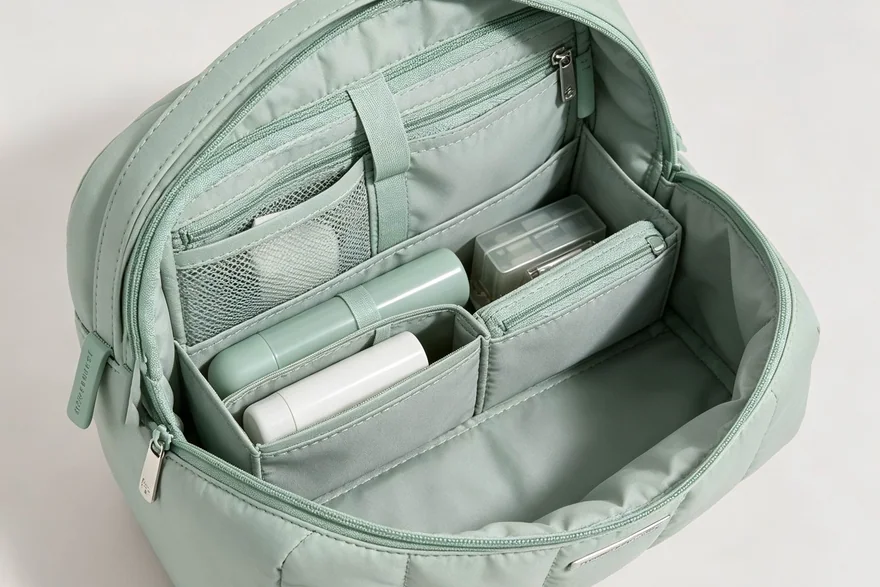
Interior geometry matters as much as the join. A welded or taped floor seam that runs 20-25 mm up the side wall turns the bottom of the bag into a tray holding 150-300 ml; a flat-stitched floor seam lets the same spill reach the seam in under ten seconds. Liner colour should be specified too: a mid-grey or pale-blue TPU liner makes a clear shampoo leak obvious during inspection and during consumer use, whereas a black liner hides residue until it starts to smell. Elasticated bottle loops at 35-45 mm diameter hold 30-100 ml bottles upright, which is the cheapest leak-prevention measure on the whole bill of materials.
- Gauge: a #5 reverse-coil with PU film is the usual spec for a 24-30 cm opening; #3 is too light for a hanging bag carrying 1.5 kg.
- Slider: an auto-lock slider holds position on a bag hung vertically, while a non-lock slider creeps open under 500 g of contents.
- End geometry: a boxed bottom stop 10-12 mm from the tape end stops the slider exiting and dumping contents into a suitcase.
- Puller: a 45-60 mm webbing pull gives wet hands grip that a 20 mm metal pull cannot match.
- Storm flap: a 12-18 mm coated flap over the zipper line removes 70-80% of splash ingress at negligible cost.
The bag passes a bench fill test but fails in a suitcase, because the zipper was tested closed and dry. Test the zipper under 300 g of side load with the bag lying on its side, which is how it actually travels.
- Seam method, tape width and weld dwell belong on the tech pack as numbers, not as the phrase "welded seams".
- Specify the zipper by gauge and type: #5 reverse-coil, PU film, auto-lock slider.
- A 20-25 mm upstand on the floor seam converts the base into a 150-300 ml containment tray.
- Pale liner colour is a quality-control feature, not a styling choice: residue has to be visible.
Leak Testing a Toiletry Bag Before Sample Approval
Sample approval for a waterproof toiletry bag should be a written protocol rather than an opinion. The protocol has four stages: fabric-level verification, a bench leak test on the assembled sample, a mechanical endurance run, and an ageing check. Fabric-level verification is the hydrostatic head and coating-adhesion report for the exact lot. Bench testing is done by the buyer on three samples from one build. Endurance covers zipper cycles and abrasion. Ageing covers the failure modes that appear after six to twelve months rather than in week one.
- Fill three samples with 200 ml of water at 20 °C, close, lay flat on absorbent paper for 24 hours, then inspect for damp patches; zero tolerance.
- Repeat inverted, suspended by the hanging hook with the zipper facing down, for four hours; this is the orientation that exposes a stitched floor seam.
- Drop test: fill to half capacity, drop from 1.2 m onto a concrete floor on each of six faces, then re-run the 24-hour flat test.
- Zipper endurance: 500 open-close cycles at roughly 300 mm per second, then re-test leak performance; a failing film-backed zipper usually shows it by cycle 300.
- Abrasion: 1,000 cycles on the base panel under a standard abradant, then re-test hydrostatic head; expect a 10-25% drop and reject anything worse.
- Ageing: 72 hours at 70 °C and 95% relative humidity for PVC and PU shells to force plasticiser migration, then flex 200 times at -10 °C.
| Test | Pass criterion | Typical failure found | What it protects |
|---|---|---|---|
| 24 h flat fill, 200 ml | No damp patch on absorbent paper | Seam tape lifted at corners | Suitcase damage and retail return claims |
| 4 h inverted hang | No drip at zipper or hook | Stitched floor seam wicks | Hanging-bag and wash-bag programmes |
| 1.2 m drop, 6 faces | No split at weld or tape | Brittle PVC cracking below -5 °C | Courier handling damage |
| 500 zipper cycles | Slider still locks, film intact | Film delamination at the chain | Repeat-use complaints |
| 70 °C / 95% RH, 72 h | No blocking, no odour above grade 3 | Plasticiser bloom and stiffening | Warehouse storage in hot climates |
Inspection of the bulk run follows the same logic at scale. AQL 2.5 under ISO 2859-1 sets the sample size and the accept-reject numbers for a given lot, and the defect list should be written specifically for waterproof builds: seam tape lift over 5 mm, weld voids longer than 3 mm, coating delamination at fold lines, zipper film separation, and any pinhole visible against a light box. A light-box check on a dark-liner bag is the fastest way to find pinholes, and it is worth running on 8-10% of cartons rather than only on the drawn AQL sample.
Programme timing stays predictable when the protocol is fixed before sampling begins. Sampling runs 6-10 working days for a standard stitched-and-taped build and 12-15 working days when welding jigs or moulded shells are involved; bulk runs 35-50 days after sample approval. Shipment is FOB Xiamen with T/T 30 deposit and 70 against bill of lading, and the minimum is 500 pieces per style and colourway, so a buyer evaluating three shell systems should budget for three separate colourway runs rather than splitting one minimum three ways.
Order the waterproof sample in the darkest colourway of the planned range. Dark pigments run hotter under weld horns and show scorching that a white sample will hide.
The B2B Customisation View
Teams developing cosmetic pouches, vanity cases and beauty organisers benefit from deciding the closure, the lining and the logo application before the pattern is drafted, because each choice constrains the next.
Standard terms: 500 pieces minimum per style and colourway, 6–10 working days for sampling (12–15 for complex builds), 35–50 days bulk production, AQL 2.5 inspection under ISO 2859-1, FOB Xiamen, T/T 30 deposit / 70 balance.
As a sourcing and programme-management company, QUANZHOU JUNYUAN BAGS holds the specification, the inspection record and the shipment schedule together, which is exactly the coordination work a single-factory relationship rarely covers.
Which Brand Types Benefit Most
Waterproof construction pays off unevenly across buyer types, so the specification should follow the business model rather than the other way round. Start-up brands usually need one hero size at 24 x 16 x 9 cm in two colourways; a stitched-and-taped PU-coated build keeps tooling near zero and unit cost between $1.10 and $3.20, which leaves margin for the photography and listing work that actually moves the first 500 units. Established brands with a seasonal range are better served by a TPU laminate at $2.40-$6.80, because the same shell supports a multi-year durability claim, a recycled-content story substantiated under the GRS, and a print surface that survives 20-30 wash cycles.
- Start-up brands: stitched-and-taped PU-coated polyester, one size, two colourways, minimal tooling spend.
- Established brands: TPU laminate with a documented post-laundering hydrostatic head and a substantiated recycled claim.
- Retailers and private label: seam tape plus a written leak protocol, because one refund costs four to six times the unit price once freight and handling are counted.
- E-commerce sellers: watch empty weight in grams, since 60 g saved per unit moves about 300 kg on a 5,000-piece consolidation.
- Gift and hospitality buyers: specify odour limits and a ventilation window rather than the maximum available waterproof rating.
Programme terms are identical whichever route a buyer takes: 500 pieces per style and colourway, 6-10 working days sampling and 12-15 for welded or moulded work, 35-50 days bulk after sample approval, AQL 2.5 under ISO 2859-1, FOB Xiamen, T/T 30 deposit and 70 against bill of lading. QUANZHOU JUNYUAN BAGS coordinates programmes of this kind as a sourcing and programme-management company, working with SGS-verified production floor space of 4,950 m² across 7 production lines and 149 machines and monthly output capacity of 200,000 pieces, with team experience in bag development and export since 2004; enquiries go to service@junyuanbags.com.
Frequently Asked Questions
What hydrostatic head rating should a waterproof travel toiletry bag carry?
For a toiletry bag that rides inside a suitcase, 1,500 mm is the working floor and 3,000 mm is comfortable. Below 1,500 mm the shell wets through when a 2 kg pile of clothing presses a damp bottle against it for an hour; above 5,000 mm the extra coating adds weight and cost without protecting against anything a toiletry bag meets. Ask for the figure after laundering, because PU coatings lose 15-30% of their head over five washes at 30 °C.
How does a TPU laminate differ from a PU coating on a toiletry bag?
PU is a liquid coating applied to the back of the cloth at 15-30 g/m² and cured; TPU is an extruded film 0.12-0.25 mm thick bonded to the face. TPU holds 3,000-8,000 mm against 1,000-2,000 mm for PU, stays flexible to -20 °C instead of stiffening below -5 °C, and resists hydrolysis. It costs roughly two to three times as much per metre and needs a surface pre-treatment before screen printing.
Why do stitched seams leak even when the face fabric is waterproof?
Because the needle perforates the coating. A lockstitch at 8-10 stitches per inch puts two holes per stitch through face fabric, coating and liner, so a 2.4 m seam line carries about 1,900 holes. Water does not need pressure to move through them; capillary action along the thread is enough. Seam tape over the stitch line, or a welded join, removes the path entirely, which is why the seam method belongs on the tech pack as a separate line item.
What denier and fabric weight suit a 500-piece leak-proof toiletry programme?
300-420 denier polyester or nylon at 190-260 g/m² is the practical window. Lighter 210-denier cloth at 140 g/m² saves about 40 g per bag but shows abrasion at the base corners within a season; heavier 600-denier at 320 g/m² adds 60-90 g and only welds cleanly at slower line speeds. At 500 pieces per style and colourway, fabric choice moves unit price far less than the seam and closure method does.
Does a waterproof zipper remove the need for seam sealing?
No. A waterproof zipper closes one of three leak paths. The shell seams and the liner floor seam remain, and a needle-perforated seam leaks even when the zipper is a moulded-tooth gasket type. Buyers who specify a waterproof zipper on a stitched shell usually find the bag fails the four-hour inverted test at the seam rather than at the chain. All three decisions are independent and each needs its own line on the spec sheet.
How long should a filled toiletry bag stay inverted before a sample is approved?
Four hours inverted is enough to expose a stitched floor seam, because wicking along the thread shows as a damp patch within 20-40 minutes when a seam is unsealed. Run it alongside a 24-hour flat fill with 200 ml: the flat test finds corner tape lift, the inverted test finds floor-seam and zipper-end leaks. Both should show zero damp transfer onto absorbent paper across three samples from the same build.
Which lining colour shows leaks fastest during inspection and in consumer use?
Mid-grey or pale blue TPU. A clear shampoo leak on black TPU is invisible until the residue dries to a haze, which in consumer use means the bag starts to smell before anyone sees the problem. Mid-grey shows a 5 ml spill as a darker patch immediately, which helps both the inspector checking 8-10% of cartons under a light box and the customer wiping the bag out. Black liners also hide pinholes.
What causes PVC film to stiffen and crack on a toiletry bag after one season?
Plasticiser migration. The plasticiser that keeps 0.20-0.40 mm PVC flexible slowly leaves the film, accelerated by heat above 40 °C and by contact with the oils and alcohol in toiletries. The film loses 20-40% of its elongation within 12-24 months and cracks at fold lines. A 72-hour ageing test at 70 °C and 95% relative humidity forces the failure in the laboratory before bulk is approved.
How does a roll-top closure compare with a zipper on a wet toiletry pouch?
A roll-top with three folds and a side-release buckle is impervious because there is no chain to wick, and it tolerates being packed wet. It costs less in materials but adds 25-40 mm of height when rolled and is slower to open, which suits a shower or beach pouch more than a daily cosmetic bag. A #5 reverse-coil zipper with PU film opens in about two seconds and lies flat.
What carton packing density applies to waterproof toiletry bags with welded seams?
Welded bags do not compress as flat as stitched ones, so plan on 40-60 pieces per export carton at 60 x 40 x 40 cm for a 24 x 16 x 9 cm bag, against 70-90 pieces for the same bag in stitched PU-coated polyester. Pack bags open rather than nested so the weld line is not creased under load for six weeks at sea. Ventilate cartons 7-14 days before a retail delivery date on PVC programmes.
How is a leak-proof toiletry bag sampled before bulk approval?
Sampling runs 6-10 working days for a stitched-and-taped build and 12-15 working days when a welding jig, moulded shell or custom zipper pull is involved. Buyers should request three samples from one build rather than a single unit, because seam tape adhesion varies across a shift. The sample should be made in the darkest planned colourway, since dark pigments run hotter under a weld horn.
What inspection level applies to seam defects on a waterproof run?
AQL 2.5 under ISO 2859-1, with the defect list written for waterproof construction rather than for general bagmaking: seam tape lift over 5 mm, weld voids longer than 3 mm, coating delamination at fold lines, pinholes visible on a light box, and zipper film separation. A generic bag checklist will pass a bag that leaks. ISO 2859-1 fixes sample size and accept-reject numbers against lot size.
Can a waterproof toiletry bag carry nail polish remover or alcohol-based liquids?
Usually not safely over time. Acetone and ethanol above roughly 40% attack PU coatings and many TPU films, softening the surface within hours and dissolving print inks. PVC resists them better but stiffens. Buyers selling into salon or professional kits should specify a chemical-resistance check, meaning 24 hours of contact with the actual formulation followed by a coating-adhesion test, rather than relying on the hydrostatic rating.
Which closure suits a hanging waterproof bag that opens flat?
A #5 reverse-coil zipper with PU film and an auto-lock slider, running around three sides so the lid folds down fully. A non-lock slider creeps open under 500 g of contents hanging vertically. Add a coated storm flap of 12-18 mm over the chain and a boxed bottom stop 10-12 mm from the tape end so the slider cannot exit. The hanging hook itself should be rated above the loaded weight of the bag.
How does a hydrolysis-resistant TPU change the ageing test plan?
It lengthens the humidity exposure that matters. Standard polyester-based TPU can lose 30-50% of tensile strength after 28 days at 70 °C and 95% relative humidity, while polyether-based hydrolysis-resistant grades hold above 80% over the same window at 20-35% more per metre. For a bag marketed as lasting several years, specify the polyether grade, extend laboratory ageing to 14 days, then flex 200 times at -10 °C and re-test hydrostatic head.
What unit price band covers a welded-seam waterproof toiletry bag?
Roughly $1.10-$7.50 within the $0.45-$12.00 band typical of cosmetic and toiletry bags on marketplaces. Position depends on the shell: PVC film and PU-coated polyester sit at the lower end, TPU laminate lands at $2.40-$6.80, and moulded EVA reaches $7.50 once the mould is amortised across 500 pieces per style and colourway. Welding jigs of $400-1,800 per shape add a fixed cost that bites hardest at low volume.
People Also Ask
Are waterproof toiletry bags really leak-proof?
Only if shell, seams and closure are all specified for water. A bag sold as waterproof often has a coated shell at 1,500-3,000 mm with needle-perforated seams and a standard coil zipper, which leaks at the seam within 30-60 seconds and along the chain within 60-90 seconds. Genuinely leak-proof builds use welded or taped seams, a film-backed or moulded-tooth zipper, and a floor seam with a 20-25 mm upstand. Ask for hydrostatic head, seam method and zipper gauge as three separate numbers.
Can a leaking shampoo bottle go inside a waterproof toiletry bag?
It can, and containing that is exactly what the bag is for, but the bag has to be built as a tray. A welded floor seam with a 20-25 mm upstand holds 150-300 ml, while a flat-stitched floor lets the same spill reach the seam in under ten seconds. Stand bottles upright in 35-45 mm elastic loops, keep cap torque consistent, choose a mid-grey liner so residue is visible, and dry the bag open within 24 hours of a spill.
How should the inside of a waterproof toiletry bag be cleaned?
Empty the bag, wipe the liner with a cloth dampened in lukewarm water and a mild pH-neutral detergent, then dry it open and away from direct heat. Avoid acetone, ethanol above 40% and bleach; all three attack PU coatings and can dissolve print inks within minutes. Do not machine-wash a welded bag above 30 °C or tumble-dry it, because the film can block. Cleaned weekly this way, the bag keeps its hydrostatic head for several seasons.
Do waterproof toiletry bags need a clear panel for airport security?
Not for leak protection, but it helps at the checkpoint. The TSA 3-1-1 rule allows containers up to 100 ml (3.4 oz) inside one transparent quart bag of roughly 18 x 20 cm. A clear TPU window of about 18 x 20 cm, or a removable clear pouch, lets a traveller present liquids without unpacking while the waterproof shell still contains spills. Many buyers pair a clear front window with an opaque welded body for exactly this reason.
Request a Sample or a Written Quotation
Send the silhouette, dimensions, material preference and logo artwork, and the programme team will return a written quotation with MOQ, sampling window, bulk lead time and inspection standard.
Email: service@junyuanbags.com · WhatsApp: +86 177 5002 0688