Toiletry Bag with TSA-Approved Clear Pouch: Built-In Compliance
Executive Summary
A toiletry bag with a TSA-approved clear pouch needs a careful definition, because the 3-1-1 rule governs the containers a passenger carries and the single clear bag they go in, not a product certification issued to a brand. What a buyer can specify is a kit whose clear pouch matches the quart-size format, whose opening lets a passenger lift the pouch out at the checkpoint, and whose printed instructions repeat the rule text rather than inventing a claim. Getting that wording right is the difference between a useful travel product and a compliance risk.
The engineering sits in the film and the attachment. A built-in pouch must keep clarity after folding, resist cold cracking on a winter trip, and stay attached through repeated removal, while a removable pouch adds a second attachment system and a second set of seams to inspect. Film choice drives most of the chemical documentation: PVC brings plasticiser questions, TPU avoids them at higher material cost. Programmes start at 500 pieces per style and colourway, sample in 6 to 10 working days and run 35 to 50 days in bulk, inspected at AQL 2.5 and shipped FOB Xiamen.
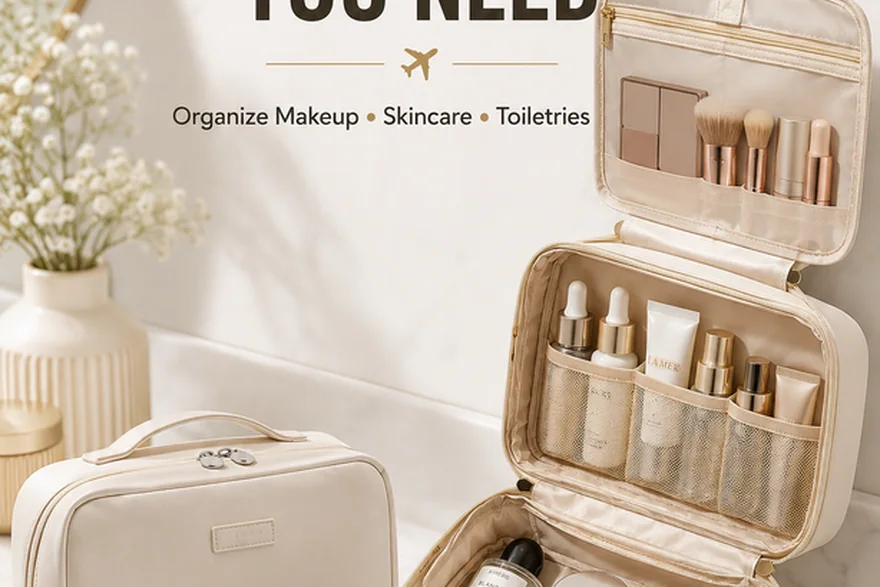
What 'TSA-approved' actually means for a toiletry bag
The phrase TSA-approved is marketing shorthand, and it is shorthand that can mislead a buyer. The liquids rule published by the Transportation Security Administration sets three conditions for carry-on liquids: containers of 3.4 ounces or 100 millilitres or less, all containers fitting in one clear quart-sized bag, and one bag per passenger. The rule describes what a traveller does at the checkpoint. It does not describe a product that any authority has certified, and no certificate exists that a brand can buy to make a kit compliant.
That distinction matters commercially. A hangtag that says TSA-approved implies a third-party endorsement that was never given, and a marketplace listing that repeats it can attract a complaint. The defensible wording describes the function instead: a clear pouch sized to hold travel containers, removable for screening, supplied with a printed card repeating the rule. Buyers should write the exact wording they want printed and require it on the approval sample, because artwork is the cheapest part of a programme and the easiest place to make a claim that later has to be withdrawn.
The TSA 3-1-1 liquids rule is also the reference point for the physical format. A quart-sized bag has a commonly used footprint of roughly 18 by 20 centimetres, though buyers should verify the current published guidance before finalising dimensions, since the defining measure is volume rather than a fixed rectangle. A pouch built to about one litre of usable volume with a flat gusset gives a passenger room for the standard set of bottles without becoming so large that it cannot be lifted out one-handed.
Demand for this format is substantial. 'travel bag for toiletries' draws roughly 110,000 monthly searches and 'toiletry bag' around 74,810 weekly searches on Amazon, and a clear-pouch version answers the specific question a traveller asks at the packing stage. Within the typical $0.45 to $12.00 unit price band reported on marketplaces, a built-in clear pouch sits in the middle, because it adds film, a second zipper and extra assembly without adding tooling.
Choosing the clear film: PVC, TPU, EVA and PEVA
The film is the component that decides how the pouch looks after three months in a suitcase. Clarity, cold flexibility, printability and chemical documentation all vary by polymer, and the differences show up in returns rather than in the sample photograph. A film that arrives bright and glass-clear can haze after contact with sunscreen, yellow after exposure to sunlight in a shop window, or stiffen into a cracked sheet after a winter trip in an unheated hold.
PVC is the cheapest and clearest option and the one with the heaviest documentation burden, because flexible PVC relies on plasticisers that fall under restriction lists in several markets. TPU costs more per metre, needs no plasticiser, and holds flexibility at low temperature, which is why it is the usual choice for a premium kit. EVA and PEVA are chlorine-free alternatives with a softer hand and slightly lower clarity, and they weld well, which suits a pouch built by high-frequency welding rather than sewing.
| Clear film | Thickness range | Clarity and hand | Documentation burden | Best fit |
|---|---|---|---|---|
| Flexible PVC | 0.20-0.40 mm | Highest initial clarity, stiff hand | Plasticiser testing required in several markets | Promotional and price-led programmes |
| TPU film | 0.15-0.30 mm | Very clear, soft, flexible when cold | Lower chemical burden, higher material cost | Premium travel kits sold on durability |
| EVA film | 0.30-0.50 mm | Slightly hazy, soft, rubbery | Chlorine-free positioning | Welded pouches and children's ranges |
| PEVA film | 0.18-0.35 mm | Clear enough, light hand | Chlorine-free positioning, thin gauge available | Mid-market kits and gift sets |
| Recycled PET film | 0.20-0.35 mm | Clear with a faint grey cast | Recycled content claim needs a transaction certificate | Programmes with a recycled-content brief |
Print on film is the third variable and the one most likely to be overlooked. A clear pouch carries a rule panel or a brand mark, and ink applied to a low-surface-energy film such as PEVA or TPU needs the right ink system or it rubs off in the first week. Buyers should specify the print method, require a rub test on the printed pouch, and confirm that the ink itself is covered by the restricted-substance declaration for the article, because the print sits on the surface a traveller handles most.
Thickness should be specified as a range with a tolerance, not as a single number. A 0.25 mm film quoted without a tolerance can arrive at 0.20 mm and still be nominally correct, and the difference is visible at the-fold line where the pouch collapses. Buyers should also specify the welding or sewing method: high-frequency welding suits PVC and EVA, while TPU can be welded or sewn, and a sewn seam in a film pouch needs a binding tape or the stitch holes will tear out under the weight of four bottles.
Film and coating performance is described in the coated-fabric standards family, and naming ASTM D751 for coated fabrics gives a buyer a shared vocabulary for testing adhesion, coating thickness and flexibility instead of relying on a supplier's internal description. The point is not to demand a full test regime on a low-cost pouch; it is to have one agreed method available when a bulk shipment does not match the approved sample.
Two TPU films of the same gauge can behave differently after contact with sunscreen or after a cold night in a car. Requiring the film grade to be declared in the specification makes a mid-programme substitution detectable, and a buyer who stores the declared grade against the style number can compare it against the next reorder rather than trusting a visual match.
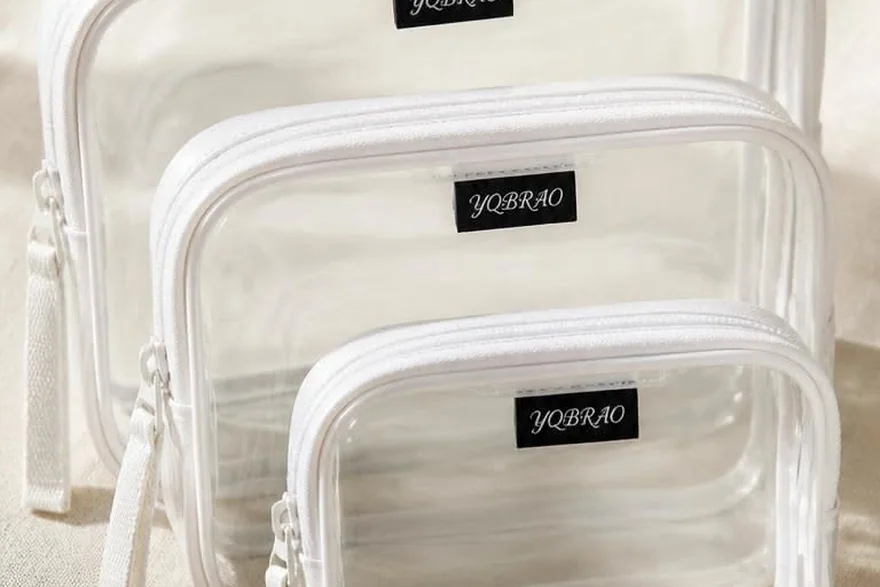
Built-in versus removable pouch: layout and attachment
A toiletry bag with a clear pouch can hold that pouch permanently or let it come out. A built-in pouch is sewn or welded into the lining, usually against the back panel or inside the main compartment, and is opened by its own zipper. A removable pouch attaches by a snap tab, a short webbing tether with a press stud, or a hook-and-loop patch, and comes away so a passenger can hand it over at the checkpoint. Each approach suits a different retail proposition.
The built-in version is cheaper and reads as an integrated product, but it fails at the checkpoint in one specific way: if the pouch cannot be lifted clear, a passenger has to unpack it into a tray, which is the exact task the product was bought to avoid. The removable version solves that, at the cost of an attachment that itself becomes a failure point. A press stud that pops open inside a suitcase releases the pouch and its contents into the main compartment, and a hook-and-loop patch loses grip once it is loaded with lint.
Layout should be planned around the order of use. The pouch goes on the side a passenger reaches first, which for a hanging kit is usually the front panel below the hook. Bottles stand upright in the main compartment, so the base needs either a stiff board or a shaped gusset. A mesh pocket above the pouch holds items that are not liquids, so a passenger is not tempted to overfill the clear section beyond the quart capacity.
- Specify pouch volume around one litre of usable space with a flat gusset, and verify the current published quart-bag guidance before locking dimensions.
- Give the pouch its own zipper, ideally with a puller in a contrasting colour so it is findable in a hurry.
- Choose a removable attachment that cannot release under side load: a webbing tether with a covered press stud beats a hook-and-loop patch.
- Keep non-liquid items out of the clear section by planning a mesh pocket beside it, not above it.
- Print the rule summary on a card sewn into the kit, and require the exact wording on the approval sample.
Attachment geometry deserves the same attention as the film. A tether sewn into a single layer of 210D lining will tear out; capturing it under a 6 by 6 centimetre reinforcement patch, with the box stitch extending onto the patch, moves the failure load up without adding meaningful cost. Where the outer shell is a coated fabric, the tether should be welded or captured in the binding rather than sewn through the coating, because a needle hole through a coating is a leak path for any spilled liquid.
There is a version question worth settling early. A brand wanting one body sold as a standard kit and a compliant kit can keep the outer shell identical and change only the internal pouch, which keeps fabric commitments and tooling shared. That only works if the pouch is a separate sub-assembly rather than welded into the lining, so the decision has to be made before the sample is built, not after the first bulk order is placed.
Documentation, testing and shipment checks
A clear-pouch kit carries two parallel documentation tracks that are easy to confuse. The first is travel-rule wording, which is a marketing-accuracy question answered by the brand's own copy and artwork. The second is chemical and physical compliance, which is answered by test reports from a laboratory. A buyer who treats the first as a certification will ask the wrong supplier for the wrong document, and a buyer who ignores the second will find a marketplace listing suspended for a reason that has nothing to do with travel.
| Document or check | What it covers | Who can issue it | When it is needed |
|---|---|---|---|
| Rule wording on hangtag and card | Accuracy of any liquids-rule claim on packaging | The brand, checked internally | Before artwork approval |
| Plasticiser or phthalate test on PVC film | Restricted substances in the clear film | Third-party laboratory | Before bulk, per film batch |
| REACH declaration for the article | Substance restrictions for the EU market | Supplier declaration plus laboratory report | Before first shipment to the EU |
| CPSIA check for children's ranges | Lead and phthalates in accessible parts | Third-party laboratory | Before US shipment of a children's item |
| OEKO-TEX Standard 100 for textiles | Shell fabric, lining and webbing, not the film | Certification body | When a textile claim is made |
| AQL 2.5 inspection report | Workmanship defects across the shipment | Inspection body under ISO 2859-1 | Final random inspection |
| Carton and packing declaration | Piece count, carton size, gross weight | The programme coordinator | At quotation stage |
Film-specific defects need their own line in the inspection classification. Typical problems include haze or whitening at the fold line, a welded seam that peels when the pouch is opened cold, a zipper that catches on the film because the tape was set too close to the teeth, print that rubs off a coated surface, and a pouch that is set crooked against the lining so the zipper track curves. Each of these is visible to a trained inspector at the final random inspection set at AQL 2.5 under ISO 2859-1, but only if it appears on the defect list.
Restricted-substance questions on the film should be answered by a laboratory report rather than a supplier letter. Flexible PVC is the film where this matters most, and a buyer can specify a phthalate screen on the film and on any print ink applied to it. Where the kit is sold into the EU, the declaration should reference EU REACH; where it is sold to children in the United States, the accessible components are assessed under CPSIA limits. Neither is satisfied by a textile certificate alone.
Programme timings follow the standard path. Sampling runs 6 to 10 working days for a clear-pouch kit, extending to 12 to 15 working days where the pouch is welded and the tooling for the weld die is not yet available, and bulk production runs 35 to 50 days after sample approval at 500 pieces per style and colourway. Shipment terms are FOB Xiamen with payment T/T 30 deposit and 70 against bill of lading. A buyer planning a travel-season launch should work backwards from the shelf date, allowing the sampling window, the approval loop and the bulk window before the freight leg.
The B2B Customisation View
Every programme for cosmetic bags begins with a written brief: target retail price, filling volume, closure type, print method and the compliance market the goods will be sold in.
Commercial parameters stay fixed across the range: MOQ 500 pieces per style and colourway, prototype turnaround 6–10 working days (extended to 12–15 for multi-panel or moulded builds), bulk lead time 35–50 days from approved sample, AQL 2.5 inspection to ISO 2859-1, FOB Xiamen, T/T 30 deposit and 70 against bill of lading.
Working as a sourcing partner rather than a single-line vendor means QUANZHOU JUNYUAN BAGS can move cosmetic bags between construction types — woven, coated, leather-look — without restarting the compliance conversation.
Which Brand Types Benefit Most
The clear-pouch kit suits buyers whose customers travel, and the fit is strongest where the product has to explain itself on a crowded shelf. A start-up brand launching a single travel kit gains a functional story that does not depend on brand recognition: the pouch lifts out, the bottles are already sorted, the rule is printed on the card. That story has to be accurate, so the wording should be reviewed before artwork is locked rather than after the first container ships.
- Established brands: adding a clear-pouch variant to a proven hanging kit tests travel positioning on one colourway at 500 pieces before a wider commitment.
- Retailers and catalogue buyers: a built-in pouch photographs well when it is opened for the shot, but the pack must show the pouch removed or the benefit is invisible.
- E-commerce sellers: the listing should state pouch volume, whether the pouch is removable and the film type, because 'TSA-approved' alone invites both scepticism and return requests.
- Gift and hospitality buyers: a kit with a printed rule card reads as considered rather than generic, and works as a welcome amenity for long-stay or international guests.
- Corporate and airline-adjacent programmes: a removable pouch with a declared film grade and a laboratory report survives a procurement review that a pouch without documentation does not.
A sixth group is the buyer supplying a regulated channel, such as an airline amenity kit or a corporate travel programme, where a procurement reviewer asks for the film declaration and a laboratory report before approving anything. For that buyer the documentation is not an optional extra; it decides whether the programme proceeds, and it should be requested at quotation stage rather than discovered during the approval loop. The common thread across all of these groups is documentation discipline. A toiletry bag with a clear pouch is not a difficult product to build, but it is a product where the claims on the packaging have to match what the pouch actually does, and where the film has to be declared and tested. Buyers who settle the wording, the film grade and the attachment method before sampling spend less on rework than buyers who discover all three at the final inspection.
Frequently Asked Questions
Can a toiletry bag be officially TSA-approved?
No product certification of that kind exists. The 3-1-1 rule sets conditions for the containers a passenger carries and the single clear quart-sized bag they fit in, and it describes traveller behaviour rather than approving a physical product. A buyer can build a kit that makes compliance easier by supplying a correctly sized removable pouch, but the wording on the packaging should describe the function rather than claim an endorsement.
What size should the clear pouch be on a toiletry bag?
The defining measure is volume rather than a fixed rectangle, and the commonly used quart-bag footprint is roughly 18 by 20 centimetres. A pouch with about one litre of usable space and a flat gusset holds a standard set of travel bottles while staying liftable with one hand. Buyers should verify current published guidance before locking dimensions, and should state the tolerance on the pattern.
Should the clear pouch be built in or removable?
Removable is the more useful design, because a pouch that stays inside the bag forces a passenger to unpack it at the checkpoint, which is the task the product was bought to avoid. Built-in is cheaper and looks integrated. Where the pouch is removable, the attachment should be a webbing tether with a covered press stud rather than hook-and-loop, which releases under side load and collects lint.
Which clear film is best for a toiletry bag pouch?
TPU is the usual premium choice: it is clear, flexible at low temperature and needs no plasticiser, which simplifies chemical documentation. PVC gives the highest initial clarity at the lowest material cost but carries a plasticiser testing burden. EVA and PEVA suit chlorine-free positioning and weld well. The decision should be made on total cost including the documentation, not on material price alone.
What film thickness should be specified for a clear pouch?
Specify a range with a tolerance rather than a single figure. TPU is commonly specified at 0.15 to 0.30 mm and PVC at 0.20 to 0.40 mm. Without a tolerance, a 0.25 mm film can arrive at 0.20 mm and still be nominally correct, with visible whitening at the fold line. The seam method matters too, because a sewn seam in thin film needs binding tape.
Does the clear film on a toiletry bag need chemical testing?
It should have a laboratory report, particularly if it is flexible PVC, where plasticisers fall under restriction lists in several markets. A phthalate screen on the film and on any print ink applied to it is a reasonable specification. A textile certificate such as OEKO-TEX Standard 100 covers fabric and webbing but not the film, so the two documents must be requested separately.
What is the 3-1-1 rule and how should it appear on packaging?
It describes containers of 3.4 ounces or 100 millilitres or less, all fitting in one clear quart-sized bag, one bag per passenger. The safest packaging approach is to repeat the rule as information and describe what the product does, rather than printing a claim of approval. Buyers should write the exact wording into the brief and check it on the approval sample before artwork is released.
How is a clear pouch attached inside a hanging toiletry bag?
The pouch usually sits on the front panel below the hook so a passenger reaches it first. Attachment is by a short webbing tether with a press stud, a snap tab, or a welded flange in the lining. Whichever is used, the anchor should be captured under a reinforcement patch of around 6 by 6 centimetres, because a tether sewn through a single lining layer tears out.
What defects are specific to clear-pouch toiletry bags?
Typical issues are haze or whitening at the fold line, a welded seam that peels when opened cold, a zipper that catches on the film because the tape sits too close to the teeth, print that rubs off a coated surface, and a pouch set crooked so the zipper track curves. None of these appear on a standard pouch defect list, so the classification needs rewriting for the construction.
What minimum order applies to a toiletry bag with a clear pouch?
Programmes start at 500 pieces per style and colourway. A clear-pouch version counts as its own style when the body carries different internal construction, so a brand wanting the same shell in three colourways with the pouch is committing to 1,500 pieces. Sampling runs 6 to 10 working days, extending to 12 to 15 where a weld die has to be made, then 35 to 50 days bulk.
Can a clear pouch be made with recycled content?
Recycled PET film is available and a recycled-content claim can be made under the Global Recycled Standard or the Recycled Claim Standard, provided the film supplier holds a valid scope certificate and a transaction certificate is requested for the purchase. The claim covers the film and not the zipper, print ink or shell fabric, so hangtag wording has to be precise about what percentage of what component.
How should a clear pouch be packed for shipment?
Film creases permanently if it is folded under weight for weeks, so pouches should be packed flat or lightly rolled, with tissue between film surfaces to prevent blocking. A silica sachet helps in humid transit. Buyers should state the packing method in the purchase order and ask for carton size, piece count and gross weight at quotation stage so freight cost is visible before the order is placed.
Which zipper suits a clear pouch on a toiletry bag?
A #3 or #4 coil chain suits a pouch of this size, and the tape colour should be matched to the film so the seam does not look grey. The important specification is the tape position relative to the teeth, because a tape set too close causes the slider to catch on the film. Naming the chain type and gauge using standard zipper terminology avoids an unenforceable quality description.
Does a clear pouch affect the shelf life of the product?
Film ages, and the visible signs are yellowing after light exposure, stiffening in cold storage and haze where the pouch has been folded. Choosing TPU over PVC reduces yellowing, and specifying a UV-stable grade reduces it further. Retailers holding stock in a sunny window display should be told the limitation, since it is a storage condition rather than a workmanship defect.
How does a removable pouch change inspection cost?
A removable pouch adds a second attachment system and a second set of seams, so the inspection checklist lengthens and the inspection takes longer per carton. The added time is small per unit and worth it, because attachment failure is the defect most likely to produce a return. Buyers should budget for the checklist change rather than reusing a flat-kit classification at AQL 2.5.
What wording should be avoided on a TSA toiletry bag listing?
Avoid stating or implying that a government body has approved, certified or endorsed the product. Descriptions that name the 3-1-1 rule as information and describe the pouch as removable and quart-sized are defensible. Any wording that suggests guaranteed screening outcomes should also be avoided, since checkpoint decisions rest with the officer and the traveller's packing, not with the bag.
People Also Ask
Is a TSA-approved toiletry bag actually a real certification?
No. The 3-1-1 rule describes what a traveller may carry: containers of 3.4 ounces or 100 millilitres or less, all in one clear quart-sized bag, one bag per passenger. There is no product certification a brand can purchase. A kit can make compliance easier by including a correctly sized removable pouch, and the packaging should describe that function rather than claim an endorsement that was never given.
Do you have to take the clear pouch out of a toiletry bag at security?
If the pouch is removable and a passenger can lift it clear, that is the whole point of the design. If it is sewn or welded into the lining, the contents have to be transferred at the checkpoint, which is the task the product was bought to avoid. This is the single strongest argument for specifying a removable attachment rather than a built-in one.
What is the difference between PVC and TPU clear pouches?
PVC is cheaper and gives the highest initial clarity, but flexible PVC relies on plasticisers that carry a testing burden in several markets. TPU costs more per metre, needs no plasticiser and stays flexible when cold, which matters on a winter trip. For a premium kit sold on durability, TPU usually costs less overall once documentation, testing and returns are counted together.
Can you put non-liquid items in the clear pouch?
Space is limited to roughly one quart of usable volume, so non-liquids crowd out the bottles the pouch exists to hold. A better layout puts a mesh pocket beside the pouch for solids such as a toothbrush, a razor or a hair tie. Overfilling the clear section is a common cause of a pouch that will not close flat at the checkpoint.
How big is a quart-sized bag in centimetres?
The commonly used footprint is roughly 18 by 20 centimetres, though the defining measure is volume rather than a fixed rectangle. Sizing a pouch to about one litre of usable space with a flat gusset gives room for a standard travel bottle set while keeping the pouch liftable one-handed, which matters when a passenger is holding a boarding pass at the same time. Verify current published guidance before locking a pattern.
Request a Sample or a Written Quotation
Send the silhouette, dimensions, material preference and logo artwork, and the programme team will return a written quotation with MOQ, sampling window, bulk lead time and inspection standard.
Email: service@junyuanbags.com · WhatsApp: +86 177 5002 0688