Frequently Asked Questions: Toiletry Bag Travel & TSA Rules (14 Q&A)
Executive Summary
Toiletry bag travel questions almost always resolve to one published screening rule and one design consequence. The rule is the 3-1-1 liquids rule issued by the US Transportation Security Administration: containers of 3.4 ounces or 100 millilitres or less, all fitting into one quart-sized clear bag, one bag per passenger, presented separately at the checkpoint. The design consequence is that a travel toiletry bag is a container for a container, and its useful internal volume, its closure and its clarity matter more than its outer dimensions. Medications and some other items are treated differently, and the published rule should be read directly rather than from memory.
The second point buyers and travellers both need is that these rules change. Limits, exemptions and screening procedures have been revised before, and different countries apply their own versions, so the current official guidance for the departure airport should be checked before flying. For a brand, the stable design targets are: a clear or semi-clear panel that survives cold, a closure that reseals repeatedly, welded seams that will not split at the corner, and a volume that holds a quart bag with room to spare.
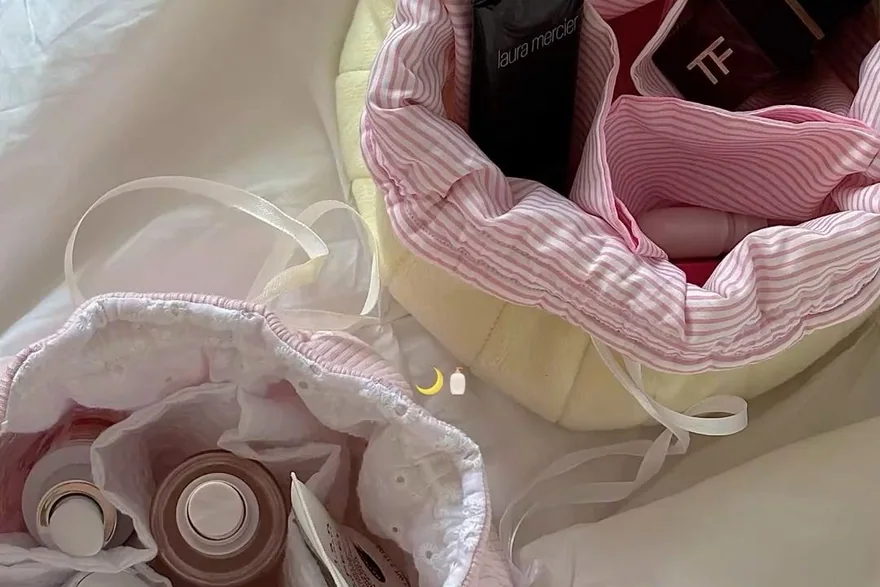
Why the liquids rule shapes travel toiletry bag design
Airport security screening treats liquids, gels and aerosols differently from dry goods, because the screening technology used for carry-on baggage cannot resolve the contents of an opaque container as easily as it resolves solid items. The practical result, published by the US Transportation Security Administration as the 3-1-1 liquids rule, is that passengers travelling with carry-on liquids must pack them in small containers held together in a single clear bag and present that bag separately. The full text should be read at the official liquids rule page, since it is the authority's own statement and it is updated.
For a bag designer, the rule creates an unusual constraint: the product is judged on how well it holds a different bag. A travel toiletry kit that cannot accommodate a quart-sized resealable bag upright, or that cannot be opened quickly at a checkpoint table, fails at the moment the traveller most needs it. This is why the internal clear compartment, rather than the external styling, is the specification that decides whether a travel bag is genuinely usable, and why clear-panel and fully clear designs dominate this part of the category.
Market demand reflects it. Search data for travel toiletry bags runs at roughly 110,000 monthly searches for terms such as travel bag for toiletries, and toiletry bag itself attracts around 74,810 weekly searches on the largest marketplace. Much of that demand is driven by travellers replacing a bag that failed at a checkpoint or in transit. A brand entering this category is therefore competing on a fairly narrow set of functional attributes: clarity, closure reliability, wipe-clean interior, and a volume that matches the rule without wasting packing space.
For a brand, the useful observation is that the structure of the rule is stable even while the detail moves. The per-container limit, the single clear bag and the separate presentation have been the working framework for years; what changes is the fine print. Designing a bag that works within the structure, and wording marketing copy so it does not pretend to state the rule, produces a product that stays sellable through revisions.
Reading the 3-1-1 rule as a bag specification
The rule has three numbers and each of them converts into something a bag designer can act on. The first is the container limit, meaning individual bottles and tubes must be at or below the stated volume. The second is the bag limit, meaning all of those containers go into one clear bag. The third is the passenger limit, meaning one such bag per traveller. Together they define a fixed payload that a travel toiletry bag either accommodates comfortably or does not.
| Element of the rule | What it constrains | Design implication for a toiletry bag | What to confirm |
|---|---|---|---|
| Container size limit | Each bottle, tube or aerosol | Internal loops and pockets sized for travel-format bottles, not full-size ones | The current published container limit, read from the authority's own page |
| One bag for liquids | All containers together in a single bag | A dedicated clear compartment sized to hold a quart bag upright | Whether the compartment is removable or fixed in the design |
| One bag per passenger | How much liquid a traveller carries | Volume optimised for one person, not for a family set | Whether the brand is selling a single or a multi-bag set |
| Separate presentation | The bag comes out of the carry-on | Quick-release access, no buried zip, clear identification at a glance | Whether the closure can be opened one-handed at a table |
| Exempt categories | Medications, some medical and infant items | Space for items that are declared separately rather than packed with toiletries | The current exemption list and its screening procedure |
Quart size is the dimension that gets quoted most often and understood least. A quart is a volume, roughly a litre, so the relevant figure for a bag is capacity rather than a fixed rectangle. In practice the clear bags sold for this purpose sit around 18 cm by 20 cm, with a gusset that may or may not be present. A travel toiletry kit designed around a clear compartment of about 20 cm by 15 cm by 7 cm will hold that payload with room for a toothbrush and a razor, which is what most travellers actually carry alongside the liquids.
The distinction between gels, aerosols and solids also matters and is a frequent source of confusion. The rule speaks to liquids, gels and aerosols, which brings items such as toothpaste, hair gel, shaving foam and cream foundation within scope. Powder, stick deodorant and bar soap generally sit outside it, though screening officers retain discretion and a traveller should expect the published guidance to be the reference point. A bag specification cannot resolve this; only a clear compartment and a traveller who has read the current rule can.
- Treat the quart bag as the payload, and size the clear compartment around it.
- Keep the clear compartment accessible without unpacking the whole kit.
- Specify a closure that reseals after repeated opening at a checkpoint.
- Use welded or high-frequency seams on film compartments, since stitched film leaks at the needle holes.
- Direct customers to the authority's own page rather than restating the rule in marketing copy.
It is also worth stating what the rule does not do. It does not set a size for the toiletry bag itself, and it does not limit how many dry items a traveller carries. Buyers sometimes design to an imagined regulated outer dimension, which produces a bag smaller than the market wants. The real outer constraint is the airline's carry-on allowance, which the bag has to fit inside alongside everything else.
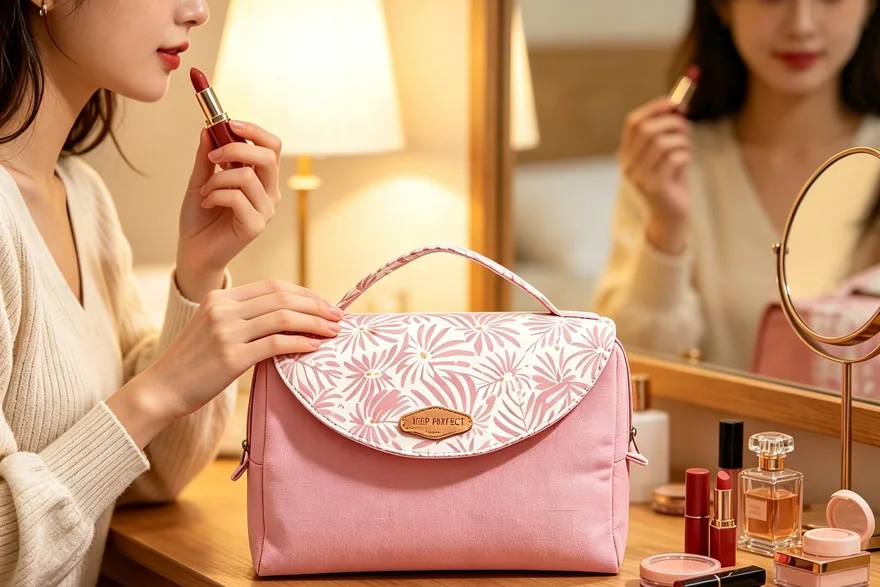
What a clear travel toiletry bag has to get right
Clarity is the obvious requirement and the least interesting one. The interesting requirements are the ones that decide whether the bag still works after a year: film flexibility at low temperature, seam integrity, closure cycle life, and resistance to the product that will inevitably leak inside it. A clear PVC bag that has been folded in a cold car boot will crease permanently and, in cold enough conditions, crack along the crease. That is a material property, and it is the reason TPU and PEVA appear in this category alongside PVC.
- Film: TPU for cold flexibility and clarity retention; PVC for cost; PEVA for a softer hand and lower odour.
- Seams: high-frequency or heat welded on film compartments, since needle holes become leak paths.
- Closure: a zip that survives repeated opening, with a puller large enough to grab quickly.
- Clarity retention: resistance to haze after contact with sunscreen and oils, which cloud PVC quickly.
- Cold behaviour: no cracking or permanent creasing after folding at low temperature.
- Interior: wipe-clean surfaces, since a leak inside a fabric-lined compartment cannot be fully removed.
Coated and film materials used for these compartments are covered by coated-fabric test standards such as ASTM D751, which address coating adhesion, hydrostatic resistance, blocking resistance and low-temperature bend. The last of those is directly relevant to a clear toiletry bag: a film that passes at room temperature can fail a low-temperature bend test, and a bag that fails in a cold vehicle at the start of a trip is a returned bag. Requesting the low-temperature result alongside a clarity specification is a reasonable and specific ask.
Closure choice is the second failure point. A clear quart bag inside a larger kit is opened and closed several times per trip, at a checkpoint and again in a hotel bathroom. A fine-gauge zip with a small puller is the cheapest option and the most annoying to use with wet hands. A #5 coil zip with a moulded puller, or a slider with a cord extension, costs slightly more and materially improves the experience. Where the bag is a hanging kit, the hook is the third failure point and should be specified for load and for cycle life rather than bought to a price.
Construction for this category runs on the same programme structure as any other bag: 500 pieces minimum per style and colourway, sampling in 6-10 working days or 12-15 working days for complex constructions with welded film compartments and moulded hardware, and bulk production in 35-50 days after sample approval. Inspection at AQL 2.5 under ISO 2859-1 should include seam integrity and closure function in the defect classes checked, since those are the two failures that generate returns in travel bags.
Odour is a smaller but real specification point. PVC film can carry a plasticiser smell that a customer notices immediately on opening the package, and it is a frequent cause of negative reviews on low-cost clear bags. Specifying PEVA or TPU, or requiring the film to be checked for odour on receipt, prevents a complaint that is cheap to avoid and expensive to refund.
What varies by country, and why the rules change
The most important sentence in this article is also the simplest: screening rules change, and they are not identical everywhere. The 3-1-1 framework is a US publication and other civil aviation authorities issue their own guidance. Many follow a broadly similar structure, with a per-container limit and a single bag, but the container limit, the bag size, the exemptions and the screening procedure can differ, and airports within one country can operate under different equipment capabilities that change what has to come out of the bag.
| Aspect | What is commonly similar | What commonly differs | What the traveller should do |
|---|---|---|---|
| Per-container limit | A small maximum volume per bottle or tube | The exact volume and whether it is stated in millilitres or ounces | Check the departure airport's own published limit |
| The liquids bag | One transparent resealable bag per passenger | Stated size, whether it must be resealable, whether it is provided at the airport | Carry a spare quart bag in the carry-on |
| Presentation at screening | Liquids bag presented separately from the carry-on | Whether laptops and electronics must also come out | Follow the officer's instruction at the checkpoint |
| Exemptions | Medications and infant items treated more flexibly | The list of exempt items and the declaration procedure | Declare exempt items before screening begins |
| Equipment capability | X-ray and, increasingly, computed tomography scanners | Whether liquids must be removed at a particular airport | Expect the requirement to differ between airports on one trip |
For a brand, the correct response is to design for the common structure and to avoid printing a compliance claim that cannot be true everywhere. A bag described as TSA approved implies a certification that does not exist for this product category; the accurate statement is that the bag is designed to hold liquids in the way the published rule describes, with a clear compartment sized for a quart bag. Marketing copy that overstates compliance creates a liability and, more prosaically, a wave of returns from travellers who were stopped at a checkpoint.
The practical advice to put on a hangtag or a product page is therefore procedural rather than declarative. Tell the traveller to check the current official guidance for the airports on the itinerary before flying, to keep the clear compartment accessible, to expect that a screening officer may ask for the bag to be opened, and to treat any printed summary as a starting point rather than an authority. That framing is accurate in every market and remains accurate after the next revision, which is more than can be said for any fixed statement of the rule.
Retail and marketplace copy deserves the same care as the bag. Claims such as compliant, approved or airport-safe overstate what a bag can guarantee, because no authority certifies toiletry bags in that way. Accurate copy describes the design instead: a clear compartment sized for a quart bag, a wipe-clean lining, a closure that reseals. That wording is defensible everywhere and stays defensible after the next revision.
The practical checklist for a traveller is short and worth printing on a hangtag or an insert card: check the current official guidance for every airport on the itinerary, keep liquids in the clear compartment, expect to present it separately, declare exempt items before screening begins, and treat any printed summary as guidance rather than authority. A brand that gives that advice is giving something genuinely useful.
The B2B Customisation View
Launch calendars are unforgiving, so cosmetic pouches, vanity cases and beauty organisers programmes are planned backwards from the on-shelf date rather than forwards from the first sketch.
Fixed commercial parameters: 500 pieces per style and colourway minimum, first sample in 6–10 working days (12–15 for complex or hardware-intensive constructions), bulk 35–50 days after approval, AQL 2.5 inspection under ISO 2859-1, FOB Xiamen, T/T 30/70.
A sourcing and programme-management company is answerable for the whole file, not just the sewing, which is why inspection reports and compliance documents are issued with every shipment.
Which Brand Types Benefit Most
Travel toiletry bags reward a specific kind of thinking, and the payoff differs by buyer. A start-up brand entering travel usually wins by solving the checkpoint moment properly rather than by styling, because the reviews that matter mention whether the bag got through security easily. An established brand extending into travel needs the bag to survive scrutiny beside its core range, which usually means upgrading the closure and the film rather than the outer fabric. Retailers building a travel aisle care about dimension discipline, since a kit that is 3 cm too tall costs shelf facings across a whole planogram. Retailers building a travel aisle have a third constraint, which is dimension discipline: a kit that is three centimetres too tall costs facings across an entire planogram, so packed dimensions should be fixed before artwork is approved. E-commerce sellers meet the same issue through imagery, because the buyer's central doubt is whether the quart bag actually fits, and only a photograph of the bag loaded and open answers it. Gift and hospitality buyers prioritise amenity practicality: neutral styling, wipe-clean interiors, and a bag that looks appropriate in a room rather than on a shelf. Where a programme repeats, the same clear compartment dimensions should be reused, so replacement stock matches what customers already own and review history carries over without complaint.
- Start-up brands: solve the clear-compartment access problem first; it drives review scores more than styling does.
- Established brands: specify film and closure to the house standard, since those are what fail in use.
- Retailers: fix the packed dimensions for shelf and peg layout before artwork is approved.
- E-commerce sellers: photograph the bag open and loaded, because the payload question is the top buyer doubt.
- Gift and hospitality buyers: choose wipe-clean interiors and neutral styling for amenity and gifting programmes.
Frequently Asked Questions
What does the 3-1-1 liquids rule actually require?
It requires that liquids, gels and aerosols in carry-on baggage are in containers at or below the stated per-container limit, that all those containers fit into one quart-sized clear bag, and that each passenger carries one such bag, presented separately at the checkpoint. The rule is published by the US Transportation Security Administration and should be read at its source, because the detail and the exemptions matter and the guidance is revised from time to time.
What size is a quart-sized bag for carry-on liquids?
A quart is a volume, roughly a litre, so the rule constrains capacity rather than a fixed rectangle. Clear bags sold for the purpose commonly measure around 18 cm by 20 cm, sometimes with a small gusset. A travel kit designed with a clear compartment of about 20 cm by 15 cm by 7 cm will hold that payload plus a toothbrush and a razor, which is what most travellers actually pack.
Does the toiletry bag itself have to be clear?
The published rule requires the liquids to be in a clear bag, which in practice is a resealable quart bag. A larger opaque travel kit is fine as long as the clear liquids bag can be reached and presented separately. This is why many travel kits include a dedicated clear compartment or a removable clear pouch, so the passenger is not unpacking the whole kit at the checkpoint table.
Do solid cosmetics count as liquids under the rule?
Powder, stick and bar products generally sit outside the liquids definition, while creams, gels, pastes and aerosols fall inside it. Foundation in a liquid or cream form is treated as a liquid; pressed powder is not. Screening officers retain discretion over any item, so a traveller should follow the published guidance and expect that an unusual product may be inspected individually regardless of how it is classified.
Which items are exempt from the liquids container limit?
Medications and certain medical and infant items are commonly treated more flexibly than toiletries, but they usually have to be declared and may be screened separately rather than packed with the rest. The exempt list and the procedure differ by country and are revised over time, so the current official guidance for the departure airport is the only reliable reference, and it should be checked close to the travel date.
Can a hanging toiletry bag go through airport security?
Yes, but it must be packed so the clear liquids bag can be removed quickly, and the hook should be folded flat so it does not obstruct the X-ray image. A hanging kit with a buried internal liquids pocket is a poor checkpoint design. The practical specification is one clear compartment reachable without unpacking the rest, plus a hook that stows without adding bulk.
What bag dimensions work best for a quart liquids bag?
Around 18 cm by 20 cm for a dedicated flat quart bag, and roughly 20 cm by 15 cm by 7 cm for a clear compartment inside a larger kit. Anything materially smaller will not close around the containers; anything much larger wastes packing volume inside a carry-on. Where the kit is sold with bottles, the compartment should be sized around those specific bottles rather than around a nominal quart.
Why do some clear bags crack or haze after a few trips?
Two separate causes. Cracking in cold conditions is a film property: PVC stiffens as temperature falls and creases permanently when folded cold. Haze is caused by product contact, since sunscreens and oils cloud PVC quickly. TPU resists both better, and PEVA offers a softer hand at lower cost. Specifying the film by name and asking for a low-temperature bend result addresses the first problem directly.
Does the liquids rule apply to checked luggage as well?
The 3-1-1 rule applies to carry-on baggage. Checked baggage has different restrictions, and some items such as aerosols and flammable products are restricted or prohibited in checked bags rather than in carry-on. Because the two regimes differ and both are revised periodically, the current official guidance for the specific journey should be checked rather than assumed from a previous trip.
Do international airports use the same liquids limits?
Many countries operate a broadly similar framework with a per-container limit and a single bag, but the container volume, the bag size, the exemptions and the screening procedure are not universal. Airports within one country can also differ, since scanner capability changes what has to be removed. The traveller should check the current published guidance for each departure airport on the itinerary.
How often do liquids screening rules change?
There is no published schedule. Limits, exemptions and procedures have been revised before and scanner technology changes what has to be presented, so any fixed statement in a product description eventually goes out of date. The reliable practice is to check the authority's own page before each trip and to word product copy procedurally, directing travellers to official guidance rather than restating the rule.
Can medication exceed the container limit?
Medication is generally treated differently from toiletries, but it typically needs to be declared and screened separately, and the procedure varies by country and by airport. Liquid medication over the standard container limit should be declared at the checkpoint rather than packed with the quart bag. Travellers with medical supplies should confirm the current procedure with the relevant authority in advance.
Where should the quart bag be placed during screening?
It should be accessible and presented separately from the carry-on, as the published rule describes, rather than buried at the bottom of a packed kit. Travellers should follow the officer's instruction at the checkpoint, since procedure can vary with the equipment in use. A bag design that allows one-handed access to the clear compartment makes this step considerably faster.
What should a brand specify when ordering a clear travel toiletry bag?
Film type by name, thickness, and a low-temperature bend result; welded rather than stitched seams on any film compartment; zipper gauge and puller design; whether the clear compartment is removable; and packed dimensions. Programmes run on 500 pieces minimum per style and colourway, with complex welded and moulded builds sampling in 12-15 working days rather than 6-10.
People Also Ask
Do I have to take my toiletry bag out at airport security?
The clear liquids bag generally has to be presented separately from carry-on baggage under the US rule, and a screening officer may ask for anything else to be produced. Whether electronics must also come out depends on the airport and the scanner in use. The safe habit is to pack the liquids bag at the top of the carry-on and to follow the instruction given at the checkpoint.
Can I bring full-size shampoo in checked luggage?
Carry-on limits on liquids do not apply in the same way to checked baggage, but checked baggage has its own restrictions, particularly on aerosols and flammable products. Because both regimes are revised periodically and differ by country, the current official guidance for the airline and the route should be checked rather than relying on a remembered rule from a previous trip.
What size toiletry bag is allowed on a plane?
There is no single regulated outer dimension for a toiletry bag; the regulation applies to the liquids inside it. The practical constraint is the airline's carry-on allowance, which the bag has to fit within alongside everything else. A clear compartment around 18 cm by 20 cm covers the usual quart payload, and the overall kit should stay within the airline's stated carry-on dimensions.
Are airport liquids rules the same in every country?
No. The general structure of a per-container limit and one bag is widely used, but the stated volumes, the bag sizes, the exemptions and the screening procedures differ by country, and can differ between airports within one country. Screening rules are also revised over time. Checking the official guidance published for each departure airport before flying is the only reliable approach.
Request a Sample or a Written Quotation
Send the silhouette, dimensions, material preference and logo artwork, and the programme team will return a written quotation with MOQ, sampling window, bulk lead time and inspection standard.
Email: service@junyuanbags.com · WhatsApp: +86 177 5002 0688