Toiletry Bottle Sets: Travel Size Containers & Bag Compatibility
Executive Summary
Toiletry bottle sets are matched groups of small containers, usually 30 ml to 100 ml, supplied empty or filled and sold as a travel kit alongside a cosmetic or toiletry bag. Three checks decide whether a set works commercially: the closure is leak-tested by a written method rather than by shaking a sample, the resin is compatible with the formula it will actually carry, and the assembled set fits the cabin baggage liquids rule and the quart pouch it is meant to live in. A set that fails any one of those three generates returns far out of proportion to its unit cost.
The commercial frame is standard for accessory programmes. Minimum order is 500 pieces per style and colourway, sampling takes 6-10 working days and 12-15 working days where the set includes bespoke closures or a fitted pouch, and bulk production runs 35-50 days after sample approval. Inspection follows AQL 2.5 under ISO 2859-1, shipment is FOB Xiamen, and payment is T/T 30 deposit with 70 against bill of lading. Buyers should confirm the destination market's liquids rule before artwork is written, since a printed volume claim cannot be changed after the cartons are sealed.
What Toiletry Bottle Sets Are and How They Are Specified Alongside a Bag
A toiletry bottle set is a matched group of small containers sold as one unit: typically two to five bottles, a jar or two, sometimes a spatula or a funnel, and often a clear pouch. Sets are supplied empty for the buyer to fill, filled as a private-label kit, or supplied empty with a filling date code. In a bag programme the set is rarely the hero product; it is the reason a customer chooses one toiletry bag over another, which is why the specification is written with the bag as much as with the bottle.
Volumes cluster around 30 ml, 50 ml, 60 ml, 80 ml and 100 ml, with 100 ml being the ceiling that matters for cabin baggage in most markets. Closures divide into screw caps, flip-tops, disc-tops, lotion pumps, fine-mist sprayers and wide-mouth jars, and each has a different leak profile. Bodies divide into rigid PET or HDPE, soft LDPE or silicone with a wide neck for filling, and laminated tubes for viscous product. A coherent set usually mixes one closure family across the bottles so the shelf presentation is consistent.
- Empty refillable set: buyer or end user fills; lowest regulatory exposure.
- Filled private-label kit: highest value, needs formula compatibility and stability work.
- Empty set with a printed fill-by date: common in hospitality and amenity channels.
- Bottle set plus a fitted clear pouch: sold as a single travel solution.
- Bottle set sized to drop into an existing bag: sold as an accessory to a bag range.
Market context supports the format. Travel bag for toiletries draws about 110,000 searches a month and toiletry bag roughly 74,810 searches a week on Amazon according to ASINSIGHT data from July 2026, and both search audiences respond to listings that show a complete travel solution rather than a container on its own. Unit prices across the wider bag and accessory category run from about $0.45 to $12.00 per piece depending on construction (Alibaba, October 2026), and a bottle set typically sits in the middle of that band once a pouch and printed carton are included.
Closure Leak Testing: Method, Orientation and Duration
Leak performance is the single largest source of returns in this category, and it is also the specification most often left vague. A brief that says leak-proof is not a test. What works is a written method: fill to a stated level, close with a stated torque, place in a stated orientation, hold at a stated temperature for a stated duration, then weigh or inspect. Because results depend entirely on those variables, the method is what allows two quotations to be compared and a repeat order to be judged against the original.
| Method element | Typical condition | Why it is stated | Common omission |
|---|---|---|---|
| Fill level | 80 percent of nominal volume | Headspace affects pressure behaviour in transit | Testing a full or near-empty bottle only |
| Closure application | Stated torque, or hand-tight plus a quarter turn | Torque is the largest single variable in leak results | No torque stated, so results are not repeatable |
| Orientation | Inverted, on side, and upright | Cap-up testing hides most real failures | Only upright testing, which almost always passes |
| Temperature | Room temperature and 40-45 C | Warm air expands and drives product past the seal | No elevated condition, so summer transit is missed |
| Duration | 24 hours per orientation | Slow seepage is invisible in a short check | A two-hour shake, which detects almost nothing |
| Assessment | Weight loss and visual inspection of the cap and neck | Gives a number rather than an opinion | Pass/fail judged by eye alone |
Orientation is the element most often skipped and the one that matters most. A bottle tested upright will pass almost any closure, because product has to climb to reach the seal. The same closure inverted puts liquid against the seal continuously and will separate good designs from marginal ones in a day. Testing on the side catches a third failure mode, where product reaches a liner edge or a thread root rather than the sealing face. A set that has to survive aircraft cargo hold pressure should also be assessed after a reduced-pressure hold, since a partly filled bottle expands as cabin pressure falls.
Cap liner choice follows from the test results rather than preceding them, and the two should be reviewed together. An induction-sealed liner gives the strongest barrier and is standard for filled kits, but it is single-use and wrong for a refillable set. A pressure-sensitive liner works for dry or low-risk product and reseals poorly. A foam or co-extruded liner in a screw cap gives a reusable seal with reasonable performance. Where the brief specifies a pump or sprayer, the closure should be tested with the actuator fitted and the dip tube in place, because an actuator that is not locked down is a leak path in its own right.
Buyers should also decide what happens on a borderline result. Because inspection runs at AQL 2.5 under ISO 2859-1, a leak test is only meaningful if it is defined as an inspection point with an acceptance number, not as a general expectation. Specifying the method, the sample size and the acceptable weight-loss threshold turns a vague promise into something a receiving team can actually check.
Material Compatibility with Contents: Which Resin for Which Formula
Compatibility is a two-way problem: the formula can attack the container, and the container can alter the formula. Solvent-rich products such as nail polish remover, fragrance and some hair serums will stress-craze polystyrene and can swell certain elastomers. High-pH or surfactant-heavy products can extract plasticiser from a soft PVC. Oils and oil-based serums migrate through low-density polyethylene over time, producing panel collapse and a sticky exterior. None of these effects show up in a one-week sample check, which is why compatibility work belongs early in the programme.
| Container material | Typical use | Compatible with | Avoid with |
|---|---|---|---|
| PET, rigid | Shampoo, shower gel, lotion | Water-based surfactant systems, most lotions | High solvent content; anything above moderate alcohol |
| HDPE, rigid | Conditioner, sunscreen, creams | Most emulsions, oils at moderate contact time | Strong solvents; stress cracking under load |
| LDPE, soft squeeze | Travel tubes, gel | Viscous water-based product | Long-term oil contact; migrates and collapses |
| Silicone, wide neck | Refillable travel tubes | Most water-based and many oil-based products | Very low viscosity solvents; hinge and valve weep |
| PP, rigid, with pump | Lotion, sanitiser | Alcohol gels up to typical hand-sanitiser levels | Prolonged contact with essential oil concentrates |
| Laminated tube | Cream, ointment, mask | Viscous product, good barrier | Anything requiring a wide neck for filling |
Silicone deserves specific comment because it dominates the refillable travel segment. A wide-neck silicone tube with a screw cap fills easily, squeezes to the last millilitre and survives being stood on, which is why it is the default for empty sets. Its weaknesses are a lower barrier than rigid plastic and a tendency for very thin liquids to find the thread. Where the end user may fill with anything, a compatibility statement on the carton is the honest solution: list the product types the tube is intended for and note what should not go in it. Compatibility work does not have to be expensive, but it does have to be timed correctly. The useful sequence is to confirm the formula first, then shortlist two resins, then run a stated contact test: fill the container, hold it at 40 °C for a stated number of weeks, and inspect at intervals for panel collapse, stress crazing, stress whitening, odour pickup and any change in the product itself. Two resins tested side by side under the same conditions tell a buyer more than any datasheet, and the cost is a few weeks of calendar time rather than a laboratory budget. The mistake is running that test after artwork is signed, because a resin change at that point resets sample approval and can move the first shipment by a full production cycle.
Regulatory exposure runs alongside material choice. A set sold into the EU has to consider REACH restrictions on substances, and anything positioned for children should consider the CPSIA limits in the US. Where the set carries a textile pouch, a Standard 100 label under OEKO-TEX can be requested for the fabric component. These requirements should be stated at enquiry stage, because a resin or coating substitution after sampling resets part of the approval timeline.
TSA Volume Limits and Quart-Pouch Dimensional Fit
For any set marketed to air travellers, cabin baggage liquids rules set the commercial ceiling. The reference most buyers work to is the TSA 3-1-1 liquids rule: containers of 3.4 ounces or 100 millilitres or less, in one quart-sized clear bag, one bag per passenger. A set built to this rule sells; a set with one 120 ml bottle in it does not, no matter how good the closure is. The practical specification is therefore 100 ml maximum per container and a total set volume that fits the pouch with the closures uppermost.
| Set configuration | Total volume | Pouch size required | Fit note |
|---|---|---|---|
| Two 50 ml bottles | 100 ml | 15 x 12 cm flat pouch | Fits with room for a toothbrush alongside |
| Three 100 ml bottles | 300 ml | 20 x 15 cm pouch | Needs a gusseted base; bottles stand if the gusset is 5 cm or more |
| Two 100 ml plus one 50 ml | 250 ml | 20 x 15 cm pouch | Best selling balance of volume and pouch size |
| Four 100 ml bottles | 400 ml | 22 x 17 cm pouch | Toward the limit of a comfortable quart-size fit |
| Five 100 ml bottles plus jar | 500 ml plus | Exceeds a comfortable quart fit | Split into two pouches or drop to 60 ml bodies |
Dimensional fit is not only about total volume. Bottle height determines whether a pouch closes: four 100 ml bottles standing upright in a flat pouch will keep the zip open, while the same bottles lying down will close. A useful rule is that the pouch internal height should exceed the bottle height by at least 10 mm when the bottles are upright, or that the pouch footprint should exceed the total bottle footprint by 15 to 20 mm when they lie flat. Where the pouch is sold with the set, this is a single decision; where the set is sold to drop into a bag an existing buyer owns, the set should be specified to lie flat.
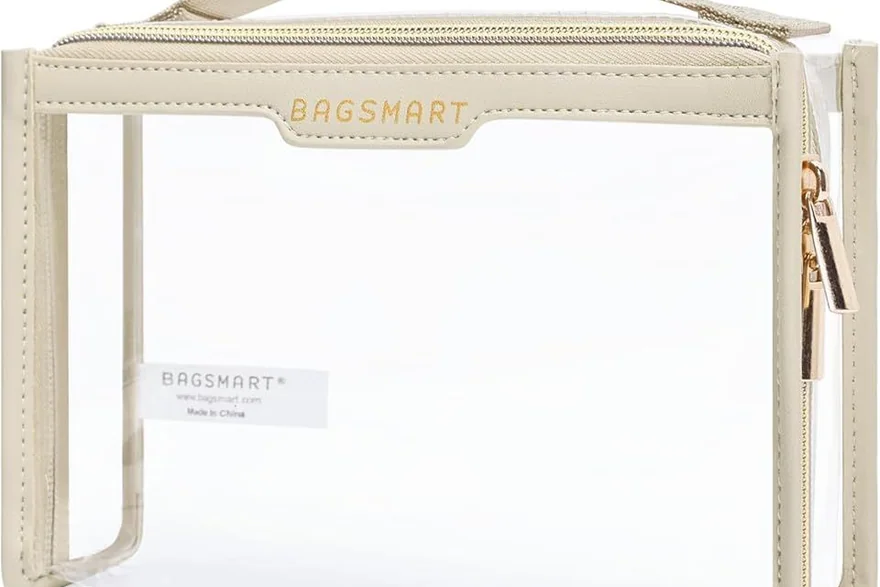
The pouch itself changes the specification. A clear PVC or TPU pouch at 0.3 to 0.5 mm is standard for the liquids bag, and the closure choice matters because a zip that runs the full width makes it easy to load and to present at screening. A pouch that is too structured will not compress once bottles are removed, and a pouch with an opaque back panel causes arguments at the checkpoint. Programmes that sell the set into a larger toiletry bag usually specify the quart pouch separately so the traveller can lift it out at security rather than unpacking the whole bag.
Labelling closes the loop. Volume markings moulded or printed on the body help the user and help the screening officer; a printed claim of 100 ml on a bottle that overflows at 105 ml is a genuine compliance problem. Where the set is filled rather than empty, the net quantity statement, ingredient list and any required symbol set belong on the carton or on a label panel sized at the artwork stage, not added afterwards. A carton designed without a label panel is one of the more common causes of a delayed first shipment in this category.
The B2B Customisation View
Before a single metre of fabric is cut, the briefing stage settles the silhouette, the lining, the closure and the branding method for makeup bags and toiletry bags.
Standard terms: 500 pieces minimum per style and colourway, 6–10 working days for sampling (12–15 for complex builds), 35–50 days bulk production, AQL 2.5 inspection under ISO 2859-1, FOB Xiamen, T/T 30 deposit / 70 balance.
The commercial arrangement is straightforward: one sourcing partner, one technical pack, one inspection standard, one consolidated shipment.
Which Brand Types Benefit Most
E-commerce sellers see the fastest return on bottle sets because the format photographs as a complete solution and the review risk is concentrated in one place: if the set does not leak, reviews are good, and if it does, they are not. Start-up brands use an empty refillable set as a low-risk first accessory, since an empty container carries less regulatory exposure than a filled one and the 500-piece minimum per style and colourway is reachable for a launch kit. Established brands typically fold a filled set into a gift-with-purchase or a seasonal travel promotion, where the bottles carry the house formula and the pouch carries the house colour. Retailers benefit most from a set that is already sized to a quart pouch, because the shopper can verify compliance on the shelf without reading a specification. Gift and hospitality buyers favour a neutral empty set with a wide-neck silicone tube and a printed fill-by date, packed in bulk into welcome kits. Timing matters more than usual in this category, because a resin or closure change after sample approval resets part of the timeline, so the destination market's liquids rule and substance requirements should be confirmed at enquiry rather than at artwork. Across all of them the programme mechanics are unchanged: sampling 6-10 working days, 12-15 where bespoke closures or a fitted pouch are involved, bulk 35-50 days after approval, inspection AQL 2.5 under ISO 2859-1, FOB Xiamen, T/T 30 deposit and 70 against bill of lading.
- Start-up brands: an empty refillable set as a low-regulatory-risk first accessory.
- Established brands: a filled set for seasonal travel promotions and gift-with-purchase.
- Retailers: a set pre-sized to a quart pouch so compliance is visible on shelf.
- E-commerce sellers: a set plus clear pouch photographed as one travel solution.
- Gift and hospitality buyers: neutral empty sets, bulk packed with a printed fill-by date.
Frequently Asked Questions
What volumes should a travel toiletry bottle set use?
Volumes cluster at 30 ml, 50 ml, 60 ml, 80 ml and 100 ml, with 100 ml the practical ceiling for cabin baggage. A three-piece set of two 100 ml bottles plus one 60 ml, or three 100 ml bottles, is the most common commercial configuration. Anything above 100 ml in a set marketed to air travellers will be refused at screening regardless of closure quality.
How should a closure leak test be written into a specification?
As a method with every variable stated: fill to 80 percent of nominal volume, close at a stated torque, test inverted, on side and upright, hold at room temperature and at 40 to 45 C for 24 hours per orientation, then assess weight loss and inspect the cap and neck. Vague terms such as leak-proof cannot be compared between quotations or checked on a repeat order.
Why does orientation matter so much in leak testing?
A bottle tested upright will pass with almost any closure because product has to climb to reach the seal. Inverted, the same closure has liquid against the seal continuously and separates good designs from marginal ones within a day. Testing on the side catches a third mode, where product reaches a liner edge or a thread root rather than the sealing face.
Which container material suits an alcohol-based hand sanitiser?
Rigid polypropylene with a pump or a disc-top is the usual choice, since PP handles alcohol gels at typical sanitiser concentrations better than polystyrene or soft PVC. Compatibility should still be confirmed against the actual formula and contact time, and the actuator should be included in the leak test rather than tested separately. Confirming contact time against the actual formula is the only way to be sure, since alcohol concentrations vary widely between products.
Are silicone travel bottles better than rigid plastic ones?
Silicone wins on filling convenience, squeezes to the last millilitre and survives being stood on, which is why it dominates refillable sets. It loses on barrier, and very thin liquids can find the thread. Rigid PET or HDPE gives a better barrier and a more premium shelf presentation but is harder to fill and does not evacuate fully.
What causes panel collapse in a soft travel bottle?
Oil or oil-based product migrating through low-density polyethylene is the usual cause, producing a sticky exterior and a collapsed panel over weeks. It will not appear in a one-week sample check. Specifying HDPE or a laminated tube for oil-based formulas, and stating compatibility on the carton, removes most of the risk. Stating compatibility on the carton costs nothing and removes the complaint that follows a collapsed bottle in a customer's bag.
What does the TSA 3-1-1 rule mean for a bottle set specification?
It sets the ceiling: containers of 3.4 ounces or 100 millilitres or less, all carried in one quart-sized clear bag, one bag per passenger. A set built to that rule is sellable to air travellers and one containing a 120 ml bottle is not. The pouch must also be clear, so an opaque back panel causes problems at the checkpoint.
How is a bottle set dimensioned to fit a quart pouch?
Total volume is only half the question; bottle height determines whether the pouch closes. With bottles upright, pouch internal height should exceed bottle height by at least 10 mm. With bottles lying flat, the pouch footprint should exceed the combined bottle footprint by 15 to 20 mm. A gusset of 5 cm or more lets 100 ml bottles stand.
Should a travel set be sold empty or filled?
Empty sets carry far less regulatory exposure, avoid stability work and suit a first accessory programme. Filled sets carry much higher value and a stronger brand message, but require formula compatibility testing, stability assessment and full labelling including net quantity and ingredients. Many brands launch empty and move to filled once volume justifies the work. Programmes frequently launch empty and move to filled once volume justifies the stability and labelling work.
Which cap liner type is right for a refillable bottle?
A foam or co-extruded liner in a screw cap gives a reusable seal with reasonable performance and is the standard choice for refillable sets. Induction-sealed liners give the strongest barrier but are single-use, and pressure-sensitive liners reseal poorly. Pump and sprayer closures should be leak-tested with the actuator fitted and the dip tube in place. The liner should also be checked after repeated opening, because a seal that performs once may not perform fifty times.
What regulatory checks apply to a set sold into the EU?
Substance restrictions under EU REACH apply to the container, closure and any coating, and should be stated at enquiry stage because a resin substitution after sampling resets part of the approval timeline. Where the set includes a textile pouch, an OEKO-TEX Standard 100 label can be requested for that component. Confirming these at enquiry rather than at artwork avoids a resin substitution that would reset part of the approval timeline.
Is CPSIA relevant to a toiletry bottle set?
It applies where the set is positioned for children or sold alongside children's products, since CPSIA sets limits on lead and certain phthalates in the US market. A general adult travel set is not automatically in scope, but a set marketed as a child's first travel kit should be specified with CPSIA limits from the start.
How are volume markings handled on a custom bottle?
Moulded graduations are the most durable and read well at screening, while printed markings are cheaper and allow a change without tooling. Either way the marked volume should match actual overflow capacity; a bottle claimed at 100 ml that holds 105 ml is a compliance problem rather than a tolerance issue. Graduations also help the user judge how much product is left, which is a small but real satisfaction factor in travel sets.
What inspection standard applies to a bottle set order?
Inspection runs at AQL 2.5 under ISO 2859-1, the same as for bag programmes. The leak test only becomes meaningful when it is defined as an inspection point with a stated sample size and an acceptable weight-loss threshold, rather than left as a general expectation in the brief. Listing cavity and closure checks alongside appearance gives the receiving team something concrete to work from.
Why is a carton label panel often the cause of a delayed first shipment?
Because net quantity, ingredient list and required symbols need physical space on the carton, and a carton designed without a label panel has to be reworked after artwork is finished. Sizing the panel at the artwork stage costs nothing and removes one of the more common causes of a delayed first shipment in this category. Net quantity, ingredients and required symbols all need space, and none of them can be added after the carton is printed.
What lead times apply to a bottle set with a fitted pouch?
Sampling runs 6-10 working days for a standard set, extending to 12-15 working days where bespoke closures or a fitted pouch are involved. Bulk production runs 35-50 days after sample approval. Shipment is FOB Xiamen and payment is T/T 30 deposit with 70 against bill of lading. Confirming which band applies at quotation is worth the question, since it changes the launch calendar by a week or more.
People Also Ask
What size bottles are allowed in carry-on luggage?
Under the TSA 3-1-1 rule, containers of 3.4 ounces or 100 millilitres or less, all placed in one quart-sized clear bag with one bag per passenger. That is why travel sets cluster at 50 ml, 60 ml and 100 ml, and why a set containing a larger bottle is not sellable to air travellers. The pouch must also be clear, so a set supplied with an opaque panel causes problems at the checkpoint even when every container is inside the volume limit.
How do you stop travel bottles from leaking on a plane?
Choose a closure that has been tested inverted and at elevated temperature, not just upright, and leave headspace rather than filling to the neck. Reduced cabin pressure expands the air in a partly filled bottle, so a cap that passes on the ground can weep in the air. Leaving roughly a fifth of the bottle empty gives the air somewhere to expand into, and a closure tested inverted at elevated temperature is far likelier to hold.
Are silicone travel bottles safe for all toiletries?
They suit most water-based products and many oil-based ones, and they fill and evacuate better than rigid bottles. Very low viscosity solvents can find the thread, and barrier is lower than rigid PET or HDPE, so a compatibility statement on the carton is the honest approach. Wide-neck silicone also fills and evacuates better than a rigid bottle, which is why it dominates refillable sets despite the lower barrier.
Can you take a full bottle set in a quart bag?
Only if every container is 100 ml or less and the whole set fits in one quart-sized clear bag. Volume alone is not enough: bottle height can prevent the pouch closing, so sets are often designed to lie flat inside the pouch rather than stand upright. Total volume is only half the question, since bottle height can stop the pouch closing, so many sets are designed to lie flat rather than stand upright.
Request a Sample or a Written Quotation
Send the silhouette, dimensions, material preference and logo artwork, and the programme team will return a written quotation with MOQ, sampling window, bulk lead time and inspection standard.
Email: service@junyuanbags.com · WhatsApp: +86 177 5002 0688