Clear Cosmetic Bags: TSA, Stadium & Venue Compliance
Executive Summary
Clear cosmetic bags are bought against a rule, not a trend, and the rule sets the specification. Air travel screening requires liquids to be carried in containers of 100 ml or less inside a single quart-sized transparent bag, while many stadiums, arenas and festival venues apply a size-based clear bag policy with a separate small-clutch allowance. The bag has to satisfy the written policy of the specific authority or venue, which is why a generic clear bag often fails at the gate even though it is transparent.
For a brand owner the sequence is: choose the policy the product is sold against, read its exact wording on size and construction, then specify the material so the bag survives the season rather than one weekend. Programmes start at 500 pieces per style and colourway, sample in 6-10 working days or 12-15 for welded constructions, and run 35-50 days in bulk. Finished goods are inspected to AQL 2.5 under ISO 2859-1, shipped FOB Xiamen, and paid T/T 30 deposit with 70 against bill of lading.
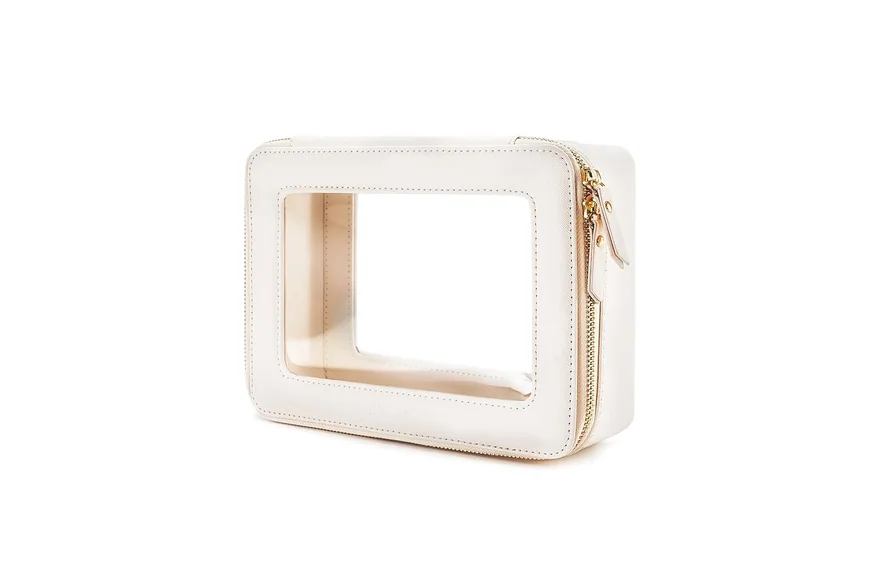
Why Clear Bag Rules Exist and What They Actually Require
Two separate regimes drive demand for clear cosmetic bags, and a buyer who conflates them ends up with a product that satisfies neither. The first is aviation security, where the rule concerns liquids, aerosols and gels carried in hand baggage: containers of 100 ml or less, aggregated into one transparent resealable bag of roughly one quart, presented separately at the checkpoint. The TSA liquids rule is the reference most buyers cite, and equivalent rules apply in most other jurisdictions.
The second regime is venue security. Stadiums, arenas, racecourses and large festivals increasingly apply a clear bag policy so that security staff can see contents without opening every bag. Those policies are written by the venue or by the league, not by a government, and they vary in three specific ways: the maximum clear bag size, whether a small opaque clutch is additionally allowed, and whether the bag must be fully transparent or merely contain a transparent panel. Because they are written locally, a buyer cannot design to a single global standard.
The commercial consequence is that clear cosmetic bags sell in two distinct shapes. Travel demand produces flat or gusseted quart-sized pouches with a zip, sold in multiples and replaced often. Venue demand produces a larger tote-shaped or crossbody clear bag, sold as a single item with a fashion element, and frequently paired with a small opaque clutch for items the buyer would rather not display. A range that tries to serve both with one SKU usually fails the venue size test or looks wrong on a travel shelf.
Demand supports the split. Travel bag for toiletries searches run around 110,000 per month and toiletry bag searches around 74,810 per week on Amazon (ASINSIGHT 2026.07), while custom makeup bag runs 5,400 to 6,600 per month. The custom figure matters here because clear bags are unusually receptive to branding: a transparent panel with a printed logo is visible from across a room, which is exactly the exposure a venue or sponsor wants.
Reading a Clear Bag Policy Before the Design Is Drawn
Policies are written in dimensions, and the dimensions are not universal. Before a tech pack is drawn, the buyer should obtain the current published policy of the authority or venue the product is sold against, and copy its wording into the brief verbatim. The table below sets out the policy archetypes that appear most often in the market. They are archetypes, not a rulebook: the current published policy always governs, and a buyer should re-check it each season because venues revise them.
| Policy archetype | Typical stated maximum | Opaque allowance | Design implication |
|---|---|---|---|
| Airport liquids bag | One quart-sized transparent bag, containers 100 ml or less | None, all liquids inside the one bag | Flat or shallow gusset, zip closure, roughly 18-20 cm square commercially |
| Stadium clear tote | About 30 x 15 x 30 cm with a single compartment | Small clutch, often about 11 x 16 cm | One compartment only, no internal divider pockets |
| Arena clear crossbody | About 25 x 15 x 25 cm, strap allowed | Small clutch sometimes allowed | Single compartment, welded strap attachment |
| Festival clear backpack | About 30 x 30 x 15 cm, transparent front and back | Varies widely | Both faces transparent, seams welded not stitched |
| School and workplace | Fully transparent, sizes set locally | Usually none | No print covering more than a small area |
Three clauses cause most of the rejected designs. The first is the single-compartment requirement, which rules out internal dividers and pockets even when they are made of clear material. The second is a strap rule: some policies permit a shoulder strap, some require it to be clear, and some restrict its width. The third is a print rule, where a logo may be allowed on one face up to a stated area but not across the whole panel. Each of these is cheap to accommodate in design and expensive to fix after 2,000 units are packed.
There is also a measurement question that catches buyers out: whether the stated maximum refers to the bag laid flat, to the bag filled, or to the bag including the strap and hardware. A clear tote quoted at 30 x 15 x 30 cm will measure differently once it is filled with a water bottle and a jacket. The safe approach is to design to the stated maximum with a margin, then measure the packed sample and record the result, rather than designing to the number exactly.
Material transparency interacts with policy wording in a way that catches buyers out. A frosted or smoked clear film reads as clear to a designer and can be read as opaque by a gate attendant, particularly under floodlights at night. Where a policy says clear or transparent without qualification, specifying a frosted film is an avoidable risk, and a fully transparent film with a printed border is the safer way to add brand character.
Hardware and trim need to be counted as part of the size. D-rings, a strap, a carabiner and a zip puller all extend beyond the stated body dimensions, and a bag that measures within policy when laid flat can exceed it once a strap is attached. The brief should state whether the maximum applies to the body only or to the bag including strap and hardware, and the sample should be measured both ways before the drawing is signed off.
PVC, TPU and EVA: Choosing a Clear Material That Survives the Season
Clarity is not the hard part; almost every candidate material starts clear. The hard part is staying clear after a summer in a car, a winter in a stadium car park, and fifty cycles of being packed and unpacked. Three materials cover the market, and each fails in a different way.
- PVC film: lowest cost and excellent clarity, but plasticiser content drives both the cold-crack risk and the compliance questions buyers face in Europe and in children-ranges
- TPU film: higher cost, better cold flexibility and abrasion resistance, weldable by radio frequency, and easier to position as a PVC-free option
- EVA: available as a clear sheet for moulded cases, stiffer and more protective, but with lower optical clarity and a hazier surface
- Thickness drives behaviour: 0.3 mm film packs flat and creases, 0.5-0.8 mm holds shape and resists creasing but adds weight and cost
- Anti-block and anti-fog treatments are worth specifying, because two clear faces pressed together in a warm carton can bond or haze
Compliance paperwork belongs in the material decision, not after it. Clear PVC formulations are the ones that attract questions about plasticisers and about restricted substances, and a buyer selling into the EU will be asked for a declaration against the restricted substance list; the European Chemicals Agency publishes an explanation of REACH that is useful for briefing a compliance team. Where the bag is marketed to children or sold through a school channel, the US CPSIA requirements apply to lead content and phthalates, and the certificate has to be produced by the importer of record.
Construction follows the material. PVC and TPU film can be high-frequency or hot-wedge welded, which gives a clean seam with no stitch holes and no opaque thread - important where a policy says fully transparent. Stitched-and-bound edges on a clear bag introduce an opaque binding tape, and some venues read a fully opaque edge as a failure, so a welded edge is the safer construction for venue-facing product. A bound edge is acceptable for travel quart bags, where the requirement is transparency of contents rather than of the container.
Two finishing details decide the shelf impression. The first is haze: film that has been folded tightly in a carton for six weeks can arrive looking milky, so packing method, an interleaving sheet and carton fill all matter. The second is print durability on a low-energy surface. Clear film does not accept conventional ink well without surface treatment, and even then a printed logo on the outside of a clear bag is subject to abrasion from every surface it is set down on.
Odour and blocking are the two finishing risks specific to clear film. PVC formulations in particular can carry a plasticiser odour that is noticeable once a carton has been sealed through a warm season, and two clear faces stored in contact can block, producing a permanent cloudy patch. Both are addressed at specification: an anti-blocking treatment on the film, an interleaving sheet between faces, an airing period before packing and an odour panel agreed before bulk. Neither is detectable from a photograph. A clear bag also shows every handling mark, so gloves on the packing line and a clean carton interior are worth specifying alongside the print itself.
Documentation, Labelling and Retail Onboarding
A clear bag sold against a rule carries a documentation burden that an ordinary pouch does not. Retailers want to see that the claim on the packaging matches a published policy, and marketplaces increasingly ask for evidence before a listing that mentions TSA or stadium approval is allowed to stay live. The following file should be assembled during sampling rather than during onboarding.
| Document | Who issues it | What it must state | Typical delay if missing |
|---|---|---|---|
| Restricted substance declaration | Film mill or material supplier | Scope covering film, ink, adhesive and hardware | Two to four weeks to obtain |
| OEKO-TEX certificate | Certification body via the supplier | Whether it covers the component or the finished article | Four to eight weeks for a new scope |
| CPSIA certificate | Importer of record | Product description, tested components, cited rule | Cannot be issued retrospectively without testing |
| Dimensional statement | Brand owner, against a drawing | Measured size of the filled bag, method stated | One to two weeks for a re-measure |
| Care and safety labelling | Brand owner | Wipe clean, no heat, not a toy | Days, but blocks a listing if absent |
The wording on the packaging deserves as much care as the bag. A claim such as TSA approved is risky, because no authority approves specific commercial products in this category; the accurate phrasing is that the bag meets the published size and construction requirements of the rule, ideally with the rule named. Where a venue is involved, naming the venue on packaging without permission invites a cease-and-desist, and using a league or event mark without a licence is a trademark issue rather than a compliance one.
On the commercial side, clear bag programmes behave like any other: 500 pieces per style and colourway minimum, 6-10 working days for sampling or 12-15 for welded and moulded constructions, 35-50 days for bulk after sample approval, inspection to AQL 2.5 under ISO 2859-1, FOB Xiamen and T/T 30 deposit with 70 against bill of lading. Where the programme needs a certificate with a new scope, the sampling window is the right time to start it, because certificate lead times frequently exceed the bulk lead time.
Print and branding deserve their own technical line, because clear film is a low-energy surface. Surface treatment before printing, an ink system matched to PVC or TPU specifically, and a rub test on a production sample are the three controls that matter. A logo printed across a panel that a venue policy requires to be fully transparent is also a compliance problem rather than only an aesthetic one, so print area should be stated as a percentage of the face.
Packing and presentation finish the programme. Clear bags arrive looking either crisp or crumpled, and the difference is usually interleaving and carton fill rather than the film. A flat travel pouch benefits from an interleaving sheet between units and a carton that is filled rather than over-filled, while a venue tote benefits from a light stuffing or a folded insert so it holds its shape on the shelf. Both cost cents and change the impression a buyer forms on opening the carton. A certificate with a new scope is the single item most likely to delay a launch, so it should be requested on the first day of sampling.
The B2B Customisation View
The first technical conversation about cosmetic bags normally resolves three things: dimensions, material laminate and the surface that will carry the logo.
The numbers a buyer can plan around: 500 pieces minimum per style and colourway, 6–10 working days to a first sample (12–15 where tooling or moulding is involved), 35–50 days to bulk completion, AQL 2.5 under ISO 2859-1 at final inspection, FOB Xiamen terms, T/T 30/70 payment.
QUANZHOU JUNYUAN BAGS acts as the sourcing and programme-management layer between the brand owner and the SGS-verified production floor, coordinating specification, sampling, inspection and shipment paperwork on the buyer's behalf.
Which Brand Types Benefit Most
Clear bag programmes are bought by five buyer types with very different tolerances for risk. Start-up brands usually enter through the travel quart bag, because it is cheap to make, easy to photograph and bought in multiples; the risk there is commoditisation, so differentiation comes from print quality, a better zip and a film that does not arrive hazy. Established brands more often enter through the venue tote, where the product sits in a seasonal fashion drop and the brand is paying for licensed marks, a printed panel and a strap that survives a season of use. Across all five, the decision that separates a workable clear bag programme from a returns problem is whether the published policy was read before the drawing was made.
- Retailers and pharmacy chains buy clear bags as a compliance category, so the dimensional statement and the restricted substance declaration matter more than the design
- E-commerce sellers selling stadium-compliant bags carry the highest claim risk, because a buyer who is turned away at a gate leaves a review the seller cannot defend
- Event, festival and sponsor buyers want maximum logo visibility on a transparent panel, which makes print durability the leading specification rather than an afterthought
- Travel and airline-channel buyers prefer flat quart bags packed in multiples, where carton cube and pieces per carton drive landed cost more than unit price
- School, campus and workplace buyers need fully transparent product with no opaque trim, which pushes the construction towards welded edges and away from bound seams
- Licensed merchandise programmes need print area agreed with the licensor before tooling, because a venue policy can limit how much of a transparent face may be covered
- Corporate and promotional buyers favour flat quart bags with a single-colour print, where the unit cost still leaves room for a fully documented film
- Cruise and resort retail buyers want a hanging or fold-flat format that packs into a cabin drawer, which pushes the design towards welded edges
Frequently Asked Questions
What size of clear cosmetic bag does the TSA liquids rule allow?
The rule concerns the liquids and the bag they travel in: containers of 100 ml or less, all carried together in one transparent resealable bag of roughly one quart, presented separately at screening. Commercially that size is usually sold as a flat or shallow-gusseted pouch around 18-20 cm square. The rule does not name a brand or a product, so no bag is formally approved by an authority.
Does a stadium clear bag policy require the whole bag to be transparent?
Most published policies specify a fully transparent bag with a single compartment, sometimes with a small opaque clutch allowed in addition. Some accept a transparent panel. Because policies are written by individual venues and leagues rather than by a regulator, the wording of the specific venue governs, and buyers should copy it verbatim into the brief.
Why do clear bag policies specify a single compartment?
A single compartment lets security staff see the entire contents at a glance without opening pockets. Internal dividers, even transparent ones, create shadowed areas and slow the inspection. This clause is the one most often missed in design, because an internal slip pocket is a natural thing for a bag designer to add and an immediate reason for a gate rejection.
Is PVC or TPU better for a clear cosmetic bag?
PVC is cheaper and very clear, but plasticiser content raises both cold-crack risk and compliance questions in Europe and in children ranges. TPU costs more, flexes better in the cold, resists abrasion and can be positioned as PVC-free. For a premium or cold-climate programme TPU usually wins; for a price-led travel pouch, PVC remains common with a declaration on file.
What film thickness should a clear cosmetic bag use?
Around 0.3 mm suits a flat travel pouch that packs flat, while 0.5-0.8 mm suits a venue tote that needs to hold shape. Thicker film resists creasing and carries a strap better, at the cost of weight and material. The decision should be made with the packing method in mind, because thin film folded tightly in a carton arrives hazy.
Can a clear cosmetic bag have opaque binding or trim?
For travel quart bags, yes, since the requirement is that contents are visible. For venue bags, it depends on the wording: some policies require the bag to be fully transparent, and an opaque binding tape round the top edge can be read as a failure. A welded edge with no binding is the safer construction for venue-facing product.
Do clear bags need welding rather than stitching?
Welding is preferred where a policy calls for full transparency, because it produces a seam with no opaque thread and no needle holes. Stitching with a clear monofilament thread is possible but slower and less durable. PVC and TPU both weld well; EVA sheet is usually moulded or stitched, which is why it is used for cases rather than for soft venue bags.
How should the size of a clear bag be measured for compliance?
Against the policy wording, and then with a margin. Policies differ on whether the maximum refers to the empty bag, the filled bag or the bag including strap and hardware. The practical approach is to design below the stated maximum, fill the sample with the intended contents, measure again, and record the result on the technical file.
Can a logo be printed on a clear cosmetic bag?
Yes, but the surface needs treatment and the print sits on the outside where it abrades against every surface the bag is set down on. Some venue policies limit print to a stated area of one face. Screen print and heat transfer are both used; the buyer should rub-test the print on a production sample rather than on a flat swatch.
Does a clear bag sold for air travel need a CPSIA certificate?
Only if it is marketed or sold as a children product in the United States, or is otherwise in scope. If it is, the importer of record must issue a certificate covering lead content and phthalates based on testing of the components. This is a decision for the brand owner before sampling, because a certificate cannot be produced retrospectively without testing.
Is it safe to print TSA approved on packaging?
It is safer not to. No authority in this category approves specific commercial products, so the accurate claim is that the bag meets the published size and construction requirements of the rule, with the rule named. Marketplace compliance teams and retail legal reviewers both tend to flag unqualified approval language. Naming the rule and its published requirements is both accurate and defensible to a marketplace reviewer.
How do clear bags behave in cold weather?
PVC formulations stiffen and can crack when folded at low temperature, which is a common failure for stadium bags used in winter. TPU retains flexibility at much lower temperatures. A programme sold into a cold climate or a winter sports channel should specify a low-temperature bend requirement and test a folded sample rather than judging a warm sample room.
Why do clear bags arrive looking cloudy or hazy?
Usually from pressure and heat in transit. Two clear faces pressed together can block or bond, and a tightly folded film can develop stress whitening at the crease. Anti-block treatment on the film, an interleaving sheet, a slightly thicker film and a carton that is not over-filled all reduce the problem. Interleaving sheets between units and a carton that is filled rather than over-filled both reduce the problem.
How many clear quart bags should be packed per carton?
Because the product is flat and light, cartons are usually limited by cube and by creasing rather than by weight, and several hundred pieces per carton is common for a flat pouch. The number should be stated in the brief because it sets the landed cost per unit, and because over-packing is the main cause of haze complaints on arrival.
Do venue clear bag policies change between seasons?
They do. Venues and leagues revise size limits, clutch allowances and strap rules, and some update before each season. A brand owner selling venue-facing product should re-read the published policy at the start of every development cycle and keep a dated copy on the technical file, rather than reusing last season drawing without checking. A dated copy on the technical file also protects the brand if a buyer is turned away at a gate.
People Also Ask
What size clear bag is allowed in stadiums?
There is no single size. A common published archetype is a clear bag of about 30 x 15 x 30 cm with a single compartment, plus a small clutch of about 11 x 16 cm, but individual venues and leagues write their own limits. Buyers should read the current policy of the venue the product is sold against and copy the wording into the brief.
Are clear makeup bags required for flying?
A transparent bag is required for carrying liquids, aerosols and gels in hand baggage, with containers of 100 ml or less grouped in one quart-sized bag presented separately at screening. The rest of the cosmetics in a bag do not have to be in a clear container unless the liquids rule applies to them. Everything else can stay in an ordinary pouch, provided the liquids themselves are grouped into the one transparent bag.
Can I use a clear cosmetic bag as my stadium bag?
Only if it meets the specific venue policy on size, compartment count and transparency. A quart-sized travel pouch is usually too small to be useful and may still fail if it has internal pockets. A venue tote with one compartment and welded edges is the safer design to buy against a stadium rule. Check the compartment rule as well, since internal pockets are a common reason a compliant-looking bag is refused at a gate.
What material is best for a clear toiletry bag?
TPU is the better-performing choice: it stays flexible in the cold, resists abrasion and can be welded into a seam with no opaque thread. PVC is cheaper and very clear but raises plasticiser questions in Europe and in children ranges. EVA suits moulded cases where stiffness matters more than optical clarity. For a moulded case where stiffness matters more than optical clarity, EVA sheet is the practical third option.
Request a Sample or a Written Quotation
Send the silhouette, dimensions, material preference and logo artwork, and the programme team will return a written quotation with MOQ, sampling window, bulk lead time and inspection standard.
Email: service@junyuanbags.com · WhatsApp: +86 177 5002 0688