Private Label Cosmetic Bags: Complete Brand Launch Guide
Executive Summary
A private label cosmetic bag programme is a bag built to the brand owner's own specification and sold under the brand owner's own name, with the brand controlling construction, materials, colourway, hardware and packaging. The standard production minimum is 500 pieces per style and colourway, sampling runs 6-10 working days (12-15 for complex constructions) and bulk production runs 35-50 days after sample approval. Those three numbers set the shape of any launch plan.
What separates a private label launch from buying a catalogue bag is the amount of the product the brand actually decides: fabric weight, lining colour, zip specification, logo method, hangtag copy, carton print and the compliance file behind all of it. Each decision has a cost and a lead-time consequence, and the decisions interact - a custom shade adds a lab dip, a moulded puller adds a tool, a certified fabric adds documentation. The launch plan is the sequence that gets all of them settled before the deposit is raised.
What private label means in a bag programme
Private label describes a product made to one buyer's specification and sold under that buyer's name. In bags, the practical test is simple: who decided the fabric, the lining, the hardware and the logo? If the brand owner decided them, the programme is private label. If the brand owner chose from a catalogue and only added a printed mark, it is closer to a branded resale. The distinction matters because the specification decisions carry the lead time, the compliance responsibility and most of the cost.
A private label cosmetic bag is specified from the inside out. The brand owner nominates the construction - a 22 x 15 x 8 cm flat pouch, a 24 x 17 x 12 cm structured case or a hanging wash bag - then the shell material, typically 300D to 900D polyester, nylon, canvas, PU or TPU-laminated fabric, then the lining, usually a 190T or 210D polyester in a pale shade chosen so that a spill is visible. Zips are nominated by size and type, most commonly a #5 nylon coil for a pouch and a #8 for a larger vanity case.
The category gives private label room to work because demand is broad and fragmented. Tracking shows a toiletry bag drawing roughly 74,810 weekly Amazon searches (ASINSIGHT 2026.07), "travel bag for toiletries" around 110,000 monthly searches and "make up bags for women" near 80,000 monthly searches, while the sourcing phrase "custom makeup bag" sits at 5,400-6,600 monthly searches. Typical unit prices quoted on marketplaces span $0.45-$12.00 (Alibaba 2026.10), which is a wide enough band for a brand to position at several price points.
Two commercial constants frame every private label launch. The minimum is 500 pieces per style and colourway, so a launch range of one style in three shades is 1,500 pieces. Inspection is to AQL 2.5 under ISO 2859-1, shipment is FOB Xiamen and payment is T/T 30 deposit, 70 against bill of lading. Everything in the launch plan is scheduled around those figures.
Branding and specification decisions for a launch range
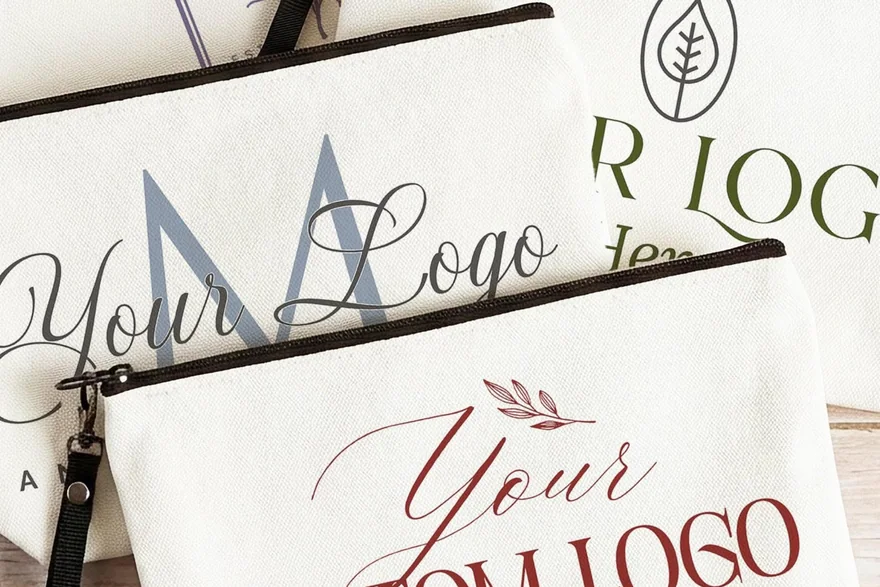
The brand mark is the first decision that has a tooling consequence. A woven label sewn into a side seam is the cheapest and most durable option and adds nothing to the sample window. A screen print or heat transfer adds a setup per colour per position. An embroidery setup is priced by stitch count. A moulded silicone badge or a custom zip puller adds a tool that has to be cut before any unit can be finished, which is what moves a sample from the 6-10 working day band into the 12-15 band.
| Branding method | Typical placement | Durability profile | Effect on sample window and cost |
|---|---|---|---|
| Woven label, sewn into a seam | Side seam, lining seam or binding | Holds through washing; edges can fray if cut short | No added days; lowest setup cost |
| Screen print, one colour | Front panel, centred or lower third | Good on polyester and canvas; flexes on coated fabric | Adds 1-2 working days; setup per colour per position |
| Heat transfer film | Front panel or a curved surface | Good detail retention; can lift on low-energy coatings | Adds 1-2 working days; film produced per artwork |
| Embroidery | Front panel or a patch | Excellent durability; adds stiffness to light fabrics | Adds 2-3 working days; priced by stitch count |
| Moulded silicone badge | Front panel or a corner | Excellent; resists abrasion and wiping | Adds 5-8 working days for the tool |
| Custom zip puller with a logo | Slider pull | Excellent; visible every time the bag is opened | Adds 5-8 working days for the tool; reused on repeat |
Fabric and colour decisions come next and they are where launch calendars are won or lost. A stock shade can be called off in days; a Pantone-matched shade needs a lab dip, an approval and then a bulk lot, which is a parallel workstream of roughly 5-8 working days per dip. Colour is also assessed for fastness rather than by eye, and the reference point is the ISO 105 colour fastness series, which is why a grey scale grade of 4 or better is the usual pass condition for a shell and lining combination.
The specification should be written as a tech pack that a pattern cutter and a line supervisor can both read: a dimensioned drawing, a materials list with fabric weights in g/m² and denier, a trim schedule with zip size and tape colour, a stitch density target of 8-10 per inch on load-bearing seams, a print placement measured from a fixed reference and a packing specification. A specification written this way removes the ambiguity that produces second sample rounds.
Construction first, then fabric and shade, then branding method, then packaging. Each stage is cheaper to change before the one after it starts. A print position changed after the bulk fabric is dyed is the most expensive kind of change in a private label programme.
Packaging is part of the brand, not an afterthought, and it is the cheapest place to create range variety. Because a hangtag, a belly band and a printed carton have their own print minimums that are usually lower than the 500-piece bag minimum, one bag run can carry several retail faces. A launch range of one style in one colourway at 500 pieces can therefore ship as three SKUs if the packaging differs, which is a useful way to test price points without commissioning three production runs.
Compliance, testing and labelling for a private label launch
A private label seller is the responsible party for the product in its market, which means the compliance file has to exist before the first unit is listed rather than after a retailer asks for it. For bags, the file is usually built from four kinds of evidence: restricted-substance evidence for the materials, a children's-product assessment if the item is marketed to children, a fibre or recycled-content claim with documentation, and the physical test reports for colour fastness, zip function and coating behaviour.
| Requirement | Applies when | Evidence typically held | Standard or reference |
|---|---|---|---|
| Restricted substances in articles | Selling into the EU market | Supplier declarations plus test reports against the candidate list | EU REACH |
| Children's product rules | The bag is designed or marketed for children under 12 | Lead and phthalate test reports plus a tracking label | CPSIA in the United States |
| Harmful substances in textiles | A retailer or marketplace asks for a textile certificate | Certificate covering the shell, lining and print inks | OEKO-TEX Standard 100 |
| Recycled content claim | The shell is marketed as recycled | Transaction certificate tying the fabric to a certified lot | Global Recycled Standard (GRS) |
| Organic fibre claim | The shell contains organic cotton or similar | Scope certificate and transaction certificate | GOTS |
| Colour fastness performance | Any custom shade or a pale lining | Grey scale grade of 4 or better on the relevant ISO 105 tests | ISO 105 series |
| Zip and coating behaviour | Any sewn bag with a zip or a coated panel | Zip cycling and coating flex results held in the sample record | ASTM zipper terminology and coated fabric methods |
Labelling content is the part most often left until the last fortnight, and it is the part that holds a shipment at a distribution centre. A retail carton needs a barcode that scans, a country-of-origin statement in the form the destination requires, a fibre composition statement where textiles rules apply, and any symbol set the retailer's specification demands. Getting the carton artwork approved at the same time as the bag artwork avoids the common failure mode of finished goods waiting for printed boxes.
Three references cover most of the file. Restricted substances in articles sold into the EU are assessed under EU REACH; textile chemical safety is commonly evidenced by OEKO-TEX Standard 100 covering shell, lining and print inks; and a bag marketed for children under 12 in the United States falls under CPSIA, which requires lead and phthalate testing and a tracking label. A recycled shell claim additionally needs a transaction certificate under the Global Recycled Standard, tied to the actual fabric lot rather than to a generic logo.
Testing has to be scheduled, not assumed. A test report ordered after bulk production has finished can add two to three weeks to a launch if a result fails, whereas the same test run on pre-production material costs a few days and allows a substitution. The practical sequence is to nominate the materials during sampling, order testing against the sample materials, then confirm bulk against the same specification.
- Build the compliance file during sampling, not after bulk - substitutions are cheap before production and expensive after.
- Nominate every material in writing: shell, lining, zip tape, binding, print inks and hardware finish.
- A recycled or organic claim needs a transaction certificate tied to the actual fabric lot, not a generic logo.
- Approve carton artwork and barcode verification at the same time as the bag artwork.
- Keep the approved sample as the reference for the AQL 2.5 inspection and for any later reorder.
Launch economics and the commercial calendar
A private label bag launch is a cash cycle, not a single purchase. The brand commits to 500 pieces per style and colourway, pays 30 percent on deposit and 70 against the bill of lading, then recovers the money over the sell-through period. The launch plan therefore has to reconcile three numbers: the landed cost per unit, the retail or wholesale price, and the number of weeks the inventory will sit. A programme that is profitable at full price and loss-making at a 30 percent markdown is a programme that needs a different price point.
| Launch model | Pieces committed | Sampling and bulk | Where the margin comes from |
|---|---|---|---|
| Single hero SKU, one colourway | 500 pieces | 8 working days plus 35 days | Lowest commitment; margin depends on a strong price point |
| One style, three colourways | 1,500 pieces | 8-10 working days plus 38-42 days | Range appeal; setup spread across more units |
| Two styles, one shared colourway | 1,000 pieces | 10-12 working days plus 40 days | Cross-sell between a pouch and a case |
| Three-piece set, one colourway | 1,500 pieces (500 sets) | 12-15 working days plus 45-50 days | Higher ticket value; more assembly time per set |
| Gift-with-purchase programme | 500 pieces per colourway | 8 working days plus 35-40 days | Margin recovered through the promoted product, not the bag |
Timing follows from the same two figures. Sampling at 6-10 working days plus bulk at 35-50 days puts goods-ready at roughly 45-60 working days from specification lock, and a launch calendar should carry 10-14 days of contingency for a rejected dip or a first inspection fail. Working backwards from an in-warehouse date gives a specification-lock date around 100-120 calendar days earlier, which is earlier than most first-time brand owners expect.
Reordering is where private label economics either work or fail. The second order is cheaper and faster than the first because the pattern, tooling, approved shade and trim references already exist: sampling can be reduced to a confirmation round and material call-off collapses. Brand owners who design the first range so that it can be extended - same construction, new colourway, same tooling - turn a one-off launch into a range with a reorder path.
Three mistakes account for most failed first launches. The first is choosing a shade before checking that it can be matched repeatedly, which produces a first run that cannot be reordered. The second is approving a sample from photographs rather than from measurements, which removes the reference the inspection needs. The third is spending the contingency before the order is placed: a brand that compresses the calendar to hit an optimistic date has no room left for a rejected dip or a re-screen, and no way to recover the date when one happens.
- Fix the price point before the specification; the target margin decides the fabric and the branding method.
- Commit to 500 pieces per style and colourway and treat each additional colourway as a separate run.
- Plan cash around T/T 30 deposit, 70 against bill of lading, with freight and duty outside the unit price on FOB Xiamen terms.
- Schedule 100-120 calendar days from specification lock to in-warehouse, including contingency.
- Design the first range for extension so the second order is a repeat rather than a new development.
The B2B Customisation View
Programme planning for cosmetic bags starts with the end market: a hotel amenity run and a beauty-retail launch ask for completely different construction and compliance evidence.
Planning figures used across the programme: MOQ 500 pieces per style and colourway, 6–10 working days sampling (12–15 when moulding or multi-layer lamination is required), 35–50 days bulk lead time, AQL 2.5 to ISO 2859-1, FOB Xiamen, T/T 30/70.
The programme-management model exists because most import problems are documentation problems, and documentation is what this office produces and holds.
Which Brand Types Benefit Most
Private label suits buyers whose value sits in the brand rather than in the logistics. A start-up beauty brand launching a bag alongside a skincare or cosmetics line gets the most from it: one style in one or two colourways at 500 pieces each, identity carried by a woven label, a printed logo and a branded carton, launched to an existing audience that already trusts the name. An established brand uses private label to extend into an adjacent category, where the bag has to match an existing palette and finish standard rather than to introduce something new.
Retailers run private label as an own-brand tier, which means the specification is usually driven by a price point and a shelf planogram, and the branding is deliberately restrained. E-commerce sellers use private label to escape competing on price alone, because a bag with a controlled specification and a branded carton can hold a higher price than the same silhouette sold generically. Gift and hospitality buyers use it for a different reason again: the bag is part of a presentation, so the specification concentrates on the packed set, the sleeve and the unboxing rather than on the shell fabric.
The common thread is control. Private label costs more in development time and commitment than buying from a catalogue, and what it buys is a specification nobody else can order, a shade nobody else can match and a compliance file with the brand's name on it.
- Start-up brands: one hero SKU at 500 pieces, identity carried by label, print and carton.
- Established brands: extend into bags with an existing palette and finish standard.
- Retailers: an own-brand tier driven by a price point and a planogram, with restrained branding.
- E-commerce sellers: a controlled specification and branded packaging that support a higher price.
- Gift and hospitality buyers: specification built around the packed set and the unboxing moment.
Frequently Asked Questions
What is the minimum order for a private label cosmetic bag range?
500 pieces per style and colourway. One style in one shade is 500 pieces; one style in three shades is 1,500 pieces because each colourway is scheduled as its own run with its own fabric lot and trim batch. Two different constructions in one shade is also 1,000 pieces, because each construction is a separate style.
How long does a private label bag launch take from brief to launch?
Roughly 100-120 calendar days from specification lock to goods in the warehouse. Sampling takes 6-10 working days, bulk takes 35-50 days after sample approval, and packing and port transfer take a further 3-5 days before FOB Xiamen release. Ocean transit and destination handling sit on top, plus 10-14 days of contingency for a rejected lab dip or a first inspection fail.
Which branding method should a first private label range use?
A woven label sewn into a seam plus a one-colour screen print is the usual answer for a first range, because neither adds tooling time to the sample window. A moulded silicone badge or a logo zip puller looks better on shelf but adds 5-8 working days for the tool to be cut. The tool is then reused, so it is often worth doing from the second order onwards.
Does a private label bag need OEKO-TEX certification?
Not legally, but many retailers and marketplaces ask for it, and it is cheaper to obtain during sampling than after production. OEKO-TEX Standard 100 covers the shell, lining and print inks against a list of harmful substances. A brand planning to sell through a retailer should confirm which certificate that retailer requires before nominating materials.
Who is responsible for REACH and CPSIA compliance on a private label bag?
The brand owner selling in that market. A private label seller is the responsible party, which is why the compliance file has to be built before listing rather than after a question arrives. REACH applies to articles sold into the EU, and CPSIA applies to products designed or marketed for children under 12 in the United States, including lead and phthalate limits and a tracking label.
Can a private label bag be marketed as recycled?
Yes, but only with documentation. A recycled claim needs a transaction certificate tying the actual fabric lot to a recognised standard such as the Global Recycled Standard, and the certificate has to match the lot used in production. Claiming recycled content without that documentation is the fastest way to lose a retail listing. A claim made without a certificate tied to the actual lot will not survive a retailer's technical review.
How is a private label shade controlled across two orders?
Through the approved lab dip and the retained golden sample. The dip is the reference for the bulk lot, and the approved unit is the reference for inspection to AQL 2.5. A brand that keeps both can reorder six months later and expect the same shade; a brand that approves from a photograph cannot. Reordering without either reference means matching by eye, which is how shade drift between orders begins.
What does a private label tech pack need to contain?
A dimensioned drawing, a materials list with fabric weights in g/m² and denier, a trim schedule naming the zip size and tape colour, a stitch density target of 8-10 per inch on load-bearing seams, print artwork with placement measured from a fixed reference, and a packing specification. A tech pack written this way is what keeps sampling inside 6-10 working days.
Can one bag run be sold as several SKUs?
Yes, using packaging. Because hangtags, belly bands and printed cartons have their own print minimums that are usually lower than the 500-piece bag minimum, one 500-piece run can carry several retail faces. This is the cheapest way to test price points or channel variations without commissioning more production runs. The carton, sleeve or hangtag carries the variation, so the bag specification stays frozen and the reorder path stays simple.
How should a launch be priced against landed cost?
Work from the landed cost per unit, which is the FOB unit price plus freight, duty and handling divided by the quantity, then apply the margin the channel needs. A useful test is whether the price still works at a 30 percent markdown: a programme that only makes money at full price is a programme priced too tightly for a seasonal category.
What inspection standard applies to a private label cosmetic bag order?
AQL 2.5 under ISO 2859-1, with the sample size set by lot size and clear accept and reject numbers. The inspector compares against the approved golden sample, so defects are judged by measurement rather than by opinion. A first inspection fail triggers rework and re-submission, which adds 4-8 days. Inspection is the last gate before packing and port transfer, and it sits inside the quoted bulk window rather than after it.
How much does a three-piece private label gift set cost to develop?
More than a single pouch because there are three patterns, three markers and three assembly sequences, and the sample window moves to 12-15 working days. The tool and print setups are shared across the set where the branding is common. The set is quoted as 500 sets, which is 500 of each piece. Print plates and branding setups are shared across the pieces where the artwork is common, which is the main saving.
Should testing be ordered before or after bulk production?
Against the sample materials, before bulk. Testing after production can add two to three weeks if a result fails, because the material has already been cut and sewn. Testing during sampling leaves room to substitute a lining or an ink while the change is still cheap and the 35-50 day window has not yet started.
What payment and shipment terms apply to a private label order?
T/T with 30 percent deposit and 70 percent against the bill of lading, on FOB Xiamen terms. Freight, insurance, duty and inland delivery belong to the buyer's forwarder and sit outside the unit price. Confirming both in the same document as the specification avoids disputes about when the balance falls due. Freight and duty should be modelled separately, because on FOB terms they sit outside the quoted unit price.
How is a second private label order different from the first?
Cheaper and faster. The pattern, tooling, approved shade and trim references already exist, so sampling can be reduced to a confirmation round and material call-off collapses. A brand that designs its first range for extension - same construction, new colourway, same tooling - gets a reorder rather than a second development programme. The saving is largest when the fabric and trim are held constant across both orders.
People Also Ask
What is a private label cosmetic bag?
A cosmetic bag built to one brand owner's specification and sold under that brand owner's name. The brand decides the construction, fabric, lining, hardware, colourway and packaging, and carries the compliance responsibility for its market. The standard production minimum is 500 pieces per style and colourway. Development happens inside the programme: sampling at 6-10 working days, then bulk at 35-50 days after approval, with the brand carrying compliance responsibility for its own market.
How much does it cost to launch a private label cosmetic bag?
The commitment is 500 pieces per style and colourway plus sample fees, tooling where a custom puller or badge is used, testing and freight. Marketplace unit prices for the category span $0.45-$12.00 (Alibaba 2026.10), so the total depends heavily on where in that band the specification sits. Tooling and testing are one-off costs that are reused on the second order.
How long does private label sampling take?
6-10 working days for a sewn pouch of ordinary complexity and 12-15 working days for complex constructions such as moulded EVA shells, welded seams or metal-framed cases. A custom Pantone shade runs in parallel as a lab dip at roughly 5-8 working days, and courier transit adds 3-5 calendar days. Two rounds is the realistic plan for a first programme, which totals 12-20 working days before bulk begins.
Do I need my own trademark for a private label bag?
A registered or applied-for mark is strongly advisable, because the brand name is what private label protects. A mark should be cleared in the target market before artwork is produced, since a name change after the woven labels and cartons are printed means reprinting both. Hardware tools carrying a logo have the same problem. Clearing the name before artwork is produced costs nothing; clearing it after cartons are printed means reprinting them.
Request a Sample or a Written Quotation
Send the silhouette, dimensions, material preference and logo artwork, and the programme team will return a written quotation with MOQ, sampling window, bulk lead time and inspection standard.
Email: service@junyuanbags.com · WhatsApp: +86 177 5002 0688