Polyester Lining vs Nylon Lining vs PEVA Lining for Makeup Bags
Executive Summary
Polyester lining, nylon lining and PEVA lining are the three materials that cover most cosmetic bag interiors, and the right choice depends on what the bag is meant to survive. Polyester is the low-cost general-purpose option, with good stain release, fast drying and the best print surface of the three. Nylon costs more but delivers higher tear strength, better abrasion life and a softer hand for bags opened many times a day. PEVA is a wipe-clean film that wins whenever leaked foundation, sunscreen or melted lipstick is the main failure mode, and loses whenever puncture resistance and seam strength matter.
The decision has to be written into the tech pack as a specification rather than a preference: name the fibre, the thread count or denier, the weight in g/m² or the film thickness in millimetres, the finish, and the tests the lining must pass. Then verify it against a retained reference. Buyers planning a programme at 500 pieces per style and colourway should allow 6-10 working days of sampling, 12-15 for complex constructions, 35-50 days of bulk after sample approval, inspection at AQL 2.5 under ISO 2859-1, FOB Xiamen and T/T 30 deposit with 70 against bill of lading.
What a Cosmetic Bag Lining Has to Survive
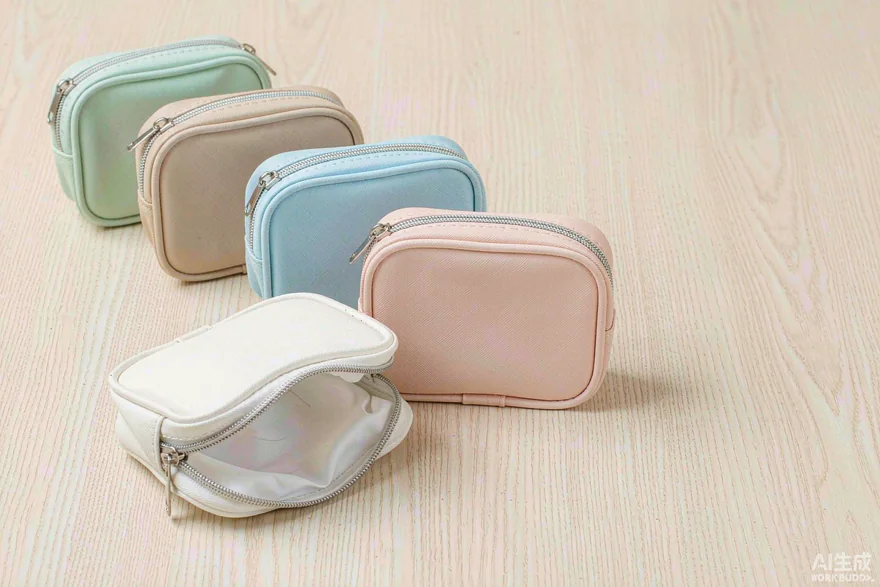
The lining of a cosmetic bag is the layer that takes the damage the shell never sees. A shell meets the inside of a suitcase or a handbag. A lining meets a foundation compact that has leaked, a mascara wand with wet product on the tip, a lipstick that softened in a warm car, and a sunscreen bottle with a half-turned cap. Liquid foundation, mascara, melted lipstick and sunscreen account for most cosmetic bag complaints that originate in the interior rather than in the zip or the seam.
A lining has to do five jobs at once: resist staining, release what it does pick up, tolerate wiping with a wet cloth or a cleanser wipe, hold a seam under load, and avoid transferring its own colour onto the contents or the shell. No single material wins all five. Polyester releases stains well and holds colour, yet it slowly absorbs oils into the fibre. Nylon resists abrasion and tear better at the same denier, but deep dyeings can crock unless the dyer controls wash-off. PEVA cannot be stained at all, because liquid sits on the surface, but it has the lowest tear and puncture resistance of the three and it fails at the seam first.
Lining choice also sets downstream decisions. A wipe-clean film changes assembly, because PEVA can be high-frequency welded rather than sewn, which removes needle holes and makes the interior genuinely liquid-tight, but it requires tooling and a different operator skill set. A woven lining has to be sewn, so the specification must also cover thread type, stitch density and seam allowance. Buyers who settle the lining late in development usually find that the sewing thread, the binding tape and the zip tape all have to be re-specified at the same time.
- Small flat pouch, roughly 18 x 12 x 6 cm: about 0.06 m² of lining per unit, so choice is driven by print quality and hand-feel rather than cost per unit.
- Medium vanity case, roughly 24 x 16 x 9 cm: about 0.14 m² of lining, where a 20 g/m² weight difference adds roughly 3 g to packed shipping weight.
- Large train case, roughly 30 x 20 x 12 cm: about 0.25 m² of lining, where abrasion at the base corners starts to dominate the specification.
- Hanging toiletry bag, roughly 26 x 20 x 9 cm folded: the lining is stressed along the fold line and needs flex resistance as well as seam strength.
Polyester Lining: Construction, Weight Bands and Where It Wins
Polyester lining is the default because it is predictable. It is a polyethylene terephthalate filament woven most often as taffeta, a plain weave where warp and weft counts are quoted as threads per inch and give the familiar 190T or 210T labels, or as an oxford or twill in heavier deniers. Moisture regain sits around 0.4 percent, so the fabric dries quickly after a wipe and does not hold water against the contents. That single property explains why polyester is the standard lining for travel-oriented cosmetic bags that may be packed while still damp.
The weakness is oil. Polyester is oleophilic: sebum, liquid foundation and lip balm migrate into the fibre and stay there. A stain-release finish slows the process but does not stop it, and the finish itself declines with repeated wiping. Buyers who sell pale linings should expect a visible patina on a polyester interior after a few months of daily use, and should either move to a mid-tone shade or specify a film instead.
Printing is where polyester wins outright. Disperse-dye sublimation bonds into the fibre, so an all-over brand pattern or a repeating logo on a polyester lining survives abrasion far better than a surface print on nylon or PEVA. For a private-label programme where the print is the feature, a 190T or 210T polyester lining at 55-70 g/m² is usually the right substrate; sublimation on a heavier 300D twill gives denser colour but costs more per yard and adds weight to every unit shipped.
Colour matching on polyester is also the most forgiving of the three families. Disperse dyeing at elevated temperature gives good levelness, lab dips can normally be matched within a ΔE of 1.0 against a reference swatch, and light fastness is the best of the three, which matters for a bag that sits on a sunlit dressing table. The trade-off is that a late colour change means re-dyeing a lot rather than swapping a roll of film.
Recycled content is straightforward on polyester and awkward on the other two. rPET lining at 60-80 g/m² is widely available with a Global Recycled Standard claim, and the documentation chain — a scope certificate plus a transaction certificate for each shipment — is the part buyers forget to request. Where a lining carries an OEKO-TEX Standard 100 certificate, the certificate should be checked for the correct product class and for an expiry date that covers bulk production rather than only the sampling window.
| Option | Construction | Weight (g/m²) | Best application | Planning note |
|---|---|---|---|---|
| 190T taffeta | Plain weave filament | 52-62 | Flat promotional pouch | Lowest cost, snags on sharp corners |
| 210T taffeta | Plain weave filament | 62-75 | Standard makeup pouch | Better cover, still lightweight |
| 300D twill | Twill weave | 100-130 | Structured vanity case | Holds shape, prints densely |
| 600D oxford with PU backcoat | Oxford weave | 190-230 | Base panel of a train case | High abrasion life, adds weight |
| rPET with GRS claim | Plain weave recycled filament | 60-80 | Sustainability-led lines | Request a transaction certificate |
Two specification habits reduce complaints. First, name both the thread count and the weight, since a 190T quoted without a g/m² figure can be delivered anywhere from 48 to 68 g/m². Second, specify the backcoating separately, since a light 8-12 g/m² acrylic backcoat adds almost no weight while buying meaningful spill resistance against a leaked bottle.
Nylon Lining and PEVA Lining: The Differences That Decide the Spec
Nylon lining is the performance option. At equal denier, a nylon 6 or nylon 6,6 filament yarn delivers higher tenacity and far better abrasion life than polyester, and it has a softer, quieter hand: the lining slides rather than rustles when the bag is opened. That matters on a bag opened several times a day. The cost is money and dye control. Nylon is dyed with acid dyes that give brilliant deep shades but can leave unfixed dye on the surface, so a black or navy nylon lining is the most common source of crocking complaints when a pale brush handle or a white interior picks up colour.
Two further cautions apply. Nylon has a moisture regain of roughly 4 percent, around ten times that of polyester, so a nylon-lined bag packed damp stays damp longer and can develop odour. And nylon yellows and loses strength under sustained heat and UV, which makes it the wrong choice for a bag designed to sit in direct sun. Where a buyer wants nylon abrasion life without the dye risk, the usual answer is a mid-tone 210D or 420D nylon with an approved lab dip and a stated wet-crocking grade rather than a deep black.
PEVA lining is a different category altogether: not a textile but a film of polyethylene vinyl acetate, typically calendered at 0.08-0.25 mm. Liquid cannot enter it, so foundation, sunscreen and melted lipstick wipe off with a damp cloth and leave no residue. It is the phthalate-free substitute for PVC and usually the cheapest route to a genuinely waterproof interior. Because it is a thermoplastic, panels can be high-frequency welded rather than sewn, which eliminates needle holes along the base seam, the single most common leak path in a sewn woven lining.
The compensating weaknesses are mechanical. A 0.12 mm PEVA film tears easily once a nick starts, and because the material does not fray it gives no warning: a small puncture at a corner becomes a long split. Seams therefore need a wider weld flange, typically 8-12 mm rather than the 6 mm seam allowance used on wovens, and internal corners should be radiused. Cold flexibility is the second issue: below roughly -10°C a low-VA film stiffens and can crack when folded, so bags shipped or used in cold climates need a grade specified for low-temperature flex. Because PEVA is impermeable, condensation collects inside a bag closed while damp, which belongs on the care label.
Coated and film linings are tested as coated fabrics rather than as wovens, and the reference most buyers cite is ASTM D751, which covers coating adhesion, blocking and tear behaviour for supported and unsupported films. Naming that standard in the tech pack, together with a minimum adhesion value and a low-temperature flex clause, is what separates a PEVA lining that survives a winter from one that cracks in transit.
- Choose polyester lining when print quality, low cost, fast drying and a wide colour range matter most.
- Choose nylon lining when abrasion life, tear strength and a soft hand justify higher fabric cost and tighter dye control.
- Choose PEVA lining when the product promise is wipe-clean, leak-proof or easy-care and the panels can be welded.
- Never specify PEVA below 0.12 mm for a bag larger than 25 cm in any dimension without a reinforced weld flange.
- Ask for coating or film adhesion results, not only tear figures: PEVA failures start at the join rather than in the panel.
Specifying, Testing and Signing Off a Lining Before Bulk Is Cut
The lining decision becomes real when it is written as numbers. A usable specification states the fibre, the construction, the thread count or denier, the weight in g/m² or the thickness in millimetres, the finish or coating, the colour reference with a tolerance, and the tests the material must pass with their target grades. Anything left as a description, such as wipe-clean lining or soft polyester, will be interpreted differently by every supplier who quotes it, and the differences only appear after bulk has been cut.
Verification is cheap relative to a rejected shipment. A buyer should require an approved and signed lab dip or film swatch, retain a gold-seal reference from the approved sample, and require the bulk material to be compared against that reference before cutting begins. Instrumental colour measurement helps: a ΔE of 1.0 or less against the approved standard is a realistic tolerance for a woven lining, while films are usually judged by grey-scale comparison because gloss affects the reading. Where the lining contacts skin or cosmetics, screening against EU REACH limits, and against CPSIA requirements for the US market, belongs in the same approval rather than in a later exercise.
Inspection is where the commercial terms bite. Bulk is normally examined at AQL 2.5 under ISO 2859-1, with lining defects classified by severity: a print defect visible at arm's length is usually a major, while a small delamination at a welded seam is critical because it will open in use. Lining-specific defects belong on the inspection worksheet alongside the generic ones, because a generic worksheet checks the shell and the zip and rarely mentions coating peel, weld voids or interior crocking.
| Property | Common test reference | Practical target | What failure looks like |
|---|---|---|---|
| Colour transfer to contents | AATCC 8 or ISO 105-X12 crocking | Dry 4, wet 3-4 on the grey scale | Pale brush handles pick up dye |
| Stain release | AATCC 130 | Grade 4 after one domestic wash | Foundation leaves a permanent ring |
| Abrasion at the fold line | Martindale, ASTM D4966 | 10,000 cycles to no hole on lining | Pile-through where the bag folds |
| Tear resistance | ASTM D2261 tongue tear | 15 N or better for 210D-class woven | A nick at the zip becomes a split |
| Seam strength | ASTM D1683 | 80 percent of fabric tensile or better | Corner seam opens under load |
| Coating or film adhesion | ASTM D751 | No peel or lift after flex cycling | Film lifts in flakes from the cloth |
| Restricted substances | REACH SVHC or CPSIA | Pass at the applicable limit | Odour complaint at unboxing |
| Wipe-clean durability | Defined in-house wipe cycle | 20 cycles with no colour loss | Dull patch where the bag is wiped |
Commercial timing should be planned around the lining as well. Sampling runs 6-10 working days for a standard construction and 12-15 working days where the lining is welded, laminated or combined with a moulded shell, and bulk runs 35-50 days after sample approval. Programmes are quoted FOB Xiamen with T/T 30 deposit and 70 against bill of lading, and the 500-piece minimum per style and colourway applies to the lining as much as to the shell, which is why a custom-dyed lining colour is a commitment rather than a late variation.
One rule saves rework: freeze the lining specification when the shell specification is frozen. Moving from a 210T taffeta to a 300D twill shifts the internal volume of a fitted case by 2-4 mm, enough to stop a rigid insert or a mirror panel from fitting as the approved sample did.
The B2B Customisation View
The commercial logic behind makeup bags and toiletry bags is simple to state and hard to execute: hold the unit cost, hold the colour, hold the delivery window.
Commercial parameters stay fixed across the range: MOQ 500 pieces per style and colourway, prototype turnaround 6–10 working days (extended to 12–15 for multi-panel or moulded builds), bulk lead time 35–50 days from approved sample, AQL 2.5 inspection to ISO 2859-1, FOB Xiamen, T/T 30 deposit and 70 against bill of lading.
For makeup bags and toiletry bags, that coordination matters most in the two weeks between packing and vessel loading, when documentation errors cost more than any material decision.
Which Brand Types Benefit Most
Different buyers reach different answers from the same three materials. A start-up brand launching its first pouch usually wants polyester: it prints well, it is the cheapest of the three per yard, and the low unit cost keeps a first purchase order inside a working budget at 500 pieces per style and colourway. An established brand with a signature deep shade is better served by nylon, provided the lab dip and the wet-crocking grade are written into the specification, because the softer hand and longer abrasion life show up in customer reviews rather than in the sample room.
- Retailers and private-label programmes: PEVA is the usual choice for an easy-care claim, and welded construction removes the needle-hole leak path that generates returns.
- E-commerce sellers: lining weight affects dimensional shipping weight. Moving from a 62 g/m² taffeta to a 140 g/m² film adds roughly 11 g to a 24 cm vanity case, which is measurable across a 5,000-unit shipment.
- Gift and hospitality buyers: amenity kits and wash-bag gifts favour PEVA because the recipient cannot stain it and the unit sits in the lower part of the typical $0.45-$12.00 market price band.
- Colour-cosmetics brands: a pale polyester lining photographs beautifully but shows service life fastest; a mid-tone lining hides it without looking cheap.
- Travel and outdoor brands: polyester wins on UV and light fastness where the bag sits in sun; nylon wins on abrasion where the bag is dragged over rough surfaces.
- Programmes balanced between two options: decide from the product claim rather than the material, since a bag sold on organisation wants polyester, one sold on longevity wants nylon and one sold on easy care wants PEVA.
- Buyers planning a custom shade: confirm the lining is available at 500 pieces per style and colourway, since a custom-dyed woven lining and a custom-compounded film carry that minimum differently.
- Programmes with a rigid insert or brush divider: freeze the lining specification when the shell is frozen, because moving from 210T to 300D shifts internal volume by 2-4 mm.
Frequently Asked Questions
What minimum order applies to a cosmetic bag with a custom-dyed PEVA lining?
The standard minimum is 500 pieces per style and colourway, and a custom-dyed or custom-gauge PEVA film carries that minimum on the film roll as well as on the finished bag. A film colour usually has to be compounded in a single run, so the 500-piece figure is effectively a raw-material constraint rather than a production constraint.
How long does sampling take for a bag with a welded PEVA lining?
A welded construction falls into the complex bracket: 12-15 working days rather than the 6-10 working days typical of a sewn woven lining. The extra time goes into the weld tooling, the parameter setting for film thickness and dwell time, and the leak test on the finished sample. Bulk then runs 35-50 days after sample approval.
Which lining performs best in a makeup bag that carries liquid foundation bottles?
PEVA is the practical answer, because liquid sits on the surface and wipes away without entering the material. A woven polyester lining with an acrylic backcoat resists a small spill but will hold oil-based foundation in the fibre once it penetrates, and a stain-release finish only slows that. The caveat is seam design: a welded PEVA interior with an 8-12 mm flange and radiused corners will hold liquid, while a sewn PEVA panel leaks through the needle holes and gives a false sense of security.
Does a nylon lining cost more than a polyester lining on the same cosmetic bag?
Nylon sits above polyester on most fabric price lists at comparable denier, and the gap widens when a deep shade requires additional wash-off and a fastness-improving after-treatment. On a small pouch the difference per unit is modest because lining consumption is only around 0.06 m²; on a 30 cm train case using 0.25 m² of lining it becomes a visible line in the costing. Buyers should weigh it against abrasion life rather than in isolation, since a lining that wears through generates returns that cost far more than the fabric saving.
What denier should the lining of a structured train case use?
A structured case in the 30 x 20 x 12 cm range usually takes 300D twill for the side panels and 600D oxford for the base, because the base is where the bag is dragged and where a loaded case puts the lining under the most abrasion. A 190T or 210T taffeta is too light for that format and will show pile-through at the fold within a season. If the case has internal dividers, the divider panels can stay lighter, since they do not carry load.
Can a brand logo be printed onto a PEVA lining?
Yes, but not with the same methods used on woven cloth. PEVA is a low-surface-energy film, so ink adhesion normally requires corona or flame treatment before printing, and even then the print sits on the surface and can be scratched. Screen printing with a flexible ink system is the common route; heat transfer can distort a thin film.
How can a buyer test whether a wipe-clean claim is genuine?
Define the test rather than accepting the adjective. A practical in-house method is to apply a measured amount of liquid foundation and of sunscreen to the lining, leave it for 24 hours, wipe with a standard cleanser wipe using a fixed number of strokes, and then rate the residue against a grey scale. Twenty cycles with no visible colour change is a reasonable pass mark. The test should be run on the production sample and repeated on a bulk sample, because finishes and film grades change between sampling and production.
Why does a dark nylon lining sometimes mark a pale brush handle?
This is crocking: unfixed acid dye sitting on the fibre surface transfers under rubbing and, in a damp bag, under contact alone. It is most common in deep black, navy and bright red nylon dyeings where the dyer has not fully washed off after dyeing or has skipped a fixing after-treatment. The fix is specification rather than material change: require a wet and dry crocking grade of 4 and 3-4 respectively, test the production lot rather than the lab dip, and avoid specifying the deepest achievable black on a bag whose contents are pale.
Is recycled polyester lining available with recognised documentation?
Yes. rPET lining at 60-80 g/m² is widely available with a Global Recycled Standard claim, and the documentation is what makes the claim defensible: a scope certificate for the fabric supplier plus a transaction certificate covering the specific shipment. Buyers should request those documents with the quotation rather than after bulk, and should check that the claimed percentage matches the hangtag figure.
Does PEVA lining crack when a cosmetic bag is used in a cold climate?
It can. Films with a low vinyl acetate content stiffen as temperature falls and may crack when folded, typically becoming noticeable below about -10°C. The specification should name a low-temperature flex requirement and the grade should be selected for it, rather than assuming that any PEVA will behave the same. For programmes shipping to or selling in cold regions, a cold-fold test on the production film at the target temperature is a cheap precaution and far easier than managing cracked returns.
What film thickness prevents a PEVA lining from splitting at the corner seam?
Thickness alone does not solve it, but 0.15-0.20 mm is a sensible floor for a bag above 25 cm in any dimension, combined with an 8-12 mm weld flange and a radiused corner. Below 0.12 mm the film is prone to nick-and-run tearing, and because PEVA does not fray there is no visual warning before a split appears. Reinforcing the corner with a welded patch or with a binding tape over the join is often more effective than increasing overall thickness, and it adds less weight.
How much does lining choice change the packed weight of a 24 cm vanity case?
A 24 x 16 x 9 cm case uses roughly 0.14 m² of lining. Moving from a 62 g/m² polyester taffeta to a 140 g/m² PEVA film adds about 11 g per unit, a little over 10 percent of the lining weight. That sounds trivial until it is multiplied across a 5,000-unit shipment, where it becomes around 55 kg of additional freight.
When is a coated woven lining a better choice than a PEVA film?
A coated woven lining suits bags that need a textile hand and some breathability while still resisting spills: a PU-coated 300D polyester, for example, wipes clean better than an uncoated cloth and sews on conventional equipment with no weld tooling. It is the better choice when the programme cannot justify tooling, when the shape has curvature that a flat film handles badly, or when the brand wants a fabric look on camera. PEVA still wins on absolute liquid-tightness and on unit cost at volume.
How is lining colour matched to the shell fabric of a cosmetic bag?
The two are rarely dyed in the same bath, because polyester shell and polyester lining can differ in yarn type and lustre, and nylon and polyester take different dye classes entirely. The practical approach is to approve a lab dip for each component against a single reference swatch, allow a ΔE of 1.0 or less, and judge under a standard light source rather than in daylight.
What inspection level applies to lining defects in a bulk shipment?
The usual basis is AQL 2.5 under ISO 2859-1, with lining defects written into the worksheet so that they are actually looked for. Coating peel, weld voids, delamination at a seam and interior crocking are the four that a generic checklist misses. Classification matters: a cosmetic print flaw may be a minor, while a weld void on a waterproof bag is critical because it fails in use. Buyers should confirm the defect list with the inspection team before the pre-shipment date.
People Also Ask
Is PEVA lining safe for cosmetic bags?
PEVA is used as a phthalate-free alternative to PVC and is widely accepted for bag interiors, but safety is a documentation question rather than a material-name question. A buyer should require a restricted-substance declaration against EU REACH limits and, for products sold in the United States, against CPSIA requirements, and should screen for odour separately because a film can be compliant and still smell unpleasant on unboxing. Certificates should be dated to cover bulk production.
Which lining material lasts longest in a makeup bag?
For mechanical life, nylon lasts longest: at equal denier it resists abrasion and tear better than polyester and far better than PEVA film. For appearance life, a mid-tone polyester holds its colour best, since it resists UV yellowing and releases stains reasonably well. PEVA lasts longest in the specific sense of never staining, but it is the first to fail mechanically. The honest answer is that the longest-lived lining depends on whether the bag fails by wearing through or by looking dirty.
Why is the lining of my makeup bag peeling?
Flaking on the inside of a bag is usually a coating failure rather than a fabric failure. Polyurethane coatings hydrolyse over time, especially in humid conditions, and lift away from the base cloth in flakes; a PEVA film separates instead at the adhesive or weld line. Heat accelerates both. Bags stored in a hot bathroom or a car reach the temperature range where coating hydrolysis speeds up, which is why peeling often appears after a summer rather than steadily through the year.
How should the inside of a cosmetic bag be cleaned?
Method follows material. A PEVA interior takes a damp cloth or a cleanser wipe and needs nothing more. A polyester lining tolerates a mild detergent solution and a soft brush, but oil-based cosmetic residue may need a solvent-based spot cleaner and may not come out entirely. A nylon lining should be cleaned cool and dried quickly, because it holds moisture and can develop odour. In every case the bag should be dried fully open, since a closed damp bag is what produces mildew.
Request a Sample or a Written Quotation
Send the silhouette, dimensions, material preference and logo artwork, and the programme team will return a written quotation with MOQ, sampling window, bulk lead time and inspection standard.
Email: service@junyuanbags.com · WhatsApp: +86 177 5002 0688