Nylon Zipper vs Plastic Zipper vs Metal Zipper for Toiletry Bags
Executive Summary
Nylon coil, moulded plastic and metal zippers are three chain constructions, and the right one depends on where the bag is used. Nylon coil weighs 4-6 g per metre, bends around curved openings and is unaffected by humidity, which is why it dominates hanging toiletry bags. Moulded plastic elements weigh 7-10 g per metre, give large toothy looks with no sharp edges, and suit children's ranges. Metal chain weighs 14-20 g per metre and offers the highest strength at 500-700 N, but brass tarnishes and aluminium oxidises in a bathroom.
Weight and corrosion, not strength, decide most of this category. A hanging bag with a metal #5 chain carries 10-16 g of extra hardware on a hook that is already loaded with 1-2 kg of contents, and the finish will spot within a season in a shower room. Programmes run at 500 pieces per style and colourway, sampling takes 6-10 working days, and bulk takes 35-50 days after sample approval.
Three Chain Constructions and How They Are Built
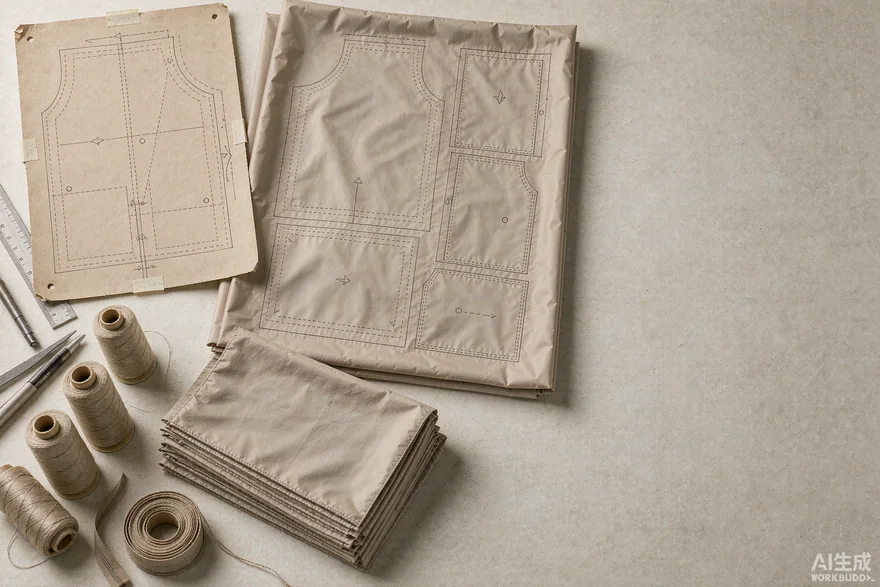
The word nylon in the zipper trade describes a coil, not necessarily the polymer. A coil zipper is a continuous monofilament wound into a helix and stitched or woven into the tape along one edge, so the chain has no discrete teeth at all. Moulded plastic zippers have individual elements injection-moulded directly on to the tape edge, usually from an acetal or polyester engineering resin. Metal zippers have discrete elements crimped or cast on to the tape, in brass, aluminium or a nickel-plated alloy, with a slider machined to match.
The construction difference drives everything else. Because a coil has no discrete elements, it can flex in any direction and follow a curved opening without jamming, and a slider that has jumped the chain can often be worked back on. Moulded elements are rigid in one axis and a lost element usually means a new zipper. Metal elements are the most robust individually and can be replaced one at a time, but the chain kinks rather than curves, which is why metal is rare on a dopp kit with a curved top opening.
The vocabulary for these parts is standardised, and using it prevents the most common specification error in this category, which is a buyer asking for a metal zipper and receiving a metal-look plastic one. Definitions of chain, element, slider, tape and stop are set out in ASTM D2053, and referencing those terms in a tech pack makes the requirement checkable rather than interpretive.
- Nylon coil: continuous helix wound into the tape, no discrete teeth, flexes in any direction
- Moulded plastic: individual resin elements injection-moulded on to the tape edge
- Metal: discrete brass, aluminium or alloy elements crimped on, with a matched slider
- Sizes follow closed width: #3 about 3 mm, #4 about 4 mm, #5 about 5 mm, #8 about 8 mm
- Write the construction and the material, not just the size and colour
Performance in a Humid Bathroom
A toiletry bag lives in the wettest room in the house, and that environment eliminates some options quickly. Metal chain is the significant casualty: brass develops verdigris and dark spotting, aluminium forms a white oxide bloom, and even plated finishes pit at the element edges where the plating is thinnest. A humidity cabinet test at 38 °C and 90 percent relative humidity for 168 hours is a reasonable screen, and it separates a well-plated part from a marginal one before 2,000 bags are made.
Weight is the second environmental factor, because most toiletry bags either hang from a hook or sit in a washbag that is carried. A 45 cm #5 metal chain weighs roughly 14-20 g per metre, so a full perimeter closure can add 30-50 g of hardware. On a hanging bag already carrying 1-2 kg of bottles, that extra mass pulls on the hook panel and changes how the bag drapes. The same closure in coil weighs 4-6 g per metre and is effectively free in weight terms.
Strength arguments are often overstated in this category. A metal #5 chain reaches 500-700 N crosswise against 300-450 N for coil and 300-500 N for moulded plastic, but a toiletry bag rarely generates that load. What does burst a bag is overpacking against a rigid frame, and the failure then occurs at the stitch line joining the tape to the panel rather than in the chain. Specifying a wider seam allowance of 10-12 mm on a closure does more for burst resistance than moving to metal.
| Property | Nylon coil #5 | Moulded plastic #5 | Metal #5 | Relevance to a toiletry bag |
|---|---|---|---|---|
| Mass per metre | 4-6 g | 7-10 g | 14-20 g | Load on a hook and packed weight |
| Chain crosswise strength | 300-450 N | 300-500 N | 500-700 N | Burst resistance when overpacked |
| Flexing around curves | Excellent, any direction | Good on one axis | Kinks rather than curves | Curved openings on a dopp kit |
| Humid bathroom after six months | No change | No change | Tarnish or white oxide bloom | Appearance complaints and returns |
| Low-temperature behaviour | Fine to -30 °C | Can embrittle below -10 °C | Fine, feels cold to touch | Winter transit and ski-season ranges |
| Repair after element loss | Slider can often be re-seated | Usually a full replacement | Element and slider replaceable | Serviceability in a hotel or home |
| Noise on opening | Quiet | Moderate rasp | Distinctive rattle | Shared bathrooms and night use |
| Colour range | Wide tape palette | Wide element palette | Limited to metal finishes | Brand colour consistency |
| Heat sensitivity | Coil deforms above about 180 °C | Elements deform above about 120 °C | Unaffected | Tumble drying and ironing |
| Cost index | 1.0 | 1.3 | 2.2 | Material cost per finished bag |
Heat sensitivity is worth a line in the care instructions. A moulded plastic element can deform above roughly 120 °C, which a tumble dryer on a hot setting reaches, and a coil deforms nearer 180 °C. Neither is a problem in normal use, but a bag labelled machine washable will eventually meet a hot dryer, and a deformed element produces the same split-behind-the-slider symptom as a worn slider.
Noise is a small but real differentiator that shows up in reviews of travel bags. A metal chain rattles against a metal hook or a mirror when the bag is carried, and in a shared hotel bathroom at night it is audible. Coil is effectively silent. For a brand positioning a quiet, soft travel range, the coil choice supports the story at a lower cost index of 1.0 against 2.2.
Matching Chain Type to Toiletry Bag Format
Format should drive the decision more than aesthetics. A hanging toiletry bag hangs from a hook stitched into a reinforced panel, and every gram above the hook line matters; coil at 4-6 g per metre is the correct default and metal is a mistake unless the design deliberately uses hardware as a visual feature. A dopp kit with a curved top opening needs a chain that flexes, which again points to coil. A rigid train case with a flat, straight closure can carry metal because the frame takes the load.
Clear liquids pouches are a special case. Travellers carry containers up to 100 ml under the TSA 3-1-1 liquids rule, and the pouch is usually a welded thermoplastic polyurethane film with a closure sewn or welded into one edge. The chain must be light and quiet, the slider must not snag on the film, and the film-to-tape junction is the real leak risk rather than the chain. A #3 or #4 coil with a small, low-profile puller is the usual answer.
| Bag format | Recommended chain | Reason | Size | Watch-out |
|---|---|---|---|---|
| Hanging toiletry bag with hook | Nylon coil | Lowest mass above the hook line | #4 | Reinforce the hook panel separately |
| Dopp kit with curved opening | Nylon coil | Flexes around the curve without kinking | #5 | Metal kinks and jams on curves |
| Clear liquids pouch | Nylon coil | Light, quiet, no sharp edges | #3 or #4 | Test the film-to-tape junction for leaks |
| Rigid train case | Metal or moulded plastic | Perceived robustness on a straight run | #5 or #8 | Weight budget for the finished case |
| Children's toiletry bag | Moulded plastic | Large elements, no sharp edges | #5 | Coating and heavy-metal limits |
| Brush roll or flat pouch | Nylon coil | Thin, flexible, packs flat | #3 | Low load, so a small size is adequate |
Children's ranges add a regulatory dimension rather than a mechanical one. A toiletry bag marketed to children falls under lead and phthalate limits in the United States under the Consumer Product Safety Improvement Act, and the puller is the part most likely to be flagged because it is often a coated metal or a painted casting. Moulded plastic with a resin puller avoids the question entirely and is the safer default for a junior range.
Length and cut tolerance deserve a line in the specification as well. A coil chain can be cut to length on the line and finished with a bottom stop, so a small change in pattern size is absorbed easily; metal and moulded chain are supplied in cut lengths with stops already applied, which means a design change can strand inventory. Buyers planning a range that may be resized between seasons are better served by coil, while a fixed-pattern case can take either.
One commercial pattern is worth noting: mixing chain types within a single range is normal and cheap. A three-piece travel set can use a #4 coil on the hanging bag, a #5 coil on the dopp kit and a #5 moulded plastic on the small pouch, and the only added cost is line-side changeovers. Consistent tape colour across the three is what makes the set look deliberate, so the colour should be approved from one reference swatch for all three parts.
Specifying, Testing and Caring for the Closure
A closure specification should name the construction, the size, the length in centimetres, the tape material and colour reference, the element material, the slider and puller type, and two numeric minimums: cycles and crosswise strength. For a toiletry bag, 5,000 cycles and 350 N is a sensible floor for coil, and 5,000 cycles and 550 N for metal. Adding a finish requirement for metal, such as 48 hours of salt spray exposure with no base metal corrosion, is what separates a part that lasts from one that spots.
- Name the construction, not just the size: coil, moulded plastic or metal
- Give two numbers: 5,000 open-close cycles and 350 N crosswise for coil, 550 N for metal
- For metal, add a finish requirement: 48 hours salt spray with no base metal corrosion
- For clear pouches, test the film-to-tape junction with a 24-hour static fill, not the chain alone
- Approve tape colour from one reference swatch across all sizes in a set
Testing should be staged. At sampling, run crosswise strength, cycle life and, for metal, salt spray exposure on five pieces. At goods-in on bulk, run a five-piece functional check: the slider must travel the full length smoothly in both directions, the stops must be present at both ends, and the tape must be free of skipped stitches where it enters the panel. Under an AQL 2.5 inspection plan a slider that will not close is a critical defect, because the bag cannot be used at all.
Care instructions protect the closure after sale, and most brands omit them. Three lines are enough: empty the bag before washing, close the zipper before it goes anywhere near a machine, and dry at low temperature or air dry. Those three instructions prevent the two most common post-sale failures, which are elements deformed by heat and a slider damaged by an open chain catching on the drum.
Puller choice is the cheapest way to change how a closure reads. A flat moulded puller, a cord puller with a heat-shrink end, and a metal casting with a logo all fit the same #5 slider body, and the difference in unit cost is often under $0.10. Because the puller is the part a customer touches and photographs, spending there buys more perceived quality than moving from coil to metal chain, which costs roughly 1.2 times the coil index and is largely hidden inside the bag.
Programme terms do not change with chain type. Minimums are 500 pieces per style and colourway; sampling takes 6-10 working days, and 12-15 working days for complex constructions such as a welded clear pouch with an integrated closure; bulk runs 35-50 days after sample approval. Final inspection is at AQL 2.5, shipment is FOB Xiamen, and payment is T/T 30 deposit with 70 against the bill of lading.
The single decision that saves the most rework is choosing coil unless there is a specific reason not to. It is the lightest, the quietest, the most flexible and the cheapest of the three at a cost index of 1.0, and it is unaffected by the humidity that defines this product category. Metal earns its 2.2 index only where the bag is rigid, straight-edged and sold on hardware as a design feature.
The B2B Customisation View
Programme planning for cosmetic bags starts with the end market: a hotel amenity run and a beauty-retail launch ask for completely different construction and compliance evidence.
Planning figures used across the programme: MOQ 500 pieces per style and colourway, 6–10 working days sampling (12–15 when moulding or multi-layer lamination is required), 35–50 days bulk lead time, AQL 2.5 to ISO 2859-1, FOB Xiamen, T/T 30/70.
The programme-management model exists because most import problems are documentation problems, and documentation is what this office produces and holds.
Which Brand Types Benefit Most
Start-up brands should default to coil for a first toiletry range and spend the saving elsewhere. A #4 or #5 coil at a cost index of 1.0 removes three risks at once: weight on a hook, corrosion in a bathroom, and jamming on a curved opening. The money saved against a metal chain funds a better lining or a moulded puller, which is the part a customer actually touches and photographs.
Established brands use chain type as a range architecture signal: coil for travel and soft bags, moulded plastic for junior ranges, metal for a rigid premium case sold on hardware. Retailers care about the finish specification on metal, because a spotted puller discovered in store becomes a markdown. E-commerce sellers should weigh the return profile: corrosion and tarnish complaints arrive four to eight months after delivery, which is long after the review window and therefore invisible in early data.
- Start-up brands: coil everywhere in season one; spend the saving on lining and puller
- Established brands: use chain type as a deliberate range signal across travel, junior and premium tiers
- Retailers: write finish and salt spray requirements into the listing for any metal-trimmed bag
- E-commerce sellers: expect corrosion complaints late, so test at sampling rather than relying on early reviews
- Gift and hospitality buyers: coil or moulded plastic at 500 pieces per colourway, sampling 6-10 working days
Buyers assembling a travel set should also think about how the three chain types read together on a shelf. A mixed set looks deliberate when the tape colour is consistent and the puller shape repeats across sizes, and looks accidental when each piece carries a different finish. Approving one tape colour and one puller family for the whole set, then varying only the size, produces a coherent range at no extra material cost.
Finally, the closure choice should be revisited when a range moves into a new climate. A coil closure specified for a temperate market will perform identically in the tropics, whereas a metal-trimmed design that survived a dry climate can corrode within months once the same bag is sold into a humid one. Re-running the humidity screen when a range enters a new region is a small cost against a seasonal return spike.
Frequently Asked Questions
Which zipper type lasts longest in a bathroom?
Nylon coil or moulded plastic, because neither corrodes. Brass tarnishes and aluminium forms a white oxide bloom within about six months of daily shower-room exposure. A humidity cabinet test at 38 °C and 90 percent relative humidity for 168 hours is a reasonable screen before committing to a metal-trimmed design.
Is a metal zipper stronger than a nylon coil one?
Yes on paper: 500-700 N crosswise against 300-450 N for a #5 coil. In practice a toiletry bag does not generate that load, and overpacking failures occur at the stitch line joining the tape to the panel rather than in the chain. A 10-12 mm seam allowance does more for burst resistance than moving to metal.
How much weight does a metal zipper add to a hanging toiletry bag?
A #5 metal chain weighs roughly 14-20 g per metre against 4-6 g for coil, so a full perimeter closure adds 30-50 g of hardware above the hook line. On a bag already carrying 1-2 kg of bottles, that changes how the bag drapes and adds stress to the hook panel.
Can a metal zipper be used on a dopp kit with a curved opening?
It can be fitted but it performs poorly. Metal chain kinks rather than curves, so the slider catches at the bend and jams, and repeated use wears the tape at the kink point. A coil chain flexes in any direction and is the correct choice for any closure that is not a straight run.
What size zipper suits a clear liquids pouch?
A #3 or #4 coil. The pouch carries containers of up to 100 ml, so the load is small; the chain needs to be light, quiet and free of sharp edges that could catch the film. The real leak risk is the film-to-tape junction, which should be checked with a 24-hour static fill test.
Are moulded plastic zippers suitable for children's toiletry bags?
They are the safest default. Large moulded elements have no sharp edges, and a resin puller avoids the coating and heavy-metal questions that arise with painted metal castings under children's product rules. A #5 moulded chain is also easy for small hands to grip and pull.
Does a nylon coil zipper melt in a tumble dryer?
Not on a normal setting. Coil begins to deform above roughly 180 °C, and moulded plastic elements above roughly 120 °C, which a hot dryer cycle can approach. Care instructions should say close the zipper before washing and dry at low temperature, which prevents the deformed element that causes splitting.
How is corrosion resistance specified on a metal zipper?
By naming the base metal, the finish and an exposure test. A workable requirement is a plated brass or alloy element with 6-10 microns of plating and no base-metal corrosion after 48 hours of salt spray exposure. Plating thickness can be verified non-destructively by X-ray fluorescence on a sample.
Can a coil zipper be repaired if the slider comes off?
Often yes. Because the chain has no discrete elements, a slider that has jumped the chain can usually be worked back on and, if the stops are intact, will function again. A lost moulded element normally means replacing the whole zipper, while a metal element can be replaced individually.
Why does a zipper rattle on a travel toiletry bag?
Metal elements and a metal puller strike each other and any hook or mirror in the bag. It is audible in a shared hotel bathroom and appears in travel reviews more often than buyers expect. Coil with a soft or moulded puller is effectively silent and costs a fraction of the metal equivalent.
Can one travel set use different zipper types?
Yes, and it is common. A hanging bag can take a #4 coil, a dopp kit a #5 coil and a small pouch a #5 moulded plastic chain, with the only added cost being line-side changeover time. Approving tape colour from a single reference swatch is what makes the mixed set look deliberate.
What cycle life should be specified for a toiletry bag closure?
Five thousand open-close cycles is a sensible floor. A bag opened twice a day accumulates about 1,460 cycles in two years, so 5,000 gives headroom for a travel bag used intensively. Test five pieces per lot on a reciprocating rig, and treat a slider that will not close as a critical defect at inspection.
How should the tape colour be approved across a range?
Approve a physical tape swatch under a D65 light source and use it for every size and every component in the set. A tape that misses the shell by Delta E 2.0-3.5 reads as a cheap bag in a product photograph, and the mismatch is most visible on saturated colours and on dark shades.
Which zipper works best on a rigid train case?
Metal or moulded plastic on a #5 or #8 chain, because the closure is a straight run and the frame carries the load that a soft bag would put on the seam. Metal at a cost index of 2.2 suits a premium positioning; moulded plastic at 1.3 gives the same robustness with less weight and no corrosion question.
Does the zipper affect whether a toiletry bag leaks?
Rarely through the chain and often through the tape. A standard polyester tape wicks water along its length, so a bag intended to contain a spill needs a polyurethane-coated tape or a sealed lining tray. On a welded clear pouch, the film-to-tape junction is the weak point and should be fill-tested.
How long does sampling take for a welded clear pouch with a closure?
Plan 12-15 working days rather than the standard 6-10, because welding tooling for the film and the closure has to be set up and the junction tested. Bulk then runs 35-50 days after sample approval at 500 pieces per style and colourway, shipped FOB Xiamen with T/T 30 deposit, 70 against the bill of lading.
People Also Ask
Which zipper is best for a toiletry bag?
A nylon coil zipper for almost every soft toiletry bag. It weighs 4-6 g per metre, flexes around curved openings, does not corrode in a bathroom and costs the least of the three. Metal suits a rigid train case sold on hardware; moulded plastic suits children's ranges.
Do metal zippers rust in a bathroom?
Brass tarnishes and develops dark spotting or verdigris, aluminium forms a white oxide bloom, and plated finishes pit at the element edges. It is usually cosmetic rather than structural, but it appears within about six months of daily shower-room use and generates returns.
What is the difference between a nylon zipper and a plastic zipper?
A nylon zipper in trade usage is a coil: a continuous monofilament helix stitched into the tape, with no discrete teeth. A moulded plastic zipper has individual resin elements injection-moulded on to the tape edge. The coil is lighter and more flexible; moulded elements give a chunkier look.
Can a toiletry bag zipper be replaced?
Yes, but it is rarely economical on a finished bag because the stitch line has to be unpicked and re-sewn. Metal allows single-element replacement and coil allows the slider to be re-seated, so both are more serviceable than moulded plastic, where a lost element usually means a new zipper.
Request a Sample or a Written Quotation
Send the silhouette, dimensions, material preference and logo artwork, and the programme team will return a written quotation with MOQ, sampling window, bulk lead time and inspection standard.
Email: service@junyuanbags.com · WhatsApp: +86 177 5002 0688