Nail Polish Carrying Cases: Bottle Organization & Safety
Executive Summary
A nail polish carrying case holds polish bottles upright and separated so caps stay tight, bottles do not strike one another and any leak stays inside a wipe-clean tray. For most programmes the right answer is a semi-rigid shell with a die-cut or moulded bottle tray rather than a soft pouch: bottle height, not bottle count, sets the tray depth, and the tray must lift out so a spilled bottle can be dealt with without replacing the whole bag.
Solvent behaviour drives the rest of the specification. Nail polish is a solvent-borne flammable product, so the case should be specified for leak containment and wipe-clean recovery, never described with fire-safety claims a bag cannot carry. Flash point, packing group and carriage limits come from the polish manufacturer's safety data sheet and the carrier's dangerous-goods rules. Air travel adds the TSA 3-1-1 liquids rule, which caps containers at 100 ml in cabin baggage. Minimum order is 500 pieces per style and colourway, with sampling in 6-10 working days.
What a nail polish carrying case has to do
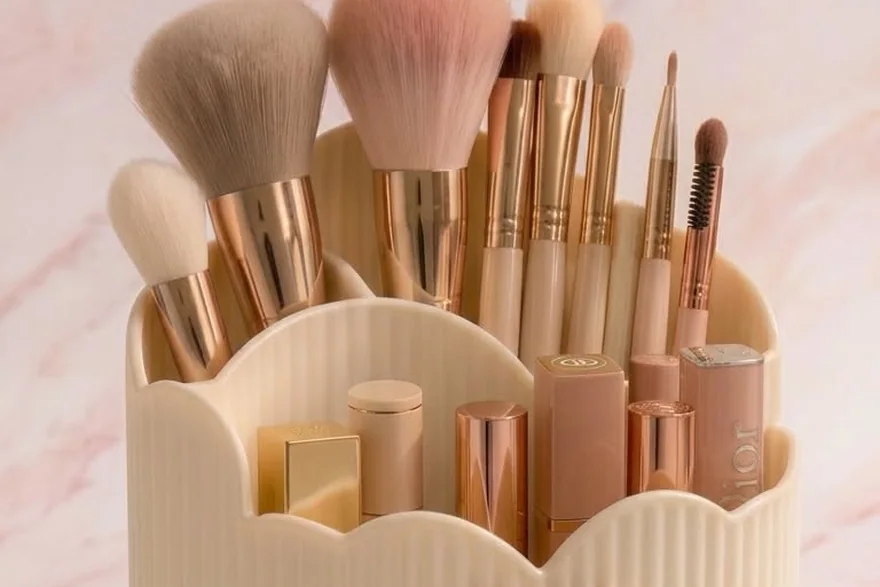
A nail polish carrying case is a bag, box or tray system built to move between 6 and 48 polish bottles without tipping them, chipping them against each other or letting a loosened cap empty into the lining. The job list is short but unforgiving: hold every bottle within roughly 10 degrees of vertical, keep glass off glass, keep a leak off the outer shell, and survive being laid flat in a suitcase and stood up again. Buyers who treat polish as just another liquid and ship it in a generic pouch inherit the two failure modes that generate the most return photographs: caps that unscrew under vibration and bottles that arrive with chipped necks. A third, quieter failure is label damage: bottles sliding against a smooth lining lose their printed or shrink labels within a few trips, which makes a full-price bottle unsellable on a retail shelf.
Bottle geometry drives everything else. A typical retail nail polish bottle holds 10-15 ml and stands 70-95 mm tall, with a cap diameter of 22-30 mm and a body diameter of 26-35 mm. Salon and professional sizes run larger, up to 30 ml and 110 mm tall, while gel, builder and treatment bottles are wider and shorter. A case designed around a 13.5 ml bottle will not restrain a 30 ml bottle and will rattle a slim 6 ml treatment bottle, so the first question in any brief is the tallest and widest bottle in the range, not the average one.
Five construction families dominate the category: a flat zip case with elastic loops, a tray case with die-cut EVA dividers, a moulded EVA shell with formed pockets, a box-style case with a lift-out tray, and a hanging roll with elastic sleeves. They differ mainly in how much they rely on friction versus geometry. Friction-based systems tolerate bottle size variation but relax over time; geometry-based systems hold position precisely but punish any bottle outside the specified diameter band. Nail brands shipping one bottle shape across a shade range usually prefer geometry. Beauty retailers shipping a mixed assortment usually need friction plus adjustable dividers.
Upright retention and bottle-to-bottle contact
Retention is a geometry problem before it is a materials problem. A bottle tips when the restraint height is too low relative to the bottle's centre of gravity. In practice the tray wall or loop should engage the bottle over at least 55-60% of its height: a 90 mm bottle needs 50-55 mm of restraint height, a 70 mm bottle needs about 40 mm. Below that, a fully loaded case laid flat lets bottles walk out of their slots under their own weight, and the caps end up bearing the load instead of the closures.
Slot diameter is the second variable. The working clearance is bottle diameter plus 2-4 mm, enough to insert and remove a bottle one-handed but tight enough that the bottle cannot shift more than a couple of millimetres. Clearance above 5 mm produces audible rattle and lets caps touch; clearance below 1 mm makes extraction slow and, on glass bottles with a printed or shrink label, scuffs the label on every removal. Because printed labels vary in thickness, the slot should be specified against the labelled bottle, not the bare glass.
Bottle-to-bottle contact is the failure that actually chips glass, and it happens at two points: cap-to-cap above the tray line and shoulder-to-shoulder below it. Specifying a centre-to-centre pitch of bottle diameter plus 8-10 mm of wall material removes both. Where the bottle count has to rise inside a fixed footprint, a two-tier tray with a 4-6 mm interlayer sheet is a better answer than thinning the walls, because wall thickness is what keeps shoulders apart when the case is squeezed into a suitcase.
| Retention method | Tilt hold | Extraction effort | Bottle diameter range | Tooling | Tray cost band |
|---|---|---|---|---|---|
| Elastic webbing loop | Good to about 45-60 degrees | Low, one hand | 22-40 mm, forgiving | None | $0.10-$0.35 |
| Sewn fabric sleeve | Fair to about 30 degrees | Low | 18-45 mm, wide | None | $0.15-$0.40 |
| Foam insert, die-cut holes | Good | Moderate | Fixed band, plus or minus 2 mm | Die-cut tool | $0.45-$1.20 |
| Die-cut EVA divider tray | Excellent, past 60 degrees | Low | Fixed band, plus or minus 2 mm | Die-cut tool | $0.60-$1.80 |
| Moulded EVA formed pocket | Excellent | Moderate | Fixed, plus or minus 1 mm | Mould tool | $1.20-$3.50 |
Performance should be verified by test rather than by eye. A usable acceptance test is a loaded case tilted to 45 degrees for 60 seconds with no bottle leaving its slot, followed by a 30 cm drop onto carpet on each of six faces with no cap opening and no fresh contact mark on any bottle. Both belong on the sample approval sheet, because they reproduce the two situations that generate customer complaints. A third check, a 24-hour closed-case odour assessment after a deliberate 2 ml spill cleaned to the instruction leaflet, tells the buyer whether the lining is recoverable at all. Extraction force is the fourth useful measurement. A bottle should come out with a light pull and should not require the case to be held with two hands; where a tray grips so tightly that the case lifts with the bottle, the slot is undersized and the glass is being loaded in bending rather than in compression.
Solvent vapours, leakage and honest claims
Nail polish is a solvent-borne flammable product. Typical formulations use esters such as ethyl acetate and butyl acetate with alcohols and a nitrocellulose film former, and the vapour is both flammable and strongly odorous. That has two consequences for a bag programme. First, the lining has to survive contact with the liquid and its vapour without dissolving, staining permanently or holding odour. Second, the bag must not be marketed with fire-safety language. Terms such as flame-resistant, fire-safe or explosion-proof are not claims a soft or moulded bag can carry, and putting them on a hangtag creates a product-liability exposure that no unit-cost saving justifies.
The defensible claims are narrower and still commercially useful: leak-resistant tray, wipe-clean lining, removable tray for inspection, odour-managed construction. Flash point, packing group and any quantity restriction belong to the product inside the bottle. A buyer specifying packaging should pull those values from the polish manufacturer's safety data sheet and from the carrier's dangerous-goods rules, and keep them in the technical file rather than in marketing copy. Packaging that claims a safety property it has not been tested for is the fastest route to a delisting conversation with a retail partner.
Air travel adds a separate, well-defined constraint. Under the TSA 3-1-1 liquids rule, liquids carried in cabin baggage must be in containers of 100 ml or less and all containers must fit inside a single one-quart bag. A 15 ml polish bottle clears the container cap easily, but ten bottles plus remover, base coat and top coat can still crowd the quart bag, so a case intended for carry-on should be specified with a quart-bag-compatible footprint. Checked baggage has no 3-1-1 cap but does fall under airline and civil-aviation dangerous-goods rules for flammable liquids.
- Take flash point, packing group and quantity limits from the polish maker's safety data sheet and the carrier's dangerous-goods rules, never from the bag specification.
- Specify containment and cleanability rather than fire performance: leak-resistant tray, wipe-clean lining, removable insert.
- Vent passively. A 3-5 mm perimeter gap or two 6 mm grommets let vapour disperse; a sealed cavity concentrates it and holds odour.
- Label for handling, not for safety: store upright, keep away from heat sources, plus a batch code printed inside the tray.
Lining choice follows from cleanability. A 210D polyester with a 0.10-0.15 mm PU coating wipes clean and holds shape cheaply but can be softened by repeated solvent contact. A TPU-laminated knit resists solvents better and stays flexible in cold conditions at higher cost. PVC film wipes clean and is cheap, but plasticiser migration stiffens it and adds its own odour, which is a poor combination with a solvent-borne product. Whichever lining is chosen, a tray that lifts out is the single most valuable feature: it turns a spill from a bag replacement into a rinse at the sink.
| Lining | Film thickness | Solvent wipe result | Odour retention | Wipe-clean | Cost relative |
|---|---|---|---|---|---|
| 210D polyester, PU coated | 0.10-0.15 mm | Fair, softens with repeat contact | Moderate | Good | Low |
| TPU-laminated knit | 0.15-0.25 mm | Good | Low | Good | Medium-high |
| PVC film | 0.18-0.30 mm | Fair, plasticiser extraction | High | Excellent | Low |
| 210D nylon, uncoated | None | Poor, stains | High | Poor | Low-medium |
| Aluminium-laminate barrier | 0.08-0.12 mm foil | Good, barrier layer | Low | Fair, creases | High |
Specifying a nail polish case for a programme
The specification that survives bulk production is the one written as numbers. A workable brief for a 12-bottle case reads: moulded EVA shell 5 mm with a 600D polyester outer laminate, die-cut EVA tray 8 mm with 12 pockets at 32 mm diameter and 55 mm depth, 210D PU-coated lining, a number 5 nylon coil zipper with an auto-lock slider, and a woven batch-code label inside the tray. Zipper components are worth naming to the terminology in ASTM D2053 so that tape, slider, pull and stop are specified unambiguously across languages and across factories.
Closure choice interacts with containment. A number 5 coil zipper with a reversed tape sheds less liquid through the teeth than a metal zipper and is quieter against glass; an auto-lock slider prevents the slow zip-down that opens a case inside a suitcase. Where the case ships filled with product, a secondary barrier such as a 0.05 mm LDPE liner or a shrink band over the tray is worth the extra cents, because it converts a leak into a contained mess that the consumer never touches.
Testing for this category is physical rather than chemical. Useful entries on a sample approval sheet include the 45-degree loaded tilt test, the 30 cm six-face drop, 500 zipper open-close cycles with no tooth separation, seam strength on the tray-to-shell join, and colour fastness to rubbing so a dark shell does not mark a pale tray. Where the shell uses a coated fabric, coating adhesion and blocking resistance are checked against ASTM D751 rather than by hand feel. One further check belongs on the sheet because it costs nothing and prevents a common complaint: a loaded case placed on a 10-degree slope with the zipper closed should not allow any bottle to touch the zipper tape. Glass bearing on a zipper chain is how teeth deform and how a case becomes stiff to open after a few months.
| Spec item | Target | Why it matters |
|---|---|---|
| Restraint height | 55-60% of bottle height | Stops tipping when the case is laid flat |
| Slot clearance | Bottle diameter plus 2-4 mm | Prevents rattle without scuffing labels |
| Pitch | Bottle diameter plus 8-10 mm | Removes cap-to-cap and shoulder contact |
| Tray removal | Lift-out, not stitched to shell | Spill recovery without replacing the bag |
| Zipper | Number 5 nylon coil, auto-lock slider | Quiet against glass, will not creep open |
| Lining | PU-coated 210D or TPU laminate | Wipe-clean recovery after a leak |
Commercial parameters are fixed and should be built into the launch calendar early: minimum 500 pieces per style and colourway, sampling in 6-10 working days and 12-15 working days for complex constructions such as a moulded shell on a new tool, bulk production 35-50 days after sample approval, inspection to AQL 2.5 under ISO 2859-1, shipment FOB Xiamen and payment T/T 30 deposit with 70 against bill of lading. A moulded tray is the item most likely to push sampling to the longer window, so a launch date should be worked back from the tool rather than from the sewing line. Buyers launching a shade range should also plan the tray around the range rather than around a single launch, since a tray cut for one bottle shape is the item that limits future shade extensions.
The B2B Customisation View
The route from concept to shelf for makeup bags and toiletry bags is short when the specification is tight at the start, and painfully long when it is not.
Fixed commercial parameters: 500 pieces per style and colourway minimum, first sample in 6–10 working days (12–15 for complex or hardware-intensive constructions), bulk 35–50 days after approval, AQL 2.5 inspection under ISO 2859-1, FOB Xiamen, T/T 30/70.
The role played here is programme coordinator: QUANZHOU JUNYUAN BAGS translates a retail brief into a factory-ready technical pack and then audits the output against it before goods leave the floor.
Which Brand Types Benefit Most
Different buyer types want different things from a nail polish carrying case, and the brief changes accordingly. Nail and salon brands shipping one bottle shape across 30 to 80 shades benefit most from a moulded or die-cut tray cut to that single bottle, because retention can be tuned to one diameter and the case becomes part of the brand's visual system. Subscription and sample-box operators ship mixed bottles from several brands and should specify elastic or adjustable systems instead, accepting slightly weaker tilt performance in exchange for tolerance across shapes. Price position matters as well: a case sold at a premium needs a moulded shell to justify the ticket, while a case given away with a purchase needs only a clean tray and a printable front panel.
- Start-up brands: one bottle, one tray. A 12-slot die-cut EVA tray in a stock shell keeps tooling at die-cut level and lets a first order land at 500 pieces per colourway without a mould investment. The first order should be sized to the shade count rather than to a round number.
- Established nail brands: a moulded shell with formed pockets and a batch-coded lift-out tray, ordered across two or three colourways so the wall can be refreshed without retooling.
- Retailers and e-commerce sellers: a friction-based case with a printed size chart on the hangtag, sized for the largest bottle in the assortment rather than the most common one.
- Gift and hospitality buyers: a two-tier tray with a removable insert, packed flat to save cube, since the case is given away rather than sold on retention performance.
- Mobile technicians and educators: a box case with a lift-out tray and a solvent-resistant secondary liner, because the case is opened and closed dozens of times a working day.
- Professional distributors and educators: a tray sold separately from the shell, so a damaged tray can be replaced without discarding a case that is otherwise sound.
Frequently Asked Questions
What slot depth should a nail polish carrying case use for a 15 ml bottle?
A 15 ml polish bottle typically stands 70-85 mm tall, so the tray wall or loop should engage it over 40-50 mm, which is 55-60% of bottle height. Shallower than that and a loaded case laid flat lets bottles lean and walk out of their slots. If the range also includes a 30 ml salon bottle at 110 mm, specify the tray to the tallest bottle or split the tray into two depth zones.
How much clearance should there be between a polish bottle and its slot?
Specify bottle diameter plus 2-4 mm measured on the labelled bottle, not on bare glass. Clearance above 5 mm lets bottles rattle and caps touch, which is how necks chip. Clearance below 1 mm makes extraction slow and can scuff shrink or printed labels on every removal. Where a range mixes bottle diameters, a friction-based elastic loop accepts the spread; a moulded pocket does not.
Why does nail polish leak inside a case that never leaks with other cosmetics?
Two reasons. Polish solvents are thin and mobile, so they creep through a cap thread that holds a cream, and they soften some coatings. Second, vibration during transit slowly backs off a screw cap, especially one carrying dried product in its thread. A case cannot fix the closure, but a tray with upright restraint, a lift-out insert and a wipe-clean lining limits the damage to one component.
Can a nail polish carrying case be described as fire-resistant or flame-retardant?
No. A soft or moulded bag has not been tested to a flame-spread or ignition-resistance standard, and such a claim creates product-liability exposure. Describe what the case actually does: leak-resistant tray, wipe-clean lining, removable insert, upright retention. Fire and flammability properties belong to the polish inside the bottle and are documented in the manufacturer's safety data sheet.
Where should a buyer get flash point and carriage limits for polish?
From the polish manufacturer's safety data sheet, which states flash point and any transport classification, and from the carrier's dangerous-goods rules for the mode being used. Those values change with formulation, so a change of polish supplier or a reformulation should trigger a re-read. The bag specification should then be adjusted for containment, venting and labelling rather than for fire performance.
How many 15 ml polish bottles fit in carry-on under the TSA liquids rule?
Each container is well under the 100 ml limit, so the constraint is the one-quart bag rather than the bottle count. Ten bottles occupy roughly 150 ml of volume plus the bag's own thickness, and remover, base coat and top coat add more. A case sold for cabin use should be sized so the filled case drops into a quart bag without forcing the zipper, and the hangtag should say so.
Should the bottle tray be fixed into the case or removable?
Removable, almost always. A lift-out tray lets a spilled bottle be rinsed without soaking the shell, lets security or retail staff inspect the contents, and lets the brand sell a replacement tray as a spare part. Fixing the tray to the shell saves a small amount of assembly cost and converts every leak into a full bag replacement, which is the more expensive outcome over a programme's life.
Which lining resists nail polish solvent best?
A TPU-laminated knit performs best of the common options, resisting repeated solvent contact while staying flexible at low temperature. PU-coated 210D polyester is the value choice and wipes clean but softens with repeat exposure. PVC film wipes cleanest yet stiffens and contributes its own odour over time. Whichever is specified, test it with the brand's own polish and remover rather than with water.
Should a nail polish case be vented or sealed?
Vented, passively. A 3-5 mm perimeter gap around the tray or two 6 mm grommets in the shell let solvent vapour disperse after a spill instead of concentrating in a closed cavity. Sealing the case keeps odour in and slows drying after cleaning. Venting does not change the fire behaviour of the contents and should never be presented as a safety feature.
What zipper type suits a case holding glass bottles?
A number 5 nylon coil zipper with a reversed tape and an auto-lock slider. Coil is quieter and gentler against glass than metal teeth, a reversed tape sheds less liquid through the chain, and the auto-lock slider stops the slow creep that lets a case open inside a suitcase. Specify tape, slider, pull and stop using ASTM D2053 terminology so the brief reads the same in every language.
How is tilt performance tested before bulk production is approved?
Load the case with the heaviest specified bottle in every slot, seal it, tilt to 45 degrees for 60 seconds and record any bottle that leaves its slot or touches a neighbour. Repeat on the opposite face. Follow with a 30 cm drop onto carpet on six faces and inspect for opened caps and fresh contact marks. Write pass conditions into the sample approval sheet so the test is repeatable at final inspection.
What is the minimum order for a custom nail polish carrying case?
The minimum is 500 pieces per style and colourway. A two-colourway launch of one tray design therefore starts at 1,000 pieces. Where a moulded EVA shell is involved, the tooling cost is carried across that quantity, so a first order at the minimum carries a higher effective unit cost than a reorder against the same tool.
How long does sampling take for a moulded EVA polish case?
Allow 6-10 working days for a sewn or die-cut construction and 12-15 working days for complex constructions, which includes a moulded shell made on a new tool. Bulk production runs 35-50 days after sample approval. Because the tool is the long pole, the launch date should be worked back from tooling rather than from the sewing schedule.
How do elastic loops compare with die-cut EVA dividers for retention?
Elastic loops accept a wide diameter band, roughly 22-40 mm, need no tooling and cost $0.10-$0.35 per position, but they relax with use and hold reliably only to about 45-60 degrees of tilt. Die-cut EVA dividers hold past 60 degrees and keep shoulders apart precisely, but accept only a plus-or-minus 2 mm diameter band and need a die-cut tool at $0.60-$1.80 per tray.
What carton packing suits a rigid polish case shipped filled with product?
Ship the case upright with a corrugated divider so bottles stay vertical, and add a 0.05 mm LDPE liner or shrink band over the tray as a secondary barrier. Carton counts are set by mass rather than cube, since 12 filled 15 ml bottles plus a shell approach 1 kg. A drop test on the packed carton, not just on the empty case, is the check that matters.
How should a nail polish case be labelled for retail?
Keep labels factual: bottle capacity and count, upright storage, keep away from heat sources, and a batch code inside the tray for traceability. Avoid any fire-safety wording. Where the case is sold with polish inside, the retail pack should carry the polish maker's own markings and any warnings from the safety data sheet, since those belong to the contents rather than to the bag.
People Also Ask
Do nail polish bottles count as liquids at airport security?
Yes. Polish is treated as a liquid or gel, so cabin baggage must follow the 3-1-1 pattern: containers of 100 ml or less, all of them inside one quart-sized bag. A 15 ml bottle passes the container test easily, but a full 12-bottle case can still crowd the quart bag, so a carry-on case should be specified with that footprint in mind. Checked bags follow airline dangerous-goods rules instead.
How do you keep nail polish bottles from breaking in a case?
Stop them touching each other and stop them tipping. That means a tray with restraint height at 55-60% of bottle height, slot clearance of 2-4 mm around each bottle, and a centre-to-centre pitch of bottle diameter plus 8-10 mm so caps and shoulders cannot strike. A semi-rigid shell then spreads any impact across the case instead of concentrating it on one bottle neck.
What is the best way to store nail polish upright when travelling?
Use a case with a dedicated tray rather than a pouch, because a pouch lets bottles lie on their side where the cap thread sits in contact with liquid. Keep bottles in their slots, tighten caps before packing, and place the case in the middle of the suitcase rather than against a hard shell. A lift-out tray also means a leaked bottle can be rinsed without soaking the whole bag.
Can you fly with gel nail polish in a cosmetic case?
Gel polish follows the same liquids handling as regular polish for cabin baggage: containers of 100 ml or less in one quart bag. Gel bottles are usually wider and shorter than lacquer bottles, so a tray cut for a slim lacquer bottle may not seat them; check the widest bottle in the range before specifying slot diameter. Larger salon sizes are better placed in checked baggage, subject to airline rules.
Request a Sample or a Written Quotation
Send the silhouette, dimensions, material preference and logo artwork, and the programme team will return a written quotation with MOQ, sampling window, bulk lead time and inspection standard.
Email: service@junyuanbags.com · WhatsApp: +86 177 5002 0688