Makeup Brush Bags & Rolls: Brush Protection Complete Guide
Executive Summary
Whether a makeup brush bag or roll genuinely protects brushes has a specific answer: it protects them when the storage system carries load at the ferrule and keeps adjacent bristle bundles from pressing against one another. Most designs sold for this purpose fail because they grip the bristles, which are the one part of a brush that tolerates almost no sustained pressure. Three engineering variables decide the outcome — how the ferrule is supported, how far apart the slots sit, and whether the closure compresses the whole set once the roll is rolled up. Moisture behaviour and material choice follow those three rather than leading them.
The difference is measurable. A flat elastic row that squeezes bundles together splays tips within weeks; a channelled construction with a rigid base insert and 3-5 mm of clearance around each bundle holds tip geometry through hundreds of roll-and-unroll cycles. Programmes begin at 500 pieces per style and colourway, sampling takes 6-10 working days and 12-15 for complex builds with moulded trays, and bulk production runs 35-50 days after sample approval. Inspection follows AQL 2.5 under ISO 2859-1, shipment is FOB Xiamen, and payment is T/T 30 deposit, 70 against bill of lading.
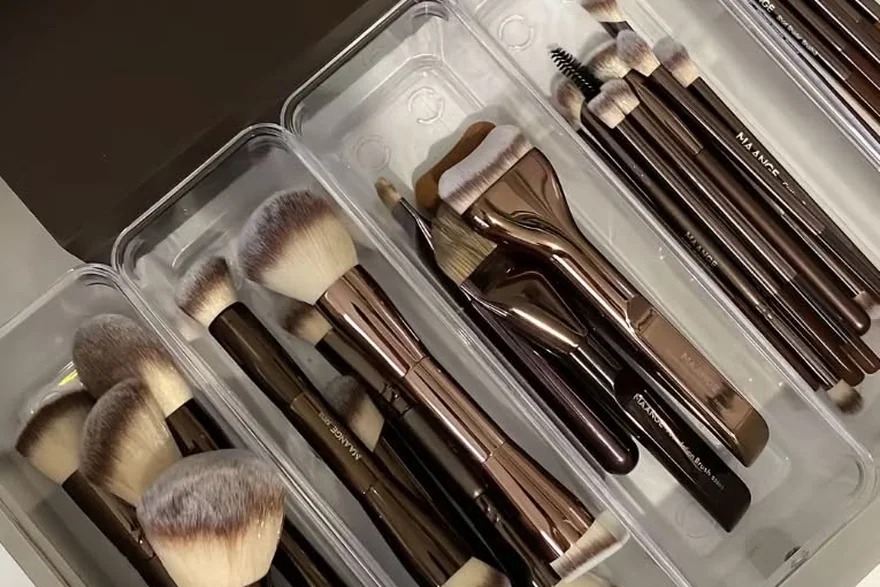
Why Brush Storage Is a Mechanical Problem Rather Than a Styling One
A makeup brush is not a soft object that can be folded. It is a composite structure made of four parts that behave very differently under load: a handle, usually wood or moulded resin; a metal ferrule; an adhesive plug joining the two; and a bristle bundle of natural hair or synthetic filament held at its base by that adhesive. Overall lengths run roughly 17 to 21 cm, with ferrule diameters from about 6 mm on a detail brush to 22 mm on a large face brush. Understanding which of those parts can carry load is the whole basis of a good storage design.
The bristle bundle cannot carry it. Synthetic filaments such as PBT and nylon recover from light deflection, but sustained pressure produces permanent set, particularly at the tips where each filament is thinnest and where natural hair scales have already been cut during manufacture. Splay begins as a few filaments leaning outward and progresses into a bundle that no longer returns to its intended shape. Once tips splay, the brush stops performing in the way the maker designed, and no amount of reshaping afterwards restores it.
Demand context explains why the category attracts attention. Make up bags for women draws roughly 80,000 monthly searches and travel bag for toiletries around 110,000, while custom makeup bag sits between 5,400 and 6,600 monthly searches, indicating that interest in organisers is broadening rather than peaking. Wholesale pricing across the wider category runs from about $0.45 to $12.00 per unit depending on construction (Alibaba, October 2026), which leaves ample room for a genuinely engineered brush roll to differentiate on specification rather than on print.
- Handle-led damage: storage that supports only the handle lets the ferrule and bundle swing, which gradually loosens the adhesive plug.
- Tip-led damage: any surface pressing on the bundle itself flattens tips, starting at the outer filaments and working inward.
- Contents-led damage: neighbouring brushes rubbing inside a shared compartment fray filaments along one side only, producing asymmetric wear.
- Moisture-led damage: a brush rolled up with residual product or water against an impermeable film stays damp, softening the adhesive line over time.
Ferrule Support and Slot Spacing: The Variables That Decide Survival
Ferrule support and slot spacing are the two specifications worth arguing about. Support describes how much of the brush — and specifically the metal band nearest the bundle — rests against a stiff element rather than against fabric that can deflect. Spacing describes how much clearance exists between adjacent bundles when the roll is closed. Both are measurable, both should appear in the tech pack, and together they account for almost all of the difference between a product that preserves brushes and one that merely holds them.
| Slot configuration | Ferrule support provided | Suits brush sizes | Deformation risk | Cost impact |
|---|---|---|---|---|
| Flat single-row elastic band | None; retention relies on tension against the bundle itself | Detail brushes up to 12 mm ferrule | High; bundles tilt and press tip to tip | Baseline, lowest of the group |
| Stepped two-row with base shelf | Partial; a fabric shelf carries the handle, not the ferrule | 6-18 mm mixed sets | Moderate; handles supported, tips still travel | Adds roughly $0.30-0.60 |
| Individual channels with rigid base insert | Full support along the ferrule and into the glue line | Up to 22 mm including fan brushes | Low; each bundle stays in its own channel | Adds roughly $0.90-1.80 |
| Cantilevered slip pockets | Partial; pockets support the handle only | Powder brushes up to 30 mm head width | Moderate to high on soft natural-hair sets | Adds roughly $0.40-0.90 |
| Moulded EVA tray with contoured channels | Complete three-dimensional support around the ferrule | Mixed professional sets, 6-24 mm | Lowest in the group | Adds $2.20-4.50 plus tooling |
Spacings should be derived from the largest brush in the intended set rather than picked from a previous design. Workable practice is to set each slot's clear width at the ferrule diameter plus 3-5 mm, then set centre-to-centre pitch accordingly. In mixed professional sets averaging around 12 mm ferrule diameter, that produces a pitch of roughly 16 to 28 mm across the row, which for a ten-slot roll gives a storage field of about 22 to 26 cm and an unrolled footprint near 48 x 34 cm including margins and closure flap. Designing the field first and then deciding how many brushes fit prevents the common error of fitting twelve brushes into a field sized for eight.
Vertical separation matters as much as horizontal. Row-to-row distance of 30-40 mm keeps the tip of one brush clear of the ferrule of its neighbour, and adding a full-width separator panel between rows — rather than relying on stitched channels alone — prevents handles from wearing against tips during transport. Where a set includes both long-handled face brushes and short detail brushes, staggered rows suit better than straight ones, since straight rows force every handle to begin at the same line and leave short brushes floating in the pocket.
Support stiffness is best expressed in measurable terms. A base insert specified at 1.2 to 2.0 mm of polypropylene or EVA sheet holds a loaded row flat without adding noticeable weight; below about 1.0 mm the sheet flexes enough between supports to let ferrules tilt. Where the brief calls for a moulded tray, wall thickness typically runs 2.5 to 4.0 mm with a Shore A hardness in the 45-65 range, soft enough to protect a plated ferrule from abrasion and stiff enough to hold channel geometry after repeated rolling.
Stating a slot count without stating the intended ferrule range is the most common weak line in a brush roll brief. Ten slots designed for 8 mm detail brushes will not hold six professional brushes with 18 mm ferrules, no matter how the channels are sewn.
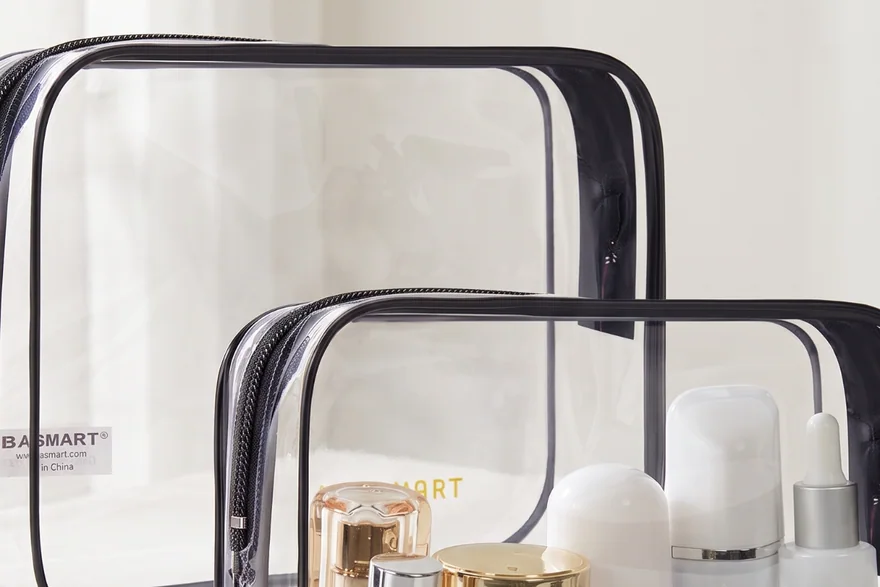
Preventing Bristle Deformation in Storage and Transit
Once support and spacing are settled, three deformation mechanisms remain: axial compression along the brush axis, lateral crush across the bundle, and damage caused by rolling a brush away while product or water is still present in the filaments. Each has a different remedy, and treating all three as one problem is how good brush rolls still end up returned.
- Roll diameter sets compression: a roll closing to under roughly 8 cm diameter forces the outermost brushes to bend against the closure; securing tabs should sit clear of the tip line.
- Tip relief panels work: extending the storage field 10-15 mm beyond the last tip, with no stitching across that zone, removes the point load that flattens the outermost bundle.
- Closure tension should be stated: a tie or strap tightened to roughly 10-15 N of hand tension holds the roll without crushing; over-tensioning is a habit of users rather than of the product.
- Residual moisture is a material question: an impermeable film facing the bristles traps whatever the brush carries, so a breathable lining panel at the bundle zone is usually preferable.
- Separators beat elastic on set storage: a full-width fabric divider between rows prevents the handle-to-tip rubbing that produces wear on one side of a bundle only.
- Transport, not display, causes most damage: designs should be validated rolled, packed and carried, rather than approved flat on a bench.
Colour transfer deserves attention because brush rolls almost always pair dark bristles with a pale interior. Synthetic filament dyed black or deep brown can bleed onto a white lining when damp, producing staining that looks like a defect even though the brush itself is unaffected. Rubbing behaviour such as this is assessed using methods within the ISO 105 series, whose scope is described at the ISO technical committee page for colour fastness. Specifying a grey-scale rating for the lining fabric against dyed bristles removes an argument that otherwise surfaces after the first wash cycle.
Tumbling and drop behaviour separates products that survive a suitcase from products that survive a shelf. A professional roll containing ten brushes with metal ferrules weighs roughly 450 to 700 g and concentrates that mass in one place, so internal migration during transit is real rather than theoretical. A simple internal validation — pack the roll, drop it from waist height onto a hard floor twenty times, then examine tip alignment — catches most imbalances between support stiffness and slot spacing before tooling is committed.
Storage orientation is the remaining piece. Tip-down storage presses a brush's own weight into its filaments, while tip-up storage lets residual product and moisture run back into the ferrule. Flat, supported storage of the kind a correctly specified roll provides avoids both problems at once. Where a brush bag rather than a roll is preferred, a removable insert panel reproduces that flat support inside a vertical carry format, typically adding $0.60 to $1.20 per unit.
Treat a brush roll as packaging for a precision tool. Any design decision that would be acceptable for storing socks is probably wrong here, because the object being carried loses its function permanently instead of simply creasing.
Materials, Closures and the Test Methods Worth Citing
Material selection in this category is governed by three requirements running in different directions: the interior must not abrade filaments, must handle residual moisture sensibly, and must hold its shape when rolled. Those requirements rarely point to one fabric, which is why most successful constructions combine a structural outer shell with a distinct bundle-facing lining. The table below compares the combinations most frequently specified.
| Interior system | Bundle-facing behaviour | Moisture handling | Shape retention | Typical unit band |
|---|---|---|---|---|
| Brushed tricot lining on polyester shell | Low friction; filaments slide rather than snag | Absorbs slowly, dries slowly | Fair without an interlining | $1.40-2.80 |
| Microfibre suede facing with foam interlining | Very low friction and gentle on natural hair | Wicks product, needs drying before rolling | Good; foam returns flat after rolling | $2.60-4.80 |
| PU-faced wipeable interior | Smooth but generates heat against filaments | Wipes clean and dries immediately | Good; the face itself stiffens slightly | $1.80-3.60 |
| Nylon ripstop with open-cell backing | Neutral; light texture against the bundle | Dries quickly, tends to retain odour | Very good at low weight | $2.00-3.90 |
| Moulded EVA tray with tricot overlay | Filaments rest in contoured channels | Depends entirely on the overlay fabric | Excellent; channels are formed, not sewn | $5.50-9.50 plus tooling |
Closures hold the roll closed and therefore control compression, which makes specification rather than description appropriate. Vocabulary for chain type, gauge, slider and tape is standardised in ASTM D2053 on zipper terminology, and using it lets a buyer name exactly what is wanted. In practice a #3 or #5 nylon coil suits most rolls because coil zips tolerate bending around a rolled body better than chain zips do, and a tie or webbing strap with a slide adjuster sets closure tension in a way a zip cannot.
Testing language should be borrowed rather than invented. The textile industry already maintains published methods for abrasion, colour fastness and water behaviour, catalogued by the AATCC test methods index, which gives buyers and specifiers a common frame for what is being measured and under what conditions. Where the outer shell is coated, the constructions themselves are described within the standard covered by ASTM D751 on coated fabrics. Citing recognised methods converts a vague durability demand into something that can be verified at inspection.
Commercial terms close out the brief. Minimum order quantity is 500 pieces per style and colourway. Sampling takes 6-10 working days, extending to 12-15 working days where moulded trays or tooled plates are required, and bulk production runs 35-50 days after sample approval. Inspection follows AQL 2.5 under ISO 2859-1, with particular attention to channel alignment and closure smoothness, since those are the two defects that recur in this construction. Shipment is FOB Xiamen with payment by T/T 30 deposit, 70 against bill of lading, and tooling costs should be agreed in writing before any mould is cut.
- State the intended ferrule diameter range in the brief, not merely the number of slots.
- Specify base insert thickness and hardness rather than describing it as stiff.
- Ask for a rolled-and-dropped sample rather than approving a roll flat on a bench.
- Set a grey-scale rating for lining against dyed filament before the first wash cycle.
- Confirm closure component parts by their standardised names to avoid silent substitution.
The B2B Customisation View
Development of makeup bags and toiletry bags is a sequence of small approvals, and each approval is cheaper than the rework it prevents.
The numbers a buyer can plan around: 500 pieces minimum per style and colourway, 6–10 working days to a first sample (12–15 where tooling or moulding is involved), 35–50 days to bulk completion, AQL 2.5 under ISO 2859-1 at final inspection, FOB Xiamen terms, T/T 30/70 payment.
As the programme coordinator, QUANZHOU JUNYUAN BAGS owns the sample history, which is what makes a repeat order of makeup bags and toiletry bags look like the original rather than a near-miss.
Which Brand Types Benefit Most
Buyer profiles here are unusually technical. Professional makeup artists and their kit managers specify by brush inventory, which means they care whether a twenty-four-piece set with ferrules from 6 mm to 24 mm actually fits without crowding; that profile accepts a higher unit cost for a moulded tray because damaged professional brushes cost far more than the bag. Cosmetics brands launching or refreshing a brush range use rolls and brush bags as the protective layer inside their own set packaging, so they specify against their own brush dimensions and frequently require the interior fabrication to match the retail outer exactly. Subscription and beauty-box operators need low cost with credible protection across unpredictable brush sizes, which usually points to wide elastic rows and a base shelf rather than contoured channels. Retailers selling open stock want something that photographs well hanging on a fixture, which introduces a display requirement absent from every other profile: the roll must look good half-open. E-commerce sellers round out the channel, typically sourcing an existing silhouette with a distinct lining print, benefiting most from clear product descriptions around slot count and maximum ferrule diameter because those two figures drive both search intent and return rates. QUANZHOU JUNYUAN BAGS coordinates programmes across these profiles with team experience in bag development and export since 2004, working to SGS-verified production floor space of 4,950 square metres across 7 production lines and 149 machines.
- Professional artists: specify against the actual brush inventory and accept premium cost for a moulded tray.
- Cosmetics brands: match the roll interior to retail packaging and their own brush dimensions.
- Subscription operators: favour wide elastic rows with a base shelf across unpredictable brush sizes.
- Retailers: add a display requirement, since the roll must photograph well half-open on a fixture.
- Marketplace sellers: publish slot count and maximum ferrule diameter to reduce avoidable returns.
Frequently Asked Questions
What causes brush tips to splay inside a roll or bag?
Sustained pressure against the bristle bundle, usually from insufficient clearance between slots or from a closure that compresses the set when rolled. Splay begins as a few filaments leaning outward and becomes permanent set, because neither synthetic filament nor natural hair fully recovers once held deflected for weeks. Supporting the ferrule rather than the bundle is the structural fix.
How much clearance should each slot leave around a brush?
Set the clear width of each slot at the ferrule diameter plus about 3-5 mm, then derive centre-to-centre pitch from that figure. In mixed sets averaging 12 mm ferrule diameter the resulting pitch falls roughly between 16 and 28 mm. Deriving spacing from the largest brush in the set, rather than copying a previous pattern, prevents tips from touching under load.
Why should a brush roll support the ferrule rather than the handle?
Load carried at the handle leaves the ferrule and the bundle free to swing, which gradually loosens the adhesive plug joining them. Support at the ferrule loads the strongest part of the assembly and keeps the tip clear of neighbouring surfaces. In practical terms this means a stiff base insert or a contoured tray rather than an elastic band gripping the bristles.
What thickness suits a rigid base insert in a brush roll?
Somewhere between 1.2 and 2.0 mm of polypropylene or EVA sheet works for most rows. Below about 1.0 mm the sheet flexes between its supports enough to let ferrules tilt, and above 2.0 mm it adds weight without measurable benefit. Where a moulded tray is chosen instead, wall thickness usually sits at 2.5 to 4.0 mm with a Shore A hardness around 45-65.
How much vertical separation should rows have in a multi-row roll?
Roughly 30-40 mm between rows keeps the tip of one brush clear of its neighbour's ferrule. Adding a full-width separator panel between rows, rather than relying on stitched channels alone, also prevents handle-to-tip rubbing during transport, which is the cause of wear appearing on one side of a bundle only.
What minimum roll diameter avoids compressing brush tips?
Rolls closing to under about 8 cm diameter begin forcing the outermost brushes to bend against the closure. Keeping securing tabs clear of the tip line, and extending the storage field 10-15 mm past the last tip with no stitching across that zone, removes the point load that otherwise flattens the outermost bundle over repeated use.
Is a wipeable PU interior a good idea inside a brush roll?
It depends on user discipline. A PU face wipes clean and dries immediately, which suits brushes dried fully before packing. It is less forgiving with residual moisture, since an impermeable film traps whatever the bundle still carries. A breathable lining panel at the bundle zone generally handles imperfect user behaviour better than a fully impermeable one.
Why do dark bristles stain pale roll linings?
Deep shades on synthetic filament can transfer onto light fabric under rubbing while damp. Rubbing behaviour of this kind is assessed with methods in the ISO 105 series, so specifying a grey-scale rating for the lining against dyed bristles is the practical control. Without it, the first wash cycle tends to uncover an argument nobody wanted to have.
Which closure type works best on a rolled brush case?
A #3 or #5 nylon coil is common because coil construction tolerates being bent around a rolled body better than chain does. A webbing strap with a slide adjuster sets closure tension explicitly, which matters because compression is what damages tips. Terms for chain, gauge, slider and tape are standardised in ASTM D2053, so components can be named precisely.
Should a brush roll be approved flat or rolled?
Rolled, packed and carried. Almost all transport damage occurs with the roll closed, and a flat-bench approval hides every defect related to slot crowding and closure tension. A useful internal check is packing ten brushes, dropping the roll from waist height onto a hard floor twenty times, then examining tip alignment before tooling is committed.
What minimum order applies to a custom brush roll?
500 pieces per style and colourway. A single construction in one colourway therefore clears the threshold in one commitment, while offering the same roll in three colourways counts as three. Brands wanting variety usually achieve it through lining print rather than shell colour, which keeps the whole programme inside one minimum.
How long does a moulded EVA tray add to the schedule?
Mould tooling pushes sampling from 6-10 working days to around 12-15 working days, since a tool must be cut before a representative sample exists. Bulk production still runs 35-50 days after approval. Programmes involving moulded trays should therefore be specified a few weeks earlier than a sewn equivalent, and the tooling should be confirmed paid before it is cut.
What defects recur most often on brush roll inspections?
Channel alignment and closure smoothness. Misaligned channels cause crowding even when spacing was correct on paper, and a stiff slider encourages users to overtighten the roll, which reintroduces the compression the design was meant to eliminate. Inspection follows AQL 2.5 under ISO 2859-1, and both issues should be defined as defect classes before inspection day rather than argued afterwards.
How should brands describe slot count to reduce returns?
Publish both the slot count and the maximum ferrule diameter the roll accommodates. Stating twelve slots without stating it fits up to 18 mm ferrules invites returns from anyone carrying larger professional brushes. These two figures also tend to drive search intent more effectively than generic descriptions about capacity or style.
Which standard naming helps avoid component substitution?
Using standardised vocabulary rather than adjectives. ASTM D2053 covers zipper terminology, so chain type, gauge and slider specification can be named exactly, and ASTM D751 covers coated fabric constructions where the shell is coated. Substituting a lighter chain between sample and bulk is a common silent change, and precise naming is the cheapest defence against it.
People Also Ask
Do brush rolls actually keep brushes in good condition?
Only when they load the ferrule rather than the bristles. A flat elastic row gripping bundles flattens tips within weeks, while channelled storage with 3-5 mm clearance around each bundle preserves tip geometry through hundreds of roll cycles. The determining specifications are ferrule support, slot pitch derived from the largest brush, and closure tension.
Should brushes go into a roll slightly damp?
No. Residual moisture trapped against an impermeable film keeps the bundle damp and can soften the adhesive line at the ferrule over time. Brushes should dry fully face-down or hanging before being packed, and rolls intended for imperfect user behaviour benefit from a breathable lining panel at the bundle zone rather than a fully sealed interior.
How many brushes should a standard roll hold?
Eight to twelve suits most personal kits, with twenty-four the usual upper end for professional sets. The right number follows from available field width rather than preference: ten slots at 16-28 mm pitch needs a storage field of roughly 22-26 cm. Crowding twelve brushes into a field sized for eight is the most frequent design error.
What is the difference between a brush bag and a brush roll?
A roll stores brushes flat in individual channels and then rolls around them, giving each bundle its own space and supporting the ferrule along its length. A brush bag holds several brushes in a shared compartment or in grouped pockets, which is lighter and simpler but allows bundles to rub against one another during transport.
Request a Sample or a Written Quotation
Send the silhouette, dimensions, material preference and logo artwork, and the programme team will return a written quotation with MOQ, sampling window, bulk lead time and inspection standard.
Email: service@junyuanbags.com · WhatsApp: +86 177 5002 0688