MOQ for Custom Cosmetic Bags: 2026 Minimum Order Quantity Guide
Executive Summary
The minimum order quantity for custom cosmetic bags is 500 pieces per style and colourway. That figure is a scheduling floor, not a negotiation: a style is one construction with one tooling and material set, and a colourway is one shell, lining and trim colour combination. Two colourways of one pouch are two dye lots and two packing lists, counted separately. Buyers who plan around 500 pieces per style and colourway get stable pricing and repeatable quality; buyers who plan around one 500-piece total usually find at quotation stage that only one shade can be scheduled.
The confusion comes from marketplace listings advertising a B2B band of 100-1,000 pieces, mostly on stock or semi-stock constructions. Those numbers describe catalogue goods, not a made-to-order programme. For a custom cosmetic bag the working minimum stays at 500 pieces per style and colourway, with sampling at 6-10 working days, 12-15 for complex constructions, bulk production of 35-50 days after sample approval, inspection to AQL 2.5 under ISO 2859-1, FOB Xiamen shipment and T/T terms of 30 deposit, 70 against bill of lading. Planning the assortment against that number from the first brief keeps a launch calendar intact.
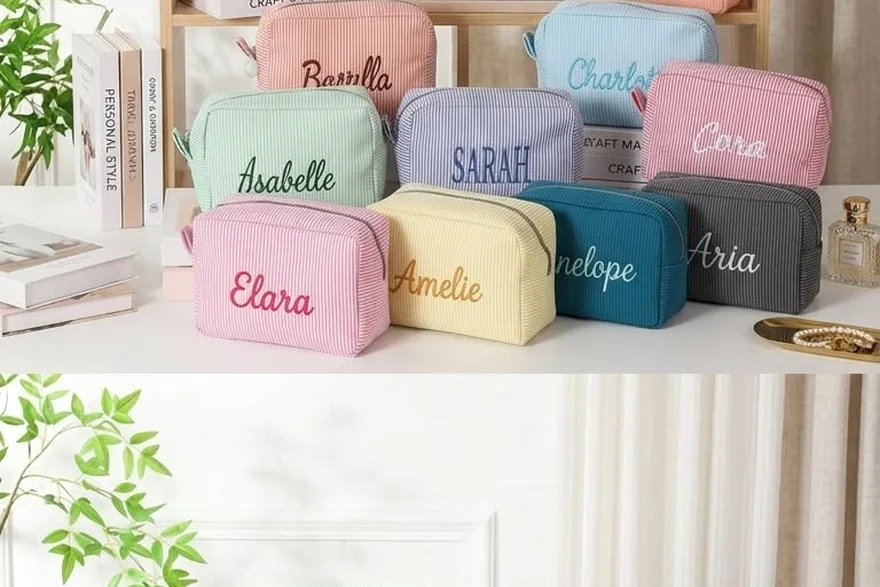
What MOQ means in a custom bag programme
MOQ, or minimum order quantity, is the smallest run a production schedule will accept for one style in one colourway before the fixed costs of setting that run up stop being recoverable. In a made-to-order bag programme the number is not arbitrary. Every custom run carries setup work that is identical whether the order is 500 pieces or 5,000: a fabric dye lot or a fabric purchase, screens or plates for printing, a cutting marker, a sewing line changeover, a packing specification and an inspection lot under ISO 2859-1 sampling procedures. The minimum is the point at which those one-off costs stop dominating the unit price.
Two counters define the minimum in a cosmetic bag programme, and confusing them is the single most common cause of a stalled quotation. The first counter is style: a 22 x 15 x 8 cm flat pouch and a 24 x 17 x 12 cm boxy vanity case are two styles, even if they share fabric, lining and hardware, because each needs its own pattern, marker and line setup. The second counter is colourway: one shell colour plus one lining colour plus one trim colour combination. A pouch in black with a beige lining and a pouch in sage with a beige lining are two colourways of one style, and each is scheduled as its own run.
A colourway is counted separately because colour is the part of the specification that cannot be shared across a production schedule. Shell fabric is dyed or purchased in a lot; lining is dyed or purchased in a lot; zip tape, binding tape and webbing are ordered in colours. Changing any one of those elements between units means a second material set on the floor, a second cutting bundle and a second packing list. This is why the standard minimum is expressed as 500 pieces per style and colourway rather than 500 pieces per order.
The 2026 demand picture explains why the question keeps coming up. Category tracking shows a toiletry bag drawing roughly 74,810 weekly Amazon searches (ASINSIGHT 2026.07), "travel bag for toiletries" around 110,000 monthly searches and "make up bags for women" close to 80,000 monthly searches, while the commercial-intent phrase "custom makeup bag" sits at 5,400-6,600 monthly searches. Typical unit prices on marketplaces span $0.45-$12.00 (Alibaba 2026.10) and typical advertised B2B minimums span 100-1,000 pieces. That spread of advertised numbers is exactly what makes buyers unsure which figure applies to their own programme.
Why marketplace minimums look lower than 500 pieces
Marketplace search results show minimums well below 500 pieces because most of those listings are catalogue goods, not custom runs. A listing offering a low minimum is usually selling a pouch that already exists: house fabric in a stock shade, an existing pattern, existing tooling, existing hardware in a finish that is already on the shelf. The buyer's only real choice is artwork position and quantity. That is a legitimate product, but it is not a custom cosmetic bag programme, and the economics behind it do not transfer to a made-to-order specification.
| Band advertised on marketplaces | What is actually on offer | Constraint the buyer accepts | Relevance to a custom programme |
|---|---|---|---|
| 100-199 pcs | Catalogue pouch in a house colourway using an existing pattern and tool | Shell colour chosen from a stock palette; no custom dye lot; one print position | Below the 500 pcs per style and colourway standard; not a made-to-order run |
| 200-299 pcs | Stock construction with substituted lining or trim | Lining and trim follow whatever is on the shelf; zip tape shade may shift between lots | Does not secure a repeatable colourway for a brand programme |
| 300-499 pcs | Semi-custom build on stock fabric with a custom print or label | Print plates and screens are charged, but the shell shade is still a stock colour | Still short of the 500 pcs per style and colourway scheduling floor |
| 500-999 pcs | A made-to-order style in one colourway | One dye lot, one trim set, branded hardware, nominated lining, full artwork control | Meets the standard minimum; the reference case for planning |
| 1,000+ pcs | One style split across two or more colourways | Each colourway is cut, sewn and packed as its own run with its own material lot | Each colourway independently meets the 500-piece minimum |
The advertised band of 100-1,000 pieces therefore describes a spectrum of stock and semi-stock products, not a discount ladder on custom work. The lower the advertised number, the more of the specification has already been decided by someone else. Once a buyer asks for a specific Pantone-matched shell, a specific recycled fabric with a transaction certificate, a custom-moulded zip puller or a lining that meets a particular colour-fastness performance, the run has to be scheduled on its own material lots, and the standard minimum of 500 pieces per style and colourway applies.
Whatever a marketplace listing displays, the planning figure for a made-to-order cosmetic bag is 500 pieces per style and colourway. Use it in the first budget, the first launch calendar and the first brief. Everything else in the programme - sampling at 6-10 working days, bulk at 35-50 days after sample approval, inspection to AQL 2.5, FOB Xiamen, T/T 30/70 - is quoted against that unit.
Colour is the clearest test. A custom shade is produced as a dye lot, and dye houses quote a lot minimum rather than a piece count; a 500-piece pouch run at roughly 0.18-0.22 m of shell fabric per unit sits comfortably inside one commercial lot, while a 150-piece requirement usually does not. The same logic applies to certified materials. A recycled polyester shell carrying a transaction certificate is bought against a documented batch, and colour consistency is held to a ISO 105 colour fastness expectation rather than to a visual match in a photograph.
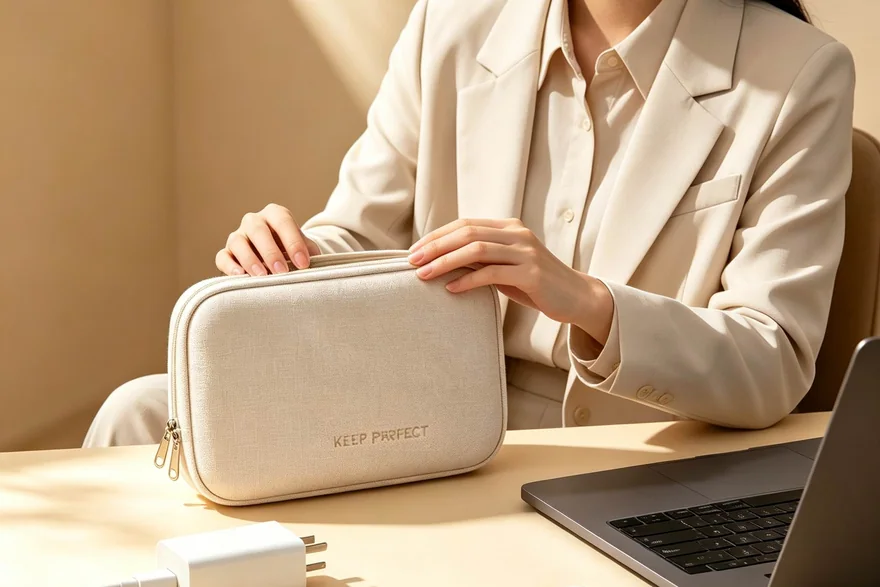
How 500 pieces per style and colourway is counted and split
Counting the minimum is arithmetic once the two counters are understood: multiply the number of styles by the number of colourways, then hold each cell of that grid at 500 pieces. A single pouch in a single colourway is one run of 500. A single pouch in four colourways is four runs of 500 and an order of 2,000 pieces. Two sizes in the same design family - a 20 cm pouch and a 26 cm pouch - are two styles, so one colourway across both sizes is 1,000 pieces. Buyers who grasp this early stop treating the minimum as a hurdle and start treating it as an assortment planning tool.
Print and trim decisions sit inside the same grid. A screen print, a heat transfer and an embroidered logo are each a setup charged per position per colourway, so two artwork treatments across two shades is four setups, not one. Common practice is to hold one artwork treatment across the whole colourway grid and vary only the shell shade, which keeps the setup count proportional to colourways rather than to colourways multiplied by artwork versions. The exception is a licensed or limited-edition print, which is normally treated as its own colourway and therefore carries its own 500-piece run.
| Assortment plan | Styles | Colourways | Total pieces | Does the plan meet the minimum? |
|---|---|---|---|---|
| One pouch, one colourway | 1 | 1 | 500 | Yes - one run at the standard minimum |
| One pouch, two colourways | 1 | 2 | 1,000 | Yes - each colourway scheduled at 500 pieces |
| Two sizes in one family, one colourway | 2 | 1 | 1,000 | Yes - each size is a style, each at 500 pieces |
| One pouch, four colourways | 1 | 4 | 2,000 | Yes - four runs of 500 pieces |
| One pouch, three shades packed as 1,500 mixed | 1 | 3 | 1,500 | Only if each shade is 500; 700 / 500 / 300 does not qualify |
| Three-piece gift set, one colourway | 3 | 1 | 1,500 | Yes - 500 sets, with each piece cut within the set run |
Gift sets and kits deserve a note because they are where assortment plans most often go wrong. A three-piece set - a large case, a medium pouch and a small brush roll - is three styles, and the set quantity that can be scheduled is 500 sets, which means 500 of each piece. If the brand owner wants the small brush roll in a second print, that print is a separate colourway and carries its own 500-piece minimum. The practical answer is to design sets so that all pieces share one colourway and one trim set, then use the outer packaging for seasonal variation rather than the bags themselves.
- One style = one construction: pattern, marker, tooling and line setup are counted once per style.
- One colourway = one shell + lining + trim combination; changing any of the three starts a new colourway.
- Standard minimum: 500 pieces per style and colourway, not 500 pieces per purchase order.
- Mixed colour totals do not qualify - 1,500 pieces split 700 / 500 / 300 only schedules the 500 shade.
- Repeat orders on an existing tool can be re-quoted, but the per-colourway minimum still applies.
What the minimum does to unit cost and programme risk
Unit price in a bag programme is dominated by two things: material yield and setup recovery. Material yield is governed by how efficiently panels nest into a cutting marker; setup recovery is governed by how many units the fixed costs are divided across. A 500-piece run of a 22 x 15 x 8 cm pouch in 600D polyester with a 210D lining might use about 0.20 m of shell and 0.16 m of lining per unit, plus 45 cm of zip tape, 90 cm of binding and one puller. Those per-unit figures barely move between 500 and 5,000 pieces. What moves is the setup cost baked into each unit.
| Cost or risk line | Why volume governs it | Behaviour at 500 pcs per colourway |
|---|---|---|
| Fabric dye lot or purchase | Dye houses and mills quote a lot minimum, commonly 300-500 m for a custom shade | One lot covers 500 pouches at roughly 0.20 m of shell plus cutting waste |
| Print screen or heat-transfer plate | Setup is charged per colour per print position | One setup amortised across 500 units instead of a partial run |
| Hardware tooling | A custom zip puller or logo plate is a one-off tool charge | Tool cost recovered across the run and reused on repeat orders |
| Cutting marker | Tables are laid for a full marker, typically 20-40 plies per lay | One marker run yields the full quantity with consistent panel alignment |
| Line changeover | A sewing line is re-threaded and re-jigged once per style | One changeover per style and colourway rather than per small batch |
| Inspection lot | Sample size under AQL 2.5 is set by lot size | A 500-piece lot has a defined sample size and a clear accept or reject rule |
| Export packing | 500 pouches pack into roughly 10-12 export cartons at 60 x 40 x 40 cm | One consolidated lot on FOB Xiamen terms rather than a part-carton shipment |
Risk behaves the same way. A run scheduled at the standard minimum has one dye lot, one trim batch and one inspection lot, which means one set of variables to control and one set of records to keep. Splitting the same total across several small batches multiplies the number of material lots, the number of inspections and the number of chances for a shade to drift between repeats. For a brand that intends to reorder, consistency between the first run and the fourth matters more than saving a few cents on the first. The same argument applies to records: one run produces one inspection report, one material declaration and one set of test references, which is what a retailer's compliance team asks for when the product is listed.
- Plan the assortment grid before the brief: styles down one axis, colourways across the other, 500 in every cell.
- Budget for setup costs separately from unit price so the effect of quantity is visible.
- Keep trim and hardware common across colourways where possible - only the shell shade needs to change.
- Ask for the inspection level in writing: AQL 2.5 under ISO 2859-1, with the sample size and accept or reject numbers stated.
- Confirm shipment terms as FOB Xiamen and payment as T/T 30 deposit, 70 against bill of lading before the deposit is raised.
The B2B Customisation View
A well-run cosmetic bags programme is a documentation exercise as much as a sewing exercise, and the documents are what keep the first shipment identical to the thousandth.
Budgeting and scheduling inputs: MOQ 500 per style and colourway; sampling 6–10 working days, extended to 12–15 for lined, moulded or hardware-heavy builds; bulk 35–50 days; pre-shipment inspection at AQL 2.5 per ISO 2859-1; FOB Xiamen; T/T 30/70.
The practical outcome for the buyer is a single accountable counterpart holding cost, quality and calendar together across the life of the programme.
Which Brand Types Benefit Most
The 500-piece minimum suits different buyers for different reasons, and the reason determines how the assortment should be built. Start-up brands usually have one hero product and a tight cash position, so the sensible shape is one style in one or two colourways at 500 pieces each, with the brand identity carried by a woven label, a printed logo and custom packaging rather than by a second construction. That puts the first genuine brand run inside reach and leaves a clear reorder path once the first 500 sells through. Established brands with an existing palette tend to run the opposite shape: one proven construction across three to five colourways, 1,500 to 2,500 pieces, refreshed seasonally against the same tooling. Retailers building an own-brand range usually work somewhere between the two, commissioning one construction with retailer-specific trim and hangtags and committing to 500 pieces per colourway so that the shelf shows a coordinated set rather than a single shade. E-commerce sellers have the most elastic requirement, because their order size is driven by a launch curve rather than by a planogram: the usual pattern is a single colourway at 500 pieces, followed by a reorder on the same specification once the first run clears.
Gift, hospitality and subscription buyers behave differently again, because their unit of sale is often a kit rather than a bag. A subscription box that ships 5,000 units a quarter needs 5,000 bags, which is comfortably above the minimum, but the useful move is to keep the whole kit on one colourway and let the printed sleeve or the carton carry the seasonal change. That way the bag specification stays frozen, reorder risk falls and the per-unit price holds across quarters.
Across all five types, the same rule applies: the minimum is per style and colourway, so the way to control total spend is to control the size of the grid, not to push the quantity in a single cell below 500.
- Start-up beauty brands: one style, one or two colourways, 500 pieces each, identity carried by label and packaging.
- Established beauty and skincare brands: one proven construction across a seasonal colourway grid of three to five shades.
- Retailers and chain stores: own-brand programmes built on one construction with retailer-specific trim and hangtags, 500 per colourway.
- E-commerce sellers: a launch quantity validated by search demand - toiletry bag searches run around 74,810 weekly on Amazon (ASINSIGHT 2026.07) - then a reorder against the same specification.
- Gift, hospitality and subscription buyers: a single colourway across a set, 500 sets, with seasonal variation moved to the outer carton or sleeve.
Frequently Asked Questions
What minimum applies to a moulded EVA cosmetic case?
A moulded EVA case is a style in its own right, so the standard minimum of 500 pieces per style and colourway applies. The mould itself is a separate one-off tooling cost amortised across the run and reused on repeat orders. Because EVA shells are formed rather than sewn, colour is a material batch decision rather than a fabric dye lot, which makes it even more important to keep each colourway at the full 500 pieces.
Does a colourway count separately from a style when the 500-piece minimum is calculated?
Yes. Style and colourway are two independent counters. A style is one construction with one pattern and tooling set; a colourway is one shell colour, one lining colour and one trim colour combination. One pouch in four colourways is four scheduled runs of 500 pieces, totalling 2,000 pieces. One pouch in one colourway is a single run of 500 pieces, which is the smallest custom programme that can be scheduled.
Can two colourways of the same pouch be pooled into one 500-piece run?
No. Each colourway needs its own fabric lot, its own trim batch and its own cutting bundle, so the standard minimum applies per colourway. Two colourways of one style is 1,000 pieces. Pooling produces a mixed lot that cannot be scheduled as a single run, and it also creates shade-consistency risk between the first and second halves of the order.
What minimum applies when a print pattern is exclusive to one colourway?
The print is tied to the colourway it sits on, so the 500-piece minimum still applies to that colourway. If the same artwork is used on three shades, there are three print setups and three lots of 500. Where budget is tight, the usual move is to run one printed colourway at 500 and keep the other shades as solid colours on the same construction.
How does the 500-piece minimum apply to a three-piece gift set?
A three-piece set is three styles, so 500 sets means 500 of each piece, or 1,500 pieces in total. All pieces should share one colourway so that one fabric lot and one trim batch cover the whole set. If the set needs seasonal variation, put it into the outer box, the sleeve or the hangtag rather than into the bags themselves.
Is the minimum lower for a repeat order that reuses an existing tool?
The tooling charge is not repeated, which lowers the setup portion of unit cost, but the per-colourway scheduling minimum stays at 500 pieces. A repeat order re-quotes faster because the pattern, marker and material specification already exist, yet the floor still needs its own fabric lot and inspection lot under AQL 2.5. The repeat quotation also skips the pattern and marker work, which is why the turnaround is quicker even though the quantity floor is unchanged.
What minimum applies when the hardware is a custom-moulded zip puller?
The puller is a tooling item, not a quantity item, so the run still carries the standard 500 pieces per style and colourway. The tool is charged once and reused. Ordering fewer pieces does not remove the tool cost; it simply spreads the same tool cost across fewer units, which is usually why a small first order quotes at a higher unit price.
How does the 500-piece minimum interact with a seasonal launch calendar?
Work backwards from the launch date. Sampling takes 6-10 working days, or 12-15 for complex constructions, bulk production takes 35-50 days after sample approval, and inspection and packing sit inside that window. A brand owner targeting a shelf date should be placing the order and locking colourways roughly 90-110 days ahead, so the assortment grid has to be decided before the brief goes out.
Can the minimum be met across several sizes of the same design family?
Not across sizes, because each size is a separate style with its own pattern and marker. A 20 cm pouch and a 26 cm pouch in the same fabric and colour are two styles at 500 pieces each. The efficient version of this plan is to launch one size first, validate demand, then add the second size as a second style on the next order.
What happens to unit cost if the order is 1,000 pieces instead of 500?
Material cost per unit stays broadly flat; setup cost per unit falls. Doubling to 1,000 pieces of one colourway halves the amortised screen, plate, marker and line changeover cost inside each unit, and it usually improves fabric purchasing because the required metreage sits more comfortably inside a mill lot. The price gap is real but modest compared with the gap caused by splitting the same total across colourways.
Does adding a branded hardware logo change the minimum?
It adds a tooling line and a setup step, not a second minimum. A logo plate or moulded puller is charged once and then applied to the run, so the quantity floor stays at 500 pieces per style and colourway. What it does change is the sample timeline, because a hardware sample has to be produced and approved alongside the sewn sample.
What minimum applies to a bag made from a GRS-certified recycled fabric?
The same 500 pieces per style and colourway, with one added constraint: certified fabric is purchased against a documented batch with a transaction certificate, so the quantity has to align with an available certified lot. Buyers planning recycled shells should confirm fabric availability during sampling rather than after the deposit is raised, because a certified lot cannot be topped up from a non-certified source.
How is the minimum applied when only the hangtag and retail packaging change?
Packaging is not a style or a colourway, so it does not change the 500-piece floor on the bag. Hangtags, belly bands and printed cartons have their own print minimums, which are usually lower than the bag minimum and are quoted separately. This is the cheapest way to give one 500-piece run several retail faces without creating additional scheduled runs.
Can a first order be split across two shipping dates?
Splitting shipment is possible, but splitting production is not. A 500-piece colourway is cut and sewn as one lot, inspected once to AQL 2.5 and then released either complete or in agreed partial cartons. Buyers who need two delivery dates usually achieve it with two colourways or two styles rather than by halving a single run.
Does the 500-piece minimum include the approved samples?
No. Samples are made before the production run and are counted separately, whether they are prototypes, salesman samples or a pre-production reference. The 500-piece figure is the production quantity that follows sample approval. Sample units approved as the golden reference are usually retained for comparison during bulk inspection rather than shipped into the order. Salesman units made for photography are quoted separately as well, since they are produced before the run rather than drawn from it.
People Also Ask
Is a 500-piece minimum per colourway negotiable for a first order?
The per-colourway floor is a scheduling constraint rather than a negotiating position, so it generally is not. What can be negotiated is the shape of the order: fewer colourways, a simpler trim set, a stock hardware finish or a smaller size range will all reduce the total pieces required without breaking the minimum. Buyers who need a lower entry point usually start with one style in one colourway at 500 pieces.
Why do marketplace listings show minimums lower than 500 pieces?
Because most of those listings are catalogue goods: existing patterns, house fabrics in stock shades and hardware already on the shelf. The advertised B2B band of 100-1,000 pieces describes stock and semi-stock products, not a made-to-order specification. As soon as a custom shade, a certified fabric or a bespoke tool is required, the run needs its own material lots and the standard 500 pieces per style and colourway applies.
How many pieces should a first custom cosmetic bag order be?
For most brands, 500 pieces of one style in one colourway is the right first order, with a second colourway added only when the first has a sell-through record. That keeps cash concentrated, validates the construction and creates a proven specification for reorder. Buyers with confirmed retail distribution often start at two colourways, 1,000 pieces, because the shelf needs a range rather than a single shade.
Does the minimum change for a plain cosmetic bag with no branding?
No. An unbranded bag is still a made-to-order run with its own fabric lot, marker and line changeover, so the standard 500 pieces per style and colourway applies. Removing branding removes a print setup and sometimes a hardware tool, which lowers unit cost slightly, but it does not lower the quantity floor. The saving is in setup, not in scheduling: the fabric lot, marker and line changeover are the same whether or not a logo is applied.
Request a Sample or a Written Quotation
Send the silhouette, dimensions, material preference and logo artwork, and the programme team will return a written quotation with MOQ, sampling window, bulk lead time and inspection standard.
Email: service@junyuanbags.com · WhatsApp: +86 177 5002 0688