Makeup Bag Industry Trends 2026: What's Driving Demand
Executive Summary
What is driving makeup bag demand in 2026 is not a single fashion cycle but four shifts that show up repeatedly in sourcing briefs: search interest concentrating on travel and personalised formats, a move away from plain printed polyester toward coated and recycled shells, re-order cycles compressing from one annual drop into 8-12 week windows, and compliance screening moving ahead of price negotiation. The practical answer for a brand owner is that demand is real but uneven, and it clusters around travel-size toiletry formats and personalised makeup pouches rather than spreading evenly across the category, so a 2026 programme should be built for repeat.
No official statistic tracks makeup bags as a standalone industry, so the defensible evidence base is search demand rather than revenue. Toiletry bag draws roughly 74,810 weekly Amazon searches (ASINSIGHT, 2026.07); make up bags for women around 80,000 monthly searches; custom makeup bag between 5,400 and 6,600 monthly searches. Programmes run to 500 pieces per style and colourway, sample in 6-10 working days, take 35-50 days in bulk, are inspected to AQL 2.5 under ISO 2859-1, ship FOB Xiamen, and settle T/T 30 deposit and 70 against bill of lading.
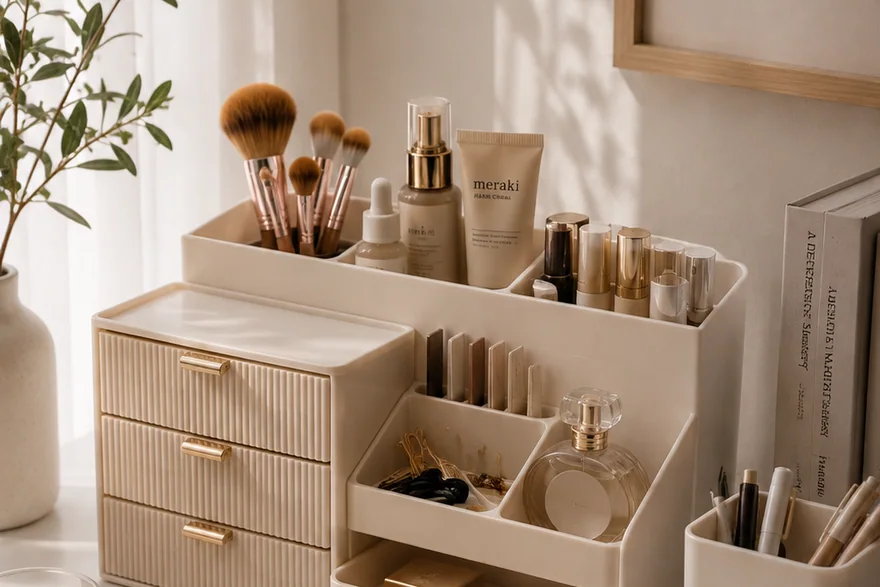
What counts as makeup bag demand in 2026
Makeup bag industry trends are easy to quote and hard to source, because no statistical agency publishes a series for makeup bags alone. Trade classifications group soft bags with luggage, travel goods and personal-care packaging, and the syndicated reports that cover beauty packaging usually measure primary containers — bottles, jars and tubes — rather than the textile pouch that carries them. A buyer who lifts a figure from a broad report and applies it to a 22 cm zip pouch is usually applying a denominator many times too large, and then discovering the error only when the first bulk arrives and the sell-through does not match the forecast.
For this article the category is defined narrowly: cosmetic bags, makeup bags, toiletry bags, cosmetic pouches, vanity cases and beauty organisers, with a widest dimension between 15 and 32 cm, closed primarily by a zip, and intended to hold personal care or colour-cosmetic items in transit or on a vanity. That definition excludes hard-shell train cases above 32 cm, hanging wash bags designed for permanent bathroom storage, and the rigid vanity trunks used by professional makeup artists, all of which behave differently in both sourcing and sale.
Three tests separate a usable trend claim from a recycled one. The measurement test asks whether the number was counted or modelled. The denominator test asks whether the population is makeup bags or all soft travel goods. The demand test asks whether the figure describes consumer interest, distributor orders or factory shipments, because those three move independently and often move in opposite directions inside the same quarter. A claim that fails any one of the three should not be used to justify a 500-piece minimum on any style.
What replaces a missing market size in practice is a set of observable indicators rather than a single total. Buyers tracking this category watch five of them: query volume on the terms customers actually type, the ratio of repeat orders to new enquiries inside a sourcing programme, the share of briefs that arrive with a compliance document already attached, the spread between the cheapest and the median quoted unit price, and the elapsed time between a sample request and a signed purchase order. None of these is a market size, but together they describe direction more honestly than a modelled total ever could, and each one can be checked without paying for a report.
Search-demand evidence: the four figures worth planning around
Search demand is the one public, repeatable and category-specific signal available for makeup and toiletry bags. The figures below come from ASINSIGHT and refer to counts of searches, not to units sold, revenue or market share. They are useful precisely because they are narrow: they describe what shoppers type, at a known frequency, on a known platform, inside a known window.
| Query | Reported volume | Window and source | What the signal describes |
|---|---|---|---|
| toiletry bag | ~74,810 | weekly, Amazon, ASINSIGHT 2026.07 | Travel-linked replacement and trip buying |
| travel bag for toiletries | ~110,000 | monthly, ASINSIGHT | Format-specific intent, peaks before holiday travel |
| make up bags for women | ~80,000 | monthly, ASINSIGHT | Broad gifting and self-purchase base |
| custom makeup bag | 5,400-6,600 | monthly, ASINSIGHT | Personalisation and branding intent, narrow but commercially dense |
The ratio between the third and fourth rows is the most useful number in the table. Custom intent sits at roughly seven to eight per cent of the generic monthly volume for make up bags. Read plainly, that says personalisation is an overlay on a large commodity base rather than a category in its own right, which is why a custom programme almost always has to justify itself on margin or on brand equity rather than on raw volume, and why a personalised range rarely carries a whole business on its own.
Search demand also has a shape over the year. Travel-linked queries tighten into the eight weeks before major holiday periods and before the northern summer, while generic makeup bag queries lift around gifting occasions. A brand owner planning a bulk run of 35-50 days plus freight needs to place the purchase order a full quarter ahead of the peak, which means the sample has to be approved roughly 20-24 weeks before the intended on-shelf date, working backwards through bulk, freight and sampling.
Two cautions apply to every figure in the table. A query is an expression of interest rather than a purchase: the same shopper may search three times and buy once, or buy from a listing that never appears in this dataset at all. And a volume figure says nothing about price. The band observed for this category on open marketplaces runs from about $0.45 to $12.00 per unit (Alibaba, 2026.10), a spread of more than twenty-fold that reflects construction and material rather than demand intensity.
A second use of these figures is format diagnosis. The travel-linked queries — toiletry bag and travel bag for toiletries — collectively outweigh the vanity-oriented queries, and the gap has direct implications for specification. Travel formats are bought to survive a suitcase: they need a hanging hook or a flat-fold profile, a lining that tolerates a leaking bottle, and a zip long enough to open the bag fully on a hotel counter. Vanity formats are bought to sit on a dresser and are judged on silhouette, colour and how the closure feels in the hand.
The third use is competitive diagnosis. A term with 80,000 monthly searches and tens of thousands of competing listings is a term where differentiation has to be structural — material, closure, certification or print quality — because price competition at the $0.45 end of the band leaves no room for a branded margin. A term with 5,400 monthly searches and a defined buying intent is a term where a specific, well-documented offer wins on fit rather than on cost. Both are legitimate business; they simply require different programmes.
- Treat every search figure as interest, never as revenue, units shipped or market share.
- Place the purchase order a quarter ahead of the seasonal peak, because bulk runs 35-50 days.
- Read custom intent as an overlay on a commodity base, not as the base itself.
- Pair every demand signal with a price band; volume without price tells a buyer nothing.
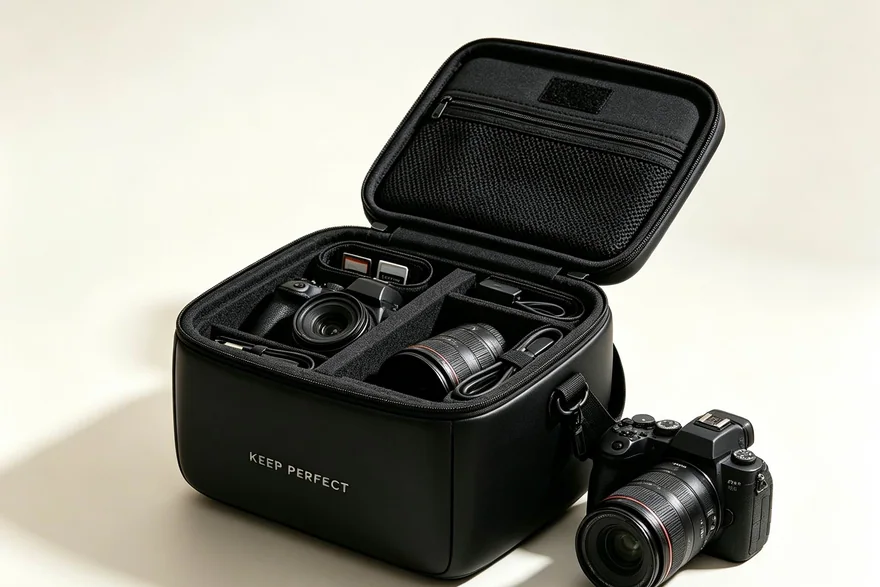
Six demand drivers shaping 2026 makeup bag programmes
Drivers are not trends. A trend is an observed change in what people buy; a driver is the underlying change that makes the trend persist long enough to plan around. Six drivers appear repeatedly in 2026 briefs for this category, and each one converts into a concrete line on a specification sheet rather than into a slide.
- Travel format consolidation. Shoppers who once bought a separate wash bag and a separate makeup pouch increasingly buy one bag that does both, driven partly by the cabin liquid constraint described in the TSA 3-1-1 liquids rule. On a specification this means one external pocket sized for a single clear liquids pouch, plus an internal divider that keeps brushes away from bottles.
- Refill and decant culture. As more brands sell refills and more consumers decant into smaller vessels, bag interiors are being specified around container heights of 8-14 cm rather than around retail packaging. Elastic loops at 20-25 mm flat width hold a 30 ml bottle upright; loops cut for full-size retail bottles leave a decanted kit rattling and scuffing.
- Social-commerce discovery. A bag bought because it appeared in a short video is judged on the unboxing, which puts weight on print fidelity, zip smoothness and interior colour. A pale interior reads better on camera and makes contents visible; a dark interior hides product and photographs badly under the warm, low light of a bathroom.
- Gifting and set economics. Bags increasingly ship as part of a gift-with-purchase or a curated set, which changes the packaging requirement rather than the bag. The bag must arrive flat-foldable, individually polybagged, and dimensioned to fit a fixed outer carton, commonly at 40-60 units per export carton for a mid-size pouch.
- Compliance pre-screening. Retail buyers now request documentation before discussing price. Briefs that two years ago contained a Pantone reference and a dimension now arrive with a test list: colour fastness to the AATCC test methods, zipper construction described in the terminology of ASTM D2053, and coating behaviour checked against ASTM D751.
- Re-order compression. Programmes that ran one annual drop now run rolling re-orders. This is the driver that most directly changes sourcing behaviour, because a rolling model only works if the specification is frozen, the material is booked in a repeatable lot, and the sampling cycle stays inside 6-10 working days for every repeat.
None of these drivers produces a percentage. What they produce is a set of constraints that a specification either satisfies or fails, which is a far more useful basis for a sourcing decision than a growth figure that nobody in the chain can verify. A buyer who writes the six constraints into the tech pack has done the work that a trend report otherwise only describes. The test of whether a driver is real is simple: if it cannot be translated into a dimension, a material, a test method or a lead time, it is commentary rather than a driver, and it does not belong in a specification.
- One bag replacing two: size the external pocket for a single clear liquids pouch.
- Interiors are now specified around decanted containers of 8-14 cm, not retail packaging.
- Pale linings outsell dark linings when the purchase is driven by video discovery.
- Test lists now precede price lists in most retail briefs for this category.
- Rolling re-orders require a frozen specification and a booked, repeatable material lot.
What the 2026 drivers change in a bag specification
Drivers only matter once they reach the tech pack. The table below maps each 2026 direction onto the specification line it changes, and the paragraphs that follow explain the three rows that most often cause a sample to fail on the first submission.
| Specification area | Common 2022-2023 default | 2026 direction | Reason for the shift |
|---|---|---|---|
| Shell fabric | 210D printed polyester | 300D-600D rPET or TPU-coated shell | Abrasion resistance plus a verifiable recycled claim |
| Interior lining | 210D black polyester | 210D pale grey or beige, wipe-clean finish | Video discovery and content visibility |
| Closure | Single nylon coil zip, 3 mm | Reverse-coil zip with branded puller, 5 mm | Smoothness on camera and tactile quality |
| Liquid containment | No dedicated pocket | Welded or TPU-lined pocket sized for 100 ml | Decant culture and cabin liquid rules |
| Documentation | Pantone reference only | Test list with inspection standard cited | Retail pre-screening before price negotiation |
| Order model | One annual drop | Rolling re-order every 8-12 weeks | Compressed replenishment cycles |
The documentation row is the one most often treated as a formality. AQL 2.5 under ISO 2859-1 is not a quality grade; it is a sampling plan that defines how many units are drawn from a lot of a given size and how many defects are permitted before the lot is rejected. A buyer who states AQL 2.5 without stating the defect classification — which cosmetic fault counts as critical, which as major and which as minor — has specified an inspection that two inspectors will run differently. Sampling procedures for inspection by attributes are set out in ISO 2859-1.
The shell row is the one most often mis-specified. A PU or TPU coating changes the hand, the weight and the way a bag folds, and it changes the test that applies: coated fabrics are assessed under ASTM D751 rather than under the methods used for uncoated woven polyester. A brand owner who approves a coated sample and then expects the same drape from an uncoated production run has changed the material without changing the specification, and the dispute that follows is usually settled against whoever signed the sample.
The lining row carries a hidden cost. A pale lining shows soil, and soil complaints are the most common after-sale complaint in this category. Specifying a pale interior therefore has to be paired with a colour fastness requirement — to rubbing, to perspiration and to washing — tested to the methods most retail laboratories already run. Without that pairing, a pale lining approved on a clean sample returns as a warranty problem roughly three months after launch, once the bag has been used daily. The pairing costs little at specification stage and a great deal to add afterwards, because a lining change after approval means a new sample round and, in most cases, a new round of testing.
Standard constructions sample in 6-10 working days; complex constructions — moulded EVA shells, welded seams, multi-panel assemblies with internal framing — take 12-15 working days. Bulk runs 35-50 days after sample approval. A brand owner targeting a holiday peak should count backwards from the on-shelf date: 35-50 days bulk, plus freight, plus 6-15 days of sampling, plus internal approval time, and then add a buffer for a second sample round.
The B2B Customisation View
Brand owners approaching cosmetic pouches, vanity cases and beauty organisers usually arrive with a mood board, a target landed cost and a launch date; the technical pack is what turns those three inputs into a repeatable specification.
Programme data for this category: minimum order quantity 500 pieces per style and colourway, sampling in 6–10 working days (12–15 working days for complex constructions), bulk production 35–50 days after sample approval, final random inspection at AQL 2.5 under ISO 2859-1, FOB Xiamen, T/T 30/70.
Engaging a sourcing partner gives the brand owner one channel for the awkward questions — shade drift, component substitution, carton marking — that otherwise bounce between three vendors.
Which Brand Types Benefit Most
Different brand types sit on different slices of the demand described above, and the useful question is not whether makeup bag demand exists but which slice each business can actually convert. Start-up colour cosmetics brands are best placed on the custom-intent slice, where 5,400-6,600 monthly searches represent buyers actively looking for a personalised or branded pouch; that volume will not support a mass programme, but it will support a 500-piece run per style and colourway sold at a branded margin. Established beauty brands convert best on the travel-format slice, because the bag can be attached to an existing product launch without carrying its own customer acquisition cost. Retailers and specialty chains sit on the broad generic slice — roughly 80,000 monthly searches for make up bags for women — where they compete on range depth and shade continuity rather than on novelty, so their programmes should be specified for re-order stability: a frozen tech pack, a booked material lot, and an agreed colour tolerance recorded before the first bulk. E-commerce marketplace sellers operate where the typical listing band runs 100-1,000 pieces and the unit price band runs $0.45-$12.00 (Alibaba, 2026.10), which means the margin only survives if the specification is built for repeat and the photography can be reused across colourways. Gift and hospitality buyers sit on the seasonal slice, where the decision turns on whether the bag survives insertion into an outer gift carton and whether the lead time — 6-10 working days for sampling, 35-50 days for bulk — lands before the campaign date.
- Start-up brands: one hero shape, 500 pcs per colourway, branded puller rather than custom tooling.
- Established brands: bag as launch attachment, matched to the primary pack colour story.
- Retailers: frozen specification and booked lot, so re-orders match the first drop.
- Marketplace sellers: 100-1,000 pc listings, reusable photography across three colourways.
- Gift buyers: flat-pack carton planning at 40-60 units per export carton.
- Hospitality buyers: durability and laundering data ahead of any price discussion.
Frequently Asked Questions
What is actually being measured when someone quotes a makeup bag market trend figure?
Usually an adjacent category rather than this one. Most syndicated beauty packaging studies measure primary containers, and most soft-goods studies measure luggage or travel goods as a whole. Before using any figure, ask which population was counted, whether the number was measured or modelled, and whether it describes consumer interest, distributor orders or factory shipments. If the answer to any of those is unclear, the figure cannot support a 500-piece commitment.
How should a brand owner use the 74,810 weekly toiletry bag search figure?
As a directional demand signal, not as a forecast. The figure counts searches on one platform in a defined window (ASINSIGHT, 2026.07) and says that interest in travel-linked toiletry formats is deep and repeat-driven. It does not say how many units are bought, at what price, or by whom. Used properly, it tells a buyer that travel formats deserve the larger share of a first range.
Why does custom makeup bag search volume sit below 7,000 monthly while generic terms exceed 80,000?
Because personalisation is an overlay on a commodity base rather than a separate category. The roughly seven to eight per cent ratio between custom intent and generic interest means a custom programme has to earn its place on margin, brand equity or a specific use case. Planning a business on the assumption that custom intent will approach generic intent is the most common forecasting error in this category.
Which makeup bag formats are gaining attention in 2026 briefs?
Travel-linked formats lead: hanging wash bags with a swivel hook, flat-fold pouches that pack into a carry-on, and clear or semi-clear liquid pouches sized for cabin screening. Vanity cases and brush rolls remain steady but sit behind travel formats in query volume. The practical effect is that a 2026 range should weight its first three styles toward travel use rather than toward dresser storage.
How far ahead of a holiday peak should a 2026 bulk order be placed?
Work backwards from the on-shelf date. Bulk takes 35-50 days after sample approval, sampling takes 6-10 working days for standard constructions or 12-15 for complex ones, and freight sits on top. In practice the sample needs approving roughly 20-24 weeks before the intended on-shelf date, which leaves room for one revision round without pushing the delivery past the peak.
What unit price band applies to makeup bags on open marketplaces in 2026?
Roughly $0.45 to $12.00 per unit (Alibaba, 2026.10). That twenty-fold spread reflects construction and material rather than demand: the low end is a lightweight printed pouch with a basic coil zip, and the high end is a structured, lined, hardware-finished case. A buyer should identify where in the band the target sits before requesting quotes, because an unspecified brief returns quotes across the whole range.
Why do retail briefs now list test standards before discussing price?
Because a failed compliance screen costs more than a slightly higher unit price. Retail buyers have absorbed the cost of pulling non-conforming stock, and they now pre-qualify on documentation. A brief that opens with colour fastness, substance testing and an inspection standard is not being difficult; it is shortening the path to a purchase order by removing the objections that would otherwise surface late.
What does AQL 2.5 under ISO 2859-1 actually define for a makeup bag lot?
It defines a sampling plan, not a quality level. The standard sets how many units are drawn from a lot of a given size and how many defects are tolerated before the lot is rejected. Its usefulness depends entirely on the defect classification agreed beforehand: which faults are critical, major or minor. Without that classification, two inspectors can reach opposite conclusions on the same shipment.
How does a TPU-coated shell change the testing a makeup bag needs?
Coating moves the bag into coated-fabric test territory. Adhesion, coating flexibility and resistance to cracking under cold fold are assessed under ASTM D751 rather than under the methods used for uncoated woven polyester. A brand owner specifying a coated shell should add those tests to the brief at the same time, because a coated bag that passes a woven-fabric test list has not actually been tested for its own failure mode.
What interior lining colour performs best for video-driven purchases?
A pale mid-tone — light grey, warm beige or a soft stone — outperforms black when discovery happens on video, because it makes contents visible and photographs well under warm bathroom light. The trade-off is soil visibility, which is why a pale lining has to be paired with a wipe-clean finish and a colour fastness requirement to rubbing and perspiration, tested to recognised laboratory methods.
How large should an external liquids pocket be for a cabin-compliant toiletry bag?
Sized around a single clear pouch holding 100 ml containers: roughly 20 x 12 x 6 cm internal, with a zip that opens across the full top edge so the pouch can be lifted out at screening without unpacking the bag. A pocket cut larger invites overfilling; a pocket cut smaller forces the pouch to be carried separately, which defeats the point of integrating it.
What elastic loop width holds a 30 ml decanted bottle upright?
Around 20-25 mm flat elastic for a standard 30 ml cylinder, with the loop anchored at two points so it cannot rotate. Loops cut for full-size retail bottles, typically 40 mm and above, let a decanted bottle lean and rattle. Because decanting is now common, elastic specifications should be written around the container the customer will actually carry, not the container the product originally shipped in.
How many units typically ship per export carton for a gift-with-purchase makeup bag?
Commonly 40-60 units for a mid-size pouch, flat-packed and individually polybagged, though the number is set by the outer carton dimensions and any weight limit rather than by convention. A gift programme should fix the carton count at specification stage, because the count determines freight cost per unit and the packing method the line will use.
What changes when a programme moves from one annual drop to rolling re-orders?
The specification has to be frozen and the material booked as a repeatable lot, because rolling re-orders remove the opportunity to re-approve a shade each time. Agree a numeric colour tolerance, record the approved lab dip as the physical standard, and keep the trim list unchanged. Rolling re-orders reward consistency over novelty; a programme that changes trim every cycle will spend its margin on resampling.
Which construction details push sampling from 6-10 to 12-15 working days?
Moulded EVA shells, radio-frequency or heat-welded seams, multi-panel assemblies with internal framing, and any custom hardware requiring tooling. Each adds a stage that cannot be compressed: a mould has to be cut, a weld parameter has to be set, a tooled puller has to be produced. A buyer with a fixed launch date should identify these features early and plan to the longer window.
People Also Ask
Are makeup bags still in demand in 2026?
Yes, and the most reliable evidence is search rather than revenue: toiletry bag draws roughly 74,810 weekly Amazon searches (ASINSIGHT, 2026.07) and travel bag for toiletries about 110,000 monthly searches. Those figures measure interest, not sales, but they show sustained, repeat-driven attention concentrated in travel-linked formats rather than a category in decline. Marketplace unit prices running from about $0.45 to $12.00 (Alibaba, 2026.10) confirm that the interest spans both commodity and premium constructions.
Which material is replacing printed polyester in makeup bags?
Heavier recycled polyester in the 300D-600D range and TPU- or PU-coated shells are the two most common moves. The first adds abrasion resistance and a verifiable recycled claim; the second adds structure and a wipe-clean surface. Both change the test list, so the material decision and the compliance decision should be made together rather than sequentially. A buyer should note the coating in the brief, because coated fabrics are assessed under ASTM D751 rather than under woven-fabric methods.
How long does a custom makeup bag programme take from sample to delivery?
Sampling runs 6-10 working days for standard constructions and 12-15 working days for complex ones. Bulk production then takes 35-50 days after sample approval, with freight additional. A realistic plan counts 20-24 weeks from brief to on-shelf date, which leaves room for one revision round and the internal approvals that sit between sampling and purchase order. Programmes run to 500 pieces per style and colourway, inspected to AQL 2.5 under ISO 2859-1 and shipped FOB Xiamen.
What minimum order applies to a custom makeup bag in 2026?
A minimum of 500 pieces per style and colourway applies to made-to-order programmes. Open marketplace listings often advertise bands of 100-1,000 pieces, but that band describes listing-level minimums rather than a full custom programme. A buyer planning multiple colourways should treat each colourway as its own 500-piece commitment when building the budget. Where the brief involves tooling, welded seams or a moulded shell, sampling moves from 6-10 to 12-15 working days.
Request a Sample or a Written Quotation
Send the silhouette, dimensions, material preference and logo artwork, and the programme team will return a written quotation with MOQ, sampling window, bulk lead time and inspection standard.
Email: service@junyuanbags.com · WhatsApp: +86 177 5002 0688