Lipstick Cases & Holders: Small Cosmetic Accessory Market
Executive Summary
Lipstick cases and holders are small-format sleeves, pouches and moulded shells dimensioned around the lipstick bullet rather than around a bag interior, and they earn their place in a range by solving three specific problems: the cap pops off in a handbag, the bullet softens in summer transit, and a loose bullet marks everything it touches. The engineering answer is a slot with a stated internal diameter tolerance, enough exposed barrel for the twist mechanism to be worked inside the holder, and a lining that wipes clean of wax and oil. Those three decisions, made at sampling, decide whether the accessory is kept or thrown away.
Commercially the unit is cheap and the decisions are expensive, because a dimensional mistake repeats across thousands of pieces. Programmes start at 500 pieces per style and colourway, sampling runs 6-10 working days and 12-15 working days for complex constructions, and bulk production runs 35-50 days after sample approval. Inspection follows AQL 2.5 under ISO 2859-1, with shipment FOB Xiamen and payment T/T 30 deposit, 70 against bill of lading. Buyers should lock bullet diameter, slot depth and lining at the sample stage rather than after the first bulk inspection.
What Lipstick Cases and Holders Are, and Where the Small-Format Accessory Market Sits
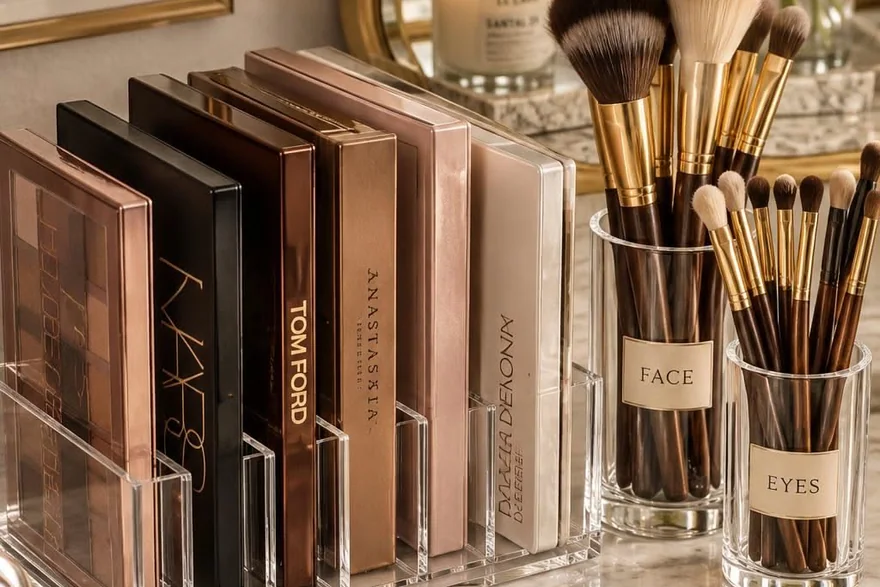
A lipstick case in the sourcing sense is any small carrier dimensioned around the lipstick bullet rather than around a bag interior. In custom programmes it appears in five recurring forms: a slip sleeve that takes one bullet, an elastic-loop panel sewn inside a flat pouch, a moulded EVA shell with individual cradles, a hard clamshell with a hinged lid, and a zip-around wallet that holds six to twelve bullets upright. All five share the same specification problem: the cavity has to accept a family of bullet diameters without rattling, and it has to let the user work the twist mechanism without lifting the bullet out of the holder.
The category sits at the low end of unit cost and the high end of dimensional risk. Unit prices across cosmetic bag and pouch programmes run from about $0.45 to $12.00 per piece depending on construction (Alibaba, October 2026); a single-bullet slip sleeve lands near the bottom of that band, while a moulded multi-bullet shell with a branded zip puller and a laminated lining moves toward the middle. Search interest is narrower than for full-size bags, with custom makeup bag drawing roughly 5,400 to 6,600 searches a month, but this segment converts through gifting and set-building, where the holder is sold alongside a cosmetic pouch rather than instead of one.
- Gift-with-purchase: a printed sleeve slipped into a larger cosmetic bag set at launch.
- Subscription and sampler boxes: a flat wallet carrying three to six mini or sample bullets.
- Professional kit: a twelve-slot upright wallet for artists working from a curated palette.
- Travel retail and counter: a single-bullet sleeve merchandised next to the lipstick itself.
- Promotional: a low-unit-cost sleeve carrying a seasonal colour and a one-colour logo.
What separates a kept holder from a returned one is rarely the shell fabric. It is whether the bullet stays upright, whether the cap survives transit, and whether the lining survives contact with wax. Buyers who specify the piece by outer dimensions alone, say 10 cm by 4 cm, routinely find at the sample stage that a slim bullet swims in a slot cut for a standard one and that a chubby-stick format will not enter at all. The fix is cheap before sampling and almost impossible after bulk, which is why the diameter schedule belongs in the first specification rather than in a revision note.
Bullet Diameter Tolerance and Twist-Mechanism Clearance: The Two Dimensions That Decide Fit
Lipstick bullets fall into a handful of diameter families, and the slot must be specified against the family rather than against one sample product. Slim and sheer bullets run about 12 to 13 mm across the barrel, standard bullets about 16 to 17 mm, chubby-stick and crayon formats 19 to 22 mm, and lip balm tubes 15 to 16 mm with a shorter exposed length. A slot cut to the nominal diameter of one product will either jam or rattle across the rest of the family, because plated and laminated barrels vary by fractions of a millimetre between colourways of the same line.
| Bullet format | Typical barrel diameter | Suggested slot internal diameter | Fit notes |
|---|---|---|---|
| Slim or sheer bullet | 12-13 mm | 13.5-14.5 mm | About 1.5 mm radial clearance; needs a stitched floor stop so the bullet cannot drop through |
| Standard bullet | 16-17 mm | 17.5-18.5 mm | Most common case; slot depth 22-25 mm so the barrel is covered below the cap line |
| Chubby stick or crayon | 19-22 mm | 21-23.5 mm | Wide band; either specify per product or use an elastic cradle instead of a fixed slot |
| Lip balm tube | 15-16 mm | 16.5-17.5 mm | Shorter exposed length; slot depth 18-20 mm is usually enough |
| Liquid lipstick with wand | 14-16 mm | 15.5-17 mm | Wand cap adds length; allow 30-35 mm slot depth or the cap will lever the slot open |
Twist-mechanism clearance is the dimension most often missed. The bullet has to be gripped and rotated while it sits in the holder; if the slot mouth closes flush around the barrel, the user has to pull the bullet out to extend it, which defeats the point of the holder. The practical rule is to leave 6 to 8 mm of exposed barrel above the slot mouth for a standard bullet, or to cut the slot mouth open at the front so two fingers can pinch the barrel. Where the slot is formed by two fabric layers with a 3 mm seam allowance on each side, that seam allowance eats into the usable mouth and should be subtracted before the pattern is cut.
Tolerance stacking is the second trap. A slot dimensioned at 17.5 mm on paper can arrive at 15.8 mm once a 1 mm interlining, a 0.4 mm laminate and two turned seam allowances are counted. Buyers should ask the programme coordinator for a tolerance statement on the finished internal dimension, not on the cut panel, and should treat anything looser than plus or minus 0.8 mm as a risk for both rattle and jam. On a multi-slot wallet, pitch error compounds across the row: a 0.5 mm per-slot drift over twelve slots puts the final cradle 6 mm out of position, which is enough to misalign a printed divider or a lid catch.
Where the format closes with a zip rather than a snap or a turn-lock, the closure parts deserve the same discipline as the slot. Chain gauge, slider type and tape width should be written down using recognised terminology so that a replacement order twelve months later matches the original; the industry reference for that vocabulary is ASTM D2053 on zipper terminology. On a sleeve this small, a #3 nylon coil with a 4 mm tape usually reads better than a metal chain, which adds weight and can scratch a metal bullet case.
Heat, Wax and Lining: How Temperature Softening and Product Transfer Drive Material Choice
Lipstick is a wax and oil system, and it slumps. The exposure that matters for a holder programme is not the moment of use but the hours a filled carton sits in a container, a warehouse or a delivery vehicle. Rather than guess at a softening point, buyers should specify a conditioning test: hold a loaded sample at a stated temperature for a stated time, then inspect for slump, cap detachment and transfer to the lining. A common conditioning protocol is 45 °C for four hours with the bullet capped and upright, followed by a visual and wipe inspection at room temperature. The value is in writing the method down so that two suppliers are compared on the same basis.
- Specify a conditioning method, not a temperature claim: stated degrees, stated hours, stated orientation, stated inspection.
- Test the holder loaded with the actual bullet, not with a wooden dowel of the same diameter.
- Inspect the lining after conditioning, not only the bullet; transfer is a lining defect as much as a product one.
- Repeat the test after three open-and-close cycles so cap retention is judged on a used holder.
- Record the result photographically at the sample stage so bulk can be compared against a reference.
Lining choice follows directly from that test. A plain 210D polyester at roughly 65 g/m² is the cheapest option and the worst performer: wax marks stay visible and oil wicks along the weave, so a holder used daily looks tired within weeks. A polyester with a PU face at about 180 to 220 g/m² wipes clean with a damp cloth and is the default for mid-range programmes, at the cost of a stiffer hand that is noticeable in a sleeve small enough to be held in one palm. A TPU laminate in the 200 to 260 g/m² range resists oil transfer better still but carries a higher unit cost and can block against itself in sustained high humidity if the shell is not vented.
Two further options appear in premium briefs. An aluminium-backed thermal film of about 90 to 120 g/m² as a laminate slows warm-up by reflecting radiant heat, which helps a holder that lives in a beach bag, though it introduces a crinkle and a metallic look that not every brand wants. A suede-look microfibre near 180 g/m² hides scuff marks and gives a luxury hand but does not wipe clean, so it protects against abrasion rather than against transfer. Whichever is chosen, the dye behaviour of a dark lining against a pale bullet should be checked against recognised colour-fastness methods; the relevant families are covered by ISO 105 colour fastness and by AATCC test methods, both of which give buyers a common language for crocking and perspiration ratings. Where the holder is destined for a beach or a hot-climate market, pairing a reflective laminate with an upright layout is more effective than either alone, because the laminate slows the rise in temperature and the upright position keeps a softened tip clear of the lining. Buyers should also consider the carton: a holder packed flat against a dark lining inside a sealed polybag retains heat longer than one packed loosely, so the conditioning test is more meaningful when it is run on a filled carton rather than on a single sample.
Single-Slot, Multi-Bullet and Hybrid Formats: Slot Pitch and Layout Geometry
Slot pitch is the centre-to-centre distance between adjacent cradles, and it is the number that decides whether a multi-bullet wallet looks deliberate or crowded. The minimum workable pitch is bullet diameter plus twice the divider wall thickness plus 1 mm of handling clearance; for a standard 17 mm bullet with 2 mm dividers that gives about 22 mm, and most programmes settle between 24 and 26 mm so that a fingertip can reach past one bullet to the next. Below that, users pull two bullets at once. Above roughly 30 mm, the wallet grows wider than a cosmetic pouch pocket and loses its reason to exist.
| Format | Slot pitch | Typical outer size | Where it sells best |
|---|---|---|---|
| Single slip sleeve | Not applicable | 9.5 x 3.5 x 3.5 cm | Gift-with-purchase, counter retail, promotional inserts |
| Three-slot flat wallet | 24-26 mm | 13 x 6 x 3 cm | Sampler boxes, subscription tiers, mini bullet sets |
| Six-slot upright tray | 25-27 mm | 14 x 8 x 4.5 cm | Travel retail, vanity-table organisation |
| Twelve-slot professional wallet | 23-25 mm | 22 x 12 x 4.5 cm | Artist kits, salon back-bar, shade libraries |
| Hybrid: six slots plus brush loop | 25 mm plus 30 mm loop bay | 20 x 10 x 4.5 cm | Set-building alongside a cosmetic pouch |
The hybrid format deserves attention because it is where the small accessory earns its margin. A wallet that carries six bullets upright plus a 30 mm bay for a lip brush or a pencil sharpener attaches to a cosmetic bag programme naturally: it drops into the main cavity of a medium pouch, it shares the shell fabric and the zip puller, and it lets a brand sell a two-piece set without tooling a second closure. The cost penalty is modest, since the brush bay is a wider divider gap rather than an extra component, and the set reads as considered rather than assembled.
Elastic loops behave differently from rigid slots and suit different briefs. A 12 mm flat elastic sewn at 20 mm intervals across a panel will accept a diameter range of roughly 13 to 20 mm, which single-handedly solves the chubby-stick problem that defeats fixed slots. The trade-off is that elastic relaxes; a loop that grips a slim bullet at sampling may grip it less firmly after a year of use, particularly if the programme ships to a humid market. Where the holder is intended as a long-life organiser, a moulded EVA cradle holds its geometry better. Where it is a one-season gift, elastic is cheaper, lighter and more forgiving of shade variations across a range.
Upright versus lying-flat is the last layout decision. Upright storage keeps the bullet tip from bearing on the lining and shows the shade from above, which matters for artist and counter use, but it makes the holder taller and less pocketable. Lying-flat storage suits a pouch that lives inside a handbag, keeps the profile under about 4 cm, and allows a printed shade card opposite the slots. Buyers should decide this from the retail context rather than from cost, because the two layouts drive different carton dimensions and therefore different freight per unit on a 500-piece minimum order.
The B2B Customisation View
What separates a smooth cosmetic pouches, vanity cases and beauty organisers launch from a painful one is usually the quality of the technical pack rather than the price of the fabric.
Planning figures used across the programme: MOQ 500 pieces per style and colourway, 6–10 working days sampling (12–15 when moulding or multi-layer lamination is required), 35–50 days bulk lead time, AQL 2.5 to ISO 2859-1, FOB Xiamen, T/T 30/70.
QUANZHOU JUNYUAN BAGS keeps the relationship deliberately narrow: specification control, sampling, inspection and logistics coordination, all documented against the buyer's own standard.
Which Brand Types Benefit Most
Start-up brands get the most from this category because the minimum is low relative to the perceived value: 500 pieces per style and colourway is a reachable first order for a lipstick sleeve that retails as an add-on, and the 6-10 working day sampling window means a launch colour can be tested before a full palette is committed. Established brands use holders differently, treating the sleeve as a shade carrier that extends an existing lipstick line into travel and gifting rather than as a standalone SKU, which favours a shell fabric matched to the master carton of the lipstick itself. Retailers and e-commerce sellers benefit most from the wallet formats, because a six- or twelve-slot organiser photographs well, ships flat and carries a higher perceived value than its unit cost suggests. Gift and hospitality buyers lean on the printed single sleeve, where a one-colour logo on a 9.5 cm panel costs little and reads clearly in a welcome kit or a conference bag. Across all five, the commercial mechanics are the same: sampling in 6-10 working days, 12-15 for complex constructions, bulk in 35-50 days after approval, inspection at AQL 2.5 under ISO 2859-1, FOB Xiamen, T/T 30 deposit and 70 against bill of lading. Whichever route is taken, the same dimensional discipline applies: bullet diameter, slot depth and lining are locked at sampling, because a sleeve that fits one shade family and not another is a sleeve that comes back.
- Start-up brands: one sleeve colourway at minimum quantity, then extend the palette once the fit is proven.
- Established brands: a shell matched to an existing lipstick line, sold as a travel or gifting companion.
- Retailers: multi-slot wallets that photograph well and ship flat for marketplace fulfilment.
- E-commerce sellers: hybrid wallet plus brush bay, bundled with a cosmetic pouch as a two-piece set.
- Gift and hospitality buyers: printed single sleeves packed in bulk for event and welcome kits.
Frequently Asked Questions
What internal diameter should a lipstick slot be specified at?
Specify the slot at the bullet diameter plus about 1.5 mm of radial clearance, measured on the finished internal dimension rather than on the cut panel. For a standard 16 to 17 mm bullet that means an internal diameter of 17.5 to 18.5 mm. Buyers should ask for the tolerance on the finished cavity, because seam allowances, interlining and laminate all consume space and a slot drawn at 17.5 mm can arrive nearer 16 mm.
How much clearance does a twist mechanism need inside a lipstick holder?
Leave 6 to 8 mm of barrel exposed above the slot mouth for a standard bullet, or cut the mouth open at the front so the barrel can be pinched with two fingers. Without that clearance the user has to pull the bullet out to extend it, which removes the point of the holder. Where the slot is made from two fabric layers, subtract the seam allowance on each side before the pattern is cut.
Why do lipstick bullets soften in transit and what can the case do about it?
Lipstick is a wax and oil system that slumps as temperature rises, and the risk window is the hours a filled carton spends in a container or a delivery vehicle rather than the moment of use. The case cannot change the formulation, but it can slow warm-up and contain the consequences: an aluminium-backed laminate reflects radiant heat, an upright layout keeps the tip off the lining, and a wipe-clean face limits visible damage.
Which conditioning method should be used to check heat behaviour?
Write a method rather than a claim: hold a loaded sample at 45 °C for four hours with the bullet capped and upright, then inspect at room temperature for slump, cap detachment and transfer to the lining. Test with the real bullet rather than a dowel, and repeat after three open-and-close cycles. The benefit is that every supplier quoting the programme is then compared on identical conditions.
Which lining materials resist lipstick wax and oil transfer?
A polyester with a PU face at roughly 180 to 220 g/m² is the default compromise, wiping clean with a damp cloth at a moderate unit cost. TPU laminate at 200 to 260 g/m² resists oil transfer better but costs more and can block in sustained humidity if the shell is unvented. Plain 210D polyester near 65 g/m² is cheapest and performs worst, since marks stay visible and oil wicks along the weave.
What is slot pitch and how is it set for a multi-bullet holder?
Slot pitch is the centre-to-centre distance between cradles. The minimum workable pitch is bullet diameter plus twice the divider wall plus 1 mm of handling clearance, which for a 17 mm bullet with 2 mm dividers is about 22 mm. Most programmes settle at 24 to 26 mm so a fingertip can reach past one bullet to the next, and pitch above about 30 mm makes the wallet wider than a pouch pocket.
Should a lipstick holder be moulded EVA or soft-sided fabric?
Moulded EVA holds cradle geometry over years of use and protects a bullet better against crush, which suits a long-life organiser or an artist wallet. Soft-sided fabric is cheaper, lighter and packs flatter, which suits a one-season gift or a promotional sleeve. The decision usually follows intended life: protection favours EVA, unit cost and freight favour fabric.
How does a lipstick case differ from a lip balm tube holder in dimension?
Lip balm tubes run about 15 to 16 mm across, similar to a standard bullet, but the exposed length is shorter, so slot depth drops from 22-25 mm to roughly 18-20 mm. The wall of a balm tube is also thinner and more prone to denting, so a slightly softer cradle is safer than a tight rigid slot. Confirm both dimensions against the actual tube before sampling.
Can a lipstick holder be zipped, and how should the closure be specified?
Yes, and the closure should be written down using standard vocabulary so a repeat order matches the original. The reference for that terminology is ASTM D2053 on zipper terminology. On a sleeve this size a #3 nylon coil with a 4 mm tape usually reads better than a metal chain, which adds weight and can scratch a metal bullet case.
Which colour-fastness test applies to a dark lipstick holder lining?
Dark linings that contact a pale bullet barrel should be checked for crocking, which is colour transfer under rubbing. The common language for that is the ISO 105 colour fastness family and the AATCC test methods, both of which let a buyer state a rating rather than a description. Buyers should also check the reverse direction, since lipstick pigment can mark the lining even when the lining does not mark the bullet.
How many bullets can a travel lipstick organiser realistically hold?
Six to twelve is the practical band. Six slots in a 14 x 8 x 4.5 cm tray fits inside most medium cosmetic pouches and suits personal travel. Twelve slots pushes the wallet to roughly 22 x 12 cm, which reads as an artist or vanity organiser rather than a travel piece. Above twelve, the holder stops being a cosmetic accessory and starts competing with a small vanity case.
What decoration methods work on a 6 cm wide holder panel?
Screen printing handles a one- or two-colour logo cleanly on a panel that narrow and is the cheapest route at volume. Heat transfer suits photographic or gradient artwork but adds a film hand on a soft shell. Embroidery is possible but a dense fill on a small sleeve can pucker the panel and crowd a slot. Debossing works only on moulded EVA or a coated shell.
Does a lipstick case need child-resistance or any product safety standard?
A holder is a general-use accessory rather than a child-resistant closure, so no specific child-resistance rule attaches to it. What does apply is the substance and coating compliance expected in the destination market, including EU REACH restrictions and OEKO-TEX Standard 100 where a brand wants a textile label. Restricted-substance requirements should be stated in the specification so the lining and print are sourced accordingly.
What packaging configuration suits a 500-piece lipstick holder order?
Because the unit is small, carton counts are high and a dimensional error multiplies fast. Sleeves are typically bulk-packed in polybags of 25 or 50 and then into an export carton, with a stated carton size and a stated pieces-per-carton so freight can be quoted accurately. Wallets that ship flat should be packed flat rather than rolled, to avoid a set crease across a cradle row.
How is dimensional fit verified before bulk production starts?
The programme coordinator should load a sample with the actual bullets across the full diameter family, not a single reference product, and record the result photographically. That image becomes the bulk comparison reference. Inspection then runs at AQL 2.5 under ISO 2859-1, and the cavity dimension should be listed as an inspection point so a drift in slot width is caught before the cartons are sealed.
People Also Ask
Do lipstick cases fit every lipstick brand?
No. Bullets fall into diameter families, roughly 12-13 mm for slim, 16-17 mm for standard and 19-22 mm for chubby sticks, and a slot cut for one will rattle or jam on another. The safest specification is a stated internal diameter with about 1.5 mm of clearance plus a tolerance, or an elastic cradle where the range is wide. Buyers should confirm diameter against the physical product before sampling rather than against a catalogue drawing, because plated and laminated barrels vary between colourways of the same line.
Why does lipstick melt inside a makeup bag?
Lipstick is a wax and oil blend that slumps well below the temperatures a bag can reach in a parked car or a delivery vehicle. A case cannot change the formulation, but it can slow warm-up with a reflective laminate, keep the bullet upright so the tip does not bear on the lining, and use a wipe-clean face that survives transfer. Testing a loaded holder at a stated temperature for a stated time is the only way to compare two quotations, since the formulation itself is outside the case designer's control.
What is the best way to store lipstick when travelling?
Upright in a cradle with the cap retained, in a holder that leaves 6 to 8 mm of barrel exposed so the twist mechanism can be worked without removing the bullet. A six-slot tray around 14 x 8 x 4.5 cm fits most medium cosmetic pouches and keeps shades visible from above, which avoids opening every cap to find a colour. Keep the holder out of direct sun on a window seat or a dashboard, because a reflective laminate slows warming without stopping it.
Are hard lipstick cases better than soft pouches?
Hard and moulded cases protect better against crush and hold cradle geometry for years, which suits artist kits and long-life organisers. Soft pouches are lighter, cheaper and pack flatter, which suits gifts and promotional sleeves. The honest answer depends on intended life rather than on quality. Whichever is chosen, diameter, exposed barrel length and lining should be locked at the sample stage, since those three decide satisfaction more than the shell does.
Request a Sample or a Written Quotation
Send the silhouette, dimensions, material preference and logo artwork, and the programme team will return a written quotation with MOQ, sampling window, bulk lead time and inspection standard.
Email: service@junyuanbags.com · WhatsApp: +86 177 5002 0688