Cosmetic Bags for Photographers: On-Location Touch-Up Kits
Executive Summary
Cosmetic bags for photographers are on-location touch-up kits, defined less by what they hold than by what they must not do. They must not add weight to a bag carried all day, must not reflect light back into a scene, and must not leak powder or cream onto a lens cloth. In practice that means a slim pouch of roughly 24 to 26 by 15 to 18 cm with a closed depth of 6 to 9 cm, an empty weight under 450 g, a matte shell, and a laminated lining that releases product on wiping.
The specification is a set of compromises worth making deliberately. A structured case protects a mirror and a pressed powder but adds 200 to 350 g and displaces a lens, while a soft pouch packs around other gear and gives no crush protection. Because the kit is often handed to a client, hygiene matters as much as layout. Programmes start at 500 pieces per style and colourway, sample in 6 to 10 working days, and ship 35 to 50 days after approval under AQL 2.5 to ISO 2859-1, FOB Xiamen, T/T 30 deposit and 70 against bill of lading.
What an on-location touch-up kit carries, and what a camera bag does not solve
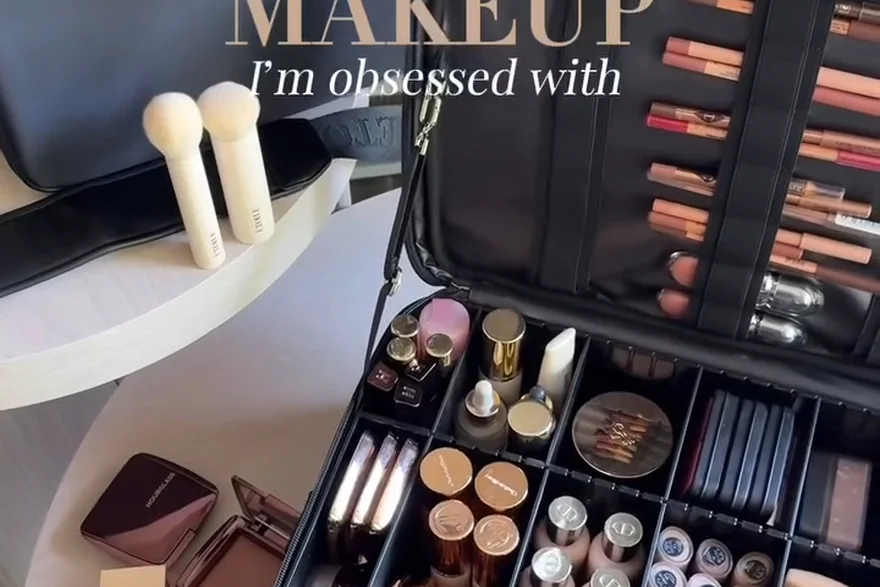
A camera bag is engineered around one problem: protecting bodies and lenses from impact while keeping them reachable. Its dividers are padded, tall and sized for glass, and its interior is usually a dark nylon that hides dust. None of that suits cosmetics. Product is small, flat, semi-liquid and easily crushed; a pressed powder compact dropped into a padded divider slot will get knocked by a lens barrel on the walk to the location. The touch-up kit therefore exists as a separate container inside the camera bag, and its job is to keep product away from optics and to keep optics away from product.
The contents list is short and specific. Blotting papers, a pressed translucent powder with a puff, a concealer in a small pan or a 5 ml pot, two or three lip products, a brow pencil and a sharpener, a small spoolie, a folding mirror, a few disposable applicators, hair pins and a small elastic, a mattifying setting spray in a 30 to 50 ml bottle, and for outdoor work a sunscreen stick and a small insect-repellent wipe. That is roughly 300 to 500 g of product, and it is everything a shooter needs to reset a face between setups. Anything more belongs in a studio case, not in a pouch that is carried all day.
What distinguishes the photographer's version from a retail touch-up pouch is the operating environment. The kit is used standing up, often outdoors, frequently in a moving vehicle between locations, and sometimes handed to a subject who is not used to handling cosmetics. That last point drives a set of requirements that have nothing to do with capacity: the pouch has to open to a stable tray rather than a collapse, the mirror has to be usable at arm's length, and every product has to be identifiable by someone who did not pack the bag. Volume expectations follow from the contents list: 2 to 4 litres for a working pouch, 5 to 8 litres for a full-location kit that also carries hair items.
Weight, bulk and the transit reality of a location kit
Weight is the first constraint and the one most often ignored at brief stage. A shooter already carries bodies, two or three lenses, a flash, batteries and a laptop, and the industry rule of thumb that a location bag is tolerable only up to a certain shoulder load means every added gram is noticed. An empty pouch at 180 to 280 g is comfortable; at 450 g it is a decision; above 600 g it gets left in the car, which defeats the purpose of carrying it. The levers are fabric weight and structure. Moving from a 600D polyester shell at 300 g/m² to a 420D nylon ripstop at 190 g/m² saves 120 to 180 g on a 3 litre build, and dropping a 3 mm EVA base board in favour of a bound seam saves a further 60 to 90 g.
Bulk is the second constraint and it is measured against lens volume, not against litres. A pouch occupying 24 by 16 by 10 cm displaces roughly the space of a 24-70 mm lens in a padded insert, and that comparison is the one a shooter will actually make. Slim formats win: a pouch that lies flat at 8 cm deep can slide into the lid pocket or the gap beside a body, whereas a 12 cm deep cube forces a re-pack of the whole bag. Buyers should specify the closed depth as a hard number in the brief, because depth is the dimension that determines whether the pouch travels in the bag or in the car.
Transit also means vibration and pressure. A pouch inside a loaded camera bag gets compressed when the bag is set down hard, and a soft pouch with no structure transfers that pressure to a pressed powder compact. A partial solution that costs almost nothing is a semi-rigid panel in the lid only, leaving the body soft. Where a mirror is carried, a 2 mm acrylic panel in a padded sleeve is standard; glass at that size cracks under compression and a cracked mirror sheds fragments into the kit. Wipe-clean shells matter here too: a coated fabric specified under ASTM D751 coated fabrics gives a consistent basis for comparing coating adhesion and abrasion resistance between two quotes.
| Kit format | Empty weight target | Typical size | Fits | Trade-off |
|---|---|---|---|---|
| Slim flat pouch | 140-200 g | 24 x 15 x 6 cm | Blot papers, lip, concealer, small mirror | No crush protection for pressed powder |
| Clamshell pouch | 260-380 g | 26 x 18 x 9 cm | Full touch-up set with applicators | Needs a semi-rigid lid to open as a tray |
| Semi-rigid case | 420-620 g | 28 x 20 x 11 cm | Mirror, pressed powder, setting spray bottle | Displaces a lens in the camera bag |
| Hanging roll | 380-520 g | 48 x 30 cm open | Brushes plus product for studio work | Too large for a location bag; studio only |
| Two-piece set | 300-460 g | 26 x 18 x 9 plus 18 x 12 x 5 | Clean kit separated from used applicators | Second item can be left behind |
Two accessories decide whether a pouch is actually kept in the bag. A wrist strap of 12 to 15 mm webbing lets the kit be hung from a light stand or a door handle when a surface is not available, which is most of the time outdoors. And a flat external slip pocket for used applicators keeps a disposable wand out of the clean compartment without adding a second bag. Both cost a few grams and a few cents, and both change how the kit is used on a working day.
Surfaces, hygiene and sharing a kit between clients
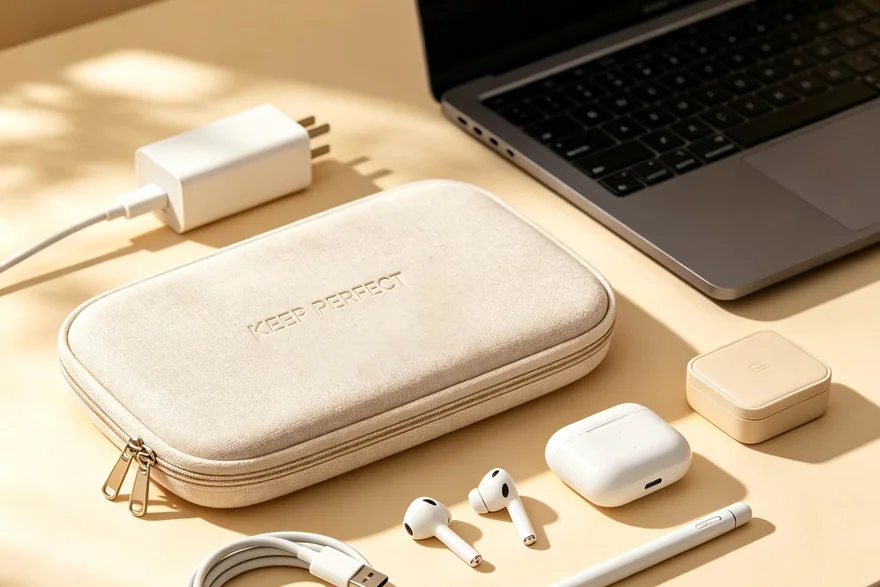
A photographer's touch-up kit is unusual among cosmetic bags in that it is shared. On a wedding, a commercial shoot or a portrait session the kit is used on several faces in one day, sometimes by the subjects themselves. That makes hygiene a design requirement rather than a preference. The interior should be a non-absorbent laminated surface that can be wiped with a cosmetic-grade sanitiser between subjects, and the compartment layout should separate single-use items from reusable ones. A mesh pocket for used applicators, a sealed pocket for anything cream, and a flat clean tray for powder are the three zones that make a shared kit workable.
Cleanability has a testing dimension that buyers can specify rather than assume. Any antimicrobial finish claimed for a lining should be tied to a named method, and the library of AATCC test methods is the usual reference point for textile antibacterial and antifungal assessment. The more reliable route, however, is mechanical rather than chemical: a smooth laminated face with welded seams has nowhere for residue to sit, and a lining that survives repeated wipe-down without delaminating outperforms a treated fabric whose finish degrades after a few dozen cleans. Buyers should ask how many wipe cycles a lining is expected to survive, and get the answer in writing.
Material safety sits alongside hygiene. Linings, elastics and any printed panel that will touch skin or sit near the eyes should be checked against a restricted-substance framework, and OEKO-TEX Standard 100 is the framework most retail and studio buyers already recognise. Colour transfer is the other surface issue specific to photography: a dark pouch carried against a light shirt or a wedding dress can crock, and the relevant test family is described under ISO 105 colour fastness. A black shell with poor wet-rub fastness is a liability on the job, not just a quality complaint.
- Shell: matte 420D nylon ripstop at 180-210 g/m² for a carried pouch; 600D polyester at 280-320 g/m² for a studio case.
- Finish: matte or semi-matte only, because a glossy shell bounces light back into a scene and shows fingerprints.
- Lining: 0.15-0.20 mm TPU lamination on a 210D base, welded seams, in a light grey for product readability.
- Hygiene: separate sealed pocket for cream product, mesh pocket for used applicators, flat tray for powder.
- Noise: coil zip with a soft puller rather than a metal slider and a metal stop, for hybrid stills and video work.
- Mirror: 2 mm acrylic at 15 x 10 cm, sleeved; glass only in a case that never leaves a padded bag.
One further surface consideration is dust. Outdoor locations produce fine grit that finds its way into every opening, and a pouch with an open-top or a magnetic closure will collect it inside a week. A closed coil zip with a small zip garage at the end of the run keeps grit out of the tape and out of the interior. Where a shooter works primarily on beaches or in desert conditions, a wipe-clean exterior is worth more than any interior feature, because sand that enters the zip track is the single most common cause of a pouch being retired early.
Branding, kit presentation and turning a pouch into studio equipment
For a studio, the touch-up pouch is one of the few items of equipment a client actually handles. A camera body is operated by the shooter; the pouch is opened by the subject, looked at for ten seconds, and remembered. That makes it a branding surface worth specifying properly rather than an afterthought printed after the bag is designed. The artwork area on a 26 by 18 cm pouch is roughly 12 by 6 cm on the front panel, which is enough for a wordmark at 8 to 12 mm cap height and no more. Buyers who try to fit a full logo lockup with a tagline end up with a mark that is illegible at arm's length and a print that cracks at the fold.
Method choice follows from the shell and from how the pouch will be cleaned. A woven label sewn into a side seam survives repeated wipe-down and reads as equipment rather than as promotional print. Embroidery on a 420D ripstop needs a backing stabiliser and adds a small amount of weight, but it is the most durable option on a soft pouch. A debossed PU patch reads well on a matte shell and hides scuffing. Screen and heat-transfer prints are the cheapest per unit and the least durable under solvent wiping, which is a real consideration for a kit that is sanitised between subjects. Sampling for any of these runs 6 to 10 working days, and 12 to 15 where a moulded patch or a custom-woven label has to be tooled first.
| Branding method | Minimum practical size | Durability under wiping | Effect on lead time | Best for |
|---|---|---|---|---|
| Woven label | 8 x 30 mm folded, 10 x 45 mm flat | Unaffected by solvent wiping | Adds 2-3 days for weaving | Side seam or zip garage |
| Embroidery | From 15 x 40 mm wordmark | Excellent; thread resists solvents | Adds 3-5 days for digitising | Front panel of a soft pouch |
| Debossed PU patch | From 25 x 25 mm | Good; hides scuffing | Adds 5-8 days for tooling | Matte shells and studio kits |
| Silicone badge | From 30 x 20 mm | Excellent; flexible and washable | Adds 8-12 days for tooling | Bags that are machine washed |
| Screen print | From 20 x 60 mm | Fair; degrades with solvent | Adds 1-2 days | Promotional one-season kits |
Presentation outside the bag matters for studios that hand kits to clients. A pouch that arrives with a printed card listing the contents and the wipe-down routine reads as professional equipment, and a spare disposable applicator pack in the mesh pocket signals that hygiene was thought about. Where kits are sold rather than given, retail packaging should state the litre capacity, the closed dimensions and the lining material, because those are the three facts a buyer compares between listings. None of this requires a different bag; it requires a different set of decisions about what travels with it.
Decide whether the pouch is given away or sold before choosing the branding method. A given-away kit should carry the most durable mark available, because it is handled by clients for years; a sold kit can carry a cheaper mark because it is replaced by the buyer.
The B2B Customisation View
Cost, compliance and craft pull against each other on every cosmetic pouches, vanity cases and beauty organisers project; the specification is the record of how those three forces were balanced.
Commercial parameters stay fixed across the range: MOQ 500 pieces per style and colourway, prototype turnaround 6–10 working days (extended to 12–15 for multi-panel or moulded builds), bulk lead time 35–50 days from approved sample, AQL 2.5 inspection to ISO 2859-1, FOB Xiamen, T/T 30 deposit and 70 against bill of lading.
Buyers who use a programme coordinator keep their own supply-chain optionality; the technical pack travels, so production can be re-placed if a launch is brought forward.
Which Brand Types Benefit Most
On-location touch-up kits suit buyers for reasons that differ sharply by channel. Start-up brands use the format as an entry into a professional segment: a pouch that solves a working problem generates reviews from people whose opinions carry weight with a consumer audience, and the photography community is unusually active online. Established brands extend into the format as a services asset rather than a retail one, supplying kits to studios and to the makeup artists they work with, which puts the bag in front of clients without a retail markup. Retailers treat it as a small but high-margin accessory category that sits naturally beside travel and grooming, and it sells best when the copy names the use case rather than the product type. E-commerce sellers benefit from the specificity of the search language: a listing that names on-location use competes against a small field, and the questions buyers ask about size and weight are answerable in the listing itself, which reduces returns. Gift and hospitality buyers use the smaller pouch as a conference or event gift, where a compact, matte, logo-carrying item is more likely to be kept and reused than a tote. The category also rewards a disciplined specification: because these pouches compete on size, weight and cleanability rather than on colour, a buyer who publishes closed dimensions, empty weight and lining material wins the comparison against listings that publish none of them. Replacement demand is the final argument for getting the first specification right, since a kit carried daily is a kit replaced every year or two, and a studio that standardises on one pouch reorders rather than re-shops.
- Start-up brands: a working-problem pouch earns credible reviews in an influential community.
- Established brands: studio-supplied kits put the brand in front of clients at low unit cost.
- Retailers: high-margin accessory that merchandises beside travel and grooming.
- E-commerce sellers: specific use-case language shortens the comparison set and cuts returns.
- Gift and hospitality buyers: compact logo pouches are kept and reused more often than totes.
Frequently Asked Questions
What size cosmetic pouch fits inside a camera bag without displacing a lens?
Aim for a closed depth of 6 to 9 cm and a footprint of about 24 to 26 by 15 to 18 cm, which is roughly 2 to 4 litres. That profile slips into a lid pocket or beside a body. A pouch deeper than 10 cm occupies the volume of a mid-range zoom in its padded insert, and that is the comparison a shooter will make before deciding whether the kit travels.
Why do location kits favour matte black exteriors?
A glossy shell reflects light back into a scene and shows fingerprints under a flash, both of which are visible in images and on set. Matte black or charcoal also hides dust and scuffing from outdoor work, and it does not distract a subject who is being photographed. A matte finish specified on the coated fabric is a functional choice here, not a styling one.
How much should an empty touch-up pouch weigh?
Under 450 g is comfortable for a pouch carried all day; 180 to 280 g is better. Weight comes from fabric and structure, so a 420D nylon ripstop shell at 180 to 210 g/m² with a bound seam rather than an EVA base board saves 180 to 270 g against a 600D structured build. Above about 600 g the pouch tends to be left in the vehicle.
Which closure keeps dust out of a kit used outdoors?
A closed coil zip with a small zip garage at the end of the run. Open tops and magnetic flaps collect fine grit within a week of beach or desert work, and grit in the zip track is the most common reason a pouch is retired early. A #5 coil with a soft puller also keeps the kit quiet when a shooter moves during a take.
Can a photographer's pouch carry liquids under airline carry-on rules?
Yes, if the bottles are within the carry-on liquid allowance. A 30 to 50 ml setting spray is comfortably inside the limit, and the general framework is set out in the TSA 3-1-1 liquids rule, which applies to containers of 100 ml or less in a single clear bag. Buyers shipping kits internationally should check the equivalent rule for each origin and destination, since limits are set nationally.
What lining survives repeated alcohol wipe-downs?
A 0.15 to 0.20 mm TPU lamination bonded to a 210D base with welded seams. The film stops solvent reaching the interlining, and welded seams remove the needle holes that would otherwise wick it in. A printed or PU-faced woven fabric without lamination will delaminate or stiffen after a few dozen wipes, so the question to ask is how many wipe cycles the lining is rated for.
How is a shared kit kept hygienic between clients?
By layout as much as by cleaning. Separate the kit into a sealed pocket for cream product, a flat tray for powder and a mesh pocket for used applicators, and stock the kit with single-use wands and sponges so nothing that touches one face touches another. The laminated interior then needs only a wipe between subjects rather than a full clean.
Should a touch-up kit include a mirror, and what size?
Yes, and 15 by 10 cm in 2 mm acrylic is the practical size. It is large enough to work at arm's length and small enough to pack flat, and acrylic survives compression inside a loaded camera bag where glass cracks. The mirror should sit in a padded sleeve so it does not scratch the lining or press against a powder compact.
What minimum applies to a custom photographer pouch with a logo patch?
500 pieces per style and colourway, the same as any other style. A debossed PU or silicone patch adds tooling time rather than quantity, so the practical effect is on the sampling schedule: 12 to 15 working days for a tooled patch against 6 to 10 for a soft pouch with a woven label or embroidery.
How long does sampling take for a pouch with a debossed PU label?
Expect 12 to 15 working days, because the patch tooling has to be cut before a representative sample can be assembled. A pouch using only a woven label or embroidery samples in 6 to 10 working days. Bulk production runs 35 to 50 days after sample approval for either route, so the tooling decision affects the front of the schedule rather than the back.
What fabric weight balances durability and pack weight?
For a carried pouch, 420D nylon ripstop at 180 to 210 g/m² is the usual answer; it resists abrasion from being slid in and out of a camera bag and keeps the pouch light. For a studio case that is not carried all day, 600D polyester at 280 to 320 g/m² gives a better print surface and more scuff resistance for a weight penalty of roughly 120 to 180 g per unit.
Can a kit be split into a clean pouch and a used-applicator pouch?
Yes, and it is the cleanest answer to the hygiene problem. A two-piece set with a 26 by 18 cm main pouch and an 18 by 12 cm secondary pouch keeps used wands out of the clean compartment without relying on the user's discipline. The trade-off is that the smaller piece can be separated and lost, so a clip or a short webbing tether between the two is worth specifying.
How do buyers check colour fastness on a black pouch that rubs against light clothing?
Specify a wet and dry rub fastness requirement by test rather than by description. The ISO 105 family covers colour fastness including rubbing, and a lining or shell that fails wet rub will mark a light shirt or a wedding dress. This is a functional risk on the job rather than a cosmetic defect, so it belongs in the brief alongside the dimensional specification.
What inspection standard applies to a 500-piece pouch run?
AQL 2.5 under ISO 2859-1, which sets the sample size and the accept and reject numbers for the lot. For pouches, the defects that matter most are functional rather than visual: zip alignment at the ends of the run, delamination at the welded seams, and print adhesion on any branded panel. A buyer-defined defect list should sit on top of the standard.
Is a clear PVC pouch better than an opaque one for on-set kits?
Only where the kit passes through security or where contents must be identified without opening. Clear PVC is heavier per litre, scuffs visibly, and can stiffen in cold conditions, and it shows every mark inside. A better compromise is an opaque pouch with one clear internal panel over the powder and lip zone, which gives the retrieval benefit without the maintenance problem.
What is the best compartment layout for a 25 cm touch-up pouch?
Three zones: a flat zip pocket for powder and blot papers, an elastic-banded strip holding up to eight slim items upright, and a sealed laminated pocket for cream product and any liquid. That arrangement lets a user see everything from above without unpacking, which is what matters when the kit is being used standing up between setups.
People Also Ask
What should a photographer keep in a touch-up kit?
Blotting papers, pressed translucent powder with a puff, a small concealer, two or three lip products, a brow pencil with a sharpener, a spoolie, disposable applicators, a 15 by 10 cm acrylic mirror, hair pins, and a 30 to 50 ml setting spray. That is 300 to 500 g of product and covers almost every inter-setup fix without turning the pouch into a full makeup kit.
Do photographers need a separate bag from their camera bag?
Yes. Camera bag dividers are padded and sized for lenses, and product stored in them gets knocked by lens bodies in transit. A separate pouch keeps cosmetics away from optics, keeps powder and cream off lens cloths and sensors, and can be handed to a subject without exposing the rest of the kit. It also allows the pouch to be wiped down separately.
How big should an on-location makeup pouch be?
Around 24 to 26 by 15 to 18 cm closed with a depth of 6 to 9 cm, giving 2 to 4 litres. That carries a full touch-up set while slipping into a lid pocket or beside a camera body. A full-location kit that also carries hair items runs 5 to 8 litres, but anything larger tends not to fit the camera bag and ends up left in the vehicle.
Can a studio put its logo on a small cosmetic pouch?
Yes. The usable artwork area on a 26 by 18 cm pouch is roughly 12 by 6 cm, which suits a wordmark at 8 to 12 mm cap height. A woven label or embroidery is the most durable under solvent wiping; a debossed PU patch reads well on matte shells and adds tooling time. Screen print is cheapest but degrades fastest on a kit that is sanitised between subjects.
Request a Sample or a Written Quotation
Send the silhouette, dimensions, material preference and logo artwork, and the programme team will return a written quotation with MOQ, sampling window, bulk lead time and inspection standard.
Email: service@junyuanbags.com · WhatsApp: +86 177 5002 0688