DTC Cosmetic Bag Brands: Direct-to-Consumer Success Factors
Executive Summary
DTC cosmetic bag brands succeed when specification, packaging and replenishment are planned as one system rather than as three separate decisions. The question is what separates a direct-to-consumer cosmetic bag programme that scales from one that stalls at the second reorder, and the answer is landed-cost discipline, an unboxing specification engineered into the product itself, and a colourway cadence that matches the production clock. Selling direct removes the retail buyer from the process, but it does not remove the arithmetic: the product still has to be photographed, shipped, returned and reordered at a margin that survives all four.
The mechanics are specific. A 500-piece per style and colourway minimum is the natural unit of a launch drop: small enough to test three colourways at once, large enough to survive a twelve-week sell-through. Sampling runs 6-10 working days, or 12-15 for complex constructions, so a drop calendar can be built backwards from a fixed launch date. Inspection at AQL 2.5 under ISO 2859-1 protects the review score the next drop depends on. Shipment is FOB Xiamen and payment is T/T 30 deposit with 70 against bill of lading. Returns, not production, are the margin leak most DTC brands underestimate.
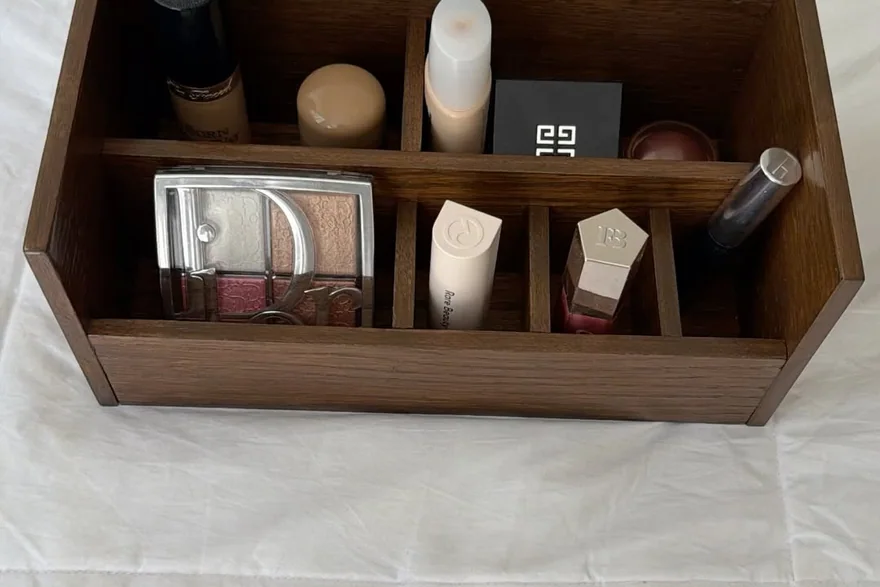
What direct-to-consumer changes in a cosmetic bag brief
Selling direct removes a gatekeeper and adds three jobs. A DTC brand owner becomes the buyer, the merchandiser and the customer service desk, and each of those roles places a different demand on the product specification. As buyer, the concern is landed cost per unit and the minimum commitment. As merchandiser, the concern is whether the product photographs well and whether the range reads as a family. As customer service, the concern is what happens when the product comes back, and that last concern is the one most often absent from a first brief.
The first structural difference is that the product ships individually rather than in a carton to a distribution centre. A wholesale programme optimises for carton utilisation; a DTC programme optimises for the single parcel. That reverses several normal decisions. A bag that packs beautifully by the flat dozen may arrive at a customer's door creased from a poly mailer, and a bag designed to hold its shape under compression is worth more to a DTC brand than one that folds flatter in transit.
The second difference is that the product is the primary marketing asset. In a retail environment a shelf talker, a planogram position and a store assistant all help sell the bag. On a product page the only assets are photography, video, copy and reviews, and all four describe the physical product. A specification decision that improves how the bag opens, how it stands, or how it reveals its contents is therefore a marketing decision as much as a manufacturing one.
The third difference is data speed. A DTC brand sees sell-through by colourway within days, which is a genuine advantage over wholesale, but it only helps if production can respond. With bulk production at 35-50 days after sample approval, a colourway that sells out in week three cannot be restocked in week five. The realistic response is to plan the second drop while the first is shipping, which changes the brief from a one-off order into a rolling programme with a fixed specification and a variable colourway mix.
- Design for the single parcel, not the master carton: shape retention under compression matters more than flat-pack efficiency.
- Treat opening behaviour as a marketing asset: the first reveal is the most-photographed moment.
- Plan drop two while drop one ships; a 35-50 day bulk cycle cannot respond to a stockout.
- Specify for the return journey as well as for the outbound one.
Unit economics of a DTC cosmetic bag
Most DTC cosmetic bag programmes that fail do so on arithmetic rather than on product quality. The unit price quoted for the bag is one line in a much longer column, and the lines below it are what decide whether the programme can be repeated. The table below sets out those lines in the order a brand owner encounters them, with the misjudgement typical of each. The point of the exercise is not to discourage spending but to make the full column visible before the 500-piece commitment is signed.
| Cost line | What it covers | Where DTC brands misjudge it |
|---|---|---|
| Unit price | The bag itself, quoted across a band of roughly $0.45-$12.00 (Alibaba, 2026.10) | Comparing unit prices without matching specification; a lower price built on a lighter lining is not the same product |
| Tooling and sampling | Custom moulds, plates, embroidery digitisation and sample runs | Treated as one-off and forgotten, then re-incurred when the second drop changes a detail |
| Inbound freight and duty | Ocean or air freight from FOB Xiamen, duty, and customs handling | Quoted per unit late, often after the retail price has already been published |
| Packaging | Polybag, tissue, insert card, mailer and any rigid support | Sized for the product rather than for the parcel, causing dimensional-weight surprises |
| Payment and platform fees | Card processing, marketplace commission, and T/T bank charges | Applied to the retail price including shipping rather than to the product margin alone |
| Returns and exchanges | Return freight, inspection, repackaging and write-off | Assumed to be a small percentage; in accessories it is driven by colour mismatch and size regret |
| Content production | Photography, video and lifestyle assets per colourway | Costed for one colourway when three are launching, so the per-unit content cost triples |
| Inventory carrying | Capital tied up in unsold units and storage | Ignored entirely until a slow colourway sits for two quarters |
The two lines that most often break a model are content production and returns. Content is usually budgeted per launch rather than per colourway, so a three-colourway drop quietly triples a cost that was only ever estimated once. Returns are worse because they are invisible until they arrive: a returned cosmetic bag has to be collected, inspected, repackaged and either resold as new, sold as imperfect or written off, and the labour in that loop frequently exceeds the unit cost of the bag itself.
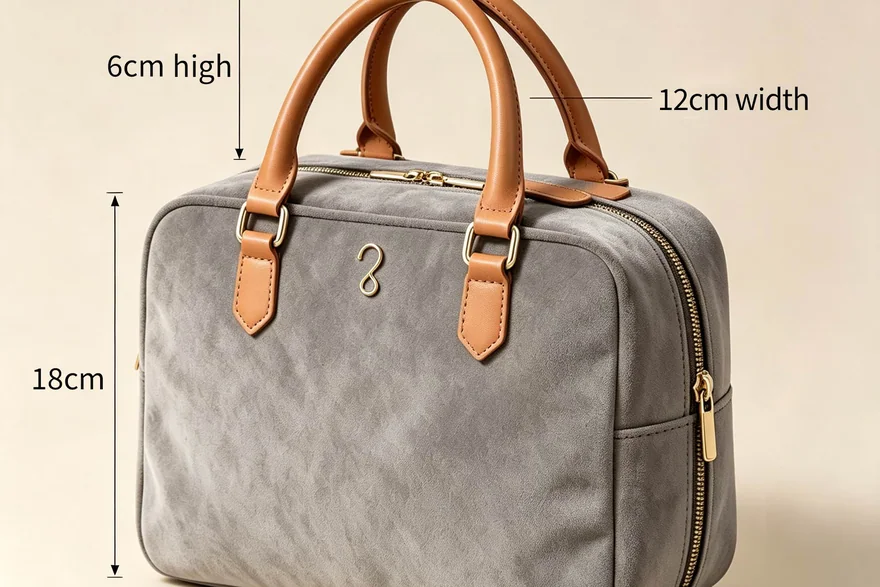
Both have specification answers. Colour-mismatch returns fall when the product photography is made from a production sample rather than a handmade prototype and when the brief fixes the dye reference in writing. Size-regret returns fall when dimensions are given in centimetres with a stated tolerance and shown against a familiar object in the imagery. These are cheap interventions at the specification stage and expensive ones after launch, which is the central argument for involving the sourcing partner in the content plan rather than handing over a finished order.
Inspection is the line that protects everything above it. AQL 2.5 under ISO 2859-1 defines the sampling procedure and the accept and reject numbers for a lot, and it is the only point in the process where a defect is caught before it becomes a return. A DTC brand lives and dies on its review score, and a review score is destroyed by defects rather than by pricing. Inspection should therefore be treated as a marketing cost rather than as a procurement formality, and the defect classification should reflect what a customer will actually complain about.
- Build the landed-cost column before publishing a retail price, not after it.
- Budget content per colourway, not per launch.
- Fix the dye reference in writing so colour-mismatch returns fall.
- Publish dimensions in centimetres with a stated tolerance, shown against a familiar object.
The unboxing specification: engineering the first twenty seconds
Unboxing is usually discussed as a packaging exercise. For a cosmetic bag it is better understood as a product specification, because the moment a customer opens the bag is the moment most often filmed, and it is entirely determined by decisions made at sampling. Three things decide whether that moment works: whether the bag opens in one motion, whether the interior is organised enough to read at a glance, and whether the bag holds its shape once the tissue is removed. It is also the moment a customer can return on, so the specification has to survive being opened repeatedly rather than once.
- One-motion opening: a zipper that runs the full width of the top panel lets the bag open flat. A zipper that stops short of the curve forces the customer to fight the shell.
- Interior contrast: a lining lighter than the shell makes the contents visible in a photo. A lining the same shade as the shell makes the interior read as a dark hole on camera.
- Stand-up ability: a bag that collapses when empty looks cheap on video. A structured base or a slightly heavier interlining fixes this for a small cost.
- First-reveal layout: the customer should see organisation before contents. Elasticated loops and a divider tray do more for perceived value than any print.
- Silent hardware: a rattling puller is audible on video and reads as poor quality even when it is not.
Packaging then extends the moment rather than creating it. A rigid or semi-rigid support inside the mailer prevents the creasing that a poly mailer otherwise guarantees, and a tissue wrap that does not shed fibre matters specifically for coated shells and for anything with a metal puller that could be scuffed in transit. An insert card belongs inside the bag rather than loose in the mailer, because a card placed inside the product is read whereas one placed beside it is frequently discarded with the packaging.
Sustainability claims are part of the same conversation and they need documentation. A brand that wants to describe recycled content on an insert card should be able to point to a recognised standard rather than to a supplier's description, and the Global Recycled Standard is the framework most commonly used for a recycled-content claim on a textile article. Where the claim is about substances rather than content, OEKO-TEX Standard 100 is the equivalent reference. A claim on a card that cannot be substantiated is a regulatory risk as well as a reputational one.
Where a DTC range includes anything aimed at children or sold alongside children's products, a further gate applies. The Consumer Product Safety Improvement Act sets requirements for children's products sold in the United States, including testing and tracking-label obligations. A brand owner who assumes a cosmetic pouch is exempt because it is sold as a beauty accessory rather than as a toy is making an expensive assumption, and the question should be asked of the sourcing partner early.
- Specify a full-width top zipper so the bag opens flat in one motion.
- Choose a lining lighter than the shell so contents are visible on camera.
- Add a structured base so the bag stands in video without support.
- Place the insert card inside the product, not beside it.
Colourway cadence and replenishment planning
A DTC brand's advantage is speed of information, and its constraint is speed of production. Reconciling the two is the central planning problem. The table below sets the programme out as a sequence with elapsed time attached to each stage and names the decision that has to be locked before the sequence can advance. It is built around the standard timetable: sampling in 6-10 working days, or 12-15 for complex constructions, followed by bulk production of 35-50 days after sample approval.
| Planning stage | Elapsed time | Decision that must be locked | What slips if it is not |
|---|---|---|---|
| Range and colourway selection | 1-2 weeks | How many colourways, and which shell and lining each uses | The 500-piece per colourway commitment multiplies before sell-through data exists |
| Sampling | 6-10 working days, or 12-15 complex | Construction, dimensions and tolerance | Bulk cannot be booked and the whole calendar moves right |
| Sample approval | 3-5 days internal | Signed reference sample and written specification | Run two has no benchmark and the product drifts |
| Bulk production | 35-50 days | Final quantities per colourway | Launch date moves, and paid media booked against it is wasted |
| Inspection | 2-4 days | Defect classification and AQL 2.5 acceptance | Defects reach customers and depress the review score |
| Inbound transit | Varies by mode | Freight mode and customs documentation | Goods land after the campaign window has closed |
| Content capture | Overlaps with transit | Which units are pulled for photography | Launch waits on assets that could have been shot earlier |
| Launch and drop-two decision | Day zero | Reorder quantity for the fastest colourway | A stockout of two months or more while drop two is produced |
The most useful habit this table supports is parallel planning. Content capture can run on a small advance shipment while the bulk is still in transit. The drop-two decision can be made from week-one sell-through rather than from month-end. Inspection can be booked before production finishes rather than after. None of those require a faster line; they require a brand owner who has mapped the sequence once and then works from the map rather than from the inbox. Parallel planning is also the cheapest way to shorten the cycle, because nothing in it costs money. It only costs a decision made earlier than it would otherwise have been made.
The commercial constants stay the same regardless of how well the calendar is planned: 500 pieces per style and colourway, sampling in 6-10 working days or 12-15 for complex constructions, bulk in 35-50 days after approval, inspection to AQL 2.5 under ISO 2859-1, shipment FOB Xiamen, and payment by T/T with 30 per cent deposit and 70 per cent against bill of lading. A DTC brand that internalises those numbers stops asking whether a launch date is achievable and starts asking which stage has to be locked to make it achievable, which is the only useful form of the question.
- Lock the colourway count before sampling; it is the multiplier on the entire commitment.
- Hold a sealed reference sample from run one for comparison at run two.
- Book inspection before production ends, not after it ships.
- Decide the drop-two quantity from week-one sell-through, using the same specification with a changed colourway mix.
The B2B Customisation View
Range planning for makeup bags and toiletry bags works best when the hero style and the gift-with-purchase style are engineered together, sharing linings and hardware to protect the budget.
Planning figures used across the programme: MOQ 500 pieces per style and colourway, 6–10 working days sampling (12–15 when moulding or multi-layer lamination is required), 35–50 days bulk lead time, AQL 2.5 to ISO 2859-1, FOB Xiamen, T/T 30/70.
The value of a programme-coordination model is continuity: QUANZHOU JUNYUAN BAGS keeps the approved reference sample, the shade standard and the AQL record for every repeat order.
Which Brand Types Benefit Most
The direct-to-consumer model suits some buyer types far better than others, and the dividing line is usually whether the buyer already owns an audience. A DTC cosmetic bag programme works where demand can be generated without a retail intermediary, and it struggles where the bag is an add-on to something else. The five buyer types below differ in which part of the DTC framework matters most to them, and in a couple of cases the honest recommendation is to source through a different route entirely. The model rewards buyers who can generate demand without an intermediary and penalises those who cannot.
- Start-up brands: DTC is usually the only available route, so the framework matters most here. Prioritise landed-cost discipline and a single hero format in one or two colourways rather than a wide range; the 500-piece minimum is large enough to teach an expensive lesson about colourway count.
- Established brands: use DTC as a data channel rather than as the main channel. Launch limited colourways direct to read demand, then place the wholesale order against what actually sold, which converts the DTC drop into market research that pays for itself.
- Retailers: the relevant lesson is defensive. Understanding how a DTC competitor lands a product at a given price helps explain why a wholesale range is losing on shelf, and the answer is usually packaging and content cost rather than unit cost.
- E-commerce and marketplace sellers: closest to the DTC model already, so the gains come from the unboxing specification and from inspection discipline. Review score is the ranking asset, and defects are what destroy it.
- Gift and hospitality buyers: DTC mechanics apply least here, but the packaging discipline transfers directly. A bag given to a guest is judged on the same first twenty seconds as one bought online, and a creased panel arriving from a mailer makes the same bad impression.
Frequently Asked Questions
What minimum order quantity suits a first DTC cosmetic bag drop?
Five hundred pieces per style and colourway is the working minimum, and it is well matched to a first drop. It is small enough to test three colourways without an unreasonable commitment and large enough to survive roughly twelve weeks of sell-through at typical DTC volumes. The decision to make is how many colourways to run, because that figure multiplies the commitment directly: three colourways is 1,500 pieces, not 500.
How should a DTC brand choose between one large drop and three small colourway drops?
Choose three colourway drops when the product is unproven and the audience is new, because the point of the first drop is information rather than margin. Choose one larger drop when the format has already sold and the only question is volume, because a single run reduces the number of set-ups the line absorbs and improves unit price. Most brands should switch from the first pattern to the second after two cycles.
Which packaging decisions most affect a DTC cosmetic bag unboxing?
Rigid or semi-rigid support inside the mailer, a tissue wrap that does not shed fibre onto a coated shell, and placing the insert card inside the bag rather than beside it. Support prevents the creasing that a poly mailer otherwise guarantees. Non-shedding tissue protects metal pullers from scuffing. A card inside the product is read; a card beside it is usually discarded with the packaging.
How do returns affect the specification of a makeup bag?
Returns are driven mainly by colour mismatch and size regret, and both have specification answers. Colour mismatch falls when the dye reference is fixed in writing and photography is shot from a production sample rather than a prototype. Size regret falls when dimensions are published in centimetres with a stated tolerance and shown against a familiar object. Each returned bag then costs return freight, inspection and repackaging, which frequently exceeds the unit cost.
What fabric weight suits a DTC cosmetic pouch that ships flat?
A 300D to 600D polyester shell is the usual range for a pouch that ships in a mailer. Below roughly 300D the panel creases in transit and looks cheap on arrival; above 600D the bag gains weight without gaining perceived value, and dimensional-weight pricing starts to matter. Where the bag must stand up for video, a structured base or an interlining does more than a heavier shell and costs less in freight.
How far ahead of a launch date should a DTC brand start sampling?
Work backwards from the date. Sampling takes 6-10 working days, or 12-15 for complex constructions, bulk takes 35-50 days after approval, inspection takes two to four days, and inbound transit varies by mode. That puts the start of sampling roughly three months before launch, and earlier if artwork approval is involved. Print and embroidery digitisation are typically the slowest items and should be started first.
Does a DTC brand need its own barcode and carton marking?
Yes, and it should be specified at the same time as the product rather than added later. A retail barcode supports marketplace listing and warehouse scanning, and carton marking supports receiving at a third-party logistics provider. Both are far cheaper to include in the first production run than to apply afterwards, and a missing barcode on a marketplace shipment can block the inbound entirely.
How does AQL 2.5 under ISO 2859-1 protect a DTC launch?
It defines the sampling procedure and the accept and reject numbers for a lot, which means defects are found before units reach customers rather than after. For a DTC brand this matters more than for a wholesaler, because review score is the ranking asset and a single defect-driven wave of one-star reviews can suppress a listing for months. The buyer's job is to write the defect classification to match what customers complain about.
What makes a cosmetic bag photograph well for a product page?
A lining lighter than the shell, so the open interior does not read as a dark hole; a structured base, so the bag stands without support; and a full-width top zipper, so the open bag lies flat. Colour accuracy is the fourth factor and it depends on fixing the dye reference in writing so that production units match the sample the photography was made against.
Should a DTC cosmetics brand sell a bag as a hero product or as a bundle add-on?
Both work, and the choice changes the specification. A hero product needs a distinctive shape, a structured base and enough interior organisation to justify a standalone price. A bundle add-on needs to be cost-disciplined, flat-packing and visually consistent with the products it ships beside. Brands frequently start with the add-on, learn what customers say about it, and then develop the hero version from that feedback.
How should a DTC brand handle a colourway that sells out early?
By having decided the reorder quantity before launch. Bulk production runs 35-50 days after sample approval, so a colourway that sells out in week three cannot be restocked in week five, and the realistic outcome is a two-month gap. Holding the same specification and changing only the colourway mix on the reorder keeps it a repeat rather than a development, which is the fastest available route back into stock.
What recycled-content claim can a DTC brand make on a cosmetic bag?
Only one that can be documented. The Global Recycled Standard is the framework most commonly used for a recycled-content claim on a textile article, and it covers chain of custody as well as content. A claim about substances rather than content is a separate matter and rests on OEKO-TEX Standard 100. Either way, the certificate scope should be checked, because a certificate covering shell fabric does not cover lining or trim.
How does FOB Xiamen affect a DTC brand's landed-cost model?
FOB Xiamen means the quoted price covers the goods up to loading at the port of export, and everything after that is the buyer's cost: ocean or air freight, insurance, duty, customs handling and inland delivery. A landed-cost model built only on the unit price will therefore understate the real figure substantially, and the gap is largest for a first-time importer using air freight to hit a launch date.
What is the risk of ordering below 500 pieces per colourway?
Below the minimum, a production run cannot be set up economically, so the usual outcome is either a significantly higher unit price or a specification quietly downgraded to hold the price. Both are worse than ordering the full minimum. Where a brand genuinely cannot absorb 500 units in one colourway, the better route is fewer colourways at the full minimum rather than more colourways below it.
How should a DTC brand brief a sourcing partner for a repeat programme?
With a written specification and a sealed reference sample from the previous approved run, plus the defect classification used at inspection. A repeat programme fails through drift rather than through error: a plating shade changes, a lining lot differs, a print shifts. A reference sample and a named specification make drift visible at inspection, which is the only point where it can still be corrected cheaply.
People Also Ask
Are cosmetic bags a good first product for a new DTC brand?
They are a reasonable first product because the category is easy to understand, the minimum commitment is modest at 500 pieces per colourway, and the product is not size-critical in the way apparel is. The risks are that the category is crowded and that differentiation has to come from shape, interior layout and materials rather than from function. A distinctive format with a tested lining beats a generic pouch with better marketing.
How much does it cost to launch a private-label makeup bag?
The unit price is only one line. A realistic column includes unit price, tooling and sampling, inbound freight and duty from FOB Xiamen, packaging, payment and platform fees, returns, content production per colourway, and inventory carrying. Typical marketplace unit prices run $0.45-$12.00 (Alibaba, 2026.10), but the lines underneath usually exceed the unit price at first-drop volumes, which is why the column should be built before a retail price is published.
Why do DTC bag launches run out of stock?
Because the reorder decision is made after the stockout rather than before the launch. Bulk production runs 35-50 days after sample approval, so a colourway that sells out in week three cannot return until roughly two months later. The fix is planning: decide the reorder quantity at launch, hold the specification constant, and change only the colourway mix so the repeat is a production run rather than a development cycle.
Do DTC cosmetic bags need sustainability or safety certification?
Any claim needs a document behind it. A recycled-content claim rests on the Global Recycled Standard; a substance claim rests on OEKO-TEX Standard 100. Where a pouch is aimed at children or sold alongside children's products, the Consumer Product Safety Improvement Act imposes testing and tracking-label obligations in the United States. Inspection runs to AQL 2.5 under ISO 2859-1 in all cases.
Request a Sample or a Written Quotation
Send the silhouette, dimensions, material preference and logo artwork, and the programme team will return a written quotation with MOQ, sampling window, bulk lead time and inspection standard.
Email: service@junyuanbags.com · WhatsApp: +86 177 5002 0688