Custom Label & Hangtag for Cosmetic Bags: Branding Guide
Executive Summary
Which label and hangtag should a custom cosmetic bag carry? The answer depends on where the mark has to survive. A woven damask label sewn into an interior seam is the default brand mark for washable or soft bags, a heat-transfer film is the right choice where the label must be invisible against skin or inside a lined pouch, and a stitched PU or leather badge carries the premium tier. The hangtag then does the retail work: it holds the barcode, the fibre content and the country of origin.
Costs are small but the failure modes are expensive. A woven label adds 0.04-0.10 USD per bag, a printed hangtag 0.05-0.25 USD, and a mis-printed barcode can block a retail delivery entirely. Labels are therefore specified, proofed and approved on the same calendar as the bag: 6-10 working days for sampling (12-15 working days for complex constructions), 35-50 days for bulk after approval, inspection at AQL 2.5 under ISO 2859-1, shipment FOB Xiamen on T/T terms of 30% deposit and 70% against the bill of lading.
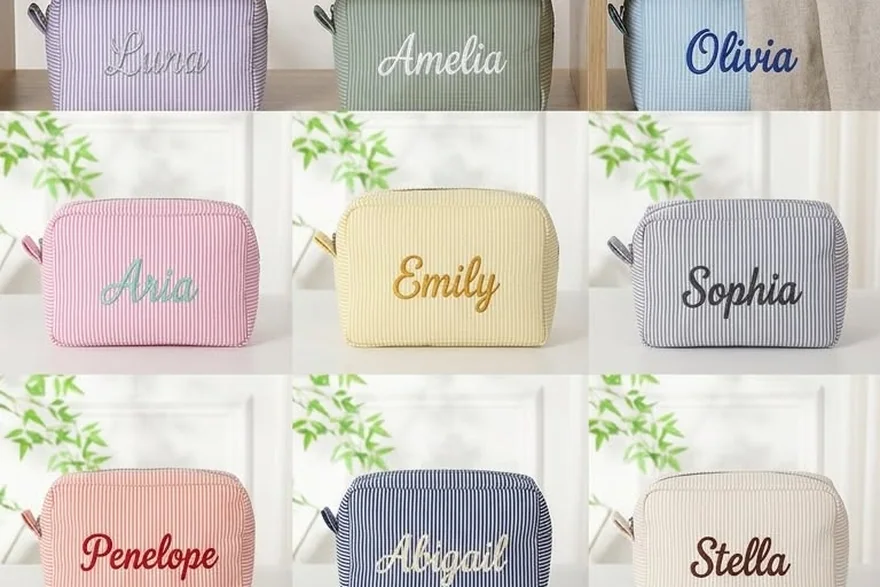
Where a label sits in the anatomy of a finished cosmetic bag
A cosmetic bag carries more printed identity than most buyers expect, and each position has a different job. The brand label is the mark the customer looks for; the composition and care label is a legal statement in most destination markets; the origin label answers customs; the hangtag carries the price and the barcode; and the polybag sticker identifies the carton in a warehouse. Confusing the jobs is what produces a beautiful bag that cannot be scanned at a till.
On a mid-size pouch of 22 x 14 x 8 cm, the brand label usually sits on the interior back panel, centred and 20-25 mm below the zipper tape, or inserted into the left side seam 30-40 mm up from the base. Insertion into a seam is the stronger fix, because the label is caught in the same stitch line as the shell; a label topstitched onto a flat panel can be picked off and leaves needle holes in the lining if it is ever removed. Exterior badges are stitched to the front panel with a 2-3 mm allowance and a bar-tack at each end.
Composition and care information is not optional. In the European Union, textile products must state fibre composition under the Textile Regulation, and in the United States the Textile Fiber Products Identification Act and the Care Labeling Rule require fibre content, an identification number and care instructions. A cosmetic bag made of 600D polyester with a PEVA lining therefore needs a statement such as 'Shell: 100% polyester; Lining: 100% PEVA', plus a registered identification number or the brand name, attached to the product itself and not only to the packaging.
The hangtag attaches where a customer's hand goes first: the zipper puller, a D-ring on the side, or the wristlet loop. Loop length of 90-120 mm suits a peg hook and keeps the tag clear of the bag body in a polybag. Where a bag ships flat-packed for e-commerce, the tag is often attached after de-bagging at the fulfilment centre, so the bag needs a reinforced attachment point that survives a second handling - a metal eyelet of 4 mm or a bar-tacked webbing loop rather than a stitch through the shell.
Label constructions compared: woven, printed satin, heat transfer, badge
Six label constructions cover almost every cosmetic bag programme. They differ in how the mark is made, what it costs, where it can be placed and how it ages. The comparison below uses the specifications a trim mill will ask for, so a buyer can specify rather than describe.
| Construction | Typical specification | Cost per piece | Best position | Watch-out |
|---|---|---|---|---|
| Woven damask | 50-76 denier polyester, 12-50 mm wide, 40-60 picks per cm, up to 8 yarn colours | 0.04-0.10 USD | Interior back panel, side seam | Small text under 2 mm fills in; allow 0.5 mm between letters |
| Printed satin | Polyester satin tape 15-25 mm, rotary or screen print, minimum 6 pt type | 0.02-0.05 USD | Side seam, care and composition | Ink can crock on pale bases; confirm wash fastness before bulk |
| Heat transfer | PU film 60-120 micrometre, pressed at 140-160 C for 10-12 seconds | 0.05-0.12 USD | Lining, interior panel, nylon shell | Cannot be applied over a seam; needs a flat area 5 mm larger than the artwork |
| PU or leather badge | 1.0-1.4 mm PU or split leather, 25-45 mm, stitched | 0.25-0.70 USD | Front panel, wristlet end | Adds bulk at the seam; bar-tack both ends |
| TPU or rubber badge | 2D or 3D moulded, 20-40 mm, stitched or high-frequency welded | 0.35-0.90 USD | Front panel of sporty or neoprene styles | Welding requires a PVC-compatible shell |
| Woven name tape | 10-15 mm tape inserted in a seam, jacquard edge | 0.02-0.04 USD | Side seam, webbing loop | Reads only on one side; specify fold direction |
Selection follows the shell fabric. A woven label is the safest default on any sewn bag because it is caught in a seam and cannot peel; it is also the most legible at small sizes, since damask weave resolves detail that printing cannot. Heat transfer is the answer where the label must not be felt: inside a pouches lining, on a nylon shell where a stitched label would perforate a water-resistant coating, or on a children's item where a sewn label is a scratch risk. A PU or leather badge is a design element as much as a label and should be costed as one.
Compliance sits behind all of it. Labels and trims that sit against skin are normally specified to OEKO-TEX Standard 100, which sets limit values for restricted substances on the finished article, and recycled-content yarns are claimed under the Global Recycled Standard with a transaction certificate per lot. A buyer selling into the EU should also confirm that inks and coatings on the label meet the restriction list in EU REACH.
Artwork discipline saves a sampling round. Vector files in AI or EPS with all fonts converted to outlines, Pantone TCX references for every colour, and a 1:1 print of the label at final size are the minimum proof set. Woven labels are judged at loom-proof stage, where a 2-5 day strike-off costs 15-40 USD and catches the two failures that photographs never show: letters that close up at the weave density chosen, and ground colours that shift because the yarn dye lot differs from the artwork swatch.
Colour matching between a label and the bag is the detail that most often delays a trim order. Woven yarns are dyed to order rather than held in stock, so a brand colour matched to a Pantone TCX reference adds a dyeing step to the first order and should be booked when the bulk fabric is confirmed, not when the artwork is finished. Printed labels are more forgiving because inks can be mixed to the reference, but they still need a strike-off on the production tape.
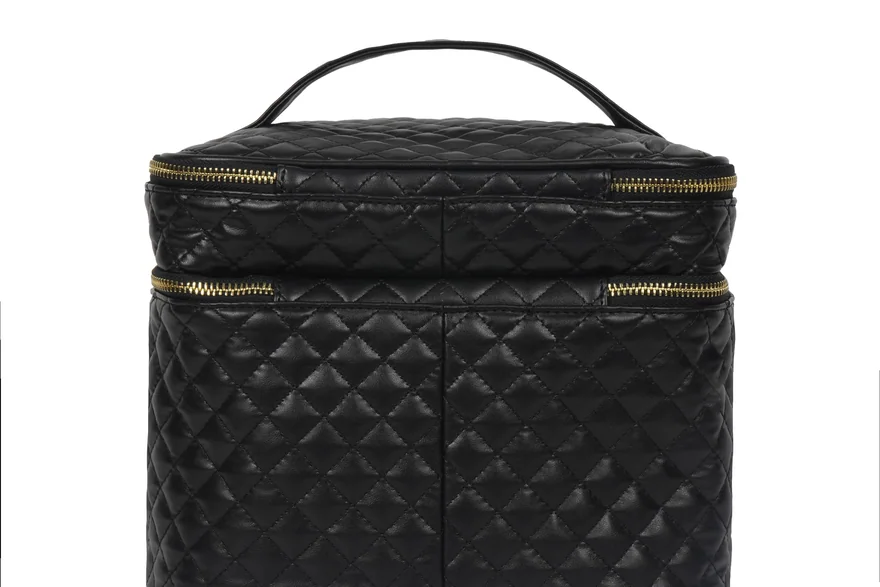
Hangtag engineering: board, finish, string and barcode compliance
A hangtag is a small printed board doing a compliance job. It has to survive the peg hook, the polybag and the returns process; it has to carry a barcode that scans first time; and it has to carry the text the destination market requires. The specification below covers the decisions that determine whether it does.
- Board: 300-400 gsm single-ply art board for lightweight bags, or a 2-ply laminated 600 gsm board for premium lines that must not curl on a hook.
- Size: 45 x 90 mm for a small pouch, 50 x 100 mm for a standard bag, 55 x 110 mm where composition text is long, 70 x 140 mm for a premium vanity case or a set.
- Finish: matte or gloss lamination at 12-25 micrometre, soft-touch coating, spot UV, hot foil, blind emboss; rounded corners at a 6 mm radius reduce dog-earing in transit.
- String and fastener: waxed cotton 1.5-2 mm, jute, or elastic loop at 90-120 mm; plastic swiftach paddle of 25-35 mm or a 4 mm metal eyelet for reinforced attachment.
- Barcode: EAN-13 or UPC-A from a GS1-issued company prefix, printed at 80-200% magnification, x-module 0.264-0.660 mm, quiet zone of 11 modules left and 7 right.
- Legal text: fibre composition, country of origin, care instructions, and the brand name or registered identification number, in the language of the destination market.
- Artwork: 300 dpi at final size, 3 mm bleed, all type converted to outlines, barcodes supplied as vector rather than raster.
Barcode placement is where most retail-ready hangtags fail. The symbol should be printed on the natural bottom of the tag, on a white or very light ground, at least 6.35 mm from any edge, and never over a foil, kraft mottle or a busy image. Verification is not a visual check: a barcode verifier grades the symbol against the ANSI/ISO print-quality method, and a grade of C or better on a 10-point scale is the usual retail acceptance threshold. A tag that scans in the studio but grades F in a verifier will be rejected at the goods-in desk of a national retailer.
E-commerce channels add a second requirement. Amazon FBA accepts a GS1 barcode, but where a brand commingles stock or sells through multiple channels, an FNSKU label applied over the retail barcode is often required; that means the hangtag barcode must sit on a flat area large enough to be over-labelled without covering legal text. QR codes are now common on beauty hangtags and should be at least 20 x 20 mm at 300 dpi with a quiet zone of four modules, printed in black on white for reliable phone scanning.
Packing determines how the tag survives. One bag per polybag of 0.03-0.05 mm with the tag folded flat against the shell, 12-24 bags per inner bundle, then into a master carton of 60 x 40 x 40 cm. Carton gross weight should stay at or below 15 kg for manual handling. Where a tag is attached with a swiftach, the paddle has to be inserted through a reinforced point; inserted through a single layer of lining, it tears out in transit and the bag arrives unlabelled and unsellable at full price.
Cost, artwork approval and QC for label and hangtag programmes
Trim is cheap per piece and expensive to get wrong, because a label defect usually affects the whole lot rather than a few units. Sampling of the labelled bag runs 6-10 working days, or 12-15 working days for complex constructions, and bulk follows 35-50 days after approval. The sequence below is the one a well-run programme follows, with the cost and the failure mode attached to each step.
| Stage | What is fixed | Time and cost | Failure mode |
|---|---|---|---|
| Artwork release | Vector files, outlined fonts, Pantone TCX codes, 1:1 print | 1-2 days, no charge | Type too small to weave or print |
| Loom or strike-off proof | Woven loom sample or printed proof on production stock | 2-5 days, 15-40 USD | Yarn dye lot does not match the artwork swatch |
| Trim compliance file | OEKO-TEX certificate, GRS transaction certificate where claimed | 3-7 days, certificate fees vary | Certificate scope does not cover the trim lot |
| Pre-production sample | Labels sewn and tag attached to a production-spec bag | 6-10 working days; 12-15 complex | Label position drift beyond 2 mm |
| Barcode verification | Verifier grade against the ANSI/ISO method | 1 day, 20-50 USD | Grade below C after lamination |
| Bulk production | Labels and tags applied on the line | 35-50 days after approval | Wrong label applied to the wrong colourway |
| Final inspection | AQL 2.5 under ISO 2859-1 | 1-2 days at 80-100% packed | Compliance text error found after packing |
| Shipment | FOB Xiamen; T/T 30 deposit, 70 against bill of lading | Balance on documents | Carton marking does not match the packing list |
Defect classification for trim is straightforward once written down. A wrong brand label, a missing composition label, an illegible barcode or any error in the compliance text is a major defect, because the piece cannot legally be sold or cannot be scanned. A label placed 2-4 mm outside the position marked on the tech pack, a crooked tag, or a minor crease on the hangtag is a minor defect. Counter-sample discipline matters too: the approved pre-production bag, with its label and tag attached, is the reference the inspector compares against.
Ordering volumes need a word of arithmetic. Label mills and print houses quote their own minimums, commonly 1,000-3,000 pieces per label design, because a loom set-up or a print plate is not economic below that. The bag programme itself carries a minimum of 500 pieces per style and colourway, so a first buy consumes part of the trim order and the surplus is warehoused flat at 20-25 C away from UV for the reorder. Buyers planning a second colourway should therefore double the label order, not place two separate ones.
A hangtag is removed by the customer within minutes of purchase, and in e-commerce it is often removed before the photograph is taken. Fibre composition, country of origin and care instructions should therefore be repeated on a permanent label sewn into the bag. Retailers and marketplaces increasingly check for that permanent label during onboarding.
When a trim error is found after packing, the cost is no longer the price of a label. Re-labelling a packed lot means opening cartons, opening polybags, applying a corrected label or tag and repacking, which costs 0.15-0.40 USD per piece and adds 3-8 days. That is why the composition text and the barcode are worth proofing twice, and why the approved trim layout should be signed before bulk starts rather than after it ends.
The B2B Customisation View
Cost, compliance and craft pull against each other on every cosmetic pouches, vanity cases and beauty organisers project; the specification is the record of how those three forces were balanced.
Commercial parameters stay fixed across the range: MOQ 500 pieces per style and colourway, prototype turnaround 6–10 working days (extended to 12–15 for multi-panel or moulded builds), bulk lead time 35–50 days from approved sample, AQL 2.5 inspection to ISO 2859-1, FOB Xiamen, T/T 30 deposit and 70 against bill of lading.
Buyers who use a programme coordinator keep their own supply-chain optionality; the technical pack travels, so production can be re-placed if a launch is brought forward.
Which Brand Types Benefit Most
Start-up brands should spend on one good woven label and a clean two-colour hangtag rather than on a leather badge; at 500 pieces per style and colourway, a 0.70 USD badge adds 350 USD to a first buy that would be better spent on photography. Established brands benefit from a trim library: one woven label size, one care-label layout and one hangtag die-line reused across every SKU, so that only the colourway and barcode change between seasons. Retailers running private label need the barcode and compliance text right above all else, because a scanning failure at goods-in costs more than the margin on the bag. E-commerce sellers should specify a hangtag that survives being photographed, opened and resealed, and should confirm the FNSKU over-label area before the die-line is cut. Gift and hospitality buyers use the hangtag as the message card, so a 70 x 140 mm folded tag with a writable inside panel often replaces a separate greeting card and removes a packing step. Trim is the one part of a bag programme where ordering ahead saves money rather than tying it up. Because the bag minimum is 500 pieces per style and colourway, a label or hangtag ordered once at the trim mill's own minimum can cover two or three seasons of reorders, and the unit price falls as the run lengthens. The discipline that makes it work is a fixed artwork: a brand that changes its logo lock-up every season pays for fresh tooling and fresh minimums each time.
- Start-up brands: one woven label, one hangtag die-line, no leather badge on the first buy.
- Established brands: a trim library with fixed sizes and layouts reused across the catalogue.
- Retailers: GS1 prefix, verified barcode, permanent composition label on the bag itself.
- E-commerce sellers: FNSKU over-label area reserved on the tag artwork before printing.
- Gift and hospitality buyers: oversized folded hangtag doubling as the message card.
Frequently Asked Questions
Where should the brand label be placed on a custom cosmetic bag?
The interior back panel, centred and 20-25 mm below the zipper tape, is the most common position; insertion into the left side seam 30-40 mm from the base is stronger because the label is caught in the shell stitch line. Front-panel badges are stitched with a 2-3 mm allowance and bar-tacked at both ends. The tech pack should dimension the position, not describe it.
What is the difference between a woven label and a printed satin label?
A woven label is made on a jacquard loom from dyed polyester yarns at 40-60 picks per cm, so the design is part of the fabric and will not wash out. A printed satin label is ink on a smooth tape, which allows photographs and very fine type but can crock or fade. Woven suits brand marks; printed satin suits long care and composition text.
Are heat-transfer labels durable inside a lined cosmetic bag?
A PU heat-transfer film of 60-120 micrometre pressed at 140-160 C for 10-12 seconds bonds well to polyester lining and survives normal use, including gentle hand washing at 30 C. It fails when applied over a seam, on a silicone-finished fabric, or with insufficient pressure. A 20-cycle wash test on the pre-production sample is the standard screen. Transfers also remove the scratch risk of a sewn label, which matters on a bag sold for children.
What size hangtag suits a 20 cm cosmetic bag?
A 50 x 100 mm tag is proportionate for a bag of that size, with 55 x 110 mm used where composition text is long or two languages are required. Anything smaller crowds the barcode; anything larger overhangs the shelf edge and catches on adjacent stock. Corner radius of 6 mm reduces dog-earing in the polybag. A folded tag of the same footprint works where the brand message needs more than one panel.
Which board weight keeps a hangtag from curling on a peg hook?
A single-ply 350-400 gsm art board with matte lamination holds flat for a standard bag. Where a tag must hang on a peg for months under retail lighting, a 2-ply laminated board of 600 gsm is safer. Board grain should run vertically, parallel to the hanging direction, or the tag curls along the grain within days. Matte lamination on both faces also helps, because a single-sided lamination pulls the board towards the coated side.
How is a barcode verified before a retail-ready hangtag goes to press?
A proof is printed on the production stock with the production finish and then graded on a barcode verifier against the ANSI/ISO print-quality method. The usual acceptance threshold is grade C or better. Lamination, spot UV and foil can each change the contrast, so verification must happen after finishing, not on the raw press sheet. Verifier reports should be kept on file, since retailers often ask for one during onboarding.
Does a hangtag need a country-of-origin statement?
Yes for customs clearance in most markets, and in the United States the origin must also appear on the product. The safest arrangement is to print origin on the hangtag and repeat it on a permanent label sewn into the bag, because a hangtag is discarded by the end customer and cannot be relied on at a border inspection.
What fibre-content information must a cosmetic bag label carry?
The label must state the fibre composition of the shell and lining by percentage, using the fibre names recognised in the destination market, for example 'Shell: 100% polyester; Lining: 100% PEVA'. In the United States it must also carry a brand name or registered identification number. Printing this only on the packaging is not sufficient. Percentages are normally given to the nearest whole number, with any component below 5 per cent named separately.
How much does a custom woven label add per bag?
A woven damask label of 25-40 mm typically adds 0.04-0.10 USD per bag depending on width, yarn colours and quantity. A printed satin care label adds 0.02-0.05 USD, a heat transfer 0.05-0.12 USD and a stitched PU badge 0.25-0.70 USD. On a bag in the 0.45-12.00 USD band, trim of this order is a small share of unit cost.
Can a leather or PU badge be stitched onto a nylon cosmetic bag?
Yes. A PU badge of 1.0-1.4 mm is stitched through the nylon shell with a 2-3 mm allowance and bar-tacked at both ends, and the needle holes are acceptable on uncoated nylon. On a silicone-coated or water-resistant nylon, stitching perforates the coating; a high-frequency welded TPU badge is the alternative, provided the shell is PVC-compatible. A badge also stiffens the panel it sits on, which should be checked on a sample before the position is fixed.
What string and fastener hold a hangtag through e-commerce fulfilment?
A waxed cotton or jute loop of 90-120 mm through a 4 mm metal eyelet, closed with a plastic swiftach paddle of 25-35 mm, survives both retail handling and a fulfilment centre. The eyelet must be set through a reinforced point such as a webbing loop or a bar-tacked tab; through a single layer of lining it tears out in transit.
Can the same hangtag serve Amazon FBA and a retail shelf?
It can, provided the artwork reserves a flat white area beside the retail barcode for an FNSKU over-label, and that the over-label does not cover composition or origin text. The symbol itself should be printed at 80-200% magnification with a full quiet zone so that it grades C or better after lamination. Where both channels are planned from the start, printing two symbols on the tag avoids over-labelling altogether.
How many spare labels should a 500-piece bag order include?
A label run is governed by the mill minimum rather than by the bag order, so a 500-piece buy usually draws on a larger quantity and the surplus is warehoused flat for reorders. Within the packing operation itself, a 3-5% trim allowance covers application losses, misprints and the pieces retained as reference samples. Labels should be stored flat and dry, since heat-transfer film loses adhesion once it has absorbed moisture.
What artwork file format do label mills require?
Vector files in AI or EPS with all fonts converted to outlines, Pantone TCX references for each colour, and a 1:1 print at final size. Barcodes should be supplied as vector at the correct magnification rather than as images. Raster artwork below 300 dpi at final size will not weave or print cleanly and adds a sampling round.
How is label placement checked during AQL 2.5 inspection?
Inspectors measure the label position against the dimensioned tech pack and count drift beyond 2 mm as a minor defect. A wrong label, a missing composition label, an illegible barcode or any error in the compliance text is a major defect and counts against the AQL 2.5 accept number, because the piece cannot be sold or scanned. A dimensioned tech pack is what makes that measurement possible, so label position should be drawn rather than described.
Can recycled-content labels be certified for a cosmetic bag programme?
Yes. Recycled polyester yarns for woven labels and recycled board for hangtags are claimed under the Global Recycled Standard, with a transaction certificate covering the specific lot. Buyers should request the certificate before artwork release and check that its scope covers trims, not only shell fabric, or the claim will fail at a brand audit. Hangtag board is covered by a separate certificate, so a recycled claim needs two documents rather than one.
People Also Ask
What is the cheapest label for a custom makeup bag?
A printed satin label is the cheapest at 0.02-0.05 USD per piece, and it is the sensible choice for long care and composition text. A woven damask label costs 0.04-0.10 USD and is preferred for the brand mark because it will not crock or fade. Both are far cheaper than a stitched PU or leather badge at 0.25-0.70 USD. Both are far cheaper than adding a second print pass to the bag itself.
Do you need a barcode on a hangtag?
Any bag sold through a scanned retail till or a marketplace warehouse needs a scannable EAN-13 or UPC-A symbol printed on the hangtag or on the polybag. The prefix must come from a GS1 member allocation, not a generated number. Direct-to-consumer brands selling only through their own site can omit it, though most add it later. Marketplace fulfilment centres will not receive stock without one.
What is a care label?
A care label is the permanent label inside a product that states fibre composition, care instructions and origin. On a cosmetic bag it is usually a printed satin label sewn into a side seam, because a hangtag is removed by the customer. Markets including the EU and the US require this information to appear on the product itself. It is normally the last label a customer reads and the first one a regulator looks for.
Can a hangtag be recycled with the box?
An uncoated paper hangtag can go into paper recycling once the string and any plastic fastener are removed. Laminated, foiled or soft-touch coated tags are generally not recyclable in a paper stream. Brands pursuing plastic-free packaging usually move to an uncoated recycled board tag with a paper string and no lamination. A paper string and no lamination put the whole tag into one recycling stream.
Request a Sample or a Written Quotation
Send the silhouette, dimensions, material preference and logo artwork, and the programme team will return a written quotation with MOQ, sampling window, bulk lead time and inspection standard.
Email: service@junyuanbags.com · WhatsApp: +86 177 5002 0688