Cost Breakdown of a Custom Cosmetic Bag: Material, Labor, Overhead
Executive Summary
The cost of a custom cosmetic bag is a five-part sum: direct material at 45-60% of the FOB price, direct labour at 18-28%, factory overhead at 12-20%, packaging at 3-7%, and margin at 8-15%. Those bands are illustrative planning ranges, but the shape is consistent, and it tells a buyer where negotiation can work. Material dominates, so fabric and hardware choices move the number most; labour is driven by the number of operations in the construction; and overhead plus set-up are what make low quantities disproportionately expensive.
A 22 x 14 x 8 cm bag with a 600D polyester shell, a 210T lining, a #5 nylon coil zipper, a one-colour screen print and a polybag typically lands near 2.85 USD FOB Xiamen at 2,000 pieces. Changing the shell to 900D with a TPU coating adds about 0.44 USD; adding a 350 gsm retail box adds about 0.63 USD; and moving the logo to an embossed PU patch adds about 0.33 USD. Fixed set-up adds 0.12-0.28 USD per piece at 500 pieces and 0.012-0.028 USD at 5,000 pieces, which is why the 500-piece minimum per style and colourway prices so differently from a 5,000-piece run.
How a cosmetic bag price is assembled
Every custom bag quote, whatever its final number, is built from the same five blocks. Direct material covers the shell, lining, zippers, webbing, binding, interlining, thread and any logo application. Direct labour covers the minutes spent cutting, printing, sewing, turning, binding, inspecting and packing. Factory overhead covers machinery depreciation, utilities, compliance and audit costs, testing, quality staff, and the waste and rework that every cutting room produces. Packaging covers the polybag, the carton and any retail presentation. Margin is what remains.
The proportions are informative rather than fixed. On a simple flat pouch with no structure, material can reach 65% and labour fall to 12%, because there are only four operations. On a structured vanity case with a moulded shell, bound internal seams, an elastic organiser grid and a metal frame, labour can reach 35% and material fall to 45%, because the shell is bought in but the assembly is long. Knowing which category the bag falls into tells a buyer which lever to reach for.
There is also a sixth line that rarely appears on a quote and always appears in reality: fixed cost per order. Set-up, pattern making, a sample round, screen making for each print colour, a cutting die, and any tooling charge are incurred once regardless of quantity. Spread across 500 pieces they add roughly 0.30-1.00 USD per bag; across 5,000 pieces they add 0.03-0.10 USD. This single line explains most of the gap between the 500-piece price and the 5,000-piece price.
What the buyer pays, of course, is not the FOB cost. On top of a 2.85 USD FOB Xiamen price sit freight, duty, inspection at AQL 2.5 under ISO 2859-1, inland delivery and the cost of capital across the 6-10 working days of sampling and 35-50 days of bulk production. Cost breakdowns are still worth doing at FOB level, because that is the level at which specification decisions are made; the landed calculation belongs on a separate sheet with the buyer's own rates.
The material lines: a bill of materials for a 22 x 14 x 8 cm bag
The clearest way to read a bag quote is to rebuild it as a bill of materials. Take a mid-market cosmetic bag of 22 x 14 x 8 cm: a structured pouch with a 600D polyester shell, a full 210T lining, a #5 nylon coil zipper across the top and down one side, a 25 mm webbing wrist strap, bound internal seams, one screen-printed logo and a polybag in a 5-ply carton holding 50 pieces. Nine material lines appear, and each has its own cost driver.
| Component | Typical specification | Consumption per piece | Share of material cost | Main cost driver |
|---|---|---|---|---|
| Shell fabric | 600D polyester with PU coating, 210-260 g/m² | 0.28-0.36 m² | 30-40% | Denier, coating weight, certification such as GRS |
| Lining | 210T polyester taffeta, 55-65 g/m² | 0.30-0.38 m² | 10-14% | Colour, print registration, stain resistance |
| Main zipper | #5 nylon coil, 55-60 cm tape length, metal-look puller | 1 piece | 8-14% | Tape and slider brand, puller finish, custom colour |
| Binding and piping | 20 mm polyester bias binding, 1.6-2.2 m | 1.6-2.2 m | 5-8% | Width, matched shade, application length |
| Interlining or foam | 2-3 mm EVA or needle-punched non-woven | 0.25-0.32 m² | 6-10% | Thickness, density, whether it is laminated |
| Logo application | One-colour screen print or PU patch, 60 x 25 mm | 1 application | 5-12% | Number of colours, plate making, Pantone matching |
| Webbing handle | 25 mm polyester webbing, 18-22 cm | 1 piece | 3-5% | Width, weave density, custom dye |
| Thread and small parts | 40s/2 polyester thread, elastic loops, label | 90-140 m of thread | 4-7% | Stitch density at 7-9 stitches per inch |
| Polybag and carton | PE polybag, 5-ply export carton, 50 pieces | 1/50 of a carton | 4-9% | Carton grade, print, pieces per carton |
Two specification habits make these lines comparable between quotes. First, name the coated fabric by performance rather than by nickname: ASTM D751 test methods for coated fabrics give a shared vocabulary for coating adhesion, hydrostatic resistance and low-temperature behaviour, so two quotes for "PU leather" become two quotes for the same thing. Second, name the zipper by size and type: the terminology in ASTM D2053 zipper terminology separates a #3 from a #5 and a coil from a metal chain, which is a cost difference of 0.08-0.35 USD per bag.
Waste is the hidden tenth line. Cutting a 22 x 14 x 8 cm bag from 150 cm-wide roll goods typically yields 82-90% marker efficiency, depending on how the panels nest, and a printed or striped fabric drops that to 70-78% because the pattern must be matched across panels. On a shell costing 0.95 USD per bag at perfect yield, a 10% loss adds 0.095 USD. Buyers rarely see this line, but it is why a small artwork change that re-orients the pattern pieces can move the price.
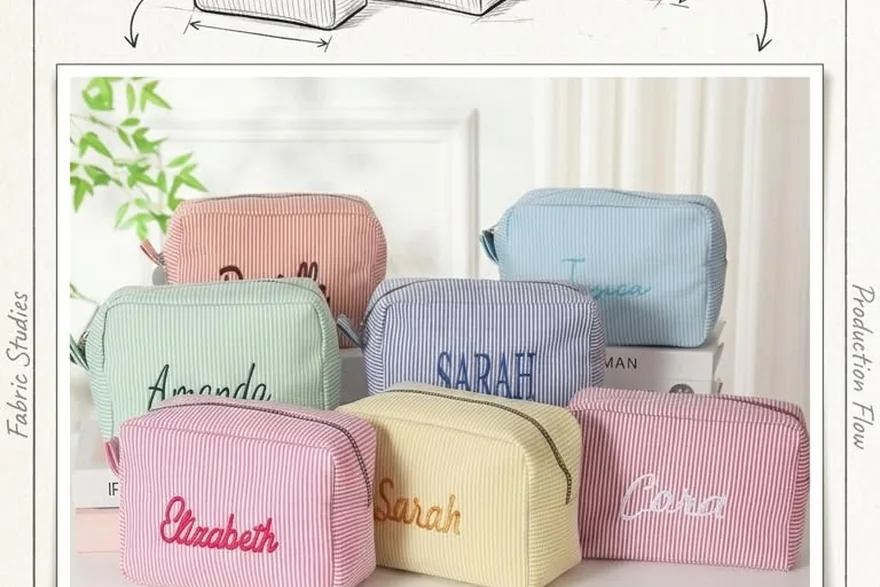
Two further lines appear on some programmes and are worth anticipating. A wipe-clean coated lining costs 0.10-0.25 USD more than a 210T taffeta but reduces returns on pale colourways, and a metal frame or structured insert adds 0.30-0.90 USD plus two or three extra operations. Neither is visible in a photograph, which is why a bill of materials rather than a picture is the correct basis for comparing two quotes.
Labour minutes and overhead absorption
Direct labour on a bag is measured in standard minutes, and the total is remarkably predictable. The operations stack in a fixed order: cut, print and dry the logo, set the zipper, assemble the lining, close and turn, bind the internal seams, then inspect and pack. A mid-complexity cosmetic bag comes to roughly 9.3 standard minutes. At an illustrative loaded rate of 0.06-0.10 USD per minute, that is 0.56-0.93 USD of direct labour per piece, before any rework.
| Operation | Standard minutes | Share of labour | Notes on the driver |
|---|---|---|---|
| Cutting | 0.6 | 6% | Rises to 1.4 if panels are pattern-matched or hand-cut |
| Logo print and drying | 0.9 | 10% | Adds 0.5-0.7 minutes per extra print colour |
| Zipper setting | 1.8 | 19% | Longest single operation; rises with a gusseted zipper path |
| Lining assembly | 2.4 | 26% | Rises to 4.0 with pockets, elastic loops or a divider |
| Closing and turning | 1.2 | 13% | Higher on structured bags with foam or EVA |
| Internal binding | 1.6 | 17% | Bound seams cost roughly double what overlocked seams do |
| Inspection and packing | 0.8 | 9% | Flat-pack versus stuffed packing changes carton volume |
Overhead is where the less visible costs live, and it is typically 12-20% of the FOB price. It is absorbed across the month's output, so the share allocated to any one bag depends on how busy the floor is. A buyer who schedules in a quiet month is, in effect, buying cheaper overhead, which is one reason off-peak timing produces better quotes than hard bargaining.
| Overhead line | Indicative share of unit cost | What moves it |
|---|---|---|
| Machinery depreciation and maintenance | 3-5% | Utilisation rate; 149 machines across 7 lines only cost less per piece when they run |
| Compliance, audits and social accountability | 1-3% | Buyer-mandated audits, corrective actions, documentation |
| Testing and certification | 1-4% | Third-party test count, REACH or OEKO-TEX evidence, GRS transaction certificates |
| Quality staff and in-line checking | 1-2% | AQL level, inspection frequency, defect rate |
| Waste and rework | 2-4% | Marker efficiency, fabric faults, operator turnover |
| Utilities and consumables | 1-2% | Energy cost, needles, machine oil, packing tape |
Two overhead lines deserve a buyer's attention because they are negotiable in effect. Testing cost scales with the number of tests requested: a bag going into the EU with a REACH statement, an OEKO-TEX Standard 100 certificate for skin contact and a full colour-fastness panel carries a different test budget from one going into a domestic market with none. Rework cost scales with the agreed quality standard: inspection at AQL 2.5 under ISO 2859-1 sets a shared definition of acceptable and keeps the line stable.
Labour cost also varies with how a bag is packed. Flat-packing takes about 0.5 minutes per piece; stuffing with tissue to hold shape in a retail box takes 0.8-1.1 minutes and increases carton volume by 15-30%. On a 2,000-piece order that is roughly 10-20 additional labour hours plus freight on the larger carton, which is why packing method belongs in the cost conversation rather than in a footnote. Rework deserves its own line in any honest model: a first-pass yield of 94-97% is typical on a mid-complexity bag, and each percentage point of rework costs both the labour to repair it and the material to replace it.
A worked model: what each specification change does to the same bag
The value of a cost breakdown is that it turns a vague conversation about price into an arithmetic one. Starting from the 22 x 14 x 8 cm bag described earlier at 2.85 USD FOB Xiamen and 2,000 pieces, four specification changes can be costed line by line. None of them alters the shape of the bag; all of them are decisions a brand owner makes for commercial reasons, and each has a measurable price.
| Scenario | Change from baseline | Material effect per piece | Labour effect per piece | Indicative unit price |
|---|---|---|---|---|
| Baseline | 600D polyester, one-colour print, polybag, 2,000 pieces | — | — | 2.85 USD |
| A | Shell upgraded to 900D with TPU coating | +0.42 USD | +0.02 USD | 3.29 USD |
| B | Retail box added, 350 gsm, printed | +0.48 USD | +0.15 USD | 3.48 USD |
| C | Logo changed to an embossed PU patch | +0.22 USD | +0.11 USD | 3.18 USD |
| D | All three changes together | +1.12 USD | +0.28 USD | 4.25 USD |
| E | Baseline specification but 500 pieces | +0.00 USD | +0.00 USD | 3.05-3.15 USD |
Scenario E is the one that surprises buyers. The bag is identical; only the quantity changed. At 2,000 pieces the fixed set-up of 60-140 USD adds 0.03-0.07 USD per bag; at 500 pieces it adds 0.12-0.28 USD, and material is bought at less favourable terms because a dye lot or coating run has a minimum. That is the arithmetic behind the 500-piece-per-style-and-colourway minimum, and it is why consolidating three colourways of 500 into one of 1,500 saves more than any discount negotiation.
All prices, minutes and percentages in this article are illustrative planning ranges for a mid-market construction, not quotations. Actual figures move with fabric markets, order quantity, hardware choice, print colour count, carton specification and season. Buyers should use the structure to interrogate a real quote line by line rather than to predict a number, and should confirm each figure against a written tech pack.
The last step is to place the FOB figure into a landed model. Add sea freight per cubic metre, duty at the applicable HS rate, inspection at AQL 2.5, inland delivery and the cost of capital across the 35-50 day bulk window plus transit. A 0.15 USD FOB saving on a bag packed 40 to a carton can be wiped out by a carton that is 20% larger, because freight is charged on volume. The breakdown is only useful if it is read all the way to the warehouse.
The same model read backwards becomes a design tool. A buyer with a retail price of 19.99 USD and a channel margin requirement can work backwards through duty, freight, inspection and marketplace fees to a maximum landed cost, and from there to a maximum FOB figure. On a typical direct-to-consumer structure that lands somewhere near 3.40-4.20 USD, which immediately rules out a moulded shell, a metal frame or custom-dyed hardware, and points towards a 600D shell with a single print colour and a polybag. That is the real value of a cost breakdown: it converts a budget into a specification. Rather than asking what a bag costs, the buyer asks which specification fits the budget, and the answer is a set of decisions, each with a price attached and each reversible before the specification freeze.
The B2B Customisation View
The route from concept to shelf for makeup bags and toiletry bags is short when the specification is tight at the start, and painfully long when it is not.
Fixed commercial parameters: 500 pieces per style and colourway minimum, first sample in 6–10 working days (12–15 for complex or hardware-intensive constructions), bulk 35–50 days after approval, AQL 2.5 inspection under ISO 2859-1, FOB Xiamen, T/T 30/70.
The role played here is programme coordinator: QUANZHOU JUNYUAN BAGS translates a retail brief into a factory-ready technical pack and then audits the output against it before goods leave the floor.
Which Brand Types Benefit Most
A cost breakdown is useful in direct proportion to how specific the buyer's own question is. A start-up brand usually needs to know the minimum viable specification, so the labour table and the fixed-cost line matter most: which operations can be dropped to reach a target price without the bag looking cheap. An established brand already knows its price point and needs stability, so the overhead and testing lines matter more. Retailers and e-commerce sellers care about the packaging and carton lines, because those drive both shelf presentation and freight. Cost transparency also changes the conversation. A buyer who understands that a 500-piece run carries 0.12-0.28 USD of fixed set-up per bag stops asking for a discount and starts asking whether the next colourway can be consolidated into the same run, which is usually a larger saving and a smaller argument. The second habit worth forming is asking for the quote to be rebuilt as a bill of materials, because that is the only way to compare two suppliers honestly.
- Start-up brands: strip operations before stripping material. Removing internal binding or a divider saves 1.4-2.4 standard minutes, while a thinner shell saves little and reads as cheap.
- Established brands: cost the test and certificate budget as a recurring annual line rather than a per-order surprise, and lock fabric specifications so quotes stay comparable between seasons.
- Retailers: focus on the packaging line and pieces per carton; a 350 gsm box adds 0.35-0.70 USD and a poorly sized carton adds freight on every shipment.
- E-commerce sellers: model landed cost including return rates and marketplace fees; a 0.10 USD material saving rarely survives a 2% change in return rate.
- Gift and hospitality buyers: cost the calendar. Off-peak slots avoid the 3-8% seasonal premium on material and freight, which is often larger than any line-item saving.
- Wholesalers and distributors: cost the annual framework rather than the individual order, because tooling amortised across 20,000 pieces a year is close to free.
Frequently Asked Questions
What percentage of a cosmetic bag cost is material versus labour?
Material typically accounts for 45-60% of the FOB price and direct labour 18-28%, with factory overhead at 12-20%, packaging at 3-7% and margin at 8-15%. A simple flat pouch sits at the material-heavy end because it has only four operations; a structured case with bound internal seams and a divider can reach 35% labour. These are planning ranges, not quotations.
How much does a zipper add to the cost of a makeup bag?
The zipper is usually the largest single trim line at 8-14% of material cost, roughly 0.20-0.45 USD on a mid-market bag. Size drives it: a #3 coil zipper costs less than a #5, and a metal chain costs more again. A custom tape colour adds 15-25 days of lead time and a dye-lot surcharge, while a custom puller adds a tooling charge of 150-400 USD amortised over the run.
Why does a 500-piece order cost more per piece than a 2,000-piece order?
Because fixed costs do not scale down. Set-up of 60-140 USD, pattern making, screen making and any tooling charge are incurred once: at 500 pieces they add 0.12-0.28 USD per bag, at 2,000 pieces only 0.03-0.07 USD. Material buying is also less favourable at low volume, since dye lots and coating runs carry their own minimums regardless of how many bags are cut.
How many standard minutes does it take to sew a cosmetic bag?
A mid-complexity pouch runs about 9.3 standard minutes: 0.6 cutting, 0.9 logo print, 1.8 zipper setting, 2.4 lining assembly, 1.2 closing and turning, 1.6 internal binding and 0.8 inspection and packing. Adding an internal divider or elastic organiser grid adds 1.4-2.4 minutes. At an illustrative 0.06-0.10 USD per minute, the baseline is 0.56-0.93 USD of direct labour.
What does overhead include in a bag factory cost model?
Machinery depreciation and maintenance at 3-5% of unit cost, compliance and audit costs at 1-3%, testing and certification at 1-4%, quality staff at 1-2%, waste and rework at 2-4%, and utilities and consumables at 1-2%. It is absorbed across monthly output, so a floor running near capacity allocates less to each bag than one running at half capacity, which is one reason quieter months quote better.
How much does packaging add to a custom cosmetic bag?
Packaging is typically 3-7% of the FOB price. A PE polybag costs 0.06-0.14 USD; a printed 350 gsm retail box costs 0.35-0.70 USD and adds about 0.15 USD of packing labour; a header card or belly band sits between the two. The second effect is freight: pieces per carton determines cubic volume, so a box that doubles carton volume can cost more in freight than it does in board.
Does a custom Pantone colour increase the unit cost?
Yes, mainly through material minimums. A lab dip costs 15-40 USD per shade per round and a custom dye lot carries a fabric minimum, often 300-800 m, which at 500 pieces adds roughly 0.05-0.25 USD per bag. Above about 5,000 pieces the surcharge approaches zero because the lot is amortised across the run. Stock colours on the shell, lining, binding and thread avoid all of it.
How much does an extra print colour cost per bag?
Typically 0.04-0.12 USD per piece at 500 pieces, made up of a screen charge of 15-30 USD per colour and an extra print pass of about 0.5-0.7 standard minutes. The screen charge is fixed, so the per-piece effect falls sharply with quantity: the same second colour adds under 0.02 USD at 5,000 pieces. Four-colour process printing removes the per-colour logic but adds a plates and registration cost.
What is cutting waste and how does it affect price?
Cutting waste is the fabric lost between the marker and the roll. A 22 x 14 x 8 cm bag nested from 150 cm roll goods typically yields 82-90%; a striped, printed or direction-matched fabric drops that to 70-78% because panels must be aligned. On a shell costing 0.95 USD at perfect yield, a 10% loss adds 0.095 USD. It is invisible on a quote and significant on a large run.
How much does an internal divider or organiser grid add?
A simple divider panel adds about 1.4 standard minutes and 0.08-0.18 USD of material; an elastic organiser grid with six to ten loops adds 2.0-2.4 minutes and 0.15-0.30 USD. On a bag at 0.06-0.10 USD per labour minute, that is 0.12-0.24 USD of labour on top of the material. It is one of the most expensive interior features relative to how little buyers notice it in a quote.
Why do two quotes for the same photo differ by 30%?
Because a photograph is not a specification. Differences in shell denier, coating weight, lining weight, zipper size and brand, stitch density, binding method and carton grade routinely produce a 30% spread on the same-looking bag. Rebuilding both quotes as a bill of materials, with coated fabric specified against ASTM D751 and zippers named by size and type, collapses the spread to a real difference.
How does EVA or foam interlining change the cost?
Interlining is 6-10% of material cost, roughly 0.17-0.35 USD on a mid-market bag, and it drives labor too. A 2-3 mm EVA laminated to the shell adds about 0.05-0.12 USD in material and 0.3-0.6 standard minutes in closing and turning, because a stiffened panel is slower to manipulate. Moulded EVA shells are a different construction entirely and carry a tooling charge plus a longer sample window.
What is the labour cost per minute used in bag costing?
An illustrative loaded rate of 0.06-0.10 USD per minute covers wages plus employment overhead on a typical export floor. That puts the 9.3-minute baseline bag at 0.56-0.93 USD of direct labour. Rates vary by region, by skill mix and by season, and skilled operations such as zipper setting on a gusseted path are usually performed by higher-paid operators, so the effective rate rises with construction complexity.
Does inspection cost appear in the unit price?
Usually as part of overhead at 1-2%, not as a separate line. The buyer's own third-party inspection is a separate cost borne by the buyer, typically 200-350 USD per man-day, and inspection at AQL 2.5 under ISO 2859-1 on a 2,000-piece order draws 125 pieces. Tightening to AQL 1.0 roughly doubles the sample size and the sorting time, which is a legitimate cost increase rather than a concession.
How should a buyer use a cost breakdown in a price negotiation?
Ask for the quote to be rebuilt line by line against a frozen tech pack, then negotiate the lines rather than the total. The productive lines are packaging, print colour count, interlining thickness, consolidation of colourways to raise quantity, and substitution of the shell fabric. The unproductive ones are inspection level, compliance testing and material documentation, where a small saving buys an unbounded risk.
People Also Ask
What is the cost to manufacture a cosmetic bag?
A mid-market custom cosmetic bag of 22 x 14 x 8 cm with a 600D shell, full lining, #5 zipper and one print colour typically lands near 2.85 USD FOB Xiamen at 2,000 pieces, and 3.05-3.15 USD at the 500-piece minimum per style and colourway. Marketplace listings span roughly 0.45-12.00 USD per piece, with the spread driven by specification rather than by efficiency.
Why is labour such a large share of bag cost?
Bag assembly has resisted automation because fabric panels are limp and vary slightly in size. A mid-complexity pouch still needs about 9.3 standard minutes of human work across cutting, printing, zipper setting, lining assembly, closing, binding and packing. Operations that add interior features, such as a divider or an elastic grid, add 1.4-2.4 minutes each, which is why labour reaches 35% on structured cases.
What is overhead in garment and bag manufacturing?
Overhead is everything not traceable to one unit: machinery depreciation and maintenance, utilities, compliance and audit costs, testing and certification, quality staff, waste and rework, and consumables. In bag programmes it runs 12-20% of the FOB price and is absorbed across monthly output, so a floor near capacity allocates less per bag than an under-used one. Buyers should confirm the figure against their own written specification before relying on it, since programmes differ by construction, quantity and season.
How do I calculate landed cost for a bag order?
Start from FOB Xiamen, then add sea freight per cubic metre, duty at the applicable HS rate, third-party inspection, inland delivery and the cost of capital across the 35-50 day production window plus transit. Freight is charged on volume, so pieces per carton matters as much as unit price. Buyers should build one sheet with their own rates and compare suppliers on landed cost per piece.
Request a Sample or a Written Quotation
Send the silhouette, dimensions, material preference and logo artwork, and the programme team will return a written quotation with MOQ, sampling window, bulk lead time and inspection standard.
Email: service@junyuanbags.com · WhatsApp: +86 177 5002 0688