Cosmetic Bags for College Students: Dorm & Campus Use
Executive Summary
Cosmetic bags for college students are defined by the dorm bathroom rather than by the student. A shared, damp, high-traffic washroom with limited shelf space and no personal storage forces a specific set of requirements: the bag has to hang, drain, dry within hours, carry in one hand alongside a towel, and occupy a footprint small enough for a shared shelf or a shower rail. A pouch designed for a bedroom vanity fails that environment within the first week of term.
The commercial window is equally specific. Demand concentrates in the move-in weeks before term begins, which means a buyer briefs in the spring for an autumn delivery: sampling takes 6 to 10 working days for a soft build and 12 to 15 for complex constructions, bulk runs 35 to 50 days after approval, and freight and clearance sit on top. Programmes start at 500 pieces per style and colourway, are inspected to AQL 2.5 under ISO 2859-1, and ship FOB Xiamen on T/T 30 deposit and 70 against bill of lading.
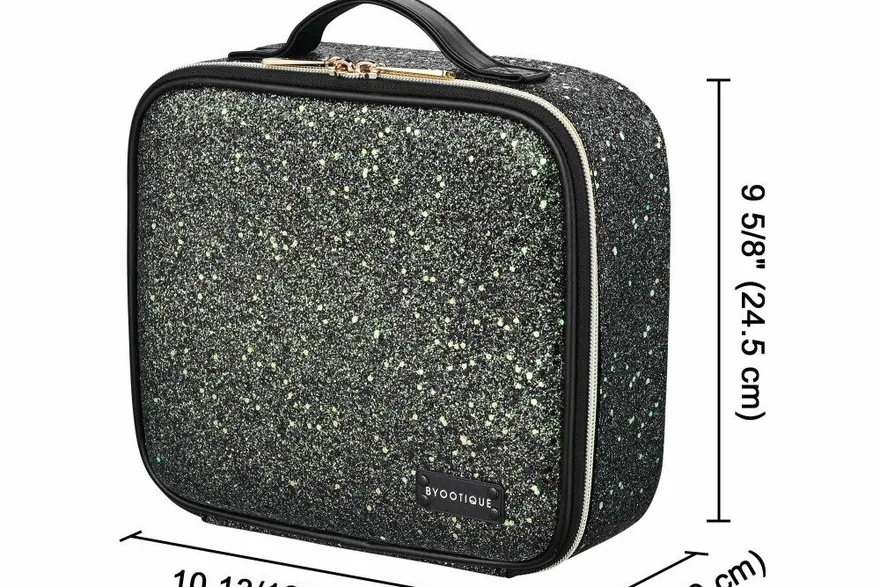
The dorm use case: a shared bathroom with no shelf of its own
A dorm washroom is the hardest environment a cosmetic bag ever meets. It is shared by a corridor of residents, cleaned on someone else's schedule, permanently damp, and fitted with a shower rail and a sink ledge rather than with storage. Everything a student owns has to travel to the washroom and back, every day, in one trip, because the alternative is leaving property in a communal space. That single constraint shapes the product more than any aesthetic preference.
Three consequences follow. The bag must be carried one-handed alongside a towel and a wash kit, so it needs a real handle rather than a wrist loop. It must hang, because the only available surface is a rail or a hook behind a door, and a bag left on a wet ledge is a bag that goes mouldy. And it must dry quickly, because it is closed and carried within minutes of being used in a wet room, twice a day, for nine months.
Size is the fourth constraint and it works in the opposite direction from the travel category. A travel wash bag can be large because a suitcase absorbs it; a dorm bag has to fit a shelf cube or a shower caddy, commonly around 24 x 16 x 14 cm, and anything larger competes with textbooks for the same limited space. Buyers should treat the footprint as a hard dimension in the tech pack rather than as a consequence of the volume target.
Demand data supports treating this as a real segment rather than a seasonal novelty. Travel bag for toiletries records roughly 110,000 monthly searches and toiletry bag about 74,810 weekly searches in ASINSIGHT's 2026.07 data, and a meaningful share of that volume is driven by students and their households outfitting a first independent living space. The search behaviour is practical and specific, which is why product copy that names the shared-bathroom problem converts better than copy that leads on style.
Design requirements driven by shared-bathroom living
Each dorm requirement maps to a specific construction decision, and each construction decision carries a cost and a failure mode. The table below sets out the eight requirements that matter in this environment, what to specify, and what happens when the specification is skipped. It is a useful checklist to attach to a tech pack before the first sample is requested.
| Requirement | What to specify | Failure mode if skipped | Cost impact |
|---|---|---|---|
| Hang from a rail or hook | Metal or acetal swivel hook, webbing anchor bartacked into the frame seam | Hook tears out of the shell under a loaded bag | Low; one component plus reinforcement |
| Dry within hours | Unlined or mesh-vented wet compartment, no absorbent interlining | Lining stays damp and smells by week three | Neutral; removes a layer |
| Carry one-handed with a towel | 12-16 cm webbing loop handle, load path into the body panel | Wrist strap stretches and the bag is dropped | Low; webbing length only |
| Fit a shelf cube | Maximum 24 x 16 x 14 cm packed footprint | Bag will not sit on the shelf and lives on the floor | Neutral; a dimension constraint |
| Drain after a shower | Two to four grommets or a mesh base panel | Water pools in the bottom and grows mould | Low; grommets are inexpensive |
| Contain a leak | Welded or taped seams in the wet compartment | Shampoo escapes into a backpack | Medium; welded seams cost more than sewn |
| Keep contents private and organised | One zip pocket for medication and personal items | Everything mixes; shared-shelf awkwardness | Low; one panel and one zipper |
| Survive being dropped on tile | Structured base insert, abrasion-resistant shell | Base deforms and bottles fall through | Medium; insert plus corner reinforcement |
The hook deserves more attention than its cost suggests. A swivel hook lets a loaded bag hang square on a shower rail rather than twisting, and an acetal or stainless hook survives a damp room where a plated zinc alloy will spot and stain within a term. The attachment matters more than the hook: the webbing anchor has to be bartacked into a reinforced seam or a frame panel, because a hook stitched only into the shell fabric will pull out under a loaded bag within weeks.
Drainage and drying pull in opposite directions from leak containment, and this is the genuine design tension in the category. A fully welded, sealed wet compartment contains a leaking bottle perfectly and never dries, while a mesh-vented compartment dries in an hour and will weep onto whatever it is carried against. The resolution most programmes settle on is a hybrid: a sealed base with two to four drain grommets at the lowest point, plus a mesh-vented upper section for items that are used wet, such as a razor or a flannel.
Closure specification also changes in this environment. A bag that hangs open on a rail is a bag whose contents are visible to a corridor of people passing the washroom, so a full-length zipper with a closed end is preferable to a magnet or a snap. Zipper terminology should be stated consistently using ASTM D2053 so that the brief, the quotation and the physical sample all describe the same component.
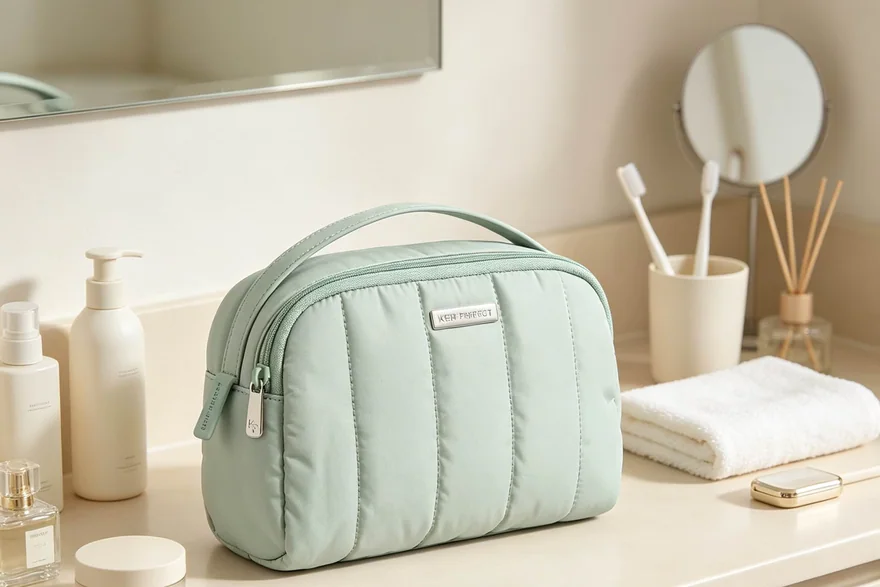
Material selection for a permanently damp room
Damp is the defining material problem. A bag that is used in a wet room, closed while still wet and carried to a warm bedroom twice a day will grow mould in any absorbent layer and will corrode any unprotected metal. Specifying for that environment means removing absorbent materials from the wet path, choosing a shell that does not hold water, and treating every metal component as a corrosion risk rather than as trim.
- Shell: 600D polyester with a PU or PVC backing at 210-260 g/m², or a coated nylon; avoid uncoated cotton canvas, which stays wet and mildews.
- Wet compartment lining: welded TPU or PVC film at 0.3-0.5 mm, or a coated fabric tested for coating adhesion under ASTM D751.
- Ventilation: 2-4 drain grommets at the lowest point plus a mesh upper panel; mesh gauge fine enough not to snag a razor handle.
- Hardware: acetal or stainless hooks and pulls, not plated zinc; request a salt-spray result on the approval sample.
- Base: closed-cell EVA or PE board insert at 3-5 mm, removable so the bag can be fully dried out between terms.
- Interlining: none in the wet path. Any wadding or foam in contact with water becomes a mould reservoir.
- Colour: mid-tone shells; a white or pale shell shows mildew spotting and looks unsellable long before it stops working.
Coated fabrics behave differently under repeated wetting and flexing, and the difference shows up as cracking or as a coating that blocks in warm storage. The coated-fabric test methods in ASTM D751 give a buyer a defined vocabulary for coating adhesion, blocking resistance and hydrostatic behaviour, so a sample can be assessed against a method rather than against an opinion. Requesting those results at sampling costs little and prevents the most common bulk disappointment in this category.
Mildew resistance itself is worth specifying explicitly rather than hoping for. A buyer can require an antifungal finish on the shell and lining and then require a stated test result, or can take the structural route instead, removing every absorbent layer so there is nothing for mould to grow in. The structural route costs less over a nine-month term and does not depend on a finish that washes out, so most dorm programmes should prefer it and use a finish only as a secondary measure.
Restricted substances still apply. Shell fabric, coating, film, zipper tape, thread, elastic and printed labels should be covered by OEKO-TEX Standard 100 certification held against the fabric roll, with separate declarations for films and trims, and the certificate set should be requested with the approval sample so a substitute material cannot appear silently at bulk. Cleaning and colour stability under repeated wiping and washing is assessed by the methods published by AATCC, which a buyer can cite in the brief.
Back-to-campus programme planning by channel
Campus demand is concentrated and immovable: it peaks in the weeks before term starts and falls away sharply once students are settled. That makes the channel decision more important than the product decision, because each channel buys on a different calendar and at a different depth. The table below sets out the four main routes and the assortment each one supports against the 500-piece minimum per style and colourway.
| Channel | Assortment that works | Units at 500 per colourway | Briefing window | Merchandising note |
|---|---|---|---|---|
| University bookshop and campus store | One hanging bag, one pouch, two colourways | 2,000 | Brief in March for an August delivery | Logo use requires written permission from the institution |
| Mass retailer dorm aisle | Two sizes of hanging bag, three colourways | 3,000 | Brief in February for a July delivery | Shelf talker should name the shared-bathroom problem |
| Marketplace and online seller | One hanging bag, one value pouch, multipack liners | 1,000-1,500 | Brief in April for an August delivery | Main photograph should show the bag hanging loaded |
| Brand direct-to-consumer | One hanging bag plus a matching laundry or shoe bag | 1,000 | Brief in March for an August delivery | Bundle raises the order value without new tooling |
| Accommodation and hospitality buyer | One neutral hanging bag, one colourway | 500-1,000 | Rolling; aligned to the accommodation year | Specify spare hooks and pulls as catalogued parts |
The calendar is unforgiving and should be built backwards from the move-in date. Sampling is 6 to 10 working days for a soft hanging bag and 12 to 15 working days if the build includes a frame, a moulded base or welded compartments, and bulk is 35 to 50 days after approval. Freight, customs clearance and the buyer's own distribution to stores sit on top. A buyer who starts sampling in June has already missed an August shelf, which is why the briefing windows in the table sit in the spring.
Institutional branding needs its own note. A university name or crest is licensed property, and a bookshop programme requires written permission from the institution before artwork is produced, not after. Where permission is not available, a neutral colourway matching the institution's palette achieves much of the same shelf effect without the licence, and it also allows unsold stock to be moved to another channel at the end of the season rather than written off.
Minimums, inspection and terms complete the plan. Each style and colourway starts at 500 pieces, so the two-style bookshop assortment commits 2,000 units, and a buyer should decide at the outset which style carries the depth. Shipments are inspected to AQL 2.5 under ISO 2859-1, with hook attachment, weld integrity and zipper function written into the brief as major defects rather than minor ones. Standard terms are FOB Xiamen, T/T 30 deposit and 70 against bill of lading, and pieces per carton should be stated because a hanging bag with a structured base ships far fewer units per carton than a flat pouch.
One aftersales detail separates a good campus programme from an average one. Hooks and pulls are the components that break in a dorm, and a buyer who carries a small quantity of spare parts can replace a component instead of a bag. Specifying those parts with their own part numbers at the briefing stage, and ordering them alongside the first bulk run, costs very little and turns a warranty complaint into a two-minute fix.
The B2B Customisation View
Brand owners approaching cosmetic pouches, vanity cases and beauty organisers usually arrive with a mood board, a target landed cost and a launch date; the technical pack is what turns those three inputs into a repeatable specification.
Programme data for this category: minimum order quantity 500 pieces per style and colourway, sampling in 6–10 working days (12–15 working days for complex constructions), bulk production 35–50 days after sample approval, final random inspection at AQL 2.5 under ISO 2859-1, FOB Xiamen, T/T 30/70.
Engaging a sourcing partner gives the brand owner one channel for the awkward questions — shade drift, component substitution, carton marking — that otherwise bounce between three vendors.
Which Brand Types Benefit Most
Campus programmes reward buyers who can plan a season ahead and who understand that the product is sold as a solution to a shared bathroom rather than as a fashion item. Start-up brands do best with the marketplace route: one hanging bag and one value pouch at 1,000 to 1,500 units, where the listing photograph showing the bag hanging loaded is the single strongest commercial asset. Established brands should build the direct-to-consumer bundle, pairing a hanging bag with a matching laundry or shoe bag so the order value rises without a second tooling set. Retailers, including mass and drugstore chains, need the two-size dorm assortment at 3,000 units, because the aisle has to offer a choice at two price points and a single size will not fill a shelf block. A shelf talker that names the shared-bathroom problem sells the category better than any colourway decision, and it is the cheapest merchandising asset available in the move-in window.
- Start-up brands: one hanging bag plus a value pouch at 1,000 to 1,500 units, briefed in April, differentiated by drainage and drying performance.
- Established brands: a hanging bag bundled with a matching laundry or shoe bag at 1,000 units, raising order value on shared fabric and trim.
- Retailers and own-brand teams: two sizes of hanging bag in three colourways at 3,000 units, briefed in February for a July delivery.
- E-commerce sellers: multipack liners and replacement pouches alongside the main bag, which is the format most likely to generate a second purchase within the academic year.
- Accommodation and hospitality buyers: one neutral hanging bag held at 500 to 1,000 units with spare hooks and pulls catalogued, since the accommodation year runs on a rolling rather than a seasonal calendar and stock has to be available for a replacement at short notice rather than for a seasonal bay change.
Frequently Asked Questions
What makes a dorm toiletry bag different from a travel toiletry bag?
The environment. A travel bag is packed once and lives in a suitcase; a dorm bag is carried to a shared washroom twice a day, hung on a rail, closed while still damp and stored on a shared shelf. That requires a hanging hook, drainage, a quick-drying structure and a compact footprint, none of which a travel bag needs and few of which it has.
How strong does a hanging hook need to be on a dorm wash bag?
Strong enough to hold the bag loaded, which typically means 3 to 5 kg including bottles. The hook itself rarely fails; the attachment does. Specify a webbing anchor bartacked into a reinforced seam or frame panel, and require a static load test on the approval sample rather than relying on how the sample feels in the hand.
Which lining prevents mould in a shared bathroom bag?
A welded TPU or PVC film at 0.3 to 0.5 mm in the wet compartment, with no absorbent interlining anywhere in the wet path. Mould grows in material that stays damp, so the structural answer is better than a chemical one: remove wadding and foam from wet areas, add drain grommets and vent the upper section with mesh.
What size should a college cosmetic bag be?
Small enough for a shelf cube or a shower caddy, commonly a packed footprint near 24 x 16 x 14 cm. A larger bag competes with textbooks for the same limited space and ends up on the floor. Buyers should state the maximum packed dimension in the tech pack as a hard constraint rather than deriving it from a volume target.
Should a dorm bag have drainage holes or a sealed base?
Both, in different places. A sealed base with two to four drain grommets at the lowest point contains a leaking bottle while still letting water out, and a mesh-vented upper section dries items used wet, such as a razor or a flannel. A fully sealed compartment never dries; a fully vented one weeps onto whatever it is carried against.
Which hardware survives a damp dorm bathroom?
Acetal or stainless steel hooks and pulls. Plated zinc alloys spot and stain within a term in a permanently damp room, and rust spots on a hook are read as a dirty product rather than as a hardware choice. Request a salt-spray result on the approval sample and state the hook material in the tech pack rather than accepting a generic metal description.
What fabric weight suits a dorm toiletry bag shell?
600D polyester at roughly 210 to 260 g/m² with a PU or PVC backing, or a coated nylon. The backing is the important part: it stops the shell holding water. Uncoated cotton canvas looks good on a product page and stays wet and mildews in a shared washroom, which is a failure the end user will notice within the first month.
What minimum applies to a campus wash bag programme?
500 pieces per style and colourway. A two-style bookshop assortment in two colourways commits 2,000 units, and a two-size retail assortment in three colourways commits 3,000. Marketplace listings advertising 100 to 1,000 pieces generally describe stock designs rather than a specified hanging build with a welded wet compartment. A buyer should also decide early which style carries the depth, because a re-order during the move-in peak cannot be produced in time to catch it.
When should a buyer brief for an autumn campus delivery?
In the spring. Sampling takes 6 to 10 working days for a soft hanging bag and 12 to 15 working days for framed or welded constructions, bulk runs 35 to 50 days after approval, and freight, clearance and distribution sit on top. A programme sampled in June misses an August shelf, so most buyers brief between February and April.
How long does sampling take for a hanging bag with welded compartments?
12 to 15 working days, because welding, grommets, a structured base insert and a hook assembly are separate operations with their own set-up time. A simple soft hanging bag samples in 6 to 10 working days. Buyers should allow a second sample round after corrections and then count 35 to 50 days of bulk plus freight.
Can a university logo be printed on a campus wash bag?
Only with written permission from the institution, obtained before artwork is produced rather than after. A university name and crest are licensed property, and a bookshop programme without documentation risks having the shipment stopped. Where permission is unavailable, a neutral colourway in the institution's palette gives much of the same shelf effect and can be moved to another channel later.
Which closure works best on a bag used in a shared washroom?
A full-length zipper with closed ends. A bag hanging open on a rail exposes its contents to everyone passing the washroom, so a magnet or a snap is inadequate. Specify gauge, slider and end stop consistently using ASTM D2053 terminology so the brief, the quotation and the sample all describe the same component. A closed-end zipper also stops the slider running off the tape when the bag is opened one-handed while hanging on a rail.
What inspection standard applies to a campus bag shipment?
AQL 2.5 under ISO 2859-1, which sets sample size and accept and reject numbers for the lot. For a hanging bag the defect classification matters more than the level: hook attachment, weld integrity and zipper function should be written into the brief as major defects so a lot failing on those points is rejected rather than accepted.
How many units fit in a carton for a hanging dorm bag?
Fewer than a flat pouch, because a structured base and a fitted hook do not pack flat. The brief should state pieces per carton, carton dimensions and whether the hook ships attached or separate, since that decision changes both freight cost and the labour needed at the distribution centre before the product reaches a shelf.
Should spare hooks and pulls be ordered with the first shipment?
Yes. Hooks and pulls are the components that break in a dorm, and a buyer holding spare parts can replace a component rather than a whole bag. Specify those parts with their own part numbers at the briefing stage and add a small quantity to the first bulk order so the parts exist before the first complaint arrives.
People Also Ask
What should a college student keep in a dorm toiletry bag?
The items carried to a shared washroom every day: toothbrush and paste, a razor, shampoo and shower gel in travel sizes, deodorant, and any medication in a separate zip pocket. A bag with a welded wet compartment keeps damp items away from the rest, and a swivel hook lets the whole thing hang on a shower rail between trips. A separate zip pocket keeps medication out of sight in a shared space.
How do you store toiletries in a dorm without a shelf?
Hang them. A hanging wash bag with a swivel hook uses the shower rail or the back of the door, which is usually the only available surface in a shared washroom. A compact footprint near 24 x 16 x 14 cm also fits a shelf cube or a shower caddy, so the bag can be moved between the two as the room is used.
What size toiletry bag is best for college?
Smaller than a travel bag. A packed footprint around 24 x 16 x 14 cm fits a shelf cube and still holds a toothbrush, a razor and travel-size bottles. Anything larger competes with textbooks for limited dorm space, and the bag ends up on the floor rather than on the shelf it was designed for. Drainage grommets matter at that size, because a compact bag is carried closed straight after use.
Are hanging toiletry bags worth it in a dorm?
Yes, because a shared washroom offers a rail and a wet ledge and nothing else. A hanging bag stays off the wet surface, dries between uses and keeps contents together in one trip. The specification to check is the hook attachment, which should be a bartacked webbing anchor into a reinforced seam rather than a hook stitched only into the shell fabric, since a loaded bag will pull a weak anchor out within a few weeks.
Request a Sample or a Written Quotation
Send the silhouette, dimensions, material preference and logo artwork, and the programme team will return a written quotation with MOQ, sampling window, bulk lead time and inspection standard.
Email: service@junyuanbags.com · WhatsApp: +86 177 5002 0688