Convertible Cosmetic Bags: Pouch to Hanging Organizer
Executive Summary
A convertible cosmetic bag is a pouch that opens into a hanging organiser, and the design question is whether both modes work rather than whether one does. The reliable construction is a wrap-around zipper that releases a hook stored under a flap or in a zipped pocket, so the pouch keeps a closed shape of about 24 x 16 x 9 cm and opens to 58-64 cm across three or four tiers. Everything that makes it convertible adds 45-120 g and $0.55-$2.30 to the unit, and each addition creates a new failure point.
Those failure points are predictable: the fold line that flexes on every conversion, the zipper end that sits exactly where the panel bends, and the hook anchor that then carries 1.5-2.2 kg of contents rather than an empty shell. A buyer can test all three inside a week: 500 pouch-to-hanging conversions, 1,000 fold cycles at the crease, and a 24-hour hang at working load. Programme terms stay fixed: 500 pieces per style and colourway, 6-10 working days sampling, 35-50 days bulk, AQL 2.5 under ISO 2859-1, FOB Xiamen, T/T 30/70.
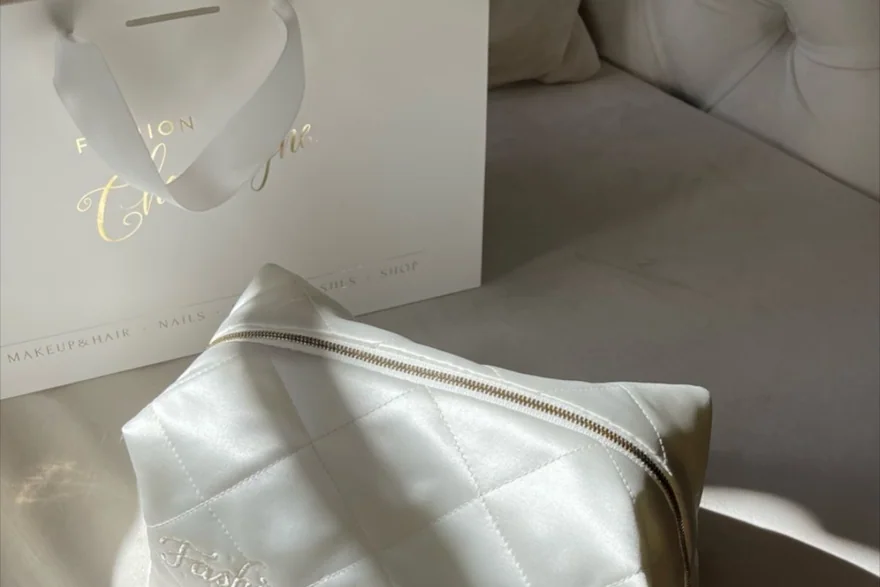
What "Convertible" Means in Cosmetic Bag Construction
Convertible describes a bag with two working states. In pouch mode it closes to a compact shape that fits a suitcase or a handbag; in hanging mode it opens flat and suspends from a hook, exposing three or four tiers of compartments. The conversion is what separates it from a hanging bag that merely folds: a true convertible is designed to be used as a pouch most of the time and as an organiser for the length of a trip, so both states have to be engineered rather than one being an afterthought of the other.
- Pouch mode: about 24 x 16 x 9 cm closed and 240-320 g empty, carried in a holdall or a handbag.
- Hanging mode: 58-64 cm tall when open, across three or four tiers each carrying 300-600 g.
- Conversion time matters: a traveller tolerates 10-15 seconds, not 45 seconds with a strap to thread.
- Stored hook: the hook has to be concealed in pouch mode or it snags on clothing and on other bags.
- The bag must stand up in pouch mode; a convertible that flops closed is the most common complaint.
The commercial reason to offer one is basket size. A convertible sits at a retail band of $24.99-$44.99 against $12.99-$24.99 for a plain hanging bag, because the customer can see two products in one. The engineering reason to be careful is that the conversion mechanism is the part most likely to fail, and a failed conversion turns a premium product into a loose pouch with a useless flap. Most returns on convertible programmes trace back to three components: the fold line, the zipper end crossing the fold, and the hook anchor. All three can be strengthened at the specification stage for under $0.35 per unit, which is why the engineering discussion belongs before the first sample is cut rather than after the first customer complaint arrives.
State both mode dimensions: closed 24 x 16 x 9 cm and open 58-64 cm. A sample that meets only one of those has not been specified as a convertible and will usually fail in the other mode.
Conversion Mechanisms: Zipper, Hook, Buckle and Fold
Five mechanisms cover most of the market, and they differ in cost, conversion time and failure mode. The wrap-around zipper with a stored hook is the most common, because one continuous chain closes the pouch and releases the hanging panel while the hook lives under a flap or inside a small zipped pocket at the top. The hook-on-a-tab mechanism tucks a webbing tab into a pocket for the traveller to pull out and clip to a rail. The buckle-strap unroll suits roll-style organisers, the snap-out panel uses press studs, and the detachable inner pouch separates entirely.
| Mechanism | How it converts | Conversion time | Added cost | Weakest point |
|---|---|---|---|---|
| Wrap-around zipper with stored hook | One chain releases the panel and a hook folds out from a flap | 8-12 s | $0.55-$1.25 | Zipper end at the fold line |
| Hook on a webbing tab | Tab pulls from a pocket and clips to a rail | 6-10 s | $0.20-$0.45 | Bar-tack at the tab root |
| Buckle-strap unroll | Body unrolls and a strap buckles over the rail | 20-35 s | $0.40-$0.95 | Strap anchor seam |
| Snap-out panel with press studs | Studs release and the panel drops open | 10-18 s | $0.30-$0.75 | Stud pull-out from the cloth |
| Detachable inner pouch | Inner pouch unclips and hangs separately | 12-20 s | $0.80-$2.30 | Clip fatigue at 1,500-2,500 cycles |
Zipper specification carries most of the mechanism. A convertible typically needs a #5 chain 55-70 cm long running around three sides, and that chain crosses the fold line at least once, which is exactly where it fails. Zipper parts are named in ASTM D2053 as chain, tape, slider, top and bottom stop and gauge, and that vocabulary is what a buyer needs when specifying a two-way slider or a reverse-coil chain, because a two-way slider lets the panel open from either end and is worth its premium on a bag that converts daily.
- A two-way slider on a 60 cm chain lets a traveller open the panel from either end, at roughly $0.12-$0.28 more.
- Reverse-coil chain hides the teeth behind a flap, which matters because the chain crosses the fold line.
- Auto-lock slider is essential: each tier hangs under 300-600 g and a non-lock slider creeps open.
- The bottom stop at the fold should be boxed and backed with a 20 x 15 mm reinforcement patch.
- A 45-60 mm puller makes the conversion usable with wet hands in a hotel bathroom.
Weight and bulk are the cost of conversion. A plain pouch at 24 x 16 x 9 cm weighs 180-240 g; the same bag built as a convertible weighs 240-360 g once the hook, the tab, the extra chain length and the tier panels are added. That is a 45-120 g penalty, which matters for e-commerce dimensional weight but rarely for retail shelf. The bigger issue is bulk in pouch mode: a convertible with four tiers folded on itself closes to 9-13 cm thick against 5-7 cm for a plain pouch of the same footprint, and that extra thickness is what customers notice when packing.
- Specify the zipper by gauge, type and slider: #5 reverse-coil, two-way, auto-lock.
- Conceal the hook in pouch mode, or it snags on everything it travels with.
- Budget a 45-120 g weight penalty for the conversion hardware.
- Conversion taking longer than 20 seconds is too slow for daily use; time it with a stopwatch.
Approve the sample in both modes. A hanging-mode approval alone misses the pouch-mode faults: a hook printing through the face fabric, a fold that will not lie flat, and a closed profile 4-6 cm thicker than the specification.
Stress Points Unique to a Convertible Build
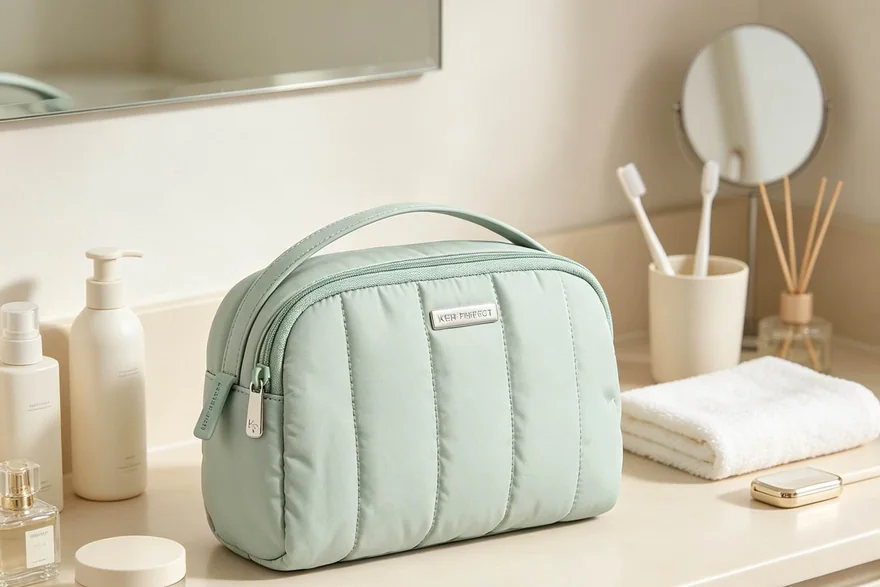
A convertible carries three stress concentrations that a plain pouch does not: the fold line, the zipper end that crosses it, and the hook anchor that now carries a loaded hanging bag. The fold line is the most under-designed part of most programmes. A panel folded 500-1,500 times over the life of the bag work-hardens the coating, and on PU-coated cloth above 260 g/m² the crease begins to craze. The fix is mechanical rather than chemical: a 6-10 mm radius at the fold, a stitch line 12-15 mm to either side of it to control where the crease forms, and a lighter fabric weight on the folding panel.
| Stress point | Typical load or cycles | Common failure | Recommended fix | Added cost |
|---|---|---|---|---|
| Fold line | 500-1,500 folds over bag life | Coating crazing, cloth cracking at the crease | 6-10 mm fold radius, control stitches 12-15 mm apart | $0.02-$0.08 |
| Zipper end at fold | Chain flexes on every conversion | Tape delamination, bottom stop pull-out | Boxed stop plus a 20 x 15 mm patch | $0.05-$0.15 |
| Hook anchor | 1.5-2.2 kg loaded | Bar-tack pull-out at 4-6 kg | 42 x 12 mm box stitch, 70 x 60 mm patch | $0.04-$0.12 |
| Tier seams | 300-600 g per tier | Seam creep, tier sagging 10-15 mm | Double-needle seam with 10-12 mm allowance | $0.03-$0.10 |
| Panel corner at fold | Repeated compression in pouch mode | Corner wearing through to the liner | Bound corner or a 15 mm turn-back | $0.05-$0.14 |
The hook anchor on a convertible carries more than it appears to. In pouch mode the bag weighs 240-360 g; in hanging mode the same bag holds 1.5-2.2 kg of contents, so the anchor sees six to eight times the load depending on which mode the traveller is in. The anchor also sits at the top of the panel that folds, so the load path runs through the fold line. That is why the reinforcement patch on a convertible should be larger than on a plain hanging bag: 70 x 60 mm rather than 60 x 50 mm, extending past the fold so the load spreads into two panels.
- Tier loads are uneven: the bottom tier carries 500-900 g while the top carries 200-350 g.
- Load heavy items low; a top-heavy bag hangs 10-15 degrees off vertical and drags the hook sideways.
- Elastic loops at 30-45 mm keep bottles upright in hanging mode and stop them shifting mid-conversion.
- A stiffener of 0.8-1.2 mm PE board in the top tier stops the panel collapsing when the bag opens.
- Mesh or clear TPU pockets at 0.20-0.30 mm save 30-50 g per tier against lined fabric pockets.
Material choice interacts with the fold. A 420-denier PU-coated polyester at 240 g/m² creases cleanly and recovers; a 0.30 mm PVC film creases permanently and shows a white stress mark at the fold after 200-400 conversions, which is why PVC convertibles are usually built with a fabric hinge panel rather than folding the film itself. TPU laminate is the best of the three for a folding panel, because it recovers from creasing and keeps its hydrostatic head across the fold, though it lands at $2.40-$6.80 per unit.
- Give the fold line its own specification: radius, control stitches and fabric weight.
- Use a 70 x 60 mm reinforcement patch on a convertible, larger than on a plain hanging bag.
- Mesh or clear pockets save 30-50 g per tier against lined fabric pockets.
- Do not fold 0.30 mm PVC directly; build a fabric hinge panel instead.
Treat the fold line as a hinge with a specified radius, stitch control lines and its own fabric weight. Programmes that leave the fold to chance see crazing complaints around month four, long after the sample was signed off.
Testing a Convertible Sample in Both Modes
A convertible needs two test passes, one per mode, plus a conversion-cycling pass that no single-mode bag requires. The pouch-mode pass checks closed profile, hook concealment and zipper closure under compression. The hanging-mode pass checks tier load, hook anchor and hang angle. The conversion pass checks that the mechanism survives repetition. Three samples from one build should run all three, because conversion hardware is assembled by hand and varies more between operators than a sewn seam does.
- Measure the closed profile: a 24 x 16 cm footprint should close to 9-13 cm thick and stand upright on a shelf without slumping.
- Conversion cycling: 500 full pouch-to-hanging conversions at a natural pace, then inspect the fold line for crazing and the zipper tape for delamination.
- Fold-line flex: 1,000 flex cycles at the crease on a jig, then check for coating cracks under 10x magnification.
- Hanging load: load tiers to 1.5-2.2 kg and hang for 24 hours on a 25 mm rail; accept no seam creep above 5 mm and no hook-mouth opening above 2 mm.
- Zipper endurance in both modes: 500 open-close cycles flat and 200 hanging, then re-check slider lock.
- Transit simulation: pack the bag in pouch mode, drop the case from 0.8 m on six faces, then check that the hook has not printed through the face fabric.
| Test | Criterion | Failure it finds | When it appears |
|---|---|---|---|
| 500 conversions | No crack at the fold, no tape lift | Coating crazing, zipper delamination | Month 2-4 of consumer use |
| 1,000 fold flexes | No crack visible at 10x | PU coating work-hardening | Month 4-6 |
| 24 h hang at 2.2 kg | Seam creep under 5 mm | Tier seam extension, hook creep | First trip |
| 500 + 200 zipper cycles | Slider locks in both modes | Auto-lock wear from dual-mode use | Month 3-5 |
| 0.8 m drop in pouch mode | No hook print-through | Hook sitting under thin cloth | First flight |
Inspection of the bulk run should name convertible-specific defects. Under ISO 2859-1 at AQL 2.5 the defect list adds: fold line off-centre by more than 3 mm, zipper tape delamination at the fold, hook not seating flat in its pocket, tier seam allowance under 8 mm, and any crack visible at the crease on a randomly pulled unit. The standard fixes sample size and accept-reject numbers against lot size; the buyer should also require one full conversion on every sampled unit, which takes about 15 seconds and catches assembly faults a visual check misses.
Timing follows the usual pattern with one addition. Sampling runs 6-10 working days for a sewn convertible and 12-15 working days when a moulded hook, a welded clear tier or a custom two-way slider is specified; bulk runs 35-50 days after sample approval. The minimum is 500 pieces per style and colourway, shipment is FOB Xiamen, and payment is T/T 30 deposit and 70 against bill of lading. Buyers should put the conversion-cycling test inside the sampling window rather than after it, because a failed fold line usually means a fabric change and a second sample round.
- Run two mode passes plus a conversion-cycling pass; one mode alone is not an approval.
- Require one full conversion on every unit drawn for AQL inspection.
- Put the cycling test inside the sampling window, not after it.
- Record fold-line condition under 10x magnification at 500 and at 1,000 cycles.
Most convertible samples are approved hanging on a rail and never tested packed. A hook sitting under 210-denier cloth prints through after one flight, and the mark is permanent.
The B2B Customisation View
Launch calendars are unforgiving, so cosmetic pouches, vanity cases and beauty organisers programmes are planned backwards from the on-shelf date rather than forwards from the first sketch.
Fixed commercial parameters: 500 pieces per style and colourway minimum, first sample in 6–10 working days (12–15 for complex or hardware-intensive constructions), bulk 35–50 days after approval, AQL 2.5 inspection under ISO 2859-1, FOB Xiamen, T/T 30/70.
A sourcing and programme-management company is answerable for the whole file, not just the sewing, which is why inspection reports and compliance documents are issued with every shipment.
Which Brand Types Benefit Most
Convertibles suit buyers whose customers travel rather than buyers whose customers store at home. Start-up brands should treat a convertible as the second or third SKU rather than the first: at $6.80-$12.00 landed it needs a $34.99-$44.99 retail band, and the photography has to show both modes or the value stays invisible in a listing. Established travel brands get the most from convertibles, because an existing audience already understands the hanging format and reads the convertible as an upgrade. Retailers should weigh shelf demonstration: a convertible that cannot be shown hanging on a display arm loses most of its advantage.
- Start-up brands: launch a plain pouch first, then a convertible once reviews establish the range.
- Established travel brands: convertible as an upgrade SKU at $34.99-$44.99, photographed in both modes.
- Retailers: stock convertibles only where the display arm allows the hanging mode to be shown.
- E-commerce sellers: the listing needs a short video or a two-image set showing the conversion, or returns rise.
- Gift and hospitality buyers: convertibles work as premium welcome kits for recipients who travel on.
Programme terms are unchanged: 500 pieces per style and colourway, 6-10 working days sampling and 12-15 for complex constructions, 35-50 days bulk after sample approval, AQL 2.5 under ISO 2859-1, FOB Xiamen, T/T 30 deposit and 70 against bill of lading. A convertible in three colourways is 1,500 units, and because the conversion hardware is assembled by hand, unit-to-unit variation is wider than on a plain pouch, so inspection should be sized accordingly.
Two checks protect margin on a first convertible order. The first is the closed-thickness measurement: a sample that closes at 9-13 cm on a 24 x 16 cm footprint fits a handbag, while one at 15 cm does not, and the difference only shows when the tiers are folded exactly as the packer will fold them. The second is a packing trial: ship six units in their retail cartons through one courier cycle and check for hook print-through, because that defect is invisible on a bench and universal after a flight.
Frequently Asked Questions
What makes a cosmetic bag genuinely convertible rather than just foldable?
Both modes have to be engineered. A foldable hanging bag simply bends; a convertible has a specified closed profile, a concealed hook, a zipper routed so the panel releases cleanly, and tiers that carry load when open. If the specification lists only an open dimension, or only a closed one, the bag has been designed as one thing that happens to do the other.
Which conversion mechanism is most reliable at 500 pieces per colourway?
The wrap-around zipper with a stored hook, because it uses one chain for both jobs and has only one new failure point, the zipper end at the fold. It converts in 8-12 seconds and adds $0.55-$1.25. The hook-on-a-tab is cheaper at $0.20-$0.45 but puts the load on a bar-tack at the tab root, which is the component most often returned.
How much weight does a convertible add to a plain pouch?
Between 45 and 120 g. A plain 24 x 16 x 9 cm pouch weighs 180-240 g; the convertible version weighs 240-360 g once the hook, the tab, the extra 20-30 cm of chain and the tier panels are counted. On a 5,000-unit order that is 225-600 kg of extra freight, which is immaterial by sea and noticeable by air.
Why does the fold line fail before anything else on a convertible?
Because it is the only part that moves on every single use. A panel folded 500-1,500 times work-hardens the coating, and PU-coated cloth above 260 g/m² starts to craze at the crease. Give the fold a 6-10 mm radius, put control stitches 12-15 mm either side of it so the crease forms in one predictable place, and use a lighter fabric on the folding panel.
What zipper specification suits a pouch-to-hanging convertible?
A #5 reverse-coil chain 55-70 cm long with a two-way auto-lock slider, a boxed bottom stop at the fold backed by a 20 x 15 mm patch, and a 45-60 mm puller. Reverse-coil hides the teeth behind a flap, which matters because the chain crosses the fold line; the two-way slider lets the panel open from either end and costs $0.12-$0.28 more.
How thick is a convertible cosmetic bag when closed?
Typically 9-13 cm for a four-tier build on a 24 x 16 cm footprint, against 5-7 cm for a plain pouch of the same footprint. The thickness comes from the folded tiers and from the hook pocket. Buyers should state the closed thickness on the tech pack, because a sample that closes at 15 cm will not fit the handbag the customer intends.
How long should a pouch-to-hanging conversion take?
Eight to fifteen seconds. A wrap-around zipper converts in 8-12 seconds and a hook-on-a-tab in 6-10; a buckle-strap unroll takes 20-35 seconds, which is long enough that travellers stop using the hanging mode and treat the bag as a pouch. Time it with a stopwatch on the sample rather than trusting a written description.
What reinforcement patch size does a convertible hook anchor need?
About 70 x 60 mm, larger than the 60 x 50 mm used on a plain hanging bag. The reason is the load path: on a convertible the anchor sits at the top of the folding panel, so the pull runs through the fold. The patch should extend past the fold line so the load spreads into two panels instead of shearing one.
How much weight do hanging tiers carry on a convertible organiser?
Between 200 and 900 g per tier depending on position. The bottom tier carries 500-900 g because liquids and heavier items settle there, while the top tier carries 200-350 g. Tier seams should be double-needled with a 10-12 mm allowance; a single-needle seam creeps and the tier sags 10-15 mm within a season.
Can a convertible be built from PVC film?
Yes, but not by folding the film itself. A 0.30 mm PVC creases permanently and shows a white stress mark after 200-400 conversions. The usual solution is a fabric hinge panel: PVC panels joined by a 420-denier PU-coated strip 25-40 mm wide that takes the fold. TPU laminate is the better single-material answer for a folding panel.
How many conversion cycles should a convertible sample survive?
Five hundred full pouch-to-hanging conversions with no crack at the fold and no tape delamination, followed by 1,000 flex cycles at the crease on a jig checked under 10x magnification. A bag used on two trips a month reaches 500 conversions in about two years, so the benchmark covers a realistic service life rather than a laboratory fantasy.
What defects should an AQL 2.5 inspection list for a convertible bag?
Alongside the usual stitching checks: fold line off-centre by more than 3 mm, zipper tape delamination at the fold, hook not seating flat in its pocket, tier seam allowance under 8 mm, coating crack at the crease, and any hook print-through visible on the face fabric. Require one full conversion on every unit drawn, which takes about 15 seconds each.
Does a convertible need a two-way zipper slider?
Not strictly, but it is worth the $0.12-$0.28. A two-way slider lets a traveller open the hanging panel from either end, which matters when the bag is hung at eye level and the natural reach is from the right. Single-slider convertibles force the user to unzip the whole chain to reach the bottom tier, and reviews mention it.
How is the hook concealed in pouch mode without snagging?
In a zipped pocket 60-80 mm wide lined with the same fabric, or under a flap closed with a 20-30 mm piece of hook-and-loop tape. The hook needs at least 3 mm of padding between it and the outer face fabric, or it prints through during a flight. A hook left exposed snags on knitwear and on the lining of other bags in a suitcase.
What sampling window applies to a convertible with a moulded hook?
Twelve to fifteen working days rather than the standard 6-10, because the hook tooling and the first shots have to be produced. Buyers should request three samples from one build, since conversion hardware is assembled by hand and varies between operators. Bulk then runs 35-50 days after sample approval, with a 500-piece minimum per style and colourway.
How does a convertible compare in cost with a plain hanging toiletry bag?
A convertible lands $1.55-$4.20 higher, at roughly $6.80-$12.00 against $5.25-$7.80 for a plain hanging bag of similar size. The premium buys the stored hook, 20-30 cm of extra chain, the tier panels and the hand assembly. At a $34.99-$44.99 retail band against $19.99-$29.99, the margin gain is real if the conversion survives use.
People Also Ask
What is a convertible cosmetic bag?
It is a pouch with two engineered states: closed at roughly 24 x 16 x 9 cm for travel, and open to 58-64 cm as a hanging organiser with three or four tiers. A wrap-around zipper releases the panel and a hook stored under a flap or in a pocket carries the loaded bag. It adds 45-120 g and $0.55-$2.30 over a plain pouch.
How do you convert a cosmetic pouch into a hanging organiser?
Unzip the wrap-around chain, unfold the panel so the tiers hang vertically, then pull the hook from its pocket or flap and clip it to a rail or door top. The whole sequence should take 8-15 seconds. Load heavy items into the bottom tier, which carries 500-900 g, and keep bottles upright in 30-45 mm elastic loops.
Are convertible cosmetic bags worth the extra cost?
They are worth $1.55-$4.20 more at landed cost when the customer travels regularly, because the hanging mode halves the counter space needed in a hotel bathroom. They are poor value for someone who stores cosmetics at home, where the conversion hardware adds 45-120 g and 4-6 cm of closed thickness for no daily benefit. Judge the premium against the return rate: a convertible that survives 500 conversions earns the upgrade, while one that fails at the fold line costs more in refunds than the premium ever earned.
Can a convertible bag be used as a normal pouch?
Yes, provided the specification covers pouch mode: a closed profile of 9-13 cm, a concealed hook with 3 mm of padding behind it, and enough structure to stand upright on a shelf. Bags specified only in hanging mode tend to flop closed and let the hook print through the face fabric. One test settles it: pack the bag as a pouch, drop the case from 0.8 m on six faces, then check for print-through.
Request a Sample or a Written Quotation
Send the silhouette, dimensions, material preference and logo artwork, and the programme team will return a written quotation with MOQ, sampling window, bulk lead time and inspection standard.
Email: service@junyuanbags.com · WhatsApp: +86 177 5002 0688