Travel Cosmetic Bag Packing Checklist: Printable Guide
Executive Summary
A travel cosmetic bag packing checklist is a fixed list of what goes in the bag, in what order, with a volume allowance for each item, so the same bag can be packed the same way on every trip. The working version covers four groups: liquids in containers of 100 ml or less held together in one clear quart-size bag for screening, non-liquid toiletries, make-up, and tools. A one-week trip typically needs 12 to 18 items in a bag of 22 to 26 cm width; a weekend needs 8 to 11 items in 18 to 20 cm.
The checklist becomes a specification once volumes are converted into compartment dimensions: a clear liquids pouch of about 19 x 20 cm, brush loops of 12 to 18 mm, and a bottom compartment tall enough for a 14 to 18 cm bottle standing upright. Writing those numbers down is what stops a bag from being a single open cavity. A custom travel toiletry programme starts at 500 pieces per style and colourway, samples in 6-10 working days, runs bulk in 35-50 days and is inspected to AQL 2.5 under ISO 2859-1.
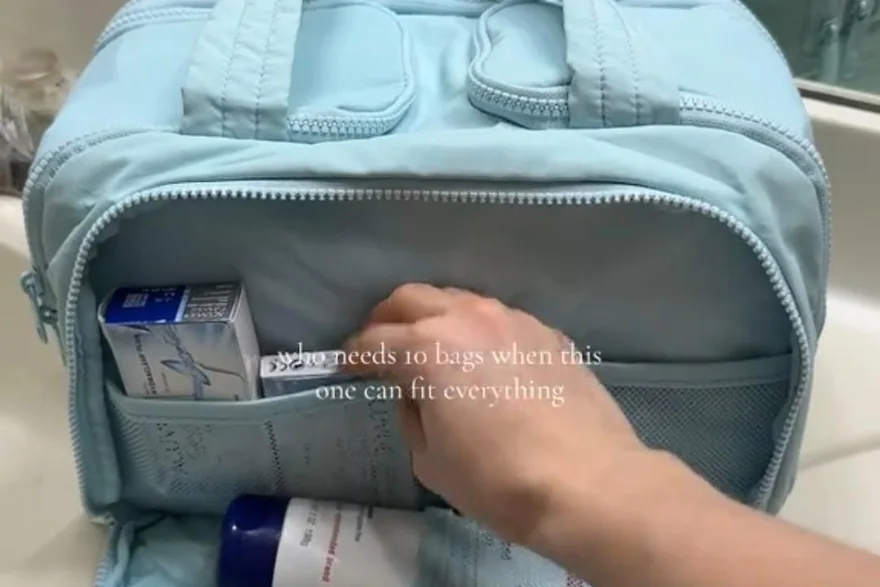
What a packing checklist does that a product list does not
A checklist differs from a product list in that it fixes quantity, container size and position. Shampoo is a product; shampoo, 100 ml, upright in the bottom compartment, left of the razor, is a checklist line. That difference is what makes packing repeatable and what makes the bag specifiable, because a bag can be designed around a fixed set of volumes in a way it cannot be designed around a variable one.
The checklist also resolves the two constraints that actually break travel packing. The first is screening: liquids, gels and aerosols carried in hand baggage are limited to containers of 100 ml or 3.4 oz, held together in one clear resealable quart-size bag, one bag per passenger, presented separately at the checkpoint. The second is leakage: a bottle laid on its side in a shared cavity will eventually open under pressure, and separating liquids from fabrics is a design task rather than a packing tip.
Category demand reflects both constraints. Amazon search data shows close to 110,000 monthly searches for travel bag for toiletries and roughly 74,810 weekly searches for toiletry bag, and the marketplace unit price band of about $0.45 to $12.00 covers everything from a flat clear pouch to a multi-compartment hanging organiser. The checklist is what tells a buyer which end of that band a programme actually needs, and it is the cheapest tool available for answering the question.
A printable checklist should therefore carry three columns that an ordinary packing list omits: container volume in millilitres, position inside the bag, and whether the item counts as a liquid for screening purposes. Those three columns are also the direct input to a tech pack, which is why the same document is worth building twice, once for the end user and once for the factory.
The checklist is also a shared document. Given to a factory, it defines the compartments; given to a warehouse, it defines the packing order; given to a customer, it defines what the bag is for. One document serving three purposes is the reason to write it properly rather than copy a generic version from elsewhere.
The printable checklist: four groups with quantities and volumes
- Group 1, liquids, 100 ml or 3.4 oz maximum per container, all in one clear quart-size bag: shampoo 100 ml, conditioner 100 ml, shower gel 100 ml, facial cleanser 100 ml, sunscreen 50 ml, toothpaste 100 ml. Six containers, about 550 ml total.
- Group 2, non-liquid toiletries: toothbrush with cover, razor with guard, deodorant stick, folding hairbrush, nail file, tweezers, small mirror. Seven items, no volume limit.
- Group 3, make-up: foundation 30 ml, concealer, pressed powder palette, mascara, lipstick, lip balm, eyebrow pencil, small eyeshadow quad. Eight items, roughly 900 g including compact mirrors.
- Group 4, tools and spares: brush sleeve holding three brushes, beauty sponge, hair ties, cotton pads in a flat sleeve, adhesive plasters, laundry sheet, spare zip pouch for used items.
- Packed weight target: 1.1 to 1.6 kg for a one-week trip, 0.6 to 0.9 kg for a weekend, measured with the liquids pouch full.
- Packing order: tallest and heaviest items first, standing upright in the bottom compartment; flat palettes against the back panel; brushes in sleeves along one wall; liquids pouch last, on top and reachable without unpacking.
Scaling the list is arithmetic rather than a fresh decision. A weekend drops group 1 to three containers, cuts group 3 to five items and removes the spare pouch, which takes the packed weight to about 0.6 to 0.9 kg and fits an 18 to 20 cm bag. A two-week trip does not double anything: it keeps the same container count and adds a refill plan, because container size is capped by screening rather than by trip length.
Family packing changes the structure rather than the quantities. The liquids rule applies per passenger, so a family of four needs four clear pouches or one bag with four clearly separated clear sections, and the practical solution is a family organiser with four labelled clear pockets. Sharing one large cavity means one person's leak becomes everyone's problem, and it also makes the checkpoint presentation slower.
The spare zip pouch is the line most people omit and most often regret. Used brushes, a damp sponge and a cosmetic-stained cloth should never go back into the main lining, and a flat fold-up pouch of 18 x 14 cm weighs under 40 g. Specifying it as a detachable component of the travel set costs very little and removes the most common source of a stained lining.
Order matters more than most packing advice suggests. Packing tall bottles first establishes the vertical space the rest of the list has to fit around; packing them last forces flat items to be wedged underneath, which is how palettes crack. A bag designed with the tall compartment at one end supports that order naturally, and a bag with a single cavity does not, which is why the checklist and the layout have to be written together.
Printing the checklist is worth doing even in a digital programme. A laminated card inserted into the bag costs a few cents, survives contact with water, and turns the bag into a product with an instruction rather than an empty container. For gift-with-purchase and hotel programmes it also answers the question of what the bag is for, which is otherwise left to the recipient to work out.
Liquid rules, screening and the bag that clears them
| Requirement | What the rule states | What the bag must allow | Specification check |
|---|---|---|---|
| Container size | 100 ml or 3.4 oz maximum per container | Holds six to eight 100 ml bottles upright | Internal compartment height 14 to 18 cm |
| Container count | All liquids carried in one bag | A dedicated clear pouch, not a shared cavity | Separate clear pouch of about 19 x 20 cm |
| Presentation | Presented separately at the checkpoint | Removable in one motion when packed | Grab handle or clip-out attachment |
| Visibility | Contents seen without opening | Transparent panel on at least one face | Clear PVC or TPU, no print across the panel |
| Closure | Resealable | Closes fully when filled to roughly 90% | Cycle test with eight filled bottles inside |
| Checked baggage | Larger volumes allowed, higher leak risk | A welded wet compartment if the bag is checked | Welded-seam wet pocket, no stitched base |
The operative detail for a bag designer is that the rule governs containers and the bag that holds them, not the outer travel cosmetic bag itself. A passenger may carry one clear quart-size bag of liquids inside a larger hanging organiser, which is why the removable clear pouch is the single most useful component in a travel set. The TSA liquids rule is the reference buyers should quote when writing that component into a specification, and the same 100 ml logic applies at most international checkpoints.
Closure choice on the clear pouch matters more than its size. A pouch that cannot close once six bottles are inside fails the resealable requirement in practice, so the pouch should be cycle-tested filled rather than empty. Zipper terminology and component naming follow ASTM D2053, and using that vocabulary in a tech pack removes most of the ambiguity between a buyer's intent and what arrives.
Sharp items deserve their own line. Razors with guards, tweezers, scissors under the permitted blade length and nail files are best carried in a small zip pocket of about 12 x 9 cm so they neither snag the lining nor present an unpacked sharp at the checkpoint. A loose razor blade in the main cavity is the most common cause of a cut lining, and a cut lining is not repairable on a coated bag.
Decanting is the practical constraint behind container size. A 100 ml bottle is rarely filled with 100 ml of product; most travellers decant 60 to 80 ml into a labelled bottle, which reduces both weight and leak risk. Bottles should be specified with a wide mouth for filling, a secure screw cap rather than a flip top, and a flat side so they stand rather than roll inside the compartment.
Temperature and pressure deserve one line in the specification. Aircraft holds and car boots both subject a bag to pressure change and heat, and a flip-top closure that survives a bathroom shelf will often weep in a hold bag. Specifying screw caps, a welded wet compartment and an upright bottle position removes most of that risk without adding meaningful cost.
Medication and specialist items sit outside the checklist. Prescription liquids, contact lens solution and infant products are handled under separate provisions at most checkpoints, so a travel bag intended to carry them needs a clearly labelled compartment that can be presented separately rather than buried in the main cavity.
Turning the checklist into a bag specification
Every checklist line implies a dimension. Writing those dimensions into a tech pack is the difference between a travel bag that works and a travel bag that is a single open cavity with a nicer fabric. The table below maps the six lines that most often determine whether a travel cosmetic bag succeeds.
| Checklist line | Dimension it implies | Component to specify | Common error |
|---|---|---|---|
| Six 100 ml bottles upright | Compartment height 14 to 18 cm | Upright dividers or a moulded base insert | Bottles laid flat with no upright support |
| One clear quart-size pouch | About 19 x 20 cm, removable | Clip-out clear pouch on a #3 zipper | Printing placed across the clear panel |
| Three brushes in sleeves | Loop width 12 to 18 mm | Elastic brush bar with six loops | Loops sized for pencils, not brush handles |
| Pressed powder palette | Flat pocket about 16 x 12 cm | Slip pocket against the back panel | Palette loose in the main cavity, cracks |
| Razor, tweezers, nail file | Small parts pocket about 12 x 9 cm | Zip pocket with a bound edge | Sharp items loose against the lining |
| Spare pouch for used items | About 18 x 14 cm, fold flat | Detachable or fold-flat secondary pouch | Omitted, so wet items share the lining |
Overall bag size follows from the compartment sizes rather than the other way round. A seven to ten day kit resolves to roughly 24 x 18 x 10 cm closed for a hanging organiser, 22 x 14 x 9 cm for a soft-sided travel pouch, and 26 x 20 x 12 cm where the set includes a removable clear pouch and a brush sleeve. Those three footprints pack differently into an outer carton, so carton quantity and freight cost should be modelled before the pattern is cut.
Programme timings apply as they do elsewhere. A custom travel toiletry programme starts at 500 pieces per style and colourway, sampling takes 6-10 working days for a standard pouch and 12-15 working days where welded seams, moulded inserts or multi-process printing are involved, and bulk production runs 35-50 days after sample approval. Shipment is on FOB Xiamen terms with payment by T/T, 30% deposit and 70% against bill of lading.
Inspection is set to AQL 2.5 under ISO 2859-1, and the defects that matter in this format are specific: a clear panel that is hazy, a pouch that will not close with six bottles inside, loops that are too narrow for the stated brush, and a hook attachment that pulls under load. Listing those four as classified defects in the inspection plan is more useful than a generic appearance clause.
Sets should be treated as one product rather than two. Where a programme includes an outer organiser and a removable clear pouch, the two have to be specified together: the pouch must fit the compartment it clips into with the bottles inside, and the attachment has to survive repeated removal. Specifying them separately is the usual cause of a pouch that fits the bag but not the contents.
Weight matters to the recipient more than dimensions do. A travel set weighing over roughly 700 g empty is described as heavy in reviews regardless of how well it is laid out, which is why a 420D shell with a lightweight lining is usually a better choice than a heavier decorative fabric that costs the same.
The B2B Customisation View
A realistic cosmetic bags schedule assumes one round of sample revision; planning for a perfect first sample is the most common cause of a slipped launch.
Fixed commercial parameters: 500 pieces per style and colourway minimum, first sample in 6–10 working days (12–15 for complex or hardware-intensive constructions), bulk 35–50 days after approval, AQL 2.5 inspection under ISO 2859-1, FOB Xiamen, T/T 30/70.
A sourcing-partner structure also protects the buyer when volumes grow, because capacity for cosmetic bags can be spread across SGS-verified production lines without changing the specification.
Which Brand Types Benefit Most
A checklist is used differently by each buyer type. Start-up travel and beauty brands use it as a product-definition tool: the ten to eighteen lines tell them whether to launch a flat pouch, a hanging organiser or a two-piece set, and they usually discover that the removable clear pouch is the feature customers actually mention in reviews. Established brands adding a travel set to a gifting calendar use the checklist to fix a single configuration that can be reordered unchanged for 18 to 36 months, because a set that changes shape every season cannot be packed consistently at the warehouse. Retailers and wholesalers use it as buying-side arithmetic, converting compartment sizes into carton quantities and shelf footprints before committing to a range. E-commerce sellers use the checklist as listing content, since a product page that states internal dimensions and bottle capacity answers the questions that otherwise arrive as returns. Gift and hospitality buyers, including hotels, airlines and corporate travel programmes, use it to define what a kit must contain so that every issued bag is identical. QUANZHOU JUNYUAN BAGS coordinates travel-set programmes for all five from a sourcing and programme-management position, with bag development and export experience since 2004 and SGS-verified production floor space of 4,950 m2 across 7 production lines and 149 machines, monthly output capacity of 200,000 pieces; enquiries go to service@junyuanbags.com.
- Start-up brands: use the checklist to choose between a flat pouch, a hanging organiser and a two-piece set.
- Established brands: freeze one configuration so warehouse packing stays consistent across reorder cycles.
- Retailers and wholesalers: convert compartment sizes into carton quantities and shelf footprints before ranging.
- E-commerce sellers: publish internal dimensions and bottle capacity to reduce size-related returns.
- Gift and hospitality buyers: define kit contents so every issued bag is identical and auditable.
- All five: keep two versions of the checklist, one for the factory as a specification and one for the end user as an insert.
Frequently Asked Questions
What size clear toiletry bag satisfies the 3-1-1 liquids rule?
The rule specifies a quart-size bag, which in practice means roughly 19 x 20 cm or 7.5 x 8 inches, with a resealable closure. Containers inside it must each be 100 ml or 3.4 oz or less, and a passenger may carry one such bag. A pouch specified at 19 x 20 cm holds six to eight standard travel bottles comfortably while still closing, which is the configuration most buyers settle on.
How many 100 ml containers fit in a standard quart-size liquids bag?
Six to eight, depending on bottle shape. Slim cylindrical bottles of about 4 cm diameter pack to eight; squat jars and pump-top bottles pack to five or six. The specification test is not capacity but closure: fill the pouch to roughly 90% and run the zipper through several cycles. A pouch that only closes at 60% full will be overpacked by users and will fail in service.
Should a travel cosmetic bag have a hook for hanging?
A hook suits a hanging organiser of 24 x 18 cm or larger carrying a full group 1 and group 3 load, because it turns a closed bag into an open shelf in a small hotel bathroom. It is unnecessary on a flat pouch under 20 cm. The specification point is the attachment: a metal hook on a bar-tacked, reinforced panel, not a plastic hook sewn into a single layer.
What is the recommended packing order for a hanging toiletry organiser?
Tallest and heaviest items go into the bottom compartment first, standing upright; flat palettes go against the back panel where they cannot flex; brushes go into sleeves along one wall; small sharp items go into a zip pocket. The clear liquids pouch goes last, on top and reachable without unpacking, because it comes out at the checkpoint while everything else stays in the bag.
How many days of product should a one-week trip checklist cover?
Seven days plus a margin of two, so nine days of product, because travel delays and a lost bottle are ordinary events. That works out at roughly 100 ml shampoo, 100 ml conditioner and 100 ml shower gel for most users, and 50 ml sunscreen. Trip length beyond about ten days does not change the container count under the liquids rule; it changes the refill plan.
What dimensions suit a carry-on toiletry bag for a seven to ten day trip?
Roughly 24 x 18 x 10 cm closed for a hanging organiser, 22 x 14 x 9 cm for a soft-sided pouch, and 26 x 20 x 12 cm where the set includes a removable clear pouch and a brush sleeve. The critical internal dimension is compartment height of 14 to 18 cm, which allows a 100 ml bottle to stand upright rather than lie on its side.
How should liquids be separated from powders in a travel cosmetic bag?
Physically, with a dedicated clear pouch for liquids and a separate compartment for powders and palettes. Powders are not subject to the liquids rule but are the items most damaged by a leak, and pressed palettes crack when they share a cavity with hard bottles. A welded or wipe-clean base in the liquids compartment contains the leak that will eventually happen.
Does a solid cosmetics-only packing list avoid the liquids rule entirely?
It avoids it for the items that are genuinely solid, such as powder, stick foundation, solid perfume and shampoo bars, which is a growing part of the market. Most lists still include at least one liquid or gel, typically toothpaste or cleanser, so the clear pouch remains necessary. A solid-first list does reduce the pouch size needed, from eight containers to three or four.
Which zipper configuration works best for a travel toiletry bag?
A #5 nylon coil on the main opening for load-bearing closure, a #3 coil on the internal clear pouch, and a reverse-coil construction where the bag may be splashed. Metal zippers look premium but add weight and can catch on linings. Terminology for tape, slider and pull should follow ASTM D2053 so the tech pack and the sample are described the same way.
How much should a packed travel cosmetic bag weigh?
Between 1.1 and 1.6 kg for a one-week kit with a full liquids pouch, and 0.6 to 0.9 kg for a weekend kit. The bag itself typically contributes 180 to 400 g depending on whether it is a flat pouch or a structured organiser with a hook. Exceeding roughly 1.6 kg usually means the liquids pouch is oversized rather than that too much make-up is packed.
What checklist applies to a family of four sharing one toiletry bag?
The liquids rule is per passenger, so four people need four clear pouches or one organiser with four labelled clear pockets. Group 2 and group 3 items should be colour-coded per person to avoid cross-use, and the bag should be sized at roughly 30 x 22 x 12 cm. Sharing one large cavity is the faster route to a leak affecting every family member.
How should razors, scissors and nail tools be packed for screening?
In a small zip pocket of about 12 x 9 cm, with blades guarded, so nothing is loose in the lining and nothing presents as an unpacked sharp. Razors with fixed cartridge heads are generally acceptable in hand baggage; scissors are subject to blade-length limits that vary by authority. The bag should keep these items contained and easy to locate rather than buried.
What is the difference between a packing list and a bag specification?
A packing list names products; a specification names dimensions, materials and components. The conversion is direct: six 100 ml bottles imply a 14 to 18 cm compartment height, three brushes imply 12 to 18 mm loops, a palette implies a flat 16 x 12 cm pocket. A specification built that way produces a bag that matches the list, which is why both documents should be written together.
How often should a travel cosmetic bag be re-packed and audited?
Before every trip, and fully emptied and audited every three months. The audit covers expired product, half-empty bottles that should be decanted, and residue in the seams. A bag that is simply topped up between trips accumulates old containers and leaked residue, which is how a sound bag develops an odour that looks like a manufacturing defect.
What carton quantity and packing method suits a retail travel toiletry kit?
A flat pouch of 22 x 14 x 9 cm typically packs 80 to 120 pieces per export carton, while a structured organiser of 24 x 18 x 10 cm packs 40 to 60 because it does not collapse. Kits with a removable pouch and a hook should be nested rather than stacked to avoid hook impressions. Carton quantity should be fixed before the pattern is cut, because it feeds freight cost directly.
People Also Ask
What should I pack in a toiletry bag for a weekend trip?
Three 100 ml liquids containers, a toothbrush with cover, a razor with guard, a deodorant stick, five make-up items and a small brush sleeve. That comes to eight to eleven items, 0.6 to 0.9 kg packed, and fits an 18 to 20 cm bag. Liquids still go in one clear quart-size pouch even for a weekend, because the screening rule applies to every trip.
Can I take a full-size shampoo bottle in my carry-on?
No, not in hand baggage. Liquids, gels and aerosols must be in containers of 100 ml or 3.4 oz or less, held together in one clear resealable quart-size bag per passenger. Full-size bottles go in checked baggage, where the leak risk is higher, so a welded wet compartment is worth specifying on a bag intended for the hold. Decanting into 100 ml bottles is the usual solution and it also cuts packed weight by 100 to 200 g.
How do I stop makeup spilling inside a travel bag?
Give liquids their own clear pouch, keep bottles upright in a compartment 14 to 18 cm tall, and put palettes in a flat pocket against the back panel rather than loose in the cavity. Close every container before packing, and carry a fold-flat spare pouch for used brushes. Most spills happen in transit because a bottle is lying on its side under pressure.
What is the best size for a travel makeup bag?
Roughly 22 to 26 cm wide for a seven to ten day trip, and 18 to 20 cm for a weekend. The dimension that decides whether the bag works is internal compartment height, which should be 14 to 18 cm so a 100 ml bottle stands upright. Width matters less than people expect; an oversized bag encourages packing items that are never used.
Request a Sample or a Written Quotation
Send the silhouette, dimensions, material preference and logo artwork, and the programme team will return a written quotation with MOQ, sampling window, bulk lead time and inspection standard.
Email: service@junyuanbags.com · WhatsApp: +86 177 5002 0688