Study Abroad Cosmetic Bags: Semester-Long Packing Guide
Executive Summary
A study abroad cosmetic bag should be a 26-28 cm hanging case with a pale welded or TPU-laminated liquids lining, a swivel hook rated above 5 kg of gate strength, and roughly 3.4-4.0 L of usable volume. That combination answers the three problems a semester creates: a shared dorm bathroom with no dry shelf, a cabin liquids limit of 100 ml per container, and a 23 kg checked allowance that leaves only 3-4 L for the kit. A weekend pouch is judged on a hotel shelf; a term bag is judged on week twelve.
For buyers building a term-time programme, the specification has to be locked against a calendar, not against a mood board. Northern hemisphere autumn terms begin in late August and early September, spring terms in early January, and southern hemisphere terms in February and July, so the brief needs to be signed 110-130 days before the welcome-week date. Programmes run at 500 pieces per style and colourway, with sampling at 6-10 working days, 12-15 for complex constructions, bulk production of 35-50 days after sample approval and inspection to AQL 2.5 under ISO 2859-1, on FOB Xiamen terms with T/T 30 deposit, 70 against bill of lading.
What a semester-long brief changes about a cosmetic bag
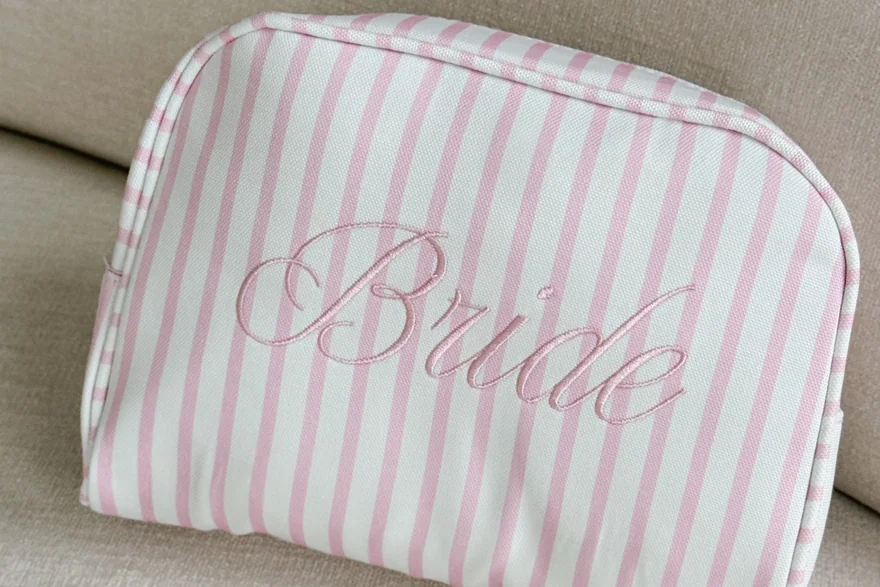
A term abroad turns a wash bag into a storage system with a fixed end date. A student flying out for a 90- to 120-day semester takes one checked case, usually capped at 23 kg by the carrier, and lives out of it for three to four months before the first trip home. That single constraint is what separates a study abroad cosmetic bag from a weekend wash pouch. A weekend pouch is judged on how it looks on a hotel shelf in the first hour of a trip. A term bag is judged on whether a leaking shampoo bottle is caught before it reaches a textbook, whether the hook still holds in week twelve, and whether the lining can be wiped down in a bathroom shared by eight people on a cleaning rota that nobody follows.
The liquids regime is the second hard constraint, and it governs the flight rather than the residence. Cabin baggage is controlled by the TSA 3-1-1 liquids rule: containers of 100 ml or 3.4 oz or less, carried in one transparent resealable bag of roughly one quart or one litre, one bag per passenger. A student therefore packs in two states. On the outbound flight the kit is a set of 100 ml decants inside a clear pouch; once resident, the same student buys 400 ml bottles locally and the bag has to hold those instead. A specification that only fits one of those two states fails in the other.
The third constraint is the room itself. Dormitory and shared-flat bathrooms rarely offer a dry shelf wider than 25-30 cm, and the floor near a shower is wet by definition, so a bag that only stands will spend the term balanced on a radiator or a windowsill. A bag that hangs from a shower rail needs a hook rated for the packed load and a shell that does not distort when the whole kit bears on one point. Weight budget, decant versus bulk, and hanging versus standing determine every dimension that follows, and should be settled before any fabric is chosen.
Sizing the bag around one suitcase, one term and one shared bathroom
Start with the volume budget rather than with a product photograph. A 23 kg checked allowance typically absorbs 12-15 kg of clothing and shoes for a term that crosses two seasons, 2-3 kg of electronics and plug adapters, and 1-2 kg of documents, gifts and a winter coat worn onto the plane. That leaves roughly 2-4 kg and 3-4 L for the wash kit. Because liquids weigh close to 1 g per ml, a kit carrying 600 ml of product is already carrying 0.6 kg before the bag itself is counted, which is why the useful target is an empty weight of 400-650 g and a usable volume of 3.0-4.5 L. Anything heavier is weight the student will feel at the check-in desk; anything smaller forces a repack by mid-term.
Capacity should then be checked against refill cadence, which is the number most briefs omit. A 200 ml shampoo bottle lasts about six weeks at 8 ml per wash on a four-wash week, and a 90-day term is 13 weeks, so the student either refills twice locally or starts with 400 ml. A 75 g toothpaste tube lasts roughly eight to ten weeks at twice-daily brushing with a 0.25 g bead. Designing around those figures means a tall bottle bay with 18-20 cm of internal height that takes a 200-250 ml bottle upright, plus a separate brush and dental bay that keeps a wet toothbrush away from the bottle threads.
Hanging behaviour decides the rest. A hook carrying a 3.2 kg loaded kit from a 22 mm shower rail should be a 180-degree swivel hook with a gate strength above 5 kg, anchored to a webbing yoke 25 mm wide and 10 cm long that spreads the load across the shell rather than through two rows of stitching. The practical test is simple: load the bag to 3.2 kg, hang it for 24 hours, then measure mouth distortion and check that no seam has elongated more than 2 mm. A bag that passes this test will survive a term; one that does not will usually fail within the first six weeks of daily use.
| Format | Packed footprint (cm) | Usable volume (L) | Term-life strength | Where it fails |
|---|---|---|---|---|
| Fold-out hanging case, four panels | 26 x 20 x 10 closed | 3.4-4.0 | Whole kit visible at once; wipes down | Hook yoke tears above 3.5 kg loaded |
| Flat-bottom vanity case | 24 x 15 x 14 | 4.2-5.0 | Stands on a wet shelf; protects palettes | No hang option; borrows floor space |
| Soft pouch trio, large/medium/small | 22 x 15 x 7 each | 2.0-2.6 total | Separates liquids from brushes | Pieces go missing by week six |
| Clear quart-size flight pouch | 20 x 18 x 6 | 1.0-1.2 | Passes the cabin liquids checkpoint | PVC stiffens below 10 C; seams split |
| Moulded EVA shell case | 27 x 18 x 12 | 3.8-4.5 | Crush-proof under a fully packed case | Bulky; hook must be riveted, not sewn |
The last sizing question is the electrical pocket, because most students travel with a heat tool. A travel straightener measures roughly 32 x 4 x 4 cm and 380 g, and is typically rated 110-240 V at 50/60 Hz, so it needs a plug adapter rather than a converter. The bag needs a lined sleeve of at least 34 x 6 x 5 cm with a heat-resistant panel rated to 180 C, because a student will pack a tool that has not cooled. Placing that sleeve on the outer panel keeps warmth away from liquids and from a pale lining.
One further dimension check prevents most returns: the closed bag must pass through the narrowest opening in the student's week, usually a 30 cm gym locker or a 28 cm under-bed drawer. That is why the hanging case above closes to 26 x 20 x 10 cm rather than 30 x 24 x 12 cm. A bag forced into a locker daily ends up left on a bed, and a bag on a bed in a shared room gets borrowed.
Fabrics, liners and closures that survive a dorm bathroom
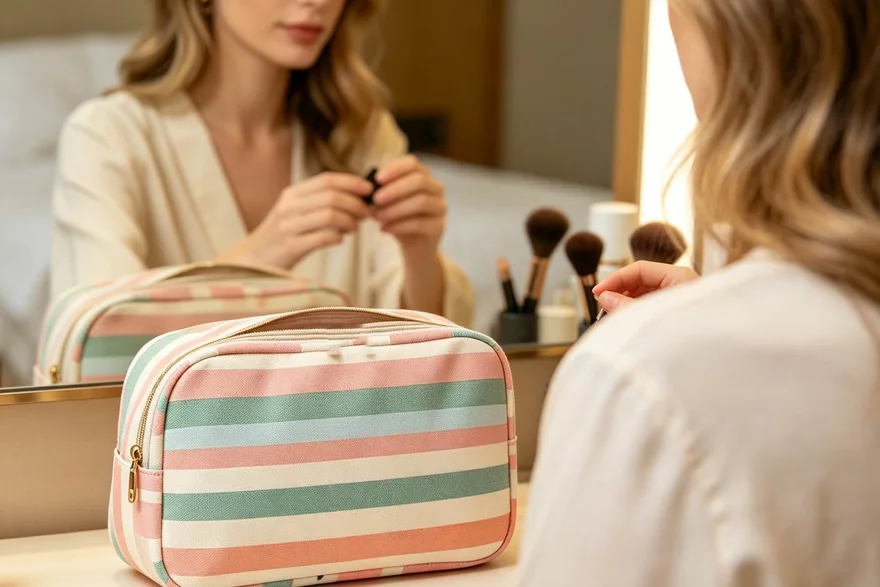
A dorm bathroom is a wet, warm, high-traffic environment with a predictable set of abuses. Humidity routinely exceeds 70% in the twenty minutes after the last morning shower, cleaning agents are sprayed rather than poured and therefore reach the shell, and the bag will eventually go through a 40 C machine wash with whatever else is in the basket. The shell has to resist hydrolysis and abrasion, the lining has to be welded or laminated so a leak cannot migrate into the interlining, and the hardware has to survive a chlorine-based bathroom cleaner without corroding or spotting.
- Shell: 600D polyester with a 0.18-0.22 mm PU coating at 210-240 g/m2, or 420D nylon ripstop at 165-190 g/m2; both hold shape and accept screen or transfer print.
- Lining: 0.30-0.35 mm TPU laminate with radio-frequency welded seams in the liquids bay. A sewn-and-taped seam weeps at the needle holes after 20-30 fill cycles.
- Liner colour: a pale tone around 2-3 on the grey scale makes a 5 ml leak visible immediately; a black liner hides it until the interlining smells.
- Zippers: #5 nylon coil with a reverse-mount slider on the main bay, #3 coil on interior pockets. Metal teeth corrode under bathroom cleaner and snag mesh.
- Hook: 180-degree swivel, gate tested to 5 kg, anchored to a 25 mm webbing yoke at least 10 cm long with bar-tack reinforcement.
- Feet: four moulded studs of 6 mm height on any standing case, so the base never sits in 3 mm of standing water.
- Venting: a mesh panel of at least 60 cm2 on the brush bay, plus a removable liquids liner that can be pulled out and dried overnight.
Colour fastness is the cheapest insurance a buyer can specify, and it is the test most often skipped. A navy or oxblood shell against a pale liner is the classic crocking failure: dye transfers during the first damp week and the lining looks permanently dirty. Buyers should request a rubbing assessment and a washing assessment on the exact shell and lining combination, referencing the ISO 105 colour fastness series and the corresponding AATCC test methods for laundering, with an acceptance grade of 4 or better on the lining. Both documents describe the procedures; neither sets the commercial acceptance level, which belongs in the buyer's own tech pack.
Odour and mould are the hidden failure modes after a damp winter term. A bag folded away at 30% residual moisture will smell within ten days and will carry that smell into the suitcase on the return flight. The specifications that help are a removable liquids liner, a mesh vent panel, and an antimicrobial finish assessed to AATCC 100 or ISO 20743 where the brand intends to claim it. Programmes shipping to northern Europe should also specify a vented polybag with one desiccant sachet per unit.
Zipper terminology is worth pinning down in the tech pack so that a sample rejection is not argued about later. Terms such as coil, chain, slider, tape and top stop are defined in ASTM D2053 zipper terminology, and citing the standard removes ambiguity that otherwise costs a week of sampling time. For a term bag, require 5,000-8,000 open and close cycles on the main zipper with no chain separation, tested on a loaded bag.
Branding durability is the last material decision. A university crest applied by heat transfer will craze and lift after 20-30 laundry cycles, roughly one term of careless washing. Embroidered crests at 6,000-8,000 stitches survive the same period with minor edge fray, at the cost of 1-2 g and a higher unit price. Woven labels sewn into a side seam are the lowest-risk option and the usual choice for a co-branded programme.
Planning a term-time launch: colourways, sampling and carton maths
A study abroad programme is a calendar product, and the calendar is unforgiving. Autumn terms in the northern hemisphere begin in late August and early September, spring terms in early January, and southern hemisphere terms in February and July. Working backwards from a welcome-week date, bulk production of 35-50 days, sampling of 6-10 working days, and sea freight and inland delivery of 25-35 days means the brief needs to be signed roughly 110-130 days before the bags must be on a shelf. Buyers who miss that window have two options: pay for air freight on a partial quantity, or re-date the launch to the following term.
| Programme step | Working days | Decision gate |
|---|---|---|
| Brief, tech pack and material confirmation | 5-8 | Signed dimensions, fabric weight, hardware finish |
| Sampling, standard sewn construction | 6-10 | Fit test with a 200 ml bottle; hook load test |
| Sampling, complex construction (moulded EVA, welded TPU) | 12-15 | Tooling released only after a 1 m drop test |
| Bulk production after sample approval | 35-50 | Pre-production sample retained as the reference |
| Inspection to AQL 2.5 under ISO 2859-1 | 2-3 within the bulk window | Random sampling by lot size, not by pallet |
| Sea freight and inland delivery | 25-35 | Booked against the term start date plus 14 days |
Colourway planning is where the minimum order quantity bites. The rule is 500 pieces per style and colourway, so a three-colourway launch in one style is 1,500 pieces, not 500. A buyer who wants four colours but only has budget for 500 units has two legitimate routes: launch one body colour with four different print or trim variants, which keeps the fabric and tooling common, or commit to four colourways of 500 pieces each and phase the deliveries across two terms. What is not available is a 125-piece split across four colours, because each colourway carries its own fabric dye lot, its own cutting marker and its own trim setup.
Carton maths then determines whether air freight is even thinkable for a late launch. Take the four-panel hanging case: closed at 26 x 20 x 10 cm and 480 g, packed 25 pieces per carton of 60 x 40 x 40 cm. A 500-piece order is 20 cartons, about 1.92 CBM, and about 13 kg gross per carton including the carton itself. At typical air freight rates charged on volumetric weight, 1.92 CBM bills as roughly 320 kg, which is why a late air shipment on a full 500-piece order is usually more expensive than the margin on the goods. Splitting the order into a 150-piece air top-up and a 350-piece sea shipment is the standard rescue, provided the air top-up comes from the same dye lot.
Commercial terms are simple enough to state once and then never renegotiate: shipment on FOB Xiamen terms, payment by T/T with 30% deposit and 70% against bill of lading, and inspection to AQL 2.5 under ISO 2859-1 with the sampling plan sized to the lot. Sampling charges are normally credited against the bulk order once it is placed. Because a term bag is a repeat purchase with a predictable annual cycle, the most valuable thing a buyer can do after the first season is to freeze the approved specification, including fabric lot references and hardware source, so the following year's re-order is a confirmation rather than a new development. QUANZHOU JUNYUAN BAGS coordinates programmes of this type as a sourcing and programme-management partner; specifications and drawings can be sent to service@junyuanbags.com for a feasibility review.
The B2B Customisation View
A realistic cosmetic bags schedule assumes one round of sample revision; planning for a perfect first sample is the most common cause of a slipped launch.
Fixed commercial parameters: 500 pieces per style and colourway minimum, first sample in 6–10 working days (12–15 for complex or hardware-intensive constructions), bulk 35–50 days after approval, AQL 2.5 inspection under ISO 2859-1, FOB Xiamen, T/T 30/70.
A sourcing-partner structure also protects the buyer when volumes grow, because capacity for cosmetic bags can be spread across SGS-verified production lines without changing the specification.
Which Brand Types Benefit Most
Study abroad cosmetic bags suit five buyer profiles, and each values a different part of the specification. University bookstores and campus retailers buy against a hard date and a fixed crest, so they care most about hook strength, embroidery durability and a carton count that matches shelf-ready packaging. Student travel and gap-year brands sell to a customer who will use the bag daily for four months, so they care about welded linings and wipe-down surfaces, because the review that follows a leak in week two is the review that decides the listing. Luggage brands add a term bag as a companion SKU that shares shell fabric, zipper tape and hardware finish with an existing case range, so it runs on the same cutting marker with one substituted panel. Buyers planning a second season should freeze the approved specification, including fabric lot references and hardware source, so the re-order becomes a confirmation rather than a fresh development, and should book the sampling slot against the academic calendar rather than the retail one.
- Start-up brands: a term bag is a credible entry into travel because the specification is defensible on function rather than on print, and 500 pieces per colourway is a realistic first buy.
- Established brands: the same programme extends an existing fabric and hardware platform into a new use case without new tooling, usually within the 6-10 day standard sampling window.
- Retailers and campus stores: colourways and crest placement matter more than capacity, and a 20-carton minimum pallet fits a single-store display plus a stockroom reserve.
- E-commerce sellers: a hanging case with a welded liquids liner earns reviews that mention leakage by name, which is the single strongest conversion signal in this category.
- Gift, orientation and hospitality buyers: welcome-week bundles need a bag that arrives flat-packed, vents in transit and looks presentable with a 6,000-stitch crest and a hangtag.
Frequently Asked Questions
What size cosmetic bag fits a 23 kg checked suitcase alongside a full term of clothing?
Budget 3-4 L and 26 x 20 x 10 cm closed. A 23 kg allowance typically absorbs 12-15 kg of clothing, 2-3 kg of electronics and 1-2 kg of documents, leaving 2-4 kg for the kit. Because liquids weigh about 1 g per ml, 600 ml of product is already 0.6 kg, so an empty bag of 400-650 g keeps the total inside the remaining weight.
How many 100 ml bottles does a 90-day term actually require?
Only enough for the outbound flight, because the cabin rule caps containers at 100 ml. A 13-week term consumes roughly 400 ml of shampoo at 8 ml per wash on a four-wash week, so most students fly with three or four decants and buy full-size bottles locally within the first fortnight. The bag should therefore hold both a 100 ml decant set and a 200-250 ml upright bottle.
Should a study abroad wash bag hang or stand in a shared dorm bathroom?
Hang, because shelf space in a shared bathroom is usually under 30 cm wide and the floor near a shower stays wet. A hanging case needs a 180-degree swivel hook with gate strength above 5 kg, a 25 mm webbing yoke at least 10 cm long, and a packed load kept below 3.5 kg. A standing case is a better call only when the student has a private shelf.
Which zipper type survives daily opening in a humid dorm bathroom?
A #5 nylon coil zipper with a reverse-mount slider on the main bay and #3 coil on interior pockets. Coil chain resists corrosion from chlorine-based bathroom cleaner, whereas metal teeth spot and snag mesh panels. Specify terminology according to ASTM D2053 and require 5,000-8,000 open and close cycles on a loaded bag with no chain separation before sample approval.
How heavy can a hanging cosmetic bag be before a shower rail hook fails?
A hook gate should be rated at least 1.5 times the loaded bag weight, so a realistic 3.2 kg packed kit needs a gate above 5 kg. The failure point is rarely the hook itself; it is the yoke stitching or the shell panel it anchors into. Test by loading to 3.2 kg, hanging for 24 hours, then measuring mouth distortion and seam elongation beyond 2 mm.
What liner colour makes a shampoo leak easiest to detect in a term bag?
A pale liner around 2-3 on the grey scale. A 5 ml leak shows as a dark patch within seconds on a pale TPU laminate, while the same leak on a black liner is invisible until the interlining smells or the shell stains. Pair the pale liner with radio-frequency welded seams, because a sewn seam weeps at the needle holes after 20-30 fill cycles.
Is a clear quart-size pouch needed in addition to the main wash bag?
Yes, for the outbound flight only. The cabin liquids rule requires containers of 100 ml or less inside one transparent resealable bag of roughly one litre, one per passenger. The practical specification is a 20 x 18 x 6 cm clear pouch that stows in an outer pocket of the hanging case, then empties into the main bay once the student is resident and has bought full-size product.
What fabric weight suits a cosmetic bag that gets machine-washed between terms?
A 600D polyester with 0.18-0.22 mm PU coating at 210-240 g/m2, or a 420D nylon ripstop at 165-190 g/m2. Both survive repeated 40 C washes without meaningful shrinkage or coating hydrolysis. Request a colour fastness assessment to the ISO 105 series and the corresponding AATCC laundering method, with acceptance at grade 4 or better on the lining.
How are colourways split across a 500-piece minimum order?
The minimum is 500 pieces per style and colourway, so three colourways in one style is 1,500 pieces. A buyer with a 500-unit budget and four colour ideas should run one body colour with four print or trim variants, which keeps the dye lot and cutting marker common, or phase two colourways across consecutive terms rather than splitting a single 500-piece run.
Can a study abroad bag be personalised with a student's initials?
Personalisation is usually applied at the programme level rather than per student, because a per-unit name change breaks the 500-piece efficiency. Common practice is a 6,000-8,000 stitch embroidered crest or a woven label for the institution, plus a blank writable name panel inside the lid, or a retail personalisation station at orientation where initials are heat-pressed after sale.
What lead time applies when a university welcome-week date is fixed?
Sign the brief 110-130 days before the bags must be on shelf. That covers 6-10 working days for standard sampling, 12-15 working days for complex constructions such as moulded EVA, 35-50 days of bulk production after sample approval, and 25-35 days of sea freight and inland delivery. Missing the window means an air top-up on part of the quantity.
How is mould risk handled after a damp winter term?
Design the bag to dry: a removable liquids liner, a mesh vent panel of at least 60 cm2 on the brush bay, and four 6 mm feet on any standing case. Pack with a vented polybag and one desiccant sachet per unit rather than a sealed bag, and confirm carton moisture content below 12% before loading. A bag folded away at 30% residual moisture will smell within ten days.
Which closure keeps brushes separated from liquids in a single bag?
A welded liquids bay with its own #5 coil zipper, physically divided from the brush bay by a bonded TPU panel rather than a stitched fabric wall. The brush bay should carry elastic loops sized 15-25 mm in diameter and a mesh vent panel, so a wet brush dries instead of wicking into the liquids compartment. Two zippers, two bays, one welded divider.
What inspection level applies before a term-abroad shipment sails?
Inspection to AQL 2.5 under ISO 2859-1, with the sampling plan sized to the lot rather than to the pallet count. On a 500-piece order that means a defined sample size and defined accept and reject numbers for critical, major and minor defects. Critical defects such as a broken hook gate or a split welded seam are normally zero-acceptance regardless of the AQL level.
How many units fit in a shipping carton for a dorm-kit bundle?
For a four-panel hanging case closed at 26 x 20 x 10 cm, plan 25 pieces per carton of 60 x 40 x 40 cm, giving 20 cartons for a 500-piece order, about 1.92 CBM and roughly 13 kg gross per carton. If the bundle also contains a clear pouch and a laundry bag, the carton usually becomes the constraint rather than the piece count, so cube the whole bundle before quoting freight.
Does a study abroad bag need a heat-resistant panel for styling tools?
Yes, if the student carries a straightener or dryer. A travel straightener measures about 32 x 4 x 4 cm and 380 g and is usually rated 110-240 V at 50/60 Hz, so it needs an adapter rather than a converter. Specify a lined sleeve of at least 34 x 6 x 5 cm with a panel rated to 180 C, placed on the outer shell so residual warmth never reaches liquids or a pale lining.
People Also Ask
How early should a student buy a study abroad toiletry bag?
Buy it before the flight rather than on arrival, because the outbound journey is the only point at which the cabin liquids rule applies. A student needs a bag with a clear pouch and a set of 100 ml decants for the flight, and then capacity for full-size bottles bought locally. Purchasing four to six weeks before departure leaves time to test pack a 200 ml bottle and check the hook on a real shower rail.
Do international flights allow full-size shampoo in checked luggage?
Checked luggage is not subject to the 100 ml cabin limit, so full-size bottles can travel in the hold. The practical risk is leakage under pressure and movement, which is why a welded or TPU-laminated liquids bay and bottles with a positive-seal closure matter more than size. Many students still decant for the flight and check the full-size bottles in a sealed bag within the case.
What is the difference between a hanging toiletry bag and a vanity case?
A hanging case folds open into three or four panels and suspends from a hook, giving visibility of the whole kit in a bathroom with no shelf space, typically 3.4-4.0 L. A vanity case has a flat base and a structured lid, stands upright at 4.2-5.0 L and protects palettes and glass jars. Hanging suits shared bathrooms; standing suits a private shelf.
Can one cosmetic bag serve a term abroad and weekend travel home?
Yes, if the bag closes to about 26 x 20 x 10 cm and empty weight stays between 400 and 650 g. That footprint fits a gym locker and a weekend duffel as well as a checked case. The compromise is capacity: a term bag built at 4.5 L feels oversized for two nights, which is why many programmes pair a main hanging case with a small removable pouch.
Request a Sample or a Written Quotation
Send the silhouette, dimensions, material preference and logo artwork, and the programme team will return a written quotation with MOQ, sampling window, bulk lead time and inspection standard.
Email: service@junyuanbags.com · WhatsApp: +86 177 5002 0688