Smart Cosmetic Bags: IoT & Technology Integration Trends
Executive Summary
Smart cosmetic bags are a real sourcing category in 2026, but a narrow one. The question brand owners ask is whether IoT and electronics integration in a cosmetic bag is a shipping reality or a trade-show concept, and the answer is that three formats ship at volume today: illuminated vanity cases with a mirror light, powered travel pouches with a USB-C pass-through and a lining cable channel, and BLE-tagged organisers that pair with a phone find-my network. Illumination and power are production-ready. Sensor-led and app-connected variants remain at prototype scale, usually launched below the 500-piece minimum.
The demand side supports lighting and power and little else. Travel bag for toiletries draws roughly 110,000 monthly searches and toiletry bag roughly 74,810 weekly Amazon searches (ASINSIGHT, 2026.07); custom makeup bag draws 5,400-6,600 monthly searches, which is the pool a smart case competes in. Electronics change the timetable rather than the specification: sampling moves into the 12-15 working day complex window, bulk stays at 35-50 days after approval, inspection runs to AQL 2.5 under ISO 2859-1 with an added function check, shipment is FOB Xiamen, and payment is T/T 30 deposit, 70 against bill of lading.
What smart names in a 2026 cosmetic bag brief
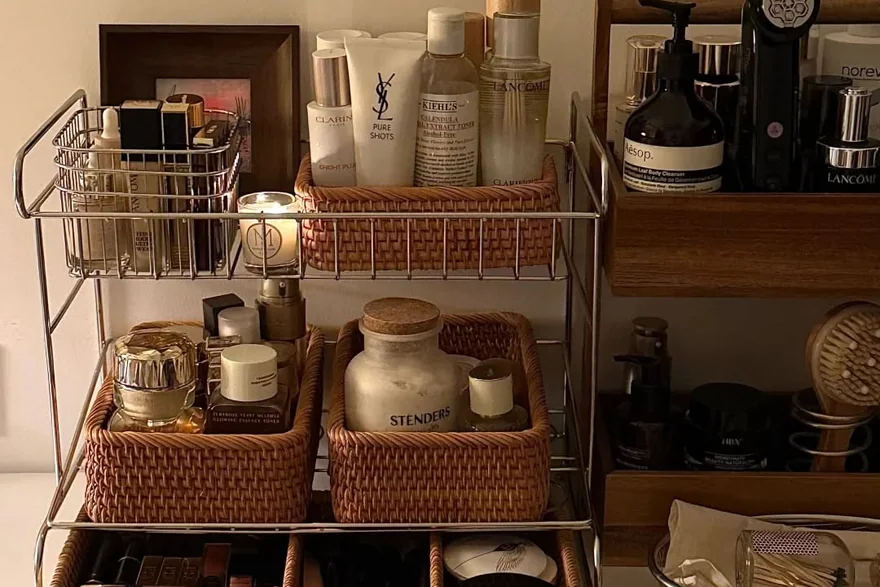
Smart cosmetic bags are the label buyers use when a cosmetic bag, vanity case or beauty organiser carries a function that a purely textile pouch cannot deliver. Inside a sourcing brief the word covers three different things that behave differently in sampling, bulk timing and compliance: illumination, power delivery and connectivity. Treating them as one category is the most common reason a first smart-bag sample disappoints, because a buyer describes a mirror light and receives a specification written for an app-connected device, or the reverse, and neither side notices until the prototype arrives.
Illumination is the mature layer. It normally takes the form of an LED strip or an edge-lit diffuser around an internal mirror, powered by a small rechargeable cell, switched by a hall sensor that fires when the lid opens or by a capacitive touch point on the shell. Power delivery is the second layer: a USB-C port held in a moulded frame, a cable channel inside the lining, and a pocket dimensioned for an external power bank. Connectivity is the third and thinnest layer: a BLE module, a locating tag, or a weight or humidity sensor reporting into a phone application.
Only the first two layers appear in repeat bulk orders, and the reason is unglamorous. A light and a port keep working for the life of the bag with no external dependency, while an app-connected feature depends on firmware, on an operating system version and on a support commitment that outlasts the selling season. A brand owner who commissions a connected case is also commissioning a maintenance obligation, and most cosmetic bag programmes are not staffed to carry one across three or four re-order cycles.
Demand data points the same way. Travel bag for toiletries draws roughly 110,000 monthly searches and toiletry bag roughly 74,810 weekly Amazon searches (ASINSIGHT, 2026.07), which are travel formats where a light and a port solve a real problem in a hotel bathroom with one mirror and one socket. Custom makeup bag, at 5,400-6,600 monthly searches, is where a branded smart vanity case has to win its space, and that pool is small enough that a 500-piece run per style and colourway represents a meaningful share of it rather than a rounding error.
Where electronics enter the bill of materials
A smart cosmetic bag is a textile product with an inserted assembly, and almost all of the engineering risk sits at the seam between the two. The shell is cut, sewn and turned the way any vanity case is; the electronics are fitted into a cavity that has to survive a hinge cycle, a drop onto a tiled floor, and the compression of a suitcase packed at 110 percent of its intended volume. A specification that describes the LED module in detail and says nothing about how the harness crosses the hinge is a specification that will fail at inspection.
| Component | Function inside the bag | Specification to freeze in the tech pack | Failure mode seen at inspection | Effect on programme timing |
|---|---|---|---|---|
| LED mirror module | Edge-lit or strip illumination around an internal vanity mirror | Colour temperature in kelvin, CRI value, diffuser type, run-time in hours per charge | Hot spots, uneven diffusion, adhesive lift at the diffuser edge | Adds one electronics sample round |
| Rechargeable cell | Powers the LED module and any output port | Cell chemistry, rated capacity in mAh, cycle life, protection circuit, cell marking | Capacity below rating, swelling after cycle testing, missing cell marking | Cell sourcing is often the longest single line item |
| USB-C pass-through | Charges a phone or brush from an external power bank | Port orientation, retention after mating cycles, strain relief, cable routing channel | Port looseness, cracked solder joints after repeated plug cycles | Requires a plug-cycle test before bulk release |
| BLE locating module | Pairs with a phone network to report last known location | Firmware version, cell type and access, pairing distance, replaceable-cell door | Pairing failure on current phone operating systems, dead cell on arrival | Firmware version must be frozen before bulk |
| Hall or touch switch | Turns illumination on when the case opens or is tapped | Actuation distance in millimetres, cycles to failure, debounce behaviour | Flicker, false triggering in transit, no positive off state | Adds a switch-cycle line to the function check |
| Wiring loft and harness | Routes power between cell, module and port inside the lining | Wire gauge, sleeve type, anchor points, bend radius at the hinge | Chafing at the hinge, audible rattle, a sharp end pressing through the lining | Hinge bend-test before sample approval |
Each row of that matrix brings a document with it, and the discipline that separates a clean launch from a painful one is requesting those documents at design freeze rather than at pre-shipment. The cell needs a specification sheet and a transport test summary. The port needs a mating-cycle result. The BLE module needs a firmware version recorded in the tech pack so that a re-order eight months later can be matched to the unit already in the field. Buyers who skip this step discover the gap only when the second bulk arrives with a module that pairs differently from the first.
- Freeze the firmware version, cell rating and port orientation in writing before the sample round begins; verbal agreement on electronics is not reproducible at re-order.
- Route every harness crossing a hinge through a sleeve with a stated bend radius, and require a bend-cycle count on the sample.
- Specify an accessible cell door or a documented replacement route, because a sealed cell turns a dead battery into a returned bag.
- Write the run-time claim into the tech pack as a measured value with a test condition, not as a marketing estimate.
One further decision shapes everything downstream: whether the electronics are serviceable. A module bonded into the lining is cheaper to fit and impossible to repair. A module held in a lined pocket with a hook-and-loop or zip access panel costs more in labour and lets a brand owner replace a failed cell instead of replacing the bag. For a vanity case retailing at the top of the typical $0.45-$12.00 unit price band (Alibaba, 2026.10), that choice determines whether a warranty claim is a spare part or a write-off.
Compliance, cell transport and the function gate
Adding a cell and a circuit to a soft bag pulls a cosmetics accessory into the compliance world of portable electronics. The textile obligations do not disappear; they are joined by a second set covering the cell, the wiring and, where the product is marketed to children, the chemical limits and tracking-label duties that apply to consumer goods sold in the United States. The practical consequence is that a smart-bag programme carries two compliance tracks that run in parallel and finish at different times, and a buyer who tracks only one will book a shipment that cannot be cleared.
| Gate | What it covers | Reference cited | When it happens | Evidence the buyer should hold |
|---|---|---|---|---|
| Sampling inspection | Dimensional, visual and workmanship attributes on a random sample | AQL 2.5 under ISO 2859-1 | Before bulk release | Inspection report with accept and reject counts |
| Electrical safety reference | Battery and cell safety expectations for portable electronic products | IEC standards portfolio | At design freeze | Supplier declaration or third-party test report |
| US consumer product limits | Lead and phthalate limits plus tracking-label duties where the product is in scope | CPSIA | Before the first US shipment | Certificate and approved tracking-label artwork |
| Cell transport classification | Whether the packed cell ships as regulated dangerous goods and how it is declared | Carrier rules plus the cell maker test summary | Before booking freight | Test summary and packing declaration |
| Coating and shell durability | Adhesion, abrasion and hydrostatic behaviour of coated shell fabrics | ASTM D751 | At material approval | Coating test record against the stated spec |
| Function cycle protocol | Plug cycles, switch cycles and measured run-time against the stated rating | Buyer-defined protocol | At sample approval | Signed protocol with measured values |
The textile track finishes at material approval; the electronics track finishes at the cell test summary and the function protocol. Bulk booking should wait for the later of the two, not the earlier.
The electrical function check deserves particular care because it is the one attribute that a standard AQL inspection is not designed to catch. ISO 2859-1 sampling procedures, documented at ISO 2859-1, count defective units against an acceptable quality limit for visual and dimensional attributes. A unit whose LED lights but whose port is intermittent after eleven plug cycles may pass a visual AQL draw and fail in a customer's hands in week three, so the function protocol has to be written as a separate document with its own sample size and its own accept criteria.
Battery and cell safety expectations for portable electronics sit in the IEC standards portfolio, and the buyer's job is not to memorise the standards but to obtain the cell maker's test summary and check that the cell is marked. An unmarked cell with no test summary is the single most common cause of a smart-bag shipment being held at booking. In the United States, CPSIA obligations on lead content, phthalates and tracking labels apply where a product falls in scope, which for a glitter-finished or character-themed pouch marketed to under-12s is a live question rather than a theoretical one.
Coated shells deserve their own line because a smart case is often specified in a coated fabric for wipe-clean reasons, and coatings behave differently once a rigid module is glued or riveted to them. ASTM D751, described at ASTM D751, gives the buyer a common language for coating adhesion, abrasion resistance and related properties, so that a dispute about whether the coating lifted during assembly can be settled against a number rather than an opinion.
Sequencing a smart-bag launch without over-committing
The cheapest way to test a smart cosmetic bag is to launch the electronics on one style and the silhouette on two. That sounds contradictory until the economics are laid out: the tooling, the cell sourcing and the firmware freeze are per-electronic-SKU costs, while the pattern, the photography and the listing copy are per-silhouette costs. Running one powered style alongside one non-electronic twin lets a brand owner learn whether buyers are paying for the function or for the shape, using a single 500-piece run per style and colourway.
- Launch lighting before connectivity: an LED mirror module has no external dependency and no firmware to maintain.
- Keep a non-electronic twin in the range with visibly different hardware, so returns can be attributed to the right SKU.
- Book the cell lot at sample approval, not at bulk start; cell lead time is the variable that moves the 35-50 day window.
- Set the re-order trigger on sell-through of the first 500, and re-test the module before re-ordering rather than assuming continuity.
- Decide before launch what happens to a returned electronic unit, who tests it, and what the spares allowance is.
Demand sizing should stay honest. Travel bag for toiletries at roughly 110,000 monthly searches and toiletry bag at roughly 74,810 weekly Amazon searches (ASINSIGHT, 2026.07) describe the travel pouch category, not the smart subset of it, and no search figure in the available data isolates illuminated or powered variants. The defensible reading is that smart features ride on existing travel demand rather than creating a pool of their own, which argues for attaching the electronics to a format that already sells and against building a whole brand on a connected case.
- Lighting-first vanity case: LED module and cell only, no connectivity, no firmware commitment.
- Powered travel pouch: USB-C pass-through plus a lining cable channel and a power-bank pocket dimensioned to the actual device.
- BLE-tagged organiser: locating module behind a lined access panel, chosen only where the brand already operates an app.
- Non-electronic control: same silhouette, different hardware finish, used to isolate what the customer is actually paying for.
After-sales handling is the part of a smart-bag programme most often underestimated. A returned conventional pouch can be inspected, repacked and resold. A returned illuminated case has to be functionally tested before it goes back into stock, and a unit with a flat cell needs a replacement route rather than a repack. Buyers should settle before launch who tests a returned unit and what the spares allowance is, because a small return rate on 500 pieces still produces a handful of units that each need a decision rather than a shelf.
Programme mechanics stay the same as any other custom bag order, with one adjustment. Minimum order quantity is 500 pieces per style and colourway. Sampling runs 6-10 working days for a conventional construction and 12-15 working days for a complex one, which is where every smart format lands. Bulk production is 35-50 days after sample approval, inspection is AQL 2.5 under ISO 2859-1 with the added function protocol, shipment is FOB Xiamen, and payment is T/T 30 deposit with 70 against bill of lading. A buyer who plans the calendar backwards from a seasonal shelf date should add the cell sourcing window on top of the bulk window, not inside it.
The B2B Customisation View
The commercial logic behind makeup bags and toiletry bags is simple to state and hard to execute: hold the unit cost, hold the colour, hold the delivery window.
Commercial parameters stay fixed across the range: MOQ 500 pieces per style and colourway, prototype turnaround 6–10 working days (extended to 12–15 for multi-panel or moulded builds), bulk lead time 35–50 days from approved sample, AQL 2.5 inspection to ISO 2859-1, FOB Xiamen, T/T 30 deposit and 70 against bill of lading.
For makeup bags and toiletry bags, that coordination matters most in the two weeks between packing and vessel loading, when documentation errors cost more than any material decision.
Which Brand Types Benefit Most
The five buyer types in this category want different things from the same electronics, and the useful question is not whether a smart cosmetic bag is a good idea but which layer each business can support after the sale. Start-up colour cosmetics brands should stay on the illumination layer: an LED mirror module needs no app, no firmware maintenance and no update policy, and it photographs well enough to carry a launch on its own. Established beauty brands are the only group with a realistic path to connectivity, because they already employ the people who maintain an app and already hold the customer relationship that makes a pairing feature worth offering. Retailers and specialty chains are better served by a powered travel pouch than by a connected case, since a store can demonstrate a port in ten seconds and cannot demonstrate an app feature in any reasonable time. E-commerce marketplace sellers sit where the typical listing band runs 100-1,000 pieces and the unit price band runs $0.45-$12.00 (Alibaba, 2026.10), which means the electronics have to be justified by review scores and lower return rates rather than by a premium the marketplace will not sustain. Gift and hospitality buyers should treat smart features as a gifting hook only where a cell replacement route exists, because a dead light in a welcome amenity is worse than no light at all. Programmes of this kind are coordinated by QUANZHOU JUNYUAN BAGS, a sourcing and programme-management company coordinating bag programmes since 2014, working with SGS-verified production floor space of 4,950 m² across 7 production lines and 149 machines and monthly output capacity of 200,000 pieces.
- Start-up brands: one illuminated style at 500 pieces, no connectivity, no app commitment.
- Established brands: powered pouch or connected case where an existing app team absorbs the maintenance cost.
- Retailers and chains: demonstrable features at shelf, staged across two colourways rather than one.
- Marketplace sellers: hardware that reduces returns, specified so the photography carries the feature.
- Gift and hospitality buyers: serviceable cell access or no electronics at all.
Frequently Asked Questions
What counts as a smart cosmetic bag rather than an ordinary bag with a light inside?
A smart cosmetic bag contains an integrated electronic function that is part of the product specification: a fitted LED module and cell, a mounted USB-C port with a cable channel, or a BLE or sensor module with a recorded firmware version. A bag sold with a loose mirror light dropped into the pocket is an accessory bundle, not a smart bag, and it carries none of the compliance or inspection obligations described here.
How long does sampling take for a cosmetic bag with an integrated LED mirror?
Sampling runs 12-15 working days for a smart cosmetic bag, because the construction is classed as complex once a module, cell and harness are fitted. A conventional pouch without electronics samples in 6-10 working days. The extra time covers cell sourcing, harness routing at the hinge and the function protocol, not the sewing, which is unchanged.
Which cosmetic bag formats actually carry electronics at volume in 2026?
Three: illuminated vanity cases with an edge-lit mirror, powered travel pouches with a USB-C pass-through and power-bank pocket, and BLE-tagged organisers for brands that already run an app. Everything else in this space is prototype-scale, typically produced in runs below the 500-piece minimum that governs an ordinary custom style. Buyers testing a fourth format should expect to fund the development themselves rather than amortise it across a standard run.
What colour temperature should a brand owner specify for a makeup mirror light?
Specify the colour temperature in kelvin inside the tech pack, together with a CRI value, and require the sample to be photographed under both. A neutral-to-cool band around 4000-6000 kelvin reads as daylight for most makeup application, but the number that matters commercially is consistency across the run, so the tolerance should be stated and checked at inspection.
How is a BLE locating module accessed for cell replacement in a finished bag?
Specify a lined access panel behind a zip or hook-and-loop closure, dimensioned so a cell can be removed and refitted without unpicking the lining. A module bonded directly into the lining turns a flat cell into a dead product, and in a category where the bag outlasts the cell by years, that design choice drives warranty returns.
What inspection standard applies to a cosmetic bag with electronics inside?
Visual, dimensional and workmanship attributes are inspected to AQL 2.5 under ISO 2859-1. The electrical function is not covered by that draw and needs a separate buyer-defined protocol with its own sample size covering plug cycles, switch cycles and measured run-time, signed off at sample approval and repeated at pre-shipment. The panel should be dimensioned in the tech pack rather than left to the line to decide.
Why does cell sourcing often drive the bulk lead time more than the shell does?
Shell fabric, lining, zips and hardware are stocked or woven to schedule, but a cell of a specific chemistry, capacity and marking has to be matched to a maker's production slot and then tested for transport classification. Book the cell lot at sample approval rather than at bulk start, and treat the 35-50 day bulk window as running after the cell is in hand.
What does CPSIA require of a smart cosmetic bag sold in the United States?
Where a product falls in scope, CPSIA sets lead and phthalate limits and tracking-label duties. A glitter-coated or character-themed pouch marketed to children is the realistic in-scope case for this category. Buyers shipping to the US should obtain the certificate and approved tracking-label artwork before the first shipment rather than after a hold at the port.
How is a lithium cell inside a bag declared for transport?
The cell maker's test summary determines whether the packed cell ships as regulated dangerous goods and under which packing instruction. The buyer should hold that summary and the packing declaration before booking freight, because an unmarked cell with no test summary is the most common reason a smart-bag shipment is held at booking. Confirming the cell maker's slot at design freeze removes most of that uncertainty from the bulk calendar.
What run-time figure should appear in the tech pack for a mirror light?
State a measured run-time in hours per charge together with the test condition: brightness setting, ambient temperature and whether the figure is continuous or intermittent use. A run-time quoted without a condition cannot be verified at inspection, and it becomes the number a customer disputes when the first unit falls short. Adult-market bags are assessed on general product safety expectations rather than on those specific duties.
What stops a USB-C port from loosening after repeated plug cycles?
Specify the port orientation, a moulded retention frame rather than an adhesive mount, a strain-relief boot on the harness and a mating-cycle count the sample must survive. Cracked solder joints and port looseness are the two failure modes a visual AQL inspection will not catch, so they belong in the function protocol with a stated cycle figure.
Should a smart cosmetic bag programme carry a firmware support commitment in the supply agreement?
Yes, where the bag contains a BLE or sensor module. Firmware depends on phone operating system versions that change independently of the bag, so the agreement should state which version is shipped, how long it is supported, and what happens at re-order. Without it, a second bulk can arrive with a module that pairs differently from the first.
How many units per style and colourway does a smart cosmetic bag programme require?
Minimum order quantity is 500 pieces per style and colourway, the same as a conventional custom bag. Because smart formats need a cell lot and a frozen firmware version, splitting the 500 across multiple electronics variants usually costs more than concentrating it on one, so the first run should be one module in one silhouette.
What payment and shipment terms apply to a first smart-bag bulk order?
Shipment is FOB Xiamen and payment is T/T 30 deposit with 70 against bill of lading, unchanged from a non-electronic programme. What changes is the pre-booking paperwork: the cell test summary, the packing declaration and the function protocol report all have to be in hand before freight is booked. Splitting a run across several electronics variants usually raises the cost of each one.
What is the safest way to test demand for a smart cosmetic bag before committing?
Run one powered style alongside a non-electronic twin of the same silhouette with visibly different hardware, both at 500 pieces. That isolates whether the customer is paying for the function or the shape, and it produces a control SKU that can be re-ordered on the normal 6-10 working day sample and 35-50 day bulk cycle if the electronics underperform.
People Also Ask
Are smart makeup bags worth the extra cost?
They are worth it when the electronics solve a problem the customer already has in a travel or vanity context, and not when the feature exists to justify a price rise. The test is whether the function survives daily use without external support: an LED mirror light does, an app-paired sensor does not. Buyers can check the demand side against travel bag for toiletries at roughly 110,000 monthly searches.
Do LED makeup mirrors in bags need certification?
The cell and the assembly carry portable-electronics safety expectations referenced in the IEC standards portfolio, and the finished bag still answers to textile and consumer-product rules in the destination market. The buyer does not need to memorise the standards, but does need the cell maker's test summary, cell marking and a function protocol before booking freight. A control SKU answers the question faster than a forecast does.
How long do the batteries in smart cosmetic bags last?
Two different answers matter: charge-to-charge run-time, measured in hours per charge under a stated condition, and cell service life, measured in charge cycles. Both should be written into the tech pack as measured values. A serviceable access panel matters more than either figure, because the bag will outlast the cell. Booking freight before those documents exist is the mistake that costs the most time.
Can a smart cosmetic bag go in hand luggage on a plane?
A bag with an installed lithium cell normally travels in the cabin rather than the hold, subject to the carrier's rules and to the cell being marked and declared. Separate power banks carried in the pouch follow the same logic. Buyers should confirm the airline's current watt-hour allowance at the time of travel rather than relying on a figure printed on packaging.
Request a Sample or a Written Quotation
Send the silhouette, dimensions, material preference and logo artwork, and the programme team will return a written quotation with MOQ, sampling window, bulk lead time and inspection standard.
Email: service@junyuanbags.com · WhatsApp: +86 177 5002 0688