Round vs Rectangular vs Cylindrical Cosmetic Bags
Executive Summary
Round vs rectangular vs cylindrical cosmetic bags is a question of usable volume, not of style. A rectangular bag converts 88-94 percent of its external volume into space a shopper can actually fill, because bottles and palettes pack against flat walls. A cylindrical bag converts 74-80 percent, and a flat round disc converts only 62-70 percent, because curved walls leave unusable gaps around rigid contents.
Geometry then drives everything downstream: pattern complexity, zipper length, carton density and how the bag stands on a shelf. Rectangular is the default for full-size programmes; cylindrical suits brushes and tubes; round flat discs suit gifting and promotional budgets. Programmes start at 500 pieces per style and colourway, sample in 6-10 working days and run 35-50 days in bulk after approval. The quickest way to settle a shape argument is to fill a sample with the actual contents list and close the zip; a shape that will not close over the intended kit is disqualified regardless of how it looks empty.
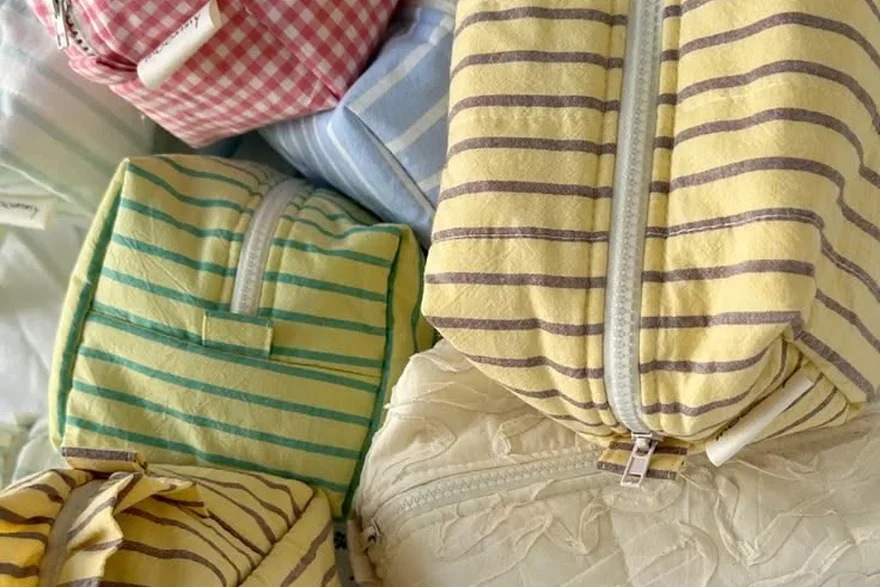
Three Geometries and Where the Volume Actually Goes
Three shapes cover almost every brief in the category. A rectangular bag is a box: flat front, flat back, four sides and a base, with the opening either along the top or across the front. A cylindrical bag is a tube with circular or elliptical end panels and a curved side wall carrying the zipper. A round bag in trade usage means a flat disc: two circular panels joined by a narrow side wall of 3-6 cm, closer to a coin purse than to a box.
The difference that matters is usable volume, which is the share of the internal space a shopper can fill with real objects. A rectangular bag at 24 x 16 x 10 cm holds 3.84 litres externally and delivers roughly 3.4-3.6 litres of usable space. A cylindrical bag of the same external volume loses 20-26 percent to the curved wall, because a rectangular bottle leaves a crescent-shaped gap wherever it meets a curve. A flat round disc at 22 cm diameter and 6 cm deep holds 2.28 litres externally and delivers only 1.4-1.6 litres of usable space.
- Rectangular: 88-94 percent usable volume; the default for full-size contents
- Cylindrical: 74-80 percent usable volume; suits brushes, tubes and pencils
- Round flat disc: 62-70 percent usable volume; suits sample and gift budgets
- Rule of thumb: a round disc needs 40 percent more external size to hold the same kit
Search intent reflects the split. Travel bag for toiletries draws roughly 110,000 monthly searches and the product behind it is overwhelmingly rectangular, because a wash bag has to hold bottles upright. Custom makeup bag runs 5,400-6,600 monthly searches and that intent is far more open to round and cylindrical shapes, because the buyer is choosing a branded gift rather than solving a packing problem.
Whatever the shape, the programme mechanics are fixed: 500 pieces per style and colourway, 6-10 working days of sampling extended to 12-15 where tooling is involved, 35-50 days of bulk after approval, and release against final random inspection at AQL 2.5 under ISO 2859-1, shipped FOB Xiamen. Typical unit prices on trade marketplaces span 0.45-12.00 dollars (Alibaba 2026.10).
One clarification saves time at sampling: round in this article means a flat disc, while a cylindrical bag is what many buyers casually call a round bag when it stands on its end. The two behave completely differently on a shelf and in a carton, so a specification should always give three dimensions plus the shape word, for example cylindrical 22 cm high x 12 cm diameter.
Pattern Complexity, Tooling and Zipper Geometry
Geometry sets the pattern cost before a single unit is cut. A rectangular bag is four or five flat pieces plus a binding, all cut on a straight knife from a rectangular marker, with fabric waste of 4-8 percent. A cylindrical bag needs a curved side wall that must match the circumference of the end panels exactly, plus the panels themselves, and the marker waste rises to 9-16 percent because circles do not nest.
| Construction factor | Rectangular | Cylindrical | Round flat disc |
|---|---|---|---|
| Pattern pieces | 4-6 flat pieces | Side wall plus 2 end panels | 2 discs plus 1 side strip |
| Marker waste | 4-8 percent | 9-16 percent | 12-20 percent |
| Seam length per unit | 1.4-1.9 m | 1.1-1.5 m plus curve setting | 0.9-1.2 m |
| Zipper path | Straight, 40-60 cm | Curved, 38-52 cm on an arc | Straight or curved, 35-45 cm |
| Assembly time | 8-12 minutes | 12-18 minutes | 7-10 minutes |
| Tooling required | None, die-cut board at most | Former or moulded end panel above 3,000 pcs | None |
The zipper is where curved geometry gets expensive. A straight zipper on a rectangular bag is a single pass on a standard machine at 8-12 seconds. A zipper set into a curved cylindrical wall has to be fed on an arc, which needs a skilled operator and a walking-foot or cylinder-bed machine, and misalignment shows immediately as a wavy closure. Zipper types, gauges and component terminology are standardised under ASTM D2053, which helps when a curved path has to be specified across two countries.
A cylindrical bag also needs something to hold its section. Below roughly 3,000 pieces the usual solution is a die-cut EVA or PE board rolled inside the side wall, which costs 0.06-0.14 dollars and is cut on the same die as the end panel. Above that volume a moulded end panel or a vacuum-formed shell becomes economic at a tooling cost of 400-1,200 dollars, and it holds the circle true through packing and shipping in a way a die-cut board does not.
Round flat discs are the cheapest of the three to assemble at 7-10 minutes, because there are only three pieces and the side strip is a simple straight band. The cost sits elsewhere: the disc wastes the most fabric of the three shapes, because two circles cut from a rectangular marker leave four large corner offcuts. A buyer can recover part of that by using the offcuts for a matching round mirror or a small round pouch in the same programme.
Lining behaves differently by shape and is a common source of a bag that will not close. A rectangular lining is cut from the same pattern as the shell and drops in cleanly. A cylindrical lining has to be cut slightly smaller in circumference than the shell so it does not bunch against the curve, typically 3-5 percent smaller, and it needs a second seam allowance at the base. Getting this wrong produces a bag whose interior rucks up and steals usable volume, which defeats the point of choosing the shape in the first place.
Always give three dimensions plus the shape word. Cylindrical 22 cm high x 12 cm diameter is unambiguous; round 22 cm can mean either of two very different products.
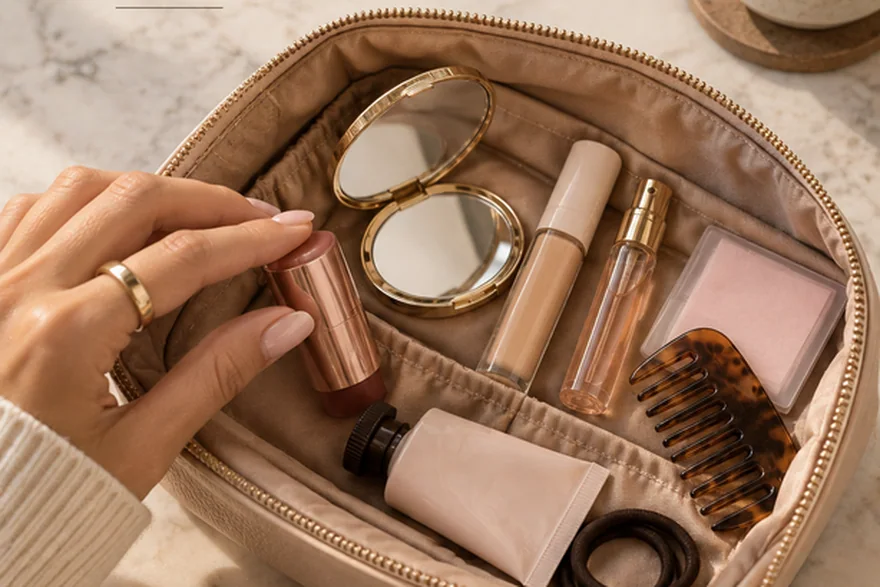
Packing Density, Shelf Behaviour and Transit
Shape decides how the product travels and how it presents, and those two are frequently in conflict. Rectangular bags pack into a carton with almost no void, stand on a shelf unaided and stack two or three high. Cylindrical bags leave a void at every corner of the carton, roll on a shelf unless the base is weighted, and cannot be stacked. Round discs pack flat and cheaply but present poorly upright.
| Logistics and shelf factor | Rectangular | Cylindrical | Round flat disc |
|---|---|---|---|
| Carton void | 5-10 percent | 18-28 percent | 8-14 percent |
| Units per 60 x 40 x 40 cm carton | 30-44 at 24 x 16 x 10 cm | 22-34 at 22 x 12 cm | 55-80 at 22 x 6 cm |
| Shelf stability | Stands and stacks unaided | Rolls unless base is weighted | Lies flat or hangs only |
| Facings per 60 cm bay | 12-16 | 10-14 | 8-12 on a rack or peg |
| Transit deformation risk | Low, 0.5-1.5 percent | Moderate, 2-4 percent crush | Very low, below 0.5 percent |
| Merchandising hardware needed | Shelf or riser | Acrylic cradle or base weight | Peg hook or flat tray |
Carton void is the hidden cost of cylindrical product. An 18-28 percent void means paying to ship air, and on a 5,000-piece sea shipment at roughly 45 dollars per cubic metre that is 250-600 dollars of wasted freight per order. The practical fix is a nested carton layout with alternating orientation, which typically recovers 8-12 points of void, or a slightly smaller carton with a compression allowance.
Shelf behaviour is the reason rectangular dominates retail. A cylindrical bag that rolls is a merchandising problem that staff will not solve; it ends up lying down in the bay and losing its facing. Where a brand insists on a cylindrical shape for shelf retail, the specification should include either a weighted base disc of 60-120 g or a flat spot pressed into the base, both of which cost 0.08-0.20 dollars and stop the roll.
Round discs behave almost the opposite way and are underrated for that reason. They pack 55-80 per carton, they do not deform in transit, and they hang perfectly on a peg with a simple grommet. Their weakness is presentation: lying flat in a tray, a disc shows only its top face, so the brand mark has to be centred and the print has to be legible at a steep viewing angle. Impulse and checkout fixtures suit them very well for that reason.
Freight arithmetic follows directly from the carton figures. On a 5,000-piece sea shipment at roughly 45 dollars per cubic metre, the 18-28 percent void of a cylindrical programme costs 250-600 dollars of wasted cube per order against an equivalent rectangular programme. Buyers who want the cylindrical shape but not the freight penalty can specify a slightly smaller diameter, because volume rises with the square of the radius: cutting a 12 cm diameter to 11 cm reduces section area by roughly 16 percent while barely changing what the bag will hold.
Returns also track shape. Rectangular bags return at roughly 2-4 percent overall, with smaller-than-expected the dominant reason. Cylindrical bags return at 4-7 percent, with crushed-on-arrival the dominant reason, which is a packaging fix rather than a design fix: a formed insert or a corrugated divider in the carton typically removes one to two points. Round discs return lowest at 1-3 percent, mostly for perceived size, because the shape is cheap, soft and difficult to damage in transit.
Choosing by Use Case: Brushes, Palettes, Travel and Gifting
The decision usually resolves itself once the contents are named. A bag has to fit what goes inside it, and each geometry suits a different kit. Working backwards from the contents list is faster and more reliable than working forwards from a mood board, and it prevents the most common failure in the category: a beautiful bag that will not close over the products it was designed to hold.
| Use case | Best geometry | Reference size | Reason |
|---|---|---|---|
| Brush and pencil kits | Cylindrical | 22 x 12 cm | Tubes match the section, no wasted corners |
| Full-size bottles and palettes | Rectangular | 24 x 16 x 10 cm | Flat walls let rigid items pack tight |
| Travel wash bag | Rectangular | 26 x 18 x 11 cm | Bottles stand upright, fits a suitcase |
| Lipstick and sample gifting | Round flat disc | 20 x 5 cm | Low cost, hangs on a peg, packs flat |
| Skincare tubes and rollers | Cylindrical | 20 x 10 cm | Round contents pack efficiently in a round bag |
| Checkpoint liquids bag | Rectangular, clear | 20 x 15 x 6 cm | Fits the tray and the 3-1-1 requirement |
| Modular vanity system | Rectangular | Nested set of 3 | Stacks, nests and ships as a set |
Travel deserves a specific note because the liquids rule shapes the geometry. Under the TSA 3-1-1 liquids rule, liquids must be in containers of 100 ml or less inside a single quart-size transparent bag, which in practice means a flat rectangular clear bag at roughly 20 x 15 x 6 cm. A cylindrical clear bag does not use a screening tray efficiently and will not hold four 100 ml bottles upright side by side.
Gifting is where the round disc earns its place. At a unit cost in the 0.85-2.40 dollar band, a 20 cm round pouch with a centred one-colour print is the cheapest branded gift that still reads as a product rather than as a wrapper, and 55-80 units per carton keeps the freight contribution negligible. The limitation is honest and should be planned for: a disc will not hold a full-size kit, so the gift copy should describe it as a pouch for essentials rather than as a travel bag.
A mixed programme is the usual commercial answer. A three-piece set with a rectangular hero bag, a cylindrical brush case and a round disc for samples covers every use case, shares one lining and one hardware set, and merchandises as a family. Each piece is a separate style against the 500-piece minimum, so a three-piece set in two colourways is six minimums, and buyers should confirm that arithmetic before the brief is issued.
Photography cost is the last practical difference and it follows shelf behaviour. A rectangular bag stands unaided and shoots in 8-12 minutes per SKU. A cylindrical bag needs a cradle or a hidden base weight, adding 6-10 minutes per SKU, and it needs a rim light to separate the curve from the background. A round disc needs a flat-lay or a peg shot and reads smaller than shoppers expect unless a scale reference such as a lipstick or a compact is placed beside it in the frame.
- Name the contents first, then the geometry; the shape follows the kit
- Cylindrical for tubes and brushes, rectangular for bottles and palettes, round disc for gifting
- Cylindrical on shelf needs a 60-120 g weighted base or a flat spot or it will roll
- A three-piece mixed set is six minimums at 500 pieces per style and colourway
The B2B Customisation View
The route from concept to shelf for makeup bags and toiletry bags is short when the specification is tight at the start, and painfully long when it is not.
Fixed commercial parameters: 500 pieces per style and colourway minimum, first sample in 6–10 working days (12–15 for complex or hardware-intensive constructions), bulk 35–50 days after approval, AQL 2.5 inspection under ISO 2859-1, FOB Xiamen, T/T 30/70.
The role played here is programme coordinator: QUANZHOU JUNYUAN BAGS translates a retail brief into a factory-ready technical pack and then audits the output against it before goods leave the floor.
Which Brand Types Benefit Most
Start-up brands usually launch with one rectangular bag at 24 x 16 x 10 cm, because it is the cheapest shape to tool, the easiest to photograph and the most forgiving of an uncertain contents list. Adding a cylindrical brush case as the second SKU is a natural step for a colour-cosmetics brand, and the tooling is small: a die-cut end panel rather than a mould below 3,000 pieces. Established brands tend to build a three-piece set around one Pantone story, using the rectangular bag as the hero, the cylindrical case as the premium piece and the round disc as the gift-with-purchase that introduces the range. Retailers building a house-brand fixture usually take only the rectangular shape for the first season and add the others once the sell-through data justifies a second tooling spend, because each new shape is a separate 500-piece minimum and a separate pattern development. Buyers committing to a second shape should also allow a longer sampling window, since a cylindrical bag with a curved zipper path typically needs two to three days more than a rectangular bag of the same volume.
- Retailers: rectangular for shelf bays because it stands and stacks; avoid cylindrical unless a weighted base is specified.
- E-commerce sellers: rectangular for the volume SKU, round discs for low-price add-on and bundle items that ship flat.
- Gift and hospitality buyers: round flat discs and small rectangular pouches, because 55-80 units per carton keeps the landed cost low.
- Travel and outdoor brands: rectangular, and clear where the liquids rule applies, because bottles have to stand upright.
- Professional and salon brands: cylindrical for brush and tool kits, rectangular for palettes and bottles, sold as a two-piece set.
- Skincare and serum brands: cylindrical, because tubes and rollers pack efficiently in a round section and the shape reads as modern on a shelf.
Frequently Asked Questions
How much usable space does a cylindrical cosmetic bag lose to its shape?
Typically 20-26 percent compared with a rectangular bag of the same external volume, because a rectangular bottle leaves a crescent-shaped gap wherever it meets a curved wall. A cylindrical bag rated at 3.0 litres externally delivers roughly 2.2-2.4 litres of usable space, against 2.6-2.8 litres for a rectangular bag of the same external size. Size a cylindrical bag from the contents list rather than from a dimension copied off a rectangular style.
Why does a cylindrical bag roll on a retail shelf?
Because a true circular section has no stable resting point. The fixes are a weighted base disc of 60-120 g, a flat spot pressed into the base panel, or an acrylic cradle supplied with the fixture. Each costs 0.08-0.20 dollars per unit, and without one the bag will end up lying down in the bay and losing its facing. Confirming the fix on the sample before bulk is cheaper than discovering the problem at the fixture.
What stops a cylindrical bag from losing its shape in transit?
An internal stiffener. Below about 3,000 pieces the usual solution is a die-cut EVA or PE board rolled inside the side wall, at 0.06-0.14 dollars. Above that volume a moulded end panel or a vacuum-formed shell at 400-1,200 dollars of tooling holds the circle true through packing and shipping in a way a board does not. A moulded shell also improves the hand-feel, which matters on a premium cylindrical SKU.
Why is a curved zipper more expensive to fit?
A straight zipper on a rectangular panel is a single pass at 8-12 seconds on a standard machine. A zipper set into a curved wall has to be fed on an arc using a walking-foot or cylinder-bed machine by a skilled operator, and any misalignment shows immediately as a wavy closure. Zipper terminology is standardised under ASTM D2053. Buyers should allow an extra two to three days of sampling for a curved zipper path.
How many units of each shape fit in a standard export carton?
A rectangular bag at 24 x 16 x 10 cm packs 30-44 per 60 x 40 x 40 cm carton; a cylindrical bag at 22 x 12 cm packs 22-34; a round disc at 22 cm diameter and 6 cm deep packs 55-80. The cylindrical void of 18-28 percent is the worst of the three and is the main reason the shape costs more to ship.
Can a round cosmetic bag be used as a travel wash bag?
Not effectively. A flat round disc at 20 cm diameter and 5-6 cm deep holds only 1.4-1.6 litres of usable space and will not take four 100 ml bottles upright. It works well as an essentials pouch or a gift, and the copy should describe it that way rather than implying it will carry a full travel kit. A small rectangular pouch at 20 x 15 x 6 cm holds the same kit in a shape that packs flat.
Which shape satisfies the TSA liquids rule best?
A flat rectangular clear bag at roughly 20 x 15 x 6 cm. Liquids must be in containers of 100 ml or less inside a single quart-size transparent bag, and a rectangular shape uses the screening tray efficiently and holds four bottles upright. A cylindrical clear bag wastes tray space and will not hold the bottles side by side. The bag should also lift out of the suitcase easily, because screeners regularly ask for that.
What minimum applies to a cylindrical cosmetic bag with a moulded end panel?
500 pieces per style and colourway applies to standard constructions. Where a new mould is commissioned for the end panel, a tooling charge of 400-1,200 dollars applies and the minimum may rise by agreement. Buyers can usually hold 500 pieces by using a die-cut board from an existing circular profile instead of commissioning a new mould. Amortised over 3,000 pieces, tooling of 400-1,200 dollars adds only 0.13-0.40 dollars per unit.
How long does sampling take for a cylindrical or round bag?
Six to ten working days for a cylindrical bag with a die-cut end panel and for any round flat disc. Where a moulded end panel, a vacuum-formed shell or custom hardware is involved, sampling runs 12-15 working days. Bulk then takes 35-50 days after approval, and the inspection slot should be booked before the goods are packed. Booking the inspection slot before the goods are packed avoids a delay at the end of the run.
Which geometry is cheapest to produce per unit?
A round flat disc is cheapest to assemble at 7-10 minutes and only three pattern pieces, but it wastes the most fabric at 12-20 percent because circles do not nest on a marker. A rectangular bag at 8-12 minutes and 4-8 percent waste is usually the cheapest overall once the fabric is counted, which is why it remains the default.
Do round discs need special merchandising hardware?
They need either a peg hook with a grommet or a flat tray. Lying flat in a tray, a disc shows only its top face, so the print has to be centred and legible at a steep viewing angle. Checkout and impulse fixtures suit the shape well; a conventional shelf bay does not, because the disc cannot be faced upright.
Can one programme combine all three shapes under one minimum?
No. The 500-piece minimum is per style and colourway, so a three-piece set in two colourways is six minimums, or 3,000 pieces in total. Buyers reduce the impact by sharing one lining, one zipper gauge and one Pantone set across the three shapes so the material purchase is consolidated into a single buy. Confirming the arithmetic before the brief is issued avoids an unwelcome surprise at quotation.
What fabric waste should be expected for each shape?
Roughly 4-8 percent for a rectangular bag, 9-16 percent for a cylindrical bag whose end panels are circles, and 12-20 percent for a round flat disc. The disc offcuts are large enough to be useful, and many programmes cut a matching round mirror or a small round accessory pouch from the same marker. Waste is one reason a round disc of equal capacity can cost more to make than a rectangular bag.
Which shape photographs best for a marketplace listing?
Rectangular, because it stands unaided and needs no support, with studio time of 8-12 minutes per SKU. A cylindrical bag needs a cradle or a base weight to stop it rolling, which adds 6-10 minutes. A round disc needs a styled flat-lay or a peg shot, and reads smaller than shoppers expect unless a scale reference is included. A cradle used in photography can often be reused as the shelf fixture, which recovers part of the cost.
Is a cylindrical bag better for makeup brushes?
Yes. Brushes, pencils and tubes have round sections, so a cylindrical bag at about 22 x 12 cm wastes no space around them, and the curved wall supports them upright rather than letting them slide. A rectangular brush case of the same volume leaves a gap at each corner and lets brushes shift in transit. A cylindrical case also stands upright on a counter, which matters while brushes are being selected.
How should geometry be written into a specification?
Give three dimensions plus the shape word. Cylindrical 22 cm high x 12 cm diameter is unambiguous, whereas round 22 cm can describe either a flat disc or a standing cylinder. Add the zipper path, straight or curved, and the stiffener type, so the sample that arrives is the shape that was intended. Adding the shape word to the tech pack title prevents the wrong pattern being pulled at sampling.
People Also Ask
Which cosmetic bag shape holds the most?
Rectangular, by a wide margin. It converts 88-94 percent of external volume into usable space, against 74-80 percent for a cylindrical bag and 62-70 percent for a flat round disc. A round disc needs roughly 40 percent more external size to hold the same kit, which is why it is used for gifting rather than for storage. A round disc needs about 40 percent more external size to hold the same kit, so compare capacity, not dimensions.
Why are cylindrical makeup bags popular for brushes?
Brushes and tubes have round sections, so a cylindrical bag wastes no space around them and the curved wall holds them upright instead of letting them slide. A rectangular case of the same volume leaves a gap at each corner. A cylindrical brush case at about 22 x 12 cm is the standard professional format. The curved wall also holds brushes upright instead of letting them slide, which protects the tips in transit.
Do cylindrical cosmetic bags cost more to ship?
Yes. The circular section leaves 18-28 percent void in a carton against 5-10 percent for a rectangular bag, so a 5,000-piece sea shipment carries 250-600 dollars of wasted freight. Alternating the orientation in a nested carton layout typically recovers 8-12 points of that void. Alternating orientations in a nested carton layout typically recovers 8-12 points of that void at no material cost.
Should I choose a round or rectangular cosmetic bag for a gift-with-purchase?
A round flat disc if the gift holds samples or a lipstick, because it costs 0.85-2.40 dollars FOB and packs 55-80 per carton. Choose a small rectangular pouch if the gift has to hold a full-size item, because a disc will not. Both should carry a centred print, since a disc lying in a tray shows only its top face.
Request a Sample or a Written Quotation
Send the silhouette, dimensions, material preference and logo artwork, and the programme team will return a written quotation with MOQ, sampling window, bulk lead time and inspection standard.
Email: service@junyuanbags.com · WhatsApp: +86 177 5002 0688