Organic Cotton Cosmetic Bags: GOTS Certification & Sourcing
Executive Summary
Organic cotton cosmetic bags are wash bags, pouches and vanity cases whose main cloth is woven from cotton grown without synthetic pesticides, synthetic fertilisers or genetically modified seed, verified through the fibre chain by an organic standard rather than by supplier statement. For most programmes the practical specification lands on 10 oz to 12 oz organic cotton canvas, roughly 340 to 410 g/m², either plain or twill weave, with a lining chosen to suit the product's intended wet or dry use.
Certification is what makes the claim legal rather than decorative. The Global Organic Textile Standard sets fibre thresholds for labelling, restricts chemical inputs, requires wastewater treatment at wet processors and adds social criteria, and it is evidenced by scope certificates for each site plus transaction certificates per shipment. Organic is not automatically lower impact: cotton still uses water, and dyeing, coating and freight carry their own burden. Programmes start at 500 pieces per style and colourway, sampling takes 6 to 10 working days, and bulk ships 35 to 50 days after approval to AQL 2.5 under ISO 2859-1, FOB Xiamen, T/T 30 deposit and 70 against bill of lading.
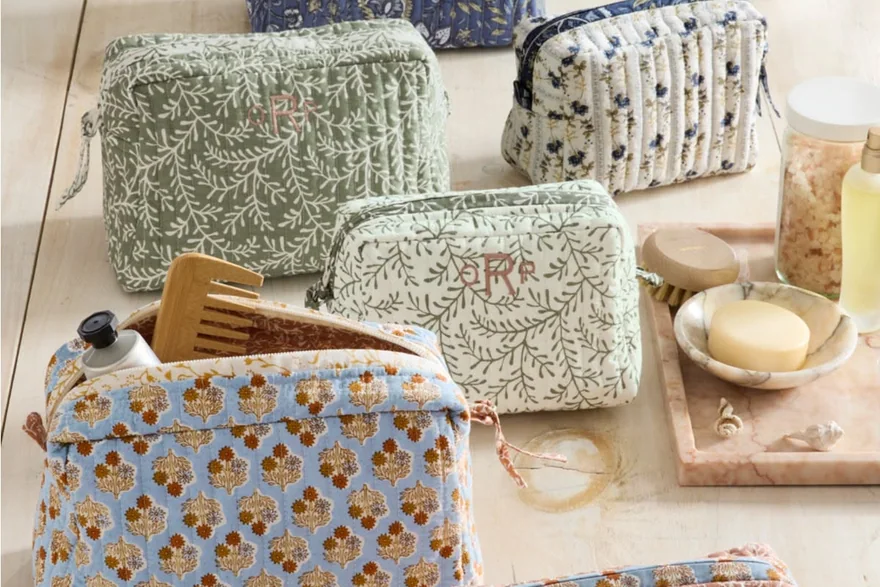
What organic cotton means once it becomes a cosmetic bag
Organic cotton is cotton grown under rules that prohibit synthetic pesticides and synthetic fertilisers, prohibit genetically modified seed and require crop rotation and documented farming practice, with those rules verified annually by an accredited body. Everything after picking is a separate question. Ginning, spinning, weaving, dyeing, finishing and sewing are industrial processes, and it is perfectly possible to take certified organic fibre and finish it with inputs that undermine the point of growing it organically. That is why the fibre certificate alone never satisfies a serious buyer, and why the scope of a processing certificate matters as much as the certificate itself.
In this product category the fabric almost always arrives as canvas or twill rather than as a light shirting. Useful weights run from about 8 oz canvas, near 270 g/m², for a soft fold-flat pouch, through 10 oz at roughly 340 g/m² and 12 oz near 410 g/m² for a structured wash bag that stands on a shelf, to 16 oz and above for a heavy vanity case that must hold its shape around cosmetics bottles. Weave choice changes surface more than strength: plain canvas reads flat and print-friendly, twill shows diagonal texture and hides scuffs better, and basket weave gives a coarser, rustic hand.
A cosmetic bag spec should also state what happens next. Options include no finish at all, which gives the most natural hand and least contamination but stains readily; a fluorocarbon-free water-repellent finish, which a GOTS-certified finisher can apply with approved inputs; wax impregnation for a heritage look; or a PU or TPU back-coat that makes the bag wipe-clean. The last is often what buyers want functionally, and it is where several otherwise attractive claims stop being true. Printing follows the same logic, since inks also have to be acceptable to the finisher's certification.
Different product formats pull different constructions out of the same fibre. A flat zip pouch rarely needs more than 8 oz canvas with a bound inner seam. A hanging wash bag wants 10 or 12 oz, a reinforced panel behind the hook and a wipe-clean lining, because it meets damp contents. A vanity case needs 16 oz plus a base stiffener and usually a zip frame rather than a coil zip, since it has to stay open while being filled.
Reading a GOTS scope certificate before you buy the cloth
The Global Organic Textile Standard is the rulebook most organic cotton programmes are written against, and it is published and maintained independently at global-standard.org. Buyers should read the current version rather than rely on summary slides, because thresholds, permitted inputs and labelling rules are revised. Two features distinguish it from a simple fibre certificate: it covers the processing chain rather than only the farm, and it sets environmental and social conditions at every certified step, not just a raw-material test.
A scope certificate is issued to a single legal entity at a single address for a defined list of activities. Those activities might be ginning, spinning, weaving, dyeing, finishing, printing, manufacturing of the finished accessory, trading, importing or retailing. The certificate also lists the fibre inputs the site may use and the certification body that audited it. The commonest sourcing error is accepting a certificate from a mill that only appears elsewhere in the chain: a spinning certificate is not evidence about dyeing, and a trading certificate does not authorise sewing.
Transaction certificates carry the claim from one site to the next. When certified fabric moves between certified entities, the seller requests a TC from its own certification body against that shipment, recording quantity, lot or batch reference and input description. The receiving site files it as evidence of certified input. A finished cosmetic bag can only be sold with a GOTS claim where each entity in the chain holds a valid scope certificate and the goods are backed by transaction certificates that reconcile in quantity and date with the commercial documents.
| Certificate field | What to read | Typical failure |
|---|---|---|
| Certified entity and address | Must match the company invoicing the goods | Certificate held by a parent or a related trading entity |
| Listed processes | Must include the step that entity performed | Dyeing done by an uncertified sub-contractor |
| Accepted fibre inputs | Must include organic cotton of the type used | Conventional fibre blended in without disclosure |
| Certification body and licence number | Checkable against the body's own register | Expired licence quietly reused |
| Validity dates | Must cover the production window | Audit lapse during the season |
| Product categories | Must cover the goods being made | Category excludes accessories or finished articles |
Labels have their own arithmetic. A GOTS grade described simply as organic generally requires the great majority of the fibres in the article to be certified organic, while the grade described as made with organic material allows a lower proportion and a conventional or regenerated remainder, with distinct labelling rules for each. Since the fibre percentage is calculated over the textile components, a lining, interlining, filling or piping counts against it. Buyers should decide which grade they need before selecting trims, because the difference between the two grades is often decided by a single lining choice made late in development.
The site that cuts and sews the bag, and the entity that sells it onward, generally need their own GOTS certification for the finished article to carry the claim. A programme with perfectly certified cloth can still fail at final assembly, which is why the cutting room's certificate should be requested in the same week as the mill's.
Water, dyestuffs and the parts of the impact that certification cannot remove
The honest position on cotton is that it is a thirsty crop whether or not it is organic, and the word organic describes how it was grown rather than any measured total. Organic systems avoid synthetic fertiliser and pesticides, build soil organic matter and remove a set of hazardous agrochemicals from the fibreshed, all of which matter. They do not make irrigation disappear, and in regions where irrigation is required, the water is drawn all the same. Organic yields are also commonly below conventional yields on the same land, which is one reason prices carry a premium and why some analyses judge the advantage per kilogram of fibre rather than per hectare.
Wet processing is the second half of the picture. Scouring, bleaching and dyeing consume water and energy and generate effluent, and a certified cotton article is subject to the same load there as any other. GOTS does address this deliberately: chemical inputs have to meet toxicity and biodegradability criteria, certain substance groups are prohibited outright, and wet-processing units are required to treat their wastewater. Those requirements are real and they are audited, but they reduce harm rather than eliminate it, and they say nothing about the coal or grid mix heating the dyehouse.
Restricted-substance screening of the finished article is therefore a separate decision from organic certification. Brands selling into the EU will also be working within the registration and restriction framework operated by the European Chemicals Agency, set out at REACH, which governs substances placed on the market rather than cotton farming methods. Both matter, neither substitutes for the other, and together with colour fastness testing they form the compliance folder a retailer will ask to see.
| Impact area | What organic or GOTS addresses | What stays the buyer's responsibility |
|---|---|---|
| Fibre production | Organic farming rules, prohibition of GMO seed, annual farm audits | Choice of growing region and irrigation practice |
| Input chemistry | Positive list for auxiliaries, prohibited substance groups | Specifying finish type, then verifying residues on the finished cloth |
| Effluent | Required wastewater treatment at wet processors | Nothing beyond relying on the audit and requesting discharge evidence |
| Colour fastness | Reference to recognised test methods in the quality section | Setting numerical tolerances and reviewing reports per lot |
| Transport and freight | Not covered | Consolidating shipments and choosing sea rather than air freight |
| Service life | Not covered | Durability, repairability and honest care advice to extend use |
Two further points keep claims defensible. First, an organic claim describes the fibre; it does not license words like sustainable, clean or plastic-free, and a bag with a PU-coated lining is not plastic-free however organic its outer canvas is. Second, comparing a heavy organic canvas bag against a light recycled polyester one purely on fibre misses the larger variables of how long each survives and how it is transported. Buyers who publish comparisons should compare finished products with stated constructions rather than fibres in the abstract. A third point deserves equal weight because it is the cheapest to act on: extending service life reduces impact per use more reliably than any fibre substitution, so reinforcement detail, repairability and honest care advice belong in the same document as the certification requirements.
Finally, certification should not be treated as a substitute for testing the actual production lot. Organic status and laboratory performance are independent properties. A certified canvas can still fail a rubbing fastness test, still contain a residue above a retailer's limit and still arrive off shade, because none of those are guaranteed by a farm audit. The compliance file that survives a retailer review therefore contains three families of documents: fibre and processing certificates, chemical and physical test reports for the specific lot, and the commercial documents tying them together.
Canvas construction, finishing and the trade-offs that follow
Once the fibre decision is settled, the outcome is decided by construction. A 12 oz organic cotton canvas sewn with a 5 mm single-needle seam allowance and no reinforcement will open at stress points within a year of daily use, while the same cloth with bound seams, bar-tacked corners and a boxed base will last several years. Reinforcement detail therefore carries more weight in perceived quality than fabric weight does, and it costs nothing extra in carbon. Specification should name seam construction, stitch density per centimetre, thread type and the reinforcement at handle roots, boxed corners and zip ends.
Thread is the perennial problem in a cotton bag because cotton thread is weaker than polyester core-spun at the same gauge. Using a polyester or cotton-wrapped polyester core thread slightly reduces the fibre percentage and sometimes the labelling grade, so the decision has to be made with the certificate in hand. Paper-based or yarn-dyed woven labels, cotton webbing handles and metal-free closures are the choices that keep the highest grade achievable; a zipper with polyester tape plus a plastic slider does not, on its own, disqualify the bag, but it does enter the calculation.
Colour behaviour needs tolerances written down. Heavy cotton canvas moves more than synthetic cloth: unwashed canvas can shrink appreciably on first washing, and deep indigo, black and red shades crock against light linings and pale clothing. Requests for colour fastness should reference established methods such as the ISO 105 series or the equivalent AATCC methods, with numeric ratings agreed for rubbing, washing and light, plus a retained reference swatch per dye lot. Pre-washing the canvas before cut is the simplest way to stabilise dimensions when tolerances are tight.
Hardware and closures deserve their own line in the specification. Metal zippers give the longest service life on heavy canvas and are compatible with most labelling grades, provided finishes meet any restricted-substance requirement the retail destination imposes. Cotton tape at handle roots looks coherent with canvas but abrades faster than polyester equivalent, particularly where the bag is carried by the handle daily. For pouches that ship flat packed, considering how the bag behaves after weeks compressed inside a master carton often reveals that reinforcement, not cloth weight, is what keeps corners crisp on shelf. Zip choice interacts with the same decision: a heavier gauge gives longer life on a structured case, while a fine gauge suits a light pouch and reduces bulk at the binding.
- Fabric weight: 8 oz near 270 g/m² for fold-flat pouches, 12 oz near 410 g/m² for structured wash bags, 16 oz for heavy vanity cases.
- Seam construction: bound seams and bar-tacks at every handle root rather than a higher cloth weight to solve the same problem.
- Thread: core-spun polyester for strength where the labelling grade allows it, cotton only where the grade requires it.
- Finishing: fluorocarbon-free repellency on the face, no coating inside if the finish is expected to age gracefully.
- Testing: fastness ratings in numbers, not adjectives, plus shrinkage limits expressed as a percentage after an agreed wash cycle.
- Labelling: state the fibre percentages actually certified, not the ones hoped for at costing stage.
- Cartons: canvas absorbs moisture in transit, so specify packing in breathable material rather than sealed polybags for long sea freight.
The B2B Customisation View
What separates a smooth cosmetic pouches, vanity cases and beauty organisers launch from a painful one is usually the quality of the technical pack rather than the price of the fabric.
Planning figures used across the programme: MOQ 500 pieces per style and colourway, 6–10 working days sampling (12–15 when moulding or multi-layer lamination is required), 35–50 days bulk lead time, AQL 2.5 to ISO 2859-1, FOB Xiamen, T/T 30/70.
QUANZHOU JUNYUAN BAGS keeps the relationship deliberately narrow: specification control, sampling, inspection and logistics coordination, all documented against the buyer's own standard.
Which Brand Types Benefit Most
Organic cotton suits programmes whose buyers already understand what the claim does and does not say, and it suits them least where nobody can explain the premium. Skincare and natural-beauty brands get the clearest fit, because the canvas reads as consistent with a formulation-led range and hangs well beside glass bottles. Independent retailers running refill or zero-waste shelves value a bag that can be presented without wrappers, although those same retailers are also the most likely to ask whether the coating and zip tape are plastic, so trim decisions should be settled before the range meeting. Established brands adding a canvas line alongside synthetics benefit from the construction contrast, since a dark twill pouch photographs very differently from a coated polyester one. E-commerce sellers should note that the word organic is heavily moderated on marketplaces and requires documentation ready before listing. Gift and hospitality buyers tend to choose canvas for texture and print quality rather than for certification, in which case the cost of a fully certified chain may not pay for itself. Across all of these, canvas programmes run most smoothly when the fabric lot is committed early, because certified lots are dyed to order and cannot be recreated quickly if the first run sells through faster than expected. Where a programme sells in more than one colourway, committing all of them against one production window protects both shade consistency and documentation.
- Skincare and natural-beauty brands: the material story already matches the range, so the canvas reinforces rather than explains.
- Zero-waste and refill retailers: expect questions about coating and zipper tape, so decide those components first.
- Established apparel brands: canvas gives visual contrast against existing synthetic bags at little development risk.
- E-commerce sellers: have certificates on file before listing, because the claim is frequently challenged.
- Hospitality and spa buyers: choose canvas for hand and printability, and certify only if guests ask.
- Subscription box programmes: a single canvas construction repeated across issues amortises the certification cost across many orders.
Frequently Asked Questions
What does organic certification cover when buying an organic cotton cosmetic bag?
It covers the cotton's origin and then, if GOTS is used, the processing steps that follow it. Certified origin means the fibre was grown under organic rules and audited at farm or gin level. GOTS extends that into spinning, weaving, dyeing, finishing and sewing, adding limits on chemical inputs, a wastewater requirement for wet processors and social criteria. It does not cover logistics or product durability.
What is the difference between a GOTS organic label and a made with organic label?
They are two labelling grades with different fibre thresholds and different labelling conditions. The higher grade requires almost all of the textile fibres in the article to be certified organic. The lower grade permits a specified minority of non-organic fibre, typically a conventional or regenerated one, and is labelled differently. Both are legitimate, but they are not interchangeable, so the target grade must be chosen before trims are selected.
Does every facility in the supply chain need its own GOTS certificate?
Each entity performing a certified activity needs the right scope for that activity. The exceptions sit at either end: some entities handling goods only for storage or transport may not need certification, and traders handling certified goods do generally need it. In practice the simplest approach for a bag programme is to require scope certificates from every named supplier in the tech pack before costing is finalised.
Can a certified organic cotton cosmetic bag have a synthetic lining?
Yes, but it changes the arithmetic. A polyester or nylon lining counts as non-organic fibre in the percentage calculation and may move the article down to the lower labelling grade. Some programmes accept that deliberately, preferring a wipe-clean lining for wet use. The key is to calculate the fibre mix during sampling rather than after the grade has been promised to a retail buyer.
What weight of organic cotton canvas suits a toiletry bag?
Ten to 12 oz canvas, roughly 340 to 410 g/m², covers most structured wash bags and holds boxed corners without collapsing. Eight oz suits soft fold-flat pouches that will not be stood upright. Sixteen oz is reserved for vanity cases that must keep their shape around heavy bottles. Weight should be paired with seam construction, because a bound seam does more for longevity than another 2 oz of cloth.
Does organic cotton canvas shrink more than conventional canvas?
Certified organic and conventional cotton are the same species, so shrinkage behaviour is governed by finishing rather than by certification. Unsanforised canvas can shrink noticeably on first wash, particularly along the warp. Specifying sanforising or pre-washing the cloth before cutting controls it, and a shrinkage limit expressed as a percentage after an agreed domestic wash cycle is easier to enforce than a qualitative description.
How can a buyer check that a supplier's GOTS certificate is genuine?
Read the licence or registration number and the certifying body named on the certificate, then verify it through that body's own online register. Check that the certified entity is the one invoicing, that the listed processes include the work performed, and that the validity dates cover the production window. A certificate that fails any of those checks should be treated as absent, whatever the accompanying email says.
What transaction certificate applies to organic cotton fabric?
A GOTS transaction certificate issued to the seller by its own certification body against the specific shipment. It records the quantity, lot reference and input description, and the receiving site files it as evidence of certified input for that order. Requests are time-limited after shipping, so buyers should make document delivery a payment condition in the purchase order and name the deadline.
Does GOTS cover social criteria, or only fibre content?
It covers both. Beyond fibre content and input chemistry, the standard includes social criteria based on core labour conventions, covering areas such as freely chosen employment, freedom of association, working hours and health and safety. These are audited at the certified site. Buyers should still run their own social compliance visits where their retailer requires them, since scope audits are not a substitute for everything.
Is organic cotton automatically better for the environment than conventional cotton?
It removes synthetic pesticides and fertilisers from the growing stage and requires soil-building practice, which are real advantages. It does not remove water demand, lowers mined yield in many comparisons, and says nothing about dyeing energy or freight. The defensible statement is narrower than most packaging allows: organic cotton avoids certain harms at the farm, while other impacts depend on the whole product.
Which dyestuffs are permitted on GOTS certified canvas?
The standard operates a positive-list approach rather than a short ban list: dyeing auxiliaries and dyestuffs must meet defined toxicity and biodegradability requirements, and particular groups such as certain azo compounds, heavy-metal-based and formaldehyde-releasing inputs are restricted or prohibited. In practice the finisher must use approved preparations and evidence that with purchase records, so brands should ask the finisher rather than the weaving mill.
Can an organic cotton cosmetic bag be made waterproof?
Wipe-clean performance usually comes from a coating, and that is exactly where claims become complicated. A PU or TPU back-coat gives reliable water resistance but adds a synthetic layer to the cloth, affects the fibre calculation and prevents any composting claim. Fluorocarbon-free water-repellent finishes preserve more of the natural character but resist spills rather than standing water, so many programmes prefer them for outer faces.
How much does certified organic canvas cost compared with conventional canvas?
Expect a premium from two sources: the certified fibre itself, which carries its own farming and audit economics, and the certified processing, which requires segregated runs, approved inputs and audits at each site. The premium is usually quoted per metre of finished cloth. Buyers comparing options should request both quotes on the identical weight and construction, since cheapest-possible canvas distorts the comparison.
What lead time should be allowed for certified organic canvas?
Longer than for synthetic cloth, because certified lots are smaller and often dyed to order. Beyond the 35 to 50 day bulk window after sample approval, buyers should allow additional weeks for the mill to source certified yarn against a valid scope certificate and to dye an approved lot. Ordering cloth ahead of a confirmed season is the safest pattern, particularly for a 12 oz canvas with custom shade.
How should an organic cotton pouch be labelled and cared for?
Fibre content should state the certified percentages exactly, and any GOTS claim must match the grade evidenced by the certificates on file. Care wording does practical work: cool machine washing and line drying limit shrinkage, and warning that deep indigo or black may transfer in damp conditions prevents returns. Claims like sustainable or eco should be avoided unless there is a documented basis for them.
People Also Ask
Is organic cotton worth the extra cost for a cosmetic bag?
It is worth it where the audience understands the claim and will pay for it, typically in skincare, natural beauty and refill retail. It is less compelling where the selling points are texture and print quality alone, because those come from weave and finish rather than certification. Decide by asking whether the range already makes specific ingredient or sourcing claims on other products. Where the audience buys on price alone, the premium is better spent on reinforcement and hardware.
What is the difference between organic cotton and recycled cotton?
Organic cotton describes how virgin fibre was grown, while recycled cotton describes fibre recovered from pre- or post-consumer textile waste and mechanically re-spun. Recycled cotton usually has shorter staple length and is often blended with a carrier fibre for strength. The two claims are independent: cotton can be organic, recycled, both in a blend, or neither. Blended yarns combining both qualities are available, and their labelling depends on which fibre dominates.
Does GOTS certification mean a cosmetic bag is plastic-free?
No. GOTS governs organic fibre content and processing, not the absence of synthetic components. Many certified bags carry a polyester or polyurethane-coated lining, synthetic zipper tape or synthetic thread, all of which may be permitted within the standard subject to percentage rules. A plastic-free claim has to be evidenced component by component, separately from the fibre certification. Component-level checks are therefore the only reliable way to answer it for any specific bag.
Can an organic cotton cosmetic bag be composted at home?
Only if every component is biodegradable and free of prohibited residues. Untreated organic cotton canvas will break down under composting conditions, but most finished bags also contain thread, webbing, interfacing, printed labels, zip tape and hardware which will not. Removing hardware and cutting away synthetics makes home composting marginally realistic, but it is rarely a practical end-of-life route. Removing hardware first makes home composting marginally more realistic, though it is rarely a practical route.
Request a Sample or a Written Quotation
Send the silhouette, dimensions, material preference and logo artwork, and the programme team will return a written quotation with MOQ, sampling window, bulk lead time and inspection standard.
Email: service@junyuanbags.com · WhatsApp: +86 177 5002 0688