Mother's Day Cosmetic Bags: Gifting Trend & Retail Strategy
Executive Summary
Who plans a Mother's Day cosmetic bag programme, and how? In most retail organisations the buyer is a category or seasonal planner working to a fixed shelf window and a planogram slot, not a gift buyer choosing an item in isolation. That changes the specification: the bag has to fit an allocated shelf dimension, hit an allocated retail price point, and arrive before the display date, in that order of priority. Design preference comes after all three.
The two decisions that determine profitability are gift-set assembly and price architecture. Assembly decides what goes into the bag and whether that work happens at the factory or at the distribution centre, which drives both unit cost and line flexibility. Price architecture decides how many tiers the range carries and where each one sits in the $0.45 to $12.00 unit band, with the 500-piece minimum per style and colourway limiting how much variety a single seasonal range can afford. Freight, clearance and inland delivery sit on top of that chain, and none of the three can be compressed by urgency once the goods are finished.
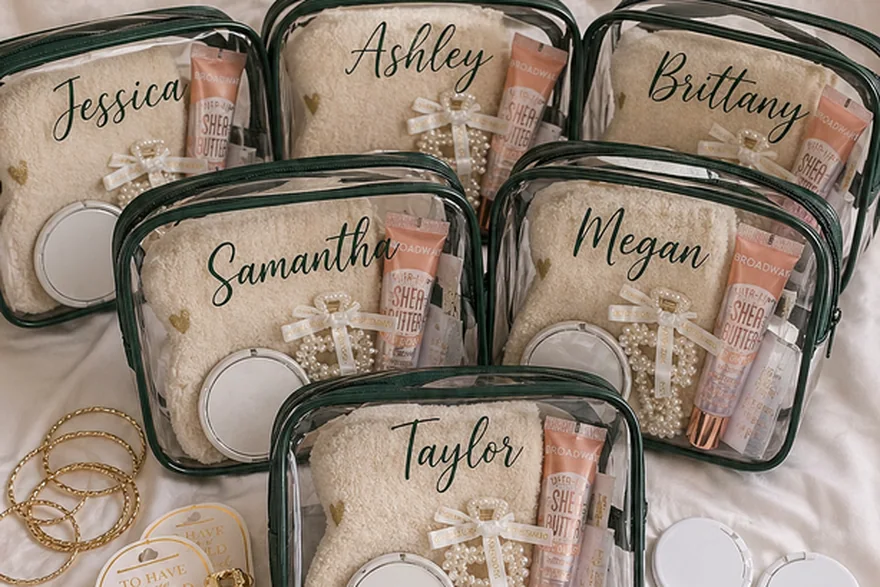
Who plans a Mother's Day cosmetic bag programme, and to what constraints
A Mother's Day cosmetic bag programme is a seasonal gifting programme in which a cosmetic bag, makeup bag, toiletry pouch or vanity case is bought either as the gift itself or as the container for a gift, and planned against a shelf window that opens a few weeks before the occasion and closes the day it passes. The object is familiar; the constraints are not. The person specifying it is usually working inside a planogram.
That matters because a planogram assigns three things before any design work starts: a physical footprint on the fixture, a retail price point, and a number of facings. A pouch that is 2 cm too tall does not get a slot. A set that lands 20 per cent above the assigned price point does not get listed. A range that cannot fill its facings for the whole window loses the slot next year. Specification is therefore an exercise in hitting three fixed numbers.
The demand underneath is stable rather than trend-driven. Toiletry bags draw roughly 74,810 weekly Amazon searches according to ASINSIGHT 2026.07, and the phrase travel bag for toiletries draws about 110,000 monthly searches, so the format needs no explanation to a gift buyer. Typical unit price bands run $0.45 to $12.00 on Alibaba as of 2026.10, and typical marketplace minimums run 100 to 1,000 pieces against a programme minimum of 500 pieces per style and colourway.
Three consequences follow. First, dimension is a specification line with a tolerance, not a suggestion. Second, the unit cost target has to be set before fabric selection, because fabric weight and hardware finish are the two fastest ways to break it. Third, timing has to be planned backwards from the display date using the production windows, because a seasonal slot that opens empty is worse than a slot that was never allocated.
The gifting angle adds one more constraint that general bag programmes do not have. A Mother's Day pouch is bought by someone who is not the user and often not the buyer either, which means the design has to communicate gift-worthiness through a photograph, a shelf edge or a product listing rather than through touch. Closure sound, lining contrast and the presence of a card or insert carry most of that signal, and all three are specification lines rather than creative afterthoughts.
Gift-set assembly and what it does to the pack-out line
A Mother's Day cosmetic bag is rarely sold empty. It is usually part of a gift set containing product, a card, or a second smaller pouch. Assembly is where the margin is made or lost, because labour is the one cost that does not fall with volume in the way fabric does. The central question is simple: what goes into the bag, and who puts it there.
| Assembly location | Typical contents handled | Advantage | Constraint | Suits |
|---|---|---|---|---|
| At the bag production site | Empty pouches, cards, tissue, rigid inserts | Lowest labour cost; bags ship filled and display-ready | Liquid or cosmetic product usually cannot be inserted there | Sets where the bag is the gift and contents are dry |
| At the buyer's distribution centre | Full product including liquids and cosmetics | Maximum flexibility to re-merchandise late | Highest labour cost; requires a second quality gate | Sets where product assortment is decided close to the window |
| At a third-party co-packing facility | Product plus printed packaging | Handles regulated product under local compliance | Adds a hand-off, a lead time and a coordination step | Programmes selling into multiple markets with different labelling rules |
Kitting sequence matters more than kitting cost. A set that inserts product before the bag is inspected forces a re-check after insertion, because insertion is where scuffs and puller damage happen. A better sequence inspects the empty pouch, inserts product, then packs into the display tray. Where the bag is the gift rather than the container, the sequence inverts: the bag is packed into the sleeve first and the card inserted last, so the card does not crease during packing.
Pack-out format follows from the fixture. Shelf trays want the pouch standing on its base with the printed face forward, which requires a structured base panel and a gusset wide enough to stand without slumping. Pegged or hanging fixtures want a hangtab or a woven loop, which is a specification line in its own right. A pouch designed for one format rarely performs in the other, and converting it after sampling means a new sample cycle.
Timing arithmetic for a gifting programme runs from the display date backwards. Bulk production takes 35-50 days after sample approval, sampling takes 6-10 working days or 12-15 working days for complex constructions, and receipt, release and allocation add another 10-15 working days before stock reaches the fixture. Insertion and co-packing sit on top of that. The chain is long enough that a first-season Mother's Day programme should be briefed in the previous calendar year rather than in the quarter it sells in.
Assembly also determines how late the assortment can be changed. Factory-side kitting is cheaper per unit but locks the assortment at the point the packing instruction is issued, which can be two production windows before the window opens. Distribution-centre kitting costs more per unit but lets the buyer respond to early-season data. Programmes selling into more than one market often split the difference, inserting dry components early and regulated components locally under the labelling rules of the destination.
Pack-out verification is the step most likely to be skipped and the one that generates the most chargebacks. A gift set that leaves the line with a missing card, a mis-folded tissue or a reversed puller generates a return that costs more than the unit margin. The practical control is a retained pack-out sample per production batch, photographed and stored alongside the inspection report, so that a dispute can be resolved against an agreed reference rather than a memory.

Price architecture for a Mother's Day cosmetic bag range
Price architecture is the decision about how many tiers a range carries and where each tier sits. Most Mother's Day cosmetic bag ranges work as three tiers: an impulse tier at a price point that needs no deliberation, a core tier that carries the volume, and a premium tier that gives the fixture an anchor. The mistake is to design three bags and then discover that only one of them fits the allocated price point.
| Tier | Construction | Typical size | Unit cost character (illustrative planning range) | Role in the fixture |
|---|---|---|---|---|
| Impulse | Flat polyester pouch, single-colour print, standard puller | 18 x 12 cm, no gusset | Lower third of the $0.45-$12.00 band | Add-on at till or end-cap; fills the price point that needs no deliberation |
| Core | 300D-600D shell, wipe-clean lining, #5 coil zipper, contrasting lining | 22 x 14 x 7 cm | Middle of the band | Volume driver; sits in the allocated planogram slot for the full window |
| Premium | Structured vanity case, moulded or padded shell, metal-look hardware | 24 x 16 x 10 cm | Upper third of the band | Anchor that makes the core tier look reasonably priced |
The arithmetic that links tiers to minimums is straightforward but constraining. Each tier in each colourway is 500 pieces, so a three-tier range in two colourways is six production commitments. A planner with a modest forecast is better served by three tiers in one shared colourway with different decoration, or by two tiers with a deeper buy. The tier structure should be decided from forecast volume rather than from the desire for shelf variety.
A second piece of arithmetic governs the set economics: the bag cost as a share of the set retail price. If the core set retails at a given price point and the bag is the least expensive component in it, the bag can carry a higher unit cost than it could as a standalone SKU, because the perceived value of the set is set by the product inside. Planners who evaluate the bag on standalone margin systematically under-specify the gift tier.
Carryover discipline applies to the premium tier most of all. A Mother's Day premium vanity case with occasion-specific embroidery has almost no second route to market, whereas the same case with a brand mark and a neutral lining sells as a travel item for the rest of the year. Where the programme can only afford one evergreen decision, it should be the most expensive tier.
Tier width matters as much as tier count. Three tiers only work if the price gaps between them are wide enough that a shopper perceives a reason to trade up, and narrow enough that the premium tier does not look absurd. A common structure spaces the tiers so that each step up roughly doubles the perceived contents while adding less than double the unit cost, which is achievable because the bag is usually a smaller share of the set cost at the top tier.
Margin arithmetic per tier should be done before artwork rather than after. Take the assigned retail price, subtract the product cost, the bag cost, the secondary packaging and the assembly labour, and check the remainder against the required margin. If the remainder is negative, the lever that preserves the design is usually the secondary packaging rather than the shell fabric, because the sleeve carries the seasonal signal at a fraction of the cost.
Compliance and safety documentation for a gift set that contains product
A bag sold empty is a textile article. A bag sold with product inside is a gift set, and the documentation burden rises accordingly, because the textile components and the product components are regulated separately and the set has to satisfy both. Buyers frequently discover this at the labelling stage, which is late enough to be expensive.
- Textile components: hold a current OEKO-TEX Standard 100 certificate whose article class covers the pouch as sold, and check that the certificate lists the printed and laminated fabric, not only the base cloth.
- EU market: obtain a REACH declaration covering substances of very high concern and any restricted substances used in coatings, prints or hardware plating.
- US market: for any set marketed to children, confirm CPSIA tracking-label and testing requirements apply to the set as a whole rather than only to the bag.
- Printed and coated surfaces: confirm the print method was tested after application, since a clean base fabric does not guarantee a clean printed panel.
- Hardware: request plating and nickel-release documentation for metal-look pullers used on premium tiers.
- Labelling: agree country-of-origin and fibre-content labelling at artwork stage, since these lines cannot be added after the print plates are made.
The certificate-scope problem is worth stating plainly. A certificate issued for a greige fabric or for yarn does not automatically cover a dyed, laminated and printed pouch, because dyeing, coating and printing introduce substances the original certificate did not test. The correct question to ask of an OEKO-TEX Standard 100 certificate is which article class and which process steps it covers. Where a recycled or organic claim is printed on the bag, the same logic applies to the chain-of-custody documentation, and a REACH declaration should be collected at the same time.
Colour performance is a compliance and a quality question at the same time. A Mother's Day palette leans towards soft pinks, warm neutrals and florals, and pale shades show rub transfer and light fading more readily than dark ones. Colour fastness behaviour is described in the ISO 105 series, and a buyer can specify a rub-fastness and light-fastness grade as a pass-or-fail line in the inspection, rather than discovering the problem when returned stock arrives.
Timing for documentation runs parallel to production rather than after it. Certificate collection, declaration review and labelling approval should be scheduled during the 6-10 working day sampling window and the 35-50 day bulk window, so that the release decision at AQL 2.5 under ISO 2859-1 is the last step rather than the first. Programmes that leave documentation to the end discover that a container can be perfectly made and still unshippable.
Labelling is the documentation item most likely to delay a release. Country of origin, fibre content and any care instructions have to appear in the artwork, which means they must be agreed before the print plates or the transfer film are made. Changing a labelling line after approval is a design change, with the same restart cost as any other change after sampling has begun.
The inspection gate closes the plan. Inspection runs to AQL 2.5 under ISO 2859-1, which sets the sample size but not the defect definitions, so the buyer has to supply those: print registration tolerance, colour match against the retained reference, puller attachment, lining cleanliness and coating appearance at folds. Writing them into the purchase order at sampling is what turns an inspection result into an actionable decision.
The B2B Customisation View
The commercial logic behind makeup bags and toiletry bags is simple to state and hard to execute: hold the unit cost, hold the colour, hold the delivery window.
Commercial parameters stay fixed across the range: MOQ 500 pieces per style and colourway, prototype turnaround 6–10 working days (extended to 12–15 for multi-panel or moulded builds), bulk lead time 35–50 days from approved sample, AQL 2.5 inspection to ISO 2859-1, FOB Xiamen, T/T 30 deposit and 70 against bill of lading.
For makeup bags and toiletry bags, that coordination matters most in the two weeks between packing and vessel loading, when documentation errors cost more than any material decision.
Which Brand Types Benefit Most
The Mother's Day cosmetic bag buyer is most often a retail planner, and the planning logic differs by organisation type. A national retailer works to a planogram with fixed facings and a fixed price point, so the useful supplier conversation is about hitting a dimension and a cost target rather than about aesthetics. An e-commerce seller works to a listing rather than a fixture, so the bag has to photograph well at thumbnail size and survive parcel transit, which favours a structured shell and a contrasting lining. A start-up brand usually has no seasonal slot at all and is better served by a gift-ready stock pouch with custom decoration than by a full custom development. Gift and hospitality buyers sending welcome kits, alumni organisations and corporate scholarship programmes all face the same planning logic, because each has a fixed recipient date and no appetite for surplus printed with an occasion that has passed. Where volumes are small, the evergreen shell with custom secondary packaging is almost always the more efficient structure.
- Start-up brands: use a stock shell in a neutral colourway with a custom woven label, avoiding the 500-piece colourway commitment while the concept is unproven.
- Established beauty brands: build the Mother's Day pouch as a gift-with-purchase tier so the bag cost sits in the promotion budget rather than the product margin.
- Retailers: design to the allocated shelf footprint first, then to the price point, then to the design; reversing that order costs the slot next season.
- E-commerce sellers: prioritise a structured base and a lining colour that reads clearly in a photograph, because the listing image is the fixture.
- Gift and hospitality buyers: keep the lining neutral and the hardware standard so unsold premium stock re-enters the year-round range.
- Programmes with an organic or recycled claim: confirm the certificate covers the finished printed article before any claim is approved at artwork stage.
- Programmes with a fixed recipient date: confirm the date in writing at brief stage and plan the production windows backwards from it rather than forwards from today.
Frequently Asked Questions
Who is the buyer for a Mother's Day cosmetic bag programme inside a retail organisation?
Usually a category or seasonal planner working to a planogram, not an individual gift buyer. That planner has three fixed numbers before design begins: a shelf footprint, a retail price point and a facing count. The bag has to fit all three, in that order of priority, and design preference comes last. Where the buyer is an individual rather than a planner, the same three numbers still apply in a softer form: a rough size, a rough budget and a deadline.
How should a Mother's Day price ladder be structured across three tiers?
Use an impulse tier built as a flat pouch with single-colour print, a core tier built on a 300D to 600D shell with wipe-clean lining, and a premium tier built as a structured vanity case. Assign the unit cost target for each tier before selecting fabric, because fabric weight and hardware finish break the target fastest.
What goes into a Mother's Day cosmetic gift set besides the bag?
Typically a product component, a printed card, tissue and a rigid insert or tray. Each added component is a specification line with its own tolerance and its own lead time. The decision that matters most is whether insertion happens at the bag production site, at a co-packer, or at the buyer's distribution centre. Product category drives the documentation burden, so the assortment should be fixed before compliance review rather than after it.
Should gift-set assembly happen at the factory or at the distribution centre?
Factory assembly is cheaper per unit but cannot usually handle regulated product such as liquids or cosmetics. Distribution-centre assembly costs more per unit but lets the assortment be decided late. Co-packing sits between the two and suits programmes selling into several markets with different labelling rules. Assembly location should be chosen from the assortment decision rather than from habit; the cheapest option is only cheapest if it can handle what goes inside.
Which cosmetic bag size works best as a Mother's Day gift?
A core tier around 22 x 14 cm with a 7 cm gusset is the most versatile, because it stands on a shelf, holds a full-size product and fits a standard gift bag. Larger structured cases around 24 x 16 x 10 cm work as premium anchors but need more fixture depth and a higher price point to carry them.
How is a personalised Mother's Day bag specified without slowing the packing line?
Keep personalisation on a component that sits outside the main print. A woven initials label on the side seam, a debossed badge, or a printed card inserted at the end all avoid adding a variable step to the shell print. Variable data printed directly onto the shell forces a slower, per-unit decoration route. Variable data belongs on components that can be printed separately, because per-unit decoration on the shell slows the whole line.
What fabric weight suits a structured Mother's Day vanity case?
A 600D polyester with a PU backing in the 240 to 320 g/m² range, combined with a padded or moulded panel, holds shape without excessive weight. Lighter 210D shells need an internal frame, which adds assembly steps. The lining should be a wipe-clean PEVA or TPU rather than a printed fabric that shows marks.
How should Mother's Day colourways be chosen?
Choose one shell colourway that survives the occasion and express the season through lining, print and packaging instead. Pale pinks and florals are seasonal but show rub transfer and fading more readily than mid-tone neutrals. Because the minimum is 500 pieces per style and colourway, a second colourway is a second production commitment rather than a decoration option.
What compliance documents are needed for a Mother's Day gift set?
For textile components, a current OEKO-TEX Standard 100 certificate covering the printed and laminated article, plus a REACH declaration for the EU market. For the product components, the documentation depends on the product category and market. Where the set is marketed to children in the US, CPSIA requirements apply to the set as a whole.
Why is certificate scope the most common compliance failure on printed pouches?
Because a certificate issued for yarn, greige fabric or base cloth does not test the substances introduced by dyeing, coating and printing. The printed panel is the surface the recipient touches. Buyers should ask which article class and which process steps the certificate covers, and request a test report on the finished printed fabric rather than on the base material.
How is Mother's Day display allocation planned?
Allocation follows facings rather than forecast alone. Multiply facings by units per facing by stores, then compare with the production minimum and the planned overrun. If the fixture allocation falls below 500 pieces per colourway, the range should be reduced in variety rather than over-ordered in depth, because the slot is worth more than the surplus stock.
What overrun is sensible on a short gifting window?
Enough to cover transit damage, store-level loss and unforecast demand, and no more. The correct size depends on how much of the range is evergreen: a neutral shell can be over-ordered because it sells afterwards, while a bag printed with an occasion-specific message cannot. Overrun should therefore be planned per element, not per SKU. Where the range must hold safety stock, hold it in the undated components, which keep their value however the season performs.
How do FOB Xiamen and T/T 30/70 terms shape the seasonal cash plan?
FOB Xiamen places freight, insurance, clearance and inland delivery with the buyer, and T/T 30/70 means the deposit is due when the production slot is confirmed and the balance against bill of lading. All three cash events land before the gifting window generates revenue, so the seasonal cash plan has to fund production and freight in advance.
How early should sampling start for a Mother's Day programme?
Sampling takes 6-10 working days, or 12-15 working days for complex constructions, and bulk production runs 35-50 days after sample approval. Adding receipt, release and allocation gives the minimum forward horizon. Because the occasion date differs by market and by year, the planner should work backwards from the display date rather than from a fixed calendar month.
People Also Ask
Are cosmetic bags a good Mother's Day gift?
They work because the recipient already understands the format and will keep using it. The risk is that a purely decorative occasion bag gets used for a week and then stored. The specification answer is to build the bag to year-round quality and express the occasion through lining, print and packaging rather than through a theme that expires. Where the programme sells through more than one channel, the evergreen version usually absorbs post-season traffic better than the themed one.
What price should a Mother's Day cosmetic gift set be?
Most ranges work as three tiers: an impulse tier that needs no deliberation, a core tier carrying the volume, and a premium anchor. Unit costs should be planned against the $0.45 to $12.00 band common in the category, with the bag evaluated as a share of set retail value rather than on standalone margin. The bag cost should be judged against set retail value rather than standalone margin, because the perceived worth of the set is carried by the product inside it.
How do retailers plan Mother's Day inventory?
From the planogram outwards: the allocated footprint and price point come first, then units per facing and store count give the total requirement. That total is then tested against the 500-piece per style and colourway minimum. Where the allocation is below the minimum, the range loses variety rather than gaining surplus inventory. Allocation should be tested against the 500-piece minimum per style and colourway before the range is finalised, since that floor does not flex to fit the fixture.
Can a Mother's Day cosmetic bag be personalised with initials?
Yes, and the most reliable route is a woven initials label sewn into the side seam or a debossed badge rather than variable printing on the shell. This keeps the main print run uniform and moves the variable element to a small component, which is cheaper, faster and easier to inspect at AQL 2.5. Woven labels and debossed badges keep the main print uniform, which protects the decoration lead time and keeps the reject rate low at inspection.
Request a Sample or a Written Quotation
Send the silhouette, dimensions, material preference and logo artwork, and the programme team will return a written quotation with MOQ, sampling window, bulk lead time and inspection standard.
Email: service@junyuanbags.com · WhatsApp: +86 177 5002 0688