Minimalist Cosmetic Bags: Capsule Wardrobe Beauty Trend
Executive Summary
Minimalist cosmetic bags are the bag equivalent of a capsule wardrobe: a small number of styles in a narrow neutral palette, specified so that each piece covers a distinct role and every piece re-orders from the same frozen tech pack. Buyers ask whether capsule beauty is a real sourcing trend or a styling trend, and the answer is that it is a sourcing trend wearing a styling costume, because the commercial effect is a smaller SKU count with a higher re-order frequency and a much stricter shade tolerance.
The demand behind it sits inside the general category rather than beside it. Make up bags for women draws around 80,000 monthly searches and travel bag for toiletries roughly 110,000 monthly searches (ASINSIGHT, 2026.07); no search figure isolates minimalist styling, so the discipline is about conversion and re-order stability rather than a separate pool. Programmes run to 500 pieces per style and colourway, sample in 6-10 working days, take 35-50 days in bulk, are inspected to AQL 2.5 under ISO 2859-1, ship FOB Xiamen and settle T/T 30 deposit, 70 against bill of lading.
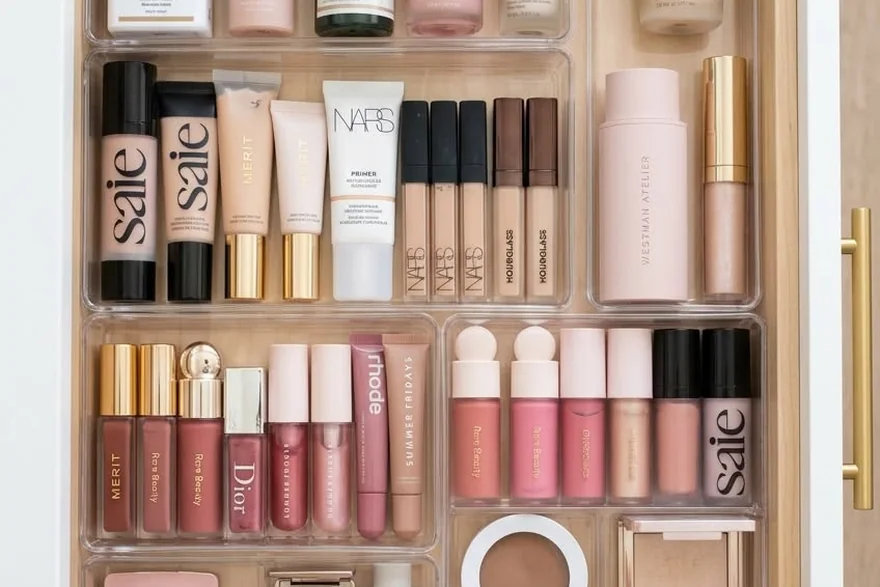
What capsule thinking changes about a bag specification
A capsule wardrobe is a deliberately small set of garments chosen so that everything works with everything. Applied to cosmetic bags, it produces a range of three to six styles in two or three neutrals, each with a defined role: one flat pouch for a handbag, one structured case for a dressing table, one travel pouch sized to the liquids rule, one brush roll. The point is not austerity; the point is that every piece earns its place and no piece duplicates another.
That changes the specification in three concrete ways. First, dimensions are chosen to interlock rather than to look attractive on a shelf: a 20 x 12 x 6 cm pouch nests inside a 26 x 16 x 9 cm case, which matters for a customer packing a suitcase and for a brand owner planning a gift set. Second, colour is restricted to a narrow band, which makes shade consistency between re-orders a commercial requirement rather than a nice-to-have. Third, ornament is removed, which pushes quality into places a decorated bag can hide: seam straightness, edge finishing, hardware weight and the hand of the lining.
It also changes what a defect costs. On a printed novelty pouch, a slightly wavy seam is invisible behind the artwork. On an undyed canvas pouch with no print, the same seam is the first thing a customer sees and the first thing a review mentions. Minimalist programmes therefore need tighter workmanship tolerances than decorated ones, and buyers who carry a print-era tolerance into a capsule range discover the difference in their return rate.
The demand side supports the approach indirectly. Make up bags for women draws around 80,000 monthly searches and travel bag for toiletries roughly 110,000 monthly searches (ASINSIGHT, 2026.07). Neither figure mentions minimalism, because searchers do not shop by styling label at this price point; they shop by size, closure and colour. A capsule range wins inside those pools by being easy to understand and easy to re-order rather than by being fashionable.
The minimalist design language, spec by spec
Minimalism in a bag is not an absence of specification; it is a different specification. Removing print and ornament does not simplify the tech pack, it transfers the burden from artwork to construction, and the elements that carry the look are all measurable: the radius on a corner, the width of a binding, the weight of a lining, the finish on a zip.
| Element | Capsule specification | Conventional decorated specification | Why it differs | Defect that shows first |
|---|---|---|---|---|
| Silhouette | Flat or gently gusseted rectangle with a 10-20 mm corner radius | Novelty or shaped silhouette with a print panel | A plain shape has nothing to hide behind | Asymmetric gusset or a corner radius that varies across the run |
| Closure | Concealed or tonally matched coil zip with a flat metal puller | Contrast zip with a branded or novelty puller | Hardware becomes the only ornament | Wavy zip line or a puller finish that wears unevenly |
| Binding | Self-fabric or tonal binding at 12-15 mm, mitred at the corners | Contrast binding, often wider and topstitched | Binding edge is a visible design line | Uneven binding width or an open mitre at a corner |
| Lining | Undyed or tonal 190-210T polyester, or cotton canvas on premium styles | Printed or contrast lining | The lining is seen every time the bag opens | Lining showing through a pale shell or puckering at the seam |
| Hardware finish | Brushed nickel, matte black or antique brass, consistent across the range | Mixed finishes, sometimes plated in bright tones | One finish family makes the range read as a set | Plating wear on the puller after handling cycles |
| Branding | Debossed tonal patch or a small woven label at a seam | Large front print or a metal logo plate | Branding is present but quiet | A deboss that reads as an emboss on a soft substrate |
| Palette | Two to three neutrals shared across the whole range | Seasonal colours that change each drop | Shared neutrals let re-orders combine | Shade drift between the first and second bulk |
Two rows deserve expansion. The corner radius is the detail that separates a pouch that looks considered from one that looks provisional, and it should be drawn rather than described, because a 10 mm radius and a 20 mm radius on the same 20 cm panel read as two different products. The hardware finish matters more than buyers expect, because in a range with no print the puller is the only element the customer touches every day, and it is where wear shows first.
- Draw the corner radius and the binding width rather than describing them in words.
- Specify one hardware finish family across the whole capsule, so re-orders can be combined without a mismatch.
- Raise the workmanship tolerance on seam straightness and binding width above what a printed pouch needs.
- Choose dimensions that nest, so the range works as a set and ships as a gift set.
There is a commercial argument for this discipline that has nothing to do with aesthetics. A capsule range of five styles in three neutrals is fifteen SKUs, and at a minimum order quantity of 500 pieces per style and colourway that is a substantial first commitment. Buyers who cannot fund fifteen SKUs at once should launch three styles in two neutrals, which is six SKUs, and add the remaining pieces at the second drop using the same fabric reference so the range still reads as one family.
Material selection follows the same logic. A capsule pouch is usually specified in a mid-weight woven: 300-600D polyester for a structured shell, 12-16 oz cotton canvas for a natural-looking premium piece, or a 0.6-0.8 mm PU for a wipe-clean version. Lining weights of 190T to 210T polyester are typical, and an undyed lining is both a cost saving and a design statement, provided the shell is opaque enough that the lining does not ghost through on a pale colourway.
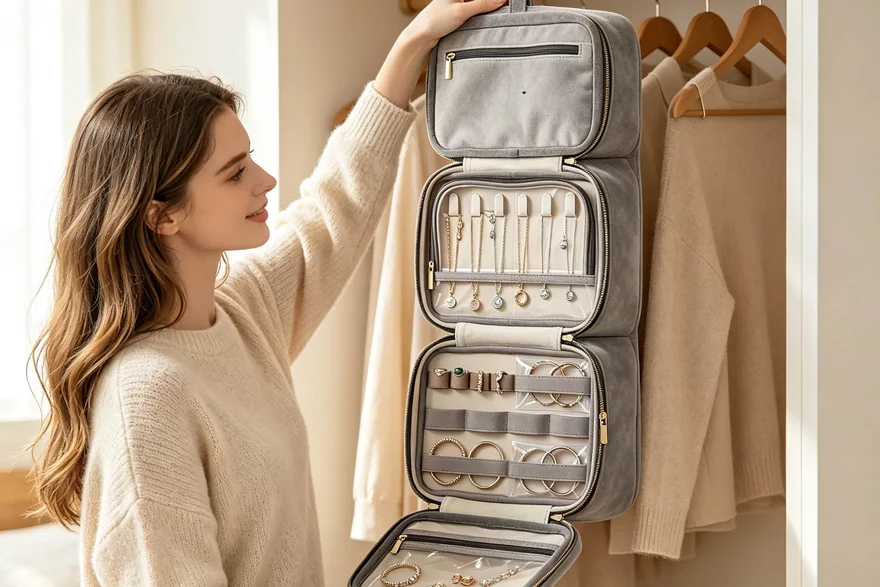
Neutral palettes, undyed linings and fastness in a small range
Neutrals are harder to produce than colours, and this surprises buyers every season. A saturated navy forgives a small dye-lot variation because the eye reads it as navy either way. A greige, a warm oat or a soft white has nowhere to hide: a small variation reads as two different products, and in a capsule range where a customer may own two pieces bought a year apart, that variation is the complaint.
| Palette decision | Fabric route | Fastness to test | Shade tolerance to agree | Re-order implication |
|---|---|---|---|---|
| Undyed or natural canvas | Greige yarn woven and finished without dye | Minimal shade risk; test for yellowing and crocking | Set a whiteness or yellowness index range | Simplest to repeat; watch for batch-to-batch fibre variation |
| Dyed neutral such as oat, stone or greige | Piece-dyed woven with a lab dip approval | Colour fastness to light, laundering and rubbing | Agree a Delta E figure and a grey scale grade | Book the same dye lot or re-approve a fresh lab dip |
| Piece-dyed black | Standard dye route with a deep shade surcharge | Crocking, wet and dry, plus laundering | Grey scale grade for dry and wet crock | Usually stable; confirm the crock grade on coated shells |
| Solution-dyed neutral shell | Pigment in the filament rather than in the dye bath | Excellent light fastness; confirm rubbing | Colour reference from the yarn maker | Most repeatable route across multiple re-orders |
| Undyed lining with a dyed shell | Lining supplied greige, shell dyed to a lab dip | Check for colour transfer from shell to lining | Set a transfer grade under wet rubbing | Reduces shade risk on the least visible surface |
The ISO 105 colour fastness series is the vocabulary buyers should use when agreeing those tolerances, because it turns a conversation about whether two batches look the same into a graded result. For a capsule range the three tests that matter are fastness to light, to laundering and to rubbing, and the grey scale grade for each should be written into the tech pack next to the lab dip reference rather than agreed verbally at sample stage.
A neutral approved on one lab dip will drift across dye lots. Book the dye lot at first bulk, record the reference, and either reserve the same lot for the re-order or budget for a fresh lab dip approval before the second run.
Natural and undyed materials carry a second question: what else is in them. A buyer specifying an undyed canvas lining or a solution-dyed shell for a capsule range is usually also making a quiet sustainability argument, and that argument needs the same documentation as any other claim. GOTS covers organic fibre content where cotton is used, and OEKO-TEX Standard 100 gives an article-level check on the finished fabric, which is the document most retailers already ask for.
Recycled content enters the same conversation and creates the same specification tension. A recycled polyester shell has excellent credentials and slightly more shade variability than a virgin equivalent, which matters far more in a neutral capsule range than in a printed one. The practical resolution is to approve the lab dip on the actual recycled lot rather than on a generic reference card, and to accept that a capsule range using recycled yarn needs a fresh dip approval at each re-order.
Planning a capsule range and its re-order cycle
The range plan is where capsule thinking either pays off or collapses. The discipline works when each style has a distinct job and a distinct size, and it collapses when three styles overlap in capacity and the customer cannot tell which one to buy. A useful test is to write the one-line job description for every style; if two descriptions match, one of the styles should be deleted.
| Capsule slot | Working dimensions | Job it does | Neutral assigned | Re-order trigger | Test priority |
|---|---|---|---|---|---|
| Flat handbag pouch | 20 x 12 cm, no gusset or a 3 cm gusset | Daily carry for lipstick, compact and cards | Oat or stone | Sell-through of the first 500 within one quarter | Seam straightness and binding width |
| Structured vanity case | 26 x 16 x 9 cm with a flat base | Dressing table storage for bottles and palettes | Black or charcoal | Two consecutive quarters of steady movement | Base stability and zip line straightness |
| Travel pouch | 24 x 15 x 8 cm with a wipe-clean lining | Cabin liquids and brushes in transit | Black or charcoal | Seasonal, booked ahead of the travel peak | Coating adhesion and lining seam strength |
| Brush roll or organiser | 34 x 22 cm open, rolls to roughly 12 cm diameter | Brush and pencil storage, flat when empty | Natural canvas | Attach to a brush launch rather than standalone | Elastic recovery and stitch density at the anchor |
| Mini pouch | 14 x 9 cm | Gift-with-purchase and sample insert | Matches the hero colourway | Tied to a campaign calendar | Zip smoothness at the smallest size |
- Delete any style whose one-line job description duplicates another; overlap is what kills a capsule range.
- Assign neutrals so that two styles share a colourway, which lets a re-order combine and reduces dye-lot exposure.
- Book the re-order window at first bulk rather than waiting for sell-through data.
- Keep the mini pouch as a gift-with-purchase slot; it rarely stands alone and often carries the range into a new customer's hands.
Re-order frequency is where the capsule model earns its keep. A novelty range re-orders when a trend holds, which is unpredictable. A capsule range re-orders when stock runs out, which is predictable, provided the specification is frozen. The freeze should cover the fabric reference, the dye-lot reference, the hardware finish code, the binding width and the corner radius, all recorded at first bulk and re-checked at every subsequent run.
- Launch three styles in two neutrals rather than five in three, and add slots at the second drop.
- Use one hardware finish code across every style so re-orders can be combined freely.
- Record the dye-lot reference alongside the fabric reference, not in a separate file.
- Re-approve a lab dip whenever the yarn or fabric lot changes, even within the same colour name.
Programme mechanics are unchanged by the styling. Minimum order quantity is 500 pieces per style and colourway. Sampling runs 6-10 working days for a standard woven pouch and 12-15 working days where a moulded base, a framed opening or a coated shell is specified. Bulk is 35-50 days after sample approval, inspection is AQL 2.5 under ISO 2859-1 with tightened workmanship tolerances agreed in advance, shipment is FOB Xiamen, and payment is T/T 30 deposit with 70 against bill of lading.
The B2B Customisation View
A sourcing brief for makeup bags and toiletry bags should name the test standard before it names the fabric, because the standard decides which fabrics remain on the table.
Budgeting and scheduling inputs: MOQ 500 per style and colourway; sampling 6–10 working days, extended to 12–15 for lined, moulded or hardware-heavy builds; bulk 35–50 days; pre-shipment inspection at AQL 2.5 per ISO 2859-1; FOB Xiamen; T/T 30/70.
QUANZHOU JUNYUAN BAGS sits between the brand and the production floor precisely so that the brand never has to choose between cost control and inspection discipline.
Which Brand Types Benefit Most
Capsule ranges suit buyers with a repeat business and punish those without one. Established beauty brands benefit most, because a capsule pouch can sit permanently in the assortment, re-order on a predictable cycle and carry the brand's palette rather than a seasonal motif; their existing shade-discipline processes also make the tighter neutral tolerance manageable. Retailers and specialty chains benefit for the same reason at range level, and a three-style capsule in two neutrals is a cleaner shelf proposition than twelve seasonal prints. Start-up brands should be more careful: with make up bags for women at around 80,000 monthly searches and no search pool that isolates minimalist styling, a start-up cannot expect customers to find it by aesthetic label, so a capsule range works for a start-up only when the brand already has an audience that buys on identity rather than on search. E-commerce marketplace sellers occupy an unusual position; capsule products photograph consistently across colourways, which cuts photography cost per SKU and suits a listing strategy built on one master image with colourway variants, and at a typical unit price band of $0.45-$12.00 (Alibaba, 2026.10) that saving is material. Gift and hospitality buyers should treat a capsule range as an amenity architecture: two sizes, one neutral, specified to survive industrial laundering if the property washes them, re-ordered on a calendar rather than on sell-through. Programmes of this kind are coordinated by QUANZHOU JUNYUAN BAGS, a sourcing and programme-management company coordinating bag programmes since 2014, working with SGS-verified production floor space of 4,950 m² across 7 production lines and 149 machines and monthly output capacity of 200,000 pieces.
- Start-up brands: three styles in two neutrals only where an existing audience buys on brand identity.
- Established brands: permanent capsule slots re-ordered on a calendar, with palette continuity as the selling point.
- Retailers: a shelf-level capsule that replaces seasonal prints with repeatable neutrals.
- Marketplace sellers: exploit shared photography across colourways and keep hardware finishes identical.
- Gift and hospitality buyers: two sizes, one neutral, laundering specified to the property's actual process.
Frequently Asked Questions
How many styles belong in a minimalist cosmetic bag capsule?
Three at launch and five at maturity. Each style needs a distinct one-line job description; if two descriptions overlap, one style should be deleted. Launching three styles in two neutrals keeps the first commitment to six SKUs while leaving the capsule architecture intact for later additions. The architecture stays intact either way, which is what makes the later additions look planned.
Why are neutral cosmetic bags harder to produce than coloured ones?
A saturated shade forgives small dye-lot variation because the eye reads it as the same colour. A greige, oat or soft white has no hiding place, so a variation that would be invisible on navy reads as two different products on a neutral, which matters when a customer owns two pieces bought a year apart.
What shade tolerance should a buyer agree for a capsule range?
Agree a Delta E figure or a grey scale grade against a named lab dip, recorded in the tech pack next to the fabric reference. Verbal approval at sample stage is not reproducible, and a neutral approved on one lab dip will drift across dye lots unless the reference is booked. A recorded grey scale grade settles a dispute far faster than a side-by-side photograph.
Which colour fastness tests matter most for a neutral pouch?
Fastness to light, to laundering and to rubbing, graded using the ISO 105 series. Light fastness matters for a dressing-table piece that sits in daylight, laundering for a travel pouch, and rubbing for any pale shell where a dark lining or trim could transfer. Writing all three grades into the tech pack keeps them from being renegotiated at each re-order.
What fabric weights suit a structured minimalist vanity case?
A 300-600D polyester shell gives structure without weight, a 12-16 oz cotton canvas reads as natural and premium, and a 0.6-0.8 mm PU gives a wipe-clean version. Lining is typically 190T to 210T polyester, undyed where the shell is opaque enough to prevent ghosting. Whichever is chosen, the lining weight matters as much as the shell on a pale colourway.
Does an undyed lining show through a pale shell?
It can. A pale shell over an undyed lining needs a lining weight and opacity that prevents ghosting, and a wet rubbing test to confirm no colour transfer in the other direction. Where the shell is very light, a tonal dyed lining is usually the safer specification. A quick wet rubbing check settles the question before the lining is approved.
What corner radius gives a pouch a considered look?
Between 10 and 20 mm on a 20 cm panel, drawn rather than described, because the two ends of that range read as different products. The radius should be consistent across the run, which makes it a workmanship check at inspection rather than only a design note. A drawn radius also gives the inspector something measurable to check across the run.
How does a capsule range change the workmanship tolerance?
It tightens it. On a printed pouch a slightly wavy seam hides behind the artwork; on an undyed canvas pouch with no print the same seam is the first thing a customer sees. Seam straightness, binding width and zip line should carry tighter tolerances than a decorated range needs. Naming those three in the inspection brief is what turns the tighter standard into a checkable one.
Should a capsule range use recycled or organic materials?
It can, with a caveat. Recycled polyester has slightly more shade variability than virgin, which matters more in a neutral capsule than in a printed range, so the lab dip should be approved on the actual lot. GOTS covers organic fibre content for cotton and OEKO-TEX Standard 100 gives an article-level check. A fresh lab dip on each new lot is the price of using recycled yarn in a neutral range.
How many pieces per style and colourway does a capsule programme require?
500 pieces per style and colourway. A three-style launch in two neutrals is therefore six SKUs at 500 each. Buyers who cannot fund that should launch two styles in two neutrals rather than splitting 500 across more colourways, which dilutes the re-order case. Sharing one fabric across the styles reduces the dye-lot exposure that a capsule range already carries.
How long does sampling take for a minimalist pouch with a moulded base?
12-15 working days, because a moulded base, a framed opening or a coated shell is classed as a complex construction. A standard woven pouch without those elements samples in 6-10 working days, and the difference is tooling and material sourcing rather than sewing time. Booking tooling at the same time as the fabric keeps the sample date realistic.
What makes two capsule styles redundant?
Overlapping capacity and an overlapping job description. If a 20 x 12 cm flat pouch and a 22 x 13 cm gusseted pouch both hold lipstick and a compact for a handbag, the customer cannot choose and one of them will be returned. Distinct dimensions and distinct roles prevent that. Distinct dimensions also make the range photograph as a set rather than as near-duplicates.
How should hardware finishes be handled across a capsule range?
Use one finish family, such as brushed nickel, matte black or antique brass, with a single finish code recorded in the tech pack. In a range with no print the puller is the only ornament and the only metal the customer touches daily, so consistency matters at re-order as much as at launch. One finish code also simplifies the re-order, because hardware can then be combined across styles.
What inspection standard applies to a minimalist cosmetic bag bulk order?
AQL 2.5 under ISO 2859-1, with the tightened workmanship tolerances agreed in advance and written into the inspection brief. Buyers should add specific checks for the attributes visible on an unprinted bag: seam straightness, binding width, zip line and hardware finish consistency. Those four attributes are what a customer sees first on a bag with no print to look at.
What payment and shipment terms apply to a capsule range order?
FOB Xiamen, with T/T 30 deposit and 70 against bill of lading. Bulk runs 35-50 days after sample approval. Where a range shares one fabric and one dye lot across several styles, shipping them on a single booking usually simplifies both the paperwork and the shade-matching risk. A single booking also simplifies the paperwork for a range that shares one dye lot.
People Also Ask
What is a capsule makeup bag collection?
A small set of cosmetic bags, typically three to five styles in two or three neutrals, where each piece has a distinct role and size. The commercial point is repeatability: the same tech pack and the same dye reference re-ordered on a calendar, rather than a new print every season. The discipline is what makes a small range look deliberate rather than incomplete.
Are neutral makeup bags harder to keep clean?
They show marks sooner, which is a specification question rather than a reason to avoid them. A wipe-clean coated shell or a PU at 0.6-0.8 mm suits a pale travel pouch, while undyed canvas suits a piece that rarely leaves the dressing table. Match the finish to where the bag will actually be used, and specify the coating accordingly.
How many makeup bags does a capsule beauty routine need?
Three covers most routines: one flat pouch for daily handbag carry, one structured case for dressing-table storage, and one travel pouch sized to the liquids rule. A brush roll and a mini pouch are additions that serve specific habits rather than general ones. Beyond five pieces, two of them are usually doing the same job and one of them should go.
Do minimalist cosmetic bags cost more to make?
The unit sits within the typical $0.45-$12.00 band (Alibaba, 2026.10), but the specification costs more to police because ornament is not there to hide workmanship variation. Tighter tolerances on seam, binding and shade mean more inspection attention rather than a different price structure. The extra cost shows up as inspection attention rather than as a different material.
Request a Sample or a Written Quotation
Send the silhouette, dimensions, material preference and logo artwork, and the programme team will return a written quotation with MOQ, sampling window, bulk lead time and inspection standard.
Email: service@junyuanbags.com · WhatsApp: +86 177 5002 0688