How to Pack a Cosmetic Bag: Professional Organizer Method
Executive Summary
How to pack a cosmetic bag the professional organiser way is a four-step sequence, not a list of tips: edit the contents down to what is actually used, zone them by frequency of use, orient every item so its largest face lies flat against the base, and fill to about 80 percent so the zip closes without compressing the contents. The sequence matters because packing fails at the edit step far more often than at the arrangement step.
Professional organisers work from volume rather than from item count. A medium pouch at 22 x 15 x 8 cm holds roughly 2.6 litres, and a typical daily kit of fourteen to eighteen products occupies 1.9 to 2.2 litres once orientation is handled properly. That gap is the whole method: it is the difference between a bag that closes flat and lies down in a suitcase, and one that bulges, strains its zip tape and transfers pressure onto every closure inside it.
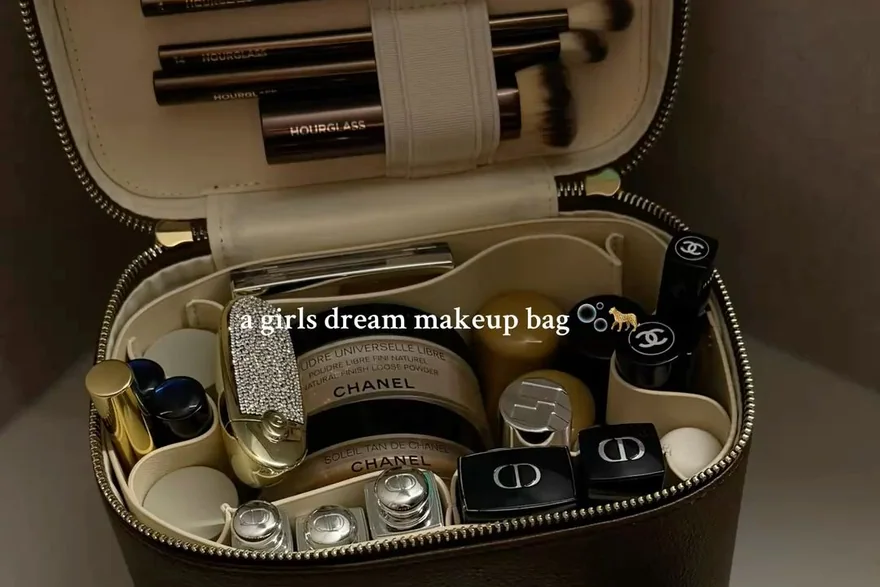
What professional organisers do differently
Most people pack a cosmetic bag by accumulation: items go in as they are bought and the bag is replaced when it will no longer close. Professional organisers pack by allocation, treating the bag as a fixed volume to be divided before anything goes in. That change is why an organiser fits a fortnight of products into a bag a client has already declared too small.
Demand for the skill is measurable. Travel bag for toiletries attracts around 110,000 monthly searches and toiletry bag around 74,810 weekly searches on Amazon in 2026, which places packing and capacity questions at the top of the category's content demand. Yet most of the advice available to consumers is a list of products to buy rather than a method, and the method is what transfers between bag sizes.
For brand owners and retailers, the method is a specification input. A pouch sold as a travel cosmetic bag should hold a defined kit, described in litres and item dimensions rather than in vague terms. A buyer specifying a 22 x 15 x 8 cm shell should know it holds a 2.6 litre kit: a daily face kit of 14-18 items, or a hair-and-body kit of 8-10 larger items, but not both.
Three rules distinguish the organiser approach. First, everything is decided outside the bag: items are laid out, counted and rejected on a flat surface, never dropped in one at a time. Second, orientation is deliberate; a bottle laid on its side occupies a different footprint from the same bottle standing up. Third, the bag is closed before it is full, at about 80 percent, because a fully packed bag has no tolerance and every closure inside it is under load.
- Allocation, not accumulation: the volume is divided before the items are placed.
- Decisions made outside the bag: lay out, count, reject, then place.
- Orientation is a decision: the largest face of each item lies flat against the base.
- Eighty percent fill: a bag that closes without pressure protects its zip tape and inner closures.
- One home per category: everything of one type lives in one place, so the bag can be checked in seconds on departure.
The method is also reversible, which matters for daily use. A bag packed by zone can be unpacked in the order it is used and repacked in the same order in under a minute. A bag packed by accumulation cannot, which is why accumulation bags become the ones people tip out onto a hotel counter every morning.
Step one to three: edit, decant, zone
Editing comes first and is the step most people skip. Empty the bag completely onto a flat surface, then sort into three piles: used daily, used occasionally, and unused in the last three months. The third pile leaves. In a typical kit this removes four to six items and 0.4 to 0.6 litres, which is usually more space than any rearrangement technique will recover.
Decanting is the second lever. A 200 ml shampoo bottle at 18 cm tall occupies about 0.35 litres of a bag; the same product decanted into a 50 ml travel bottle at 9 cm occupies under 0.1 litres. Decant only what is used every day, keep decanted containers to 50-100 ml, and label them, because an unlabelled clear bottle is the most common cause of a kit being repacked incorrectly.
| Zone | What goes in it | Typical items | Share of a 2.6 litre kit |
|---|---|---|---|
| Zone 1, daily face | Items used every morning, placed last so they are on top | Cleanser 50 ml, moisturiser 50 ml, SPF 50 ml, concealer, lip balm | About 40 percent |
| Zone 2, colour | Compact items used daily but in a single session | Palette 15 x 10 x 1.5 cm, one compact 9 cm, two brushes, one lipstick | About 25 percent |
| Zone 3, tools | Long thin items, always laid flat along one wall | Mascara 13 cm, eyeliner, tweezers, hair tie, folding brush | About 15 percent |
| Zone 4, occasional | Items needed once or twice on a trip, packed at the bottom | Mask sachet, nail file, spare hair band, stain remover pen | About 10 percent |
| Reserve, 20 percent | Empty space, deliberately left | Nothing | About 20 percent |
Zoning by frequency rather than by category is the part that surprises people. Category zoning - all skincare together, all colour together - looks tidy on a shelf and is inefficient in a bag, because it ignores how the bag is opened. Frequency zoning puts the morning routine on top where it can be lifted out in one motion, and buries the items needed twice a week at the bottom.
The zone plan should be written down for a kit that is packed repeatedly. A card listing the fourteen items and their zones turns a ten-minute decision into a thirty-second one, and it is the same document a brand owner can use as a packing insert. Where a pouch is sold as a set with contents, the zone plan becomes the pick list for the packing line, and the fill percentage becomes a quality check.
One caution about decanting into very small containers. Below about 15 ml, a wide jar becomes harder to open and easier to spill than the product it replaced, and a screw closure under 20 mm in diameter is awkward to grip with wet hands. Travel containers between 30 and 100 ml with a 24-28 mm closure are the practical range for a cosmetic kit.
Where a kit is packed repeatedly, the zone plan can be made physical. A removable insert with three slip pockets turns the zones into fixed positions, so the bag is repacked in the same order without a decision each time. For a brand, an insert is also a product feature that is easy to photograph and easy to describe: three pockets, fourteen items, one motion to lift out the morning routine.
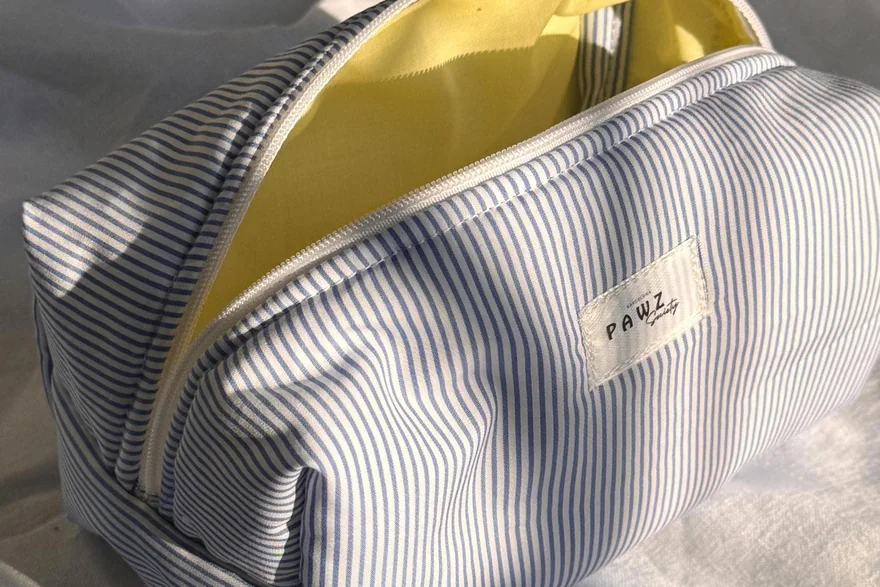
Packing geometry: order, orientation and zip management
Geometry decides whether the method works. Items go into the bag in reverse order of use, so the last thing packed is the first thing needed. Within that constraint, the rule is flat-to-flat: the largest face of every item lies parallel to the base, because a stack of flat objects occupies far less volume than the same objects at random angles.
- Heavy and rigid first: palettes, compacts and jars go against the base, forming a flat platform.
- Medium bottles second: 50-100 ml bottles laid on their side, all oriented the same way, caps inward.
- Long thin items along one wall: mascara, eyeliner and brushes lie flat against the longest side.
- Soft items fill the gaps: sachets, sponges and a hair band go into the voids between rigid items.
- Daily items last: cleanser, moisturiser and SPF sit on top where one hand can lift them out.
- Close at 80 percent: if the zip needs two hands or any force, remove an item rather than pressing harder.
- Zip ends together: park both sliders at the same end so the tape is not held under uneven tension.
Weight distribution is part of the geometry. A kit of fourteen to eighteen products weighs 1.2-2.5 kg, and if that weight sits in one corner the bag will not stand and will drag its own zip tape out of line. Distributing the two or three heaviest items across the base rather than stacking them keeps the bag flat, which in turn keeps it stable when it is stood on a counter or laid in a suitcase.
The zip is the component most often damaged by packing, and the failure is gradual. A bag filled past about 90 percent places continuous tension on the tape and on the stitch line that holds it, and the slider then rides on the elements rather than between them. Zipper components are named precisely in the ASTM D2053 zipper terminology standard, which is worth using in a specification so that a claim about a slider, a tape or an element refers to the same part on both sides of the conversation.
Lining material changes the geometry slightly. A wipe-clean coated lining lets items slide into position, which helps, but it also lets them slide out of position in transit. A bag with a coated lining benefits from one elastic loop or one slip pocket holding the two or three longest items, because those are the ones that migrate. Coated shells are characterised and tested against standards such as ASTM D751 for coated fabrics, so a specification can state the coating performance alongside the capacity.
Multi-compartment bags need one extra decision: which compartment holds what. The rule is that the compartment that opens widest holds the daily zone, because a narrow compartment forces the user to dig. On a hanging toiletry bag, the top compartment should hold the items used at the mirror and the bottom compartment the items used at the basin, so the bag is worked top to bottom in the order the user moves.
Two design details affect whether the method survives contact with a real user. A light-coloured lining makes items findable in a dim hotel room, and a mouth that opens fully flat lets the whole kit be seen at once. Both are small specification choices, and both determine whether the user keeps the organiser method or reverts to tipping the bag out onto the nearest counter.
Matching the method to the bag format
The same kit behaves differently in different formats. A flat pouch has no depth, so everything must be genuinely flat; a structured case holds its shape, so it tolerates a taller item standing up; a hanging bag has compartments, so it divides the kit for you. Choosing the format first and then packing it is faster than packing a bag and discovering it is the wrong shape.
| Format | Typical dimensions and volume | Holds | Best used for |
|---|---|---|---|
| Flat pouch | 20 x 13 x 2 cm, about 0.5 litres | 6-8 flat items: compact, cards, sachets, lipstick | Handbag carry, daily touch-up kit |
| Small box pouch | 18 x 12 x 6 cm, about 1.3 litres | 10-12 items, no bottle over 10 cm standing | Overnight trip, gym kit |
| Medium box pouch | 22 x 15 x 8 cm, about 2.6 litres | 14-18 items, daily face kit plus colour | Week-long trip, standard retail gift set |
| Large box pouch | 26 x 18 x 10 cm, about 4.7 litres | 20-26 items, hair and body plus face | Two-week trip, family shared kit |
| Hanging toiletry bag | 24 x 18 x 9 cm open, three compartments | 18-24 items split across compartments | Hotel and guest-room use |
| Structured vanity case | 28 x 20 x 14 cm, about 7.8 litres | Full kit plus tools, items may stand | Counter display, professional use |
Capacity should be stated as usable volume rather than as external dimension. A 22 x 15 x 8 cm shell has an external volume of 2.6 litres, but seam allowances, binding, a lining and a base board reduce the usable figure by 10-15 percent. A specification that quotes 2.6 litres externally and 2.2 litres usable avoids the argument that follows when a customer measures the bag and finds it smaller than expected.
For a programme that ships a bag with contents, capacity becomes a production check. The pick list, the fill percentage and the closing force can all be verified on the line, and sampling by attributes is defined in ISO 2859-1. An AQL 2.5 check on a packed set will catch a bag that has been over-filled as reliably as it catches a stitching defect, provided the acceptance criteria say what over-filled means.
The format list is a starting point for a range, not a complete size architecture. A coherent assortment usually needs three sizes rather than six: a flat pouch for handbag carry, a medium box pouch for travel, and one structured case for counter or professional use. Three sizes are easier to merchandise, easier to hold in stock and easier to describe in copy than a long ladder of near-identical dimensions.
External dimensions, usable volume in litres, target fill of 80 percent, maximum packed weight, and the reference kit of item dimensions the bag is designed to hold. Four numbers replace an argument about whether a bag is big enough.
Programme timing follows the same logic as any other specification change. Minimum order quantity is 500 pieces per style and colourway, sampling runs 6-10 working days and 12-15 working days for complex constructions, and bulk production takes 35-50 days after sample approval, with inspection at AQL 2.5 under ISO 2859-1 and shipment FOB Xiamen on T/T 30 deposit, 70 against bill of lading.
The B2B Customisation View
For buyers building a range of cosmetic bags, the specification sheet doubles as the costing sheet, which is why it is worth getting right in week one.
Programme data for this category: minimum order quantity 500 pieces per style and colourway, sampling in 6–10 working days (12–15 working days for complex constructions), bulk production 35–50 days after sample approval, final random inspection at AQL 2.5 under ISO 2859-1, FOB Xiamen, T/T 30/70.
Because the entity is a sourcing and programme-management company, the buyer deals with one accountable counterpart for specification, sampling, inspection and consolidation.
Which Brand Types Benefit Most
Packing method is a commercial asset, not only a consumer tip, and the value differs by buyer type. Start-up brands can build a whole first programme around one capacity claim if they define it properly: a 2.6 litre pouch holding a stated fourteen-item kit is a defensible product description, where a medium travel bag is not. Established brands running gift sets need the method as a production standard, because a set packed by hand in two different factories will not look the same on shelf. Retailers and wholesalers benefit from one capacity language across an assortment, so that a small, medium and large pouch are described in litres rather than in adjectives. Three specification items follow from the method. Usable litres rather than external dimensions, so a capacity claim can be checked with a ruler and a reference kit. A compartment count that suits the zone plan, which usually means one wide compartment and one or two narrow ones rather than six small ones. And a packed-weight figure, since a kit of fourteen to eighteen products at 1.2-2.5 kg puts a very different load on a handle or a hook than an empty shell does. Gift and hospitality buyers should add a fourth: a layout that matches the order in which a guest moves through a room, because a bag that has to be unpacked fully to find one item will be repacked badly every time.
- Start-up brands: define the bag by usable litres and by the reference kit it holds, then build the copy from that.
- Established brands: turn the zone plan into a pick list so every gift set is packed identically across factories.
- Retailers and wholesalers: describe the assortment in litres so size comparisons are honest and consistent.
- E-commerce sellers: publish the reference kit and the fill percentage, since capacity is the top pre-purchase question.
- Gift and hospitality buyers: specify a compartment layout that matches how the guest actually moves through a room.
Frequently Asked Questions
How full should a cosmetic bag be before it is closed?
About 80 percent. That leaves enough tolerance for the zip to close without tension and for the contents to shift slightly in transit. If the zip needs two hands or any force, an item should come out rather than the bag being pressed shut, because continuous tension on the tape is the main cause of a zip that fails later. A bag that closes with one hand and no pressure has the right amount in it.
What size cosmetic bag suits a week-long trip?
A medium box pouch at about 22 x 15 x 8 cm and 2.6 litres, holding fourteen to eighteen items after editing and decanting. A daily face kit plus colour fits; add hair and body products and the same trip needs the 26 x 18 x 10 cm size at 4.7 litres. Buyers should state the reference kit rather than the trip length, since kit sizes vary widely between users.
Should bottles stand up or lie down in a cosmetic bag?
Lie down, all oriented the same way with caps inward. Standing bottles waste vertical space in a shallow pouch and tip over when the bag is moved. Lying flat along the base gives a stable platform for the lighter items above and keeps closures away from the zip line. Consistent orientation also makes a packed bag faster to check at a glance before departure.
How much does a packed cosmetic bag weigh?
A kit of fourteen to eighteen products weighs 1.2-2.5 kg depending on how much has been decanted. Decanting a 200 ml product into a 50 ml bottle saves around 150 g each time. Distributing the two or three heaviest items across the base keeps the bag flat and stable. A packed weight above about 2.5 kg usually means the kit has not been edited properly.
What is the best way to organise a hanging toiletry bag?
Work the compartments in the order the user moves. The top compartment holds items used at the mirror, the bottom holds items used at the basin, and the widest compartment holds the daily zone. Narrow compartments should never hold the daily items, because they force the user to dig. The hook should carry the bag from a fixed point rather than from a towel rail that moves.
Should makeup be organised by category or by frequency?
By frequency. Category grouping looks tidy on a shelf but ignores how the bag is opened, and it buries the morning routine under items used once a week. Frequency zoning puts the daily items on top where one hand can lift them out in a single motion. Frequency zoning also makes it obvious which items are candidates for removal at the next edit.
What size travel container works best for decanting?
Between 30 and 100 ml with a closure of 24-28 mm. Below about 15 ml a jar becomes hard to open and easy to spill, and a closure under 20 mm is awkward with wet hands. Label every decanted container, because unlabelled bottles are the usual cause of a kit being repacked wrongly. Clear containers make a missing label obvious, which is a small but real advantage in a shared kit.
How many items should be edited out before packing?
Anything unused in the last three months. In a typical kit this removes four to six items and 0.4 to 0.6 litres, which is usually more space than any rearrangement will recover. Editing is the highest-value step and the one most often skipped. Keeping a written kit list makes the next edit a two-minute job rather than a fresh decision.
Why does a cosmetic bag bulge even when it closes?
Because it is filled past about 90 percent and the contents are at random angles. The bulge transfers pressure onto every closure inside the bag and onto the zip tape. Repack flat-to-flat with the largest face of each item against the base, and remove one item rather than pressing. A bulging bag also presses on its own lining seams, which is where stitch failure usually starts.
What causes a zip to fail on a packed cosmetic bag?
Continuous tension from over-filling, and uneven tension from parking the two sliders at opposite ends. Fill to 80 percent, park both sliders at the same end, and keep rigid items away from the zip line. Zipper parts are named precisely in ASTM D2053, which helps in a specification. A bag carried daily should be checked at the zip every few weeks, before the failure becomes obvious.
How should brushes and long tools be packed?
Laid flat along the longest interior wall, all pointing the same way, rather than standing in a corner or rolled loosely. A 13 cm mascara or a folding brush laid along the wall occupies almost no usable volume, while the same item at an angle creates a void either side of it. A brush roll or one wide loop keeps tools together and stops them migrating in transit.
Is usable capacity smaller than the external measurement?
Yes, by roughly 10-15 percent. Seam allowances, binding, the lining and any base board all take space from the external figure, so a 22 x 15 x 8 cm shell with 2.6 litres externally offers around 2.2 litres usable. Quoting both numbers prevents a dispute after purchase. Quoting usable volume in litres makes comparisons between two suppliers of the same nominal size honest.
How can a brand owner specify capacity without ambiguity?
State external dimensions, usable volume in litres, target fill of 80 percent, maximum packed weight, and the reference kit of item dimensions the bag is designed to hold. Four numbers replace an argument about whether a bag is big enough, and the same figures become the packing line check. The reference kit should be listed with item dimensions so it can be reproduced at inspection.
Should a coated-lining pouch have internal loops or pockets?
One is usually enough. A wipe-clean lining lets items slide into place, but it also lets them migrate in transit, and the longest items migrate furthest. A single elastic loop or slip pocket holding the two or three longest items is sufficient; more internal divisions reduce usable volume. A single divider also stops the longest items sliding into the zip line.
How is a packed gift set inspected on a production line?
By attributes, using acceptance sampling such as AQL 2.5 under ISO 2859-1, with the criteria written to cover the pick list, the fill percentage and the closing force as well as the stitching. Specifying what over-filled means is the part usually missing from the criteria. Photographing one packed set per shift gives a visual reference for what acceptable looks like.
What is the minimum order for a pouch sized to a stated kit?
Five hundred pieces per style and colourway. Sampling takes 6-10 working days, or 12-15 working days for complex constructions, which is long enough to pack a reference kit into the sample and confirm the volume before bulk production runs its 35-50 days. Packing the reference kit into the sample is the cheapest capacity test available to a buyer.
People Also Ask
How do I fit more makeup in a small bag?
Edit first, decant second, rearrange third. Removing items unused in three months frees 0.4-0.6 litres, decanting a 200 ml product into 50 ml frees about 0.25 litres, and laying every item flat against the base recovers the rest. Rearranging alone rarely frees enough space to matter. Keep the daily items at the top, because access matters more than symmetry once the bag is in use.
What order should you pack a makeup bag in?
Reverse order of use: heavy rigid items against the base, medium bottles laid flat with caps inward, long thin items along one wall, soft items filling the gaps, and daily items last on top. Close at about 80 percent so the zip is never under tension. Heaviest items form the base platform, since a flat base is what makes the rest of the packing work.
Should a makeup bag have compartments?
One wide compartment plus one or two narrow ones is the practical arrangement. The widest compartment should hold the daily items so they can be lifted out in one motion; narrow compartments suit occasional items. Many small compartments reduce usable volume and force the user to dig. One wide compartment also makes the bag easier to clean, which matters for a cotton or brushed lining.
How do you keep makeup from spilling in a bag?
Close every closure before packing, keep liquids in a separate sealed pouch, orient bottles with caps inward and away from the zip line, and leave 20 percent of the volume empty. Over-filling is the main cause of closures being forced open in transit. A welded-seam liquids pouch adds a second barrier and costs almost nothing in usable space. Keep the pouch flat against the base so nothing presses on the closures in transit.
Request a Sample or a Written Quotation
Send the silhouette, dimensions, material preference and logo artwork, and the programme team will return a written quotation with MOQ, sampling window, bulk lead time and inspection standard.
Email: service@junyuanbags.com · WhatsApp: +86 177 5002 0688